THE IMPACT OF COLLEGE
IN A MAXIMUM-SECURITY PRISON
Collaborative Research by
The Graduate Center of the City University of New York
& Women in Prison at the Bedford Hills Correctional Facility
MICHELLE FINE, MARIA ELENA TORRE, KATHY BOUDIN, IRIS BOWEN, JUDITH CLARK, DONNA HYLTON,
MIGDALIA MARTINEZ, “MISSY”, ROSEMARIE A. ROBERTS, PAMELA SMART, DEBORA UPEGUI
with a Reincarceration Analysis conducted by The New York State Department of Correctional Services
September 2001
SM
CHANGING MINDS
The Impact of College in a Maximum-Security Prison:
Effects on Women in Prison, the Prison Environment, Reincarceration Rates
and Post-Release Outcomes
Table of Contents Page
Preface by Helena Huang, Open Society Institute .....................................................i-iii
Introduction..................................................................................................................1
Executive Summary of the Research Findings ...............................................................3
College Education in Prison ..........................................................................................4
The Women at BHCF: Who’s in College? .................................................................6
Research Design ............................................................................................................9
Methods.....................................................................................................................9
Results.........................................................................................................................13
I. The Impact of College-in-Prison on Crime, Taxes
and Reincarceration Rates ........................................................................13
a. Reincarceration Rates for Inmates With and
Without College-in-Prison ...................................................................13
b. Tax Savings: A Cost-Benefit Analysis of Providing and
Withholding College-in-Prison ............................................................15
II. College as a Positive Management Tool in Prison.....................................18
III. College-in-Prison Supports Powerful Transformations
Within Students and their Children .......................................................20
a. Strengthened Sense of Responsibility for Crime,
Family and Society ...............................................................................23
b. The Influence of Mothers’ Educational Pursuits on
Children’s Academic Motivation ..........................................................24
IV. Lasting Transitions out of Prison..............................................................26
Conclusions.................................................................................................................29
Policy Issues for College-in-Prison ...........................................................................31
A National Model: Questions of Replicability..........................................................35
Appendices..................................................................................................................38
Report References........................................................................................................42
For Further Reading....................................................................................................47
Notes on Authors........................................................................................................49
Preface
“The experiment is whether the children of the people — the children of the whole people — can be
educated: and whether an institution of learning of the highest grade can be successfully controlled, not
by the privileged few but by the privileged many.”
Horace Webster, the first President of the Free Academy, 1849
For more than a century, the state of New York has provided quality higher education to
generations of poor and working class Americans. In 1847, when the New York State legislature
created the Free Academy or what would become City College, its primary goal was to offer
economically disadvantaged students an academic curriculum comparable to that provided to Ivy
League students.1
The founders of City College, and later the City University of New York and
the State University of New York, firmly believed that affordable higher learning would foster
economic opportunity and civic responsibility. They trusted that higher education would produce
citizens who would actively and productively participate in the nation’s democracy, thereby
ensuring a stable, civilized society.
Today, New York’s commitment to higher education has fallen short of the founding principles of
its public university system. Spending on education in New York has endured crippling cuts over
the past decades, as budget deficits and allocations for crime control and prisons grew to consume
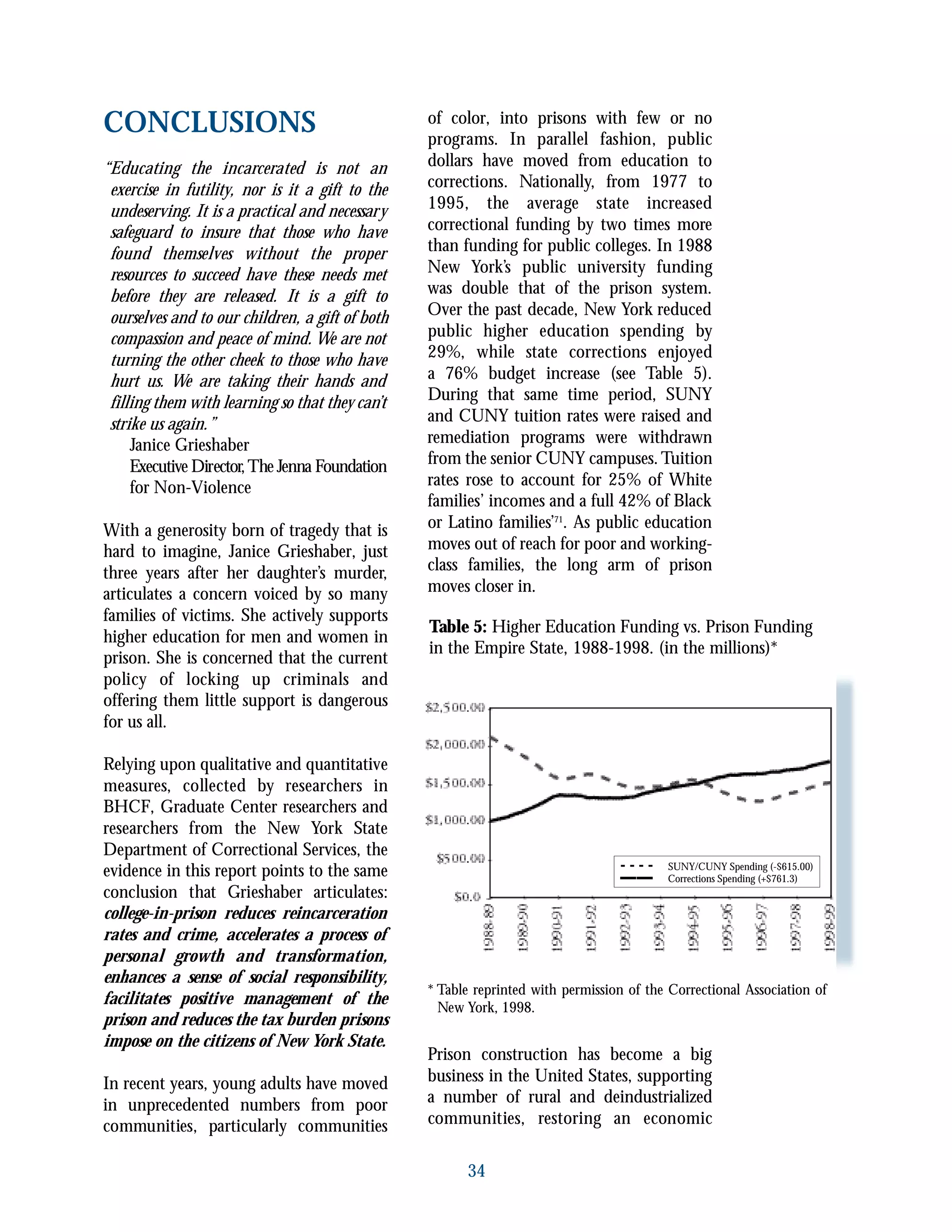
a lion’s share of public money. Since 1988, the operating budgets of the state’s public universities
have plummeted by 29%, leading to higher tuition across the board. During the same period, the
state’s prison spending burgeoned by 76%. In 1994, for the first time in its history, New York
State spent more public dollars on prisons than on public universities.2
Between 1979 and 1999,
per capita state spending on prisons grew 117% while per capita spending on higher education
dropped 22%.3
Advocates for higher education funding say this will only become bleaker as an
economic downturn could cause states, strained by the loss of revenue, to cut budgets for college
funding to pay for increasingly expensive prisons.
Despite the promise of equal access to education, black and brown communities — particularly
those most isolated and disenfranchised — today are seeing more of their young people enter
prisons than college. Twice as many Blacks and Hispanics are held in prison today than are
attending the State University of New York. Since 1998, more Blacks have entered the prison
system for drug offenses each year than have graduated from SUNY with undergraduate, masters,
and doctoral degrees combined. Nationally, the numbers are equally discouraging: five times as
many black men are presently in prison as in four-year colleges and universities.4
The growth of prisons and prison spending in New York has mirrored the national trend to
control crime and incarcerate more people. As the U.S. prison population grew to historical
proportions in the past three decades, the Empire State’s inmate population followed, rising from
10,000 in the 1970’s to 70,000 today.5
Despite the declining crime rates, the incarceration trend
has continued to spiral uncontrollably, fed by tough-on-crime attitudes and the political rhetoric
of the War on Drugs. This war, and the media frenzy it fueled, has contributed to America’s
disproportionate preoccupation with the fear of random violence and what many believed to be
the failure of the criminal justice system to punish criminals. In the name of public safety, state
and national leaders have justified the priority to build more and more prisons at the expense of
classrooms. They have led voters to believe that their personal safety require sacrifices in virtually
every area of public spending, including education, when in fact, education has proven time and
again to be the indisputable tool for crime reduction and public safety.
The distorted public priorities practiced by state and national leaders are rooted firmly in a
convergence of events that began in the 1960s. As crime rates and public unrest grew significantly
in that period, Republican politicians and later Democrats came to see crime as an issue they
could exploit to capture the attention of American voters.Tough on crime rhetoric became an easy
way to win votes. Richard Nixon first used this strategy on a national level to position himself as
the law and order candidate during the civil disobedience of the Civil Rights Movement and anti-
war protests of the Vietnam era. In New York, the legislature passed the Rockefeller Drug Laws
in1973, promising mandatory minimum sentences for drug-related offenses and creating a model
strategy for the War on Drugs. New York’s law spawned a generation of harsh and fixed mandatory
sentencing measures nationally, including California’s “Three Strikes” and the “Truth in
Sentencing” schemes adopted by many states.
i
ii
In such a climate, the media has played an influential role in molding the public’s perception of crime and its
support for punitive criminal justice policies. The consolidation of media and the tremendous corporate
pressures on media to attract viewers or sell newspapers have produced a pitched level of crime coverage that
has only heightened public fears. We have all heard the saying, “If it bleeds it leads.” No evening news
or tabloid is complete without its share of sensational crimes and acts against humanity. Given this steady diet
of mayhem, the result is a public more enthusiastic and sometimes eager to extend criminal sanctions to a
broader range of anti-social behavior such as drug use and mental illness and less willing to consider the
possibility of rehabilitation. In one striking example, researchers found that during the period when states
increasingly passed laws to try youths as adults, television coverage of juvenile crime during that same period
had increased by 473%, even though the number of juveniles charged with homicides in that time actually
decreased by 32%.6
Buttressed by the media, proponents of tough-on-crime policies believed that such policies would ensure the
public’s safety while improving a criminal justice system that they perceived to be too “soft” on criminals. It
didn’t seem to matter that during this same period, from 1970-1998, crime rates and incarceration rates did
not always coincide.7
The result was that by 1994, when Governor George Pataki took office, New York State
and much of the rest of the country, had more prisoners than existing prisons could hold. Not surprisingly, the
race to punish also dictated a harsher attitude towards prisoners. By 1994, the US Congress and then the New
York State Legislature had slashed federal and state funding for higher education in prison. In such a climate,
higher education took a back seat to punishment.
Before the passage of the Rockefeller Drug Laws and other fixed sentencing policies, there were 10,000 people
in New York prisons, 250,000 nationwide. Today, over 70,000 New Yorkers are incarcerated, 2 million
nationwide.8,9
Mandatory sentencing guidelines were meant to standardize sentencing practices and restrict
discretion on the part of judges. They, instead, have offered a one-size fits-all approach to sentencing that has
fed the growth of prison populations nationwide. Under the Rockefeller laws, for example, a person convicted
of selling two ounces of a narcotic must receive a sentence equal to that of someone who possessed four ounces
of drugs — a minimum prison term of 15 years to life. According to the New York State Department of
Criminal Justice Services, nearly 80% of drug offenders who received prison sentences in 1997 had never been
convicted of a violent felony and almost half had never even been arrested for a violent crime.10
Likewise, the
majority of Americans entering our prison system today are non-violent offenders — 52.7% in state prisons,
73.70% in jails, and 87.6% in federal prisons.11
Prisons in America no longer house only those charged with
violent offenses; they now warehouse people who suffer from substance abuse, mental illness and poverty.
Women make up the fastest growing segment of the prison population. In New York and nationally, women
have been incarcerated at nearly double the rate of men.12
Since 1980, the population of women in prison has
increased 654%.13
As my colleague Leslie Glass suggests, and as the women in BHCF fully acknowledge, not
all women prisoners are passive victims in the cycle of drugs, crime, and incarceration. Yet, it is important to
note that the majority of women behind bars today are convicted of non-violent, drug-related offenses.14
Many
women are convicted as accessories to a drug crime, i.e. for carrying drugs for their male partners.
Black women in particular account for a high percentage of women incarcerated today, their numbers
reflecting the disproportionate representation of Blacks and Hispanics in prisons nationwide. In New York
State, Blacks and Hispanics make up over 80% of the entire prison population, and they comprise more than
90% of those committed for drug offenses.15
Nationwide, 50 percent of all current U.S. prison inmates are
African American, and another 17 percent are Hispanic.16
In contrast, African Americans make up 12.3% of
the US population and Hispanics 12.8%.17
According to the Sentencing Project, one in three young black men
between the ages of 20-29 are under some form of criminal justice supervision.18
To a great extent, the current level of incarceration is sustained by cycling people in and out of prison. Many
inmates simply languish in prison, lacking quality services such as education, employment training, and drug
treatment. Most are released to their communities without transitional support to acquire jobs, housing, health
care and education. Recidivism and re-arrest rates are at an all time high. In 1998, New York State released
27,993 men and women from prison.19
The recidivism rate for that same year was 43.8%.20
Nationally, the
figures are worse. Sixty-two percent of those released from state prisons will be re-arrested within three years.
Forty percent will repeat the cycle, ending up behind bars again, only to be released... again.
iii
Most people who end up in prison have received very little formal education; very few have a college degree
— with some exceptions at BHCF. It would be inaccurate to suggest that low educational attainment causes
higher levels of criminal behavior or incarceration. But a disproportionate number of the incarcerated
are undereducated. Recidivism studies have demonstrated repeatedly — though perhaps not as eloquently
as this study — that those who receive a college education while in prison fare better when they rejoin
society than those who do not. They are less likely to re-offend, more likely to find employment, and to
become active and productive members of our communities. Some become leaders — professors, CEO’s, and
even elected officials.
Far from a waste of taxpayers’ dollars, higher education in prison is an investment in our public safety. It enables
those who have been cast off to rejoin us as responsible neighbors and productive co-workers, giving us all a chance
to live in a more stable, civilized society. By supporting college education in prison we are reminded of the cause
championed by the founders of New York’s public universities long ago: higher education can open minds. In prison,
it can change lives.
Helena Huang
Open Society Institute
This ground-breaking study began in an inmate meeting at the Bedford Hills Correctional Facility three years ago. I
went to Bedford as a funder on a site visit: to meet face-to-face some of the women who wanted college reintroduced
to Bedford and to find out why education was so important to them. When I entered the facility, I had some idea of
the demographics at Bedford and believed that I would be meeting with women who’d been convicted and received
long sentences for non-violent, drug-related crimes. In short, I thought I would be meeting some of the “innocents”
caught in our deadly system.
There is much strong feeling about the perpetrators of crime in our society. Literature and the news tell us everything
we think we need to know. We’ve all read books and articles describing “the criminal mind.” We’ve seen unrepentant
killers on TV many times. They scare us, and rightly so. From the information the general public has received on the
subject, it’s easy to accept the idea that all people who commit crimes are formed from the same mold, are unreachable,
and therefore deserve to be isolated from every human comfort and positive resource. For those who have never met
or talked to or cared about a person who has committed any kind of crime, much less a violent one, it is not difficult
to accept the proliferation of maximum-security prisons with few to zero programs for preparing those on the inside
for a different kind of life when they are released. It’s easy to be a skeptic about the possibility for profound change
occurring in the minds and hearts of people who are serving time, and at the same time, reading, writing, studying
and discussing new ideas.
Had I been told three years ago that I would be sitting virtually alone in a room with a dozen women who had been
convicted of committing violent crimes, I would have been fearful and not so eager to question them closely about the
circumstances of their lives. Uninformed, however, I plunged ahead. I asked the group assembled in the Learning
Center what their level of education was when they came in, how long their sentences were, and what the impact of
college had been on them and their families.
Knowing no better, I further asked them what they had done to merit such severe sentences. Bad form in the extreme.
The room crackled with tension as one by one the women answered a stranger’s intimate and probing questions about
their crimes, their families and children on the outside, and their hopes for the future. When the circle was completed
and we had come around to me, they were not shy about turning the tables. They asked me just what I was doing
there, asking these questions, and what I hoped to accomplish. This document is what I hoped to accomplish.
Educators everywhere know a simple truth: learning brings about transformations of many kinds. It helps to equip
people for a better life wherever that life may be led. With this study on the impact of education behind bars, the
women at Bedford have given legislators, judges, the media, and the general public real data to demonstrate that
education makes a difference, and all of society benefits by each new person who receives it.
Leslie Glass
Leslie Glass Foundation
In 1994, over 350 college programs in prisons were shut down throughout the
nation. In that year, President Clinton signed the Violent Crime Control and Law
Enforcement Act into law, which included a provision that denied incarcerated men
and women access to Pell Grants. This federal tuition assistance program, previously
available to all low-income persons, supported most college-in-prison programs.
New York State, like most other states, soon thereafter withdrew its financial support
for college in prisons as well, and effectively ended all higher education for men and
women in prison across the state. At one facility, the Bedford Hills Correctional
Facility (BHCF), a maximum-security prison for women located in Westchester
County, NewYork State, college-in-prison was reintroduced in 1997 by a consortium
of private colleges and universities, involved community members, the
Superintendent and a dedicated Inmate Committee.
Changing Minds reports empirically on the effects of that college program on its
students and the prison environment. The analysis focuses on the impact of college
on women while inside prison; the effects of college on the prison environment; the
effects of college on other inmates; the effects of a mother’s college experience on her
children and the long term effects of college on the economic, social and civic
engagements of women once released from prison. Given the precarious state of
higher education within prison facilities, it is important to document the
consequences of current public policy that does not support college in prison and to
evaluate the costs and benefits of a college program broadly available to prisoners
within a maximum-security facility.21,22
At the moment, neither the Federal government nor any State governments will
pay for higher education in prison, with the exception of some recent funding for
youthful offenders.23
The subject of this study, the College Bound program at BHCF,
is a fully volunteer effort, initiated and sustained through the generosity and
commitments of a set of private colleges and universities, the prison administration,
community volunteers and inmate vision and energy. No public dollars support
this project. A volunteer effort is powerful, but ultimately vulnerable. In the midst
of national conversations about prison reform, education in prison and transitions
out of prison, this report reintroduces the debate about college-in-prison to the
public agenda.24
1
“We understand the public’s anger about
crime and realize that prison is first and
foremost a punishment for crime. But we
believe that when we are able to work and
earn a higher education degree while in
prison, we are empowered to truly pay our
debts to society by working toward
repairing some of what has been broken…
It is for all these reasons, and in the name of
hope and redemption, that we ask you to
help us rebuild a college program here at
Bedford Hills Correctional Facility.”
The Inmate Committee, 1996
“When I was at Bedford, especially in the college program, I learned about the
importance of giving back. I had a lot of time inside to think about what I
had done and the many people who paid a price for my behavior. I decided
that I had to commit myself to helping others, my children and other people
who are going through hard times. Working at Miracles Can Happen, going
to school and hanging out with my kids — even fighting over homework —
I know what I have to do. It isn’t always easy. You can’t just pop back into your
life or your kids’ lives. You’ve changed and so have they. But having the chance
to find our way has been — well, I have never done anything so rewarding.”
Victoria
4
EXECUTIVE
SUMMARY OF
THE RESEARCH
FINDINGS
A broad based multi-method research
design was undertaken to document the
impact of college within prison on women,
the prison environment and women post-
release. Three conclusions, with national
implications, organize this report.
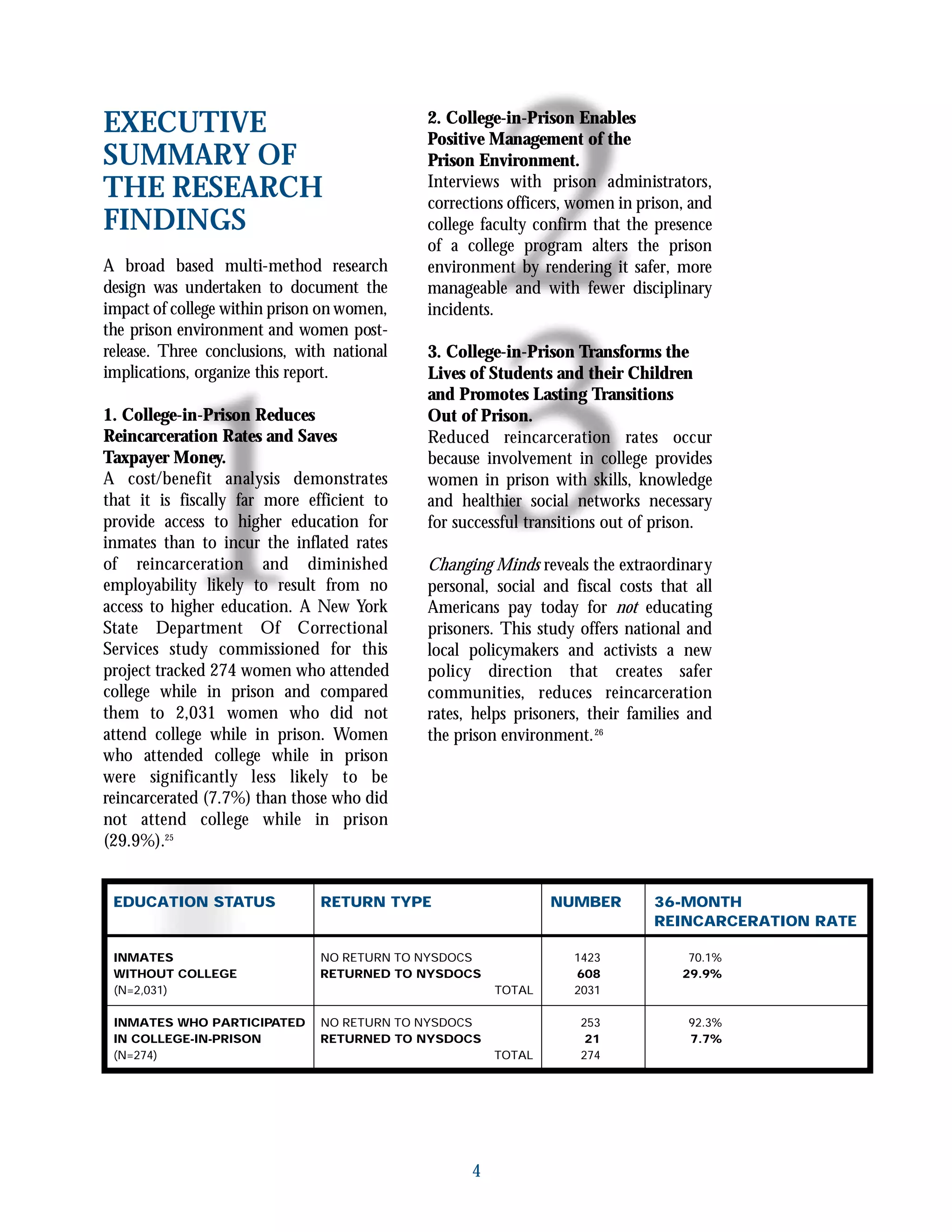
1. College-in-Prison Reduces
Reincarceration Rates and Saves
Taxpayer Money.
A cost/benefit analysis demonstrates
that it is fiscally far more efficient to
provide access to higher education for
inmates than to incur the inflated rates
of reincarceration and diminished
employability likely to result from no
access to higher education. A New York
State Department Of Correctional
Services study commissioned for this
project tracked 274 women who attended
college while in prison and compared
them to 2,031 women who did not
attend college while in prison. Women
who attended college while in prison
were significantly less likely to be
reincarcerated (7.7%) than those who did
not attend college while in prison
(29.9%).25
2. College-in-Prison Enables
Positive Management of the
Prison Environment.
Interviews with prison administrators,
corrections officers, women in prison, and
college faculty confirm that the presence
of a college program alters the prison
environment by rendering it safer, more
manageable and with fewer disciplinary
incidents.
3. College-in-Prison Transforms the
Lives of Students and their Children
and Promotes Lasting Transitions
Out of Prison.
Reduced reincarceration rates occur
because involvement in college provides
women in prison with skills, knowledge
and healthier social networks necessary
for successful transitions out of prison.
Changing Minds reveals the extraordinary
personal, social and fiscal costs that all
Americans pay today for not educating
prisoners. This study offers national and
local policymakers and activists a new
policy direction that creates safer
communities, reduces reincarceration
rates, helps prisoners, their families and
the prison environment.26
EDUCATION STATUS
INMATES
WITHOUT COLLEGE
(N=2,031)
INMATES WHO PARTICIPATED
IN COLLEGE-IN-PRISON
(N=274)
RETURN TYPE
NO RETURN TO NYSDOCS
RETURNED TO NYSDOCS
TOTAL
NO RETURN TO NYSDOCS
RETURNED TO NYSDOCS
TOTAL
NUMBER
1423
608
2031
253
21
274
36-MONTH
REINCARCERATION RATE
70.1%
29.9%
92.3%
7.7%
5
COLLEGE
EDUCATION
IN PRISON
Most women and men in our nation’s jails
and prisons come from economically
depressed African American and Latino
communities with failing urban schools.27
In New York State, as of January 1, 2000,
there were 73,826 people in New York
State Prisons, up from 12,500 in 1973
and 28,500 in 1983.28
The state prison
population is disproportionately (84%)
African American and Hispanic and a full
65% of the total population are from
New York City — almost all from poor
communities of color.29,30
Turning to
education, approximately two-thirds of
the men and women in New York State
prisons have neither high school diploma
nor a GED. This figure jumps to 90%
in New York City jails. Between 50%
and 70% of the City’s adult inmate
population read below the sixth grade
level in English.31
The women at BHCF reflect national and
state trends. A full 51% of the women at
BHCF enter with neither a high school
diploma nor a GED, most lived in poor
neighborhoods of New York City prior to
arrest and over 80% are African American
or Latina.32
While our country may waffle
on whether or not we believe prisoners are
entitled to higher education, we are
consistent with respect to who ends up in
prison: disproportionately those who
have never received adequate education.
It is no small irony, then, that those most
often denied quality education prior to
their involvement with prison are also
those most likely to serve time in prisons
and jails.
Understanding the link between edu-
cational inequities and incarceration,
policymakers from the 1870 American
Correctional Association Congress
endorsed a provision for education within
prison.33
In 1970, one hundred years after
their declaration was written, sections
136 and 137 of the Corrections Law in
the State of New York were passed,
requiring the Department of Correctional
Services to assess a prisoner’s “educational
and vocational needs” and “provide each
inmate with a program of education
which seems most likely to further the
process of socialization and rehabilitation,
the objective being to return these inmates
to society with a more wholesome
attitude toward living, with a desire to
conduct themselves as good citizens, and
with the skills and knowledge which will
give them a reasonable chance to
maintain themselves and their depend-
ents through honest labor.”
Nationally, federal support for higher
education in prison materialized in the
form of allowing women and men in
prison eligibility for Pell grants, the
non-competitive needs-based federal
college funds available to all qualifying
low-income students. In New York State,
Pell grants were supplemented with
Tap grants in order to subsidize college-
in-prison programs. From 1970 through
1994, the federal and New York State
governments were true to their commit-
ments to support prison-based higher
education.
In 1994, under a provision of the Violent
Crime Control and Law Enforcement
Act, Congress eliminated inmate
eligibility for Pell Grants. Allowing
inmate access to Pell Grants was viewed as
taking money away from law-abiding
citizens, despite the fact that inmate
education accounted for 1/10 of 1% of
the Pell Grants’ annual budget.34
At the
time that federal support was removed,
6
Participating
members of
the College
Consortium at
BHCF as of
Spring 2001:
Marymount
Manhattan College
grants the degree.
Bank Street College
of Education,
Barnard College,
Berkeley College,
Columbia University,
Fordham University,
Manhattanville
College, Marymount
Tarrytown, Mercy
College, New York
University, Pace
University, Sarah
Lawrence College,
SUNY New Paltz
Foundation, and
Teachers College,
Columbia University
contribute faculty,
resources, and
support of varied
forms.
extensive research demonstrated that
recidivism rates decline significantly with
higher education.35
Despite the evidence,
by 1995, all but eight of the 350 college
programs in prisons were closed
nationwide. As public funds for college
education in all New York State prisons
were eliminated, a successful college
program at BHCF, run by Mercy College
from 1984 through 1994, closed its
doors. Given the extraordinarily low
levels of educational achievement with
which most enter prison, this loss was not
only educationally consequential but also,
according to reports from women and
corrections officers at BHCF, profound in
terms of morale and discipline.
In June of 1995, the last graduation took
place. During the following weeks, the
women who had staffed the Learning
Center, who had received their bachelor’s
and master’s degrees and who had acted
as role models, packed books, put
computers in boxes, took posters off walls
and turned their learning center into an
empty shell. A feeling of despair settled
over the prison as women experienced a
loss of hope about their own futures and
the futures of younger women coming
into the prison.
Community members and educational
leaders began to gather to try to imagine
how they could restore college-in-
prison at BHCF. In March of 1996,
seven women in BHCF asked to meet
with Superintendent Elaine Lord and
the Deputy Superintendent of Programs
about the possible restoration of the
college program. Shortly thereafter,
the Superintendent and Deputy
Superintendent, the Inmate Committee
and a local community leader, former
New York State Deputy Commissioner
for Aging, Thea Jackson, convened to
explore the possibility of creating a new,
privately funded college program.
Response from citizen groups across
Westchester and New York City was
immediate and positive. A strong alliance
emerged between three communities: the
prison community including admin-
istration, staff and inmates; the Westchester
and metropolitan New York City
community, including hundreds of
citizens committed to the return of
college and responsible for equipping the
Learning Center with staff, desks, files,
computers and books, and the academic
community, led by President Regina
Peruggi of Marymount Manhattan
College, serving as the degree granting
institution.
Over the next few months, a Task Force
was established consisting of community
members from the Westchester area; local
government officials; local clergy and
church members; professors, presidents
and administrators from local colleges
and universities; administrators from
BHCF, and inmates from the Inmate
Advisory Committee. It was at this point
that the concept of a “consortium of
colleges” was realized. If one college
would offer the degree, then many
colleges could work together to donate
courses. The Superintendent, the inmates
and community members generated
Statements of Commitment. By Spring of
1997, a BA in sociology program was
underway in the facility.
7
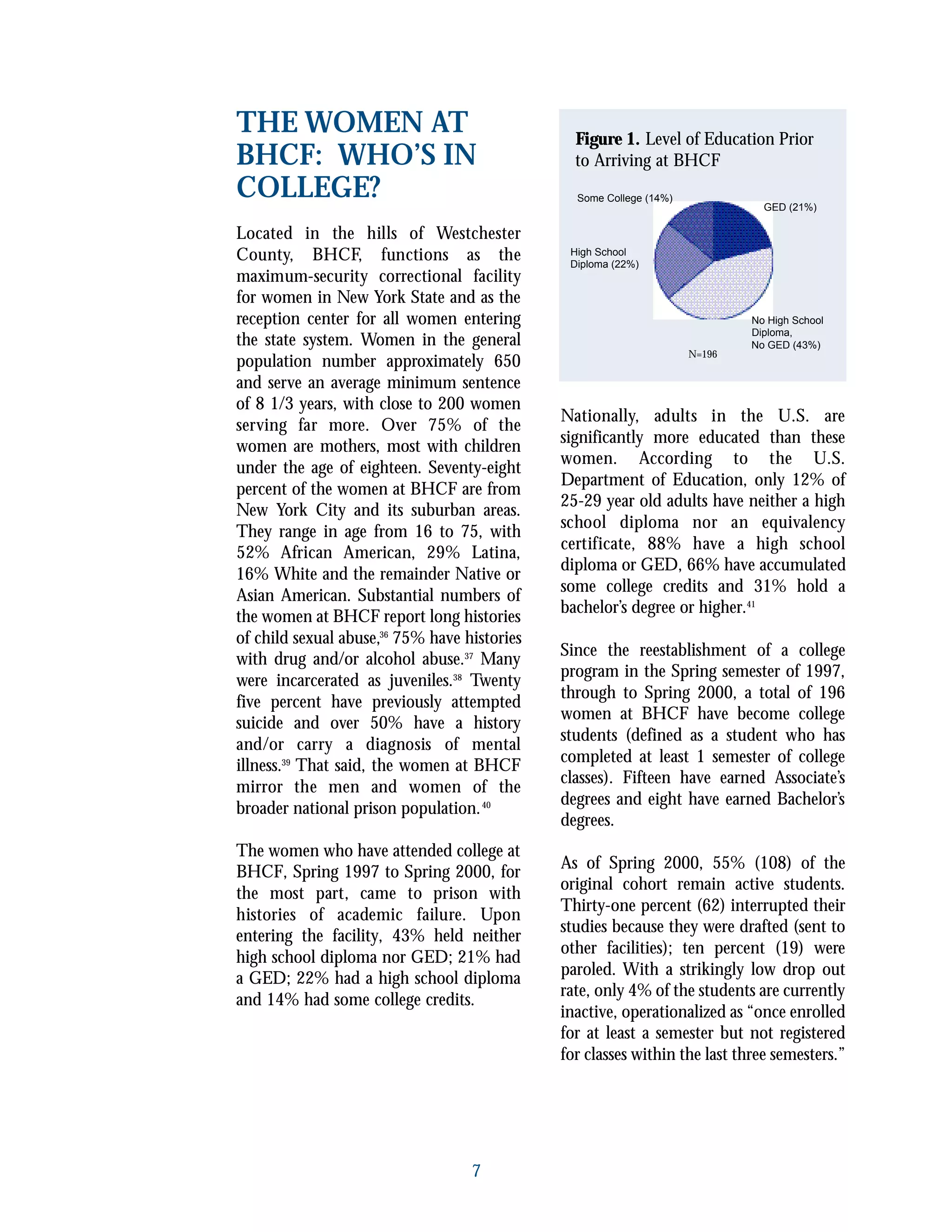
No High School
Diploma,
No GED (43%)
GED (21%)
Some College (14%)
High School
Diploma (22%)
THE WOMEN AT
BHCF: WHO’S IN
COLLEGE?
Located in the hills of Westchester
County, BHCF, functions as the
maximum-security correctional facility
for women in New York State and as the
reception center for all women entering
the state system. Women in the general
population number approximately 650
and serve an average minimum sentence
of 8 1/3 years, with close to 200 women
serving far more. Over 75% of the
women are mothers, most with children
under the age of eighteen. Seventy-eight
percent of the women at BHCF are from
New York City and its suburban areas.
They range in age from 16 to 75, with
52% African American, 29% Latina,
16% White and the remainder Native or
Asian American. Substantial numbers of
the women at BHCF report long histories
of child sexual abuse,36
75% have histories
with drug and/or alcohol abuse.37
Many
were incarcerated as juveniles.38
Twenty
five percent have previously attempted
suicide and over 50% have a history
and/or carry a diagnosis of mental
illness.39
That said, the women at BHCF
mirror the men and women of the
broader national prison population.40
The women who have attended college at
BHCF, Spring 1997 to Spring 2000, for
the most part, came to prison with
histories of academic failure. Upon
entering the facility, 43% held neither
high school diploma nor GED; 21% had
a GED; 22% had a high school diploma
and 14% had some college credits.
Figure 1. Level of Education Prior
to Arriving at BHCF
N=196
Nationally, adults in the U.S. are
significantly more educated than these
women. According to the U.S.
Department of Education, only 12% of
25-29 year old adults have neither a high
school diploma nor an equivalency
certificate, 88% have a high school
diploma or GED, 66% have accumulated
some college credits and 31% hold a
bachelor’s degree or higher.41
Since the reestablishment of a college
program in the Spring semester of 1997,
through to Spring 2000, a total of 196
women at BHCF have become college
students (defined as a student who has
completed at least 1 semester of college
classes). Fifteen have earned Associate’s
degrees and eight have earned Bachelor’s
degrees.
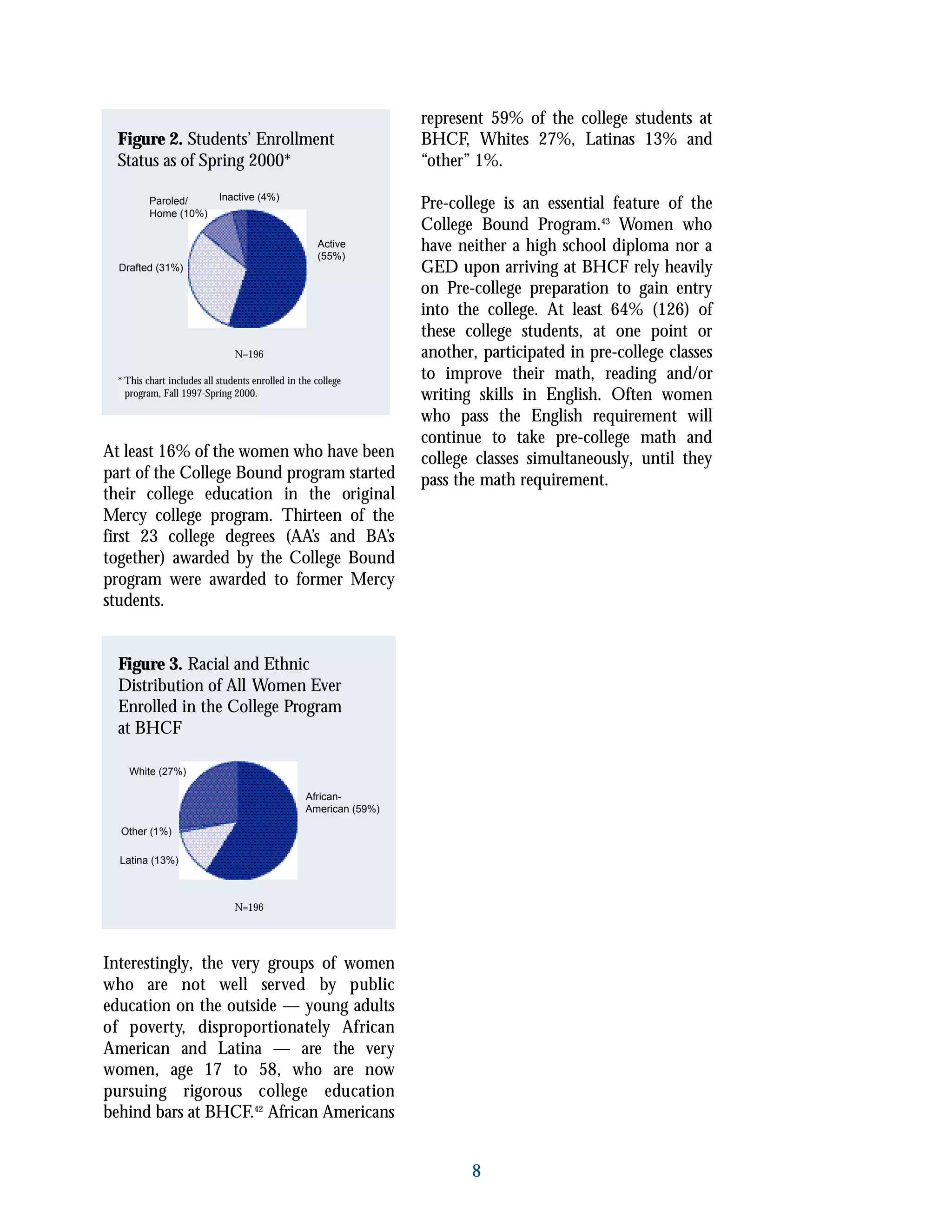
As of Spring 2000, 55% (108) of the
original cohort remain active students.
Thirty-one percent (62) interrupted their
studies because they were drafted (sent to
other facilities); ten percent (19) were
paroled. With a strikingly low drop out
rate, only 4% of the students are currently
inactive, operationalized as “once enrolled
for at least a semester but not registered
for classes within the last three semesters.”
Inactive (4%)
Active
(55%)
Paroled/
Home (10%)
Drafted (31%)
Figure 2. Students’ Enrollment
Status as of Spring 2000*
N=196
* This chart includes all students enrolled in the college
program, Fall 1997-Spring 2000.
At least 16% of the women who have been
part of the College Bound program started
their college education in the original
Mercy college program. Thirteen of the
first 23 college degrees (AA’s and BA’s
together) awarded by the College Bound
program were awarded to former Mercy
students.
Figure 3. Racial and Ethnic
Distribution of All Women Ever
Enrolled in the College Program
at BHCF
N=196
Interestingly, the very groups of women
who are not well served by public
education on the outside — young adults
of poverty, disproportionately African
American and Latina — are the very
women, age 17 to 58, who are now
pursuing rigorous college education
behind bars at BHCF.42
African Americans
represent 59% of the college students at
BHCF, Whites 27%, Latinas 13% and
“other” 1%.
Pre-college is an essential feature of the
College Bound Program.43
Women who
have neither a high school diploma nor a
GED upon arriving at BHCF rely heavily
on Pre-college preparation to gain entry
into the college. At least 64% (126) of
these college students, at one point or
another, participated in pre-college classes
to improve their math, reading and/or
writing skills in English. Often women
who pass the English requirement will
continue to take pre-college math and
college classes simultaneously, until they
pass the math requirement.
8
White (27%)
African-
American (59%)
Other (1%)
Latina (13%)
“We, members and supporters of the College Bound
Task Force, come from diverse communities
throughout the metropolitan and Westchester area.
The primary needs of our community are for public
safety, less crime and less cost… The potential
national net savings from college programs in prison
have been calculated to be hundreds of millions of
dollars per year. Without programs of assistance like
College Bound, it is difficult for the women to
escape from the cycle of poverty, despair and crime
that brought them to prison. More disturbing is the
likelihood that their children will continue this
destructive pattern if unchecked.
Time spent in prison can be used for rehabilitation
as well as punishment. The privately funded College
Bound program offers the opportunity for
redirection through education. For the women, it is
the key to self-esteem, social responsibility and the
best chance of making a successful return to their
communities. For our communities, it is an offer of
renewed life.”
The Citizens Task Force for the
College Bound Program, 1996
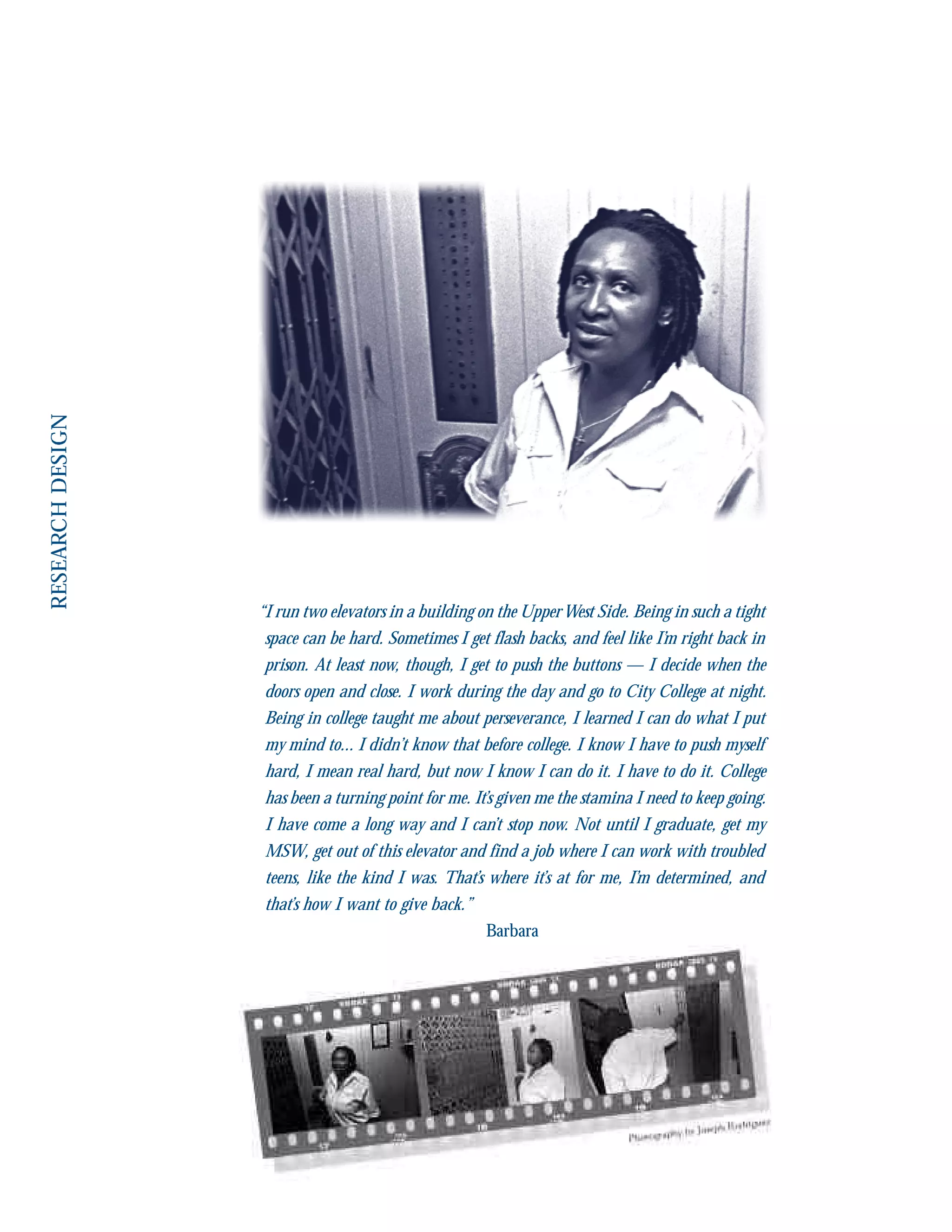
“I run two elevators in a building on the UpperWest Side. Being in such a tight
space can be hard. Sometimes I get flash backs, and feel like I’m right back in
prison. At least now, though, I get to push the buttons — I decide when the
doors open and close. I work during the day and go to City College at night.
Being in college taught me about perseverance, I learned I can do what I put
my mind to... I didn’t know that before college. I know I have to push myself
hard, I mean real hard, but now I know I can do it. I have to do it. College
has been a turning point for me. It’s given me the stamina I need to keep going.
I have come a long way and I can’t stop now. Not until I graduate, get my
MSW, get out of this elevator and find a job where I can work with troubled
teens, like the kind I was. That’s where it’s at for me, I’m determined, and
that’s how I want to give back.”
Barbara
11
RESEARCH DESIGN
Once college was reestablished in the
facility, the Leslie Glass Foundation
offered to fund a research project
documenting the impact of college on the
prison community. Michelle Fine,
Professor of Social/Personality Psychology
at The Graduate Center of the City
University of New York, agreed to
become the Principal Investigator of the
Project and hired a team of graduate
students to help conduct the study:
Melissa Rivera (Harvard), Rosemarie A.
Roberts (Graduate Center), María Elena
Torre (Graduate Center) and Debora
Upegui (Graduate Center). It was
determined early in the design phase that
the validity of the project would be
strengthened with inmate researchers on
the research team.44
The Superintendent
was consulted and agreed to the design
after the New York State Department of
Correctional Services provided official
approval. A team of inmate researchers
joined the research: Kathy Boudin, Iris
Bowen,45
Judith Clark, Aisha Elliot,46
Donna Hylton, Migdalia Martinez,47
Pamela Smart and “Missy” (preferred
name). In 1999, Research Specialist III E.
Michele Staley of the New York State
Department of Correctional Services
(NYSDOCS) joined the research effort
by conducting a longitudinal analysis of
post-release reincarceration data.
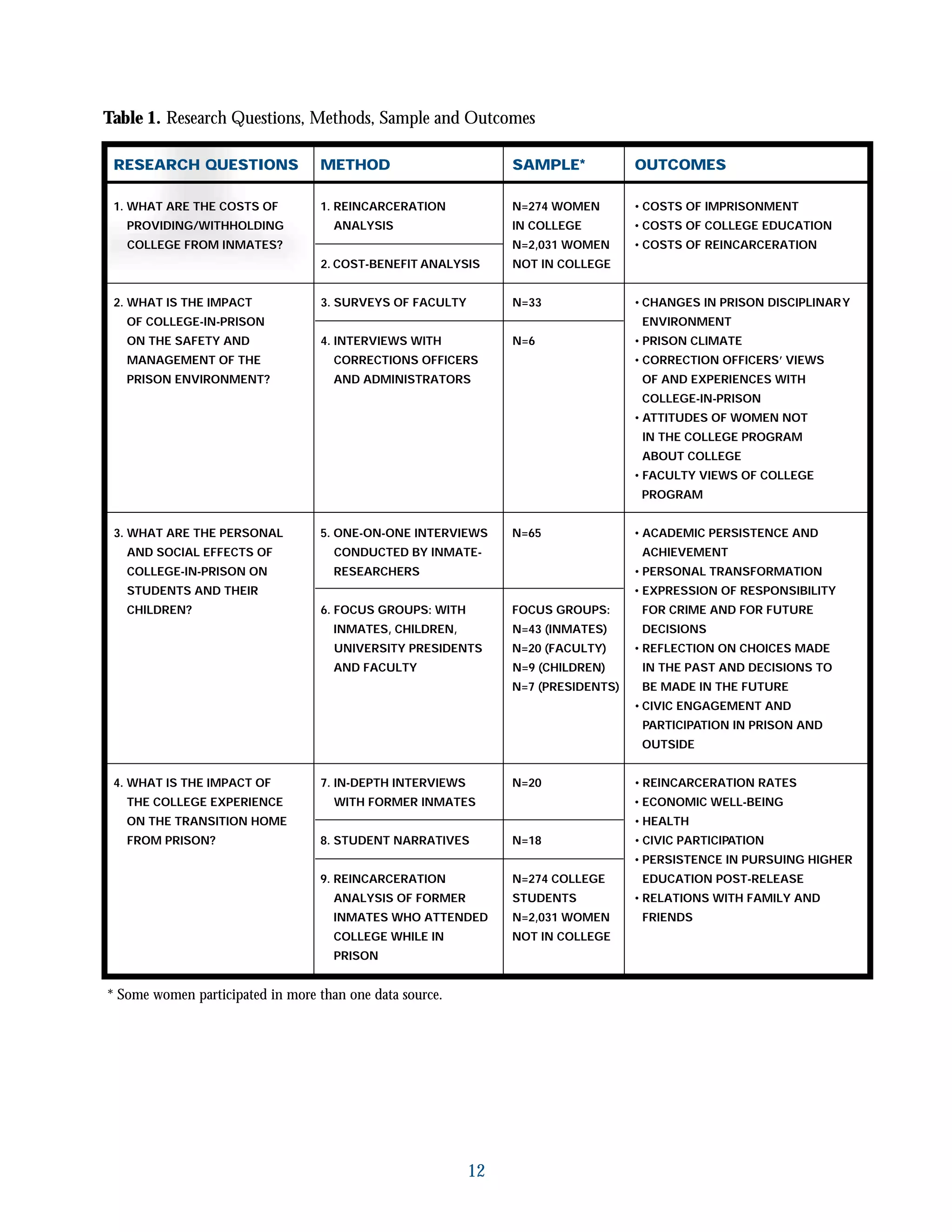
The research was designed to answer
four questions:
1. What are the fiscal costs and benefits
of providing college to women in prison,
and what are the fiscal costs and benefits
of withholding college from women
in prison?
Outcomes include: financial costs of
provision of college and calculations for
reincarceration rates with and without
college.
2. What is the impact of college-in-
prison on the safety and management
of the prison environment?
Outcomes include: prison disciplinary
environment, prison climate, corrections
officers’ views of and experiences with
college and faculty views of the
college program.
3. What are the personal and social
effects of college-in-prison on students
and their children?
Outcomes include: academic, social and
psychological effects including academic
achievement and perseverance; sense of
responsibility for past and future;
personal transformation and civic
engagement in prison and beyond.
4. What is the impact of the college
experience on the transition home
from prison?
Outcomes include: economic well being;
health; civic participation; continued
pursuit of higher education; relations
with family, children and friends;
reincarceration rates.
METHODS
Conducted over the course of three
years, the research design required a
quantitative analysis to assess the extent
to which college affected reincarceration
rates (conducted by the New York
State Department of Correctional
Services) and thereby affected the tax
burden imposed on citizens of New York
State for prisons (conducted in part
by Former Commissioner of the New
York City Department of Corrections,
Commissioner of Probation and Deputy
Director, NYC Office of Management
and Budget, Michael Jacobson). A
qualitative analysis was undertaken to
determine the psychosocial effects of
college on the women, the prison
environment, the children of students
and post-release transitions (see Table 1).
Table 1. Research Questions, Methods, Sample and Outcomes
12
RESEARCH QUESTIONS
1. WHAT ARE THE COSTS OF
PROVIDING/WITHHOLDING
COLLEGE FROM INMATES?
2. WHAT IS THE IMPACT
OF COLLEGE-IN-PRISON
ON THE SAFETY AND
MANAGEMENT OF THE
PRISON ENVIRONMENT?
3. WHAT ARE THE PERSONAL
AND SOCIAL EFFECTS OF
COLLEGE-IN-PRISON ON
STUDENTS AND THEIR
CHILDREN?
4. WHAT IS THE IMPACT OF
THE COLLEGE EXPERIENCE
ON THE TRANSITION HOME
FROM PRISON?
METHOD
1. REINCARCERATION
ANALYSIS
2. COST-BENEFIT ANALYSIS
3. SURVEYS OF FACULTY
4. INTERVIEWS WITH
CORRECTIONS OFFICERS
AND ADMINISTRATORS
5. ONE-ON-ONE INTERVIEWS
CONDUCTED BY INMATE-
RESEARCHERS
6. FOCUS GROUPS: WITH
INMATES, CHILDREN,
UNIVERSITY PRESIDENTS
AND FACULTY
7. IN-DEPTH INTERVIEWS
WITH FORMER INMATES
8. STUDENT NARRATIVES
9. REINCARCERATION
ANALYSIS OF FORMER
INMATES WHO ATTENDED
COLLEGE WHILE IN
PRISON
SAMPLE*
N=274 WOMEN
IN COLLEGE
N=2,031 WOMEN
NOT IN COLLEGE
N=33
N=6
N=65
FOCUS GROUPS:
N=43 (INMATES)
N=20 (FACULTY)
N=9 (CHILDREN)
N=7 (PRESIDENTS)
N=20
N=18
N=274 COLLEGE
STUDENTS
N=2,031 WOMEN
NOT IN COLLEGE
OUTCOMES
• COSTS OF IMPRISONMENT
• COSTS OF COLLEGE EDUCATION
• COSTS OF REINCARCERATION
• CHANGES IN PRISON DISCIPLINARY
ENVIRONMENT
• PRISON CLIMATE
• CORRECTION OFFICERS’ VIEWS
OF AND EXPERIENCES WITH
COLLEGE-IN-PRISON
• ATTITUDES OF WOMEN NOT
IN THE COLLEGE PROGRAM
ABOUT COLLEGE
• FACULTY VIEWS OF COLLEGE
PROGRAM
• ACADEMIC PERSISTENCE AND
ACHIEVEMENT
• PERSONAL TRANSFORMATION
• EXPRESSION OF RESPONSIBILITY
FOR CRIME AND FOR FUTURE
DECISIONS
• REFLECTION ON CHOICES MADE
IN THE PAST AND DECISIONS TO
BE MADE IN THE FUTURE
• CIVIC ENGAGEMENT AND
PARTICIPATION IN PRISON AND
OUTSIDE
• REINCARCERATION RATES
• ECONOMIC WELL-BEING
• HEALTH
• CIVIC PARTICIPATION
• PERSISTENCE IN PURSUING HIGHER
EDUCATION POST-RELEASE
• RELATIONS WITH FAMILY AND
FRIENDS
* Some women participated in more than one data source.
13
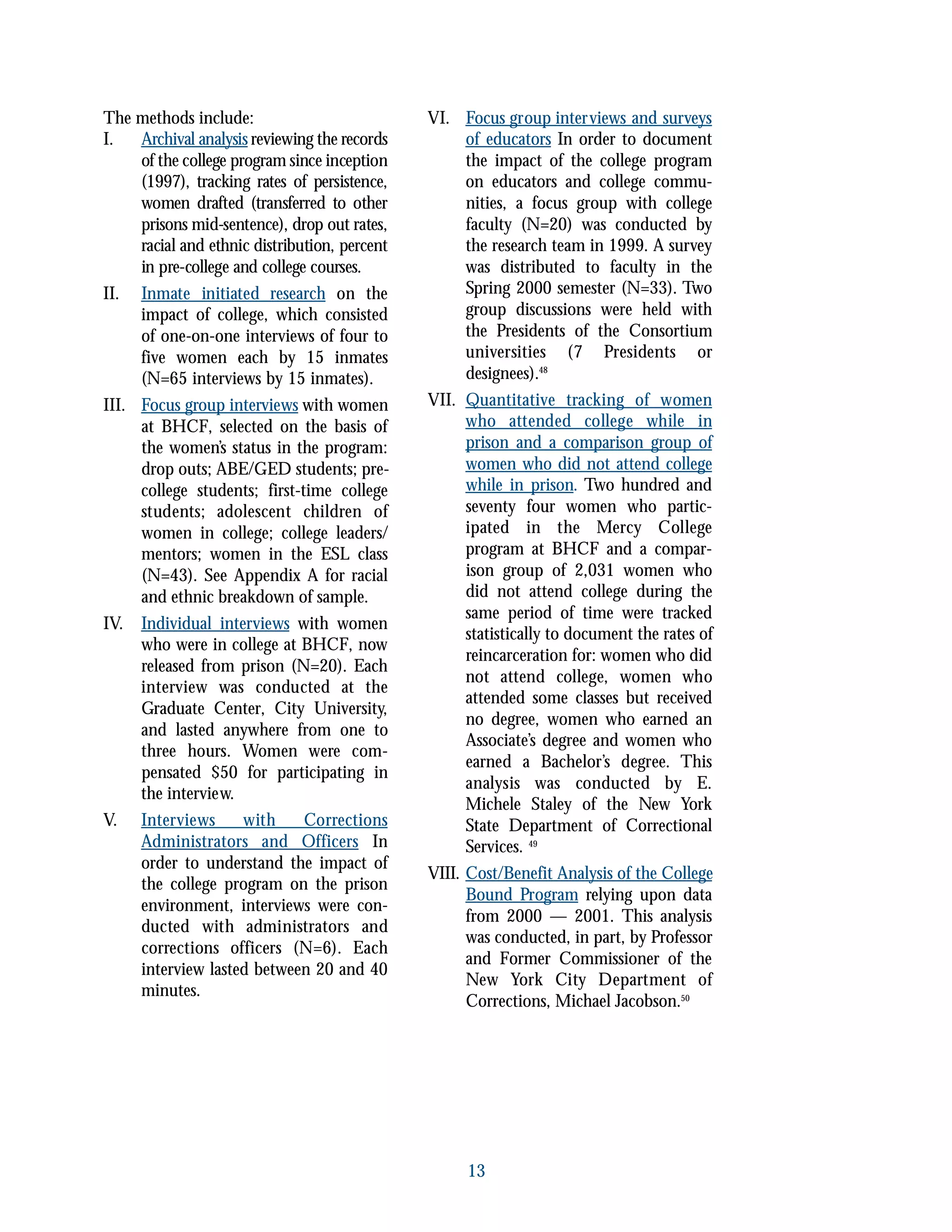
The methods include:
I. Archival analysis reviewing the records
of the college program since inception
(1997), tracking rates of persistence,
women drafted (transferred to other
prisons mid-sentence), drop out rates,
racial and ethnic distribution, percent
in pre-college and college courses.
II. Inmate initiated research on the
impact of college, which consisted
of one-on-one interviews of four to
five women each by 15 inmates
(N=65 interviews by 15 inmates).
III. Focus group interviews with women
at BHCF, selected on the basis of
the women’s status in the program:
drop outs; ABE/GED students; pre-
college students; first-time college
students; adolescent children of
women in college; college leaders/
mentors; women in the ESL class
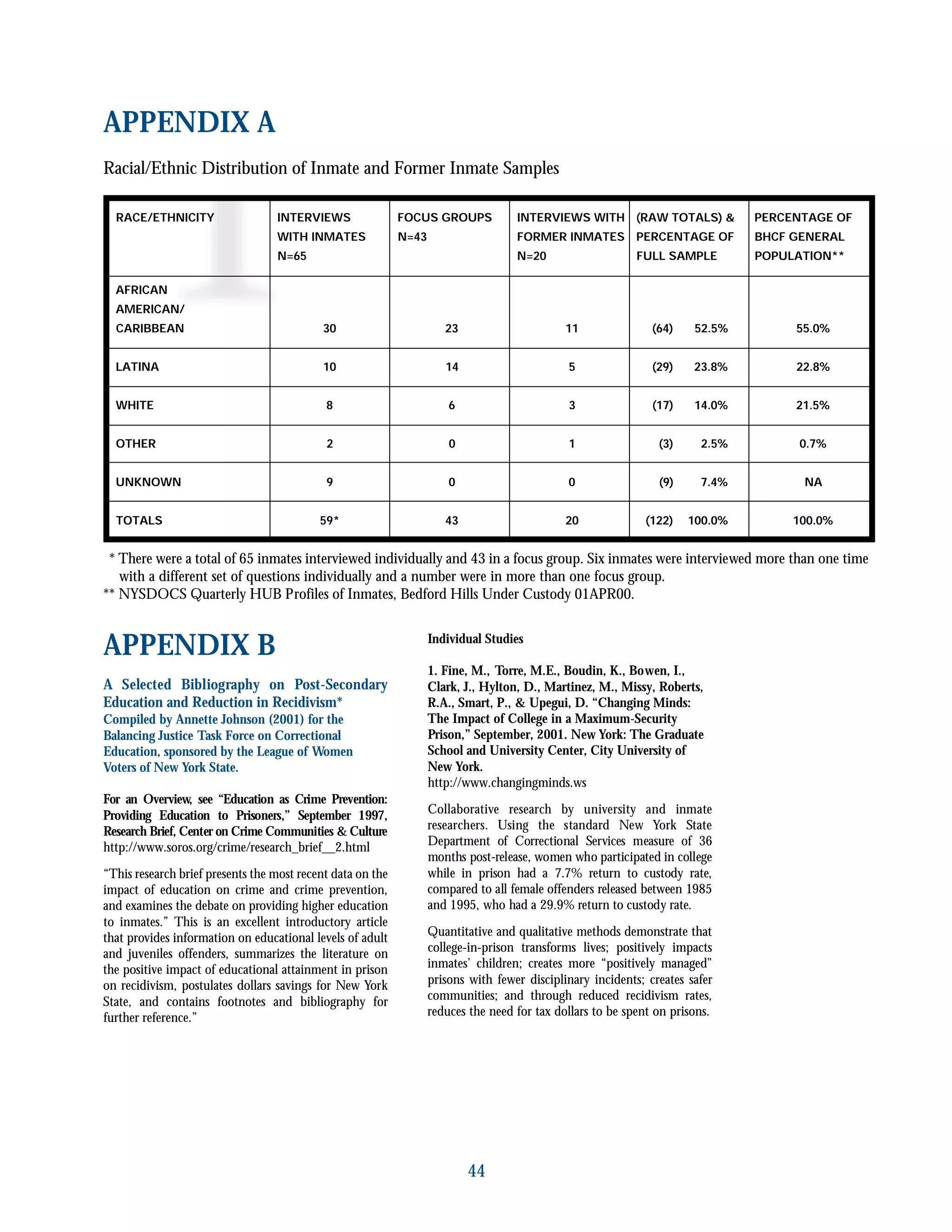
(N=43). See Appendix A for racial
and ethnic breakdown of sample.
IV. Individual interviews with women
who were in college at BHCF, now
released from prison (N=20). Each
interview was conducted at the
Graduate Center, City University,
and lasted anywhere from one to
three hours. Women were com-
pensated $50 for participating in
the interview.
V. Interviews with Corrections
Administrators and Officers In
order to understand the impact of
the college program on the prison
environment, interviews were con-
ducted with administrators and
corrections officers (N=6). Each
interview lasted between 20 and 40
minutes.
VI. Focus group interviews and surveys
of educators In order to document
the impact of the college program
on educators and college commu-
nities, a focus group with college
faculty (N=20) was conducted by
the research team in 1999. A survey
was distributed to faculty in the
Spring 2000 semester (N=33). Two
group discussions were held with
the Presidents of the Consortium
universities (7 Presidents or
designees).48
VII. Quantitative tracking of women
who attended college while in
prison and a comparison group of
women who did not attend college
while in prison. Two hundred and
seventy four women who partic-
ipated in the Mercy College
program at BHCF and a compar-
ison group of 2,031 women who
did not attend college during the
same period of time were tracked
statistically to document the rates of
reincarceration for: women who did
not attend college, women who
attended some classes but received
no degree, women who earned an
Associate’s degree and women who
earned a Bachelor’s degree. This
analysis was conducted by E.
Michele Staley of the New York
State Department of Correctional
Services. 49
VIII. Cost/Benefit Analysis of the College
Bound Program relying upon data
from 2000 — 2001. This analysis
was conducted, in part, by Professor
and Former Commissioner of the
New York City Department of
Corrections, Michael Jacobson.50
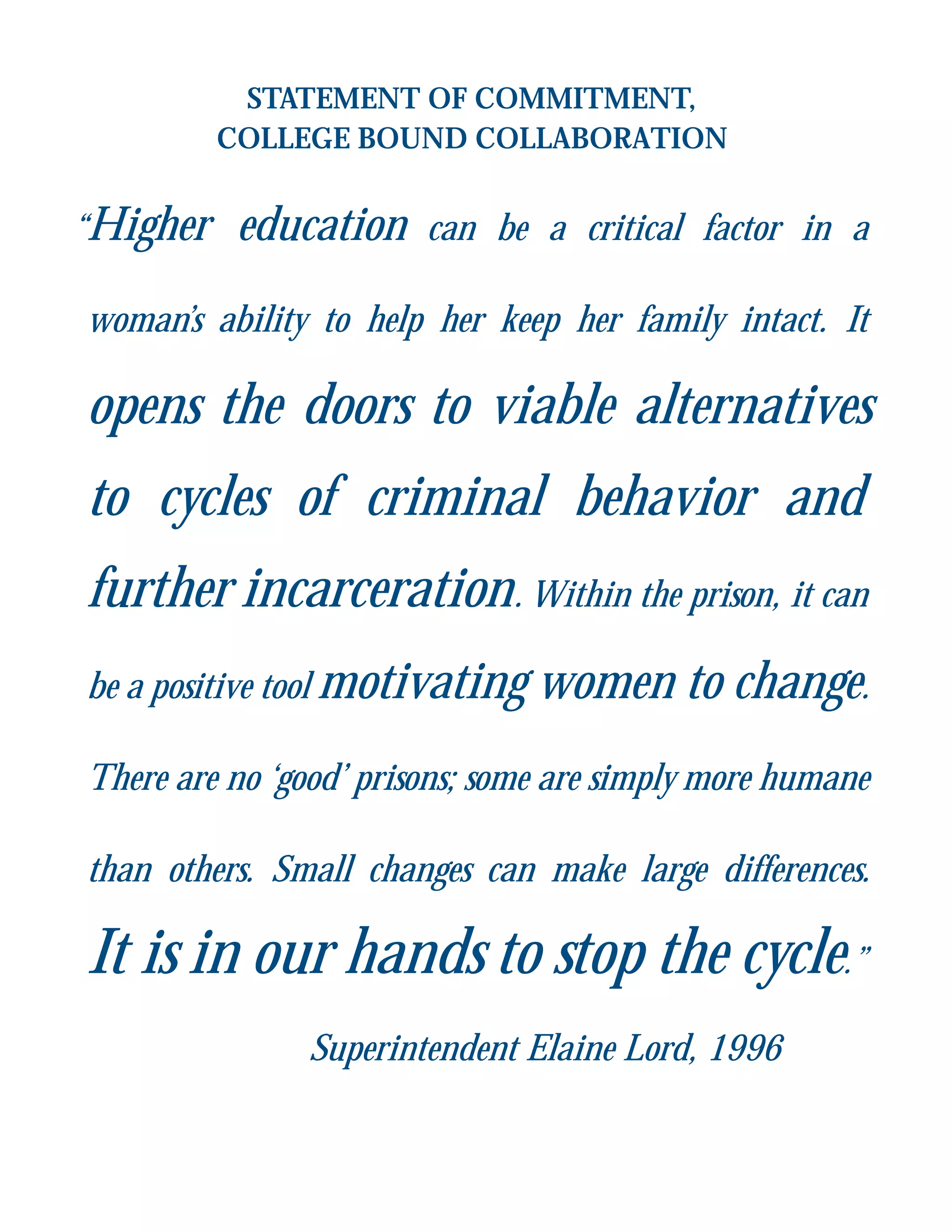
STATEMENT OF COMMITMENT,
COLLEGE BOUND COLLABORATION
“Higher education can be a critical factor in a
woman’s ability to help her keep her family intact. It
opens the doors to viable alternatives
to cycles of criminal behavior and
further incarceration. Within the prison, it can
be a positive tool motivating women to change.
There are no ‘good’ prisons; some are simply more humane
than others. Small changes can make large differences.
It is in our hands to stop the cycle.”
Superintendent Elaine Lord, 1996
“College and the poetry and writing I was able to produce during the 12
years I spent at BHCF, helped me imagine and create worlds that were
unreachable from inside. College gave me the tools to survive economically,
socially and psychologically. Today, I educate women, I work, I have a desk,
a computer, a life... but once a prisoner... it’s a life-long sentence, even on the
outside. The punishment is never really over. Even for someone like me. I may
have privileges some other women don’t — remember, in prison you don’t
get to make decisions for yourself, so you forget how to do that; in prison... you
don't have freedom. Then you get out — Welcome to America. Only now you
can’t even vote!”
Jan
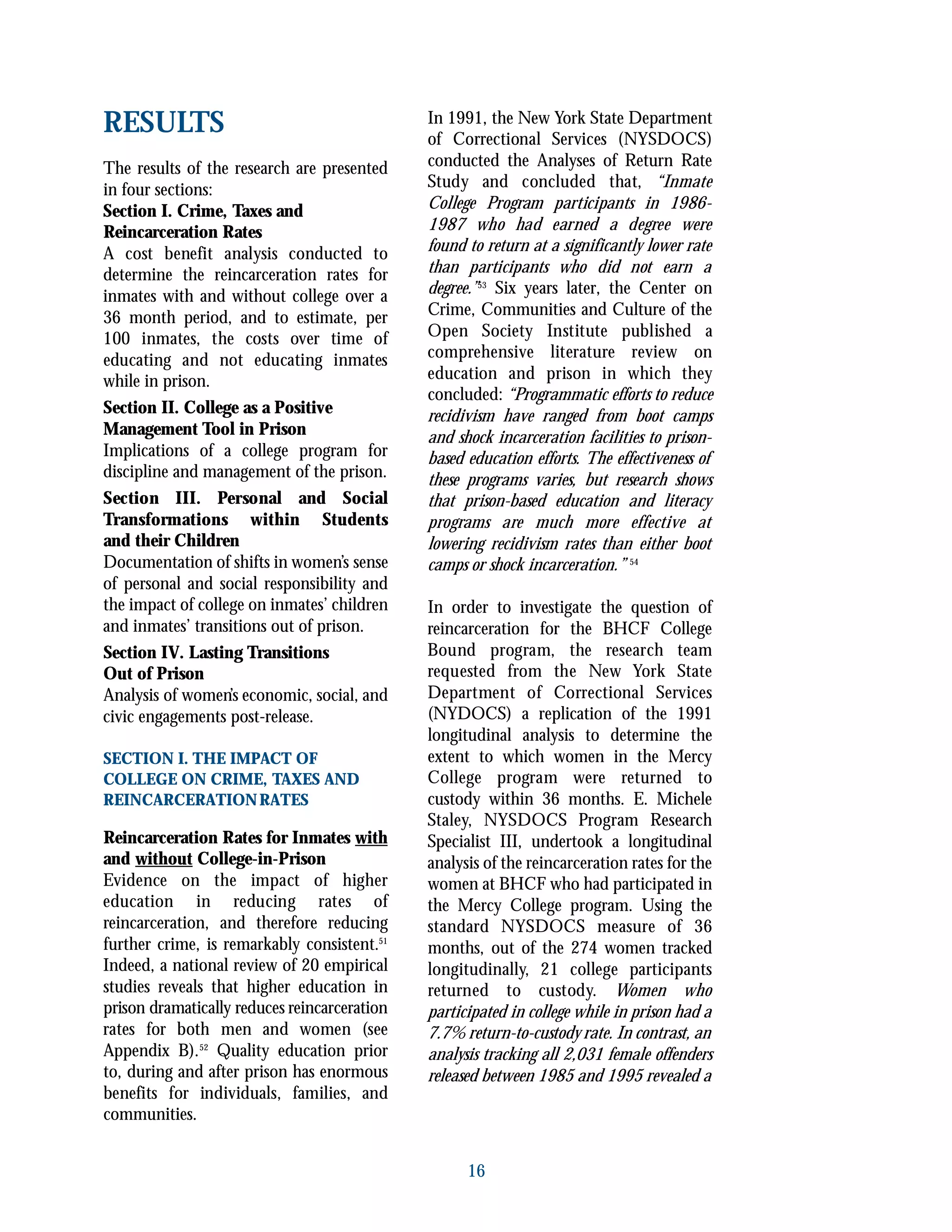
RESULTS
The results of the research are presented
in four sections:
Section I. Crime, Taxes and
Reincarceration Rates
A cost benefit analysis conducted to
determine the reincarceration rates for
inmates with and without college over a
36 month period, and to estimate, per
100 inmates, the costs over time of
educating and not educating inmates
while in prison.
Section II. College as a Positive
Management Tool in Prison
Implications of a college program for
discipline and management of the prison.
Section III. Personal and Social
Transformations within Students
and their Children
Documentation of shifts in women’s sense
of personal and social responsibility and
the impact of college on inmates’ children
and inmates’ transitions out of prison.
Section IV. Lasting Transitions
Out of Prison
Analysis of women’s economic, social, and
civic engagements post-release.
SECTION I. THE IMPACT OF
COLLEGE ON CRIME, TAXES AND
REINCARCERATIONRATES
Reincarceration Rates for Inmates with
and without College-in-Prison
Evidence on the impact of higher
education in reducing rates of
reincarceration, and therefore reducing
further crime, is remarkably consistent.51
Indeed, a national review of 20 empirical
studies reveals that higher education in
prison dramatically reduces reincarceration
rates for both men and women (see
Appendix B).52
Quality education prior
to, during and after prison has enormous
benefits for individuals, families, and
communities.
In 1991, the New York State Department
of Correctional Services (NYSDOCS)
conducted the Analyses of Return Rate
Study and concluded that, “Inmate
College Program participants in 1986-
1987 who had earned a degree were
found to return at a significantly lower rate
than participants who did not earn a
degree.”53
Six years later, the Center on
Crime, Communities and Culture of the
Open Society Institute published a
comprehensive literature review on
education and prison in which they
concluded: “Programmatic efforts to reduce
recidivism have ranged from boot camps
and shock incarceration facilities to prison-
based education efforts. The effectiveness of
these programs varies, but research shows
that prison-based education and literacy
programs are much more effective at
lowering recidivism rates than either boot
camps or shock incarceration.” 54
In order to investigate the question of
reincarceration for the BHCF College
Bound program, the research team
requested from the New York State
Department of Correctional Services
(NYDOCS) a replication of the 1991
longitudinal analysis to determine the
extent to which women in the Mercy
College program were returned to
custody within 36 months. E. Michele
Staley, NYSDOCS Program Research
Specialist III, undertook a longitudinal
analysis of the reincarceration rates for the
women at BHCF who had participated in
the Mercy College program. Using the
standard NYSDOCS measure of 36
months, out of the 274 women tracked
longitudinally, 21 college participants
returned to custody. Women who
participated in college while in prison had a
7.7% return-to-custody rate. In contrast, an
analysis tracking all 2,031 female offenders
released between 1985 and 1995 revealed a
16
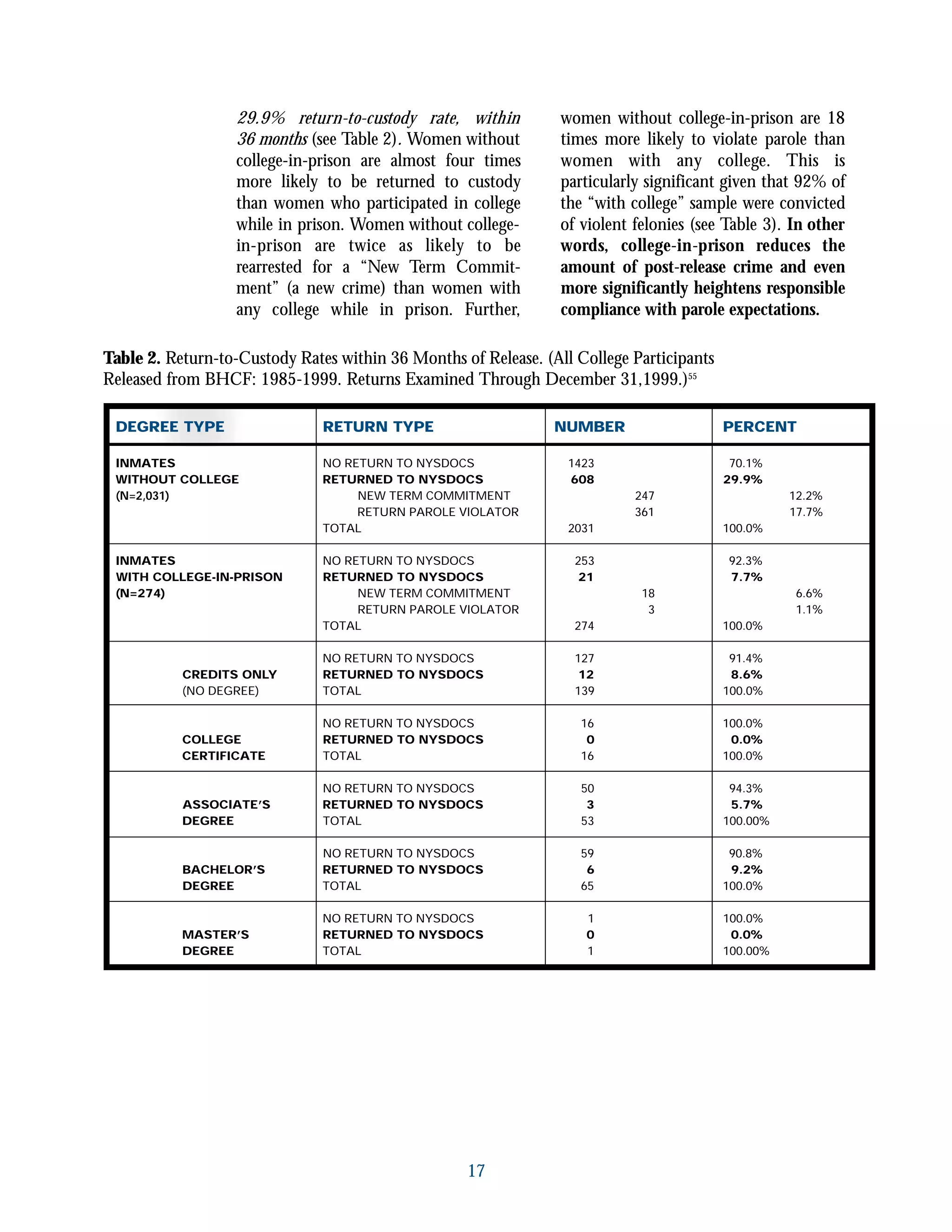
Table 2. Return-to-Custody Rates within 36 Months of Release. (All College Participants
Released from BHCF: 1985-1999. Returns Examined Through December 31,1999.)55
29.9% return-to-custody rate, within
36 months (see Table 2). Women without
college-in-prison are almost four times
more likely to be returned to custody
than women who participated in college
while in prison. Women without college-
in-prison are twice as likely to be
rearrested for a “New Term Commit-
ment” (a new crime) than women with
any college while in prison. Further,
women without college-in-prison are 18
times more likely to violate parole than
women with any college. This is
particularly significant given that 92% of
the “with college” sample were convicted
of violent felonies (see Table 3). In other
words, college-in-prison reduces the
amount of post-release crime and even
more significantly heightens responsible
compliance with parole expectations.
17
DEGREE TYPE
INMATES
WITHOUT COLLEGE
(N=2,031)
INMATES
WITH COLLEGE-IN-PRISON
(N=274)
CREDITS ONLY
(NO DEGREE)
COLLEGE
CERTIFICATE
ASSOCIATE’S
DEGREE
BACHELOR’S
DEGREE
MASTER’S
DEGREE
RETURN TYPE
NO RETURN TO NYSDOCS
RETURNED TO NYSDOCS
NEW TERM COMMITMENT
RETURN PAROLE VIOLATOR
TOTAL
NO RETURN TO NYSDOCS
RETURNED TO NYSDOCS
NEW TERM COMMITMENT
RETURN PAROLE VIOLATOR
TOTAL
NO RETURN TO NYSDOCS
RETURNED TO NYSDOCS
TOTAL
NO RETURN TO NYSDOCS
RETURNED TO NYSDOCS
TOTAL
NO RETURN TO NYSDOCS
RETURNED TO NYSDOCS
TOTAL
NO RETURN TO NYSDOCS
RETURNED TO NYSDOCS
TOTAL
NO RETURN TO NYSDOCS
RETURNED TO NYSDOCS
TOTAL
NUMBER
1423
608
247
361
2031
253
21
18
3
274
127
12
139
16
0
16
50
3
53
59
6
65
1
0
1
PERCENT
70.1%
29.9%
12.2%
17.7%
100.0%
92.3%
7.7%
6.6%
1.1%
100.0%
91.4%
8.6%
100.0%
100.0%
0.0%
100.0%
94.3%
5.7%
100.00%
90.8%
9.2%
100.0%
100.0%
0.0%
100.00%
18
Table 3: Crime Type by Female Sample
* This group is composed of females released from DOCS between 1985 and 1998 who participated in
the Mercy College Program at Bedford Hills. (N=274)
** This group is composed of females released from DOCS (to parole supervision or at maximum
expiration of sentence) between 1985 and 1995.
COMMITMENT OFFENSE TYPE
FEMALE RELEASE GROUPS
BEDFORD COLLEGE SAMPLE* COMPARISON GROUP**
VIOLENT FELONY 92.0% 21.2%
OTHER COERCIVE OFFENSE 2.6% 4.6%
DRUG OFFENSE 4.0% 58.7%
PROPERTY & OTHER OFFENSES 0.7% 14.2%
YOUTHFUL OFFENDER 0.0% 1.4%
UNKNOWN 0.7% 0.0%
TOTAL 100.0% 100.0%
3-YEAR RETURN TO CUSTODY RATE 7.7% 29.9%
“Given the relatively
small baseline of
funding for the
College Bound
program, the ‘bang
for the buck’ in
terms of the
dramatic post-
release outcomes is
quite significant.”
Michael Jacobson
Professor,
John Jay College
of Criminal Justice
Former
Commissioner
of the New York
City Department
of Corrections,
1995-98
These data confirm earlier studies: it is
efficient social policy to offer inmates
quality higher education within prison.56
As the remainder of this text
will testify, college enables women in
prison to experience personal growth and
refine a sense of personal and social
responsibility; college has become a
“positive management tool” for prison
administrators and staff, and college-in-
prison appears to be a significant feature
of successful transitions out of prison.
As former Attorney General Janet Reno
testified, commenting on the women and
men released from prison every year: “In
the year 2000, 585,000 are anticipated
to return [from prison] to communities...
They come into prison with rage, with
a sense that they had been treated unfairly.
They come into prison as dropouts or
illiterate. They come into prison without
life skills, without a job or an anticipated
job. They come with so little chance of
getting off on the right foot, unless we do
it the right way… is it any surprise that
nationwide two-thirds are rearrested?”
Tax Savings: A Cost-Benefit Analysis
of Providing vs. Withholding College-
in-Prison
Policymakers, community activists, jour-
nalists and everyday citizens throughout
New York are beginning to challenge the
wisdom of the cumulative tax burden
imposed on citizens because the
government denies prisoners access to
college and other support services. Fox
Butterfield argues in the New York
Times that the “revolving door parole
policy” is worsened by the absence of
developmental programs within prison
facilities.57
The Open Society Institute’s
(OSI) Center for Crime, Communities
and Culture has reported that because
an estimated 97% of adult felony
inmates are released eventually back
into local communities and because
recidivism rates now average between
40-60%, over the long term, the expense
of providing higher education to women
and men in prison is minimal relative to
the costs of re-arrests, additional crime
and re-imprisonment.58
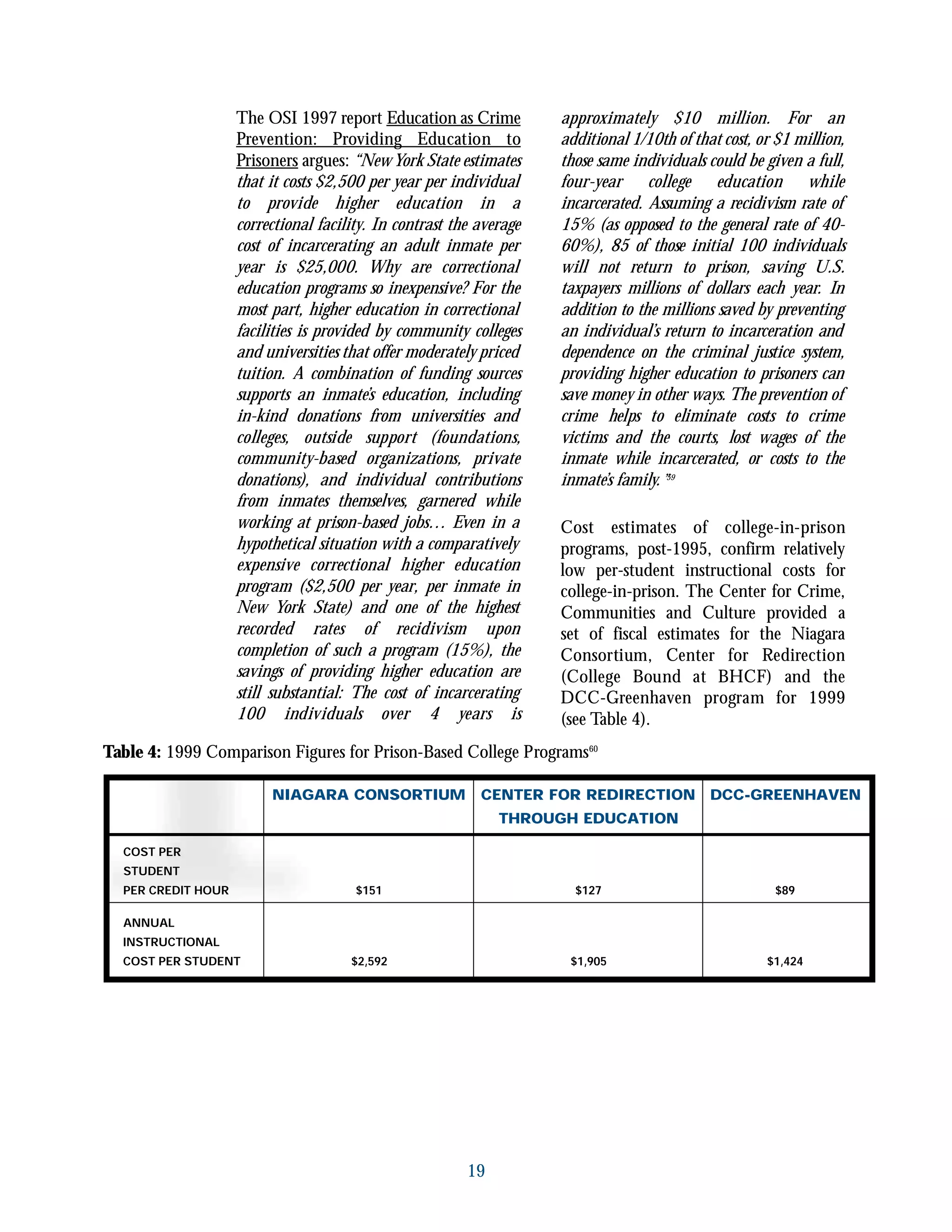
Table 4: 1999 Comparison Figures for Prison-Based College Programs60
The OSI 1997 report Education as Crime
Prevention: Providing Education to
Prisoners argues: “NewYork State estimates
that it costs $2,500 per year per individual
to provide higher education in a
correctional facility. In contrast the average
cost of incarcerating an adult inmate per
year is $25,000. Why are correctional
education programs so inexpensive? For the
most part, higher education in correctional
facilities is provided by community colleges
and universities that offer moderately priced
tuition. A combination of funding sources
supports an inmate’s education, including
in-kind donations from universities and
colleges, outside support (foundations,
community-based organizations, private
donations), and individual contributions
from inmates themselves, garnered while
working at prison-based jobs… Even in a
hypothetical situation with a comparatively
expensive correctional higher education
program ($2,500 per year, per inmate in
New York State) and one of the highest
recorded rates of recidivism upon
completion of such a program (15%), the
savings of providing higher education are
still substantial: The cost of incarcerating
100 individuals over 4 years is
approximately $10 million. For an
additional 1/10th of that cost, or $1 million,
those same individuals could be given a full,
four-year college education while
incarcerated. Assuming a recidivism rate of
15% (as opposed to the general rate of 40-
60%), 85 of those initial 100 individuals
will not return to prison, saving U.S.
taxpayers millions of dollars each year. In
addition to the millions saved by preventing
an individual’s return to incarceration and
dependence on the criminal justice system,
providing higher education to prisoners can
save money in other ways. The prevention of
crime helps to eliminate costs to crime
victims and the courts, lost wages of the
inmate while incarcerated, or costs to the
inmate’s family.”59
Cost estimates of college-in-prison
programs, post-1995, confirm relatively
low per-student instructional costs for
college-in-prison. The Center for Crime,
Communities and Culture provided a
set of fiscal estimates for the Niagara
Consortium, Center for Redirection
(College Bound at BHCF) and the
DCC-Greenhaven program for 1999
(see Table 4).
19
NIAGARA CONSORTIUM CENTER FOR REDIRECTION DCC-GREENHAVEN
THROUGH EDUCATION
COST PER
STUDENT
PER CREDIT HOUR $151 $127 $89
ANNUAL
INSTRUCTIONAL
COST PER STUDENT $2,592 $1,905 $1,424
20
“Have you ever seen
crabs in a bucket?
Ever notice how
when one makes it to
the top, another is
right there to pull it
back down? That’s
how I feel trying to
obtain higher
education. There’s
always someone
waiting to pull you
down. It’s as if
caging people is more
important than
educating them.
When those of us in
prison are stripped of
the opportunity to go
to college, prison
becomes nothing
more than a human
warehouse. Do we
really want to be
known as America –
Land of the Free
and Home of the
Caged? Thinking
about this is
disheartening, and
yet it is the sad
reality for me and so
many others.”
Donna,
college graduate
More recently, in June of 2001, Michael
Jacobson re-calculated the estimates for
the Center for Redirection/College
Bound and found that, at present,
costs per student average approximately
$1, 465.45
Per head instructional costs,
across three models, are consistently low.
To estimate the costs and benefits over
time of college-in-prison, consider the
case of 100 men or women who cost the
State an average of $25,000 per year to
incarcerate, totaling $2.5 million dollars
per year. This is a very conservative
estimate, insofar as the New York State
cost in 1999 was $27,006.35 per inmate
per year.61
With college calculated by the
Director of the Center for Redirection to
cost $1,905 a year per student, the annual
cost equals $2,690,500 per 100 educated
inmates. While it is true that the same
number of inmates without college costs
$2,500,000 annually, the differential
reincarceration rates for the two groups
turn this initial savings into an increased
expense.
Following release, it is estimated that
7.7% of the educated group and 29.9%
of the non-educated group will be
reincarcerated, conservatively, for an
estimated average of 2 years. The extra
expenses incurred for withholding
college, for one hundred women and men
in prison (much less the full prison
population in New York State), comes to
almost $300,000 for one additional year
of imprisonment and over $900,000 for
two. This tax saving does not calculate
the fiscal and emotional costs of foster
care for children of incarcerated adults
or elderly care for their parents, lost
wages and tax contributions, welfare
dependency, disrupted families and
communities worsened by reincarceration.
Nor does it take into account the loss of
emotional, financial and civic resources
that well educated men and women, post-
release, contribute to their families and
communities.
As of January 1, 2000, New York State
had 73,826 prisoners.62
If only a third of
these men and women in prison were to
participate in a college program while
in prison, over $150,000,000 in tax
dollars that could be saved or, better yet,
allocated to quality education to prevent
imprisonment.63
The argument here is not that women
and men in prison deserve more than
other citizens.To the contrary, if prisoners
had access to the same support as other
citizens, the tax benefits to society at
large, as well as the personal/social
benefits to women and men in prison,
their families and their communities
would be enormous. At present, our tax
dollars are paying the equivalent of an
elite private college education for women
and men in prison to be uneducated,
without adequate drug treatment and to
emerge more cynical, more hardened,
more difficult to employ and less likely to
engage productive lives than before they
entered prison.
21
“When I first came
to Bedford Hills, I
was a chronic
disciplinary problem,
getting tickets back
to back. I had a very
poor attitude as well,
I was rude and
obnoxious for no
reason, I did not care
about anything or
anyone… Then I
became motivated to
participate in a
number of programs,
one of which was
college. I started to
care about getting in
trouble and became
conscious of the
attitude I had that
influenced my
negative behaviors…
College is a form of
rehabilitation, one
of the best.”
Denise,
college student,
mother of three
SECTION II. COLLEGE AS A
POSITIVE MANAGEMENT TOOL
IN THE PRISON
“[College] opens the door to viable
alternatives to cycles of criminal behavior
and further incarceration. Within the
prison, it can be a positive management
tool motivating women to change.”
Elaine Lord
BHCF Superintendent
“I cannot stress enough how powerful a
factor college has been in maintaining
peace and well-being in prisons.”
George W. Webber
Professor of Urban Ministry
President Emeritus, New York
Theological Seminary
While no direct evidence on disciplinary
incidents could be collected for this
study due to the strictly confidential
nature of such reports, interviews
with administrators, corrections officers,
inmates and faculty consistently confirm
the Superintendent’s and theologian
Webber’s observation: college creates a
more “peaceful” and manageable prison
environment. Indeed, 93% of prison
wardens strongly support educational and
vocational programming for adult
inmates.65
Disciplinary incidents are less
likely to occur. When tensions do arise,
educated inmates are more likely to opt
away from trouble, especially if
participation in college courses is
jeopardized.64
“When faced with a confrontation, I walk
away. I don’t let them bother me... I don’t
react to everything they say. In the past I
would have fought the girl, [but now] I
don’t want to lose the program. I don’t
want to fight because I’m in college.”
Fatima, college student
“I mean to a point where we don’t have to
worry about the stabbings, the fighting
within the facility. College gives them
something else to occupy their time and
occupy their minds... The more educated
the women are, the better they can express
themselves and the easier it is to manage
them. The better educated women can take
care of themselves better within the
facility…”
Corrections Officer Fiske
A number of the corrections officers
agreed to be interviewed. While they vary
with respect to whether or not they
believe that college-in-prison should be
publicly funded, they were unanimous in
noting the positive impact of college on
the women and the prison environment.
Officer Lewis, for instance, is pleased
with the program, although he does not
approve of public funding for prisoner
education: “Everyone should have an
education, whether they are an inmate or a
teenager on the street. Education improves a
person — [the prison administration is]
trying to do everything they can to improve
the lives of these women. The women are
here because they committed a crime and
they really need to be helped and this is one
way of giving them help. But it is not fair
for tax payers to be footing the bill,
particularly when there are people who
haven’t committed crimes who can’t afford
to send their own kids to college… [but]
college is a great way to keep the inmates
occupied and busy so that they don’t get
into trouble. You don’t want inmates to
get out of prison with the same limited
opportunities they had when they came in.
You have to make sure they have some new
opportunities, so that they can enter the
blue-collar workforce.”
Officer Cross participated as a student in
a sign language class with some of the
college students: “We learned each other’s
names and… a lot of [inmate students]
went into detail about how they grew up
and what occurred in their families, so I
found that to be very interesting and it
gives you a different outlook as far as your
feelings toward these women… You get to
know them a little better. I mean,
unfortunately, it could be any of us in the
same position… it definitely could be any of
us, but I’m glad I chose a different route,
because it is not what I wanted, but
unfortunately it happens.”
All of the Officers agreed that when funds
were withdrawn from Mercy College, the
loss of college caused, “a definite change in
morale, the women seemed deflated.” In
contrast, the presence of college enriches
the prison environment in terms of
discipline — “Maturity! Maturity! They’re
more mature because they are learning and
they have something to occupy their time
and they have less time to get into other
activities.”
Corrections Officer Woodruff
A number of faculty, as well as students
and Corrections Officers, commented
that women’s involvement in and
appreciation of college seem to take the
rough edge off of potentially tense or
confrontational classroom moments. One
faculty member, Professor Powell, noted
that in her classroom, students discipline
each other. “I think in my Bedford classes,
these are the only places I’ve ever taught
where other students have cooperated in
disciplining somebody who gets out of
hand... I’ve never experienced that…with
such wisdom.”
While faculty testify about the power of
teaching within a prison, perhaps most
compelling are the comments from
corrections officers, often hard-working
men and women struggling to support
their own, or their children’s, college
educations. These officers, for the most
part, resonate with the words of Officer
Sampson, who was initially quite
skeptical about college-in-prison, and yet,
goes on to say: “Well, [education] does a
few things. Predominantly, it gives the
inmates self-esteem that they lack when
they come in. It gives them something to
strive for. I mean, there are so many miracle
stories down there [in the education
department]… At first I was like, you
know, as a corrections officer you learn to
separate yourself… Inmates are inmates,
and officers are officers. But after dealing
with them on a one-to-one basis and you
start learning about them, you get a sense
that you get where they come from, what
kind of background they had… They ask
for advice and you become a counselor also,
besides a corrections officer. And they’ll
bring you their grades and if they have
a problem they come over and ask me to
see if I can help them. And overall, the
transformation they make from coming in
initially… I can’t even put it into words.”
22
“I was surprised by
the intelligence and
spirituality of some
of the inmates.
BHCF has indeed
become a ‘house of
healing’ for some of
the women.”
Professor Moreno
23
“And that’s what
happens in here, in
this very dark place.
We are educated.
We go to college and
we learn new things.
And we have a lot
of confidence. Not
only our self-esteem,
but we even have
something to offer
others.”
Rose, college
graduate, serving
25 years to life
SECTION III. COLLEGE SUPPORTS
POWERFULTRANSFORMATIONS
WITHIN STUDENTS AND THEIR
CHILDREN
The numbers provided by NYSDOCS
and former Commissioner Jacobson tell
us that college-in-prison reduces rein-
carceration, crime and taxes. Corrections
administrators and officers report that
college diminishes the likelihood of
disciplinary incidents. The interviews
with women in prison and their children,
correction officers, faculty, community
members and women post-release tell us
why. In some ways the story is simple.
College offers an opportunity for women
in prison to think, grow, reflect on the
past and reimagine responsible futures.
College signals a process of personal
development and transforms the
devastation of prison into an opportunity
to turn one’s life around. College enables
— for most — a safe and final transition
out of prison.
The College Bound program was
designed carefully and collaboratively to
help women in prison develop the skills
and strength necessary for successful
transitions out of prison. The College
Bound program was structured to:
• stimulate intellectual and personal growth
for individual students;
• build a supportive community of learners
among the women in the college;
• encourage inmate participation, responsi-
bility and a commitment to giving
back to the prison environment and
communities post-release.
In the College Bound program, students
are expected to engage in serious
academic work. To gain entrance into
the Marymount Manhattan College
program, students must satisfy the same
entrance criteria that students on the
outside are required to fulfill, including
passing a set of rigorous entrance exams.
Once in, most students aim to complete a
degree — to the extent possible — before
they leave prison.
At the heart of the program are rules
for student participation and giving
back. College builds a context for
transformation and responsibility
that the women take with them as they
leave the facility. As suggested by the
Inmate Committee, all women pay a
fee of $10 per semester — the equivalent
of one month’s wages — for their
education. In order to encourage student
ownership of the program, the Inmate
Committee and outside volunteers
agreed that such payment would be
psychologically and politically significant.
Further, the contribution was designed
to recognize the difficulty poor and
working-class people who are not in
prison confront as they try to pay for
higher education.
Classes are offered in the evening after a
full day of work. Women promise to tutor
other women while in the facility, and
others once they are released. The women
are, many for the first time in their lives,
expected to participate as engaged
“citizens” in this community of learners,
taking much and giving back more.
Indeed, as you will hear later in the
document, many of these women find
themselves surprised that they can be
effective mentors, that they have
something to give back, and that they
are able to make an academic contri-
bution to others.
“I’m the head cook
[at the prison] and
it’s very hard. You
know, it’s very hard
working eight
hours…and it’s a
physical task. Then
I have to go to school
at night, which is a
mental, you know,
task… So I have to,
I have to kind of like
psyche myself up. I
have to make room
in my life. Well, I’ll
rest for an hour then
I’ll come to the
College Bound,
complete my
homework and go
back to sleep at
night. You know, I
have to make time
for that.”
Lourdes, a
Pre-College
student
24
At BHCF, the college program sits
within a carefully structured matrix of
educational programs, ranging from
Adult Basic Education (ABE) to the
GED, pre-college, vocational programs
and College Bound. Once the college
program developed as “a light to redirect
ourselves,” enrollment in prerequisite and
auxiliary programs heightened as well.
Passing the GED, in this context, is often
a first step into the little-known world of
higher education. Debra describes a
typical, bumpy road toward the GED:
“…finally the GED came. I took it and I
didn’t pass. I was so devastated... I only
needed like one or two points and I was like
really, really hurt, crushed. But I was
like…maybe if I study a little harder next
time, I could get it. So that pushed me.
Whenever I had free time after that, I was
always studying my books.”
A month later Debra was called by an
officer to come to the education center.
Two of her teachers and several fellow
students were waiting for her.
“So I got the envelope. I opened it and a
copy of my diploma fell out, and I just
started crying. Tears just started coming to
my eyes. I was like ‘Oh! I got it! I finally…’
I was so happy. I made so many copies. I
sent it to my grandfather, to my son, to my
daughter, to everybody! To let them know,
you know, that I was in school and just,
you know, I may be away but I’m doing
something to better myself while I’m here.
My grandpa was so proud.”
As women move from ABE to GED, and
on to pre-college and college, they acquire
new skills, points of view, networks and
expectations for themselves. They also
shed old views of themselves, insecurities,
some old friends and even older habits.
Professor Clements notes, “[It takes time
for the women] to take away their masks.
Their voices should be heard because many
of these young women and older women
have never had an occasion to speak and be
heard... [Initially] there’s a shyness and
reticence; then they learn that their lives
have been valuable and unique, and there’s
a dignity within themselves that they could
hold onto.”
The women describe the plunge into
college as an immersion in books and
ideas. It is important to remember that
for the most part, these are the very
women for whom public education did
not work the first time. Their academic
biographies are heavily seasoned with
failure. With college, the capacity to
reflect on the past actions and plan
responsible futures strengthens. Mary
admits with irony:“I was in a much bigger
prison before I got here, but I didn’t
know it.”
Many women talk about college-in-
prison as a kind of insurance on their
futures. For these women, college isn’t
simply a credential or a promotion at
work. College is an opportunity to
prepare for the final transition out of
prison. In the following quote, Roz a
woman who is serving a 50 year-to-life
sentence, speaks like many of the women.
She describes an “old self” in need of
change, anxiety about the rigorous nature
of college work, the experience of a
“whole new world” opening up, and the
powerful relationship between her new
found sense of personal agency and social
responsibility.
“I was so young when I came here… I
waited ten years to go to school. And when
I started going to school…it was a whole
new world. Being able to exchange ideas
and learn new ways of life, and learn
about the classics and learn about
methodology — opened this whole new
world for me. I was overwhelmed at first,
but then I got to a point where inside of me
it was an urge. It was, like, ’You can do
this.’ You know, I wanted to learn more. I
wanted to get more… I sort of started
identifying with the world, understanding
the world better; understanding…my
crime and why I was here…I just wanted
to read everything… I wanted to know
more, I wanted to explore… And I found
that…I started surrounding myself with
people of like minds. Because when I first
came here I… had a chip on my shoulder
that I wanted somebody to knock off… I
stayed in trouble. I was disrespectful. I had
no self-respect, no respect for others. And it
took a while for me to change gradually
through the years, and… when I started
going to college that was like the key point
for me of rehabilitation, of changing
myself. And nobody did it for me, I did it
for myself… [I] realize that, you know, I
have an education and this education is
going to carry me someplace. And even if I
don’t get a better job, I’ll be a better person
because of it. And that’s, that’s what it’s all
about.”
Roz, college graduate
serving 50 to life
Our data validate for college-in-prison
what other researchers have found about
higher education for “non-traditional”
students in general. The core elements of
education, such as self-reflection, critique
and inquiry, enable a transformed sense of
self and, in turn, the women contribute to
a rich college community.66
Women see
themselves and society, critically and
reflexively. Said another way, college
enables students to move from seeing
themselves as passive objects into seeing
themselves as active subjects. Critical
thinkers who actively participate in their
lives and social surroundings take
responsibility for past and future actions
and view themselves as engaged in
changing society and themselves.
Professor Jones, a poet, explains how the
women develop what she calls voices of
the soul, “Poetry has to come from inside.
And there’s always a little bit of a resistance
at first, and then a little hiding, a little
secretiveness. Like one person who wrote a
poem about the old man, or her old man.
And then we all finally learned to jump on
her and say, ‘What is it? What does it mean?
You can’t hide!’ And she said, ‘That’s what I
call my virus.’ And it was that way, through
those kinds of needs, that we got to know
each other. And you have to trust people... I
was happy to see a kind of competition
starting in that those who were willing to
divulge encountered those who had been
hiding all the time... You know, the adults
that I teach on the outside, they come
regularly because they’ve paid their good
money. The kids at colleges…don’t come
regularly because it’s their parents’ good
money they’re spending. What do they care?
But these women at Bedford feel that this is
their good time, and so it’s been just that, for
me, and I really thank them for that.”
College prepares women for their
transitions out of prison because it
provokes critical perspectives. Students
come to see themselves as independent
thinkers who have decisions to make.
Faculty attest that in their classrooms,
students often start out seeing the social
deck stacked against them. Most have
experienced a combination of poverty,
racial discrimination, poor schools and
often violent homes. Women new to
BHCF typically see life as a “set up.” They
argue that little can be done to improve
their circumstances. Such an attitude
disables women in prison from seeing
that they do have options, can make
choices and can embark on actions to
alter the course of their lives and
participate in social change projects.
Through education, many of the women
take the opportunity to critically re-assess
social conditions, their pasts, presents and
25
26
“Education softens
you too. It’s made
me soften. I think
about things more.
I appreciate things
more. People. Their
feelings. And it made
me feel differently
about the crime.
Before I was stupid.
I had that thug
mentality. That
street thing. That
hard thing. But now,
you can do anything
to me, and I’m not
going to react like
that. I’m not going
there.”
Francine,
college senior
futures, and the opportunities available
(and denied) to others in their home
communities. The women develop a
language and ethic of personal and social
responsibility.
Strengthened Sense of Responsibility
for Crime, Family and Society
“I can think and talk about my victim
now. It’s not just ‘the bitch cut me and I
cut her back.’ Even that idea comes out
differently now, ‘the girl cut me and I
chose to strike back.’ Those words weren’t
in me before, but now, just having the
words to articulate things, puts them into
perspective differently.”
Tanisha, college graduate,
still at BHCF
Women often describe a connection
between their college experiences and a
growing sense of responsibility — for
their crime, to their victims and victims’
families; to their children, families and
communities from whom they are
separated; to friends and fellow students,
and to social change. One of the more
difficult aspects of this process occurs
when the women reflect, deliberately and
critically, on their crimes and the
consequences to the victims and the
victims’ families. In the college program,
they join a community through which
they are able to make sense of sometimes
horrifying pasts, terrible mistakes and
possible futures.
Rayla talks about how college affected her
feelings about her crime: “At first I was
incapable of feeling anything but a fretful
kind of regret. After having time to
reevaluate how many people were hurt and
the ridiculous choices I made, I had a
chance to feel sorry. I know what role I
would like to play now... I think the process
of going to college and all these other things,
my remorse turned into wanting to make
amends. Wanting to make things better.
Helping others not make the same
mistakes…[College creates] a lot of self-
reflection. [I recognize] the pain of being
separated from my family, of knowing that
I hurt others from my actions. [I] definitely
thank God.”
Mentoring and “giving back” have been
embroidered into the fabric of the college
program. In a culture of peer support,
tutoring and mentoring, the women
come to understand themselves as
connected to a larger social context, one
that is affected by their actions and one to
which they are accountable. Martina
Leonard, Executive Assistant to the
President of Marymount Manhattan
College, provided an image of how the
women, once educated, commit to
educating others even after they leave
BHCF: “One woman told me last June
about a former Bedford student who was so
appreciative about having the college
program because now at Albion [another
prison] she and other students were the
leaders there, working to educate other
women. They’re tutors and mentors to other
students and they feel that just having
that college program at Bedford Hills
has really allowed them to begin to…help
other people.”
Faculty note that this commitment to
“giving back” becomes contagious: “The
women are like shooting stars that move
from one world to another…[but so too are
the faculty]. We have a teacher who taught
a class and met some students who were
involved in the parenting program [at
Bedford] and working with the teens, the
teenage children of inmates. As a result of
his coming to the teen meeting last Saturday,
he’s going to help get some kids into camp
this summer [and work with] the Beacon
School programs in New York City. So there’s
“The women raved
about the course.
They felt like science
was demystified.
They understood
how to take care
of their bodies.
They were ready to
write a petition to
Albany about the
high level of
carbohydrates and
fat in the prison
diet…and they are
yelling at their kids
for too many potato
chips!”
Science
Professor Alcoff
“On my cell block,
the ticking of
typewriter keys can
be heard late into
the night. Some
nights a young
inmate knocks softly
on my wall, after
midnight, asking me
how to spell or
punctuate… That’s
what college means
in prison.”
Sophia,
serving 20 to life
27
just a myriad of ways that the impact of the
college program connects with other programs
within and beyond the facility.”
Professor Andrews
The research was designed, in part,
to investigate the extent to which
involvement in college facilitates women’s
sense of responsibility and civic
participation while in prison and post-
release. The research team learned from
interviews with faculty, corrections
officers, women in prison and post-
release, that college graduates go on to
develop, facilitate and evaluate many
prison and community-based programs.
These programs address far ranging issues
such as anger management, substance
abuse, HIV and AIDS, domestic violence,
sexual abuse, parenting skills and support
and prenatal care. Each of these programs
has to be written up as a proposal and
formally submitted to the Superintendent
for approval. Developing and running
programs within the facility is one way
college students and graduates “give back”
to their peers.
The Influence of Mothers’ Educational
Pursuits on Children’s Academic
Motivation
With bitter acknowledgement, many of
the women speak as mothers, daughters
and sisters about the impact college has
had on their sense of debt to their families
in terms of helping children with
homework, being a role model for their
children and grandchildren, and fulfilling
broken promises.
There is a strong developmental literature
that confirms the impact of a mother’s
education on her children’s academic
aspirations and achievement. The children
of educated mothers not only do better in
school but also stay longer, are held back
less often, have higher educational
aspirations and are more likely to decide
to go to college.67
It has been found that
the best predictor of a child’s educational
success is the educational attainment of
his or her mother across social classes,
races and ethnicities.
This relationship has not been tested
across the telephone lines and geography
separating children from mothers in
prison. It is nevertheless important to note
that the research team heard from both
children and mothers about the strong
influence that maternal commitment to
college held on the academic ambitions of
their adolescent children. In interviews
with early adolescent children who visit
the prison for a Teen Group, youths
indicated an ironic pride in their mother’s
college experiences. For some of these
youth, their mothers — although in
prison — are role models pioneering new
educational frontiers.
“My mother is the only person I know who
went to college. As far as anybody else, like
any other grown-up I ask, they said they
never went to college.”
Sarah, age 15
The youth told us about the lessons they
learned from their mothers’ experience
in college: lessons of perseverance,
possibility and hard work. Despite the
stigma and shame through which many
spoke, their mothers’ involvement in
college enabled a new story that could
honestly be told to friends and teachers.
As Shanice, age 12, explains: “My teacher
is always asking me how’s your
mother…[and I say] ‘She’s okay, she’s at
college.’ I brag about her to all my teachers.”
28
“My mother is
extremely proud
about her GED...
I’ve seen her do
certain things…
[learn] skills that
she’s good at. As far
as her aspiring and
working this hard,
I know she’s like,
she’s really happy
with it. Because it’s
something that her
mother or her sisters
never put their
hearts to… and
she is.”
DeShawn,
age 14
“My daughter is
proud of me and it
gives her incentive
to want to go (to
college). I remember
she asked me, if she
had to go to college
if she didn’t want
to. My response was
no, she didn’t have
to if she didn’t want.
Then I sent her my
grades with a little
note that said,
‘Not bad for a 30
year old Mom,
huh?’ When I spoke
with her after that
she said, if her
mother could do it
so could she.”
Tanya,
college student
While proud of their mothers’ accom-
plishments, the youth also described
concrete ways in which they, and their
mothers, worked through homework,
academic problems, tough times.
Demetrius, age 16 reports: “[When I]
spend time with her it’s like, we seem to like
working together. ‘Cause she’ll have
questions to ask, and we’ll have questions to
ask her, so forth and so on. And it’s like I
know she’s happy about it. I know [for a
fact]... she’s not happy with what the
situation is, but she has an opportunity to
get an education, I know she’s extremely
pleased about that.’ Cause beforehand she
never had that opportunity. I guess now she’s
taking advantage of it.”
The pride, reciprocity and delight at their
mothers’ educational persistence is tinged
with a recognition, by some, that their
mothers might not have succeeded
academically had they not gone to prison.
It was sobering to hear, from youth, one
of the bitter ironies of this study. Prison
has become a place for intellectual,
emotional and social growth for some
women. A space free of male-violence,
drugs and overwhelming responsibilities,
college-in-prison carves out a space which
nurtures a kind of growth and maturity
that would perhaps not have been realized
on the outside. The experience of
watching their mothers succeed in school
opens up complicated feelings for some
of the children. They ask themselves
what might have been, if their mothers
had not gone to prison. Some children
felt strongly that their mothers would
eventually have continued their educa-
tion. Others were not so sure.
“I don’t think she would have. I don’t know,
because this really, when she came here it
really turned her around. I don’t even
know if she would have stopped doing
what she was doing, or whatever. But
when she came up here she, she could
really…[steer herself right]… for the rest of
her life, she probably said, ‘Well, I need a
change.’”
Paul, age 12
“Well, I don’t think, personally I don’t think
that my mother would have gone back to
school if she was out there, because she
would be too interested in being with her
friends and fighting…and, you know,
taking [up]…from me, ‘cause I’m very
violent, too, when it comes to somebody
bothering me. So, I don’t think she would
be in school.”
Tasheena, age 13
Through the conflicted emotions of
abandonment, disappointment, pride and
inspiration, these youth have learned
many tough lessons from their mothers,
and from their mothers’ imprisonments.
29
SECTION IV. LASTING TRANSITIONS
OUT OF PRISON
Even with all the skills and strengths
developed through college, life after
prison is difficult. As recent testimonies in
national media publications detail, the
world waiting for former inmates,
especially those with few resources, can
feel insurmountable.68
Women — now
with a criminal record — typically return
to lives of poverty, many unable to vote,
with few opportunities, and damaged, if
not, shattered social networks. The
research team interviewed 20 graduates of
the Mercy College program post-release.
These women have been out of prison for
an average of 8.6 years, ranging from one
to 23 years. Of the 20, 18 are employed,
one is on disability and another is retired.
The majority (88%) of the employed
women work in social service
organizations. Thirteen (65%) of the
women are pursing graduate degrees,
most commonly in social work. All but
four of the women had stable housing at
the time of the interview. Six women
(30%) report serious health problems.
The women spoke with us about their
rocky transitions out of prison.
Issues facing women as they reintegrate
into society range from the details of
everyday living to large structural barriers.
These women must relearn how to
negotiate overcrowded subways, cell-
phones and ATM machines, as well as the
job market and the healthcare system.
They face challenges in housing, with
many women fearing shelters for
themselves and their children and often
encountering difficulty securing Section 8
status; employment, employers are not
eager to hire women with felony
convictions; parenting and family, after
long absences reuniting with children and
family and resuming leadership roles in
children’s lives can be unexpectedly
difficult; health care, inadequate health
care in prison often results in cumulative
problems upon release, and a lack of
support networks, relationships with
formerly incarcerated peers are forbidden
by parole, while transitional programs for
women are few and under-resourced.
Linda comments that college gave her the
skills to withstand these unexpected
difficulties of “coming home”: “I’m a
thinker now. Before I was a reactor. So that’s
what’s changed... If you’re educated and you
are well informed about a lot of things, you
have a tendency to look at life through a
whole different perspective. And I know
people might [ask] how can just a degree
add so much internally? But that’s all it’s
about, because once you learn that you are
capable, you know what I mean? It’s like
knowing that you’re not stuck in the
substance abuse world, that you do have a
brain, and that brain tells you, ‘Oh, you do
have choices,’ or, ‘You are capable of having
a job.’ Because now you have the skills, you
have the education. It makes you qualified.
So, education is the biggest piece. I can’t
stress it enough. Without that I don’t know
where I would be. I’d probably be back
doing another [prison term]…Probably. I’m
being perfectly honest. Because [education]
was the thing that turned my whole life
around. It really did.”
The few employers whom we met, as
we interviewed women on the outside,
attest to the sense of responsibility
practiced by these women. Indeed men
and women who have attended college
while incarcerated have a significantly
higher rate of employment (60 - 70%)
upon release than those who do not
(40%).69
Frank Tower, owner of a carpet
business in New York City explains, “I
have employed women with criminal
records for years now and I have found them
to be careful, hard working employees. In
fact I think they are some of the best
employees I have had. They take the job very
seriously and because of their experiences
they don’t take anything for granted. We
work with the public so it is important for
my workers to be respectful and troubleshoot
customer’s needs. I have no complaints and
I think my customers would say the same.”
In addition to paid work, many women
return to college soon after release.
Migdalia Martinez, one of the authors of
this report, was granted clemency by
Governor George Pataki at the end of
the year 2000. She arrived on the campus
of Marymount Manhattan College the
day of her release, eager to learn how she
could re-enroll “on the outside.” Juanita,
while at Albion Correctional Facility,
received educational counseling from a
fellow inmate and former participant of
the College Bound program at BHCF.
Shortly after her release, Juanita enrolled
in the recommended transitional program
designed to support women who are
returning to higher education post-
release. She is now nearing completion of
her Bachelor’s Degree from City College.
As women try to carve out new lives
post-incarceration, many feel a personal
and professional need to continue
their education.69
College is viewed as a
sustaining lifeline; a way to keep the
mind, sense of personal growth and social
support networks alive. Sandra, a
graduate of the Mercy program, now
home from BHCF, describes this draw to
return to college: “[O]nce you get open for
school, you know that there’s another level
that you can go to... I know I probably won’t
be satisfied ‘til I get my Master’s Degree. I
know that. But I’m saying, it’s not that I
won’t feel complete. But I know, that the
level that I want to be on requires that, you
know what I mean? And I’ll eventually get
it, ‘cause I really want that. I want that
title, you know? CSW, you know? An MBA,
or something!... [laughs]... It could be
anything… My main concern is keeping the
ties [to education], you know, keeping the
link open.”
A problem arises, however, for the men
and women who have been incarcerated
in New York State under drug-related
sentences. The recently added Question
28 on the Free Application for Federal
Student Aid (FAFSA), asks, “Have you
ever been convicted of possessing or
selling illegal drugs?” Approved by
Congress in 1998 and put into effect in
2000, answering yes to Question 28
renders an individual with one drug
conviction ineligible for financial aid
for one year. Individuals with two
convictions are ineligible for two years.
Those with three or more convictions are
ineligible for financial aid indefinitely.70
For many women interested in returning
to college or pursuing graduate work, as
58% of those interviewed were, Question
28 may pose a very real threat to post-
release transitions.
30
“Because when you take somebody who feels that they’re not going to amount
to anything... and you put them in an environment… like, when
you’re in college it takes you
away from the prison,you know what I’m
saying? I can’t really find the words, but it’s like, you’re opening your
mind to a whole different experience. But you’re still in
prison, but once you’re in that class it’s like you’re not in prison, you know? You’re here
getting an education. You know so much. It’s like, things that
you never even thought that
you would learn…I didn’t know anything about
India and China and the opium war… And it took me to go to Bedford, to go to
Mercy College, to take up that class in order for me to learn that, you know what I’m
saying? I didn’t know about Sigmund Freud, none of that! But reading the books and
writing… I’m telling you, it was just so amazing for me, I was like bugged out, because
I… I never would’ve known. To me, [College] puts you on a higher level. It broadens
your way of thinking, you know? And it’s something that
you could use for the rest of your life.”
Sarah, college student
has served 8 years at BHCF
LISA FINKLE
VALEDICTORIAN SPEECH,
COLLEGE BOUND, BHCF
JUNE 10, 1999
Each year, the valedictorian has the awesome privilege of saying “Farewell” on behalf of her graduating class.
I want you to know that I really intended to do this. But, somehow, this year it didn’t really seem appropriate
to say “farewell.” So, in defiance of perhaps a few hundred years of tradition, I’ve chosen to say something
else, something I believe better represents the class of 1999. To understand this, you need to take note for
just a few seconds of the many great accomplishments that women have achieved during this century.
Although there are too many to name them all, I would like to point out just three that are very relevant to
this moment.
The first actually began in the 1600’s when a woman by the name of Margaret Brent declared that women
should have both a place and a voice in the political discourse that shapes our country, our lives and our
futures. It took 300 years of perseverance, determination, and hard work, by women such as Anthony,
Stone, and Chapman, and it required standing firm and believing in the ability of women to achieve their
goals, even in the face of political, economic, legislative and social obstacles. Yet, on August 26, 1920, the
19th Amendment was adopted, stating that the right to vote shall not be denied on account of sex.
The second great achievement happened, of all places, on a bus in 1955, in Montgomery Alabama, when a
woman named Rosa Parks decided one day that she believed in herself, and in her worth as a human being.
This woman decided to stand firm in the identity that she chose for herself in spite of the fact that society
had determined to stigmatize and label her, and to tell her that she was not valuable to them. Rosa Parks
made history.
The third and last great achievement that I will mention, happened ’very recently in our history. Like the
women’s suffrage movement, it involved a group of women ’with the goal of improving their lives, gaining their
own voice, determining their own identity and finding their own place in our society’s discourse. It too, took
perseverance, determination, and hard work, by women such as Cheryl Wilkins, Elaine Bartlett, Julia Blanco,
Iris Bowen, Ingrid Carrero, Aisha Elliot, Migdalia Martinez Arlene Oberg Denise Solla, Veronica Flournoy,
and Carolyn Nurse.
We, the class of 1999, are also women who are standing firm and who believe in our ability to achieve, even in
the face of political, legislative, economic and social obstacles. We too are women who have decided that we
believe in ourselves and in our worth as human beings, in spite of the fact that society has tried to stigmatize
and label us, and to tell us that we are not valuable to them. So, like the other great women who went before
us throughout this century, we have actively determined to change the course of our lives, and in so doing,’ we
have begun to change the course of history for all women.
Therefore, on behalf of the graduating class of 1999, a class of women who have found our voices and our
place as women, and who will not move to the back of any bus, I will not say farewell, because the world and
its history simply have not heard the last from us yet This century is nearly over, but for us today is just the
beginning.
With this in mind, I would like to thank the Superintendent Elaine Lord and the administration for providing
us with the place, and the college consortium, the board of directors, the task force and, of course, our teachers,
for allowing us our voice. Our hats are off to all of you.
I particularly need to thank the teacher most responsible for helping me to find my own place of distinction,
Ms. Barbara Martinson. Last, but never least, I would like to thank my family, especially my Dad and my
Grandma for teaching me all the valuable things that college can’t. And the Lord my God, for the faith and
the hope that has brought me this far... Thank you.
“My life now is 180 degrees different than before. It’s about living in the
present, about enjoying my freedom, my life and all the richness life has to
offer. I have a lot of new friends, a new perspective, and a new home with
Freckles and Tigra, my dog and cat. I love my animals. I have a special bond
with them. We share a closeness, like they are my family, my children. The
unconditional love I receive from them helps me realize just how special I am
and how much love I have to offer.”
Mikki
CONCLUSIONS
“Educating the incarcerated is not an
exercise in futility, nor is it a gift to the
undeserving. It is a practical and necessary
safeguard to insure that those who have
found themselves without the proper
resources to succeed have these needs met
before they are released. It is a gift to
ourselves and to our children, a gift of both
compassion and peace of mind. We are not
turning the other cheek to those who have
hurt us. We are taking their hands and
filling them with learning so that they can’t
strike us again.”
Janice Grieshaber
Executive Director,The Jenna Foundation
for Non-Violence
With a generosity born of tragedy that is
hard to imagine, Janice Grieshaber, just
three years after her daughter’s murder,
articulates a concern voiced by so many
families of victims. She actively supports
higher education for men and women in
prison. She is concerned that the current
policy of locking up criminals and
offering them little support is dangerous
for us all.
Relying upon qualitative and quantitative
measures, collected by researchers in
BHCF, Graduate Center researchers and
researchers from the New York State
Department of Correctional Services, the
evidence in this report points to the same
conclusion that Grieshaber articulates:
college-in-prison reduces reincarceration
rates and crime, accelerates a process of
personal growth and transformation,
enhances a sense of social responsibility,
facilitates positive management of the
prison and reduces the tax burden prisons
impose on the citizens of New York State.
In recent years, young adults have moved
in unprecedented numbers from poor
communities, particularly communities
of color, into prisons with few or no
programs. In parallel fashion, public
dollars have moved from education to
corrections. Nationally, from 1977 to
1995, the average state increased
correctional funding by two times more
than funding for public colleges. In 1988
New York’s public university funding
was double that of the prison system.
Over the past decade, New York reduced
public higher education spending by
29%, while state corrections enjoyed
a 76% budget increase (see Table 5).
During that same time period, SUNY
and CUNY tuition rates were raised and
remediation programs were withdrawn
from the senior CUNY campuses. Tuition
rates rose to account for 25% of White
families’ incomes and a full 42% of Black
or Latino families’71
. As public education
moves out of reach for poor and working-
class families, the long arm of prison
moves closer in.
Prison construction has become a big
business in the United States, supporting
a number of rural and deindustrialized
communities, restoring an economic
34
Table 5: Higher Education Funding vs. Prison Funding
in the Empire State, 1988-1998. (in the millions)*
* Table reprinted with permission of the Correctional Association of
New York, 1998.
- - - - SUNY/CUNY Spending (-$615.00)
—— Corrections Spending (+$761.3)
base, for instance, to a series of towns in
Upstate New York. It is often said, in New
York, that “Downstate’s crime is Upstate’s
industry.” Yet questions of public
accountability loom large. Has the public
been informed about the shift in dollars
from higher education to prison? Has the
public approved the mass proliferation of
prisons and the dramatic increase in
imprisonment, particularly within African
American and Latino communities? Has
the public been fully educated to
understand the consequences of shifting
public dollars from education into prison
construction and then withdrawing
public dollars for education within prison?
Quality education is needed to prevent
young people from entering prisons. For
those who do find themselves within
prisons and jails, quality education within
and after prison makes an enormous
difference to inmates, the prison
environment and successful post-release
transitions. Quality education, from pre-
kindergarten through 12th grade and
higher education, may be the most
promising investment and industry that
New York State can offer its citizens.
There are a series of policy issues that
deserve further attention — for the
nation, for prisons and for colleges or
universities considering collaborations
with prisons. National and state policy
issues concern, at minimum, the
restoration of Pell and Tap grants, or
otherwise available public grants to
support higher education within prison.
The BHCF model is unique, vibrant
and built on the energy of volunteer
individuals and institutions. Citizens
and community members from the
Westchester and New York City area
mobilized when Congress and the state
withdrew funding. The community
understood the significance of college-
in-prison. However, a fully volunteer
program, no matter how vibrant, is
fragile. At present, federal and state
governments — by refusing to subsidize
college-in-prison — enforce a policy that
insures heightened reincarceration rates,
unsafe communities and prolonged
ignorance. This state of affairs is worsened
by a provision in the 1994 Violent Crime
Bill which specifies that persons convicted
of a drug related felony may be ineligible
for federal financial aid even after release
from prison. Those former inmates
affected by this provision, while eager to
turn their lives around post-release, are
systematically denied access to federal
financial aid for college because of a crime
for which they have already served time.
As Mayor Ed Koch testified at recent
New York State Senate Hearings on
Criminal Justice Reform, “When is the
punishment over?”72
In contrast to current policy, by
supporting federal and state aid for
college-in-prison — as in the 2001
Workplace and Community Transition
for Incarcerated Youth Offenders Grant
— governments would be advocating and
implementing policies which reduce
reincarceration rates, reduce crime, cut
the tax burden of prison construction
and maintenance, render prisons more
“peaceful” and manageable, build
stronger communities and support
healthier transitions back into society.
One might deduce: To be tough on crime,
we must educate prisoners.
College-in-prison must be part of the
broader national conversation about prison
reform, alternatives to incarceration and
transitions out of prison. Likewise, the
inequities of public education within
impoverished communities must be
redressed, for it is those schools that are,
unfortunately, often the pipelines
to prison.
35
POLICY ISSUES
FOR COLLEGE-
IN-PRISON
A number of issues are worthy of
consideration before and throughout the
establishment of a college program within
a prison. Listed below is a sampling of
some of the more acute issues that deserve
serious deliberation.
1. Any college program designed for
a prison must explicitly and continuously
address the questions of community and
student participation in shaping,
sustaining and governing the college
program. In the early stages of
conceptualizing the college program at
BHCF, the model reflected high levels of
leadership and participation from among
the prison administration, universities
and colleges, the local community,
volunteers, inmate leaders, students and
faculty. Such collaboration was crucial to
the design, stability and success of the
College program. Over time, however,
the contradictions of a participatory
college program in prison grew more
apparent. As the Superintendent herself
has noted, she manages a “para-military
organization that has strong participatory
commitments.”
BHCF is a maximum-security facility.
The prison administration maintains a
strong hold on who enters, with what
frequency and how closely outsiders
work with insiders. At the same time,
college learning, particularly in the
absence of State funding, requires
extraordinary reliance upon volunteers,
deep participatory commitments and
engagement by all relevant parties. Initial
and ongoing conversations about
structures and processes for participation
are crucial for sustaining a college program
within a prison. In the absence of regular
communication and checking-in, tensions
and misunderstandings are inevitable. To
lose student or community participation
is to sacrifice an element crucial to the
success of this model.
2.Pre-college and English for speakers of
other languages are essential to the success
of a prison-based college program. Both
pre-college and ESOL programs facilitate
women’s entry into higher education
through the provision of skills and a
community of support. Given the low
levels of academic achievement with
which women enter the facility, a quality
pre-college program is essential. Further,
with respect to ESOL, the population of
Latinas at BHCF has doubled in the last
three decades. Many Latinas at BHCF
are monolingual Spanish-speakers and
many are undocumented. The particular
needs of Latina students, e.g. for ESOL
classes and bilingual education, must be
addressed if they are to enjoy equal access
to the college program.
3. The evidence presented here suggests
that graduation matters. It is not the
mere taking of courses that facilitates
dramatic change in the women, but the
experience of earning a degree, of walking
down the aisle, of completion. As one
graduate who now works in the Learning
Center beamed, “When I walked for
graduation, I was walking more for the
young ones behind me, than for me. They
must see that the diploma is valuable and
that they can achieve it.” For women
whose lives have been characterized
by incompletes and interruptions,
earning a degree — Associate’s, Bachelor’s
or Master’s — is a significant accomplish-
ment. Courses are growth producing;
graduation is transformative.
36
4. As others have written before us,
prisons are increasingly facilities for those
who have mental health problems. At
present, prisons and jails are sites in
which disproportionate numbers of men
and women with mental heath problems
can be found.73
Within BHCF, the
percentages of women who are on
the Office of Mental Health rolls is
estimated to be approximately 50%.
Seventy-five percent of these women are
on psychotropic medication and in an
analysis conducted in June of 1998, it was
determined that 80% of the Unusual
Incident reports involved women who
were diagnosed as having mental health
problems.74
The day-to-day life within
prisons supervised by staff who are not
trained to deal with mental health
problems is precarious for all. While it is
the case that a college-in-prison — like
any college — must be equipped to deal
with issues of mental health and
counseling, it is even truer that in the
absence of college and other support
programs, mental health problems are
likely to worsen, as depression deepens
and despair spreads.
5. The “drafting” of women from one
facility to another, mid-semester, causes
major disruptions for students and
faculty. In the course of this three-year
study, over 30% of the students were
drafted75
during their involvement in the
college program. A number of teachers
commented on the problems provoked
when “one of my best students has to leave
the class because she is being drafted
somewhere up North, eight hours from her
kids in the Bronx!” The negative impact of
disrupted education is magnified in the
prison context, creating adverse conse-
quences for students and faculty.
6. The issue of parole emerged often
through the research. As has been well
documented nationally and in New York
State, parole boards have, of recent, been
far less likely to grant parole than under
prior administrations.76
In New York
State, most inmates are denied parole at
their first board hearing. Women are
rightfully worried, and some officers
concur, that “having a college degree doesn’t
mean anything to the parole board.”
A community lawyer who fought hard for
the restoration of college explains, “At
parole, these women and men are being
retried on their original crime. The law is
clear. The parole board is supposed evaluate
inmates on the basis of what they have
accomplished while in prison, not retry
them on their crime.”
As one woman put it, “My parole board is
more likely to give me credit for my
Certification in Money Addiction —
because I dealt drugs — than my Master’s
in Forensic Psychology.”
Another echoed, “The parole board —
they see me as a crack addict or a murderer.
I’ve been here 12 years, can’t help my
daughter from in here. I’m working for a
college degree, but their personal biases take
precedence over what we’ve accomplished.
They throw cold water on your face and
then you find yourself in a rut. You take
courses, you try to complete your degree. If
you don’t go for college, they hold it against
you. If you do go for college, they hold it
against you. It feels like you’re damned if
you do, and damned if you don’t.”
A critical, historic analysis of parole
decisions in general and as they relate to
higher education would be timely and
could serve as a significant opportunity
for public debate about alternatives to
prison, length of prison sentences, parole
and clemency. Many throughout New
York State and the nation are beginning
to ask, “When is the punishment over?”
or “When is justice served?”
37
A recent proliferation of critical writings
by political and religious leaders about
the criminal justice system and parole
raises questions about the impact of mass
incarceration on poor communities of
color, the importance of restorative justice
and reconciliation, and the significance of
an ethic of redemption.77, 78
7.Many have asked, “Does college work
particularly well for women?” Put another
way, “Does college have the same benefits
for male inmates?” There is substantial
evidence (see Appendix B for an
annotated bibliography) documenting
the positive impact of education, ranging
from GED programs through vocational
programs and college, on men and in
male facilities.79
Indeed, most research
on prison-based education has been
conducted within male facilities.
Evidence from social scientists, testimony
from educators who have worked in male
and female facilities, and interviews with
corrections officers who have moved
between systems, confirm that education
in prison is a gender neutral intervention.
While college programs must always take
into account the particular circumstances
of the student body (gender, language,
academic biography, strengths, needs,
length of sentence, age, etc.), there is
nothing to suggest that college is any
more effective for women than for men
in prison.
8. The relation between corrections
officers and the college program needs to
be explicitly addressed. When the College
Bound program was first designed, there
was much appropriate concern that
corrections officers would be offended by
the program. Community members
worried that corrections officers might
resent men and women in prison going to
college for “free.” With these concerns
in mind, a number of programmatic
features were instituted. First, as noted
above, the college program is not free
for inmates. Every student pays an
average of one month’s salary toward
her tuition. Second, the Center for
Redirection in Education awards an
annual college scholarship to the child
of a college student, the child of a
corrections officer and the child of a
victim. Third, there have been embryonic
discussions about providing higher
educational opportunities to corrections
officers through similar consortium
arrangements. While a few courses (e.g.
the Sign Language course) have
successfully been offered jointly to
inmates and officers, the hope is that over
time officers in this and other facilities
will have access to an array of courses
for their own personal and professional
development. It should be noted,
however, that counter to early concerns,
the administrators and officers who were
interviewed and those who work with
the college program, have supported
the program.
9. Do college programs in prisons need
State funding? Changing Minds presents
the results of a study of a very particular
kind of college-in-prison program.
This is the first post 1995 empirical
documentation of college-in-prison. The
focus of the study is on College Bound, a
thoughtfully constructed model that is
heavily reliant upon the good will of
private colleges and universities and the
generous donations of individuals and
foundations from across the country. The
program is strong and sustainable.
Nevertheless, an all-volunteer program is
always fragile. It seems clear from the
BHCF program, and certainly from
comparable programs now shut down or
struggling across the nation, that some
steady stream of state funding is necessary
in order to create and sustain a viable
college program. This is particularly so in
communities which are less affluent or
38
enjoy less access to multiple colleges and
universities than Westchester County.
Some state legislators from across the
country are considering giving grants to
colleges interested in prison education or
to prisons interested in recruiting college
partners.
It seems unlikely, in the near future, that
individual Pell grants (or the equivalent)
will be available to individuals in prison.
However, recent federal support for
youthful offenders’ pursuit of higher
education suggests that the strict no-
support-for-higher-education-in-prison
policy of the past six years is taking a
turn. To educate inmates across age
and geography, government funded
institutional grants offered at the
equivalent of $2,500 per student would
likely be sufficient to maintain a high
quality college program in prison. To
answer the question, then, college
programs in prison do need State
funding. The costs, however, given
dramatic reductions in reincarceration
rates, are relatively low.
10. Is it fair to educate prisoners? As
researchers, we have been asked this
question often, particularly by working
class men and women who struggle to pay
for their own, or their children’s higher
education. The present research can only
assess whether our current policies insure
and enable public safety, social justice and
personal transformation.
The data presented here suggest that
our present national policy of not
providing higher education to men and
women in prison is costly and dangerous.
The decision to not educate produces
negative consequences for women and
men in prison, persons who work in
prisons, the children of inmates and our
communities. In addition, the evidence
presented here demonstrates that a
national policy which supports higher
education for men and women in prison
is cost effective, creates safer communities
and prisons, and transforms the lives of
prisoners, their children and, in all
likelihood, the generation after that.
Funding college-in-prison programs does
not take money away from individual
citizens, nor does it weaken any one
person’s chance of receiving federal
support for college. Restoring prisoner
access to Pell Grants would only allow
prisoners an equal opportunity to apply
for federal support.80
It has been most sobering for the research
team to hear responses to our work from
the parents of murdered children. These
men and women offered eloquent
endorsements of this research, quoted
on the back of this report. To diverse
audiences, including these victim
advocates, the evidence for higher
education in prison is indeed compelling.
Providing college education in prison is
smart and effective social policy.
39
“When I was nine, my mother first gave me a book by Frederick Douglass. I was
fascinated to learn that people weren’t allowed to read or write, and were beaten or
killed if they got caught trying. For Douglass, literacy meant freedom from slavery. For
me it means freedom to live independently, to acquire skills, maintain
a job that empowers and not dabble with a life of crime. For women,
college means the difference between having to go back to abusive relationships,
substance abuse, boosting, hanging paper, picking pockets and a life of poverty and law
breaking. The revolving doors are wide open for those who leave the
prison system, especially those with no skills or education. Having left
Bedford, now in a new prison without college, I sit here and look around, and I see
clearly the toll of the disadvantage.
There are twelve women who reside in the dorm with me, my eyes circle the room and
I gaze closely at them. Many of them were abused, drug addicts or living in poverty. I
wonder exactly what brought them down this dismal road to meet at the same place
and time. How did they get here?
In between my quiet thoughts, I hear in the background a loud roar of, ‘ON – THE
– COUNT!’ I scurry to my feet, searching for my hot pink slippers. The officer looks
around in silence, counts us. We are all here. Some of the women go back to television
watching, others play cards, few opt to read or write. Few know how. Several of the
women have never thought to do anything constructive with their lives. I struggle and
wonder why? I myself desperately fight the feeling of a life without hope. I know the
best possible solution for successful reintegration into society is
higher education. In my mind, I am refusing to go back to a life where I assumed
I have no choices. I look at these women and I feel anxious and afraid all at the
same time.”
A letter from Iris, serving 15 to life,
transferred to another facility midway
through her college program
A NATIONAL
MODEL:
QUESTIONS OF
REPLICABILITY
BHCF is nationally recognized as a
maximum-security facility for women,
rich in inmate-focused and inmate-
initiated programs,81
coordinated by a
professional and proactive staff.
The Superintendent is well established
as a leader of vision, courage and
integrity. Located in the wealthy hills
of Westchester County, surrounded by
elite homes, corporations, colleges and
universities, it would be easy to see the
College Program as an idiosyncratic
success, a sign of local prosperity and
charismatic leadership and therefore
not replicable.
Indeed, while the BHCF College
program has benefited from local wealth,
generosity and organizing, most of the
funds that support the program come
from out-of-state contributions.82
Most of
the internal strength of the prison comes
from the Superintendent, her staff and
the inmates. The Superintendent believes
in and practices a commitment to inmate
and staff participation and leadership.
The inmates and staff rise to the occasion.
The resources of Westchester County
accumulate inside the prison because the
Superintendent, her staff and the women
at BHCF are strong advocates for
educational programs.
In this context, two policy questions
emerge: First, what elements of this model
of college-in-prison are generalizable?
Second, can this model be replicated in
other prisons and with other colleges?
To the question of generalizability, three
sources of data are offered. First, our
qualitative and quantitative databases
triangulate to confirm the positive effects
of college on the women, the prison
environment, post-release outcomes
and reincarceration rates. The findings
reported here replicate and extend the
existent literatures on the positive effects
of higher education for poor and
working-class women and men and the
literature on prison-based education.83
Second, our design explicitly sought
evidence that could disconfirm positive
impact. The research team interviewed
women who dropped out of the college
program and women dissatisfied with
the college program; corrections officers
who work at a distance from the college
program and those who work closely
were interviewed. A focus group was
conducted with the teen children who
have witnessed much and paid an
enormous price for their mothers’
incarcerations. The impact of college was
subjected to a quantitative analysis of
reincarceration despite overwhelming
evidence of prison as a revolving door.
41
“This program pro-
duces the generation
of excitement, of
possibility and a
sense of purpose.
The College program
has galvanized
everyone! I would
hope that this project
remains in place
long enough for
knowledge of
its existence and
usefulness to reach
backwoods places.
Light a fire
under all other
universities!!!”
Professor
Oppenheimer
42
Third, when our research team has
spoken with researchers, policymakers,
corrections officers and prison activists
from San Quentin, from women’s
prisons in New Zealand and inmates/
officers/superintendents from other
facilities and departments of corrections
across the United States, there has been
a strong positive response across these
very diverse contexts. While at first many
offer snide comments about the wealth
of Westchester, as if suggesting that it
must have been easy to pull this
off in BHCF (easy would not be an
appropriate adjective), ultimately people
from these other communities under-
stand that the key to the success of
the model lies in: the active involvement
and support of prison administrators,
community members and University
Presidents; a powerful inmate-centered
community of programs, and a rigorous
and creative inventory of community
assets in all forms. The replicable and
necessary elements for college-in-prison
include active collaboration among
prison administration, external commu-
nity and local universities; strong student
participation in shaping and sustaining
the program, and serious documentation
and recruitment of local community
resources that can be brought to bear on
the college-in-prison program.
To the question, “Can this program be
replicated?” the research team would have
to answer a qualified yes. Indeed, it would
be foolish to deny that location matters.
With BHCF located so near to New York
City, surrounded by Westchester wealth
and a plethora of colleges and universities,
the task of attracting consortium
members and local support was not
initially difficult (although funds to
sustain, rather than initiate the program,
seem harder to come by). With sponsors
such as Glenn Close, Eve Ensler, Ossie
Davis, and Ruby Dee, the national name
recognition of the BHCF College
program was almost immediate.84
With the generous support and courage
of Marymount Manhattan College
President Regina Peruggi and the Open
Society Institute, the program was
launched so that additional college
involvement and foundation support
were easier to come by, once the “firsts”
were lined up. Nevertheless, the research
team has been encouraged that other
communities have different resources
to bring to bear. We recommend that
the Center for Redirection through
Education pursue the establishment of
and/or support for college programs in
other facilities across the state, working
with other community based organ-
izations, prisons, inmate groups, colleges
and universities. It is of particular
importance to test the College Bound
model in men’s facilities and rural
communities. At a session of College
Presidents who participate in the
Consortium, the former President of Pace
University, Patricia Ewers, suggested a
state wide strategy by which a map of
New York State Criminal Justice facilities
would be layered over a map of New York
State Colleges and Universities, in an
effort to encourage and sponsor “hubs” of
college-prison collaborations across the
State. Such a strategy seems important
to pursue.
Because of the Workplace and
Community Transition for Incarcerated
Youth Offenders Grant, a new generation
of college programs is beginning to sprout
up in juvenile facilities and/or for juveniles
in adult facilities. This may be a moment
when various models of college-in-prison
need to be developed in settings that
include male prisoners, minimum
and moderate security facilities with short-
term sentences and younger inmates, and
facilities located in more rural, working-
class communities. The impact is clear, and
the need is recognized, even by persons
who have lost a loved one to murder.
The research team hopes this report
opens up conversations about prison
reform, college-in-prison and college
post-prison in state legislatures; in
colleges and universities; in State and
Federal Departments of Education and
Corrections, and most importantly in
churches, beauty parlors, dentist offices,
schools, mosques, synagogues, nail salons,
bowling alleys and community based
organizations throughout our nation.
While a dramatic shift in public dollars
— from education to prisons — has
occurred in the name of a War on Crime,
the public has been neither well educated
nor informed. The results presented here
suggest that this shift has been costly
in fiscal and human terms. The
consequences have been most devastating
in low income communities of color.
Public investments in higher education
before, during and after prison are
powerfully effective in terms of economic,
social, psychological and civic outcomes
for us all.
43
APPENDIX B
A Selected Bibliography on Post-Secondary
Education and Reduction in Recidivism*
Compiled by Annette Johnson (2001) for the
Balancing Justice Task Force on Correctional
Education, sponsored by the League of Women
Voters of New York State.
For an Overview, see “Education as Crime Prevention:
Providing Education to Prisoners,” September 1997,
Research Brief, Center on Crime Communities & Culture
http://www.soros.org/crime/research_brief__2.html
“This research brief presents the most recent data on the
impact of education on crime and crime prevention,
and examines the debate on providing higher education
to inmates.” This is an excellent introductory article
that provides information on educational levels of adult
and juveniles offenders, summarizes the literature on
the positive impact of educational attainment in prison
on recidivism, postulates dollars savings for New York
State, and contains footnotes and bibliography for
further reference.”
Individual Studies
1. Fine, M., Torre, M.E., Boudin, K., Bowen, I.,
Clark, J., Hylton, D., Martinez, M., Missy, Roberts,
R.A., Smart, P., & Upegui, D. “Changing Minds:
The Impact of College in a Maximum-Security
Prison,” September, 2001. New York: The Graduate
School and University Center, City University of
New York.
http://www.changingminds.ws
Collaborative research by university and inmate
researchers. Using the standard New York State
Department of Correctional Services measure of 36
months post-release, women who participated in college
while in prison had a 7.7% return to custody rate,
compared to all female offenders released between 1985
and 1995, who had a 29.9% return to custody rate.
Quantitative and qualitative methods demonstrate that
college-in-prison transforms lives; positively impacts
inmates’ children; creates more “positively managed”
prisons with fewer disciplinary incidents; creates safer
communities; and through reduced recidivism rates,
reduces the need for tax dollars to be spent on prisons.
44
RACE/ETHNICITY (RAW TOTALS) &
PERCENTAGE OF
FULL SAMPLE
PERCENTAGE OF
BHCF GENERAL
POPULATION**
AFRICAN
AMERICAN/
CARIBBEAN 30 23 11 (64) 52.5% 55.0%
LATINA 10 14 5 (29) 23.8% 22.8%
WHITE 8 6 3 (17) 14.0% 21.5%
OTHER 2 0 1 (3) 2.5% 0.7%
UNKNOWN 9 0 0 (9) 7.4% NA
TOTALS 59* 43 20 (122) 100.0% 100.0%
INTERVIEWS
WITH INMATES
N=65
FOCUS GROUPS
N=43
INTERVIEWS WITH
FORMER INMATES
N=20
* There were a total of 65 inmates interviewed individually and 43 in a focus group. Six inmates were interviewed more than one time
with a different set of questions individually and a number were in more than one focus group.
** NYSDOCS Quarterly HUB Profiles of Inmates, Bedford Hills Under Custody 01APR00.
APPENDIX A
Racial/Ethnic Distribution of Inmate and Former Inmate Samples
2. “Division of Continuing Education Post-
Secondary Programs Executive Summary,” January
2000, Windham School District, Texas Department
of Criminal Justice
Noting studies in Maryland, Ohio, Indiana, Alabama,
Wisconsin and New York that showed a clear and fairly
consistent correlation between completion of collegiate
studies and reduction in recidivism, the Texas
Department of Criminal Justice reviewed post-release
data for 883 offenders who received college degrees
while incarcerated between 1986 and 1992. Compared
to a system-wide recidivism rate of 43%, prisoners who
completed an Associate’s Degree recidivated at the rate
of 27% and those who completed a Baccalaureate
Degree recidivated at the rate of 7.8%.
3. “Impact of Educational Achievement of Inmates
in the Windham School District on Recidivism,”
August 2000, Tony Fabelo, Ph.D., Executive
Director, Criminal Justice Policy Council
http://www.cjpc.state.tx.us/wsdrec10.pdf
The Criminal Justice Policy Council evaluated the
performance of the Texas prison educational system —
the Windham School District — analyzing the impact
of educational achievement of inmates on recidivism.
The study collected data for 25,000 inmates released
between Sept. 1996 and May 1998, controlling for
factors such as age and type of offense, post-release
employment and earnings.
Among the conclusions: educational achievement in
prisons is associated with lower recidivism rates,
regardless of inmates’ characteristics. The higher the level
of education attained, the lower the recidivism rates.
Acquiring a vocational certificate did not have a
significant impact on recidivism. The apparent non-
impact of vocational certification on recidivism may
reflect the fact that only 21% of inmates who earned a
certificate obtained employment in their field of
training.
4. “Return on Investment for Correctional
Education in Florida” (based on a Study
Conducted by TaxWatch and the Center for Needs
Assessment & Planning), June 1999, Florida
Department of Corrections, Bureau of Research
and Data Analysis
http://www.dc.state.fl.us/pub/taxwatch/index.html
Using the Costs Consequences Analysis model
developed by Florida Tax Watch (FTW) (a neutral
‘government-watchdog agency’) and the Florida State
University Center for Needs Assessment & Planning
(CNAP), adapted by the Florida Department of
Corrections (DC), FTW and CNAP examined DC
educational programs to study returns on public
investment in job training and education programs
conducted by the DC.
Among the study results: all sub groups of Correctional
Education completers for FY 1993-94 had positive
returns on investment ratios. The highest return was for
“Academic” completers, with $3.53 returned per $1.00
of public investment.
Additional information regarding the study and Cost-
Consequences Analysis appears in two articles: 1)
Kaufman, R., Watkins, R. & Sims, L. Crispo, N.,
Hall, J., Sprague, D. (1997). Cost-Consequences
Analysis: A case study. Performance Improvement
Quarterly. Vol. 10, No. 2; and 2)Muir, M., Watkins, R.,
Kaufman, R., and Leigh, D. (1998). Costs-Consequences
Analysis: A primer. Performance Improvement, Vol. 37,
No. 4, pp.8-17, both of which can be accessed at
http://onap.fsu.edu/onap/download/pubs/
5. Davis, Dr. H.C., “Correctional Education:
Success and Hope,” Correctional Education
Association News and Notes, October 1999
Data collected at the Eddie Warrior Correctional
Center, Taft, OK, reports reduction of recidivism to 8%
for inmates who participated in college courses in
prison and to 3% for inmates who earned a college
degree in prison.
The costs in the state of Oklahoma were $1,500 per
year for post secondary students. The study notes: “If
you take one person that does not come back for a
second time you have created a savings to the state of
approximately $225,000 over the rest of their life span.”
6. Duguid, Stephen and Ray Pawson, “Education,
Change, and Transformation: The Prison
Experience,” Evaluation Review, August 1998
This study explores the transformative capacity of
education in the context of a follow-up study of
654 Canadian former federal prisoners who had been
part of a liberal arts university prison education
program, separately examining a group whose academic
performance improved, a group of whose academic
performance was consistently high and who were active
in program affairs, and a group who were high school
dropouts from broken homes. After release, 75% of the
prisoners remained free of reincarceration for at least
3 years.
7. “Reflections from a life behind bars: Build
colleges, not prisons,” James Gilligan, The
Chronicle of Higher Education, Oct. 16, 1998
http://www.chronicle.com
Reporting on a Massachusetts recidivism study, the
author, a psychiatrist and former director of mental
health for the Massachusetts prison system, reports:
“While several programs had worked, the most
successful of all, and the only one that had been 100 per
cent effective in preventing recidivism, was the program
that allowed inmates to receive a college degree while in
prison. Several hundred prisoners in Massachusetts had
completed at least a bachelor’s degree while in prison
over a 25-year period, and not one of them had been
returned to prison for a new crime.”
45
8. Stevens, Dennis J. and Charles S. Ward, “College
Education and Recidivism: Educating Criminals
Meritorious,” Journal of Correctional Education.
Vol. 48, Issue 3, September 1997, pp. 106-11I
This paper reports on a number of educational
programs with recidivism defined as the re-
incarceration for a criminal offense (other than a
technical violation of parole) with the following results:
Alabama:The general prison population recidivism rate
in any given 12 month period averages 35% as
compared to 1% for inmates who completed post-
secondary degrees in prison.
Maryland: 46% of inmates released from the general
prison population of 19,014 inmates were returned to
prison within three years of their release as compared to
none of the 120 inmates who had received degrees while
in prison.
New York: 26% of the inmates who earned a college
degree while incarcerated were returned to prison
compared with 45% of New York’s general prison
population.
Texas: Of the 60 men and women who had earned
degrees and were released, 10% returned to prison.
Generally, the recidivism rate of inmates in Texas is
36%. The state projects a $6.6 million savings for every
one percent reduction in recidivism.
9. Batiuk, Mary Ellen, “The State of Post-
Secondary Education in Ohio,” Journal of
Correctional Education, Vol. 48. Issue 2, June
1997, pp 70-72
While the overall recidivism rate was 40%, the
recidivism rate for those who completed the Associate
Degree program was 18%.
The Dept. of Rehabilitation and Correction announced
plans to fund 2623 inmate college students, based on
a formula where 10% of the population of minimum
security institutions, 8% of the population in medium
institutions, and 4% of the population at close-security
institutions will be eligible for post-secondary classes.
10. Duguid, Stephen, “Cognitive Dissidents Bite
the Dust - The Demise of University Education in
Canada’s Prisons,” Journal of Correctional
Education, Vol. 48, issue 2, June 1997, pp. 56-68
The researchers followed up the post-release lives of 654
federal inmates who had completed at least two
university courses while incarcerated during the period
1973-1993, separately examining prisoner-students by
risk scores on a recidivism prediction system (SIR),
which uses indicators such as type of offense, number of
offenses, age at first arrest, and marital status.
Both as a group (only 25% of the 654 subjects
recidivated in the three years following their release - a
50% reduction compared to the Canadian recidivism
rate) and in separate SIR-controlled sub-groups,
prisoners who completed college courses experienced
reduction in recidivism, from 46% reduction for those
at high risk of recidivism, to 23% reduction for those
identified at low risk of recidivism.
11. Batiuk, M. E., P. Moke. P. W. Rounree, “Crime
and Rehabilitation: Correctional Education as an
Agent of Change-A Research Note,” Justice
Quarterly, Vol. 14, No. 1, March 1997
The authors report a 58% reduction in expected
recidivism for 95 inmates who completed an Associate’s
degree while in medium security prisons compared to
223 randomly selected inmates,including some
completing less than 3 months of college, some high
school graduates, and some high school dropouts. The
authors conclude college education reduces the
likelihood of recidivism, but this effect works
principally through post-release employment. That is,
college education increases the likelihood of post-release
employment, which in turn reduces the risk of
recidivism
12. Waldon, Alton R. Jr., “Unhealthy Choice:
Prisons Over Schools in New York State,” A Report
from the office of NY State Senator Alton R.
Waldon. Jr., April 1996
Society gains an estimated $500,000 in tax revenue and
avoided social costs for every child who is saved from
becoming a criminal justice statistic.
13. Fowles, Richard (University of Utah) and Matt
Christensen (Datametrics Incorporated), “A
Statistical Analysis of Project Horizon: The Utah
Corrections Education Recidivism Reduction
Plan,” December 1995
http://www.econ.utah.edu/fowles/index.html
This study, which is part of a larger, ongoing study of
the cost-effectiveness of prisoner education in Utah,
analyzes recidivism rates for 231 Utah prisoners who
participated in Project Horizon, a comprehensive
education and training program, compared to a
statistically matched control group of 3022 prisoners
released from January 1993 to September 1995. Project
Horizon participant recidivism rates are significantly
lower than non-Horizon rates.
Anticipated long term recidivism rates for non-Horizon
participants range from 71% to 90%. Corresponding
recidivism rates for Horizon participants range from
61% to 72%. The point estimate for non-Horizon
participants is 82%, for Horizon participants, it is 65%,
which represents a 20% reduction in recidivism. These
values are in accord with previous studies, both locally
and nationally.
Because incarceration costs are large relative to
education costs, even minimal reductions in recidivism
have the potential for large economic savings. “As such
the program appears to deliver a net benefit to the State
of Utah.”
46
14. Prison Education Program Participation and
Recidivism: A Test of the Normalization
Hypothesis, May 1995, Miles D. Harer, Research
Analyst, Federal Bureau of Prisons
http://www.bop.gov/orepg/edrepabs.html
Using multivariate models to predict recidivism and the
propensity score approach, the author tests the
hypothesis “that inmates who actively participate in
education programs have lower likelihoods of
recidivating, defined as rearrest or parole revocation
within 3 years after release, controlling for several
background and post-release measures, including post-
release employment. Results show that inmates who
actively participate in education programs have
significantly lower likelihoods of recidivating.” This
effect is independent of post-release employment.
Because of this, the author concludes that education has
a “normalizing” effect on prisoners, by reducing
prisonization and by helping prisoners to appreciate
and adopt prosocial norms.
15. “Recidivism Among Federal Prisoners Released
in 1987,” Miles D. Harer, Federal Bureau Of
Prisons, Office of Research & Evaluation, 1994.
Recidivism rates were inversely related to educational
program participation while in prison. The more
educational programs successfully completed for each 6
months confined, the lower the recidivism rate.
16. Batiuk, M. E. and P.Moke, “Education in Ohio
Prisons: An Analysis of Recidivism Rates “, An
unpublished research paper.
Race, youth, number of prior convictions and property
offenses are all significantly related to higher rates of
recidivism. The authors show how these high risk
factors relate to recidivism in general and specifically by
educational programs.
Among the study’s findings: For black property
offenders with prior convictions, college programs
reduced recidivism dramatically. College programs
reduced recidivism in each of the high-risk categories
and low-risk categories examined.
Three conclusions arise: (1) all correctional educational
programs reduce recidivism rates; (2) the more education
offenders receive, the lower their recidivism rates
are; and (3) post-secondary correctional education
programs reduce recidivism the most.
17. “The Impact of Correctional Education On
Recidivism 1988- 1994,” Office of Correctional
Education, U.S Dept. of Education
This report contains summaries of diverse programs,
including the following:
Texas: 1994 State of Texas report (Tracy and Johnson,
Windham School System) found that the recidivism
rate for those who received a GED certificate and
completed a vocational trade was more than 20% lower
than for those who did not reach either milestone. The
report also showed that two years after release, the
overall recidivism rate for college degree holders was a
low 12%, and inversely differentiated by type of degree:
Associate: 3.7%; Baccalaureate: 5.6%; Masters: 0%.
18. Lawyer, Heidi L., and Thomas D. Dertinger,
“Back to School or Back to Jail,” ABA Criminal
Justice, Winter 1993, p. 21
A 1983 study at Folsom Prison in California showed
that none of the prisoners there who earned Bachelor’s
degrees recidivated, compared to the three-year 55%
recidivism rate of the rest of the prisoners released.
19. Taylor, Jon M., “Post Secondary Correctional
Education: An Evaluation of Effectiveness and
Efficiency “ Journal of Correctional Education, Vol.
43, Issue 3, Sept. 1992, pp. 132-141
Bureau of Justice Statistics (1987) reports that in two
studies those offenders with at least some college
education recidivated at the rate of 30.4% and 31%,
while respectively, high school dropouts from the same
sample recidivated at rates of 40.9% and 51%.
New Jersey: In 1974, Thomas reported in an in-house
study that the Burlington County College of New
Jersey prison program experienced a recidivism rate of
10% compared to an overall national recidivism rate of
80%.
Canada: Duguid (1981), reporting on an objective
analysis of the University of Victoria’s prison college
program noted: “the rate of recidivism for the students
is 14% compared to 52% of the matched group of non-
student prisoners.”
California:Chase and Dickover (1983) reporting on the
evaluation of the Folsom Prison college program
revealed a zero percent recidivism rate for the released
participants over one year, while the average recidivism
rate for the state’s parolees was 23.9% for the first year,
increasing to 55% within three years
New Mexico: Psychology Today (1983) reported “the
rate of recidivism among inmates who took college
classes at New Mexico State Penitentiary between 1967
and 1977 averaged 15.5%, while the general population
averaged 68% recidivism.
20. Clark, Chester H., Asst. Commissioner,
“Analysis of Return Rates of the Inmate College
Program Participants,” New York State Dept. of
Correctional Services, August, 1991
Inmate College Program participants in 1986-1987
who had earned a college degree while incarcerated were
found to return to prison at a significantly lower rate
than participants who did not earn a degree. Of those
earning a degree, 26.4% had been returned to the
Department’s custody by Feb 28. 1991, whereas 44.6%
of those lower rate than would be expected when
compared to the overall male return rate.
*For more information contact Annette Johnson, Ph.D., J.D. at
abc.johnson@att.net
47
Report References:
1
Roff, S.S., Cucchiara, A.M., & Dunlap, B.J. (2000).
From the Free Academy to CUNY : Illustrating public
Higher Education in New York City, 1847-1997. New
York: Fordham University Press.
2
Schiraldi, V., Gangi, R. & Ziedenberg, J. (1998). New
York State of Mind?: Higher Education vs. Prison
Funding in the Empire State, 1988-1998. Washington
D.C.: Justice Policy Institute, Correctional Association of
New York.
3
Mother Jones, & Justice Policy Institute (July, 2001).
Debt to Society. www.motherjones.com/prison: Mother
Jones Interactive.
4
Schiraldi, Gangi, & Ziedenberg, (1998). Ibid.
5
Schiraldi, V. & Ziedenberg, J. (2000). The Punishing
Decade: Prison and Jail Estimates at the Millennium.
Washington D.C.: Justice Policy Institute.
6
Dorfman, L. & Schiraldi,V. (April 2001). Off Balance:
Youth, Race & Crime in the News. Washington D.C.:
Building Blocks For Youth.
7
Gainsborough, J. & Mauer, M. (September, 2000).
Diminishing returns: Crime and Incarceration in the
1990’s. Washington D.C.: The Sentencing Project.
8
Beck, A.J. (August, 2000). Prisoners in 1999.
Washington D.C.: United States Department of Justice,
Bureau of Justice Statistics.
9
Camp, C.G., & Camp, G.M. (2000). The Corrections
Yearbook 2000, Adult Corrections. Middletown, CT:
Criminal Justice Institute.
1 0
Human Rights Watch (1997). Human Rights
Violations in the United States, Cruel and Usual:
Disproportionate Sentences for New York Drug
Offenders. New York: Human Rights Watch.
11
Irwin, J., Schiraldi, V. & Ziedenberg, J. (1999).
America’s One Million Nonviolent Prisoners.
Washington D.C.: Justice Policy Institute.
1 2
Beck, A.J. (August, 2000). Prisoners in 1999.
Washington D.C.: United States Department of Justice,
Bureau of Justice Statistics.
13
Data provided by The Sentencing Project.
1 4
Beck, A.J. (August, 2000). Prisoners in 1999.
Washington D.C.: United States Department of Justice,
Bureau of Justice Statistics.
15
New York State Department of Correctional Services
(1999). Men and Women Under Custody 1987–1998.
1 6
Beck, A.J. (August, 2000). Prisoners in 1999.
Washington D.C.: United States Department of Justice,
Bureau of Justice Statistics.
17
United States Census Bureau (2000). Overview of
Race and Hispanic Origin. Washington D.C.: United
States Department of Commerce.
1 8
Mauer, M. & Huling, T. (1995). Young Black
Americans and the Criminal Justice System: Five Years
Later. Washington D.C.: The Sentencing Project.
19
New York State Department of Correctional Services
(1999). Men and Women Under Custody 1987–1998.
New York.
20
Camp, C.G. & Camp, G.M. (1999). The Corrections
Yearbook 1999, Adult Corrections. Middletown, CT:
Criminal Justice Institute.
21
This research was generously funded by the Leslie
Glass Foundation and the Spencer Foundation.
Production and distribution of the report was
supported by the Open Society Institute and the Glass
Foundation. The project was housed at the Center for
Human Environments at the Graduate Center.
22
This report documents the findings of research
conducted from 1997 through 2000 at the BHCF in
Bedford Hills, New York. Permission was granted from
the New York State Department of Correctional
Services, Superintendent Elaine Lord and all of the
participating women, teachers and corrections officers
willing to be involved in the research.
2 3
The Workplace and Community Transition for
Incarcerated Youth Offenders Grant provides federal
funding to state correctional education agencies. The
purpose of the grant program is to “assist and encourage
incarcerated youths to acquire functional literacy and
life and job skills through the pursuit of a post-
secondary education certificate, or an associate or arts or
bachelor’s degree while in prison.” In addition, eligible
correctional education programs should provide
“employment counseling and other related services
which start during incarceration and continue through
prerelease and while on parole.”
State correctional education agencies applying for
funding of post-secondary education programs must
provide services to “youth offenders” who are 25 years
of age or younger.
24
This research could not have taken place without
the explicit support of the State Department of
Correctional Services in Albany and the Superintendent
of the facility, Elaine Lord. The research team
appreciates the generosity of both. The Superintendent,
in particular, was personally involved in every aspect of
the research process, personally checking names and
numbers of all records entered into the quantitative
study of re-incarceration. The staff at BHCF have been
professional and collaborative throughout. The New
York State Department of Correctional Services has a
wealth of information available on its facilities, prison
populations, etc. The research team appreciates, in
particular, the assistance of Program Research Specialist
III E. Michele Staley.
48
We are indebted to Annette Johnson, Rudy Cypser, and
Shura Saul for their tireless compilation of materials
and generous contributions to our thinking. An
additional note of gratitude belongs to Benay
Rubenstein for her continual support for the research
inside and out of the prison.
We must also acknowledge David Surrey and Francine
Almash for reading and rereading the manuscript,
always bringing fresh eyes, ideas and encouragement;
Sam and Caleb Finesurrey for their boundless
enthusiasm and inspirational belief in the possibility
of justice; and Ron, Amy, Priya and the complete staff
at Ronald Ridgeway Incorporated for bridging art
and scholarship into questions of social policy and
social justice.
25
Staley, E.M. (2001). New York State Department of
Correctional Services. For the purposes of this report,
the phrases reincarceration and return-to-custody are
used interchangeably to mean any return to a
correctional facility.
26
Throughout this report we have used “women in
prison,” “inmates,” “prisoners” and “students”
interchangeably because the research team members
from BHCF differed on preferences for “inmates” versus
“prisoners.” To capture the fullness of the lives of the
women who participated in the research, who when in
college feel and describe themselves as “students,” our
preference was to refer to them as “women in prison” or
“students.”
27
“Hispanic” and “Latino/a” are used interchangeably
throughout the report. While the authors prefer
Latino/a, most state and federal documents use
“Hispanic.”
28
Correctional Association of New York. Prisoner Profile
2/2001.
29
Camp, C.G. & Camp, G.M. (2000). The Corrections
Yearbook 1999, Adult Corrections. Middletown, CT:
Criminal Justice Institute, Inc. page 13.
30
New York State Department of Correctional Services.
The Hub System: Profile of Inmates Under Custody on
January 1, 2001.
31
See Correctional Association of New York. Prisoner
Profile 2/2001; Survey of State Prison Inmates 1991;
Surveys of State and Federal Inmates 1997.
32
See New York State Department of Correctional
Services. (1996). Women Under Custody, April 1,
1996; and College Bound Programs. (1997). Bedford
Hills, NY: Center for Redirection Through Education.
33
The first formal commitment to educating the
incarcerated in the United States was stated in the
Declaration of Principles of the American Correctional
Association Congress in Cincinnati Ohio, in 1870
(Ryan, 1994). It was not until 100 years later — in 1970
that federal support for educational programs began to
appear in prisons. Adult Basic Education (ABE) was the
result of one of the first large-scale educational
programs, supported by the U.S. Office of Education,
which by 1975 was present in 45 states. Similarly,
General Educational Development (GED) high school
equivalency programs and vocational training for men
and women in prison flourished in the 1970s as the
philosophical attitudes in corrections moved from a
model of penance to one of “rehabilitation” (Ryan,
1976). In 1965, Title IV of the Higher Education Act
was passed by Congress that explicitly stated that
inmates were eligible for financial aid to attend college in
the form of Pell Grants. This resulted in a growth of
college courses and programs available in prisons, and by
1990, 350 programs existed across 90% of the states
(Taylor, 1993). Yet, in 1986 the Federal Bureau of
Prisons set the current standard for mandatory
education at the eighth-grade achievement level. This is
the standard upheld at Bedford Hills, whereby inmates
must attend ABE and pre-GED classes in place of some
regular work hours and all other education coursework
(GED, pre-college and college classes) must be taken in
addition to a full work schedule.
34
United States Department of Education, Office of
Correctional Education. (1995). Pell Grants and the
Incarcerated. [pamphlet]. Washington, DC: U.S.
Department of Education.
35
See Clark, D. (1991). Analysis of Return Rates of the
Inmate College Program Participants. New York State
Department of Correctional Services: Albany, NY;
Lockwood, D. (1988) Prison higher education,
recidivism, and employment after release. Unpublished
manuscript, Utica College of Syracuse University; and
Tracy, C. & Johnson, C. (1994). Review of Various
Outcome Studies relating Prison Education to Reduced
Recidivism. Hunstville, TX: Windham School System.
36
Bowen I. (1998) The Impact of a college education on
women in prison who have suffered from domestic
violence, unpublished manuscript; Finkle, L. (1998).
The impact of college on the self -image of incarcerated
women whose histories included physical and or sexual
abuse, unpublished manuscript.
37
Browne, A., Miller, B.A., & Maguin, E. (1999)
Prevalence and severity of lifetime physical and sexual
victimization among incarcerated women.
International Journal of Law and Psychiatry, 22, 304,
301-322, and Mancuso, R. and Miller, B. (2001) Crime
and punishment in the lives of women alcohol and
other drug users: Exploring the gender, lifestyle and
legal issues. In C. Renzetti and L. Goodstein (Eds)
Women, Crime and Criminal Justice: Original Feminist
Readings (pp. 93-110). Los Angeles, CA: Roxbury.
38
Burnett, C. (1998). Education as a crime prevention
for young women in prison their families and
communities, unpublished manuscript.
39
E. Lord (personal communication, September 21, 2000).
40
See Browne, A. (1987). When Battered Women Kill.
New York: Free Press; Richie, B. (1996). Compelled to
Crime: The Gender Entrapment of Battered Black
Women. New York: Routledge.
49
50
41
The Condition of Education, U.S. Department of
Education, 1999.
42
See Bowen, W.G., & Bok, D. (1998). The Shape of
the River: The Long-Term Consequences of
Considering Race in College and University
Admissions. Princeton, NJ: Princeton University Press,
and Fine, M. (1991). Framing Dropouts. Albany, NY:
SUNY Press.
43
Smart, P. (2000). Parole: Behind Bars, unpublished
manuscript.
44
Toch, H. (1967). The convict as researcher. Style and
substance in sociology, 497-500.
45
Iris Bowen was transferred to Albion Correctional
Facility midway through the study. Though more than
500 miles away from the support of her family and
friends, she remained an active contributor to the
research.
46
Aisha Elliot contributed to the theoretical design of
the research and is no longer an active member of the
research team.
47
Migdalia Martinez was granted clemency in December
2000 and released, after serving 11 years, 3 months, on
January 31, 2001.
48
In 1999, 20 faculty of the College, including both
teachers and tutors, were interviewed as a full group to
document their experiences of teaching at the prison
and to assess their sense of the impact of prison on the
women and the college environment. In the Spring of
2000, the full faculty (N=30) were sent a survey, with
questions that followed up from the focus group, asking
about experiences teaching, rating of students’
motivation, responsibility, discipline problems,
commitment, etc. Thirteen responded yielding a 33%
response rate. As faculty and tutors working within a
prison environment, there was enormous variety within
the sample. Most work at private universities, many of
which are quite elite; only a few are employed by public
universities, and these faculty represent themselves, not
their institutions. Two faculty members are introduced
here so that readers appreciate the range of experiences
and expectations they bring to the task of teaching
in prison.
Professor Criss tells us, “I teach full time at a College of
Criminal Justice which puts me in this very interesting
position of, during the day, teaching those who want to
be future cops and in corrections, and then at night, I
go to prison and work with the inmates.”
Professor Everhart, from a private institution, speaks of
her erroneous preconceptions, “This course is unique
because... there really hasn’t been a science course in this
college. This is science for non-majors, just the word
science sends chills down most of the students’ spines.
The first night, giving out the syllabus, sent a lot of
them flying out of the room. But I did run the course
as true to the syllabus and true to higher standards as I
possibly could. I did offer the students a choice in their
exams, of either short answers or essays. And of all of
them, only one continually chose the essays. So I was
quite surprised when I got assignments back from them
that were so well written. I thought that they had
chosen the short answers because they had problems
with the English language. When I read what they
wrote, I was speechless... Based on what I received, I
would say that they would have done better with a
grade had they chosen the essays... even the guards
notice their enthusiasm… [This was a science course, in
which we worked on dissection, so] I did bring in
plastic spoons to use as the probes. And pins… I got
permission to do that. The magic markers, we got in
trouble bringing in. But the tea pins were easy, figure
that one!”
49
Staley, conducted the analyses for the project, relying
upon the following methodology:
[NYSDOCS] matched the file [of college students from
the Mercy College registrar’s office] with our
department’s release file that included releases between
1985 and 1999, using DIN... [I]ncluded in the analysis
were only the inmates that were released from
NYSDOCS’ custody subsequent to their participation
in the college program. Of the 454 cases provided, 297
college participants have been released from
NYSDOCS since their college participation. This is the
sample that was used in the follow up analysis to
determine how many of these participants returned to
NYSDOCS’ custody. With respect to the return-to-
custody analysis, I used the same survival analysis
methodology that is used to prepare our department’s
standard return-to-custody report (e.g. “1995 Releases:
Three Year Post Release Follow Up.” [E.M. Staley,
personal correspondence, August 22, 2000]).
5 0
Jacobson’s calculations were based on two
assumptions: 1. There are no (or very little) differences
in the resources allocated to those students who are in
college or pre-college classes. 2. The per student costs
are based only on those completing the courses not on
the numbers initially enrolled. Therefore based on the
total number of students in 2000 who completed
courses (265 college and 60 pre-college), a total of 325,
the average cost per student in 2000 was $1,465 based
on actual expenditures ($476 thousand). If the
budgeted amount ($501.5 thousand) as opposed to the
actual is used the average per student number increases
slightly to $1,543. The incremental costs for expansion
within Bedford Hills would require relatively minimal
funding so that the marginal costs for the new students
would be far lower than the average. For instance if the
number of total students increased by 100, the
following increases would have to be appropriated:
5 instructors @ $2,000 each...........................$10,000
textbooks and materials......................................5,000
increased administrative support ........................7,000
increased advertising...........................................1,000
miscellaneous.....................................................3,000
TOTAL..........................................................$26,000
The per-student cost for a marginal increase of 100
would be only $260 per student since so many of the
Center’s costs are fixed. The average per-student cost
with this marginal increase of 100 would be $1,241
assuming a total budget of $527 thousand.
If the Center for Redirection through Education
decided to expand by 100 students in another facility,
the above incremental costs would still apply and in
addition it would probably need to have an additional
administrative staff person. Assuming a salary and
benefits cost of $40,000, the total incremental cost for
100 students in a new facility would be $66,000 or
$660 dollars per student. This would bring the total
per-student cost to $1,334 assuming a total budget
$567 thousand. Having this additional administrative
person would allow for greater expansion both within
the new facility and, perhaps, in other proximate
facilities as well.
If the Center did both expansions (within Bedford Hills
and another facility) then the total new costs would be
$92,000 ($26,000 x 2= $52,000 + $40,000 + $92,000).
It might actually be slightly less than this since the
$7,000 allocated for administrative support in Bedford
Hills would not necessarily have to be duplicated at a
new facility given the addition of a full time staff
person. The per-student cost for the additional 200
students would be $460 bringing the total per-student
cost for 525 students to $1,130.
51
See Harer, M. D. (1994). Recidivism Among Federal
Prison Releasees in 1987: A Preliminary Report.
Washington, DC: Federal Bureau of Prisons, Office of
Research and Evaluation. p. 2.; Anderson, D. B.,
Anderson S. L. & Schumacker R. E. (1988).
Correctional Education A Way to Stay Out:
Recommendations for Illinois and a Report of the
Anderson Study. Illinois Council on Vocational
Education; Beck, A. J. & Shipley, B. E. (1989).
Recidivism of Prisoners Released in 1983.
Washington, DC: Bureau of Justice Statistics, U.S.
Department of Justice, pp. 1-13; Gainous, F. J. (1992).
Alabama: Correctional Education Research. Alabama,
GA: Department of Postsecondary Education; and
Holloway, J & Moke, P. (1986). Post Secondary
Correctional Education: An Evaluation of Parolee
Performance. Wilmington, OH: Wilmington College.
52
Johnson, A. (2001). A Selected Bibliography on Post-
Secondary Education and Reduction in Recidivism.
The League of Women Voters of New York State:
Balancing Justice Task Force on Correctional
Education.
53
New York State Department of Correctional Services
(1991). Analyses of Return Rate Study, Executive
Summary, 1991.
54
Open Society Institute. (1997, September). Education as
Crime Prevention: Providing Education to Prisoners.
Research Brief, Occasional Paper Series No. 2., pp. 5-6.
NewYork: OSI Center on CrimeCommunities &Culture.
55
Prepared by NYSDOCS on October 25, 2000.
56
Barton, P.E. & Cooley, R.J. (1996). Captive Students:
Education andTraining in America’s Prisons. Princeton,
NJ: Educational Testing Service, Policy Information
Center.
57
Butterfield, F. (2000). Often, parole is one stop on the
way back to prison. The New York Times, November
29, 2000, A1.
58
Open Society Institute. (1997, September). Education
as Crime Prevention: Providing Education to Prisoners.
Research Brief, Occasional Paper Series No. 2. New
York: OSI Center on Crime Communities & Culture.
59
Open Society Institute. (1997, September). Education
as Crime Prevention: Providing Education to Prisoners.
Research Brief, Occasional Paper Series No. 2. New
York: OSI Center on Crime Communities & Culture.
60
Prepared by the Open Society Institute — New York,
December 2000.
61
Camp, C.G. & Camp, G.M. (2000). The Corrections
Yearbook 1999, Adult Corrections. Middletown, CT:
Criminal Justice Institute, Inc. page 87.
62
Camp, C.G. & Camp, G.M. (2000). The Corrections
Yearbook 1999, Adult Corrections. Middletown, CT:
Criminal Justice Institute, Inc. page 2.
63
A more recent calculation of cost per student was
conducted by Michael Jacobson, see endnote 45.
Jacobson’s analysis not only estimates current costs per
students but also extrapolates the costs of a volunteer-
only program if expanded in terms of size of student
body and number of facilities included in the college
program. In our estimates of the “costs” of educating a
student in prison, we have relied upon the earlier
estimate which is slightly more expensive, thus
rendering a more conservative estimate of tax savings
with the provision of college-in-prison.
64
For similar results see Butterfield, F. (2001). Inmate
Rehabilitation Returns as Prison Goal. The New York
Times, May 20, 2001, A1.
65
Elikann, P.T. (1996). The Tough-on-Crime Myth: Real
Solutions to Cut Crime. New York: Insight Books, p. 151.
66
See Germanotta, D. (1995). Prison education: A
contextual analysis. In H.S. Davidson (Ed.), Schooling
in a “total institution” (pp. 103-121). Westport, CT:
Bergin & Garvey; Greene, M. (1995). Releasing the
imagination: Essays on education, the arts, and social
change. San Francisco: Jossey-Bass; Rivera, J.A. (1995).
A nontraditional approach to social and criminal
justice. In H.S. Davidson (Ed.), Schooling in a “total
institution”: Critical perspectives on prison education
(pp. 159-171). Westport, CT: Bergin & Garvey; Faith,
K. (1993). Unruly women: The politics of confinement
and resistance. Vancouver : Press Gang Publishers;
Conway, K. (1998). The impact of attending college
while incarcerated on women’s self-esteem.
Unpublished manuscript.
51
67
See Pallas, A. M. (1989). Making schools more
responsive to at-risk students. (ERIC Clearinghouse of
Urban Education, Document Reproduction Service,
No. ED316617); Hersh, L. R. (1988). Correlates of
elementary school retention: A case study. (Report
#537). NY: Horseheads Central School District. (ERIC
Clearinghouse of Urban Education, Document
Reproduction Service, No. ED294679); McCarter, V.
& Frese, W. (1982). The Effects of Two Generations of
Status Attainments on Educational Aspirations for
Offspring. Southern Association of Agricultural
Scientists, Rural Sociology Section;Tuttle, R. (1981). A
Path Analytic Model of the College Going Decision.
Boone, NC: Appalachian State University. (ERIC
Clearinghouse of Urban Education, Document
Reproduction Service, No. ED224434); and Department
of Defense (1982). Profile of American Youth.
68
See Cose, E. (2000). The Prison Paradox. Newsweek.
November 13, 2000; Gonnerman, J. (2000). Roaming
Rikers. Village Voice, December 13-19, 2000;
Gonnerman, J. (2000). Life on the outside. Village
Voice. December 20-26, 2000; Fisher, L. (2000).
Florida law prohibits felons from voting. The Gainsville
Sun. http://www.gainesvillesun.com/articles/2000-11-
17a.shtml; Flood of ex-convicts finds job market tight.
New York Times, March 15, 2001, B2; From prison to
polls. Christian Science Monitor, May 24, 2001,
editorial; and Travis, J., Solomon, A. & Waul, M. From
Prison to Home: The dimensions and consequences of
prisoner reentry. Washington DC: Urban Institute,
Justice Policy Center, June 2001.
69
Taylor, J.M., (1993). Pell Grants for Prisoners. The
Nation, January 25, p. 88.
70
Burd, S. (2001). Aid applicants to be required to
answer question on drug convictions. The Chronicle of
Higher Education, April 20, 2001, A43.
71
Gangi, R. et al. (1998). New York State of Mind?:
Higher Education vs. Prison Funding in the Empire
State, 1988-1998. New York: Correctional Association
of New York and the Justice Policy Institute.
72
Koch, E. (Testimony at New York State Senate
Hearings on Criminal Justice Reform, December 4,
2000.) See also: Montgomery, V., Duane, T. K.,
Oppenheimer, S. & Stavisky, T. A. (2001). Criminal
Justice Reform: A Time that’s Come. A report of the
New York State Senate Democratic Task Force on
Criminal Justice Reform. Albany, NY.
73
See Open Society Institute. (1996, November). Mental
Illness in US Jails: Diverting the Nonviolent, Lower-
level Offender. Research Brief, Occasional Paper Series
No. 1. New York: OSI Center on Crime Communities
& Culture; and Stedman, H. J., et al. (1987). A Survey
of Mental Disability Among State Prison Inmates.
Hospital and Community Psychiatry, 1086.
74
Lord, E. (Personal communication, January 12, 2000.)
75
“Drafted” refers to the moving of inmates from one
facility to another. Inmates are often drafted from
BHFC if they have good disciplinary histories and are
nearing their parole date.
76
See Arnold, Jean. (2000). California’s Secret Judges.
San Francisco Chronicle. August 20, 2000; Butterfield,
F. (2000). Often, parole is one stop on the way back to
prison. The New York Times, November 29, 2000, A1;
Mitchell, J. (1999). Nothing Left to Lose. Justicia
(November-December). New York: Judicial Process
Commission.; Palacios, V. J. (1994). Go and Sin No
More: Rationality and Release Decisions by Parole
Boards. South Carolina Law Review, 45, Spring,
pp.567-615; and Citizens Budget Committee. (2000).
Making More Effective Use of New York State’s Prisons,
New York: Citizens Budget Committee.
77
For key readings in the area of political and religious
leadership and the criminal justice system see: See
Chubb, K. & Van Dijk, L. (2001). Between Anger and
Hope: South Africa’s Youth and the Truth and
Reconciliation Commission. South Africa:
Witwatersrand University Press; Shriver, D. (1997). An
Ethic for Enemies: Forgiveness in Politics. New York:
Oxford University Press; and Wallis, J. (1995). The
Soul of Politics. New York: Harcourt Publishing.
78
A statement released in June 2001 by religious leaders
in Westchester County, New York, takes the position
that “As people of faith, part of one human family, we
are called to speak the truth in love, to point out the
failings of the present criminal justice system, to
identify injustice and to envision a system of justice that
is consistent with the central tenets of our faith, for
everyone... We do not confuse forgiveness of the
offender with acceptance of the crime. Our faith teaches
us that offenders can have a change of heart and calls us
to forgive the repentant. Those on whom the burden of
forgiveness weighs the heaviest are the victims of crime.
So our system must provide a meaningful role for the
victims of crime so they can find healing, and ultimately,
the ability to forgive.” Collective statement by Marian
Bohen, Rev. Barbara Brechi, Cordon Brown, Nicole
Crifo, Marian Farrell, Rev. Nathaniel Grady, Hans
Hallundbaek, Rev. William Mizell, Thomas Penney, Mati
Scanlon, Robert Steed, Rachel Thompson, Katherine
Vockins, and Prison Communities International.
79
Johnson, A. (2001). A Selected Bibliography on Post-
Secondary Education and Reduction in Recidivism. The
League of Women Voters of New York State: Balancing
Justice Task Force on Correctional Education.
8 0
As of the 2000-2001 New York State budget,
TAP grants are available to every academically
qualified New York State Resident with a family
income of less than $80,000, providing up to $5,000
over a four year period for full time students. (See
http://assembly.state.ny.us/Reports/WAM/2001ABudg
/31.html.) Allowing prisoners to apply for these needs-
based (and therefore non-competitive) grants would not
take money away from any other students.
81
Examples of inmate-initiated programs at BHCF
stretch as far back as the 1970s with the creation of the
Children’s Center, the Family violence Program in the
mid-1980s and the nationally recognized AIDS
Counseling and Education Program (ACE) in 1998.
52
82
Zickefoos, S. (Personal communication, November
14, 2000.)
83
Gittell, M., Vandersall, K., Holdaway, J., & Newman,
K. (1996). Creating Social Capital at CUNY: A
Comparison of Higher Education Programs for AFDC
Recipients. New York: Howard Samuels State
Management and Policy Center.
84
Other performers who have generously donated their
talent for College Bound Program benefits are: Mary
Alice, Paula Allan, Dame Zoe Caldwell, Camille O.
Cosby, Hazelle Goodman, Mary Beth Hurt, Rosie
Perez, Phylicia Rashaad, Pete Seeger, Willa Shalit, Gene
Shalit, Phoebe Snow, Gary Sunshine, Marissa Tomei,
Ulali and Vanessa Williams, and Joanne Woodward.
For Further Reading
Ayers, R., Ayers, W. and Dohrn, B. (editors) Zero
Tolerance: Resisting the Drive for Punishment. New
York: Teachers College Press, forthcoming.
Batiuk, M.E., Moke, P. & Rounree, P.W. (1997). Crime
and Rehabilitation: Correctional Education as an Agent
of Change-A Research Note. Justice Quarterly, 14 (1),
March 1997
Batiuk, M.E. (1997). The State of Post-Secondary
Education in Ohio. Journal of Correctional Education,
48 (2), pp 70-72.
Becker, G. S. (1993). Human Capital: A Theoretical and
Empirical Analysis, with Special Reference to Education.
Chicago University. Chicago University Press.
Behrman, J. R., et al. (1996). The Impact of College
Quality Choices on Wages: Are There differences
Among Demographic Groups? Discussion Paper n. 38.
Williams Project on the Economics of Higher
Education.
Bhavnani, K. & Davis, A.Y. (2000). “Women in prison:
Researching race in three national contexts.” In F
Winddance Twine & J.W. Warren (Eds.), Racing
research, Researching race: Methodological dilemmas in
critical race studies. NY: New York University Press.
Bonta, J., Pang, B, & Wallace-Capretta, S. (1995).
Predictors of recidivism among incarcerated female
offenders. The Prison Journal, 75(3), 277-294.
Boudin, K. (1993). ‘Participatory literacy education
behind bars: AIDS opens the door.’ Harvard
Educational Review 63: 207-232.
Bowen, W. and Bok, D. The Shape of the River.
Princeton: Princeton University Press, 1998.
Bush-Baskette, S.R. (1999). “Women, Drugs and Prison
in the United States.” In S. Cook and S. Davies (eds.),
Harsh Punishment: International Experiences of
Women’s Imprisonment, (p. 211-229). Boston:
Northeastern University Press.
Bush-Baskette, S.R. (1998). “The War on Drugs as a War
Against Black Women.” In Susan Miller (ed.), Crime
Control and Women: Feminist Implications of Criminal
Justice Policy. Thousand Oaks, CA: Sage Publications.
Carcach, C. & Grant, A. (1999). Imprisonment in
Australia: Trends and prison populations &
imprisonment rates 1982-1998. Trends and Issues, 130.
Canberra: Australian Institute of Criminology.
Chesney-Lind, M. (1997). The Female Offender: Girls,
Women, and Crime. Thousand Oaks, CA: Sage.
Chubb, K. & Van Dijk, L. (2001). Between Anger
and Hope: South Africa’s Youth and the Truth
and Reconciliation Commission. South Africa:
Witwatersrand University Press
Clark, Chester H., Asst. Commissioner, “Analysis of
Return Rates of the Inmate College Program
Participants,” New York State Dept. of Correctional
Services, August, 1991
Clark, J. (1995). The impact of the prison environment
on mothers. The Prison Journal, 75(3), 306-329.
Cook, S & Davis, S. (1999). Harsh Punishment:
International Experiences of Women’s Imprisonment.
Boston: Northeastern University Press.
Currie, E. (1998). Crime and Punishment in America.
New York: Henry Holt & Company.
Daniel, K., Black, D. & Smith, J. (1997). College
Quality and the Wages of Young Men. Research Report
no. 9707. Department of Economics, University of
Western Ontario.
Davis, A. (1998). Masked Racism: Reflections on the
Prison Industrial Complex. Colorlines 1 (2).
Davis, H.C. (1999). Correctional Education: Success
and Hope. Correctional Education Association News
and Notes, October 1999.
Diaz-Sotto, J. (1996) Gender, ethnicity and the State:
Latina and Latino Prison Populations. Albany: SUNY
Press.
Donziger, S.R. (1996). The Real War on Crime: The
Report of the National Criminal Justice Commission.
New York: Harper Collins.
Economic Policy Institute/Center on Budget and Policy
Priorities. Income inequality among families in New
York since the 1970s. Washington, D.C.: Monograph,
2000.
Eastel, P.W. (1992). Women and crime: Imprisonment
issues. Trends and Issues, 35. Canberra: Australian
Institute of Criminology.
Faith, K. (1993). Unruly women: The politics of
confinement and resistance. Vancouver : Press Gang
Publishers.
53
Fellner, J., & Mauer, M. (1998). Losing the Vote: The
Impact of Felony Disenfranchisement Laws in the
United States. Washington, DC: The Sentencing Project
and Human Rights Watch.
Fine, M., Torre, M.E., Boudin, K., Bowen, I., Clark, J.,
Hylton, D., Martinez, M., “Missy,” Roberts, R.A.,
Smart, P. & Upegui, D. (2001, in press). Participatory
action research: Within and beyond bars. In Camic, P.,
Rhodes, J.E., & Yardley, L. (Eds.), Qualitative research
in psychology: Expanding perspectives in methodology
and design. Washington, DC: American Psychological
Association.
Gangi, R. Shiraldi, V. & Ziedenberg J. (1998). New
York state of mind?: Higher education vs. prison funding
in the Empire state, 1988-1998. Washington, DC: The
Justice Policy Institute.
Garland, D. (1996). The limits of the sovereign state:
Strategies of crime control in contemporary society.
British Journal of Criminology, 36 (4).
Gates, H. L. & West, C. (1996). The Future of the Race.
New York: Knopf.
George, A. (1999). The new prison culture: making
millions from misery. In S. Cook & S. Davies (Eds.),
Harsh Punishment: International Experiences of
Women’s Imprisonment, (pp.189-210). Boston:
Northeastern University Press.
Germanotta, D. (1995). Prison education: A contextual
analysis. In H.S. Davidson (Ed.), Schooling in a “total
institution”: Critical perspectives on prison education
(pp. 103-121). Westport, CT: Bergin & Garvey.
Giallombardo, R. (1966). Society of Women: A Study
of a Women’s Prison. New York: John Wiley & Sons.
Gilbert, E. (1999). Crime, sex, and justice: African
American women in US prisons. In S. Cook and S.
Davies (eds.), Harsh Punishment: International
Experiences of Women’s Imprisonment, (p. 211-229).
Boston: Northeastern University Press.
Goldberg, E. & Evans, L. (1999). The prison industrial
complex and the global economy. Berkeley, CA: The
Prison Activist Resource Center.
Gow, C. & Williamson, D. (1998). From penal colony
to corporate colony: Australia’s prison experience. Paper
presented at the Critical Resistance conference. Berkeley,
CA: University of California, Berkeley.
Gray T., Mays, G.L., & Stohr, M. (1995). Inmate needs
and programming in exclusively women’s jails. The
Prison Journal, 75(3), 186-202.
Hayduk, R. Regionalism and structural racism. Paper
prepared for the Aspen Institute Roundtable on
Comprehensive Community Initiatives. September
2000.
Harding, R. (1998). Private prisons in Australia: The
second phase. Trends and Issues, 84. Canberra:
Australian Institute of Criminology.
Heffernan, E. (1972). Making it in Prison: The Square,
the Cool, and the Life. New York: John Wiley & Sons.
Immarigeon, R., & Chesney-Lind, M. (1992). Women’s
Prisons: Overcrowded and Overused. San Francisco:
National Council on Crime and Delinquency
Kellam, L. (1999). 1995 Releases: Three Year Post
Release Follow-Up. New York State Department of
Correctional Services: Albany, NY.
Kozol, J. (1995). Amazing Grace. New York:
HarperPerennial.
Jaeger, D. A. & Page, M. E. (1996). Degrees Matter:
New Evidence on Sheepskin Effects in the Returns to
Education. Review of Economics and Statistics, 78, 4,
733-40.
Johnson, A. (2001). A Selected Bibliography on Post-
Secondary Education and Reduction in Recidivism. The
League of Women Voters of New York State: Balancing
Justice Task Force on Correctional Education.
Lawyer, H.L., T.D. and Dertinger, “Back to School or
Back to Jail,” ABA Criminal Justice, Winter 1993, p. 21.
Loury, L. D. & German, D. (1995). College Selectivity
and Earnings. Journal of Labor Economics, 13, 2, 289-
308.
Marable, M. (1986). Race, Reform and Rebellion: The
Second Reconstruction in Black America, 1945-90.
Jackson, MS: University Press of Mississippi.
Martín-Baró, I. (1994). Writings for a Liberation
Psychology. Cambridge, MA: Harvard University Press.
Mauer, M. (1995). Young Black Americans in the
Criminal Justice System: Five Years Later. Washington,
DC: The Sentencing Project.
Mauer, M., Potler, C., & Wolf, R. (1999). Gender and
justice: Women, drugs, and sentencing policy.
Washington, DC: The Sentencing Project.
Michel, L., Bernstein, J., & Schmitt, J. (1999). The
State of Working America 1998-1999. Economic Policy
Institute. Cornell University Press, Ithica, New York.
Oliver, M. and Shapiro, T. Black Wealth/White Wealth.
New York: Routledge, 1995.
Owen, B. (1999). Women and imprisonment in the
United States: The gendered consequences of the US
imprisonment binge. In S. Cook & S. Davies (Eds.),
Harsh Punishment: International Experiences of
Women’s Imprisonment, (pp. 81-98). Boston:
Northeastern University Press.
Owen, B. (1998). “In the Mix”: Struggle and Survival
in a Women’s Prison. Albany, NY: State University Press
of New York.
Owen, B. & Bloom, B. (1995). Profiling women
prisoners: Findings from national surveys and a
California sample. The Prison Journal, 75 (3), 165-185.
54
Parenti, C. (1999). Lockdown America: Police and
Prisons in the Age of Crisis. New York: Verso.
Poe-Yamagata, E. and Jones, S. And Justice for Some.
Washington D.C.: Youth Law Center, Building Blocks
for Youth Report, April 2000.
Reich, R. (2000). How selective colleges heighten
inequality. The Chronicle of Higher Education,
September 15, B7-10.
Richie, B. (1996) Compelled to Crime: The Gender
Entrapment of Battered Black Women. New York:
Routledge.
Schlosser, E. (1998, December). The prison-industrial
complex. The Atlantic Monthly, 51-77.
The Sentencing Project. (2000, February). Facts about
prisons and prisoners. (Briefing/Fact Sheets 1035).
Washington, D.C.: The Sentencing Project.
The Sentencing Project. (1999). Gender and Justice:
Women, Drugs and Sentencing Policy. Washington,
D.C.: The Sentencing Project.
Shriver, D. (1997). An Ethic for Enemies: Forgiveness in
Politics. New York: Oxford University Press.
United States Department of Justice, Bureau of Justice
Statistics. (1998). Women in Prison. Bulletin.
Washington, DC: U.S. Government Printing Office.
Ward, D.A., & Kassebaum, G.G. (1965). Women’s
prison: Sex and social structure. Chicago: Aldine.
Wallis, J. (1995). The Soul of Politics. New York:
Harcourt Publishing.
Waldon, A. R. Jr. (1996). Unhealthy Choice: Prisons
Over Schools in New York State. A Report from the
office of NY State Senator Alton R. Waldon. Jr.
Welle, D. (1999). Invisibility Routes: Recovering
Women in the American Carceral Network. (Doctoral
dissertation, New School for Social Research, 1999).
UMI Dissertation Services 0145.
Williford, M. (1994). Higher education in prison:
A contradiction in terms? Phoenix, AZ: Oryx Press.
Ziedenberg, J. and Schiraldi, V. (1999). The Punishing
Decade: Prison and Jail Estimates at the Millennium.
The Justice Policy Institute, Washington DC.
Notes on the Authors
Michelle Fine, Principal Investigator, is Professor of
Social/Personality Psychology, Women’s Studies and
Urban Education at The Graduate Center of the City
University of New York. Her research focuses on urban
high schools and, more recently, women in prison. Her
books include: Construction Sites: Excavating Race,
Class and Gender with Urban Youth (with Lois Weis,
Teachers College Press, 2000); Speedbumps: A Student
Friendly Guide to Qualitative Research(with Lois Weis,
Teachers College Press, 2000); The Unknown City:
Poor and Working Class Young Adults in Urban
America (with Lois Weis, Beacon Press, 1998); Off-
White: Society, Culture and Race (with Linda Powell,
Lois Weis and Mun Wong, Routledge, 1996);
Becoming Gentlemen: Race and Gender Politics in Law
School (with Lani Guinier and Jane Balin, Beacon
Press, 1996) and Framing Dropouts (SUNY Press,
1991).
María Elena Torre, Research Director, is a doctoral
student in Social/Personality Psychology at The
Graduate Center of the City University of New York
and a Leslie Glass Fellow. Her research focuses on
women and the criminal justice system, youth activism
and social justice movements. She teaches youth studies
and has been published in The International Journal of
Critical Psychology.
Kathy Boudin has been incarcerated since 1981 and
was eligible for parole in August 2001. Having earned
her MA while at the Bedford Hills Correctional Facility,
she is currently pursuing doctoral studies through
Teachers College and she is a Leslie Glass Fellow. She
has been published in the Harvard Education Review,
Women and Therapy and American Corrections
Association publications. Her poetry has appeared in
various books and journals including Aliens at the
Border, and she is a co-author of Breaking the Walls of
Silence: Women and AIDS in a Maximum-Security
Prison.
Iris Bowen is a poet, mother, tutor and mentor at the
Albion Correctional Facility where she is finishing her
sentence after being moved from the Bedford Hills
Correctional Facility where she earned her associate’s
degree in sociology from Marymount Manhattan
College. At Bedford she was a member of the Inmate
Advisory Committee and an assistant for the College
Bound program. She has been published in The
International Journal of Critical Psychology.
Judith Clark has been serving a life sentence since 1981.
She earned her MA while at the Bedford Hills
Correctional Facility, is currently pursuing doctoral
studies through Teachers College and is a Leslie Glass
Fellow. She is a peer-facilitator in the parenting center
at Bedford and has published in the Prison Journal and
Zero to Three. Her poetry has appeared in The New
Yorker and Global City Review. She is a co-author of
Breaking the Walls of Silence: Women and AIDS in a
Maximum-Security Prison.
Donna Hylton is currently pursuing her Master’s in
Fine Arts in creative writing through Sarah Lawrence
College, after earning her BA from Mercy College while
serving time at the Bedford Hills Correctional Facility.
She is a member of the Inmate Advisory Committee for
the College Bound program and has been published in
The International Journal of Critical Psychology.
55
Migdalia Martínez was granted clemency in December
2000 and released from Bedford Hills Correctional
Facility, after serving 11 years and 3 months, on January
31, 2001. She began her college career while at Bedford
and earned her BA from Marymount Manhattan
College the semester after her release. At Bedford, she
was the founder of Latinas Organizadas Viviendo
Encarceladas (LOVE), an organization dedicated to the
needs of the Latina inmate community, and co-founder
of the College Bound program. Currently she is
working as a harm reduction coordinator at a
methadone clinic, is a public speaker on behalf of
incarcerated women and has been published in The
International Journal of Critical Psychology.
‘Missy’ is a mentor, member of the Inmate Advisory
Committee and assistant for the College Bound
program at the Bedford Hills Correctional Facility,
where she earned her bachelor’s degree in sociology
from Marymount Manhattan College. She has been
published in The International Journal of Critical
Psychology.
Rosemarie A. Roberts is a Ph.D. candidate in Social
/Personality Psychology at the Graduate Center of the
City University of New York and a Leslie Glass Fellow.
She is a recipient of numerous awards including
National Science Foundation Fellowship and American
Psychological Association Minority Fellowship. She
teaches psychology, critical race theory, qualitative
research methods and Afro-Caribbean dance. Her
dissertation research focuses on the practice of critical
consciousness through African-derived Black dance.
She has been published in journals including Feminism
and Psychology, Anthropology and Education
Quarterly and Critical Theory and Practice, and has
contributed chapters to a number of edited volumes
including Speedbumps (Weis and Fine), The Unknown
City (Fine and Weis), and Myths about the Powerless:
Contesting Social Inequalities (Lykes, Banuzzi, Liem,
and Morris).
Pamela Smart has a Master’s Degree in the Science of
Law from the University of Southern California for
Professional Studies and a Master’s of Arts from Mercy
College. She has been published in The International
Journal of Critical Psychology. She has been
incarcerated since 1990, and is serving a life sentence
without the possibility of parole. She works as a tutor
and teacher for the GED and pre-college programs at
the Bedford Hills Correctional Facility.
Debora Upegui is a doctoral student in Social
/Personality Psychology at the Graduate Center of the
City University of New York and a Leslie Glass Fellow.
Her research focuses on the relationship between
language and identity, bilingual education, socio-
political conflicts and displaced peoples, and has been
published in The International Journal of Critical
Psychology.
56
Endorsements
“The high rate of incarceration in the United
States is one of our society’s greatest failures.
Offering higher education to those
imprisoned opens the door to the possibility
of a
productive future and, ultimately, makes
ours a more just and democratic nation.”
George Soros
Chairman, Open Society Institute
“Educating the incarcerated is not an exercise
in futility, nor is it a gift to the undeserving.
It is a practical and necessary safeguard to
insure that those who have found themselves
without the proper resources to succeed have
these needs met before they are released.
It is a gift to ourselves and to our children, a
gift of both compassion and peace of mind.
We are not turning the other cheek to those
who have hurt us. We are taking their hands
and filling them with learning so that they
can’t strike us again.”
Janice Grieshaber
Executive Director, The Jenna
Foundation for Non-Violence
“Given the relatively small baseline of
funding for the College Bound program, the
‘bang for the buck’ in terms of the dramatic
post-release outcomes is quite significant.”
Michael Jacobson
Professor, John Jay College
of Criminal Justice
Former Commissioner of the NYC
Department of Corrections
“It’s our responsibility as leaders of higher
education institutions to ensure that access to
education is within everyone’s reach. My
experience with the College Bound Program
that provides baccalaureate level education
opportunities to the women in Bedford Hills
Correctional Facility, confirms my belief not
only in the power of education to change lives,
but also in the power that can be brought
to bear when diverse education institutions
come together to do something they know is
essential, important and right!”
Regina S. Peruggi
President, Central Park Conservatory
Former President Marymount
Manhattan College
“As the parent of a murdered son, I would not
have seen myself advocating for the prison
community, until I studied this reasonable
idea, of positive societal behavior to be
accomplished by education. I have seen it
work and I believe in it. Changing Minds?
It happens!”
Ralph H. Hubbard
Victim Advocate
“This important and welcomed study of
college in prison gives us a new perspective
on the ramifications of education and
democracy. The foundation of our democracy
is a belief in the ability of diversity to
strengthen our unity. We must understand
and accept the rights of individuals, groups,
and their potential to contribute to the
larger community and the nation.
Understanding and acceptance, in turn,
require knowledge and knowledge requires
knowing not only other people’s history but
also our heritage and what makes a nation.”
Vartan Gregorian
President, Carnegie Corporation
of New York
“Having had 2 children and a brother
murdered, I have several reasons to be
concerned about justice and the correctional
system. While I certainly believe people must
be appropriately punished for their crimes,
there is no rehabilitation without education.
Higher education for inmates will never
bring my children or my brother back, but
hopefully it will prevent further violence.”
Allen Mohammed
Father of two children lost
to violent crime
“Crime ravages the human. Education
empowers the soul.”
Camille O. Cosby, Ed.D
“Clearly education is one really powerful
means of preparing inmates for a responsible
return to society… Through my work at
Sing-Sing, I have experienced how powerful
a factor colleges have been in maintaining
the peace and well being of the prison.”
George W. Webber
Professor of Urban Ministry
President Emeritus, New York
Theological Seminary
“From a business perspective, higher
education in prison is a good investment! The
ex-offender gains the knowledge, attitudes
and skills to earn a decent living
upon release. Society benefits from the
productivity of a taxpaying citizen and
significantly reduced crime and
reincarceration rates.”
Gerard A. McCallion
President S.B. Cantor Co., Inc.
Investment Bankers
“Changing Minds leaves no doubt that an
investment in higher education is the most
effective way to reduce reincarceration rates,
reduce crime, and lessen the taxpayers
burdens. This is a must read for professionals
and citizens alike — for everyone who wants
to see the dead end spiral of the so-called
corrections industry reversed.”
Augusta Kappner
President, Bank Street College
“Women enter prison from among the most
marginalized sectors in our society. Usually
poor women of color, they are survivors
of adult violence as well as childhood
physical and sexual abuse, and experience
much higher rates of mental illness,
AIDs, and other illness than the general
population. Changing Minds demonstrates
that despite these incredible disadvantages,
when presented with a genuine opportunity
to learn, these same women can and will
reinvent their own lives, spirits, and futures.
And it is not only their own futures that are
at stake: 75% of women in New York State
are mothers of over 6000 children. The
positive generational impact of higher
education in prison is nothing less than
staggering. Simply put: everybody wins.”
Julie F. Kowitz
Chair, Coalition for
Women Prisoners
Director, Women in Prison Project
“Changing Minds serves to confirm the truth
of the adage that ‘the right thing to do is also
the smart thing to do.’ Education for inmates
is reformative for the individual students
and at the same time utilitarian for society
and economically prudent. The report is both
impressive and compelling.”
Roger Bowen
President and Professor of
Political Science at The University
of New Paltz
www.changingminds.ws
CHANGING MINDS: THE IMPACT OF COLLEGE
IN A MAXIMUM-SECURITY PRISON
Funded by Leslie Glass Foundation and The Open Society Institute
Report Designed and Published by Ronald Ridgeway Incorporated
For Further Information Contact Research Director María Elena Torre
mtorre@gc.cuny.edu
September 2001
www.changingminds.ws

changing_minds

  • 1.
    THE IMPACT OFCOLLEGE IN A MAXIMUM-SECURITY PRISON Collaborative Research by The Graduate Center of the City University of New York & Women in Prison at the Bedford Hills Correctional Facility MICHELLE FINE, MARIA ELENA TORRE, KATHY BOUDIN, IRIS BOWEN, JUDITH CLARK, DONNA HYLTON, MIGDALIA MARTINEZ, “MISSY”, ROSEMARIE A. ROBERTS, PAMELA SMART, DEBORA UPEGUI with a Reincarceration Analysis conducted by The New York State Department of Correctional Services September 2001 SM
  • 2.
    CHANGING MINDS The Impactof College in a Maximum-Security Prison: Effects on Women in Prison, the Prison Environment, Reincarceration Rates and Post-Release Outcomes Table of Contents Page Preface by Helena Huang, Open Society Institute .....................................................i-iii Introduction..................................................................................................................1 Executive Summary of the Research Findings ...............................................................3 College Education in Prison ..........................................................................................4 The Women at BHCF: Who’s in College? .................................................................6 Research Design ............................................................................................................9 Methods.....................................................................................................................9 Results.........................................................................................................................13 I. The Impact of College-in-Prison on Crime, Taxes and Reincarceration Rates ........................................................................13 a. Reincarceration Rates for Inmates With and Without College-in-Prison ...................................................................13 b. Tax Savings: A Cost-Benefit Analysis of Providing and Withholding College-in-Prison ............................................................15 II. College as a Positive Management Tool in Prison.....................................18 III. College-in-Prison Supports Powerful Transformations Within Students and their Children .......................................................20 a. Strengthened Sense of Responsibility for Crime, Family and Society ...............................................................................23 b. The Influence of Mothers’ Educational Pursuits on Children’s Academic Motivation ..........................................................24 IV. Lasting Transitions out of Prison..............................................................26 Conclusions.................................................................................................................29 Policy Issues for College-in-Prison ...........................................................................31 A National Model: Questions of Replicability..........................................................35 Appendices..................................................................................................................38 Report References........................................................................................................42 For Further Reading....................................................................................................47 Notes on Authors........................................................................................................49
  • 4.
    Preface “The experiment iswhether the children of the people — the children of the whole people — can be educated: and whether an institution of learning of the highest grade can be successfully controlled, not by the privileged few but by the privileged many.” Horace Webster, the first President of the Free Academy, 1849 For more than a century, the state of New York has provided quality higher education to generations of poor and working class Americans. In 1847, when the New York State legislature created the Free Academy or what would become City College, its primary goal was to offer economically disadvantaged students an academic curriculum comparable to that provided to Ivy League students.1 The founders of City College, and later the City University of New York and the State University of New York, firmly believed that affordable higher learning would foster economic opportunity and civic responsibility. They trusted that higher education would produce citizens who would actively and productively participate in the nation’s democracy, thereby ensuring a stable, civilized society. Today, New York’s commitment to higher education has fallen short of the founding principles of its public university system. Spending on education in New York has endured crippling cuts over the past decades, as budget deficits and allocations for crime control and prisons grew to consume a lion’s share of public money. Since 1988, the operating budgets of the state’s public universities have plummeted by 29%, leading to higher tuition across the board. During the same period, the state’s prison spending burgeoned by 76%. In 1994, for the first time in its history, New York State spent more public dollars on prisons than on public universities.2 Between 1979 and 1999, per capita state spending on prisons grew 117% while per capita spending on higher education dropped 22%.3 Advocates for higher education funding say this will only become bleaker as an economic downturn could cause states, strained by the loss of revenue, to cut budgets for college funding to pay for increasingly expensive prisons. Despite the promise of equal access to education, black and brown communities — particularly those most isolated and disenfranchised — today are seeing more of their young people enter prisons than college. Twice as many Blacks and Hispanics are held in prison today than are attending the State University of New York. Since 1998, more Blacks have entered the prison system for drug offenses each year than have graduated from SUNY with undergraduate, masters, and doctoral degrees combined. Nationally, the numbers are equally discouraging: five times as many black men are presently in prison as in four-year colleges and universities.4 The growth of prisons and prison spending in New York has mirrored the national trend to control crime and incarcerate more people. As the U.S. prison population grew to historical proportions in the past three decades, the Empire State’s inmate population followed, rising from 10,000 in the 1970’s to 70,000 today.5 Despite the declining crime rates, the incarceration trend has continued to spiral uncontrollably, fed by tough-on-crime attitudes and the political rhetoric of the War on Drugs. This war, and the media frenzy it fueled, has contributed to America’s disproportionate preoccupation with the fear of random violence and what many believed to be the failure of the criminal justice system to punish criminals. In the name of public safety, state and national leaders have justified the priority to build more and more prisons at the expense of classrooms. They have led voters to believe that their personal safety require sacrifices in virtually every area of public spending, including education, when in fact, education has proven time and again to be the indisputable tool for crime reduction and public safety. The distorted public priorities practiced by state and national leaders are rooted firmly in a convergence of events that began in the 1960s. As crime rates and public unrest grew significantly in that period, Republican politicians and later Democrats came to see crime as an issue they could exploit to capture the attention of American voters.Tough on crime rhetoric became an easy way to win votes. Richard Nixon first used this strategy on a national level to position himself as the law and order candidate during the civil disobedience of the Civil Rights Movement and anti- war protests of the Vietnam era. In New York, the legislature passed the Rockefeller Drug Laws in1973, promising mandatory minimum sentences for drug-related offenses and creating a model strategy for the War on Drugs. New York’s law spawned a generation of harsh and fixed mandatory sentencing measures nationally, including California’s “Three Strikes” and the “Truth in Sentencing” schemes adopted by many states. i
  • 5.
    ii In such aclimate, the media has played an influential role in molding the public’s perception of crime and its support for punitive criminal justice policies. The consolidation of media and the tremendous corporate pressures on media to attract viewers or sell newspapers have produced a pitched level of crime coverage that has only heightened public fears. We have all heard the saying, “If it bleeds it leads.” No evening news or tabloid is complete without its share of sensational crimes and acts against humanity. Given this steady diet of mayhem, the result is a public more enthusiastic and sometimes eager to extend criminal sanctions to a broader range of anti-social behavior such as drug use and mental illness and less willing to consider the possibility of rehabilitation. In one striking example, researchers found that during the period when states increasingly passed laws to try youths as adults, television coverage of juvenile crime during that same period had increased by 473%, even though the number of juveniles charged with homicides in that time actually decreased by 32%.6 Buttressed by the media, proponents of tough-on-crime policies believed that such policies would ensure the public’s safety while improving a criminal justice system that they perceived to be too “soft” on criminals. It didn’t seem to matter that during this same period, from 1970-1998, crime rates and incarceration rates did not always coincide.7 The result was that by 1994, when Governor George Pataki took office, New York State and much of the rest of the country, had more prisoners than existing prisons could hold. Not surprisingly, the race to punish also dictated a harsher attitude towards prisoners. By 1994, the US Congress and then the New York State Legislature had slashed federal and state funding for higher education in prison. In such a climate, higher education took a back seat to punishment. Before the passage of the Rockefeller Drug Laws and other fixed sentencing policies, there were 10,000 people in New York prisons, 250,000 nationwide. Today, over 70,000 New Yorkers are incarcerated, 2 million nationwide.8,9 Mandatory sentencing guidelines were meant to standardize sentencing practices and restrict discretion on the part of judges. They, instead, have offered a one-size fits-all approach to sentencing that has fed the growth of prison populations nationwide. Under the Rockefeller laws, for example, a person convicted of selling two ounces of a narcotic must receive a sentence equal to that of someone who possessed four ounces of drugs — a minimum prison term of 15 years to life. According to the New York State Department of Criminal Justice Services, nearly 80% of drug offenders who received prison sentences in 1997 had never been convicted of a violent felony and almost half had never even been arrested for a violent crime.10 Likewise, the majority of Americans entering our prison system today are non-violent offenders — 52.7% in state prisons, 73.70% in jails, and 87.6% in federal prisons.11 Prisons in America no longer house only those charged with violent offenses; they now warehouse people who suffer from substance abuse, mental illness and poverty. Women make up the fastest growing segment of the prison population. In New York and nationally, women have been incarcerated at nearly double the rate of men.12 Since 1980, the population of women in prison has increased 654%.13 As my colleague Leslie Glass suggests, and as the women in BHCF fully acknowledge, not all women prisoners are passive victims in the cycle of drugs, crime, and incarceration. Yet, it is important to note that the majority of women behind bars today are convicted of non-violent, drug-related offenses.14 Many women are convicted as accessories to a drug crime, i.e. for carrying drugs for their male partners. Black women in particular account for a high percentage of women incarcerated today, their numbers reflecting the disproportionate representation of Blacks and Hispanics in prisons nationwide. In New York State, Blacks and Hispanics make up over 80% of the entire prison population, and they comprise more than 90% of those committed for drug offenses.15 Nationwide, 50 percent of all current U.S. prison inmates are African American, and another 17 percent are Hispanic.16 In contrast, African Americans make up 12.3% of the US population and Hispanics 12.8%.17 According to the Sentencing Project, one in three young black men between the ages of 20-29 are under some form of criminal justice supervision.18 To a great extent, the current level of incarceration is sustained by cycling people in and out of prison. Many inmates simply languish in prison, lacking quality services such as education, employment training, and drug treatment. Most are released to their communities without transitional support to acquire jobs, housing, health care and education. Recidivism and re-arrest rates are at an all time high. In 1998, New York State released 27,993 men and women from prison.19 The recidivism rate for that same year was 43.8%.20 Nationally, the figures are worse. Sixty-two percent of those released from state prisons will be re-arrested within three years. Forty percent will repeat the cycle, ending up behind bars again, only to be released... again.
  • 6.
    iii Most people whoend up in prison have received very little formal education; very few have a college degree — with some exceptions at BHCF. It would be inaccurate to suggest that low educational attainment causes higher levels of criminal behavior or incarceration. But a disproportionate number of the incarcerated are undereducated. Recidivism studies have demonstrated repeatedly — though perhaps not as eloquently as this study — that those who receive a college education while in prison fare better when they rejoin society than those who do not. They are less likely to re-offend, more likely to find employment, and to become active and productive members of our communities. Some become leaders — professors, CEO’s, and even elected officials. Far from a waste of taxpayers’ dollars, higher education in prison is an investment in our public safety. It enables those who have been cast off to rejoin us as responsible neighbors and productive co-workers, giving us all a chance to live in a more stable, civilized society. By supporting college education in prison we are reminded of the cause championed by the founders of New York’s public universities long ago: higher education can open minds. In prison, it can change lives. Helena Huang Open Society Institute
  • 7.
    This ground-breaking studybegan in an inmate meeting at the Bedford Hills Correctional Facility three years ago. I went to Bedford as a funder on a site visit: to meet face-to-face some of the women who wanted college reintroduced to Bedford and to find out why education was so important to them. When I entered the facility, I had some idea of the demographics at Bedford and believed that I would be meeting with women who’d been convicted and received long sentences for non-violent, drug-related crimes. In short, I thought I would be meeting some of the “innocents” caught in our deadly system. There is much strong feeling about the perpetrators of crime in our society. Literature and the news tell us everything we think we need to know. We’ve all read books and articles describing “the criminal mind.” We’ve seen unrepentant killers on TV many times. They scare us, and rightly so. From the information the general public has received on the subject, it’s easy to accept the idea that all people who commit crimes are formed from the same mold, are unreachable, and therefore deserve to be isolated from every human comfort and positive resource. For those who have never met or talked to or cared about a person who has committed any kind of crime, much less a violent one, it is not difficult to accept the proliferation of maximum-security prisons with few to zero programs for preparing those on the inside for a different kind of life when they are released. It’s easy to be a skeptic about the possibility for profound change occurring in the minds and hearts of people who are serving time, and at the same time, reading, writing, studying and discussing new ideas. Had I been told three years ago that I would be sitting virtually alone in a room with a dozen women who had been convicted of committing violent crimes, I would have been fearful and not so eager to question them closely about the circumstances of their lives. Uninformed, however, I plunged ahead. I asked the group assembled in the Learning Center what their level of education was when they came in, how long their sentences were, and what the impact of college had been on them and their families. Knowing no better, I further asked them what they had done to merit such severe sentences. Bad form in the extreme. The room crackled with tension as one by one the women answered a stranger’s intimate and probing questions about their crimes, their families and children on the outside, and their hopes for the future. When the circle was completed and we had come around to me, they were not shy about turning the tables. They asked me just what I was doing there, asking these questions, and what I hoped to accomplish. This document is what I hoped to accomplish. Educators everywhere know a simple truth: learning brings about transformations of many kinds. It helps to equip people for a better life wherever that life may be led. With this study on the impact of education behind bars, the women at Bedford have given legislators, judges, the media, and the general public real data to demonstrate that education makes a difference, and all of society benefits by each new person who receives it. Leslie Glass Leslie Glass Foundation
  • 8.
    In 1994, over350 college programs in prisons were shut down throughout the nation. In that year, President Clinton signed the Violent Crime Control and Law Enforcement Act into law, which included a provision that denied incarcerated men and women access to Pell Grants. This federal tuition assistance program, previously available to all low-income persons, supported most college-in-prison programs. New York State, like most other states, soon thereafter withdrew its financial support for college in prisons as well, and effectively ended all higher education for men and women in prison across the state. At one facility, the Bedford Hills Correctional Facility (BHCF), a maximum-security prison for women located in Westchester County, NewYork State, college-in-prison was reintroduced in 1997 by a consortium of private colleges and universities, involved community members, the Superintendent and a dedicated Inmate Committee. Changing Minds reports empirically on the effects of that college program on its students and the prison environment. The analysis focuses on the impact of college on women while inside prison; the effects of college on the prison environment; the effects of college on other inmates; the effects of a mother’s college experience on her children and the long term effects of college on the economic, social and civic engagements of women once released from prison. Given the precarious state of higher education within prison facilities, it is important to document the consequences of current public policy that does not support college in prison and to evaluate the costs and benefits of a college program broadly available to prisoners within a maximum-security facility.21,22 At the moment, neither the Federal government nor any State governments will pay for higher education in prison, with the exception of some recent funding for youthful offenders.23 The subject of this study, the College Bound program at BHCF, is a fully volunteer effort, initiated and sustained through the generosity and commitments of a set of private colleges and universities, the prison administration, community volunteers and inmate vision and energy. No public dollars support this project. A volunteer effort is powerful, but ultimately vulnerable. In the midst of national conversations about prison reform, education in prison and transitions out of prison, this report reintroduces the debate about college-in-prison to the public agenda.24 1
  • 9.
    “We understand thepublic’s anger about crime and realize that prison is first and foremost a punishment for crime. But we believe that when we are able to work and earn a higher education degree while in prison, we are empowered to truly pay our debts to society by working toward repairing some of what has been broken… It is for all these reasons, and in the name of hope and redemption, that we ask you to help us rebuild a college program here at Bedford Hills Correctional Facility.” The Inmate Committee, 1996
  • 10.
    “When I wasat Bedford, especially in the college program, I learned about the importance of giving back. I had a lot of time inside to think about what I had done and the many people who paid a price for my behavior. I decided that I had to commit myself to helping others, my children and other people who are going through hard times. Working at Miracles Can Happen, going to school and hanging out with my kids — even fighting over homework — I know what I have to do. It isn’t always easy. You can’t just pop back into your life or your kids’ lives. You’ve changed and so have they. But having the chance to find our way has been — well, I have never done anything so rewarding.” Victoria
  • 11.
    4 EXECUTIVE SUMMARY OF THE RESEARCH FINDINGS Abroad based multi-method research design was undertaken to document the impact of college within prison on women, the prison environment and women post- release. Three conclusions, with national implications, organize this report. 1. College-in-Prison Reduces Reincarceration Rates and Saves Taxpayer Money. A cost/benefit analysis demonstrates that it is fiscally far more efficient to provide access to higher education for inmates than to incur the inflated rates of reincarceration and diminished employability likely to result from no access to higher education. A New York State Department Of Correctional Services study commissioned for this project tracked 274 women who attended college while in prison and compared them to 2,031 women who did not attend college while in prison. Women who attended college while in prison were significantly less likely to be reincarcerated (7.7%) than those who did not attend college while in prison (29.9%).25 2. College-in-Prison Enables Positive Management of the Prison Environment. Interviews with prison administrators, corrections officers, women in prison, and college faculty confirm that the presence of a college program alters the prison environment by rendering it safer, more manageable and with fewer disciplinary incidents. 3. College-in-Prison Transforms the Lives of Students and their Children and Promotes Lasting Transitions Out of Prison. Reduced reincarceration rates occur because involvement in college provides women in prison with skills, knowledge and healthier social networks necessary for successful transitions out of prison. Changing Minds reveals the extraordinary personal, social and fiscal costs that all Americans pay today for not educating prisoners. This study offers national and local policymakers and activists a new policy direction that creates safer communities, reduces reincarceration rates, helps prisoners, their families and the prison environment.26 EDUCATION STATUS INMATES WITHOUT COLLEGE (N=2,031) INMATES WHO PARTICIPATED IN COLLEGE-IN-PRISON (N=274) RETURN TYPE NO RETURN TO NYSDOCS RETURNED TO NYSDOCS TOTAL NO RETURN TO NYSDOCS RETURNED TO NYSDOCS TOTAL NUMBER 1423 608 2031 253 21 274 36-MONTH REINCARCERATION RATE 70.1% 29.9% 92.3% 7.7%
  • 12.
    5 COLLEGE EDUCATION IN PRISON Most womenand men in our nation’s jails and prisons come from economically depressed African American and Latino communities with failing urban schools.27 In New York State, as of January 1, 2000, there were 73,826 people in New York State Prisons, up from 12,500 in 1973 and 28,500 in 1983.28 The state prison population is disproportionately (84%) African American and Hispanic and a full 65% of the total population are from New York City — almost all from poor communities of color.29,30 Turning to education, approximately two-thirds of the men and women in New York State prisons have neither high school diploma nor a GED. This figure jumps to 90% in New York City jails. Between 50% and 70% of the City’s adult inmate population read below the sixth grade level in English.31 The women at BHCF reflect national and state trends. A full 51% of the women at BHCF enter with neither a high school diploma nor a GED, most lived in poor neighborhoods of New York City prior to arrest and over 80% are African American or Latina.32 While our country may waffle on whether or not we believe prisoners are entitled to higher education, we are consistent with respect to who ends up in prison: disproportionately those who have never received adequate education. It is no small irony, then, that those most often denied quality education prior to their involvement with prison are also those most likely to serve time in prisons and jails. Understanding the link between edu- cational inequities and incarceration, policymakers from the 1870 American Correctional Association Congress endorsed a provision for education within prison.33 In 1970, one hundred years after their declaration was written, sections 136 and 137 of the Corrections Law in the State of New York were passed, requiring the Department of Correctional Services to assess a prisoner’s “educational and vocational needs” and “provide each inmate with a program of education which seems most likely to further the process of socialization and rehabilitation, the objective being to return these inmates to society with a more wholesome attitude toward living, with a desire to conduct themselves as good citizens, and with the skills and knowledge which will give them a reasonable chance to maintain themselves and their depend- ents through honest labor.” Nationally, federal support for higher education in prison materialized in the form of allowing women and men in prison eligibility for Pell grants, the non-competitive needs-based federal college funds available to all qualifying low-income students. In New York State, Pell grants were supplemented with Tap grants in order to subsidize college- in-prison programs. From 1970 through 1994, the federal and New York State governments were true to their commit- ments to support prison-based higher education. In 1994, under a provision of the Violent Crime Control and Law Enforcement Act, Congress eliminated inmate eligibility for Pell Grants. Allowing inmate access to Pell Grants was viewed as taking money away from law-abiding citizens, despite the fact that inmate education accounted for 1/10 of 1% of the Pell Grants’ annual budget.34 At the time that federal support was removed,
  • 13.
    6 Participating members of the College Consortiumat BHCF as of Spring 2001: Marymount Manhattan College grants the degree. Bank Street College of Education, Barnard College, Berkeley College, Columbia University, Fordham University, Manhattanville College, Marymount Tarrytown, Mercy College, New York University, Pace University, Sarah Lawrence College, SUNY New Paltz Foundation, and Teachers College, Columbia University contribute faculty, resources, and support of varied forms. extensive research demonstrated that recidivism rates decline significantly with higher education.35 Despite the evidence, by 1995, all but eight of the 350 college programs in prisons were closed nationwide. As public funds for college education in all New York State prisons were eliminated, a successful college program at BHCF, run by Mercy College from 1984 through 1994, closed its doors. Given the extraordinarily low levels of educational achievement with which most enter prison, this loss was not only educationally consequential but also, according to reports from women and corrections officers at BHCF, profound in terms of morale and discipline. In June of 1995, the last graduation took place. During the following weeks, the women who had staffed the Learning Center, who had received their bachelor’s and master’s degrees and who had acted as role models, packed books, put computers in boxes, took posters off walls and turned their learning center into an empty shell. A feeling of despair settled over the prison as women experienced a loss of hope about their own futures and the futures of younger women coming into the prison. Community members and educational leaders began to gather to try to imagine how they could restore college-in- prison at BHCF. In March of 1996, seven women in BHCF asked to meet with Superintendent Elaine Lord and the Deputy Superintendent of Programs about the possible restoration of the college program. Shortly thereafter, the Superintendent and Deputy Superintendent, the Inmate Committee and a local community leader, former New York State Deputy Commissioner for Aging, Thea Jackson, convened to explore the possibility of creating a new, privately funded college program. Response from citizen groups across Westchester and New York City was immediate and positive. A strong alliance emerged between three communities: the prison community including admin- istration, staff and inmates; the Westchester and metropolitan New York City community, including hundreds of citizens committed to the return of college and responsible for equipping the Learning Center with staff, desks, files, computers and books, and the academic community, led by President Regina Peruggi of Marymount Manhattan College, serving as the degree granting institution. Over the next few months, a Task Force was established consisting of community members from the Westchester area; local government officials; local clergy and church members; professors, presidents and administrators from local colleges and universities; administrators from BHCF, and inmates from the Inmate Advisory Committee. It was at this point that the concept of a “consortium of colleges” was realized. If one college would offer the degree, then many colleges could work together to donate courses. The Superintendent, the inmates and community members generated Statements of Commitment. By Spring of 1997, a BA in sociology program was underway in the facility.
  • 14.
    7 No High School Diploma, NoGED (43%) GED (21%) Some College (14%) High School Diploma (22%) THE WOMEN AT BHCF: WHO’S IN COLLEGE? Located in the hills of Westchester County, BHCF, functions as the maximum-security correctional facility for women in New York State and as the reception center for all women entering the state system. Women in the general population number approximately 650 and serve an average minimum sentence of 8 1/3 years, with close to 200 women serving far more. Over 75% of the women are mothers, most with children under the age of eighteen. Seventy-eight percent of the women at BHCF are from New York City and its suburban areas. They range in age from 16 to 75, with 52% African American, 29% Latina, 16% White and the remainder Native or Asian American. Substantial numbers of the women at BHCF report long histories of child sexual abuse,36 75% have histories with drug and/or alcohol abuse.37 Many were incarcerated as juveniles.38 Twenty five percent have previously attempted suicide and over 50% have a history and/or carry a diagnosis of mental illness.39 That said, the women at BHCF mirror the men and women of the broader national prison population.40 The women who have attended college at BHCF, Spring 1997 to Spring 2000, for the most part, came to prison with histories of academic failure. Upon entering the facility, 43% held neither high school diploma nor GED; 21% had a GED; 22% had a high school diploma and 14% had some college credits. Figure 1. Level of Education Prior to Arriving at BHCF N=196 Nationally, adults in the U.S. are significantly more educated than these women. According to the U.S. Department of Education, only 12% of 25-29 year old adults have neither a high school diploma nor an equivalency certificate, 88% have a high school diploma or GED, 66% have accumulated some college credits and 31% hold a bachelor’s degree or higher.41 Since the reestablishment of a college program in the Spring semester of 1997, through to Spring 2000, a total of 196 women at BHCF have become college students (defined as a student who has completed at least 1 semester of college classes). Fifteen have earned Associate’s degrees and eight have earned Bachelor’s degrees. As of Spring 2000, 55% (108) of the original cohort remain active students. Thirty-one percent (62) interrupted their studies because they were drafted (sent to other facilities); ten percent (19) were paroled. With a strikingly low drop out rate, only 4% of the students are currently inactive, operationalized as “once enrolled for at least a semester but not registered for classes within the last three semesters.”
  • 15.
    Inactive (4%) Active (55%) Paroled/ Home (10%) Drafted(31%) Figure 2. Students’ Enrollment Status as of Spring 2000* N=196 * This chart includes all students enrolled in the college program, Fall 1997-Spring 2000. At least 16% of the women who have been part of the College Bound program started their college education in the original Mercy college program. Thirteen of the first 23 college degrees (AA’s and BA’s together) awarded by the College Bound program were awarded to former Mercy students. Figure 3. Racial and Ethnic Distribution of All Women Ever Enrolled in the College Program at BHCF N=196 Interestingly, the very groups of women who are not well served by public education on the outside — young adults of poverty, disproportionately African American and Latina — are the very women, age 17 to 58, who are now pursuing rigorous college education behind bars at BHCF.42 African Americans represent 59% of the college students at BHCF, Whites 27%, Latinas 13% and “other” 1%. Pre-college is an essential feature of the College Bound Program.43 Women who have neither a high school diploma nor a GED upon arriving at BHCF rely heavily on Pre-college preparation to gain entry into the college. At least 64% (126) of these college students, at one point or another, participated in pre-college classes to improve their math, reading and/or writing skills in English. Often women who pass the English requirement will continue to take pre-college math and college classes simultaneously, until they pass the math requirement. 8 White (27%) African- American (59%) Other (1%) Latina (13%)
  • 16.
    “We, members andsupporters of the College Bound Task Force, come from diverse communities throughout the metropolitan and Westchester area. The primary needs of our community are for public safety, less crime and less cost… The potential national net savings from college programs in prison have been calculated to be hundreds of millions of dollars per year. Without programs of assistance like College Bound, it is difficult for the women to escape from the cycle of poverty, despair and crime that brought them to prison. More disturbing is the likelihood that their children will continue this destructive pattern if unchecked. Time spent in prison can be used for rehabilitation as well as punishment. The privately funded College Bound program offers the opportunity for redirection through education. For the women, it is the key to self-esteem, social responsibility and the best chance of making a successful return to their communities. For our communities, it is an offer of renewed life.” The Citizens Task Force for the College Bound Program, 1996
  • 17.
    “I run twoelevators in a building on the UpperWest Side. Being in such a tight space can be hard. Sometimes I get flash backs, and feel like I’m right back in prison. At least now, though, I get to push the buttons — I decide when the doors open and close. I work during the day and go to City College at night. Being in college taught me about perseverance, I learned I can do what I put my mind to... I didn’t know that before college. I know I have to push myself hard, I mean real hard, but now I know I can do it. I have to do it. College has been a turning point for me. It’s given me the stamina I need to keep going. I have come a long way and I can’t stop now. Not until I graduate, get my MSW, get out of this elevator and find a job where I can work with troubled teens, like the kind I was. That’s where it’s at for me, I’m determined, and that’s how I want to give back.” Barbara
  • 18.
    11 RESEARCH DESIGN Once collegewas reestablished in the facility, the Leslie Glass Foundation offered to fund a research project documenting the impact of college on the prison community. Michelle Fine, Professor of Social/Personality Psychology at The Graduate Center of the City University of New York, agreed to become the Principal Investigator of the Project and hired a team of graduate students to help conduct the study: Melissa Rivera (Harvard), Rosemarie A. Roberts (Graduate Center), María Elena Torre (Graduate Center) and Debora Upegui (Graduate Center). It was determined early in the design phase that the validity of the project would be strengthened with inmate researchers on the research team.44 The Superintendent was consulted and agreed to the design after the New York State Department of Correctional Services provided official approval. A team of inmate researchers joined the research: Kathy Boudin, Iris Bowen,45 Judith Clark, Aisha Elliot,46 Donna Hylton, Migdalia Martinez,47 Pamela Smart and “Missy” (preferred name). In 1999, Research Specialist III E. Michele Staley of the New York State Department of Correctional Services (NYSDOCS) joined the research effort by conducting a longitudinal analysis of post-release reincarceration data. The research was designed to answer four questions: 1. What are the fiscal costs and benefits of providing college to women in prison, and what are the fiscal costs and benefits of withholding college from women in prison? Outcomes include: financial costs of provision of college and calculations for reincarceration rates with and without college. 2. What is the impact of college-in- prison on the safety and management of the prison environment? Outcomes include: prison disciplinary environment, prison climate, corrections officers’ views of and experiences with college and faculty views of the college program. 3. What are the personal and social effects of college-in-prison on students and their children? Outcomes include: academic, social and psychological effects including academic achievement and perseverance; sense of responsibility for past and future; personal transformation and civic engagement in prison and beyond. 4. What is the impact of the college experience on the transition home from prison? Outcomes include: economic well being; health; civic participation; continued pursuit of higher education; relations with family, children and friends; reincarceration rates. METHODS Conducted over the course of three years, the research design required a quantitative analysis to assess the extent to which college affected reincarceration rates (conducted by the New York State Department of Correctional Services) and thereby affected the tax burden imposed on citizens of New York State for prisons (conducted in part by Former Commissioner of the New York City Department of Corrections, Commissioner of Probation and Deputy Director, NYC Office of Management and Budget, Michael Jacobson). A qualitative analysis was undertaken to determine the psychosocial effects of college on the women, the prison environment, the children of students and post-release transitions (see Table 1).
  • 19.
    Table 1. ResearchQuestions, Methods, Sample and Outcomes 12 RESEARCH QUESTIONS 1. WHAT ARE THE COSTS OF PROVIDING/WITHHOLDING COLLEGE FROM INMATES? 2. WHAT IS THE IMPACT OF COLLEGE-IN-PRISON ON THE SAFETY AND MANAGEMENT OF THE PRISON ENVIRONMENT? 3. WHAT ARE THE PERSONAL AND SOCIAL EFFECTS OF COLLEGE-IN-PRISON ON STUDENTS AND THEIR CHILDREN? 4. WHAT IS THE IMPACT OF THE COLLEGE EXPERIENCE ON THE TRANSITION HOME FROM PRISON? METHOD 1. REINCARCERATION ANALYSIS 2. COST-BENEFIT ANALYSIS 3. SURVEYS OF FACULTY 4. INTERVIEWS WITH CORRECTIONS OFFICERS AND ADMINISTRATORS 5. ONE-ON-ONE INTERVIEWS CONDUCTED BY INMATE- RESEARCHERS 6. FOCUS GROUPS: WITH INMATES, CHILDREN, UNIVERSITY PRESIDENTS AND FACULTY 7. IN-DEPTH INTERVIEWS WITH FORMER INMATES 8. STUDENT NARRATIVES 9. REINCARCERATION ANALYSIS OF FORMER INMATES WHO ATTENDED COLLEGE WHILE IN PRISON SAMPLE* N=274 WOMEN IN COLLEGE N=2,031 WOMEN NOT IN COLLEGE N=33 N=6 N=65 FOCUS GROUPS: N=43 (INMATES) N=20 (FACULTY) N=9 (CHILDREN) N=7 (PRESIDENTS) N=20 N=18 N=274 COLLEGE STUDENTS N=2,031 WOMEN NOT IN COLLEGE OUTCOMES • COSTS OF IMPRISONMENT • COSTS OF COLLEGE EDUCATION • COSTS OF REINCARCERATION • CHANGES IN PRISON DISCIPLINARY ENVIRONMENT • PRISON CLIMATE • CORRECTION OFFICERS’ VIEWS OF AND EXPERIENCES WITH COLLEGE-IN-PRISON • ATTITUDES OF WOMEN NOT IN THE COLLEGE PROGRAM ABOUT COLLEGE • FACULTY VIEWS OF COLLEGE PROGRAM • ACADEMIC PERSISTENCE AND ACHIEVEMENT • PERSONAL TRANSFORMATION • EXPRESSION OF RESPONSIBILITY FOR CRIME AND FOR FUTURE DECISIONS • REFLECTION ON CHOICES MADE IN THE PAST AND DECISIONS TO BE MADE IN THE FUTURE • CIVIC ENGAGEMENT AND PARTICIPATION IN PRISON AND OUTSIDE • REINCARCERATION RATES • ECONOMIC WELL-BEING • HEALTH • CIVIC PARTICIPATION • PERSISTENCE IN PURSUING HIGHER EDUCATION POST-RELEASE • RELATIONS WITH FAMILY AND FRIENDS * Some women participated in more than one data source.
  • 20.
    13 The methods include: I.Archival analysis reviewing the records of the college program since inception (1997), tracking rates of persistence, women drafted (transferred to other prisons mid-sentence), drop out rates, racial and ethnic distribution, percent in pre-college and college courses. II. Inmate initiated research on the impact of college, which consisted of one-on-one interviews of four to five women each by 15 inmates (N=65 interviews by 15 inmates). III. Focus group interviews with women at BHCF, selected on the basis of the women’s status in the program: drop outs; ABE/GED students; pre- college students; first-time college students; adolescent children of women in college; college leaders/ mentors; women in the ESL class (N=43). See Appendix A for racial and ethnic breakdown of sample. IV. Individual interviews with women who were in college at BHCF, now released from prison (N=20). Each interview was conducted at the Graduate Center, City University, and lasted anywhere from one to three hours. Women were com- pensated $50 for participating in the interview. V. Interviews with Corrections Administrators and Officers In order to understand the impact of the college program on the prison environment, interviews were con- ducted with administrators and corrections officers (N=6). Each interview lasted between 20 and 40 minutes. VI. Focus group interviews and surveys of educators In order to document the impact of the college program on educators and college commu- nities, a focus group with college faculty (N=20) was conducted by the research team in 1999. A survey was distributed to faculty in the Spring 2000 semester (N=33). Two group discussions were held with the Presidents of the Consortium universities (7 Presidents or designees).48 VII. Quantitative tracking of women who attended college while in prison and a comparison group of women who did not attend college while in prison. Two hundred and seventy four women who partic- ipated in the Mercy College program at BHCF and a compar- ison group of 2,031 women who did not attend college during the same period of time were tracked statistically to document the rates of reincarceration for: women who did not attend college, women who attended some classes but received no degree, women who earned an Associate’s degree and women who earned a Bachelor’s degree. This analysis was conducted by E. Michele Staley of the New York State Department of Correctional Services. 49 VIII. Cost/Benefit Analysis of the College Bound Program relying upon data from 2000 — 2001. This analysis was conducted, in part, by Professor and Former Commissioner of the New York City Department of Corrections, Michael Jacobson.50
  • 21.
    STATEMENT OF COMMITMENT, COLLEGEBOUND COLLABORATION “Higher education can be a critical factor in a woman’s ability to help her keep her family intact. It opens the doors to viable alternatives to cycles of criminal behavior and further incarceration. Within the prison, it can be a positive tool motivating women to change. There are no ‘good’ prisons; some are simply more humane than others. Small changes can make large differences. It is in our hands to stop the cycle.” Superintendent Elaine Lord, 1996
  • 22.
    “College and thepoetry and writing I was able to produce during the 12 years I spent at BHCF, helped me imagine and create worlds that were unreachable from inside. College gave me the tools to survive economically, socially and psychologically. Today, I educate women, I work, I have a desk, a computer, a life... but once a prisoner... it’s a life-long sentence, even on the outside. The punishment is never really over. Even for someone like me. I may have privileges some other women don’t — remember, in prison you don’t get to make decisions for yourself, so you forget how to do that; in prison... you don't have freedom. Then you get out — Welcome to America. Only now you can’t even vote!” Jan
  • 23.
    RESULTS The results ofthe research are presented in four sections: Section I. Crime, Taxes and Reincarceration Rates A cost benefit analysis conducted to determine the reincarceration rates for inmates with and without college over a 36 month period, and to estimate, per 100 inmates, the costs over time of educating and not educating inmates while in prison. Section II. College as a Positive Management Tool in Prison Implications of a college program for discipline and management of the prison. Section III. Personal and Social Transformations within Students and their Children Documentation of shifts in women’s sense of personal and social responsibility and the impact of college on inmates’ children and inmates’ transitions out of prison. Section IV. Lasting Transitions Out of Prison Analysis of women’s economic, social, and civic engagements post-release. SECTION I. THE IMPACT OF COLLEGE ON CRIME, TAXES AND REINCARCERATIONRATES Reincarceration Rates for Inmates with and without College-in-Prison Evidence on the impact of higher education in reducing rates of reincarceration, and therefore reducing further crime, is remarkably consistent.51 Indeed, a national review of 20 empirical studies reveals that higher education in prison dramatically reduces reincarceration rates for both men and women (see Appendix B).52 Quality education prior to, during and after prison has enormous benefits for individuals, families, and communities. In 1991, the New York State Department of Correctional Services (NYSDOCS) conducted the Analyses of Return Rate Study and concluded that, “Inmate College Program participants in 1986- 1987 who had earned a degree were found to return at a significantly lower rate than participants who did not earn a degree.”53 Six years later, the Center on Crime, Communities and Culture of the Open Society Institute published a comprehensive literature review on education and prison in which they concluded: “Programmatic efforts to reduce recidivism have ranged from boot camps and shock incarceration facilities to prison- based education efforts. The effectiveness of these programs varies, but research shows that prison-based education and literacy programs are much more effective at lowering recidivism rates than either boot camps or shock incarceration.” 54 In order to investigate the question of reincarceration for the BHCF College Bound program, the research team requested from the New York State Department of Correctional Services (NYDOCS) a replication of the 1991 longitudinal analysis to determine the extent to which women in the Mercy College program were returned to custody within 36 months. E. Michele Staley, NYSDOCS Program Research Specialist III, undertook a longitudinal analysis of the reincarceration rates for the women at BHCF who had participated in the Mercy College program. Using the standard NYSDOCS measure of 36 months, out of the 274 women tracked longitudinally, 21 college participants returned to custody. Women who participated in college while in prison had a 7.7% return-to-custody rate. In contrast, an analysis tracking all 2,031 female offenders released between 1985 and 1995 revealed a 16
  • 24.
    Table 2. Return-to-CustodyRates within 36 Months of Release. (All College Participants Released from BHCF: 1985-1999. Returns Examined Through December 31,1999.)55 29.9% return-to-custody rate, within 36 months (see Table 2). Women without college-in-prison are almost four times more likely to be returned to custody than women who participated in college while in prison. Women without college- in-prison are twice as likely to be rearrested for a “New Term Commit- ment” (a new crime) than women with any college while in prison. Further, women without college-in-prison are 18 times more likely to violate parole than women with any college. This is particularly significant given that 92% of the “with college” sample were convicted of violent felonies (see Table 3). In other words, college-in-prison reduces the amount of post-release crime and even more significantly heightens responsible compliance with parole expectations. 17 DEGREE TYPE INMATES WITHOUT COLLEGE (N=2,031) INMATES WITH COLLEGE-IN-PRISON (N=274) CREDITS ONLY (NO DEGREE) COLLEGE CERTIFICATE ASSOCIATE’S DEGREE BACHELOR’S DEGREE MASTER’S DEGREE RETURN TYPE NO RETURN TO NYSDOCS RETURNED TO NYSDOCS NEW TERM COMMITMENT RETURN PAROLE VIOLATOR TOTAL NO RETURN TO NYSDOCS RETURNED TO NYSDOCS NEW TERM COMMITMENT RETURN PAROLE VIOLATOR TOTAL NO RETURN TO NYSDOCS RETURNED TO NYSDOCS TOTAL NO RETURN TO NYSDOCS RETURNED TO NYSDOCS TOTAL NO RETURN TO NYSDOCS RETURNED TO NYSDOCS TOTAL NO RETURN TO NYSDOCS RETURNED TO NYSDOCS TOTAL NO RETURN TO NYSDOCS RETURNED TO NYSDOCS TOTAL NUMBER 1423 608 247 361 2031 253 21 18 3 274 127 12 139 16 0 16 50 3 53 59 6 65 1 0 1 PERCENT 70.1% 29.9% 12.2% 17.7% 100.0% 92.3% 7.7% 6.6% 1.1% 100.0% 91.4% 8.6% 100.0% 100.0% 0.0% 100.0% 94.3% 5.7% 100.00% 90.8% 9.2% 100.0% 100.0% 0.0% 100.00%
  • 25.
    18 Table 3: CrimeType by Female Sample * This group is composed of females released from DOCS between 1985 and 1998 who participated in the Mercy College Program at Bedford Hills. (N=274) ** This group is composed of females released from DOCS (to parole supervision or at maximum expiration of sentence) between 1985 and 1995. COMMITMENT OFFENSE TYPE FEMALE RELEASE GROUPS BEDFORD COLLEGE SAMPLE* COMPARISON GROUP** VIOLENT FELONY 92.0% 21.2% OTHER COERCIVE OFFENSE 2.6% 4.6% DRUG OFFENSE 4.0% 58.7% PROPERTY & OTHER OFFENSES 0.7% 14.2% YOUTHFUL OFFENDER 0.0% 1.4% UNKNOWN 0.7% 0.0% TOTAL 100.0% 100.0% 3-YEAR RETURN TO CUSTODY RATE 7.7% 29.9% “Given the relatively small baseline of funding for the College Bound program, the ‘bang for the buck’ in terms of the dramatic post- release outcomes is quite significant.” Michael Jacobson Professor, John Jay College of Criminal Justice Former Commissioner of the New York City Department of Corrections, 1995-98 These data confirm earlier studies: it is efficient social policy to offer inmates quality higher education within prison.56 As the remainder of this text will testify, college enables women in prison to experience personal growth and refine a sense of personal and social responsibility; college has become a “positive management tool” for prison administrators and staff, and college-in- prison appears to be a significant feature of successful transitions out of prison. As former Attorney General Janet Reno testified, commenting on the women and men released from prison every year: “In the year 2000, 585,000 are anticipated to return [from prison] to communities... They come into prison with rage, with a sense that they had been treated unfairly. They come into prison as dropouts or illiterate. They come into prison without life skills, without a job or an anticipated job. They come with so little chance of getting off on the right foot, unless we do it the right way… is it any surprise that nationwide two-thirds are rearrested?” Tax Savings: A Cost-Benefit Analysis of Providing vs. Withholding College- in-Prison Policymakers, community activists, jour- nalists and everyday citizens throughout New York are beginning to challenge the wisdom of the cumulative tax burden imposed on citizens because the government denies prisoners access to college and other support services. Fox Butterfield argues in the New York Times that the “revolving door parole policy” is worsened by the absence of developmental programs within prison facilities.57 The Open Society Institute’s (OSI) Center for Crime, Communities and Culture has reported that because an estimated 97% of adult felony inmates are released eventually back into local communities and because recidivism rates now average between 40-60%, over the long term, the expense of providing higher education to women and men in prison is minimal relative to the costs of re-arrests, additional crime and re-imprisonment.58
  • 26.
    Table 4: 1999Comparison Figures for Prison-Based College Programs60 The OSI 1997 report Education as Crime Prevention: Providing Education to Prisoners argues: “NewYork State estimates that it costs $2,500 per year per individual to provide higher education in a correctional facility. In contrast the average cost of incarcerating an adult inmate per year is $25,000. Why are correctional education programs so inexpensive? For the most part, higher education in correctional facilities is provided by community colleges and universities that offer moderately priced tuition. A combination of funding sources supports an inmate’s education, including in-kind donations from universities and colleges, outside support (foundations, community-based organizations, private donations), and individual contributions from inmates themselves, garnered while working at prison-based jobs… Even in a hypothetical situation with a comparatively expensive correctional higher education program ($2,500 per year, per inmate in New York State) and one of the highest recorded rates of recidivism upon completion of such a program (15%), the savings of providing higher education are still substantial: The cost of incarcerating 100 individuals over 4 years is approximately $10 million. For an additional 1/10th of that cost, or $1 million, those same individuals could be given a full, four-year college education while incarcerated. Assuming a recidivism rate of 15% (as opposed to the general rate of 40- 60%), 85 of those initial 100 individuals will not return to prison, saving U.S. taxpayers millions of dollars each year. In addition to the millions saved by preventing an individual’s return to incarceration and dependence on the criminal justice system, providing higher education to prisoners can save money in other ways. The prevention of crime helps to eliminate costs to crime victims and the courts, lost wages of the inmate while incarcerated, or costs to the inmate’s family.”59 Cost estimates of college-in-prison programs, post-1995, confirm relatively low per-student instructional costs for college-in-prison. The Center for Crime, Communities and Culture provided a set of fiscal estimates for the Niagara Consortium, Center for Redirection (College Bound at BHCF) and the DCC-Greenhaven program for 1999 (see Table 4). 19 NIAGARA CONSORTIUM CENTER FOR REDIRECTION DCC-GREENHAVEN THROUGH EDUCATION COST PER STUDENT PER CREDIT HOUR $151 $127 $89 ANNUAL INSTRUCTIONAL COST PER STUDENT $2,592 $1,905 $1,424
  • 27.
    20 “Have you everseen crabs in a bucket? Ever notice how when one makes it to the top, another is right there to pull it back down? That’s how I feel trying to obtain higher education. There’s always someone waiting to pull you down. It’s as if caging people is more important than educating them. When those of us in prison are stripped of the opportunity to go to college, prison becomes nothing more than a human warehouse. Do we really want to be known as America – Land of the Free and Home of the Caged? Thinking about this is disheartening, and yet it is the sad reality for me and so many others.” Donna, college graduate More recently, in June of 2001, Michael Jacobson re-calculated the estimates for the Center for Redirection/College Bound and found that, at present, costs per student average approximately $1, 465.45 Per head instructional costs, across three models, are consistently low. To estimate the costs and benefits over time of college-in-prison, consider the case of 100 men or women who cost the State an average of $25,000 per year to incarcerate, totaling $2.5 million dollars per year. This is a very conservative estimate, insofar as the New York State cost in 1999 was $27,006.35 per inmate per year.61 With college calculated by the Director of the Center for Redirection to cost $1,905 a year per student, the annual cost equals $2,690,500 per 100 educated inmates. While it is true that the same number of inmates without college costs $2,500,000 annually, the differential reincarceration rates for the two groups turn this initial savings into an increased expense. Following release, it is estimated that 7.7% of the educated group and 29.9% of the non-educated group will be reincarcerated, conservatively, for an estimated average of 2 years. The extra expenses incurred for withholding college, for one hundred women and men in prison (much less the full prison population in New York State), comes to almost $300,000 for one additional year of imprisonment and over $900,000 for two. This tax saving does not calculate the fiscal and emotional costs of foster care for children of incarcerated adults or elderly care for their parents, lost wages and tax contributions, welfare dependency, disrupted families and communities worsened by reincarceration. Nor does it take into account the loss of emotional, financial and civic resources that well educated men and women, post- release, contribute to their families and communities. As of January 1, 2000, New York State had 73,826 prisoners.62 If only a third of these men and women in prison were to participate in a college program while in prison, over $150,000,000 in tax dollars that could be saved or, better yet, allocated to quality education to prevent imprisonment.63 The argument here is not that women and men in prison deserve more than other citizens.To the contrary, if prisoners had access to the same support as other citizens, the tax benefits to society at large, as well as the personal/social benefits to women and men in prison, their families and their communities would be enormous. At present, our tax dollars are paying the equivalent of an elite private college education for women and men in prison to be uneducated, without adequate drug treatment and to emerge more cynical, more hardened, more difficult to employ and less likely to engage productive lives than before they entered prison.
  • 28.
    21 “When I firstcame to Bedford Hills, I was a chronic disciplinary problem, getting tickets back to back. I had a very poor attitude as well, I was rude and obnoxious for no reason, I did not care about anything or anyone… Then I became motivated to participate in a number of programs, one of which was college. I started to care about getting in trouble and became conscious of the attitude I had that influenced my negative behaviors… College is a form of rehabilitation, one of the best.” Denise, college student, mother of three SECTION II. COLLEGE AS A POSITIVE MANAGEMENT TOOL IN THE PRISON “[College] opens the door to viable alternatives to cycles of criminal behavior and further incarceration. Within the prison, it can be a positive management tool motivating women to change.” Elaine Lord BHCF Superintendent “I cannot stress enough how powerful a factor college has been in maintaining peace and well-being in prisons.” George W. Webber Professor of Urban Ministry President Emeritus, New York Theological Seminary While no direct evidence on disciplinary incidents could be collected for this study due to the strictly confidential nature of such reports, interviews with administrators, corrections officers, inmates and faculty consistently confirm the Superintendent’s and theologian Webber’s observation: college creates a more “peaceful” and manageable prison environment. Indeed, 93% of prison wardens strongly support educational and vocational programming for adult inmates.65 Disciplinary incidents are less likely to occur. When tensions do arise, educated inmates are more likely to opt away from trouble, especially if participation in college courses is jeopardized.64 “When faced with a confrontation, I walk away. I don’t let them bother me... I don’t react to everything they say. In the past I would have fought the girl, [but now] I don’t want to lose the program. I don’t want to fight because I’m in college.” Fatima, college student “I mean to a point where we don’t have to worry about the stabbings, the fighting within the facility. College gives them something else to occupy their time and occupy their minds... The more educated the women are, the better they can express themselves and the easier it is to manage them. The better educated women can take care of themselves better within the facility…” Corrections Officer Fiske A number of the corrections officers agreed to be interviewed. While they vary with respect to whether or not they believe that college-in-prison should be publicly funded, they were unanimous in noting the positive impact of college on the women and the prison environment. Officer Lewis, for instance, is pleased with the program, although he does not approve of public funding for prisoner education: “Everyone should have an education, whether they are an inmate or a teenager on the street. Education improves a person — [the prison administration is] trying to do everything they can to improve the lives of these women. The women are here because they committed a crime and they really need to be helped and this is one way of giving them help. But it is not fair for tax payers to be footing the bill, particularly when there are people who haven’t committed crimes who can’t afford to send their own kids to college… [but] college is a great way to keep the inmates occupied and busy so that they don’t get into trouble. You don’t want inmates to get out of prison with the same limited opportunities they had when they came in. You have to make sure they have some new opportunities, so that they can enter the blue-collar workforce.”
  • 29.
    Officer Cross participatedas a student in a sign language class with some of the college students: “We learned each other’s names and… a lot of [inmate students] went into detail about how they grew up and what occurred in their families, so I found that to be very interesting and it gives you a different outlook as far as your feelings toward these women… You get to know them a little better. I mean, unfortunately, it could be any of us in the same position… it definitely could be any of us, but I’m glad I chose a different route, because it is not what I wanted, but unfortunately it happens.” All of the Officers agreed that when funds were withdrawn from Mercy College, the loss of college caused, “a definite change in morale, the women seemed deflated.” In contrast, the presence of college enriches the prison environment in terms of discipline — “Maturity! Maturity! They’re more mature because they are learning and they have something to occupy their time and they have less time to get into other activities.” Corrections Officer Woodruff A number of faculty, as well as students and Corrections Officers, commented that women’s involvement in and appreciation of college seem to take the rough edge off of potentially tense or confrontational classroom moments. One faculty member, Professor Powell, noted that in her classroom, students discipline each other. “I think in my Bedford classes, these are the only places I’ve ever taught where other students have cooperated in disciplining somebody who gets out of hand... I’ve never experienced that…with such wisdom.” While faculty testify about the power of teaching within a prison, perhaps most compelling are the comments from corrections officers, often hard-working men and women struggling to support their own, or their children’s, college educations. These officers, for the most part, resonate with the words of Officer Sampson, who was initially quite skeptical about college-in-prison, and yet, goes on to say: “Well, [education] does a few things. Predominantly, it gives the inmates self-esteem that they lack when they come in. It gives them something to strive for. I mean, there are so many miracle stories down there [in the education department]… At first I was like, you know, as a corrections officer you learn to separate yourself… Inmates are inmates, and officers are officers. But after dealing with them on a one-to-one basis and you start learning about them, you get a sense that you get where they come from, what kind of background they had… They ask for advice and you become a counselor also, besides a corrections officer. And they’ll bring you their grades and if they have a problem they come over and ask me to see if I can help them. And overall, the transformation they make from coming in initially… I can’t even put it into words.” 22 “I was surprised by the intelligence and spirituality of some of the inmates. BHCF has indeed become a ‘house of healing’ for some of the women.” Professor Moreno
  • 30.
    23 “And that’s what happensin here, in this very dark place. We are educated. We go to college and we learn new things. And we have a lot of confidence. Not only our self-esteem, but we even have something to offer others.” Rose, college graduate, serving 25 years to life SECTION III. COLLEGE SUPPORTS POWERFULTRANSFORMATIONS WITHIN STUDENTS AND THEIR CHILDREN The numbers provided by NYSDOCS and former Commissioner Jacobson tell us that college-in-prison reduces rein- carceration, crime and taxes. Corrections administrators and officers report that college diminishes the likelihood of disciplinary incidents. The interviews with women in prison and their children, correction officers, faculty, community members and women post-release tell us why. In some ways the story is simple. College offers an opportunity for women in prison to think, grow, reflect on the past and reimagine responsible futures. College signals a process of personal development and transforms the devastation of prison into an opportunity to turn one’s life around. College enables — for most — a safe and final transition out of prison. The College Bound program was designed carefully and collaboratively to help women in prison develop the skills and strength necessary for successful transitions out of prison. The College Bound program was structured to: • stimulate intellectual and personal growth for individual students; • build a supportive community of learners among the women in the college; • encourage inmate participation, responsi- bility and a commitment to giving back to the prison environment and communities post-release. In the College Bound program, students are expected to engage in serious academic work. To gain entrance into the Marymount Manhattan College program, students must satisfy the same entrance criteria that students on the outside are required to fulfill, including passing a set of rigorous entrance exams. Once in, most students aim to complete a degree — to the extent possible — before they leave prison. At the heart of the program are rules for student participation and giving back. College builds a context for transformation and responsibility that the women take with them as they leave the facility. As suggested by the Inmate Committee, all women pay a fee of $10 per semester — the equivalent of one month’s wages — for their education. In order to encourage student ownership of the program, the Inmate Committee and outside volunteers agreed that such payment would be psychologically and politically significant. Further, the contribution was designed to recognize the difficulty poor and working-class people who are not in prison confront as they try to pay for higher education. Classes are offered in the evening after a full day of work. Women promise to tutor other women while in the facility, and others once they are released. The women are, many for the first time in their lives, expected to participate as engaged “citizens” in this community of learners, taking much and giving back more. Indeed, as you will hear later in the document, many of these women find themselves surprised that they can be effective mentors, that they have something to give back, and that they are able to make an academic contri- bution to others.
  • 31.
    “I’m the headcook [at the prison] and it’s very hard. You know, it’s very hard working eight hours…and it’s a physical task. Then I have to go to school at night, which is a mental, you know, task… So I have to, I have to kind of like psyche myself up. I have to make room in my life. Well, I’ll rest for an hour then I’ll come to the College Bound, complete my homework and go back to sleep at night. You know, I have to make time for that.” Lourdes, a Pre-College student 24 At BHCF, the college program sits within a carefully structured matrix of educational programs, ranging from Adult Basic Education (ABE) to the GED, pre-college, vocational programs and College Bound. Once the college program developed as “a light to redirect ourselves,” enrollment in prerequisite and auxiliary programs heightened as well. Passing the GED, in this context, is often a first step into the little-known world of higher education. Debra describes a typical, bumpy road toward the GED: “…finally the GED came. I took it and I didn’t pass. I was so devastated... I only needed like one or two points and I was like really, really hurt, crushed. But I was like…maybe if I study a little harder next time, I could get it. So that pushed me. Whenever I had free time after that, I was always studying my books.” A month later Debra was called by an officer to come to the education center. Two of her teachers and several fellow students were waiting for her. “So I got the envelope. I opened it and a copy of my diploma fell out, and I just started crying. Tears just started coming to my eyes. I was like ‘Oh! I got it! I finally…’ I was so happy. I made so many copies. I sent it to my grandfather, to my son, to my daughter, to everybody! To let them know, you know, that I was in school and just, you know, I may be away but I’m doing something to better myself while I’m here. My grandpa was so proud.” As women move from ABE to GED, and on to pre-college and college, they acquire new skills, points of view, networks and expectations for themselves. They also shed old views of themselves, insecurities, some old friends and even older habits. Professor Clements notes, “[It takes time for the women] to take away their masks. Their voices should be heard because many of these young women and older women have never had an occasion to speak and be heard... [Initially] there’s a shyness and reticence; then they learn that their lives have been valuable and unique, and there’s a dignity within themselves that they could hold onto.” The women describe the plunge into college as an immersion in books and ideas. It is important to remember that for the most part, these are the very women for whom public education did not work the first time. Their academic biographies are heavily seasoned with failure. With college, the capacity to reflect on the past actions and plan responsible futures strengthens. Mary admits with irony:“I was in a much bigger prison before I got here, but I didn’t know it.” Many women talk about college-in- prison as a kind of insurance on their futures. For these women, college isn’t simply a credential or a promotion at work. College is an opportunity to prepare for the final transition out of prison. In the following quote, Roz a woman who is serving a 50 year-to-life sentence, speaks like many of the women. She describes an “old self” in need of change, anxiety about the rigorous nature of college work, the experience of a “whole new world” opening up, and the powerful relationship between her new found sense of personal agency and social responsibility. “I was so young when I came here… I waited ten years to go to school. And when I started going to school…it was a whole new world. Being able to exchange ideas and learn new ways of life, and learn about the classics and learn about methodology — opened this whole new
  • 32.
    world for me.I was overwhelmed at first, but then I got to a point where inside of me it was an urge. It was, like, ’You can do this.’ You know, I wanted to learn more. I wanted to get more… I sort of started identifying with the world, understanding the world better; understanding…my crime and why I was here…I just wanted to read everything… I wanted to know more, I wanted to explore… And I found that…I started surrounding myself with people of like minds. Because when I first came here I… had a chip on my shoulder that I wanted somebody to knock off… I stayed in trouble. I was disrespectful. I had no self-respect, no respect for others. And it took a while for me to change gradually through the years, and… when I started going to college that was like the key point for me of rehabilitation, of changing myself. And nobody did it for me, I did it for myself… [I] realize that, you know, I have an education and this education is going to carry me someplace. And even if I don’t get a better job, I’ll be a better person because of it. And that’s, that’s what it’s all about.” Roz, college graduate serving 50 to life Our data validate for college-in-prison what other researchers have found about higher education for “non-traditional” students in general. The core elements of education, such as self-reflection, critique and inquiry, enable a transformed sense of self and, in turn, the women contribute to a rich college community.66 Women see themselves and society, critically and reflexively. Said another way, college enables students to move from seeing themselves as passive objects into seeing themselves as active subjects. Critical thinkers who actively participate in their lives and social surroundings take responsibility for past and future actions and view themselves as engaged in changing society and themselves. Professor Jones, a poet, explains how the women develop what she calls voices of the soul, “Poetry has to come from inside. And there’s always a little bit of a resistance at first, and then a little hiding, a little secretiveness. Like one person who wrote a poem about the old man, or her old man. And then we all finally learned to jump on her and say, ‘What is it? What does it mean? You can’t hide!’ And she said, ‘That’s what I call my virus.’ And it was that way, through those kinds of needs, that we got to know each other. And you have to trust people... I was happy to see a kind of competition starting in that those who were willing to divulge encountered those who had been hiding all the time... You know, the adults that I teach on the outside, they come regularly because they’ve paid their good money. The kids at colleges…don’t come regularly because it’s their parents’ good money they’re spending. What do they care? But these women at Bedford feel that this is their good time, and so it’s been just that, for me, and I really thank them for that.” College prepares women for their transitions out of prison because it provokes critical perspectives. Students come to see themselves as independent thinkers who have decisions to make. Faculty attest that in their classrooms, students often start out seeing the social deck stacked against them. Most have experienced a combination of poverty, racial discrimination, poor schools and often violent homes. Women new to BHCF typically see life as a “set up.” They argue that little can be done to improve their circumstances. Such an attitude disables women in prison from seeing that they do have options, can make choices and can embark on actions to alter the course of their lives and participate in social change projects. Through education, many of the women take the opportunity to critically re-assess social conditions, their pasts, presents and 25
  • 33.
    26 “Education softens you too.It’s made me soften. I think about things more. I appreciate things more. People. Their feelings. And it made me feel differently about the crime. Before I was stupid. I had that thug mentality. That street thing. That hard thing. But now, you can do anything to me, and I’m not going to react like that. I’m not going there.” Francine, college senior futures, and the opportunities available (and denied) to others in their home communities. The women develop a language and ethic of personal and social responsibility. Strengthened Sense of Responsibility for Crime, Family and Society “I can think and talk about my victim now. It’s not just ‘the bitch cut me and I cut her back.’ Even that idea comes out differently now, ‘the girl cut me and I chose to strike back.’ Those words weren’t in me before, but now, just having the words to articulate things, puts them into perspective differently.” Tanisha, college graduate, still at BHCF Women often describe a connection between their college experiences and a growing sense of responsibility — for their crime, to their victims and victims’ families; to their children, families and communities from whom they are separated; to friends and fellow students, and to social change. One of the more difficult aspects of this process occurs when the women reflect, deliberately and critically, on their crimes and the consequences to the victims and the victims’ families. In the college program, they join a community through which they are able to make sense of sometimes horrifying pasts, terrible mistakes and possible futures. Rayla talks about how college affected her feelings about her crime: “At first I was incapable of feeling anything but a fretful kind of regret. After having time to reevaluate how many people were hurt and the ridiculous choices I made, I had a chance to feel sorry. I know what role I would like to play now... I think the process of going to college and all these other things, my remorse turned into wanting to make amends. Wanting to make things better. Helping others not make the same mistakes…[College creates] a lot of self- reflection. [I recognize] the pain of being separated from my family, of knowing that I hurt others from my actions. [I] definitely thank God.” Mentoring and “giving back” have been embroidered into the fabric of the college program. In a culture of peer support, tutoring and mentoring, the women come to understand themselves as connected to a larger social context, one that is affected by their actions and one to which they are accountable. Martina Leonard, Executive Assistant to the President of Marymount Manhattan College, provided an image of how the women, once educated, commit to educating others even after they leave BHCF: “One woman told me last June about a former Bedford student who was so appreciative about having the college program because now at Albion [another prison] she and other students were the leaders there, working to educate other women. They’re tutors and mentors to other students and they feel that just having that college program at Bedford Hills has really allowed them to begin to…help other people.” Faculty note that this commitment to “giving back” becomes contagious: “The women are like shooting stars that move from one world to another…[but so too are the faculty]. We have a teacher who taught a class and met some students who were involved in the parenting program [at Bedford] and working with the teens, the teenage children of inmates. As a result of his coming to the teen meeting last Saturday, he’s going to help get some kids into camp this summer [and work with] the Beacon School programs in New York City. So there’s
  • 34.
    “The women raved aboutthe course. They felt like science was demystified. They understood how to take care of their bodies. They were ready to write a petition to Albany about the high level of carbohydrates and fat in the prison diet…and they are yelling at their kids for too many potato chips!” Science Professor Alcoff “On my cell block, the ticking of typewriter keys can be heard late into the night. Some nights a young inmate knocks softly on my wall, after midnight, asking me how to spell or punctuate… That’s what college means in prison.” Sophia, serving 20 to life 27 just a myriad of ways that the impact of the college program connects with other programs within and beyond the facility.” Professor Andrews The research was designed, in part, to investigate the extent to which involvement in college facilitates women’s sense of responsibility and civic participation while in prison and post- release. The research team learned from interviews with faculty, corrections officers, women in prison and post- release, that college graduates go on to develop, facilitate and evaluate many prison and community-based programs. These programs address far ranging issues such as anger management, substance abuse, HIV and AIDS, domestic violence, sexual abuse, parenting skills and support and prenatal care. Each of these programs has to be written up as a proposal and formally submitted to the Superintendent for approval. Developing and running programs within the facility is one way college students and graduates “give back” to their peers. The Influence of Mothers’ Educational Pursuits on Children’s Academic Motivation With bitter acknowledgement, many of the women speak as mothers, daughters and sisters about the impact college has had on their sense of debt to their families in terms of helping children with homework, being a role model for their children and grandchildren, and fulfilling broken promises. There is a strong developmental literature that confirms the impact of a mother’s education on her children’s academic aspirations and achievement. The children of educated mothers not only do better in school but also stay longer, are held back less often, have higher educational aspirations and are more likely to decide to go to college.67 It has been found that the best predictor of a child’s educational success is the educational attainment of his or her mother across social classes, races and ethnicities. This relationship has not been tested across the telephone lines and geography separating children from mothers in prison. It is nevertheless important to note that the research team heard from both children and mothers about the strong influence that maternal commitment to college held on the academic ambitions of their adolescent children. In interviews with early adolescent children who visit the prison for a Teen Group, youths indicated an ironic pride in their mother’s college experiences. For some of these youth, their mothers — although in prison — are role models pioneering new educational frontiers. “My mother is the only person I know who went to college. As far as anybody else, like any other grown-up I ask, they said they never went to college.” Sarah, age 15 The youth told us about the lessons they learned from their mothers’ experience in college: lessons of perseverance, possibility and hard work. Despite the stigma and shame through which many spoke, their mothers’ involvement in college enabled a new story that could honestly be told to friends and teachers. As Shanice, age 12, explains: “My teacher is always asking me how’s your mother…[and I say] ‘She’s okay, she’s at college.’ I brag about her to all my teachers.”
  • 35.
    28 “My mother is extremelyproud about her GED... I’ve seen her do certain things… [learn] skills that she’s good at. As far as her aspiring and working this hard, I know she’s like, she’s really happy with it. Because it’s something that her mother or her sisters never put their hearts to… and she is.” DeShawn, age 14 “My daughter is proud of me and it gives her incentive to want to go (to college). I remember she asked me, if she had to go to college if she didn’t want to. My response was no, she didn’t have to if she didn’t want. Then I sent her my grades with a little note that said, ‘Not bad for a 30 year old Mom, huh?’ When I spoke with her after that she said, if her mother could do it so could she.” Tanya, college student While proud of their mothers’ accom- plishments, the youth also described concrete ways in which they, and their mothers, worked through homework, academic problems, tough times. Demetrius, age 16 reports: “[When I] spend time with her it’s like, we seem to like working together. ‘Cause she’ll have questions to ask, and we’ll have questions to ask her, so forth and so on. And it’s like I know she’s happy about it. I know [for a fact]... she’s not happy with what the situation is, but she has an opportunity to get an education, I know she’s extremely pleased about that.’ Cause beforehand she never had that opportunity. I guess now she’s taking advantage of it.” The pride, reciprocity and delight at their mothers’ educational persistence is tinged with a recognition, by some, that their mothers might not have succeeded academically had they not gone to prison. It was sobering to hear, from youth, one of the bitter ironies of this study. Prison has become a place for intellectual, emotional and social growth for some women. A space free of male-violence, drugs and overwhelming responsibilities, college-in-prison carves out a space which nurtures a kind of growth and maturity that would perhaps not have been realized on the outside. The experience of watching their mothers succeed in school opens up complicated feelings for some of the children. They ask themselves what might have been, if their mothers had not gone to prison. Some children felt strongly that their mothers would eventually have continued their educa- tion. Others were not so sure. “I don’t think she would have. I don’t know, because this really, when she came here it really turned her around. I don’t even know if she would have stopped doing what she was doing, or whatever. But when she came up here she, she could really…[steer herself right]… for the rest of her life, she probably said, ‘Well, I need a change.’” Paul, age 12 “Well, I don’t think, personally I don’t think that my mother would have gone back to school if she was out there, because she would be too interested in being with her friends and fighting…and, you know, taking [up]…from me, ‘cause I’m very violent, too, when it comes to somebody bothering me. So, I don’t think she would be in school.” Tasheena, age 13 Through the conflicted emotions of abandonment, disappointment, pride and inspiration, these youth have learned many tough lessons from their mothers, and from their mothers’ imprisonments.
  • 36.
    29 SECTION IV. LASTINGTRANSITIONS OUT OF PRISON Even with all the skills and strengths developed through college, life after prison is difficult. As recent testimonies in national media publications detail, the world waiting for former inmates, especially those with few resources, can feel insurmountable.68 Women — now with a criminal record — typically return to lives of poverty, many unable to vote, with few opportunities, and damaged, if not, shattered social networks. The research team interviewed 20 graduates of the Mercy College program post-release. These women have been out of prison for an average of 8.6 years, ranging from one to 23 years. Of the 20, 18 are employed, one is on disability and another is retired. The majority (88%) of the employed women work in social service organizations. Thirteen (65%) of the women are pursing graduate degrees, most commonly in social work. All but four of the women had stable housing at the time of the interview. Six women (30%) report serious health problems. The women spoke with us about their rocky transitions out of prison. Issues facing women as they reintegrate into society range from the details of everyday living to large structural barriers. These women must relearn how to negotiate overcrowded subways, cell- phones and ATM machines, as well as the job market and the healthcare system. They face challenges in housing, with many women fearing shelters for themselves and their children and often encountering difficulty securing Section 8 status; employment, employers are not eager to hire women with felony convictions; parenting and family, after long absences reuniting with children and family and resuming leadership roles in children’s lives can be unexpectedly difficult; health care, inadequate health care in prison often results in cumulative problems upon release, and a lack of support networks, relationships with formerly incarcerated peers are forbidden by parole, while transitional programs for women are few and under-resourced. Linda comments that college gave her the skills to withstand these unexpected difficulties of “coming home”: “I’m a thinker now. Before I was a reactor. So that’s what’s changed... If you’re educated and you are well informed about a lot of things, you have a tendency to look at life through a whole different perspective. And I know people might [ask] how can just a degree add so much internally? But that’s all it’s about, because once you learn that you are capable, you know what I mean? It’s like knowing that you’re not stuck in the substance abuse world, that you do have a brain, and that brain tells you, ‘Oh, you do have choices,’ or, ‘You are capable of having a job.’ Because now you have the skills, you have the education. It makes you qualified. So, education is the biggest piece. I can’t stress it enough. Without that I don’t know where I would be. I’d probably be back doing another [prison term]…Probably. I’m being perfectly honest. Because [education] was the thing that turned my whole life around. It really did.” The few employers whom we met, as we interviewed women on the outside, attest to the sense of responsibility practiced by these women. Indeed men and women who have attended college while incarcerated have a significantly higher rate of employment (60 - 70%) upon release than those who do not (40%).69 Frank Tower, owner of a carpet business in New York City explains, “I have employed women with criminal records for years now and I have found them
  • 37.
    to be careful,hard working employees. In fact I think they are some of the best employees I have had. They take the job very seriously and because of their experiences they don’t take anything for granted. We work with the public so it is important for my workers to be respectful and troubleshoot customer’s needs. I have no complaints and I think my customers would say the same.” In addition to paid work, many women return to college soon after release. Migdalia Martinez, one of the authors of this report, was granted clemency by Governor George Pataki at the end of the year 2000. She arrived on the campus of Marymount Manhattan College the day of her release, eager to learn how she could re-enroll “on the outside.” Juanita, while at Albion Correctional Facility, received educational counseling from a fellow inmate and former participant of the College Bound program at BHCF. Shortly after her release, Juanita enrolled in the recommended transitional program designed to support women who are returning to higher education post- release. She is now nearing completion of her Bachelor’s Degree from City College. As women try to carve out new lives post-incarceration, many feel a personal and professional need to continue their education.69 College is viewed as a sustaining lifeline; a way to keep the mind, sense of personal growth and social support networks alive. Sandra, a graduate of the Mercy program, now home from BHCF, describes this draw to return to college: “[O]nce you get open for school, you know that there’s another level that you can go to... I know I probably won’t be satisfied ‘til I get my Master’s Degree. I know that. But I’m saying, it’s not that I won’t feel complete. But I know, that the level that I want to be on requires that, you know what I mean? And I’ll eventually get it, ‘cause I really want that. I want that title, you know? CSW, you know? An MBA, or something!... [laughs]... It could be anything… My main concern is keeping the ties [to education], you know, keeping the link open.” A problem arises, however, for the men and women who have been incarcerated in New York State under drug-related sentences. The recently added Question 28 on the Free Application for Federal Student Aid (FAFSA), asks, “Have you ever been convicted of possessing or selling illegal drugs?” Approved by Congress in 1998 and put into effect in 2000, answering yes to Question 28 renders an individual with one drug conviction ineligible for financial aid for one year. Individuals with two convictions are ineligible for two years. Those with three or more convictions are ineligible for financial aid indefinitely.70 For many women interested in returning to college or pursuing graduate work, as 58% of those interviewed were, Question 28 may pose a very real threat to post- release transitions. 30
  • 38.
    “Because when youtake somebody who feels that they’re not going to amount to anything... and you put them in an environment… like, when you’re in college it takes you away from the prison,you know what I’m saying? I can’t really find the words, but it’s like, you’re opening your mind to a whole different experience. But you’re still in prison, but once you’re in that class it’s like you’re not in prison, you know? You’re here getting an education. You know so much. It’s like, things that you never even thought that you would learn…I didn’t know anything about India and China and the opium war… And it took me to go to Bedford, to go to Mercy College, to take up that class in order for me to learn that, you know what I’m saying? I didn’t know about Sigmund Freud, none of that! But reading the books and writing… I’m telling you, it was just so amazing for me, I was like bugged out, because I… I never would’ve known. To me, [College] puts you on a higher level. It broadens your way of thinking, you know? And it’s something that you could use for the rest of your life.” Sarah, college student has served 8 years at BHCF
  • 39.
    LISA FINKLE VALEDICTORIAN SPEECH, COLLEGEBOUND, BHCF JUNE 10, 1999 Each year, the valedictorian has the awesome privilege of saying “Farewell” on behalf of her graduating class. I want you to know that I really intended to do this. But, somehow, this year it didn’t really seem appropriate to say “farewell.” So, in defiance of perhaps a few hundred years of tradition, I’ve chosen to say something else, something I believe better represents the class of 1999. To understand this, you need to take note for just a few seconds of the many great accomplishments that women have achieved during this century. Although there are too many to name them all, I would like to point out just three that are very relevant to this moment. The first actually began in the 1600’s when a woman by the name of Margaret Brent declared that women should have both a place and a voice in the political discourse that shapes our country, our lives and our futures. It took 300 years of perseverance, determination, and hard work, by women such as Anthony, Stone, and Chapman, and it required standing firm and believing in the ability of women to achieve their goals, even in the face of political, economic, legislative and social obstacles. Yet, on August 26, 1920, the 19th Amendment was adopted, stating that the right to vote shall not be denied on account of sex. The second great achievement happened, of all places, on a bus in 1955, in Montgomery Alabama, when a woman named Rosa Parks decided one day that she believed in herself, and in her worth as a human being. This woman decided to stand firm in the identity that she chose for herself in spite of the fact that society had determined to stigmatize and label her, and to tell her that she was not valuable to them. Rosa Parks made history. The third and last great achievement that I will mention, happened ’very recently in our history. Like the women’s suffrage movement, it involved a group of women ’with the goal of improving their lives, gaining their own voice, determining their own identity and finding their own place in our society’s discourse. It too, took perseverance, determination, and hard work, by women such as Cheryl Wilkins, Elaine Bartlett, Julia Blanco, Iris Bowen, Ingrid Carrero, Aisha Elliot, Migdalia Martinez Arlene Oberg Denise Solla, Veronica Flournoy, and Carolyn Nurse. We, the class of 1999, are also women who are standing firm and who believe in our ability to achieve, even in the face of political, legislative, economic and social obstacles. We too are women who have decided that we believe in ourselves and in our worth as human beings, in spite of the fact that society has tried to stigmatize and label us, and to tell us that we are not valuable to them. So, like the other great women who went before us throughout this century, we have actively determined to change the course of our lives, and in so doing,’ we have begun to change the course of history for all women. Therefore, on behalf of the graduating class of 1999, a class of women who have found our voices and our place as women, and who will not move to the back of any bus, I will not say farewell, because the world and its history simply have not heard the last from us yet This century is nearly over, but for us today is just the beginning. With this in mind, I would like to thank the Superintendent Elaine Lord and the administration for providing us with the place, and the college consortium, the board of directors, the task force and, of course, our teachers, for allowing us our voice. Our hats are off to all of you. I particularly need to thank the teacher most responsible for helping me to find my own place of distinction, Ms. Barbara Martinson. Last, but never least, I would like to thank my family, especially my Dad and my Grandma for teaching me all the valuable things that college can’t. And the Lord my God, for the faith and the hope that has brought me this far... Thank you.
  • 40.
    “My life nowis 180 degrees different than before. It’s about living in the present, about enjoying my freedom, my life and all the richness life has to offer. I have a lot of new friends, a new perspective, and a new home with Freckles and Tigra, my dog and cat. I love my animals. I have a special bond with them. We share a closeness, like they are my family, my children. The unconditional love I receive from them helps me realize just how special I am and how much love I have to offer.” Mikki
  • 41.
    CONCLUSIONS “Educating the incarceratedis not an exercise in futility, nor is it a gift to the undeserving. It is a practical and necessary safeguard to insure that those who have found themselves without the proper resources to succeed have these needs met before they are released. It is a gift to ourselves and to our children, a gift of both compassion and peace of mind. We are not turning the other cheek to those who have hurt us. We are taking their hands and filling them with learning so that they can’t strike us again.” Janice Grieshaber Executive Director,The Jenna Foundation for Non-Violence With a generosity born of tragedy that is hard to imagine, Janice Grieshaber, just three years after her daughter’s murder, articulates a concern voiced by so many families of victims. She actively supports higher education for men and women in prison. She is concerned that the current policy of locking up criminals and offering them little support is dangerous for us all. Relying upon qualitative and quantitative measures, collected by researchers in BHCF, Graduate Center researchers and researchers from the New York State Department of Correctional Services, the evidence in this report points to the same conclusion that Grieshaber articulates: college-in-prison reduces reincarceration rates and crime, accelerates a process of personal growth and transformation, enhances a sense of social responsibility, facilitates positive management of the prison and reduces the tax burden prisons impose on the citizens of New York State. In recent years, young adults have moved in unprecedented numbers from poor communities, particularly communities of color, into prisons with few or no programs. In parallel fashion, public dollars have moved from education to corrections. Nationally, from 1977 to 1995, the average state increased correctional funding by two times more than funding for public colleges. In 1988 New York’s public university funding was double that of the prison system. Over the past decade, New York reduced public higher education spending by 29%, while state corrections enjoyed a 76% budget increase (see Table 5). During that same time period, SUNY and CUNY tuition rates were raised and remediation programs were withdrawn from the senior CUNY campuses. Tuition rates rose to account for 25% of White families’ incomes and a full 42% of Black or Latino families’71 . As public education moves out of reach for poor and working- class families, the long arm of prison moves closer in. Prison construction has become a big business in the United States, supporting a number of rural and deindustrialized communities, restoring an economic 34 Table 5: Higher Education Funding vs. Prison Funding in the Empire State, 1988-1998. (in the millions)* * Table reprinted with permission of the Correctional Association of New York, 1998. - - - - SUNY/CUNY Spending (-$615.00) —— Corrections Spending (+$761.3)
  • 42.
    base, for instance,to a series of towns in Upstate New York. It is often said, in New York, that “Downstate’s crime is Upstate’s industry.” Yet questions of public accountability loom large. Has the public been informed about the shift in dollars from higher education to prison? Has the public approved the mass proliferation of prisons and the dramatic increase in imprisonment, particularly within African American and Latino communities? Has the public been fully educated to understand the consequences of shifting public dollars from education into prison construction and then withdrawing public dollars for education within prison? Quality education is needed to prevent young people from entering prisons. For those who do find themselves within prisons and jails, quality education within and after prison makes an enormous difference to inmates, the prison environment and successful post-release transitions. Quality education, from pre- kindergarten through 12th grade and higher education, may be the most promising investment and industry that New York State can offer its citizens. There are a series of policy issues that deserve further attention — for the nation, for prisons and for colleges or universities considering collaborations with prisons. National and state policy issues concern, at minimum, the restoration of Pell and Tap grants, or otherwise available public grants to support higher education within prison. The BHCF model is unique, vibrant and built on the energy of volunteer individuals and institutions. Citizens and community members from the Westchester and New York City area mobilized when Congress and the state withdrew funding. The community understood the significance of college- in-prison. However, a fully volunteer program, no matter how vibrant, is fragile. At present, federal and state governments — by refusing to subsidize college-in-prison — enforce a policy that insures heightened reincarceration rates, unsafe communities and prolonged ignorance. This state of affairs is worsened by a provision in the 1994 Violent Crime Bill which specifies that persons convicted of a drug related felony may be ineligible for federal financial aid even after release from prison. Those former inmates affected by this provision, while eager to turn their lives around post-release, are systematically denied access to federal financial aid for college because of a crime for which they have already served time. As Mayor Ed Koch testified at recent New York State Senate Hearings on Criminal Justice Reform, “When is the punishment over?”72 In contrast to current policy, by supporting federal and state aid for college-in-prison — as in the 2001 Workplace and Community Transition for Incarcerated Youth Offenders Grant — governments would be advocating and implementing policies which reduce reincarceration rates, reduce crime, cut the tax burden of prison construction and maintenance, render prisons more “peaceful” and manageable, build stronger communities and support healthier transitions back into society. One might deduce: To be tough on crime, we must educate prisoners. College-in-prison must be part of the broader national conversation about prison reform, alternatives to incarceration and transitions out of prison. Likewise, the inequities of public education within impoverished communities must be redressed, for it is those schools that are, unfortunately, often the pipelines to prison. 35
  • 43.
    POLICY ISSUES FOR COLLEGE- IN-PRISON Anumber of issues are worthy of consideration before and throughout the establishment of a college program within a prison. Listed below is a sampling of some of the more acute issues that deserve serious deliberation. 1. Any college program designed for a prison must explicitly and continuously address the questions of community and student participation in shaping, sustaining and governing the college program. In the early stages of conceptualizing the college program at BHCF, the model reflected high levels of leadership and participation from among the prison administration, universities and colleges, the local community, volunteers, inmate leaders, students and faculty. Such collaboration was crucial to the design, stability and success of the College program. Over time, however, the contradictions of a participatory college program in prison grew more apparent. As the Superintendent herself has noted, she manages a “para-military organization that has strong participatory commitments.” BHCF is a maximum-security facility. The prison administration maintains a strong hold on who enters, with what frequency and how closely outsiders work with insiders. At the same time, college learning, particularly in the absence of State funding, requires extraordinary reliance upon volunteers, deep participatory commitments and engagement by all relevant parties. Initial and ongoing conversations about structures and processes for participation are crucial for sustaining a college program within a prison. In the absence of regular communication and checking-in, tensions and misunderstandings are inevitable. To lose student or community participation is to sacrifice an element crucial to the success of this model. 2.Pre-college and English for speakers of other languages are essential to the success of a prison-based college program. Both pre-college and ESOL programs facilitate women’s entry into higher education through the provision of skills and a community of support. Given the low levels of academic achievement with which women enter the facility, a quality pre-college program is essential. Further, with respect to ESOL, the population of Latinas at BHCF has doubled in the last three decades. Many Latinas at BHCF are monolingual Spanish-speakers and many are undocumented. The particular needs of Latina students, e.g. for ESOL classes and bilingual education, must be addressed if they are to enjoy equal access to the college program. 3. The evidence presented here suggests that graduation matters. It is not the mere taking of courses that facilitates dramatic change in the women, but the experience of earning a degree, of walking down the aisle, of completion. As one graduate who now works in the Learning Center beamed, “When I walked for graduation, I was walking more for the young ones behind me, than for me. They must see that the diploma is valuable and that they can achieve it.” For women whose lives have been characterized by incompletes and interruptions, earning a degree — Associate’s, Bachelor’s or Master’s — is a significant accomplish- ment. Courses are growth producing; graduation is transformative. 36
  • 44.
    4. As othershave written before us, prisons are increasingly facilities for those who have mental health problems. At present, prisons and jails are sites in which disproportionate numbers of men and women with mental heath problems can be found.73 Within BHCF, the percentages of women who are on the Office of Mental Health rolls is estimated to be approximately 50%. Seventy-five percent of these women are on psychotropic medication and in an analysis conducted in June of 1998, it was determined that 80% of the Unusual Incident reports involved women who were diagnosed as having mental health problems.74 The day-to-day life within prisons supervised by staff who are not trained to deal with mental health problems is precarious for all. While it is the case that a college-in-prison — like any college — must be equipped to deal with issues of mental health and counseling, it is even truer that in the absence of college and other support programs, mental health problems are likely to worsen, as depression deepens and despair spreads. 5. The “drafting” of women from one facility to another, mid-semester, causes major disruptions for students and faculty. In the course of this three-year study, over 30% of the students were drafted75 during their involvement in the college program. A number of teachers commented on the problems provoked when “one of my best students has to leave the class because she is being drafted somewhere up North, eight hours from her kids in the Bronx!” The negative impact of disrupted education is magnified in the prison context, creating adverse conse- quences for students and faculty. 6. The issue of parole emerged often through the research. As has been well documented nationally and in New York State, parole boards have, of recent, been far less likely to grant parole than under prior administrations.76 In New York State, most inmates are denied parole at their first board hearing. Women are rightfully worried, and some officers concur, that “having a college degree doesn’t mean anything to the parole board.” A community lawyer who fought hard for the restoration of college explains, “At parole, these women and men are being retried on their original crime. The law is clear. The parole board is supposed evaluate inmates on the basis of what they have accomplished while in prison, not retry them on their crime.” As one woman put it, “My parole board is more likely to give me credit for my Certification in Money Addiction — because I dealt drugs — than my Master’s in Forensic Psychology.” Another echoed, “The parole board — they see me as a crack addict or a murderer. I’ve been here 12 years, can’t help my daughter from in here. I’m working for a college degree, but their personal biases take precedence over what we’ve accomplished. They throw cold water on your face and then you find yourself in a rut. You take courses, you try to complete your degree. If you don’t go for college, they hold it against you. If you do go for college, they hold it against you. It feels like you’re damned if you do, and damned if you don’t.” A critical, historic analysis of parole decisions in general and as they relate to higher education would be timely and could serve as a significant opportunity for public debate about alternatives to prison, length of prison sentences, parole and clemency. Many throughout New York State and the nation are beginning to ask, “When is the punishment over?” or “When is justice served?” 37
  • 45.
    A recent proliferationof critical writings by political and religious leaders about the criminal justice system and parole raises questions about the impact of mass incarceration on poor communities of color, the importance of restorative justice and reconciliation, and the significance of an ethic of redemption.77, 78 7.Many have asked, “Does college work particularly well for women?” Put another way, “Does college have the same benefits for male inmates?” There is substantial evidence (see Appendix B for an annotated bibliography) documenting the positive impact of education, ranging from GED programs through vocational programs and college, on men and in male facilities.79 Indeed, most research on prison-based education has been conducted within male facilities. Evidence from social scientists, testimony from educators who have worked in male and female facilities, and interviews with corrections officers who have moved between systems, confirm that education in prison is a gender neutral intervention. While college programs must always take into account the particular circumstances of the student body (gender, language, academic biography, strengths, needs, length of sentence, age, etc.), there is nothing to suggest that college is any more effective for women than for men in prison. 8. The relation between corrections officers and the college program needs to be explicitly addressed. When the College Bound program was first designed, there was much appropriate concern that corrections officers would be offended by the program. Community members worried that corrections officers might resent men and women in prison going to college for “free.” With these concerns in mind, a number of programmatic features were instituted. First, as noted above, the college program is not free for inmates. Every student pays an average of one month’s salary toward her tuition. Second, the Center for Redirection in Education awards an annual college scholarship to the child of a college student, the child of a corrections officer and the child of a victim. Third, there have been embryonic discussions about providing higher educational opportunities to corrections officers through similar consortium arrangements. While a few courses (e.g. the Sign Language course) have successfully been offered jointly to inmates and officers, the hope is that over time officers in this and other facilities will have access to an array of courses for their own personal and professional development. It should be noted, however, that counter to early concerns, the administrators and officers who were interviewed and those who work with the college program, have supported the program. 9. Do college programs in prisons need State funding? Changing Minds presents the results of a study of a very particular kind of college-in-prison program. This is the first post 1995 empirical documentation of college-in-prison. The focus of the study is on College Bound, a thoughtfully constructed model that is heavily reliant upon the good will of private colleges and universities and the generous donations of individuals and foundations from across the country. The program is strong and sustainable. Nevertheless, an all-volunteer program is always fragile. It seems clear from the BHCF program, and certainly from comparable programs now shut down or struggling across the nation, that some steady stream of state funding is necessary in order to create and sustain a viable college program. This is particularly so in communities which are less affluent or 38
  • 46.
    enjoy less accessto multiple colleges and universities than Westchester County. Some state legislators from across the country are considering giving grants to colleges interested in prison education or to prisons interested in recruiting college partners. It seems unlikely, in the near future, that individual Pell grants (or the equivalent) will be available to individuals in prison. However, recent federal support for youthful offenders’ pursuit of higher education suggests that the strict no- support-for-higher-education-in-prison policy of the past six years is taking a turn. To educate inmates across age and geography, government funded institutional grants offered at the equivalent of $2,500 per student would likely be sufficient to maintain a high quality college program in prison. To answer the question, then, college programs in prison do need State funding. The costs, however, given dramatic reductions in reincarceration rates, are relatively low. 10. Is it fair to educate prisoners? As researchers, we have been asked this question often, particularly by working class men and women who struggle to pay for their own, or their children’s higher education. The present research can only assess whether our current policies insure and enable public safety, social justice and personal transformation. The data presented here suggest that our present national policy of not providing higher education to men and women in prison is costly and dangerous. The decision to not educate produces negative consequences for women and men in prison, persons who work in prisons, the children of inmates and our communities. In addition, the evidence presented here demonstrates that a national policy which supports higher education for men and women in prison is cost effective, creates safer communities and prisons, and transforms the lives of prisoners, their children and, in all likelihood, the generation after that. Funding college-in-prison programs does not take money away from individual citizens, nor does it weaken any one person’s chance of receiving federal support for college. Restoring prisoner access to Pell Grants would only allow prisoners an equal opportunity to apply for federal support.80 It has been most sobering for the research team to hear responses to our work from the parents of murdered children. These men and women offered eloquent endorsements of this research, quoted on the back of this report. To diverse audiences, including these victim advocates, the evidence for higher education in prison is indeed compelling. Providing college education in prison is smart and effective social policy. 39
  • 47.
    “When I wasnine, my mother first gave me a book by Frederick Douglass. I was fascinated to learn that people weren’t allowed to read or write, and were beaten or killed if they got caught trying. For Douglass, literacy meant freedom from slavery. For me it means freedom to live independently, to acquire skills, maintain a job that empowers and not dabble with a life of crime. For women, college means the difference between having to go back to abusive relationships, substance abuse, boosting, hanging paper, picking pockets and a life of poverty and law breaking. The revolving doors are wide open for those who leave the prison system, especially those with no skills or education. Having left Bedford, now in a new prison without college, I sit here and look around, and I see clearly the toll of the disadvantage. There are twelve women who reside in the dorm with me, my eyes circle the room and I gaze closely at them. Many of them were abused, drug addicts or living in poverty. I wonder exactly what brought them down this dismal road to meet at the same place and time. How did they get here? In between my quiet thoughts, I hear in the background a loud roar of, ‘ON – THE – COUNT!’ I scurry to my feet, searching for my hot pink slippers. The officer looks around in silence, counts us. We are all here. Some of the women go back to television watching, others play cards, few opt to read or write. Few know how. Several of the women have never thought to do anything constructive with their lives. I struggle and wonder why? I myself desperately fight the feeling of a life without hope. I know the best possible solution for successful reintegration into society is higher education. In my mind, I am refusing to go back to a life where I assumed I have no choices. I look at these women and I feel anxious and afraid all at the same time.” A letter from Iris, serving 15 to life, transferred to another facility midway through her college program
  • 48.
    A NATIONAL MODEL: QUESTIONS OF REPLICABILITY BHCFis nationally recognized as a maximum-security facility for women, rich in inmate-focused and inmate- initiated programs,81 coordinated by a professional and proactive staff. The Superintendent is well established as a leader of vision, courage and integrity. Located in the wealthy hills of Westchester County, surrounded by elite homes, corporations, colleges and universities, it would be easy to see the College Program as an idiosyncratic success, a sign of local prosperity and charismatic leadership and therefore not replicable. Indeed, while the BHCF College program has benefited from local wealth, generosity and organizing, most of the funds that support the program come from out-of-state contributions.82 Most of the internal strength of the prison comes from the Superintendent, her staff and the inmates. The Superintendent believes in and practices a commitment to inmate and staff participation and leadership. The inmates and staff rise to the occasion. The resources of Westchester County accumulate inside the prison because the Superintendent, her staff and the women at BHCF are strong advocates for educational programs. In this context, two policy questions emerge: First, what elements of this model of college-in-prison are generalizable? Second, can this model be replicated in other prisons and with other colleges? To the question of generalizability, three sources of data are offered. First, our qualitative and quantitative databases triangulate to confirm the positive effects of college on the women, the prison environment, post-release outcomes and reincarceration rates. The findings reported here replicate and extend the existent literatures on the positive effects of higher education for poor and working-class women and men and the literature on prison-based education.83 Second, our design explicitly sought evidence that could disconfirm positive impact. The research team interviewed women who dropped out of the college program and women dissatisfied with the college program; corrections officers who work at a distance from the college program and those who work closely were interviewed. A focus group was conducted with the teen children who have witnessed much and paid an enormous price for their mothers’ incarcerations. The impact of college was subjected to a quantitative analysis of reincarceration despite overwhelming evidence of prison as a revolving door. 41
  • 49.
    “This program pro- ducesthe generation of excitement, of possibility and a sense of purpose. The College program has galvanized everyone! I would hope that this project remains in place long enough for knowledge of its existence and usefulness to reach backwoods places. Light a fire under all other universities!!!” Professor Oppenheimer 42 Third, when our research team has spoken with researchers, policymakers, corrections officers and prison activists from San Quentin, from women’s prisons in New Zealand and inmates/ officers/superintendents from other facilities and departments of corrections across the United States, there has been a strong positive response across these very diverse contexts. While at first many offer snide comments about the wealth of Westchester, as if suggesting that it must have been easy to pull this off in BHCF (easy would not be an appropriate adjective), ultimately people from these other communities under- stand that the key to the success of the model lies in: the active involvement and support of prison administrators, community members and University Presidents; a powerful inmate-centered community of programs, and a rigorous and creative inventory of community assets in all forms. The replicable and necessary elements for college-in-prison include active collaboration among prison administration, external commu- nity and local universities; strong student participation in shaping and sustaining the program, and serious documentation and recruitment of local community resources that can be brought to bear on the college-in-prison program. To the question, “Can this program be replicated?” the research team would have to answer a qualified yes. Indeed, it would be foolish to deny that location matters. With BHCF located so near to New York City, surrounded by Westchester wealth and a plethora of colleges and universities, the task of attracting consortium members and local support was not initially difficult (although funds to sustain, rather than initiate the program, seem harder to come by). With sponsors such as Glenn Close, Eve Ensler, Ossie Davis, and Ruby Dee, the national name recognition of the BHCF College program was almost immediate.84 With the generous support and courage of Marymount Manhattan College President Regina Peruggi and the Open Society Institute, the program was launched so that additional college involvement and foundation support were easier to come by, once the “firsts” were lined up. Nevertheless, the research team has been encouraged that other communities have different resources to bring to bear. We recommend that the Center for Redirection through Education pursue the establishment of and/or support for college programs in other facilities across the state, working with other community based organ- izations, prisons, inmate groups, colleges and universities. It is of particular importance to test the College Bound model in men’s facilities and rural communities. At a session of College Presidents who participate in the Consortium, the former President of Pace University, Patricia Ewers, suggested a state wide strategy by which a map of New York State Criminal Justice facilities would be layered over a map of New York State Colleges and Universities, in an effort to encourage and sponsor “hubs” of college-prison collaborations across the State. Such a strategy seems important to pursue.
  • 50.
    Because of theWorkplace and Community Transition for Incarcerated Youth Offenders Grant, a new generation of college programs is beginning to sprout up in juvenile facilities and/or for juveniles in adult facilities. This may be a moment when various models of college-in-prison need to be developed in settings that include male prisoners, minimum and moderate security facilities with short- term sentences and younger inmates, and facilities located in more rural, working- class communities. The impact is clear, and the need is recognized, even by persons who have lost a loved one to murder. The research team hopes this report opens up conversations about prison reform, college-in-prison and college post-prison in state legislatures; in colleges and universities; in State and Federal Departments of Education and Corrections, and most importantly in churches, beauty parlors, dentist offices, schools, mosques, synagogues, nail salons, bowling alleys and community based organizations throughout our nation. While a dramatic shift in public dollars — from education to prisons — has occurred in the name of a War on Crime, the public has been neither well educated nor informed. The results presented here suggest that this shift has been costly in fiscal and human terms. The consequences have been most devastating in low income communities of color. Public investments in higher education before, during and after prison are powerfully effective in terms of economic, social, psychological and civic outcomes for us all. 43
  • 51.
    APPENDIX B A SelectedBibliography on Post-Secondary Education and Reduction in Recidivism* Compiled by Annette Johnson (2001) for the Balancing Justice Task Force on Correctional Education, sponsored by the League of Women Voters of New York State. For an Overview, see “Education as Crime Prevention: Providing Education to Prisoners,” September 1997, Research Brief, Center on Crime Communities & Culture http://www.soros.org/crime/research_brief__2.html “This research brief presents the most recent data on the impact of education on crime and crime prevention, and examines the debate on providing higher education to inmates.” This is an excellent introductory article that provides information on educational levels of adult and juveniles offenders, summarizes the literature on the positive impact of educational attainment in prison on recidivism, postulates dollars savings for New York State, and contains footnotes and bibliography for further reference.” Individual Studies 1. Fine, M., Torre, M.E., Boudin, K., Bowen, I., Clark, J., Hylton, D., Martinez, M., Missy, Roberts, R.A., Smart, P., & Upegui, D. “Changing Minds: The Impact of College in a Maximum-Security Prison,” September, 2001. New York: The Graduate School and University Center, City University of New York. http://www.changingminds.ws Collaborative research by university and inmate researchers. Using the standard New York State Department of Correctional Services measure of 36 months post-release, women who participated in college while in prison had a 7.7% return to custody rate, compared to all female offenders released between 1985 and 1995, who had a 29.9% return to custody rate. Quantitative and qualitative methods demonstrate that college-in-prison transforms lives; positively impacts inmates’ children; creates more “positively managed” prisons with fewer disciplinary incidents; creates safer communities; and through reduced recidivism rates, reduces the need for tax dollars to be spent on prisons. 44 RACE/ETHNICITY (RAW TOTALS) & PERCENTAGE OF FULL SAMPLE PERCENTAGE OF BHCF GENERAL POPULATION** AFRICAN AMERICAN/ CARIBBEAN 30 23 11 (64) 52.5% 55.0% LATINA 10 14 5 (29) 23.8% 22.8% WHITE 8 6 3 (17) 14.0% 21.5% OTHER 2 0 1 (3) 2.5% 0.7% UNKNOWN 9 0 0 (9) 7.4% NA TOTALS 59* 43 20 (122) 100.0% 100.0% INTERVIEWS WITH INMATES N=65 FOCUS GROUPS N=43 INTERVIEWS WITH FORMER INMATES N=20 * There were a total of 65 inmates interviewed individually and 43 in a focus group. Six inmates were interviewed more than one time with a different set of questions individually and a number were in more than one focus group. ** NYSDOCS Quarterly HUB Profiles of Inmates, Bedford Hills Under Custody 01APR00. APPENDIX A Racial/Ethnic Distribution of Inmate and Former Inmate Samples
  • 52.
    2. “Division ofContinuing Education Post- Secondary Programs Executive Summary,” January 2000, Windham School District, Texas Department of Criminal Justice Noting studies in Maryland, Ohio, Indiana, Alabama, Wisconsin and New York that showed a clear and fairly consistent correlation between completion of collegiate studies and reduction in recidivism, the Texas Department of Criminal Justice reviewed post-release data for 883 offenders who received college degrees while incarcerated between 1986 and 1992. Compared to a system-wide recidivism rate of 43%, prisoners who completed an Associate’s Degree recidivated at the rate of 27% and those who completed a Baccalaureate Degree recidivated at the rate of 7.8%. 3. “Impact of Educational Achievement of Inmates in the Windham School District on Recidivism,” August 2000, Tony Fabelo, Ph.D., Executive Director, Criminal Justice Policy Council http://www.cjpc.state.tx.us/wsdrec10.pdf The Criminal Justice Policy Council evaluated the performance of the Texas prison educational system — the Windham School District — analyzing the impact of educational achievement of inmates on recidivism. The study collected data for 25,000 inmates released between Sept. 1996 and May 1998, controlling for factors such as age and type of offense, post-release employment and earnings. Among the conclusions: educational achievement in prisons is associated with lower recidivism rates, regardless of inmates’ characteristics. The higher the level of education attained, the lower the recidivism rates. Acquiring a vocational certificate did not have a significant impact on recidivism. The apparent non- impact of vocational certification on recidivism may reflect the fact that only 21% of inmates who earned a certificate obtained employment in their field of training. 4. “Return on Investment for Correctional Education in Florida” (based on a Study Conducted by TaxWatch and the Center for Needs Assessment & Planning), June 1999, Florida Department of Corrections, Bureau of Research and Data Analysis http://www.dc.state.fl.us/pub/taxwatch/index.html Using the Costs Consequences Analysis model developed by Florida Tax Watch (FTW) (a neutral ‘government-watchdog agency’) and the Florida State University Center for Needs Assessment & Planning (CNAP), adapted by the Florida Department of Corrections (DC), FTW and CNAP examined DC educational programs to study returns on public investment in job training and education programs conducted by the DC. Among the study results: all sub groups of Correctional Education completers for FY 1993-94 had positive returns on investment ratios. The highest return was for “Academic” completers, with $3.53 returned per $1.00 of public investment. Additional information regarding the study and Cost- Consequences Analysis appears in two articles: 1) Kaufman, R., Watkins, R. & Sims, L. Crispo, N., Hall, J., Sprague, D. (1997). Cost-Consequences Analysis: A case study. Performance Improvement Quarterly. Vol. 10, No. 2; and 2)Muir, M., Watkins, R., Kaufman, R., and Leigh, D. (1998). Costs-Consequences Analysis: A primer. Performance Improvement, Vol. 37, No. 4, pp.8-17, both of which can be accessed at http://onap.fsu.edu/onap/download/pubs/ 5. Davis, Dr. H.C., “Correctional Education: Success and Hope,” Correctional Education Association News and Notes, October 1999 Data collected at the Eddie Warrior Correctional Center, Taft, OK, reports reduction of recidivism to 8% for inmates who participated in college courses in prison and to 3% for inmates who earned a college degree in prison. The costs in the state of Oklahoma were $1,500 per year for post secondary students. The study notes: “If you take one person that does not come back for a second time you have created a savings to the state of approximately $225,000 over the rest of their life span.” 6. Duguid, Stephen and Ray Pawson, “Education, Change, and Transformation: The Prison Experience,” Evaluation Review, August 1998 This study explores the transformative capacity of education in the context of a follow-up study of 654 Canadian former federal prisoners who had been part of a liberal arts university prison education program, separately examining a group whose academic performance improved, a group of whose academic performance was consistently high and who were active in program affairs, and a group who were high school dropouts from broken homes. After release, 75% of the prisoners remained free of reincarceration for at least 3 years. 7. “Reflections from a life behind bars: Build colleges, not prisons,” James Gilligan, The Chronicle of Higher Education, Oct. 16, 1998 http://www.chronicle.com Reporting on a Massachusetts recidivism study, the author, a psychiatrist and former director of mental health for the Massachusetts prison system, reports: “While several programs had worked, the most successful of all, and the only one that had been 100 per cent effective in preventing recidivism, was the program that allowed inmates to receive a college degree while in prison. Several hundred prisoners in Massachusetts had completed at least a bachelor’s degree while in prison over a 25-year period, and not one of them had been returned to prison for a new crime.” 45
  • 53.
    8. Stevens, DennisJ. and Charles S. Ward, “College Education and Recidivism: Educating Criminals Meritorious,” Journal of Correctional Education. Vol. 48, Issue 3, September 1997, pp. 106-11I This paper reports on a number of educational programs with recidivism defined as the re- incarceration for a criminal offense (other than a technical violation of parole) with the following results: Alabama:The general prison population recidivism rate in any given 12 month period averages 35% as compared to 1% for inmates who completed post- secondary degrees in prison. Maryland: 46% of inmates released from the general prison population of 19,014 inmates were returned to prison within three years of their release as compared to none of the 120 inmates who had received degrees while in prison. New York: 26% of the inmates who earned a college degree while incarcerated were returned to prison compared with 45% of New York’s general prison population. Texas: Of the 60 men and women who had earned degrees and were released, 10% returned to prison. Generally, the recidivism rate of inmates in Texas is 36%. The state projects a $6.6 million savings for every one percent reduction in recidivism. 9. Batiuk, Mary Ellen, “The State of Post- Secondary Education in Ohio,” Journal of Correctional Education, Vol. 48. Issue 2, June 1997, pp 70-72 While the overall recidivism rate was 40%, the recidivism rate for those who completed the Associate Degree program was 18%. The Dept. of Rehabilitation and Correction announced plans to fund 2623 inmate college students, based on a formula where 10% of the population of minimum security institutions, 8% of the population in medium institutions, and 4% of the population at close-security institutions will be eligible for post-secondary classes. 10. Duguid, Stephen, “Cognitive Dissidents Bite the Dust - The Demise of University Education in Canada’s Prisons,” Journal of Correctional Education, Vol. 48, issue 2, June 1997, pp. 56-68 The researchers followed up the post-release lives of 654 federal inmates who had completed at least two university courses while incarcerated during the period 1973-1993, separately examining prisoner-students by risk scores on a recidivism prediction system (SIR), which uses indicators such as type of offense, number of offenses, age at first arrest, and marital status. Both as a group (only 25% of the 654 subjects recidivated in the three years following their release - a 50% reduction compared to the Canadian recidivism rate) and in separate SIR-controlled sub-groups, prisoners who completed college courses experienced reduction in recidivism, from 46% reduction for those at high risk of recidivism, to 23% reduction for those identified at low risk of recidivism. 11. Batiuk, M. E., P. Moke. P. W. Rounree, “Crime and Rehabilitation: Correctional Education as an Agent of Change-A Research Note,” Justice Quarterly, Vol. 14, No. 1, March 1997 The authors report a 58% reduction in expected recidivism for 95 inmates who completed an Associate’s degree while in medium security prisons compared to 223 randomly selected inmates,including some completing less than 3 months of college, some high school graduates, and some high school dropouts. The authors conclude college education reduces the likelihood of recidivism, but this effect works principally through post-release employment. That is, college education increases the likelihood of post-release employment, which in turn reduces the risk of recidivism 12. Waldon, Alton R. Jr., “Unhealthy Choice: Prisons Over Schools in New York State,” A Report from the office of NY State Senator Alton R. Waldon. Jr., April 1996 Society gains an estimated $500,000 in tax revenue and avoided social costs for every child who is saved from becoming a criminal justice statistic. 13. Fowles, Richard (University of Utah) and Matt Christensen (Datametrics Incorporated), “A Statistical Analysis of Project Horizon: The Utah Corrections Education Recidivism Reduction Plan,” December 1995 http://www.econ.utah.edu/fowles/index.html This study, which is part of a larger, ongoing study of the cost-effectiveness of prisoner education in Utah, analyzes recidivism rates for 231 Utah prisoners who participated in Project Horizon, a comprehensive education and training program, compared to a statistically matched control group of 3022 prisoners released from January 1993 to September 1995. Project Horizon participant recidivism rates are significantly lower than non-Horizon rates. Anticipated long term recidivism rates for non-Horizon participants range from 71% to 90%. Corresponding recidivism rates for Horizon participants range from 61% to 72%. The point estimate for non-Horizon participants is 82%, for Horizon participants, it is 65%, which represents a 20% reduction in recidivism. These values are in accord with previous studies, both locally and nationally. Because incarceration costs are large relative to education costs, even minimal reductions in recidivism have the potential for large economic savings. “As such the program appears to deliver a net benefit to the State of Utah.” 46
  • 54.
    14. Prison EducationProgram Participation and Recidivism: A Test of the Normalization Hypothesis, May 1995, Miles D. Harer, Research Analyst, Federal Bureau of Prisons http://www.bop.gov/orepg/edrepabs.html Using multivariate models to predict recidivism and the propensity score approach, the author tests the hypothesis “that inmates who actively participate in education programs have lower likelihoods of recidivating, defined as rearrest or parole revocation within 3 years after release, controlling for several background and post-release measures, including post- release employment. Results show that inmates who actively participate in education programs have significantly lower likelihoods of recidivating.” This effect is independent of post-release employment. Because of this, the author concludes that education has a “normalizing” effect on prisoners, by reducing prisonization and by helping prisoners to appreciate and adopt prosocial norms. 15. “Recidivism Among Federal Prisoners Released in 1987,” Miles D. Harer, Federal Bureau Of Prisons, Office of Research & Evaluation, 1994. Recidivism rates were inversely related to educational program participation while in prison. The more educational programs successfully completed for each 6 months confined, the lower the recidivism rate. 16. Batiuk, M. E. and P.Moke, “Education in Ohio Prisons: An Analysis of Recidivism Rates “, An unpublished research paper. Race, youth, number of prior convictions and property offenses are all significantly related to higher rates of recidivism. The authors show how these high risk factors relate to recidivism in general and specifically by educational programs. Among the study’s findings: For black property offenders with prior convictions, college programs reduced recidivism dramatically. College programs reduced recidivism in each of the high-risk categories and low-risk categories examined. Three conclusions arise: (1) all correctional educational programs reduce recidivism rates; (2) the more education offenders receive, the lower their recidivism rates are; and (3) post-secondary correctional education programs reduce recidivism the most. 17. “The Impact of Correctional Education On Recidivism 1988- 1994,” Office of Correctional Education, U.S Dept. of Education This report contains summaries of diverse programs, including the following: Texas: 1994 State of Texas report (Tracy and Johnson, Windham School System) found that the recidivism rate for those who received a GED certificate and completed a vocational trade was more than 20% lower than for those who did not reach either milestone. The report also showed that two years after release, the overall recidivism rate for college degree holders was a low 12%, and inversely differentiated by type of degree: Associate: 3.7%; Baccalaureate: 5.6%; Masters: 0%. 18. Lawyer, Heidi L., and Thomas D. Dertinger, “Back to School or Back to Jail,” ABA Criminal Justice, Winter 1993, p. 21 A 1983 study at Folsom Prison in California showed that none of the prisoners there who earned Bachelor’s degrees recidivated, compared to the three-year 55% recidivism rate of the rest of the prisoners released. 19. Taylor, Jon M., “Post Secondary Correctional Education: An Evaluation of Effectiveness and Efficiency “ Journal of Correctional Education, Vol. 43, Issue 3, Sept. 1992, pp. 132-141 Bureau of Justice Statistics (1987) reports that in two studies those offenders with at least some college education recidivated at the rate of 30.4% and 31%, while respectively, high school dropouts from the same sample recidivated at rates of 40.9% and 51%. New Jersey: In 1974, Thomas reported in an in-house study that the Burlington County College of New Jersey prison program experienced a recidivism rate of 10% compared to an overall national recidivism rate of 80%. Canada: Duguid (1981), reporting on an objective analysis of the University of Victoria’s prison college program noted: “the rate of recidivism for the students is 14% compared to 52% of the matched group of non- student prisoners.” California:Chase and Dickover (1983) reporting on the evaluation of the Folsom Prison college program revealed a zero percent recidivism rate for the released participants over one year, while the average recidivism rate for the state’s parolees was 23.9% for the first year, increasing to 55% within three years New Mexico: Psychology Today (1983) reported “the rate of recidivism among inmates who took college classes at New Mexico State Penitentiary between 1967 and 1977 averaged 15.5%, while the general population averaged 68% recidivism. 20. Clark, Chester H., Asst. Commissioner, “Analysis of Return Rates of the Inmate College Program Participants,” New York State Dept. of Correctional Services, August, 1991 Inmate College Program participants in 1986-1987 who had earned a college degree while incarcerated were found to return to prison at a significantly lower rate than participants who did not earn a degree. Of those earning a degree, 26.4% had been returned to the Department’s custody by Feb 28. 1991, whereas 44.6% of those lower rate than would be expected when compared to the overall male return rate. *For more information contact Annette Johnson, Ph.D., J.D. at abc.johnson@att.net 47
  • 55.
    Report References: 1 Roff, S.S.,Cucchiara, A.M., & Dunlap, B.J. (2000). From the Free Academy to CUNY : Illustrating public Higher Education in New York City, 1847-1997. New York: Fordham University Press. 2 Schiraldi, V., Gangi, R. & Ziedenberg, J. (1998). New York State of Mind?: Higher Education vs. Prison Funding in the Empire State, 1988-1998. Washington D.C.: Justice Policy Institute, Correctional Association of New York. 3 Mother Jones, & Justice Policy Institute (July, 2001). Debt to Society. www.motherjones.com/prison: Mother Jones Interactive. 4 Schiraldi, Gangi, & Ziedenberg, (1998). Ibid. 5 Schiraldi, V. & Ziedenberg, J. (2000). The Punishing Decade: Prison and Jail Estimates at the Millennium. Washington D.C.: Justice Policy Institute. 6 Dorfman, L. & Schiraldi,V. (April 2001). Off Balance: Youth, Race & Crime in the News. Washington D.C.: Building Blocks For Youth. 7 Gainsborough, J. & Mauer, M. (September, 2000). Diminishing returns: Crime and Incarceration in the 1990’s. Washington D.C.: The Sentencing Project. 8 Beck, A.J. (August, 2000). Prisoners in 1999. Washington D.C.: United States Department of Justice, Bureau of Justice Statistics. 9 Camp, C.G., & Camp, G.M. (2000). The Corrections Yearbook 2000, Adult Corrections. Middletown, CT: Criminal Justice Institute. 1 0 Human Rights Watch (1997). Human Rights Violations in the United States, Cruel and Usual: Disproportionate Sentences for New York Drug Offenders. New York: Human Rights Watch. 11 Irwin, J., Schiraldi, V. & Ziedenberg, J. (1999). America’s One Million Nonviolent Prisoners. Washington D.C.: Justice Policy Institute. 1 2 Beck, A.J. (August, 2000). Prisoners in 1999. Washington D.C.: United States Department of Justice, Bureau of Justice Statistics. 13 Data provided by The Sentencing Project. 1 4 Beck, A.J. (August, 2000). Prisoners in 1999. Washington D.C.: United States Department of Justice, Bureau of Justice Statistics. 15 New York State Department of Correctional Services (1999). Men and Women Under Custody 1987–1998. 1 6 Beck, A.J. (August, 2000). Prisoners in 1999. Washington D.C.: United States Department of Justice, Bureau of Justice Statistics. 17 United States Census Bureau (2000). Overview of Race and Hispanic Origin. Washington D.C.: United States Department of Commerce. 1 8 Mauer, M. & Huling, T. (1995). Young Black Americans and the Criminal Justice System: Five Years Later. Washington D.C.: The Sentencing Project. 19 New York State Department of Correctional Services (1999). Men and Women Under Custody 1987–1998. New York. 20 Camp, C.G. & Camp, G.M. (1999). The Corrections Yearbook 1999, Adult Corrections. Middletown, CT: Criminal Justice Institute. 21 This research was generously funded by the Leslie Glass Foundation and the Spencer Foundation. Production and distribution of the report was supported by the Open Society Institute and the Glass Foundation. The project was housed at the Center for Human Environments at the Graduate Center. 22 This report documents the findings of research conducted from 1997 through 2000 at the BHCF in Bedford Hills, New York. Permission was granted from the New York State Department of Correctional Services, Superintendent Elaine Lord and all of the participating women, teachers and corrections officers willing to be involved in the research. 2 3 The Workplace and Community Transition for Incarcerated Youth Offenders Grant provides federal funding to state correctional education agencies. The purpose of the grant program is to “assist and encourage incarcerated youths to acquire functional literacy and life and job skills through the pursuit of a post- secondary education certificate, or an associate or arts or bachelor’s degree while in prison.” In addition, eligible correctional education programs should provide “employment counseling and other related services which start during incarceration and continue through prerelease and while on parole.” State correctional education agencies applying for funding of post-secondary education programs must provide services to “youth offenders” who are 25 years of age or younger. 24 This research could not have taken place without the explicit support of the State Department of Correctional Services in Albany and the Superintendent of the facility, Elaine Lord. The research team appreciates the generosity of both. The Superintendent, in particular, was personally involved in every aspect of the research process, personally checking names and numbers of all records entered into the quantitative study of re-incarceration. The staff at BHCF have been professional and collaborative throughout. The New York State Department of Correctional Services has a wealth of information available on its facilities, prison populations, etc. The research team appreciates, in particular, the assistance of Program Research Specialist III E. Michele Staley. 48
  • 56.
    We are indebtedto Annette Johnson, Rudy Cypser, and Shura Saul for their tireless compilation of materials and generous contributions to our thinking. An additional note of gratitude belongs to Benay Rubenstein for her continual support for the research inside and out of the prison. We must also acknowledge David Surrey and Francine Almash for reading and rereading the manuscript, always bringing fresh eyes, ideas and encouragement; Sam and Caleb Finesurrey for their boundless enthusiasm and inspirational belief in the possibility of justice; and Ron, Amy, Priya and the complete staff at Ronald Ridgeway Incorporated for bridging art and scholarship into questions of social policy and social justice. 25 Staley, E.M. (2001). New York State Department of Correctional Services. For the purposes of this report, the phrases reincarceration and return-to-custody are used interchangeably to mean any return to a correctional facility. 26 Throughout this report we have used “women in prison,” “inmates,” “prisoners” and “students” interchangeably because the research team members from BHCF differed on preferences for “inmates” versus “prisoners.” To capture the fullness of the lives of the women who participated in the research, who when in college feel and describe themselves as “students,” our preference was to refer to them as “women in prison” or “students.” 27 “Hispanic” and “Latino/a” are used interchangeably throughout the report. While the authors prefer Latino/a, most state and federal documents use “Hispanic.” 28 Correctional Association of New York. Prisoner Profile 2/2001. 29 Camp, C.G. & Camp, G.M. (2000). The Corrections Yearbook 1999, Adult Corrections. Middletown, CT: Criminal Justice Institute, Inc. page 13. 30 New York State Department of Correctional Services. The Hub System: Profile of Inmates Under Custody on January 1, 2001. 31 See Correctional Association of New York. Prisoner Profile 2/2001; Survey of State Prison Inmates 1991; Surveys of State and Federal Inmates 1997. 32 See New York State Department of Correctional Services. (1996). Women Under Custody, April 1, 1996; and College Bound Programs. (1997). Bedford Hills, NY: Center for Redirection Through Education. 33 The first formal commitment to educating the incarcerated in the United States was stated in the Declaration of Principles of the American Correctional Association Congress in Cincinnati Ohio, in 1870 (Ryan, 1994). It was not until 100 years later — in 1970 that federal support for educational programs began to appear in prisons. Adult Basic Education (ABE) was the result of one of the first large-scale educational programs, supported by the U.S. Office of Education, which by 1975 was present in 45 states. Similarly, General Educational Development (GED) high school equivalency programs and vocational training for men and women in prison flourished in the 1970s as the philosophical attitudes in corrections moved from a model of penance to one of “rehabilitation” (Ryan, 1976). In 1965, Title IV of the Higher Education Act was passed by Congress that explicitly stated that inmates were eligible for financial aid to attend college in the form of Pell Grants. This resulted in a growth of college courses and programs available in prisons, and by 1990, 350 programs existed across 90% of the states (Taylor, 1993). Yet, in 1986 the Federal Bureau of Prisons set the current standard for mandatory education at the eighth-grade achievement level. This is the standard upheld at Bedford Hills, whereby inmates must attend ABE and pre-GED classes in place of some regular work hours and all other education coursework (GED, pre-college and college classes) must be taken in addition to a full work schedule. 34 United States Department of Education, Office of Correctional Education. (1995). Pell Grants and the Incarcerated. [pamphlet]. Washington, DC: U.S. Department of Education. 35 See Clark, D. (1991). Analysis of Return Rates of the Inmate College Program Participants. New York State Department of Correctional Services: Albany, NY; Lockwood, D. (1988) Prison higher education, recidivism, and employment after release. Unpublished manuscript, Utica College of Syracuse University; and Tracy, C. & Johnson, C. (1994). Review of Various Outcome Studies relating Prison Education to Reduced Recidivism. Hunstville, TX: Windham School System. 36 Bowen I. (1998) The Impact of a college education on women in prison who have suffered from domestic violence, unpublished manuscript; Finkle, L. (1998). The impact of college on the self -image of incarcerated women whose histories included physical and or sexual abuse, unpublished manuscript. 37 Browne, A., Miller, B.A., & Maguin, E. (1999) Prevalence and severity of lifetime physical and sexual victimization among incarcerated women. International Journal of Law and Psychiatry, 22, 304, 301-322, and Mancuso, R. and Miller, B. (2001) Crime and punishment in the lives of women alcohol and other drug users: Exploring the gender, lifestyle and legal issues. In C. Renzetti and L. Goodstein (Eds) Women, Crime and Criminal Justice: Original Feminist Readings (pp. 93-110). Los Angeles, CA: Roxbury. 38 Burnett, C. (1998). Education as a crime prevention for young women in prison their families and communities, unpublished manuscript. 39 E. Lord (personal communication, September 21, 2000). 40 See Browne, A. (1987). When Battered Women Kill. New York: Free Press; Richie, B. (1996). Compelled to Crime: The Gender Entrapment of Battered Black Women. New York: Routledge. 49
  • 57.
    50 41 The Condition ofEducation, U.S. Department of Education, 1999. 42 See Bowen, W.G., & Bok, D. (1998). The Shape of the River: The Long-Term Consequences of Considering Race in College and University Admissions. Princeton, NJ: Princeton University Press, and Fine, M. (1991). Framing Dropouts. Albany, NY: SUNY Press. 43 Smart, P. (2000). Parole: Behind Bars, unpublished manuscript. 44 Toch, H. (1967). The convict as researcher. Style and substance in sociology, 497-500. 45 Iris Bowen was transferred to Albion Correctional Facility midway through the study. Though more than 500 miles away from the support of her family and friends, she remained an active contributor to the research. 46 Aisha Elliot contributed to the theoretical design of the research and is no longer an active member of the research team. 47 Migdalia Martinez was granted clemency in December 2000 and released, after serving 11 years, 3 months, on January 31, 2001. 48 In 1999, 20 faculty of the College, including both teachers and tutors, were interviewed as a full group to document their experiences of teaching at the prison and to assess their sense of the impact of prison on the women and the college environment. In the Spring of 2000, the full faculty (N=30) were sent a survey, with questions that followed up from the focus group, asking about experiences teaching, rating of students’ motivation, responsibility, discipline problems, commitment, etc. Thirteen responded yielding a 33% response rate. As faculty and tutors working within a prison environment, there was enormous variety within the sample. Most work at private universities, many of which are quite elite; only a few are employed by public universities, and these faculty represent themselves, not their institutions. Two faculty members are introduced here so that readers appreciate the range of experiences and expectations they bring to the task of teaching in prison. Professor Criss tells us, “I teach full time at a College of Criminal Justice which puts me in this very interesting position of, during the day, teaching those who want to be future cops and in corrections, and then at night, I go to prison and work with the inmates.” Professor Everhart, from a private institution, speaks of her erroneous preconceptions, “This course is unique because... there really hasn’t been a science course in this college. This is science for non-majors, just the word science sends chills down most of the students’ spines. The first night, giving out the syllabus, sent a lot of them flying out of the room. But I did run the course as true to the syllabus and true to higher standards as I possibly could. I did offer the students a choice in their exams, of either short answers or essays. And of all of them, only one continually chose the essays. So I was quite surprised when I got assignments back from them that were so well written. I thought that they had chosen the short answers because they had problems with the English language. When I read what they wrote, I was speechless... Based on what I received, I would say that they would have done better with a grade had they chosen the essays... even the guards notice their enthusiasm… [This was a science course, in which we worked on dissection, so] I did bring in plastic spoons to use as the probes. And pins… I got permission to do that. The magic markers, we got in trouble bringing in. But the tea pins were easy, figure that one!” 49 Staley, conducted the analyses for the project, relying upon the following methodology: [NYSDOCS] matched the file [of college students from the Mercy College registrar’s office] with our department’s release file that included releases between 1985 and 1999, using DIN... [I]ncluded in the analysis were only the inmates that were released from NYSDOCS’ custody subsequent to their participation in the college program. Of the 454 cases provided, 297 college participants have been released from NYSDOCS since their college participation. This is the sample that was used in the follow up analysis to determine how many of these participants returned to NYSDOCS’ custody. With respect to the return-to- custody analysis, I used the same survival analysis methodology that is used to prepare our department’s standard return-to-custody report (e.g. “1995 Releases: Three Year Post Release Follow Up.” [E.M. Staley, personal correspondence, August 22, 2000]). 5 0 Jacobson’s calculations were based on two assumptions: 1. There are no (or very little) differences in the resources allocated to those students who are in college or pre-college classes. 2. The per student costs are based only on those completing the courses not on the numbers initially enrolled. Therefore based on the total number of students in 2000 who completed courses (265 college and 60 pre-college), a total of 325, the average cost per student in 2000 was $1,465 based on actual expenditures ($476 thousand). If the budgeted amount ($501.5 thousand) as opposed to the actual is used the average per student number increases slightly to $1,543. The incremental costs for expansion within Bedford Hills would require relatively minimal funding so that the marginal costs for the new students would be far lower than the average. For instance if the number of total students increased by 100, the following increases would have to be appropriated: 5 instructors @ $2,000 each...........................$10,000 textbooks and materials......................................5,000 increased administrative support ........................7,000 increased advertising...........................................1,000 miscellaneous.....................................................3,000 TOTAL..........................................................$26,000
  • 58.
    The per-student costfor a marginal increase of 100 would be only $260 per student since so many of the Center’s costs are fixed. The average per-student cost with this marginal increase of 100 would be $1,241 assuming a total budget of $527 thousand. If the Center for Redirection through Education decided to expand by 100 students in another facility, the above incremental costs would still apply and in addition it would probably need to have an additional administrative staff person. Assuming a salary and benefits cost of $40,000, the total incremental cost for 100 students in a new facility would be $66,000 or $660 dollars per student. This would bring the total per-student cost to $1,334 assuming a total budget $567 thousand. Having this additional administrative person would allow for greater expansion both within the new facility and, perhaps, in other proximate facilities as well. If the Center did both expansions (within Bedford Hills and another facility) then the total new costs would be $92,000 ($26,000 x 2= $52,000 + $40,000 + $92,000). It might actually be slightly less than this since the $7,000 allocated for administrative support in Bedford Hills would not necessarily have to be duplicated at a new facility given the addition of a full time staff person. The per-student cost for the additional 200 students would be $460 bringing the total per-student cost for 525 students to $1,130. 51 See Harer, M. D. (1994). Recidivism Among Federal Prison Releasees in 1987: A Preliminary Report. Washington, DC: Federal Bureau of Prisons, Office of Research and Evaluation. p. 2.; Anderson, D. B., Anderson S. L. & Schumacker R. E. (1988). Correctional Education A Way to Stay Out: Recommendations for Illinois and a Report of the Anderson Study. Illinois Council on Vocational Education; Beck, A. J. & Shipley, B. E. (1989). Recidivism of Prisoners Released in 1983. Washington, DC: Bureau of Justice Statistics, U.S. Department of Justice, pp. 1-13; Gainous, F. J. (1992). Alabama: Correctional Education Research. Alabama, GA: Department of Postsecondary Education; and Holloway, J & Moke, P. (1986). Post Secondary Correctional Education: An Evaluation of Parolee Performance. Wilmington, OH: Wilmington College. 52 Johnson, A. (2001). A Selected Bibliography on Post- Secondary Education and Reduction in Recidivism. The League of Women Voters of New York State: Balancing Justice Task Force on Correctional Education. 53 New York State Department of Correctional Services (1991). Analyses of Return Rate Study, Executive Summary, 1991. 54 Open Society Institute. (1997, September). Education as Crime Prevention: Providing Education to Prisoners. Research Brief, Occasional Paper Series No. 2., pp. 5-6. NewYork: OSI Center on CrimeCommunities &Culture. 55 Prepared by NYSDOCS on October 25, 2000. 56 Barton, P.E. & Cooley, R.J. (1996). Captive Students: Education andTraining in America’s Prisons. Princeton, NJ: Educational Testing Service, Policy Information Center. 57 Butterfield, F. (2000). Often, parole is one stop on the way back to prison. The New York Times, November 29, 2000, A1. 58 Open Society Institute. (1997, September). Education as Crime Prevention: Providing Education to Prisoners. Research Brief, Occasional Paper Series No. 2. New York: OSI Center on Crime Communities & Culture. 59 Open Society Institute. (1997, September). Education as Crime Prevention: Providing Education to Prisoners. Research Brief, Occasional Paper Series No. 2. New York: OSI Center on Crime Communities & Culture. 60 Prepared by the Open Society Institute — New York, December 2000. 61 Camp, C.G. & Camp, G.M. (2000). The Corrections Yearbook 1999, Adult Corrections. Middletown, CT: Criminal Justice Institute, Inc. page 87. 62 Camp, C.G. & Camp, G.M. (2000). The Corrections Yearbook 1999, Adult Corrections. Middletown, CT: Criminal Justice Institute, Inc. page 2. 63 A more recent calculation of cost per student was conducted by Michael Jacobson, see endnote 45. Jacobson’s analysis not only estimates current costs per students but also extrapolates the costs of a volunteer- only program if expanded in terms of size of student body and number of facilities included in the college program. In our estimates of the “costs” of educating a student in prison, we have relied upon the earlier estimate which is slightly more expensive, thus rendering a more conservative estimate of tax savings with the provision of college-in-prison. 64 For similar results see Butterfield, F. (2001). Inmate Rehabilitation Returns as Prison Goal. The New York Times, May 20, 2001, A1. 65 Elikann, P.T. (1996). The Tough-on-Crime Myth: Real Solutions to Cut Crime. New York: Insight Books, p. 151. 66 See Germanotta, D. (1995). Prison education: A contextual analysis. In H.S. Davidson (Ed.), Schooling in a “total institution” (pp. 103-121). Westport, CT: Bergin & Garvey; Greene, M. (1995). Releasing the imagination: Essays on education, the arts, and social change. San Francisco: Jossey-Bass; Rivera, J.A. (1995). A nontraditional approach to social and criminal justice. In H.S. Davidson (Ed.), Schooling in a “total institution”: Critical perspectives on prison education (pp. 159-171). Westport, CT: Bergin & Garvey; Faith, K. (1993). Unruly women: The politics of confinement and resistance. Vancouver : Press Gang Publishers; Conway, K. (1998). The impact of attending college while incarcerated on women’s self-esteem. Unpublished manuscript. 51
  • 59.
    67 See Pallas, A.M. (1989). Making schools more responsive to at-risk students. (ERIC Clearinghouse of Urban Education, Document Reproduction Service, No. ED316617); Hersh, L. R. (1988). Correlates of elementary school retention: A case study. (Report #537). NY: Horseheads Central School District. (ERIC Clearinghouse of Urban Education, Document Reproduction Service, No. ED294679); McCarter, V. & Frese, W. (1982). The Effects of Two Generations of Status Attainments on Educational Aspirations for Offspring. Southern Association of Agricultural Scientists, Rural Sociology Section;Tuttle, R. (1981). A Path Analytic Model of the College Going Decision. Boone, NC: Appalachian State University. (ERIC Clearinghouse of Urban Education, Document Reproduction Service, No. ED224434); and Department of Defense (1982). Profile of American Youth. 68 See Cose, E. (2000). The Prison Paradox. Newsweek. November 13, 2000; Gonnerman, J. (2000). Roaming Rikers. Village Voice, December 13-19, 2000; Gonnerman, J. (2000). Life on the outside. Village Voice. December 20-26, 2000; Fisher, L. (2000). Florida law prohibits felons from voting. The Gainsville Sun. http://www.gainesvillesun.com/articles/2000-11- 17a.shtml; Flood of ex-convicts finds job market tight. New York Times, March 15, 2001, B2; From prison to polls. Christian Science Monitor, May 24, 2001, editorial; and Travis, J., Solomon, A. & Waul, M. From Prison to Home: The dimensions and consequences of prisoner reentry. Washington DC: Urban Institute, Justice Policy Center, June 2001. 69 Taylor, J.M., (1993). Pell Grants for Prisoners. The Nation, January 25, p. 88. 70 Burd, S. (2001). Aid applicants to be required to answer question on drug convictions. The Chronicle of Higher Education, April 20, 2001, A43. 71 Gangi, R. et al. (1998). New York State of Mind?: Higher Education vs. Prison Funding in the Empire State, 1988-1998. New York: Correctional Association of New York and the Justice Policy Institute. 72 Koch, E. (Testimony at New York State Senate Hearings on Criminal Justice Reform, December 4, 2000.) See also: Montgomery, V., Duane, T. K., Oppenheimer, S. & Stavisky, T. A. (2001). Criminal Justice Reform: A Time that’s Come. A report of the New York State Senate Democratic Task Force on Criminal Justice Reform. Albany, NY. 73 See Open Society Institute. (1996, November). Mental Illness in US Jails: Diverting the Nonviolent, Lower- level Offender. Research Brief, Occasional Paper Series No. 1. New York: OSI Center on Crime Communities & Culture; and Stedman, H. J., et al. (1987). A Survey of Mental Disability Among State Prison Inmates. Hospital and Community Psychiatry, 1086. 74 Lord, E. (Personal communication, January 12, 2000.) 75 “Drafted” refers to the moving of inmates from one facility to another. Inmates are often drafted from BHFC if they have good disciplinary histories and are nearing their parole date. 76 See Arnold, Jean. (2000). California’s Secret Judges. San Francisco Chronicle. August 20, 2000; Butterfield, F. (2000). Often, parole is one stop on the way back to prison. The New York Times, November 29, 2000, A1; Mitchell, J. (1999). Nothing Left to Lose. Justicia (November-December). New York: Judicial Process Commission.; Palacios, V. J. (1994). Go and Sin No More: Rationality and Release Decisions by Parole Boards. South Carolina Law Review, 45, Spring, pp.567-615; and Citizens Budget Committee. (2000). Making More Effective Use of New York State’s Prisons, New York: Citizens Budget Committee. 77 For key readings in the area of political and religious leadership and the criminal justice system see: See Chubb, K. & Van Dijk, L. (2001). Between Anger and Hope: South Africa’s Youth and the Truth and Reconciliation Commission. South Africa: Witwatersrand University Press; Shriver, D. (1997). An Ethic for Enemies: Forgiveness in Politics. New York: Oxford University Press; and Wallis, J. (1995). The Soul of Politics. New York: Harcourt Publishing. 78 A statement released in June 2001 by religious leaders in Westchester County, New York, takes the position that “As people of faith, part of one human family, we are called to speak the truth in love, to point out the failings of the present criminal justice system, to identify injustice and to envision a system of justice that is consistent with the central tenets of our faith, for everyone... We do not confuse forgiveness of the offender with acceptance of the crime. Our faith teaches us that offenders can have a change of heart and calls us to forgive the repentant. Those on whom the burden of forgiveness weighs the heaviest are the victims of crime. So our system must provide a meaningful role for the victims of crime so they can find healing, and ultimately, the ability to forgive.” Collective statement by Marian Bohen, Rev. Barbara Brechi, Cordon Brown, Nicole Crifo, Marian Farrell, Rev. Nathaniel Grady, Hans Hallundbaek, Rev. William Mizell, Thomas Penney, Mati Scanlon, Robert Steed, Rachel Thompson, Katherine Vockins, and Prison Communities International. 79 Johnson, A. (2001). A Selected Bibliography on Post- Secondary Education and Reduction in Recidivism. The League of Women Voters of New York State: Balancing Justice Task Force on Correctional Education. 8 0 As of the 2000-2001 New York State budget, TAP grants are available to every academically qualified New York State Resident with a family income of less than $80,000, providing up to $5,000 over a four year period for full time students. (See http://assembly.state.ny.us/Reports/WAM/2001ABudg /31.html.) Allowing prisoners to apply for these needs- based (and therefore non-competitive) grants would not take money away from any other students. 81 Examples of inmate-initiated programs at BHCF stretch as far back as the 1970s with the creation of the Children’s Center, the Family violence Program in the mid-1980s and the nationally recognized AIDS Counseling and Education Program (ACE) in 1998. 52
  • 60.
    82 Zickefoos, S. (Personalcommunication, November 14, 2000.) 83 Gittell, M., Vandersall, K., Holdaway, J., & Newman, K. (1996). Creating Social Capital at CUNY: A Comparison of Higher Education Programs for AFDC Recipients. New York: Howard Samuels State Management and Policy Center. 84 Other performers who have generously donated their talent for College Bound Program benefits are: Mary Alice, Paula Allan, Dame Zoe Caldwell, Camille O. Cosby, Hazelle Goodman, Mary Beth Hurt, Rosie Perez, Phylicia Rashaad, Pete Seeger, Willa Shalit, Gene Shalit, Phoebe Snow, Gary Sunshine, Marissa Tomei, Ulali and Vanessa Williams, and Joanne Woodward. For Further Reading Ayers, R., Ayers, W. and Dohrn, B. (editors) Zero Tolerance: Resisting the Drive for Punishment. New York: Teachers College Press, forthcoming. Batiuk, M.E., Moke, P. & Rounree, P.W. (1997). Crime and Rehabilitation: Correctional Education as an Agent of Change-A Research Note. Justice Quarterly, 14 (1), March 1997 Batiuk, M.E. (1997). The State of Post-Secondary Education in Ohio. Journal of Correctional Education, 48 (2), pp 70-72. Becker, G. S. (1993). Human Capital: A Theoretical and Empirical Analysis, with Special Reference to Education. Chicago University. Chicago University Press. Behrman, J. R., et al. (1996). The Impact of College Quality Choices on Wages: Are There differences Among Demographic Groups? Discussion Paper n. 38. Williams Project on the Economics of Higher Education. Bhavnani, K. & Davis, A.Y. (2000). “Women in prison: Researching race in three national contexts.” In F Winddance Twine & J.W. Warren (Eds.), Racing research, Researching race: Methodological dilemmas in critical race studies. NY: New York University Press. Bonta, J., Pang, B, & Wallace-Capretta, S. (1995). Predictors of recidivism among incarcerated female offenders. The Prison Journal, 75(3), 277-294. Boudin, K. (1993). ‘Participatory literacy education behind bars: AIDS opens the door.’ Harvard Educational Review 63: 207-232. Bowen, W. and Bok, D. The Shape of the River. Princeton: Princeton University Press, 1998. Bush-Baskette, S.R. (1999). “Women, Drugs and Prison in the United States.” In S. Cook and S. Davies (eds.), Harsh Punishment: International Experiences of Women’s Imprisonment, (p. 211-229). Boston: Northeastern University Press. Bush-Baskette, S.R. (1998). “The War on Drugs as a War Against Black Women.” In Susan Miller (ed.), Crime Control and Women: Feminist Implications of Criminal Justice Policy. Thousand Oaks, CA: Sage Publications. Carcach, C. & Grant, A. (1999). Imprisonment in Australia: Trends and prison populations & imprisonment rates 1982-1998. Trends and Issues, 130. Canberra: Australian Institute of Criminology. Chesney-Lind, M. (1997). The Female Offender: Girls, Women, and Crime. Thousand Oaks, CA: Sage. Chubb, K. & Van Dijk, L. (2001). Between Anger and Hope: South Africa’s Youth and the Truth and Reconciliation Commission. South Africa: Witwatersrand University Press Clark, Chester H., Asst. Commissioner, “Analysis of Return Rates of the Inmate College Program Participants,” New York State Dept. of Correctional Services, August, 1991 Clark, J. (1995). The impact of the prison environment on mothers. The Prison Journal, 75(3), 306-329. Cook, S & Davis, S. (1999). Harsh Punishment: International Experiences of Women’s Imprisonment. Boston: Northeastern University Press. Currie, E. (1998). Crime and Punishment in America. New York: Henry Holt & Company. Daniel, K., Black, D. & Smith, J. (1997). College Quality and the Wages of Young Men. Research Report no. 9707. Department of Economics, University of Western Ontario. Davis, A. (1998). Masked Racism: Reflections on the Prison Industrial Complex. Colorlines 1 (2). Davis, H.C. (1999). Correctional Education: Success and Hope. Correctional Education Association News and Notes, October 1999. Diaz-Sotto, J. (1996) Gender, ethnicity and the State: Latina and Latino Prison Populations. Albany: SUNY Press. Donziger, S.R. (1996). The Real War on Crime: The Report of the National Criminal Justice Commission. New York: Harper Collins. Economic Policy Institute/Center on Budget and Policy Priorities. Income inequality among families in New York since the 1970s. Washington, D.C.: Monograph, 2000. Eastel, P.W. (1992). Women and crime: Imprisonment issues. Trends and Issues, 35. Canberra: Australian Institute of Criminology. Faith, K. (1993). Unruly women: The politics of confinement and resistance. Vancouver : Press Gang Publishers. 53
  • 61.
    Fellner, J., &Mauer, M. (1998). Losing the Vote: The Impact of Felony Disenfranchisement Laws in the United States. Washington, DC: The Sentencing Project and Human Rights Watch. Fine, M., Torre, M.E., Boudin, K., Bowen, I., Clark, J., Hylton, D., Martinez, M., “Missy,” Roberts, R.A., Smart, P. & Upegui, D. (2001, in press). Participatory action research: Within and beyond bars. In Camic, P., Rhodes, J.E., & Yardley, L. (Eds.), Qualitative research in psychology: Expanding perspectives in methodology and design. Washington, DC: American Psychological Association. Gangi, R. Shiraldi, V. & Ziedenberg J. (1998). New York state of mind?: Higher education vs. prison funding in the Empire state, 1988-1998. Washington, DC: The Justice Policy Institute. Garland, D. (1996). The limits of the sovereign state: Strategies of crime control in contemporary society. British Journal of Criminology, 36 (4). Gates, H. L. & West, C. (1996). The Future of the Race. New York: Knopf. George, A. (1999). The new prison culture: making millions from misery. In S. Cook & S. Davies (Eds.), Harsh Punishment: International Experiences of Women’s Imprisonment, (pp.189-210). Boston: Northeastern University Press. Germanotta, D. (1995). Prison education: A contextual analysis. In H.S. Davidson (Ed.), Schooling in a “total institution”: Critical perspectives on prison education (pp. 103-121). Westport, CT: Bergin & Garvey. Giallombardo, R. (1966). Society of Women: A Study of a Women’s Prison. New York: John Wiley & Sons. Gilbert, E. (1999). Crime, sex, and justice: African American women in US prisons. In S. Cook and S. Davies (eds.), Harsh Punishment: International Experiences of Women’s Imprisonment, (p. 211-229). Boston: Northeastern University Press. Goldberg, E. & Evans, L. (1999). The prison industrial complex and the global economy. Berkeley, CA: The Prison Activist Resource Center. Gow, C. & Williamson, D. (1998). From penal colony to corporate colony: Australia’s prison experience. Paper presented at the Critical Resistance conference. Berkeley, CA: University of California, Berkeley. Gray T., Mays, G.L., & Stohr, M. (1995). Inmate needs and programming in exclusively women’s jails. The Prison Journal, 75(3), 186-202. Hayduk, R. Regionalism and structural racism. Paper prepared for the Aspen Institute Roundtable on Comprehensive Community Initiatives. September 2000. Harding, R. (1998). Private prisons in Australia: The second phase. Trends and Issues, 84. Canberra: Australian Institute of Criminology. Heffernan, E. (1972). Making it in Prison: The Square, the Cool, and the Life. New York: John Wiley & Sons. Immarigeon, R., & Chesney-Lind, M. (1992). Women’s Prisons: Overcrowded and Overused. San Francisco: National Council on Crime and Delinquency Kellam, L. (1999). 1995 Releases: Three Year Post Release Follow-Up. New York State Department of Correctional Services: Albany, NY. Kozol, J. (1995). Amazing Grace. New York: HarperPerennial. Jaeger, D. A. & Page, M. E. (1996). Degrees Matter: New Evidence on Sheepskin Effects in the Returns to Education. Review of Economics and Statistics, 78, 4, 733-40. Johnson, A. (2001). A Selected Bibliography on Post- Secondary Education and Reduction in Recidivism. The League of Women Voters of New York State: Balancing Justice Task Force on Correctional Education. Lawyer, H.L., T.D. and Dertinger, “Back to School or Back to Jail,” ABA Criminal Justice, Winter 1993, p. 21. Loury, L. D. & German, D. (1995). College Selectivity and Earnings. Journal of Labor Economics, 13, 2, 289- 308. Marable, M. (1986). Race, Reform and Rebellion: The Second Reconstruction in Black America, 1945-90. Jackson, MS: University Press of Mississippi. Martín-Baró, I. (1994). Writings for a Liberation Psychology. Cambridge, MA: Harvard University Press. Mauer, M. (1995). Young Black Americans in the Criminal Justice System: Five Years Later. Washington, DC: The Sentencing Project. Mauer, M., Potler, C., & Wolf, R. (1999). Gender and justice: Women, drugs, and sentencing policy. Washington, DC: The Sentencing Project. Michel, L., Bernstein, J., & Schmitt, J. (1999). The State of Working America 1998-1999. Economic Policy Institute. Cornell University Press, Ithica, New York. Oliver, M. and Shapiro, T. Black Wealth/White Wealth. New York: Routledge, 1995. Owen, B. (1999). Women and imprisonment in the United States: The gendered consequences of the US imprisonment binge. In S. Cook & S. Davies (Eds.), Harsh Punishment: International Experiences of Women’s Imprisonment, (pp. 81-98). Boston: Northeastern University Press. Owen, B. (1998). “In the Mix”: Struggle and Survival in a Women’s Prison. Albany, NY: State University Press of New York. Owen, B. & Bloom, B. (1995). Profiling women prisoners: Findings from national surveys and a California sample. The Prison Journal, 75 (3), 165-185. 54
  • 62.
    Parenti, C. (1999).Lockdown America: Police and Prisons in the Age of Crisis. New York: Verso. Poe-Yamagata, E. and Jones, S. And Justice for Some. Washington D.C.: Youth Law Center, Building Blocks for Youth Report, April 2000. Reich, R. (2000). How selective colleges heighten inequality. The Chronicle of Higher Education, September 15, B7-10. Richie, B. (1996) Compelled to Crime: The Gender Entrapment of Battered Black Women. New York: Routledge. Schlosser, E. (1998, December). The prison-industrial complex. The Atlantic Monthly, 51-77. The Sentencing Project. (2000, February). Facts about prisons and prisoners. (Briefing/Fact Sheets 1035). Washington, D.C.: The Sentencing Project. The Sentencing Project. (1999). Gender and Justice: Women, Drugs and Sentencing Policy. Washington, D.C.: The Sentencing Project. Shriver, D. (1997). An Ethic for Enemies: Forgiveness in Politics. New York: Oxford University Press. United States Department of Justice, Bureau of Justice Statistics. (1998). Women in Prison. Bulletin. Washington, DC: U.S. Government Printing Office. Ward, D.A., & Kassebaum, G.G. (1965). Women’s prison: Sex and social structure. Chicago: Aldine. Wallis, J. (1995). The Soul of Politics. New York: Harcourt Publishing. Waldon, A. R. Jr. (1996). Unhealthy Choice: Prisons Over Schools in New York State. A Report from the office of NY State Senator Alton R. Waldon. Jr. Welle, D. (1999). Invisibility Routes: Recovering Women in the American Carceral Network. (Doctoral dissertation, New School for Social Research, 1999). UMI Dissertation Services 0145. Williford, M. (1994). Higher education in prison: A contradiction in terms? Phoenix, AZ: Oryx Press. Ziedenberg, J. and Schiraldi, V. (1999). The Punishing Decade: Prison and Jail Estimates at the Millennium. The Justice Policy Institute, Washington DC. Notes on the Authors Michelle Fine, Principal Investigator, is Professor of Social/Personality Psychology, Women’s Studies and Urban Education at The Graduate Center of the City University of New York. Her research focuses on urban high schools and, more recently, women in prison. Her books include: Construction Sites: Excavating Race, Class and Gender with Urban Youth (with Lois Weis, Teachers College Press, 2000); Speedbumps: A Student Friendly Guide to Qualitative Research(with Lois Weis, Teachers College Press, 2000); The Unknown City: Poor and Working Class Young Adults in Urban America (with Lois Weis, Beacon Press, 1998); Off- White: Society, Culture and Race (with Linda Powell, Lois Weis and Mun Wong, Routledge, 1996); Becoming Gentlemen: Race and Gender Politics in Law School (with Lani Guinier and Jane Balin, Beacon Press, 1996) and Framing Dropouts (SUNY Press, 1991). María Elena Torre, Research Director, is a doctoral student in Social/Personality Psychology at The Graduate Center of the City University of New York and a Leslie Glass Fellow. Her research focuses on women and the criminal justice system, youth activism and social justice movements. She teaches youth studies and has been published in The International Journal of Critical Psychology. Kathy Boudin has been incarcerated since 1981 and was eligible for parole in August 2001. Having earned her MA while at the Bedford Hills Correctional Facility, she is currently pursuing doctoral studies through Teachers College and she is a Leslie Glass Fellow. She has been published in the Harvard Education Review, Women and Therapy and American Corrections Association publications. Her poetry has appeared in various books and journals including Aliens at the Border, and she is a co-author of Breaking the Walls of Silence: Women and AIDS in a Maximum-Security Prison. Iris Bowen is a poet, mother, tutor and mentor at the Albion Correctional Facility where she is finishing her sentence after being moved from the Bedford Hills Correctional Facility where she earned her associate’s degree in sociology from Marymount Manhattan College. At Bedford she was a member of the Inmate Advisory Committee and an assistant for the College Bound program. She has been published in The International Journal of Critical Psychology. Judith Clark has been serving a life sentence since 1981. She earned her MA while at the Bedford Hills Correctional Facility, is currently pursuing doctoral studies through Teachers College and is a Leslie Glass Fellow. She is a peer-facilitator in the parenting center at Bedford and has published in the Prison Journal and Zero to Three. Her poetry has appeared in The New Yorker and Global City Review. She is a co-author of Breaking the Walls of Silence: Women and AIDS in a Maximum-Security Prison. Donna Hylton is currently pursuing her Master’s in Fine Arts in creative writing through Sarah Lawrence College, after earning her BA from Mercy College while serving time at the Bedford Hills Correctional Facility. She is a member of the Inmate Advisory Committee for the College Bound program and has been published in The International Journal of Critical Psychology. 55
  • 63.
    Migdalia Martínez wasgranted clemency in December 2000 and released from Bedford Hills Correctional Facility, after serving 11 years and 3 months, on January 31, 2001. She began her college career while at Bedford and earned her BA from Marymount Manhattan College the semester after her release. At Bedford, she was the founder of Latinas Organizadas Viviendo Encarceladas (LOVE), an organization dedicated to the needs of the Latina inmate community, and co-founder of the College Bound program. Currently she is working as a harm reduction coordinator at a methadone clinic, is a public speaker on behalf of incarcerated women and has been published in The International Journal of Critical Psychology. ‘Missy’ is a mentor, member of the Inmate Advisory Committee and assistant for the College Bound program at the Bedford Hills Correctional Facility, where she earned her bachelor’s degree in sociology from Marymount Manhattan College. She has been published in The International Journal of Critical Psychology. Rosemarie A. Roberts is a Ph.D. candidate in Social /Personality Psychology at the Graduate Center of the City University of New York and a Leslie Glass Fellow. She is a recipient of numerous awards including National Science Foundation Fellowship and American Psychological Association Minority Fellowship. She teaches psychology, critical race theory, qualitative research methods and Afro-Caribbean dance. Her dissertation research focuses on the practice of critical consciousness through African-derived Black dance. She has been published in journals including Feminism and Psychology, Anthropology and Education Quarterly and Critical Theory and Practice, and has contributed chapters to a number of edited volumes including Speedbumps (Weis and Fine), The Unknown City (Fine and Weis), and Myths about the Powerless: Contesting Social Inequalities (Lykes, Banuzzi, Liem, and Morris). Pamela Smart has a Master’s Degree in the Science of Law from the University of Southern California for Professional Studies and a Master’s of Arts from Mercy College. She has been published in The International Journal of Critical Psychology. She has been incarcerated since 1990, and is serving a life sentence without the possibility of parole. She works as a tutor and teacher for the GED and pre-college programs at the Bedford Hills Correctional Facility. Debora Upegui is a doctoral student in Social /Personality Psychology at the Graduate Center of the City University of New York and a Leslie Glass Fellow. Her research focuses on the relationship between language and identity, bilingual education, socio- political conflicts and displaced peoples, and has been published in The International Journal of Critical Psychology. 56
  • 64.
    Endorsements “The high rateof incarceration in the United States is one of our society’s greatest failures. Offering higher education to those imprisoned opens the door to the possibility of a productive future and, ultimately, makes ours a more just and democratic nation.” George Soros Chairman, Open Society Institute “Educating the incarcerated is not an exercise in futility, nor is it a gift to the undeserving. It is a practical and necessary safeguard to insure that those who have found themselves without the proper resources to succeed have these needs met before they are released. It is a gift to ourselves and to our children, a gift of both compassion and peace of mind. We are not turning the other cheek to those who have hurt us. We are taking their hands and filling them with learning so that they can’t strike us again.” Janice Grieshaber Executive Director, The Jenna Foundation for Non-Violence “Given the relatively small baseline of funding for the College Bound program, the ‘bang for the buck’ in terms of the dramatic post-release outcomes is quite significant.” Michael Jacobson Professor, John Jay College of Criminal Justice Former Commissioner of the NYC Department of Corrections “It’s our responsibility as leaders of higher education institutions to ensure that access to education is within everyone’s reach. My experience with the College Bound Program that provides baccalaureate level education opportunities to the women in Bedford Hills Correctional Facility, confirms my belief not only in the power of education to change lives, but also in the power that can be brought to bear when diverse education institutions come together to do something they know is essential, important and right!” Regina S. Peruggi President, Central Park Conservatory Former President Marymount Manhattan College “As the parent of a murdered son, I would not have seen myself advocating for the prison community, until I studied this reasonable idea, of positive societal behavior to be accomplished by education. I have seen it work and I believe in it. Changing Minds? It happens!” Ralph H. Hubbard Victim Advocate “This important and welcomed study of college in prison gives us a new perspective on the ramifications of education and democracy. The foundation of our democracy is a belief in the ability of diversity to strengthen our unity. We must understand and accept the rights of individuals, groups, and their potential to contribute to the larger community and the nation. Understanding and acceptance, in turn, require knowledge and knowledge requires knowing not only other people’s history but also our heritage and what makes a nation.” Vartan Gregorian President, Carnegie Corporation of New York “Having had 2 children and a brother murdered, I have several reasons to be concerned about justice and the correctional system. While I certainly believe people must be appropriately punished for their crimes, there is no rehabilitation without education. Higher education for inmates will never bring my children or my brother back, but hopefully it will prevent further violence.” Allen Mohammed Father of two children lost to violent crime “Crime ravages the human. Education empowers the soul.” Camille O. Cosby, Ed.D “Clearly education is one really powerful means of preparing inmates for a responsible return to society… Through my work at Sing-Sing, I have experienced how powerful a factor colleges have been in maintaining the peace and well being of the prison.” George W. Webber Professor of Urban Ministry President Emeritus, New York Theological Seminary “From a business perspective, higher education in prison is a good investment! The ex-offender gains the knowledge, attitudes and skills to earn a decent living upon release. Society benefits from the productivity of a taxpaying citizen and significantly reduced crime and reincarceration rates.” Gerard A. McCallion President S.B. Cantor Co., Inc. Investment Bankers “Changing Minds leaves no doubt that an investment in higher education is the most effective way to reduce reincarceration rates, reduce crime, and lessen the taxpayers burdens. This is a must read for professionals and citizens alike — for everyone who wants to see the dead end spiral of the so-called corrections industry reversed.” Augusta Kappner President, Bank Street College “Women enter prison from among the most marginalized sectors in our society. Usually poor women of color, they are survivors of adult violence as well as childhood physical and sexual abuse, and experience much higher rates of mental illness, AIDs, and other illness than the general population. Changing Minds demonstrates that despite these incredible disadvantages, when presented with a genuine opportunity to learn, these same women can and will reinvent their own lives, spirits, and futures. And it is not only their own futures that are at stake: 75% of women in New York State are mothers of over 6000 children. The positive generational impact of higher education in prison is nothing less than staggering. Simply put: everybody wins.” Julie F. Kowitz Chair, Coalition for Women Prisoners Director, Women in Prison Project “Changing Minds serves to confirm the truth of the adage that ‘the right thing to do is also the smart thing to do.’ Education for inmates is reformative for the individual students and at the same time utilitarian for society and economically prudent. The report is both impressive and compelling.” Roger Bowen President and Professor of Political Science at The University of New Paltz www.changingminds.ws
  • 65.
    CHANGING MINDS: THEIMPACT OF COLLEGE IN A MAXIMUM-SECURITY PRISON Funded by Leslie Glass Foundation and The Open Society Institute Report Designed and Published by Ronald Ridgeway Incorporated For Further Information Contact Research Director María Elena Torre mtorre@gc.cuny.edu September 2001 www.changingminds.ws