Certifying capacity for work
Professor Alex Collie, Chief Executive Officer, Institute for Safety
Compensation and Recovery Research, Monash University
alex.collie@monash.edu / iscrr.com.au / @iscrr / @axcollie
Acknowledgments
• Professor Danielle Mazza, Dr Bianca Brijnath, Dr Rasa
Ruseckaite, Dr Agnieszka Kosny, Ms Nabita Singh.
• Colleagues from the TAC, WorkSafe Victoria and the
Health and Disability Strategy Group.
• The research presented was supported with funding and
in-kind assistance by:
– WorkSafe Victoria
– Transport Accident Commission
– Royal Australian College of General Practitioners
– Motor Accidents Insurance Commission of QLD
2
Overview
• The link between work, health and productivity
• Work injury in Australia
• Why emphasise capacity for work?
• What do we know about rates of sickness certification
for work-related conditions?
• What are the barriers and facilitators to GP
engagement in certification and the RTW process?
• The ‘fit note’ – has it worked?
• What is next?
3
4
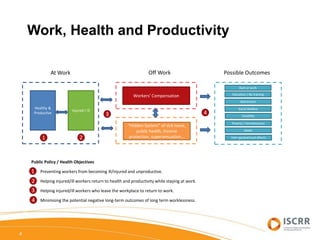
At Work Off Work Possible Outcomes
Healthy &
Productive
Injured / Ill
Workers’ Compensation
“Hidden System” of sick leave,
public health, income
protection, superannuation...
Back at work
Social Welfare
Disability
Retirement
Education / Re-training
Death
Work, Health and Productivity
Public Policy / Health Objectives
1. Preventing workers from becoming ill/injured and unproductive.
2. Helping injured/ill workers return to health and productivity while staying at work.
3. Helping injured/ill workers who leave the workplace to return to work.
4. Minimising the potential negative long-term outcomes of long term worklessness.
Poverty / Homelessness
1 2
3 4
1
2
3
4
Inter-generational effects
Work and Health – the evidence
5
Work Injury in Australia, 2013/14
6
Work Injury in Australia
• Common work-related conditions (back pain, MSK, neck pain) are 3 of
the 5 leading causes of disability (Global Burden of Disease Study, 2015).
• Among working age Australians, these conditions generate the greatest
burden of disability.
• Estimated 532,000 work related injuries in 2013/14 (one per minute).
• Being off work can lead to:
– changes in physical and mental health
– reduced labour force productivity
– impact on family and social relationships
– reduced economic security of the worker
– intergenerational effects
Cost of Work-Related Conditions
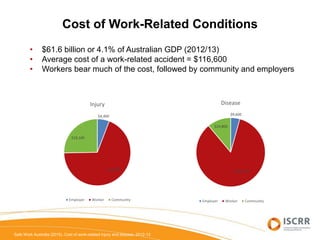
• $61.6 billion or 4.1% of Australian GDP (2012/13)
• Average cost of a work-related accident = $116,600
• Workers bear much of the cost, followed by community and employers
$4,400
$52,000
$19,100
Injury
Employer Worker Community
$9,600
$189,200
$24,800
Disease
Employer Worker Community
Safe Work Australia (2015). Cost of work-related injury and disease, 2012-13
Why focus on GPs and certificates?
• GPs issue the majority of certificates
• GPs almost exclusively (~96% of cases) issue the first certificate
• The certificate is required for claim acceptance and ongoing benefit
provision
• The certificate has potential to be a therapeutic tool as well as a
procedural requirement
9 1 Dembe, A.E. et al. Am J Ind Med, 2003. 44(4) p 331-42
Certification by numbers
• Most studies based on small clusters of GP practices.
• Few published research studies differentiate between rates of sick notes and fit notes.
• Lack of electronic population-based data capture has been a barrier to understanding.
10 Wynne-Jones et al (2009). Brit J Gen Practice
Rates of certification
by gender in UK
primary care (based
on 14 GP practices).
Certification by numbers (Victoria)
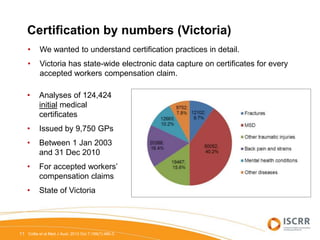
• Analyses of 124,424
initial medical
certificates
• Issued by 9,750 GPs
• Between 1 Jan 2003
and 31 Dec 2010
• For accepted workers’
compensation claims
• State of Victoria
11
• We wanted to understand certification practices in detail.
• Victoria has state-wide electronic data capture on certificates for every
accepted workers compensation claim.
Collie et al Med J Aust. 2013 Oct 7;199(7):480-3.
Certification by numbers (Victoria)
12
• 74.1% were issued as ‘unfit for work’ certificates
• 22.8% were issued as ‘alternate/modified duties’ certificates
• Proportion varies significantly by condition
Collie et al Med J Aust. 2013 Oct 7;199(7):480-3.
Certification by numbers (Victoria)
13
• Rates of unfit certificates have been reducing (A)
• Rates of alternate duties certificates have remained stable (B)
• Different patterns by injury / illness category
Ruseckaite R, Collie A et al. J Occup Rehabil. 2014 Sep;24(3):525-32.
Certification by numbers (Victoria)
14
• Regression analyses of factors associated with type of initial certificate
• Workers receiving ‘unfit for work’ certificates are more likely to:
– Be older
– Have a work-related mental health condition
– Live rurally / remotely
– See a GP with a low to moderate caseload (13 to 49 claims)
• Workers receiving ‘alternate duties’ certificates are more likely to:
– Be female
– Have a musculoskeletal disorder or back pain
– See a GP with a high caseload (>49 claims)
– Work for a medium, large or government employer
– Work in a managerial position
Ruseckaite R, Collie A et al. BMC Public Health. 2016 Apr 6;16(1):298
Certification by numbers (Victoria)
15
• A small proportion (13.2%) of GPs issue half of all certificates.
GP Group Claimants/GP GPs, N (%) Claims, N (%)
1 1 -13 (25pct) 6,824 (70%) 30,814 (24.8%)
2 14-26 (50pct) 1,638 (16.8%) 31,151 (25.1%)
3 27-48 (75pct) 917 (9.4%) 31,583 (25.4%)
4 49+ (100 pct) 369 (3.8%) 30,794 (24.8%)
Total 9,748 (100%) 124,342 (100%)
Mazza D, et al (in preparation)
Factors affecting GP engagement in RTW
• Fit to Work Study (Victoria)
• Qualitative interviews with four groups
– GPs (n=25)
– Injured workers (n=17)
– Employers (n=25)
– Insurance case managers (n=25)
• Study questions:
– How do GPs, injured workers, employers, and compensation personnel
view the role of the GP in facilitating return to work?
– What are the reported barriers and enablers to GPs facilitating injured
workers RTW?
16
Qualitative study findings
• Certification is an administrative and clinical task
underpinned by a host of social and systemic factors.
• Doctors consider certificates to be a method of
communication.
• Case managers and employers consider certificates to
be a therapeutic tool.
17 Mazza D, et al. BMC Fam Pract. 2015 Aug 15;16:100
Qualitative study findings
• High rates of unfit for work certificates are in part due
to:
• GPs reliance only on injured workers feedback on capacity to work
• Poor communication between GPs, employers and compensation
agents
• Lack of availability of alternative/modified duties
• Age and social circumstances of the injured worker and their family
• High degree of complexity in mental health claims
18 Mazza D, et al. BMC Fam Pract. 2015 Aug 15;16:100
Qualitative study findings
• Significant barriers to GP engagement in managing
injured workers:
• High administrative burden on GPs from compensation system
• Low remuneration of time and effort
• Delayed payments
• Difficulty in referrals
• Conflicting medical opinions
• Lack of GP knowledge of workers compensation system
• Lack of continuity in engagement with insurers
19
Mazza D, et al. BMC Fam Pract. 2015 Aug 15;16:100
Brijnath B et alJ Occup Rehabil. 2014 Dec;24(4):766-76
“They [insurance case managers] keep changing. And I have to ask,
‘Well why do these workers keep changing?’ Why is one patient who
is in the system for a long time, constantly handed on to another
worker who doesn’t know the patient, doesn't know their background?
I might have 15 years of knowledge of the patient ... I feel like we have
continuity of care and the system doesn’t”
(GP25, m, 50yo, 25ye).
20
Compensation system barriers
Brijnath B et alJ Occup Rehabil. 2014 Dec;24(4):766-76
• Mental health conditions = greater rate of unfit
certificates (Wynne-Jones et al, 2009. Brit J Gen Practice)
• Risk factors for longer duration include older age,
social deprivation, and presence of mild and severe
mental disorders (Sheils et al, 2004. Brit J Gen Practice)
• Factors affecting GP attitudes = doctor-patient
relationships, pressure on consultation time, limited
knowledge about their patient’s workplace, and the
administrative burden of dealing with the compensation
system (Cohen et al, 2010 Occup Med; Kosny et al, 2006 J Occup Rehab)
21
Our results are consistent with evidence from
European and North American studies
22
Some potential GP focussed interventions
Factor Example Potential intervention/s
Medical certificate Recommending alternate duties
may improve RTW outcomes.
Change to ‘fit notes’. GP specific
guidelines for RTW.
GP knowledge of compensation
system
Knowledgeable GPs aid worker
recovery and system navigation.
GP focussed education and
training on comp processes.
GP willingness to engage in comp
system
Some GPs refuse or are unwilling
to engage in comp cases. Creates
barriers to access for workers.
Financial incentives. Minimise
barriers to engagement (red tape).
GP knowledge of workers
employment circumstances
Greater understanding = more
likely to recommend alternate
duties / RTW.
Third party acts as link b/w
employer and GP (eg, OT, OR
provider). GP specific guidelines
for RTW.
GPs tend to focus on worker
condition rather than RTW.
RTW not always/often focus of GP
during worker consultation.
GP specific guidelines for RTW.
Payment code for RTW
consultation.
Strength of relationship with
injured worker
GP can become patient advocate
rather than RTW facilitator.
GP specific guidelines for RTW.
Some recent efforts to change certification
practices
• UK
– Fit Note roll-out (from 2010)
– Fit for Work Service (from 2014)
• New Zealand
– Better @ Work (2009 onwards)
• Victoria
– Health Benefits of Safe Work Program (from 2013)
• ACT
– Capital Health Network trial (from 2015)
• Queensland
– New Certificate (April 2016)
23
Has the ‘fit-note’ worked?
• Survey of GPs by UK Dept of Work and Pensions
(2012)
24
66.3%
64.6%
60.5%
81.5%
60.8%
53.5%
48.2%
70.3%
0% 20% 40% 60% 80% 100%
Improved the quality of my discussions
with patients about return to work
Improved the advice I give to patients
about their fitness for work
Increased the frequency with which I
recommend return to work as an aid to
patient recovery
Helped my patients make a phased
return to work (e.g. amended duties,
altered hours, workplace adaptations)
2010
2012
Courtesy Dame Carol Black
Has the ‘fit-note’ worked?
• CBI – Absence and workplace health survey (2013)
• UK employers views of fit note
25 Courtesy Dame Carol Black
26
What other factors influence return to work?
Biological Social
Psychological
RTW
Family factors
Employer factors
Financial factors
Coping skills
Self-esteem
Motivation
Physical health
Disability
Genetic vulnerabilities
Relationships
Policy / Environmental factors
Co-morbidity
Age
Self-efficacy
Mental Health
27
Putting it all together
RTW &
Recovery
Opportunities to improve certification
• Targeted education and training program focussing on
how to certify for capacity rather than incapacity
• Video-based demonstrations with real patient
scenarios
• Integration of the certificate into medical software
• Demonstration of long term impact
28
Vision: Improved GP performance
Prof Danielle Mazza
29
• Develop tools to aid GPs to navigate the system:
– Flow chart
– Education
– Practical guidance, tools and strategies
• Develop a suite of tools/resources and frameworks to
help guide functional assessment (e.g. for persistent
pain or mental health issues)
• Provide guidance for treatment options
• Ensure the long-term sustainability of health provider
participation in the compensable injury landscape.
New Project - National clinical guidelines for GPs on
work-related mental health claims (2016-19)
• Key outcomes will be:
– A clinical guideline to improve
GP management of patients with
work-related mental health
claims
– A guideline that is approved by
the NHMRC and RACGP
– National dissemination of the
guideline
– An evidence-based
implementation plan to facilitate
the translation of the guidelines
into clinical practice.
30
Can guidelines work?
• Sweden introduced diagnoses specific sickness
certification guidelines nationally in October 2007.
• Survey of 4394 Swedish GPs in 2008 found that:
– 76.2% reported using the guidelines
– 65.4% reported the guidelines had facilitated contacts with patients
– 43.5% reported the guidelines had facilitated contacts with social
insurance officers
– 31.5% reported the guidelines as helping to develop competence
– 33.5% reported the guidelines as improving the quality of sickness
certification consultations
31 Skaner et al. BMJ Open 2011.
Take-home messages
• We know a lot now about rates of certification and factors that impact
on GP certification practices.
• Emphasising fitness to work in certification is a positive step.
• Efforts to improve rates of fit to work certificates have not yet shown
strong evidence of substantial impact. But we should keep trying.
• Return to work is a complex process involving multiple parties, many
interactions and ‘events’.
• Changing certification practices is one opportunity among many for
improving return to work outcomes.
32
THANK YOU!
Contact Information:
alex.collie@monash.edu
(03) 9903 8610
www.iscrr.com.au
@iscrr / @axcollie
33

Certifying Capacity for Work

  • 1.
    Certifying capacity forwork Professor Alex Collie, Chief Executive Officer, Institute for Safety Compensation and Recovery Research, Monash University alex.collie@monash.edu / iscrr.com.au / @iscrr / @axcollie
  • 2.
    Acknowledgments • Professor DanielleMazza, Dr Bianca Brijnath, Dr Rasa Ruseckaite, Dr Agnieszka Kosny, Ms Nabita Singh. • Colleagues from the TAC, WorkSafe Victoria and the Health and Disability Strategy Group. • The research presented was supported with funding and in-kind assistance by: – WorkSafe Victoria – Transport Accident Commission – Royal Australian College of General Practitioners – Motor Accidents Insurance Commission of QLD 2
  • 3.
    Overview • The linkbetween work, health and productivity • Work injury in Australia • Why emphasise capacity for work? • What do we know about rates of sickness certification for work-related conditions? • What are the barriers and facilitators to GP engagement in certification and the RTW process? • The ‘fit note’ – has it worked? • What is next? 3
  • 4.
    4 At Work OffWork Possible Outcomes Healthy & Productive Injured / Ill Workers’ Compensation “Hidden System” of sick leave, public health, income protection, superannuation... Back at work Social Welfare Disability Retirement Education / Re-training Death Work, Health and Productivity Public Policy / Health Objectives 1. Preventing workers from becoming ill/injured and unproductive. 2. Helping injured/ill workers return to health and productivity while staying at work. 3. Helping injured/ill workers who leave the workplace to return to work. 4. Minimising the potential negative long-term outcomes of long term worklessness. Poverty / Homelessness 1 2 3 4 1 2 3 4 Inter-generational effects
  • 5.
    Work and Health– the evidence 5
  • 6.
    Work Injury inAustralia, 2013/14 6
  • 7.
    Work Injury inAustralia • Common work-related conditions (back pain, MSK, neck pain) are 3 of the 5 leading causes of disability (Global Burden of Disease Study, 2015). • Among working age Australians, these conditions generate the greatest burden of disability. • Estimated 532,000 work related injuries in 2013/14 (one per minute). • Being off work can lead to: – changes in physical and mental health – reduced labour force productivity – impact on family and social relationships – reduced economic security of the worker – intergenerational effects
  • 8.
    Cost of Work-RelatedConditions • $61.6 billion or 4.1% of Australian GDP (2012/13) • Average cost of a work-related accident = $116,600 • Workers bear much of the cost, followed by community and employers $4,400 $52,000 $19,100 Injury Employer Worker Community $9,600 $189,200 $24,800 Disease Employer Worker Community Safe Work Australia (2015). Cost of work-related injury and disease, 2012-13
  • 9.
    Why focus onGPs and certificates? • GPs issue the majority of certificates • GPs almost exclusively (~96% of cases) issue the first certificate • The certificate is required for claim acceptance and ongoing benefit provision • The certificate has potential to be a therapeutic tool as well as a procedural requirement 9 1 Dembe, A.E. et al. Am J Ind Med, 2003. 44(4) p 331-42
  • 10.
    Certification by numbers •Most studies based on small clusters of GP practices. • Few published research studies differentiate between rates of sick notes and fit notes. • Lack of electronic population-based data capture has been a barrier to understanding. 10 Wynne-Jones et al (2009). Brit J Gen Practice Rates of certification by gender in UK primary care (based on 14 GP practices).
  • 11.
    Certification by numbers(Victoria) • Analyses of 124,424 initial medical certificates • Issued by 9,750 GPs • Between 1 Jan 2003 and 31 Dec 2010 • For accepted workers’ compensation claims • State of Victoria 11 • We wanted to understand certification practices in detail. • Victoria has state-wide electronic data capture on certificates for every accepted workers compensation claim. Collie et al Med J Aust. 2013 Oct 7;199(7):480-3.
  • 12.
    Certification by numbers(Victoria) 12 • 74.1% were issued as ‘unfit for work’ certificates • 22.8% were issued as ‘alternate/modified duties’ certificates • Proportion varies significantly by condition Collie et al Med J Aust. 2013 Oct 7;199(7):480-3.
  • 13.
    Certification by numbers(Victoria) 13 • Rates of unfit certificates have been reducing (A) • Rates of alternate duties certificates have remained stable (B) • Different patterns by injury / illness category Ruseckaite R, Collie A et al. J Occup Rehabil. 2014 Sep;24(3):525-32.
  • 14.
    Certification by numbers(Victoria) 14 • Regression analyses of factors associated with type of initial certificate • Workers receiving ‘unfit for work’ certificates are more likely to: – Be older – Have a work-related mental health condition – Live rurally / remotely – See a GP with a low to moderate caseload (13 to 49 claims) • Workers receiving ‘alternate duties’ certificates are more likely to: – Be female – Have a musculoskeletal disorder or back pain – See a GP with a high caseload (>49 claims) – Work for a medium, large or government employer – Work in a managerial position Ruseckaite R, Collie A et al. BMC Public Health. 2016 Apr 6;16(1):298
  • 15.
    Certification by numbers(Victoria) 15 • A small proportion (13.2%) of GPs issue half of all certificates. GP Group Claimants/GP GPs, N (%) Claims, N (%) 1 1 -13 (25pct) 6,824 (70%) 30,814 (24.8%) 2 14-26 (50pct) 1,638 (16.8%) 31,151 (25.1%) 3 27-48 (75pct) 917 (9.4%) 31,583 (25.4%) 4 49+ (100 pct) 369 (3.8%) 30,794 (24.8%) Total 9,748 (100%) 124,342 (100%) Mazza D, et al (in preparation)
  • 16.
    Factors affecting GPengagement in RTW • Fit to Work Study (Victoria) • Qualitative interviews with four groups – GPs (n=25) – Injured workers (n=17) – Employers (n=25) – Insurance case managers (n=25) • Study questions: – How do GPs, injured workers, employers, and compensation personnel view the role of the GP in facilitating return to work? – What are the reported barriers and enablers to GPs facilitating injured workers RTW? 16
  • 17.
    Qualitative study findings •Certification is an administrative and clinical task underpinned by a host of social and systemic factors. • Doctors consider certificates to be a method of communication. • Case managers and employers consider certificates to be a therapeutic tool. 17 Mazza D, et al. BMC Fam Pract. 2015 Aug 15;16:100
  • 18.
    Qualitative study findings •High rates of unfit for work certificates are in part due to: • GPs reliance only on injured workers feedback on capacity to work • Poor communication between GPs, employers and compensation agents • Lack of availability of alternative/modified duties • Age and social circumstances of the injured worker and their family • High degree of complexity in mental health claims 18 Mazza D, et al. BMC Fam Pract. 2015 Aug 15;16:100
  • 19.
    Qualitative study findings •Significant barriers to GP engagement in managing injured workers: • High administrative burden on GPs from compensation system • Low remuneration of time and effort • Delayed payments • Difficulty in referrals • Conflicting medical opinions • Lack of GP knowledge of workers compensation system • Lack of continuity in engagement with insurers 19 Mazza D, et al. BMC Fam Pract. 2015 Aug 15;16:100 Brijnath B et alJ Occup Rehabil. 2014 Dec;24(4):766-76
  • 20.
    “They [insurance casemanagers] keep changing. And I have to ask, ‘Well why do these workers keep changing?’ Why is one patient who is in the system for a long time, constantly handed on to another worker who doesn’t know the patient, doesn't know their background? I might have 15 years of knowledge of the patient ... I feel like we have continuity of care and the system doesn’t” (GP25, m, 50yo, 25ye). 20 Compensation system barriers Brijnath B et alJ Occup Rehabil. 2014 Dec;24(4):766-76
  • 21.
    • Mental healthconditions = greater rate of unfit certificates (Wynne-Jones et al, 2009. Brit J Gen Practice) • Risk factors for longer duration include older age, social deprivation, and presence of mild and severe mental disorders (Sheils et al, 2004. Brit J Gen Practice) • Factors affecting GP attitudes = doctor-patient relationships, pressure on consultation time, limited knowledge about their patient’s workplace, and the administrative burden of dealing with the compensation system (Cohen et al, 2010 Occup Med; Kosny et al, 2006 J Occup Rehab) 21 Our results are consistent with evidence from European and North American studies
  • 22.
    22 Some potential GPfocussed interventions Factor Example Potential intervention/s Medical certificate Recommending alternate duties may improve RTW outcomes. Change to ‘fit notes’. GP specific guidelines for RTW. GP knowledge of compensation system Knowledgeable GPs aid worker recovery and system navigation. GP focussed education and training on comp processes. GP willingness to engage in comp system Some GPs refuse or are unwilling to engage in comp cases. Creates barriers to access for workers. Financial incentives. Minimise barriers to engagement (red tape). GP knowledge of workers employment circumstances Greater understanding = more likely to recommend alternate duties / RTW. Third party acts as link b/w employer and GP (eg, OT, OR provider). GP specific guidelines for RTW. GPs tend to focus on worker condition rather than RTW. RTW not always/often focus of GP during worker consultation. GP specific guidelines for RTW. Payment code for RTW consultation. Strength of relationship with injured worker GP can become patient advocate rather than RTW facilitator. GP specific guidelines for RTW.
  • 23.
    Some recent effortsto change certification practices • UK – Fit Note roll-out (from 2010) – Fit for Work Service (from 2014) • New Zealand – Better @ Work (2009 onwards) • Victoria – Health Benefits of Safe Work Program (from 2013) • ACT – Capital Health Network trial (from 2015) • Queensland – New Certificate (April 2016) 23
  • 24.
    Has the ‘fit-note’worked? • Survey of GPs by UK Dept of Work and Pensions (2012) 24 66.3% 64.6% 60.5% 81.5% 60.8% 53.5% 48.2% 70.3% 0% 20% 40% 60% 80% 100% Improved the quality of my discussions with patients about return to work Improved the advice I give to patients about their fitness for work Increased the frequency with which I recommend return to work as an aid to patient recovery Helped my patients make a phased return to work (e.g. amended duties, altered hours, workplace adaptations) 2010 2012 Courtesy Dame Carol Black
  • 25.
    Has the ‘fit-note’worked? • CBI – Absence and workplace health survey (2013) • UK employers views of fit note 25 Courtesy Dame Carol Black
  • 26.
    26 What other factorsinfluence return to work? Biological Social Psychological RTW Family factors Employer factors Financial factors Coping skills Self-esteem Motivation Physical health Disability Genetic vulnerabilities Relationships Policy / Environmental factors Co-morbidity Age Self-efficacy Mental Health
  • 27.
    27 Putting it alltogether RTW & Recovery
  • 28.
    Opportunities to improvecertification • Targeted education and training program focussing on how to certify for capacity rather than incapacity • Video-based demonstrations with real patient scenarios • Integration of the certificate into medical software • Demonstration of long term impact 28
  • 29.
    Vision: Improved GPperformance Prof Danielle Mazza 29 • Develop tools to aid GPs to navigate the system: – Flow chart – Education – Practical guidance, tools and strategies • Develop a suite of tools/resources and frameworks to help guide functional assessment (e.g. for persistent pain or mental health issues) • Provide guidance for treatment options • Ensure the long-term sustainability of health provider participation in the compensable injury landscape.
  • 30.
    New Project -National clinical guidelines for GPs on work-related mental health claims (2016-19) • Key outcomes will be: – A clinical guideline to improve GP management of patients with work-related mental health claims – A guideline that is approved by the NHMRC and RACGP – National dissemination of the guideline – An evidence-based implementation plan to facilitate the translation of the guidelines into clinical practice. 30
  • 31.
    Can guidelines work? •Sweden introduced diagnoses specific sickness certification guidelines nationally in October 2007. • Survey of 4394 Swedish GPs in 2008 found that: – 76.2% reported using the guidelines – 65.4% reported the guidelines had facilitated contacts with patients – 43.5% reported the guidelines had facilitated contacts with social insurance officers – 31.5% reported the guidelines as helping to develop competence – 33.5% reported the guidelines as improving the quality of sickness certification consultations 31 Skaner et al. BMJ Open 2011.
  • 32.
    Take-home messages • Weknow a lot now about rates of certification and factors that impact on GP certification practices. • Emphasising fitness to work in certification is a positive step. • Efforts to improve rates of fit to work certificates have not yet shown strong evidence of substantial impact. But we should keep trying. • Return to work is a complex process involving multiple parties, many interactions and ‘events’. • Changing certification practices is one opportunity among many for improving return to work outcomes. 32
  • 33.
    THANK YOU! Contact Information: alex.collie@monash.edu (03)9903 8610 www.iscrr.com.au @iscrr / @axcollie 33

Editor's Notes

  • #23 As with the systematic review of injured workers, this study provided some clues to potential system level, GP focussed interventions that could enhance RTW. We are now involved in evaluating some of these in practice in Victoria. The Vic compensation schemes are rolling out a major initiative focussed on improving the sickness certification practices of GPs (fit notes). This includes a new certificate, education and training, and an audit function. We are also beginning the process of developing GP focussed return to work guidelines. And I know that some jurisdictions are considering the introduction of a payment code specifically for RTW consultations by GPs.