Big Data
Big data is an evolving term that describes a large
volume of structured, semi-structured and unstructured
data that has the potential to be mined for information
and used in machine learning projects and other
advanced analytics applications.
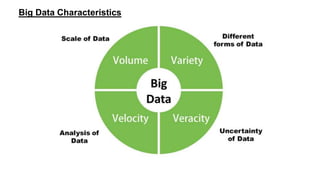
Big Data Characteristics
Big Data Applications:
● Big Data in Education
● Big Data in HealthCare
● Big Data in Government
● Big Data in Media and Entertainment
● Big Data in Weather Patterns
● Big Data in Marketing and Advertising
Big Data Challenges:
The difficulties at different levels include:
● Data capture
● Storage
● Searching
● Sharing
● Analysis
● Management
● Visualization
Big Data Technologies:
1)Big Data and Hadoop ecosystem:
Apache Hadoop is a well known Big Data technology that has an important
supporting community.
It has been designed to avoid the low performance and the complexity
encountered when processing and analyzing Big Data using traditional
technologies.
Advantage:
It rapidly process large data sets.
It relieves network and servers from a considerable communication load.
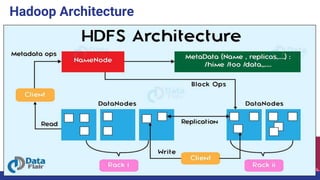
Hadoop Architecture
2)Storm:
● Storm is a stream processing framework and focuses on
continuous computation.
● Storm was developed at twitter to process hundreds of millions of
tweets generated every day and now is an open source big data
analysis system.
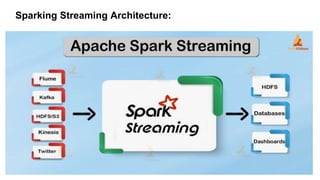
3)Spark:
● Spark is a scalable data analysis platform based on In-Memory
Computing and has performance advantage to Hadoop’s cluster
storage method.
● Spark is written in Scala and offers single data processing
environment.
● Spark supports iteration tasks of distributed data sets.
Sparking Streaming Architecture:
Information and Communication Technology (ICT)
Information and communications technology (ICT) refers to all the
technology used to handle telecommunications, broadcast media,
intelligent building management systems, audiovisual processing
and transmission systems, and network-based control and
monitoring functions.
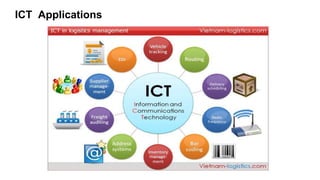
ICT Applications
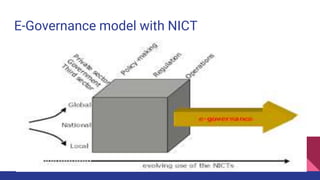
E-Governance model with NICT
Several other Techniques
The various techniques used in Big Data are,
● Data mining
● Text Analysis
● Machine learning
● Predictive Modeling
● Cluster Analysis,etc.
Algorithms used in Big Data
● IBCPRE( Identity Based Conditional Proxy Re-Encryption )
● AES (Advanced Encrypt Standard)
● Decision Tree
● Clustering
● Map Reduce
Conclusion:
Big Data if analysed with good techniques and technologies can give rise to
numerous ideas and areas to upon for getting effective results.
In Future, there may be a development to provide online modeling and training.

Big data analysis

  • 2.
    Big Data Big datais an evolving term that describes a large volume of structured, semi-structured and unstructured data that has the potential to be mined for information and used in machine learning projects and other advanced analytics applications.
  • 3.
  • 4.
    Big Data Applications: ●Big Data in Education ● Big Data in HealthCare ● Big Data in Government ● Big Data in Media and Entertainment ● Big Data in Weather Patterns ● Big Data in Marketing and Advertising
  • 5.
    Big Data Challenges: Thedifficulties at different levels include: ● Data capture ● Storage ● Searching ● Sharing ● Analysis ● Management ● Visualization
  • 6.
    Big Data Technologies: 1)BigData and Hadoop ecosystem: Apache Hadoop is a well known Big Data technology that has an important supporting community. It has been designed to avoid the low performance and the complexity encountered when processing and analyzing Big Data using traditional technologies. Advantage: It rapidly process large data sets. It relieves network and servers from a considerable communication load.
  • 7.
  • 8.
    2)Storm: ● Storm isa stream processing framework and focuses on continuous computation. ● Storm was developed at twitter to process hundreds of millions of tweets generated every day and now is an open source big data analysis system. 3)Spark: ● Spark is a scalable data analysis platform based on In-Memory Computing and has performance advantage to Hadoop’s cluster storage method. ● Spark is written in Scala and offers single data processing environment. ● Spark supports iteration tasks of distributed data sets.
  • 9.
  • 10.
    Information and CommunicationTechnology (ICT) Information and communications technology (ICT) refers to all the technology used to handle telecommunications, broadcast media, intelligent building management systems, audiovisual processing and transmission systems, and network-based control and monitoring functions.
  • 11.
  • 12.
  • 13.
    Several other Techniques Thevarious techniques used in Big Data are, ● Data mining ● Text Analysis ● Machine learning ● Predictive Modeling ● Cluster Analysis,etc.
  • 14.
    Algorithms used inBig Data ● IBCPRE( Identity Based Conditional Proxy Re-Encryption ) ● AES (Advanced Encrypt Standard) ● Decision Tree ● Clustering ● Map Reduce
  • 15.
    Conclusion: Big Data ifanalysed with good techniques and technologies can give rise to numerous ideas and areas to upon for getting effective results. In Future, there may be a development to provide online modeling and training.