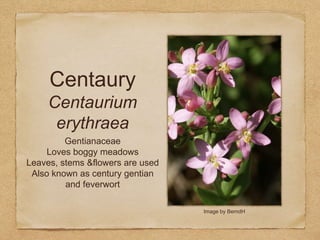
Centaury
Centaurium
erythraea
Gentianaceae
Loves boggy meadows
Leaves, stems &flowers are used
Also known as century gentian
and feverwort
Image by BerndH
Medicinal Actions
Bitter - improves appetite and digestion
Hepatic - increases flow of bile from liver
Cholagogue - increases bile from gallbladder
Febrifuge - manages fevers
Diuretic - increases urine output
Tonic - strengthens the body systems and health
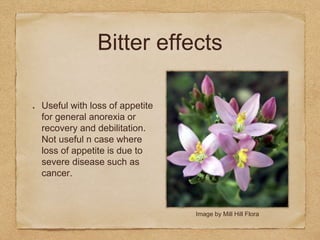
Bitter effects
Useful with loss of appetite
for general anorexia or
recovery and debilitation.
Not useful n case where
loss of appetite is due to
severe disease such as
cancer.
Image by Mill Hill Flora
Useful for:
Toning the kidneys
Regulating digestive secretions from liver and
gallbladder
Corrective for liver troubles and jaundice
Assists in regulating kidney health
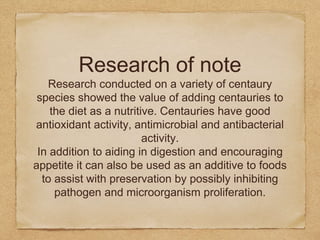
Constituents
Bitter glycosides such as gentiopicrin
Nicotinic acid compounds
Oleanic Acid
Phenolic Acid
Image by AlexNB (Talk)
Research of note
Research conducted on a variety of centaury
species showed the value of adding centauries to
the diet as a nutritive. Centauries have good
antioxidant activity, antimicrobial and antibacterial
activity.
In addition to aiding in digestion and encouraging
appetite it can also be used as an additive to foods
to assist with preservation by possibly inhibiting
pathogen and microorganism proliferation.
Usage information
Safe when used appropriately, although excessive
doses can cause irritation to mucus membranes,
nausea and vomiting.
Fluid extracts, infusions, powder and tincture
preparations can all be used internally.
The bitter taste should have aromatic or other herbs to
disguise the taste. The bitter taste is not required for
the bitter effect.
References
BerndH. (2016). Wikipedia. Retrieved 26 November 2016, from
https://en.wikipedia.org/wiki/Centaurium_erythraea#/media/File:Centaurium_erythrae
a_220603.jpg
Flora, M. H. Mill Hill 2008. Retrieved November 26, 2016, from
http://www.glaucus.org.uk/Centaury409.jpg
Petersen, D. (2016). Herb 303 Textbook. Portland, Oregon: ACHS.
(Talk), A. (2016). Wikipedia. Retrieved 26 November 2016, from
https://en.wikipedia.org/wiki/Amarogentin#/media/File:Amarogentin_gentiopicrin.png
Weiss, R. F. A., Fintelmann, V., & Wandrey, S. O. (2000). Herbal medicine (2nd ed.).
Stuttgart, Germany: Thieme Medical Publishers.
Šiler, B., Živković, S., Banjanac, T., Cvetković, J., Nestorović Živković, J., Ćirić, A., …
Mišić, D. (2014). Centauries as underestimated food additives: Antioxidant and
antimicrobial potential. Food Chemistry, 147, 367–376.
doi:10.1016/j.foodchem.2013.10.007

Centaury

  • 1.
    Centaury Centaurium erythraea Gentianaceae Loves boggy meadows Leaves,stems &flowers are used Also known as century gentian and feverwort Image by BerndH
  • 2.
    Medicinal Actions Bitter -improves appetite and digestion Hepatic - increases flow of bile from liver Cholagogue - increases bile from gallbladder Febrifuge - manages fevers Diuretic - increases urine output Tonic - strengthens the body systems and health
  • 3.
    Bitter effects Useful withloss of appetite for general anorexia or recovery and debilitation. Not useful n case where loss of appetite is due to severe disease such as cancer. Image by Mill Hill Flora
  • 4.
    Useful for: Toning thekidneys Regulating digestive secretions from liver and gallbladder Corrective for liver troubles and jaundice Assists in regulating kidney health
  • 5.
    Constituents Bitter glycosides suchas gentiopicrin Nicotinic acid compounds Oleanic Acid Phenolic Acid Image by AlexNB (Talk)
  • 6.
    Research of note Researchconducted on a variety of centaury species showed the value of adding centauries to the diet as a nutritive. Centauries have good antioxidant activity, antimicrobial and antibacterial activity. In addition to aiding in digestion and encouraging appetite it can also be used as an additive to foods to assist with preservation by possibly inhibiting pathogen and microorganism proliferation.
  • 7.
    Usage information Safe whenused appropriately, although excessive doses can cause irritation to mucus membranes, nausea and vomiting. Fluid extracts, infusions, powder and tincture preparations can all be used internally. The bitter taste should have aromatic or other herbs to disguise the taste. The bitter taste is not required for the bitter effect.
  • 8.
    References BerndH. (2016). Wikipedia.Retrieved 26 November 2016, from https://en.wikipedia.org/wiki/Centaurium_erythraea#/media/File:Centaurium_erythrae a_220603.jpg Flora, M. H. Mill Hill 2008. Retrieved November 26, 2016, from http://www.glaucus.org.uk/Centaury409.jpg Petersen, D. (2016). Herb 303 Textbook. Portland, Oregon: ACHS. (Talk), A. (2016). Wikipedia. Retrieved 26 November 2016, from https://en.wikipedia.org/wiki/Amarogentin#/media/File:Amarogentin_gentiopicrin.png Weiss, R. F. A., Fintelmann, V., & Wandrey, S. O. (2000). Herbal medicine (2nd ed.). Stuttgart, Germany: Thieme Medical Publishers. Šiler, B., Živković, S., Banjanac, T., Cvetković, J., Nestorović Živković, J., Ćirić, A., … Mišić, D. (2014). Centauries as underestimated food additives: Antioxidant and antimicrobial potential. Food Chemistry, 147, 367–376. doi:10.1016/j.foodchem.2013.10.007