Census
development
in Oman
Buthaina Ahmed Al Hadi
Fatma Ali Al Mamari
Outline:
• Definition
• Census in Oman
1. Census development in Oman
2. Stages of census
3. Categories
4. Indicators and Results
5. Challenges
• features
• Importance
• Expectations for the 2020 Census
• Definition
• A census is a survey conducted on the full set of observation objects
belonging to a given population or universe. Context: A census is the
complete enumeration of a population or groups at a point in time with
respect to well defined characteristics: for example, population,
production, traffic on particular roads. (statics )
• A census is an official survey of the population of a country that is carried out in
order to find out how many people live there and to obtain details of such
things as people's ages and jobs. (English dictionary)
• It began during the Roman Republic as list of all adult
males fit for military service.
• Census development in Oman
• Census plays an important role in all communities in the world.
• It is a general survey conducted by a national government with the aim of
gathering information.
• Muslims are among the first to discover the principle of counting.
• The idea of census began for the first time in the eighteenth century AD,
Where the census came to provide basic data for planning operations.
• Its important for future planning for human and urban development.
• Census development in Oman
• The Sultanate's interest in census began since the Renaissance 1970.
• The need for the State to know the basic data to improve health conditions,
Education and raising the standard of living.
• the Sultanate established the department of Statistics on 25 April 1973,
represented by the Development Authority
• after a period of reorganization of this body, they change its name to the
Department of National Statistics, by Ministry of Development .On 7/11/1973
• Census development in Oman
• The census is conducted in the Sultanate of Oman in two phases:
• The first phase (1970-1992): the government has conducted studies aims to
obtaining economic and social indicators and characteristics.
• The second phase (from 1993):
• This was the first royal decree issued in 1988 and continued until 2001.
• issued another royal decree( No. 29  2001), provided for the establishment of an
advisory committee for the General Population and Housing Census and
establishments was also during this period(1993 and 2003).
• industrial census was conducted in( 1993, 1994 and 1995)
• census Agricultural in (1994 and 2004) used the latest statistical techniques and
contemporary technology in the process of counting.
• Stages
1. Preparatory
2. Counting
3. Data processing
4. Data evaluation and analysis
5. publication of results.
A - Preparatory
1. Develop the necessary plans for the various stages of the census.
2. Determine process, methods and methodologies.
3. Preparing the technical, organizational and material requirements of these plans.
B - Counting
It is sometimes called the fieldwork phase,
Two sets of work are carried out:
first group is the preparatory field work.
1. Preparing and equipping the field workplaces with all means.
2. Shipping physical supplies for work like(records, other publications, equipment, pens, etc).
3. Mobilization of human resources and training.
4. Updating inventories of buildings, dwellings, families and establishments.
The second group:
the actual enumeration of the population, housing and the subsequent activities.
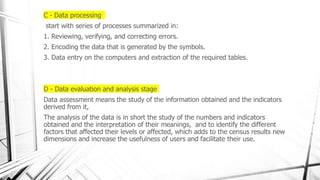
C - Data processing
start with series of processes summarized in:
1. Reviewing, verifying, and correcting errors.
2. Encoding the data that is generated by the symbols.
3. Data entry on the computers and extraction of the required tables.
D - Data evaluation and analysis stage
Data assessment means the study of the information obtained and the indicators
derived from it,
The analysis of the data is in short the study of the numbers and indicators
obtained and the interpretation of their meanings, and to identify the different
factors that affected their levels or affected, which adds to the census results new
dimensions and increase the usefulness of users and facilitate their use.
E-publication of results
A process aimed at making the data collected and processed available to all,
including the publication of all reports and results of their evaluation and the
analytical studies conducted.
• Categories
• The census categories in Oman are:
1- General Census of Population, Housing and Establishments.
2- Industrial Census.
3- Agricultural Census.
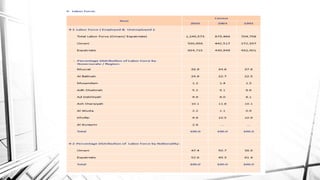
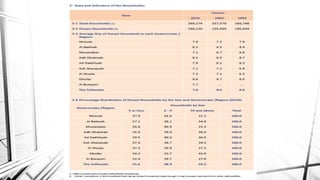
• Indicators and Results
• Challenges
• Mobility
• the weather
• The unwillingness of individuals to answer
• Conflicting answers
• Different languages
• Participation of women
• Lack of sufficient experience (maps, roads)
• Census features
A) Individual count
record the data of each enumerated individual separately from the data of
other individuals.
B) Inclusion
The census covers all individuals in the areas covered by the count
without deletion or repetition.
• Census features
C) The specified period
Population censuses are conducted on a regular basis so that the census
is separated from one another for a specified period, usually 10 full years.
This period may be five years, as is the case in a number of countries.
• importance
• Provide information on employment and foreign labor of the country and the
rate of migration of the population internally and externally.
• Provide statistical data on the population and their demographic, social and
economic characteristics, and the associated rates and indicators, such as
population growth rates, age and gender composition.
• Census data represent a major database of population, housing and
enterprise statistics.
• Providing basic data for all sectors of the country "education, health, housing,
etc.", with a view to monitoring and evaluating plans for providing the
services needed by society.
• Expectations for the 2020 Census
• A) In natural population growth:
• The ratio of expatriates from the total population at the current level
(44.5%).
• The adoption of a policy to reduce this ratio gradually to reach 33% by
2040.
• The population of Oman in 2020 to 5 million people, an increase of
727 thousand people compared to 2014,
• While the census will exceed 8 million in 2040..
• Expectations for the 2020 Census
B) In the labor market:
• The number of newcomers in the labor market until 2040 is about 568
thousand people
• Increase job seekers
C) In education:
• The need to build 4 thousand classrooms and 13 thousand teachers
during the current plan, while the cost of absorption of new students
about 285 million riyals additional.
• References
• http://www.omandaily.om
• http://alwatan.com
• http://www.alfalq.com
• https://om77.net
• http://avb.s-oman.net
• http://www.gisarab.com
• https://mawdoo3.com
• References
• Publications of the National Statistics Center (NCSI)
• https://www.ncsi.gov.om
• https://medicante.blogspot.com
• https://stats.oecd.org
• https://www.collinsdictionary.com/dictionary/english/census

census development in Oman

  • 1.
    Census development in Oman Buthaina AhmedAl Hadi Fatma Ali Al Mamari
  • 2.
    Outline: • Definition • Censusin Oman 1. Census development in Oman 2. Stages of census 3. Categories 4. Indicators and Results 5. Challenges • features • Importance • Expectations for the 2020 Census
  • 3.
    • Definition • Acensus is a survey conducted on the full set of observation objects belonging to a given population or universe. Context: A census is the complete enumeration of a population or groups at a point in time with respect to well defined characteristics: for example, population, production, traffic on particular roads. (statics ) • A census is an official survey of the population of a country that is carried out in order to find out how many people live there and to obtain details of such things as people's ages and jobs. (English dictionary) • It began during the Roman Republic as list of all adult males fit for military service.
  • 4.
    • Census developmentin Oman • Census plays an important role in all communities in the world. • It is a general survey conducted by a national government with the aim of gathering information. • Muslims are among the first to discover the principle of counting. • The idea of census began for the first time in the eighteenth century AD, Where the census came to provide basic data for planning operations. • Its important for future planning for human and urban development.
  • 5.
    • Census developmentin Oman • The Sultanate's interest in census began since the Renaissance 1970. • The need for the State to know the basic data to improve health conditions, Education and raising the standard of living. • the Sultanate established the department of Statistics on 25 April 1973, represented by the Development Authority • after a period of reorganization of this body, they change its name to the Department of National Statistics, by Ministry of Development .On 7/11/1973
  • 6.
    • Census developmentin Oman • The census is conducted in the Sultanate of Oman in two phases: • The first phase (1970-1992): the government has conducted studies aims to obtaining economic and social indicators and characteristics. • The second phase (from 1993): • This was the first royal decree issued in 1988 and continued until 2001. • issued another royal decree( No. 29 2001), provided for the establishment of an advisory committee for the General Population and Housing Census and establishments was also during this period(1993 and 2003). • industrial census was conducted in( 1993, 1994 and 1995) • census Agricultural in (1994 and 2004) used the latest statistical techniques and contemporary technology in the process of counting.
  • 7.
    • Stages 1. Preparatory 2.Counting 3. Data processing 4. Data evaluation and analysis 5. publication of results.
  • 8.
    A - Preparatory 1.Develop the necessary plans for the various stages of the census. 2. Determine process, methods and methodologies. 3. Preparing the technical, organizational and material requirements of these plans. B - Counting It is sometimes called the fieldwork phase, Two sets of work are carried out: first group is the preparatory field work. 1. Preparing and equipping the field workplaces with all means. 2. Shipping physical supplies for work like(records, other publications, equipment, pens, etc). 3. Mobilization of human resources and training. 4. Updating inventories of buildings, dwellings, families and establishments. The second group: the actual enumeration of the population, housing and the subsequent activities.
  • 9.
    C - Dataprocessing start with series of processes summarized in: 1. Reviewing, verifying, and correcting errors. 2. Encoding the data that is generated by the symbols. 3. Data entry on the computers and extraction of the required tables. D - Data evaluation and analysis stage Data assessment means the study of the information obtained and the indicators derived from it, The analysis of the data is in short the study of the numbers and indicators obtained and the interpretation of their meanings, and to identify the different factors that affected their levels or affected, which adds to the census results new dimensions and increase the usefulness of users and facilitate their use.
  • 10.
    E-publication of results Aprocess aimed at making the data collected and processed available to all, including the publication of all reports and results of their evaluation and the analytical studies conducted.
  • 11.
    • Categories • Thecensus categories in Oman are: 1- General Census of Population, Housing and Establishments. 2- Industrial Census. 3- Agricultural Census.
  • 12.
  • 17.
    • Challenges • Mobility •the weather • The unwillingness of individuals to answer • Conflicting answers • Different languages • Participation of women • Lack of sufficient experience (maps, roads)
  • 18.
    • Census features A)Individual count record the data of each enumerated individual separately from the data of other individuals. B) Inclusion The census covers all individuals in the areas covered by the count without deletion or repetition.
  • 19.
    • Census features C)The specified period Population censuses are conducted on a regular basis so that the census is separated from one another for a specified period, usually 10 full years. This period may be five years, as is the case in a number of countries.
  • 20.
    • importance • Provideinformation on employment and foreign labor of the country and the rate of migration of the population internally and externally. • Provide statistical data on the population and their demographic, social and economic characteristics, and the associated rates and indicators, such as population growth rates, age and gender composition. • Census data represent a major database of population, housing and enterprise statistics. • Providing basic data for all sectors of the country "education, health, housing, etc.", with a view to monitoring and evaluating plans for providing the services needed by society.
  • 21.
    • Expectations forthe 2020 Census • A) In natural population growth: • The ratio of expatriates from the total population at the current level (44.5%). • The adoption of a policy to reduce this ratio gradually to reach 33% by 2040. • The population of Oman in 2020 to 5 million people, an increase of 727 thousand people compared to 2014, • While the census will exceed 8 million in 2040..
  • 22.
    • Expectations forthe 2020 Census B) In the labor market: • The number of newcomers in the labor market until 2040 is about 568 thousand people • Increase job seekers C) In education: • The need to build 4 thousand classrooms and 13 thousand teachers during the current plan, while the cost of absorption of new students about 285 million riyals additional.
  • 23.
    • References • http://www.omandaily.om •http://alwatan.com • http://www.alfalq.com • https://om77.net • http://avb.s-oman.net • http://www.gisarab.com • https://mawdoo3.com
  • 24.
    • References • Publicationsof the National Statistics Center (NCSI) • https://www.ncsi.gov.om • https://medicante.blogspot.com • https://stats.oecd.org • https://www.collinsdictionary.com/dictionary/english/census