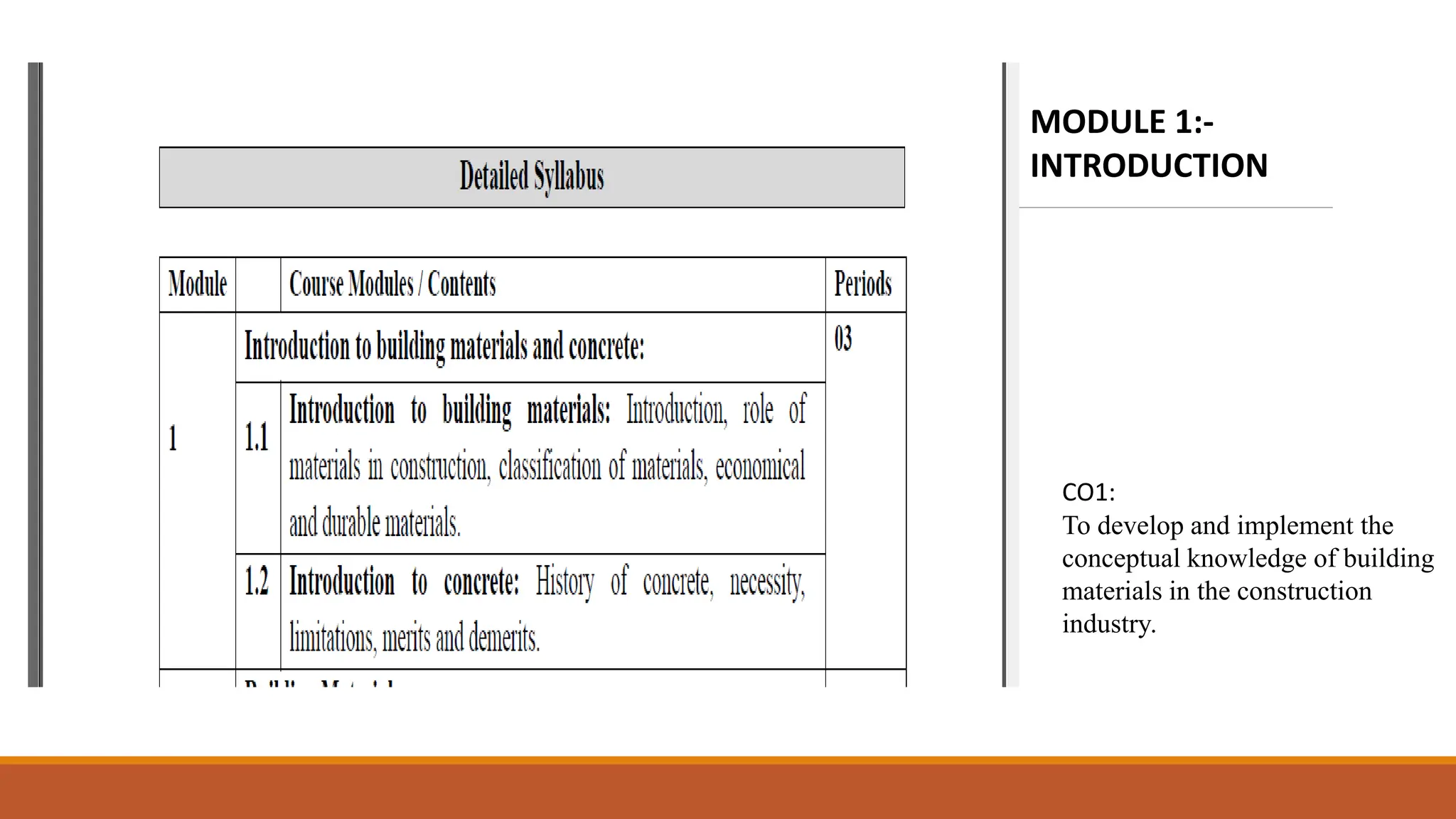
CO1:
To develop and implement the
conceptual knowledge of building
materials in the construction
industry.
MODULE 1:-
INTRODUCTION
Important Questions (5 to 10 marks)
1. State and explain classification of building materials in brief
2. Explain in brief properties of building materials
3. What are the merits (advantages) and demerits (disadvantages) of concrete.
CLASSIFICATION OF MATERIALS
Civil Engg.
Materials
Electrical Engg.
Materials
Mechanical
Engg.
Materials
Other
Discipline
Materials
Natural
Materials
Artificial
Materials
Abrasive
Materials
Adhesive
Materials
Binding
Materials
Covering
Materials
Electric
Insulator
Fuels
Heat or
thermal
Insulator
Light Weight
Materials
Lubricants
Protective
Materials
Reinforcing
Materials
Sound
absorbent
Materials
Transparent
Materials
SPECIAL MATERIALS FINISHING MATERIALS RECYCLED
CONSTRUCTION
MATERIALS
ORGANIC MATERIALS
QUALITIES OF BUILDING MATERIALS
PHYSICAL
PROPERTIES
MECHANICAL
PROPERTIES
ELECTRICAL
PROPERTIES
MAGNETIC
PROPERTIES
CHEMICAL
PROPERTIES
OPTICAL
PROPERTIES
THERMAL
PROPERTIES
TECHNOLOGICAL
PROPERTIES
PHYSICAL
PROPERTIES:
Evaluate
condition of
material
without any
external force
acting on it.
BULK DENSITY & DENSITY
CHEMICAL RESISTANCE
CO-EFFICIENT OF SOFTENING
DENSITY INDEX
DURABILITY
FIRE RESISTANCE
FROST RESISTANCE
HYGROSCOPICITY
POROSITY
REFRACTORINESS
SPALLING RESISTANCE
SPECIFIC HEAT
THERMAL CAPACITY
THERMAL CONDUCTIVITY
WATER ABSORPTION
WATER PERMEABILITY
WEATHERING RESISTANCE
MECHANICAL
PROPERTIES:
Characteristics
governing
behaviour of
material when
external forces
are applied.
ABRASION
CREEP
ELASTICITY
PLASTICITY
BRITTLENESS
FATIGUE
HARDNESS
IMPACT STRENGTH
STRENGTH
WEAR
DUCTILITY
MALLEABILITY
TOUGHNESS
STIFFNESS
STABILITY
BRITTLENESS
ELECTRICAL
PROPERTIES:
Ability to resist
flow of electric
current,
applicable to
different
situations
RESISTIVITY CONDUCTIVITY
DI-ELECTRIC
STRENGTH
SUPERCONDUCTIVITY
MAGNETIC
PROPERTIES:
Materials in
which magnetism
can be induced,
creating
magnetic field in
their vicinity.
Important when
used in
generator,
transformer
Permeability
Coercive Force
Magnetic hysteresis
CHEMICAL
PROPERTIES:
Corrosion Resistance
Chemical composition
Acidity or Alkalinity
Valency (Atomic composition)
OPTICAL
PROPERTIES:
Colour
Light Transmission
Refractive Index
Reflectivity
TECHNOLOGICAL
PROPERTIES:
Factors affecting
processing or
application
Castability
Machinability
Weldability
Workability
BUILDING MATERIALS & ITS SYMBOLS
BRICKS
STONE
RUBBLE/BOU
LDERS
ASHLAR
EXISTING
BRICKS
EXISTING
STONE
MORTAR/PLA
STER
ROCKS
CONCRETE &
EXISTING
CONCRETE
CINDERS
SAND
GLASS
UNGLAZED
CLAY TILES
CERAMICS
TILES
PLYWOOD ROUGH
WOOD
WOOD ACROSS THE
GRAINS
WOOD ALONG THE
GRAINS
GROUND
LEVEL
SHEET
METAL
STEEL &
CAST IRON
ALUMINIUM
OIL WATER
PETROL STRUCTURAL STEEL
MEMBERS
FIBRE BOARD &
INSULATING
BOARD
Historical Timeline
1
9
Mud
Red lime
Bitumen
Lime
Gypsum
Binder
Volcanic ash
Pozzolana
2
0
60
Concrete –
Historical
Straw
Gravel
Broken pottery
Frame
bones
bamboo
Sand
stone
2
1
2
A form of concrete dating to 6500 B.C. was
discovered by archaeologists in Syria. The Image is
" One of the dead towns in northern Syria”
Concrete – Historical timeline
6500 BC
2
2
3
Concrete – Historical timeline
6500
B.C.
3000
B.C.
The earliest concrete yet discovered in Europe was developed
along the Danube River in Yugoslavia. Stone age hunters
/fishermen mixed red lime, sand, gravel and water to construct
floors for their huts. 2
3
Chinese used cementitious materials to hold bamboo together in their boats and in
the Great Wall. The Chinese used concrete in Gansu Province in northwest china. "It
was greenish-black in color, it was used for floors and contained a cement mixed
with sand, broken pottery, bones & water”
Concrete – Historical timeline
3000 BC
2
4
Concrete – Historical timeline
2500 BC
Egyptians used mud mixed with straw to bind dried bricks. Also
furthered the discovery of lime and gypsum mortar as a binding
agent for building the Pyramids.
2
5
Concrete – Historical timeline
800 B.C.
+ In 800 B.C. The
Babylonians and Assyrians
used a bitumen to bind stone
and bricks. This allowed them
to combine both large and
small stone objects together.
2
6
Concrete – Historical timeline
600 B.C.
+ In 600 B.C., "The Greeks
discovered a natural material on
Santorini Island that developed
hydraulic properties when mixed
with lime. This made it possible to
produce concrete that would
harden under water, as well as in
the air."
2
7
Concrete – Historical timeline
400 B.C.
Petra (Greek, "city of rock"), ancient city of Arabia, southwestern
Jordan.
2
8
Concrete – Historical timeline
300 B.C.
+ Romans used slaked lime a
volcanic ash called
pozzuolana, found near
Pozzouli by the bay of Naples.
+ They used lime as a
cementitious material.
+ Pliny reported a mortar
mixture of 1 part lime to 4 parts
sand.
+ Vitruvius reported a 2 parts
pozzuolana to 1 part
lime. Animal fat, milk, and
blood were used as
admixtures. 2
9
Concrete – Historical timeline
193 B.C. Porticus Aemelia is
made of bound stones
to form concrete.
3
0
Concrete – Historical timeline
75 B.C.
Romans use a pozzolanic, hydraulic cement to build the
theater at Pompeii and the Roman baths.
The cement was a ground mix of lime and a volcanic ash
containing silica and alumina.
This volcanic material was discovered near Pozzouli, Italy,
hence the name pozzolanic cement
11
3
1
Concrete – Historical timeline
44 B.C.
The Palatine Hill is one of the
most ancient parts of the city
of Rome Italy
It is some 70 meters high – 12
3
2
Concrete – Historical timeline
25 B.C.
An ancient harbor at Caesarea, Israel was commissioned
and built by Herod the Great.
Built using hydraulic concrete to construct breakwaters.
Caesarea is located half way between Tel Aviv and Haifa
along the Medeterrain Sea.
13
3
3
Concrete – Historical timeline
79 AD.
Pompeii is a ruined Roman city near
modern Naples in the Italian region of
Campania, in the territory of the
commune of Pompeii.
It was destroyed and completely
buried during a catastrophic eruption
of the volcano Mount Vesuvius on 24
Aug 79 AD
3
4
Concrete – Historical timeline
82 AD.
The
Colosseum
is
completed
using large
amounts of
Roman
concrete.
3
5
Concrete – Historical timeline
80 AD.
Roman Army engineers built Aqueducts to serve many of the major cities of
the empire. Shown here is a part of the original 56 mile aqueduct between
Eiffel and Cologne built by the Romans in 80 AD. The inside measurements
of this section are 44 inches high and 30 inches wide, with
approximately 15-inch walls
16
3
6
Concrete – Historical timeline
700
Saxons built concrete mixers in the form of
shallow bowls cast into bedrock. A beam fixed
with paddles rotated about a central post hole
that was human or animal powered.
3
7
Concrete – Historical timeline
128 AD. The Pantheon is completed.
This 142 ft. diameter un-
reinforced concrete dome
remained the largest
spanning dome until it was
surpassed in 1913.
It is made of aggregates that
vary in density from basalt in
the foundations, through
brick and volcanic tuff in the
upper walls, to the lightest of
pumice at the top.
3
8
Concrete – Historical timeline
Pisa Tower - Italy
1173
The height of the tower
56.70 m (186.02 ft) on the high side.
The width of the walls
the base is 4.09 m (13.42 ft)
the top 2.48 m (8.14 ft).
–
Concrete
Historical
3
9
Concrete – Historical timeline
1824
Joseph Aspdin of England is credited with the invention of
modern portland cement. He named his cement portland, after
a rock quary that produced very strong stone.
Portland Cement Invented
4
0
Concrete – Historical timeline
1836
4
1
The first test of tensile and compressive
strength took place in Germany
Cement strength testing
Concrete – Historical timeline
1854
William B. Wilkinson, an English plasterer, erected a small reinforced
concrete two-story servant's cottage.
He reinforced the concrete floor and roof with iron bars and wire rope.
This is credited as the first reinforced concrete building.
First reinforced concrete
4
2
Concrete – Historical timeline
1850
1850 - The first concrete roads appeared in Austria.
1865 in England
concrete road
1891 in Bellefontaine, Ohio 4
3
Concrete – Historical timeline
vertical kilns produce Portland cement
1871
David O. Saylor established the first portland-cement plant in the
United States in Pennsylvania
24
4
4
Concrete – Historical timeline
1889
The first concrete reinforced bridge was built in San Francisco.
Alvord Lake Bridge still exists today, over two hundred years
Alvord Lake Bridge
after it was built!
25
4
5
Concrete – Historical timeline
1901
Arthur Henry Symons designed a column clamp to be used with job-
built concrete forms
Column clamp - Concrete form
26
4
6
Concrete – Historical timeline
1902
Thomas Edison was a pioneer in the further development of
Rotary Kiln
the rotary kiln, which is need for continuous production of
cement
27
4
7
Concrete – Historical timeline
1904
Making first concrete block
4
8
Concrete – Historical timeline
1904
The Ingalls building
Cincinnati , Ohio
Floor : 16
High: 64m
4
9
Concrete – Historical timeline
1905
As the concrete industry begins its boom a group at the
concrete convention in Indianapolis sees a need for a group to
oversee the industry.
The National Association of Cement Users is formed, which
will later be renamed the American Concrete Institute. The
groups’ objective is to promote knowledge of the art of
cement, while promoting efficiency through teaching and
research.
5
0
Concrete – Historical timeline
Concrete Homes
1908
Thomas Edison designed and built the first concrete homes in Union,
New Jersey
5
1
Concrete – Historical timeline
Ready mix concrete & concrete pump
1913
The first load of ready mix was delivered
in Baltimore, Maryland.
The first patent for a concrete pump was
filed. This made concrete transportation
easy and allowed on site mixing
– 32
5
2
Concrete – Historical timeline
3 pairs of concrete locks with floors as thick as 6.1m (20
feet) and walls as thick as 18.3 m (60 feet) at the bottom
Panama Canal
1914
33
5
3
Concrete – Historical timeline
1915
In Italy, Matte Trucco built the Fiat automobile factory Lingotti, Turin
five-story reinforced concrete used.
Especially , Fiat ‘s roof track
34
5
4
Concrete – Historical timeline
1915
Colored concrete
Lynn Mason Scofield the first company to
produce color for concrete.
5
5
Concrete – Historical timeline
Pre-stressed concrete
1928
Năm 1921, Eugène Freyssinet,
French civil engineer built two air
hangars with barabolic curved shape
at Orly Airport - Paris
1928 - Eugene Freyssinet
successfully develops pre-stressed
concrete. 5
6
Concrete – Historical timeline
1936
The Hoover Dam was built along the Colorado River, bordering
Arizona and Nevada. It was the largest scale concrete project ever
completed.
Hoover Dam
38
5
7
Concrete – Historical timeline
Decorative Concrete Developed
1950’s
Brad Bowman developed the Bomanite process, the original cast-in-place,
colored, textured and imprinted architectural concrete paving, in the
middle 1950's in Monterey, California.
5
8
Concrete – Historical timeline
Concrete Sports Dome
1967
The first concrete domed sports arena, known as the Assembly
Hall, was built at the University of Illinois.
5
9
Concrete – Historical timeline
Sydney Opera House
1967
Stage I (1959–1963) consisted of building the upper podium.
Stage II (1963–1967) saw the construction of the outer shells.
Stage III (1967–1973) consisted of the interior design and construction.
6
0
Concrete – Historical timeline
Fiber Reinforcement
1970’s
Fiber reinforcement was introduced as a way to strengthen concrete
6
1
Concrete – Historical timeline
Concrete countertop
1980’s
Buddy Rhodes, the father of the concrete countertop, cast his first
countertop in the mid '80s. Around the same time, Fu-Tung Cheng also
cast his first concrete countertop 6
2
Concrete – Historical timeline
The mid 1980’s - Japan: the development of self-compacting
1993 – Sweden : Research into self-compacting concrete, vibrating-free concrete,
Europe’s first bridge built of self-com-pacting concrete was Swedish.
Self-compacting concrete
1980’s
6
3
Concrete – Historical timeline
311 South Wacker Drive -
Chicago,
High: 293 m
Floors: 65
1990
6
4
Concrete – Historical timeline
Petronas Twin Towers,
Kuala Lampur, Malasia
High: 452 m
Floors: 88
1996
6
5
Concrete – Historical timeline
Portland Cement Association said at least 104 million tons of concrete was
recycled in 1997 in the United States.
Late twentieth century sees the development of mobile concrete recycling
Recycled concrete
1997
machines. 6
6
Concrete – Historical timeline
As part of the seismic retrofit design of
the Richmond - San Rafael Bridge, Ben
C. Gerwick, Inc. developed a concept of
using precast concrete jackets to
strengthen the existing concrete piers.
Unlike steel jackets, concrete jackets
can be designed to resist corrosion in the
aggressive tidal-splash zone for the
remaining 100-year life expectancy of
the bridge.
1998
6
7
Concrete – Historical timeline
Sunniberg Bridge, Switzerland
An extradosed bridge employs a
structure that is frequently described
as a cross between a girder bridge
and a cable stayed bridge
1998
6
8
Concrete – Historical timeline
HTC, originally a Swedish company, introduced concrete polishing to the United
States.
The first installation in the US was a 40,000-square-foot warehouse floor for the
Bellagio in Las Vegas.
The popularity of polished concrete has soared in just the few short years it has been
Polished concrete
1999
around, it is now being used in even residential homes 6
9
Concrete – Historical timeline
BIG DIG - Boston 10-lane asymmetrical bridge that spans the Boston
skyline. At 185 feet it is the largest cable-stayed bridge and the first of its
kind in the US. It also has a pre-cast tunnel system that will serve as
2000
Boston's artery connecting to Heathrow airport 7
0
Concrete – Historical timeline
Jubilee Church, Rome, Italy
2003
7
1
Concrete – Historical timeline
Leonard P. Zakim
Bunker Hill Bridge,
Boston.
2003
7
2
54
Concrete –
Concrete – Historical timeline
Auditorium De Tenerife,
Santiago Calatrava, Canary Islands, Spain
2003
Historical
7
3
Concrete – 55
Concrete – Historical timeline
Milau Viaduct.
2005
Tallest concrete bridge piers
in the world at 200m.
Historical
7
4
Concrete – Historical timeline
China's Three Gorges Dam
High: 185 m
Long: 1983 m
Reservoir : 660 km
2009
7
5
Concrete – Historical timeline
Burj Khalifa -
Dubai
High: 828 m
Floors: 162
2010
7
6
LIMITATIONS TO CONCRETE
Concrete is Quasi-brittle Material
Low Tensile Strength Due to low tensile strength, concrete is required to be reinforced
to avoid cracks.
Concrete has Low Toughness
Concrete has Low specific strength
Formwork is Required
Long curing time
Demands Strict Quality Control
In long structures expansion joints are required to be provided if there is large
temperature variance in the area.
Construction joints are provided to avoid cracks due to drying shrinkage and moisture-
expansion.
NEED FOR CONCRETE
Environmental Importance of Concrete
Versatility
Durability
Strength
MERITS OF CONCRETE
Availability of concrete ingredients easily.
Easy handling and moulding of concrete into any shape.
Easy transportation from the place of mixing to place of casting before
initial set takes place.
Ability to pump/spray to fill into cracks and lining of tunnels.
When reinforced, all types of the structures are made possible from an
ordinary lintel to massive fly overs
Monolithic character gives better appearance and much rigidity to the
structure.
The property of concrete to possess high compressive strength, makes
a concrete structure more economical than that of steel structure.

BMCT Module 1 Mumbai University ppt.pptx

  • 1.
    CO1: To develop andimplement the conceptual knowledge of building materials in the construction industry. MODULE 1:- INTRODUCTION
  • 2.
    Important Questions (5to 10 marks) 1. State and explain classification of building materials in brief 2. Explain in brief properties of building materials 3. What are the merits (advantages) and demerits (disadvantages) of concrete.
  • 3.
    CLASSIFICATION OF MATERIALS CivilEngg. Materials Electrical Engg. Materials Mechanical Engg. Materials Other Discipline Materials Natural Materials Artificial Materials Abrasive Materials Adhesive Materials Binding Materials Covering Materials
  • 5.
  • 6.
    SPECIAL MATERIALS FINISHINGMATERIALS RECYCLED CONSTRUCTION MATERIALS ORGANIC MATERIALS
  • 7.
    QUALITIES OF BUILDINGMATERIALS PHYSICAL PROPERTIES MECHANICAL PROPERTIES ELECTRICAL PROPERTIES MAGNETIC PROPERTIES CHEMICAL PROPERTIES OPTICAL PROPERTIES THERMAL PROPERTIES TECHNOLOGICAL PROPERTIES
  • 8.
    PHYSICAL PROPERTIES: Evaluate condition of material without any externalforce acting on it. BULK DENSITY & DENSITY CHEMICAL RESISTANCE CO-EFFICIENT OF SOFTENING DENSITY INDEX DURABILITY FIRE RESISTANCE FROST RESISTANCE HYGROSCOPICITY POROSITY
  • 9.
    REFRACTORINESS SPALLING RESISTANCE SPECIFIC HEAT THERMALCAPACITY THERMAL CONDUCTIVITY WATER ABSORPTION WATER PERMEABILITY WEATHERING RESISTANCE
  • 10.
    MECHANICAL PROPERTIES: Characteristics governing behaviour of material when externalforces are applied. ABRASION CREEP ELASTICITY PLASTICITY BRITTLENESS FATIGUE HARDNESS IMPACT STRENGTH STRENGTH WEAR
  • 11.
  • 12.
    ELECTRICAL PROPERTIES: Ability to resist flowof electric current, applicable to different situations RESISTIVITY CONDUCTIVITY DI-ELECTRIC STRENGTH SUPERCONDUCTIVITY
  • 13.
    MAGNETIC PROPERTIES: Materials in which magnetism canbe induced, creating magnetic field in their vicinity. Important when used in generator, transformer Permeability Coercive Force Magnetic hysteresis
  • 14.
  • 15.
  • 16.
  • 17.
    BUILDING MATERIALS &ITS SYMBOLS BRICKS STONE RUBBLE/BOU LDERS ASHLAR EXISTING BRICKS EXISTING STONE MORTAR/PLA STER ROCKS CONCRETE & EXISTING CONCRETE CINDERS SAND GLASS
  • 18.
    UNGLAZED CLAY TILES CERAMICS TILES PLYWOOD ROUGH WOOD WOODACROSS THE GRAINS WOOD ALONG THE GRAINS GROUND LEVEL SHEET METAL STEEL & CAST IRON ALUMINIUM OIL WATER PETROL STRUCTURAL STEEL MEMBERS FIBRE BOARD & INSULATING BOARD
  • 19.
  • 20.
  • 21.
  • 22.
    2 A form ofconcrete dating to 6500 B.C. was discovered by archaeologists in Syria. The Image is " One of the dead towns in northern Syria” Concrete – Historical timeline 6500 BC 2 2
  • 23.
    3 Concrete – Historicaltimeline 6500 B.C. 3000 B.C. The earliest concrete yet discovered in Europe was developed along the Danube River in Yugoslavia. Stone age hunters /fishermen mixed red lime, sand, gravel and water to construct floors for their huts. 2 3
  • 24.
    Chinese used cementitiousmaterials to hold bamboo together in their boats and in the Great Wall. The Chinese used concrete in Gansu Province in northwest china. "It was greenish-black in color, it was used for floors and contained a cement mixed with sand, broken pottery, bones & water” Concrete – Historical timeline 3000 BC 2 4
  • 25.
    Concrete – Historicaltimeline 2500 BC Egyptians used mud mixed with straw to bind dried bricks. Also furthered the discovery of lime and gypsum mortar as a binding agent for building the Pyramids. 2 5
  • 26.
    Concrete – Historicaltimeline 800 B.C. + In 800 B.C. The Babylonians and Assyrians used a bitumen to bind stone and bricks. This allowed them to combine both large and small stone objects together. 2 6
  • 27.
    Concrete – Historicaltimeline 600 B.C. + In 600 B.C., "The Greeks discovered a natural material on Santorini Island that developed hydraulic properties when mixed with lime. This made it possible to produce concrete that would harden under water, as well as in the air." 2 7
  • 28.
    Concrete – Historicaltimeline 400 B.C. Petra (Greek, "city of rock"), ancient city of Arabia, southwestern Jordan. 2 8
  • 29.
    Concrete – Historicaltimeline 300 B.C. + Romans used slaked lime a volcanic ash called pozzuolana, found near Pozzouli by the bay of Naples. + They used lime as a cementitious material. + Pliny reported a mortar mixture of 1 part lime to 4 parts sand. + Vitruvius reported a 2 parts pozzuolana to 1 part lime. Animal fat, milk, and blood were used as admixtures. 2 9
  • 30.
    Concrete – Historicaltimeline 193 B.C. Porticus Aemelia is made of bound stones to form concrete. 3 0
  • 31.
    Concrete – Historicaltimeline 75 B.C. Romans use a pozzolanic, hydraulic cement to build the theater at Pompeii and the Roman baths. The cement was a ground mix of lime and a volcanic ash containing silica and alumina. This volcanic material was discovered near Pozzouli, Italy, hence the name pozzolanic cement 11 3 1
  • 32.
    Concrete – Historicaltimeline 44 B.C. The Palatine Hill is one of the most ancient parts of the city of Rome Italy It is some 70 meters high – 12 3 2
  • 33.
    Concrete – Historicaltimeline 25 B.C. An ancient harbor at Caesarea, Israel was commissioned and built by Herod the Great. Built using hydraulic concrete to construct breakwaters. Caesarea is located half way between Tel Aviv and Haifa along the Medeterrain Sea. 13 3 3
  • 34.
    Concrete – Historicaltimeline 79 AD. Pompeii is a ruined Roman city near modern Naples in the Italian region of Campania, in the territory of the commune of Pompeii. It was destroyed and completely buried during a catastrophic eruption of the volcano Mount Vesuvius on 24 Aug 79 AD 3 4
  • 35.
    Concrete – Historicaltimeline 82 AD. The Colosseum is completed using large amounts of Roman concrete. 3 5
  • 36.
    Concrete – Historicaltimeline 80 AD. Roman Army engineers built Aqueducts to serve many of the major cities of the empire. Shown here is a part of the original 56 mile aqueduct between Eiffel and Cologne built by the Romans in 80 AD. The inside measurements of this section are 44 inches high and 30 inches wide, with approximately 15-inch walls 16 3 6
  • 37.
    Concrete – Historicaltimeline 700 Saxons built concrete mixers in the form of shallow bowls cast into bedrock. A beam fixed with paddles rotated about a central post hole that was human or animal powered. 3 7
  • 38.
    Concrete – Historicaltimeline 128 AD. The Pantheon is completed. This 142 ft. diameter un- reinforced concrete dome remained the largest spanning dome until it was surpassed in 1913. It is made of aggregates that vary in density from basalt in the foundations, through brick and volcanic tuff in the upper walls, to the lightest of pumice at the top. 3 8
  • 39.
    Concrete – Historicaltimeline Pisa Tower - Italy 1173 The height of the tower 56.70 m (186.02 ft) on the high side. The width of the walls the base is 4.09 m (13.42 ft) the top 2.48 m (8.14 ft). – Concrete Historical 3 9
  • 40.
    Concrete – Historicaltimeline 1824 Joseph Aspdin of England is credited with the invention of modern portland cement. He named his cement portland, after a rock quary that produced very strong stone. Portland Cement Invented 4 0
  • 41.
    Concrete – Historicaltimeline 1836 4 1 The first test of tensile and compressive strength took place in Germany Cement strength testing
  • 42.
    Concrete – Historicaltimeline 1854 William B. Wilkinson, an English plasterer, erected a small reinforced concrete two-story servant's cottage. He reinforced the concrete floor and roof with iron bars and wire rope. This is credited as the first reinforced concrete building. First reinforced concrete 4 2
  • 43.
    Concrete – Historicaltimeline 1850 1850 - The first concrete roads appeared in Austria. 1865 in England concrete road 1891 in Bellefontaine, Ohio 4 3
  • 44.
    Concrete – Historicaltimeline vertical kilns produce Portland cement 1871 David O. Saylor established the first portland-cement plant in the United States in Pennsylvania 24 4 4
  • 45.
    Concrete – Historicaltimeline 1889 The first concrete reinforced bridge was built in San Francisco. Alvord Lake Bridge still exists today, over two hundred years Alvord Lake Bridge after it was built! 25 4 5
  • 46.
    Concrete – Historicaltimeline 1901 Arthur Henry Symons designed a column clamp to be used with job- built concrete forms Column clamp - Concrete form 26 4 6
  • 47.
    Concrete – Historicaltimeline 1902 Thomas Edison was a pioneer in the further development of Rotary Kiln the rotary kiln, which is need for continuous production of cement 27 4 7
  • 48.
    Concrete – Historicaltimeline 1904 Making first concrete block 4 8
  • 49.
    Concrete – Historicaltimeline 1904 The Ingalls building Cincinnati , Ohio Floor : 16 High: 64m 4 9
  • 50.
    Concrete – Historicaltimeline 1905 As the concrete industry begins its boom a group at the concrete convention in Indianapolis sees a need for a group to oversee the industry. The National Association of Cement Users is formed, which will later be renamed the American Concrete Institute. The groups’ objective is to promote knowledge of the art of cement, while promoting efficiency through teaching and research. 5 0
  • 51.
    Concrete – Historicaltimeline Concrete Homes 1908 Thomas Edison designed and built the first concrete homes in Union, New Jersey 5 1
  • 52.
    Concrete – Historicaltimeline Ready mix concrete & concrete pump 1913 The first load of ready mix was delivered in Baltimore, Maryland. The first patent for a concrete pump was filed. This made concrete transportation easy and allowed on site mixing – 32 5 2
  • 53.
    Concrete – Historicaltimeline 3 pairs of concrete locks with floors as thick as 6.1m (20 feet) and walls as thick as 18.3 m (60 feet) at the bottom Panama Canal 1914 33 5 3
  • 54.
    Concrete – Historicaltimeline 1915 In Italy, Matte Trucco built the Fiat automobile factory Lingotti, Turin five-story reinforced concrete used. Especially , Fiat ‘s roof track 34 5 4
  • 55.
    Concrete – Historicaltimeline 1915 Colored concrete Lynn Mason Scofield the first company to produce color for concrete. 5 5
  • 56.
    Concrete – Historicaltimeline Pre-stressed concrete 1928 Năm 1921, Eugène Freyssinet, French civil engineer built two air hangars with barabolic curved shape at Orly Airport - Paris 1928 - Eugene Freyssinet successfully develops pre-stressed concrete. 5 6
  • 57.
    Concrete – Historicaltimeline 1936 The Hoover Dam was built along the Colorado River, bordering Arizona and Nevada. It was the largest scale concrete project ever completed. Hoover Dam 38 5 7
  • 58.
    Concrete – Historicaltimeline Decorative Concrete Developed 1950’s Brad Bowman developed the Bomanite process, the original cast-in-place, colored, textured and imprinted architectural concrete paving, in the middle 1950's in Monterey, California. 5 8
  • 59.
    Concrete – Historicaltimeline Concrete Sports Dome 1967 The first concrete domed sports arena, known as the Assembly Hall, was built at the University of Illinois. 5 9
  • 60.
    Concrete – Historicaltimeline Sydney Opera House 1967 Stage I (1959–1963) consisted of building the upper podium. Stage II (1963–1967) saw the construction of the outer shells. Stage III (1967–1973) consisted of the interior design and construction. 6 0
  • 61.
    Concrete – Historicaltimeline Fiber Reinforcement 1970’s Fiber reinforcement was introduced as a way to strengthen concrete 6 1
  • 62.
    Concrete – Historicaltimeline Concrete countertop 1980’s Buddy Rhodes, the father of the concrete countertop, cast his first countertop in the mid '80s. Around the same time, Fu-Tung Cheng also cast his first concrete countertop 6 2
  • 63.
    Concrete – Historicaltimeline The mid 1980’s - Japan: the development of self-compacting 1993 – Sweden : Research into self-compacting concrete, vibrating-free concrete, Europe’s first bridge built of self-com-pacting concrete was Swedish. Self-compacting concrete 1980’s 6 3
  • 64.
    Concrete – Historicaltimeline 311 South Wacker Drive - Chicago, High: 293 m Floors: 65 1990 6 4
  • 65.
    Concrete – Historicaltimeline Petronas Twin Towers, Kuala Lampur, Malasia High: 452 m Floors: 88 1996 6 5
  • 66.
    Concrete – Historicaltimeline Portland Cement Association said at least 104 million tons of concrete was recycled in 1997 in the United States. Late twentieth century sees the development of mobile concrete recycling Recycled concrete 1997 machines. 6 6
  • 67.
    Concrete – Historicaltimeline As part of the seismic retrofit design of the Richmond - San Rafael Bridge, Ben C. Gerwick, Inc. developed a concept of using precast concrete jackets to strengthen the existing concrete piers. Unlike steel jackets, concrete jackets can be designed to resist corrosion in the aggressive tidal-splash zone for the remaining 100-year life expectancy of the bridge. 1998 6 7
  • 68.
    Concrete – Historicaltimeline Sunniberg Bridge, Switzerland An extradosed bridge employs a structure that is frequently described as a cross between a girder bridge and a cable stayed bridge 1998 6 8
  • 69.
    Concrete – Historicaltimeline HTC, originally a Swedish company, introduced concrete polishing to the United States. The first installation in the US was a 40,000-square-foot warehouse floor for the Bellagio in Las Vegas. The popularity of polished concrete has soared in just the few short years it has been Polished concrete 1999 around, it is now being used in even residential homes 6 9
  • 70.
    Concrete – Historicaltimeline BIG DIG - Boston 10-lane asymmetrical bridge that spans the Boston skyline. At 185 feet it is the largest cable-stayed bridge and the first of its kind in the US. It also has a pre-cast tunnel system that will serve as 2000 Boston's artery connecting to Heathrow airport 7 0
  • 71.
    Concrete – Historicaltimeline Jubilee Church, Rome, Italy 2003 7 1
  • 72.
    Concrete – Historicaltimeline Leonard P. Zakim Bunker Hill Bridge, Boston. 2003 7 2
  • 73.
    54 Concrete – Concrete –Historical timeline Auditorium De Tenerife, Santiago Calatrava, Canary Islands, Spain 2003 Historical 7 3
  • 74.
    Concrete – 55 Concrete– Historical timeline Milau Viaduct. 2005 Tallest concrete bridge piers in the world at 200m. Historical 7 4
  • 75.
    Concrete – Historicaltimeline China's Three Gorges Dam High: 185 m Long: 1983 m Reservoir : 660 km 2009 7 5
  • 76.
    Concrete – Historicaltimeline Burj Khalifa - Dubai High: 828 m Floors: 162 2010 7 6
  • 77.
    LIMITATIONS TO CONCRETE Concreteis Quasi-brittle Material Low Tensile Strength Due to low tensile strength, concrete is required to be reinforced to avoid cracks. Concrete has Low Toughness Concrete has Low specific strength Formwork is Required Long curing time Demands Strict Quality Control In long structures expansion joints are required to be provided if there is large temperature variance in the area. Construction joints are provided to avoid cracks due to drying shrinkage and moisture- expansion.
  • 78.
    NEED FOR CONCRETE EnvironmentalImportance of Concrete Versatility Durability Strength
  • 79.
    MERITS OF CONCRETE Availabilityof concrete ingredients easily. Easy handling and moulding of concrete into any shape. Easy transportation from the place of mixing to place of casting before initial set takes place. Ability to pump/spray to fill into cracks and lining of tunnels. When reinforced, all types of the structures are made possible from an ordinary lintel to massive fly overs Monolithic character gives better appearance and much rigidity to the structure. The property of concrete to possess high compressive strength, makes a concrete structure more economical than that of steel structure.