CELLULAR RESPIRATION
metabolic pathway that breaks down glucose and produces ATP
TYPES OF CELLULAR RESPIRATION
Aerobic Anaerobic
Why is oxygen the determining factor of these respirations?
TYPES OF CELLULAR RESPIRATION
Why is oxygen the determining factor of
these respirations?
In aerobic, oxygen is necessary to
accept the electrons at the last part
of the process, while in anaerobic,
oxygen is not needed at all due to
other electron acceptors present in
the process.
FERMENTATION: ANAEROBIC PROCESS
Like glycolysis, fermentation pathways occur in the cytoplasm.
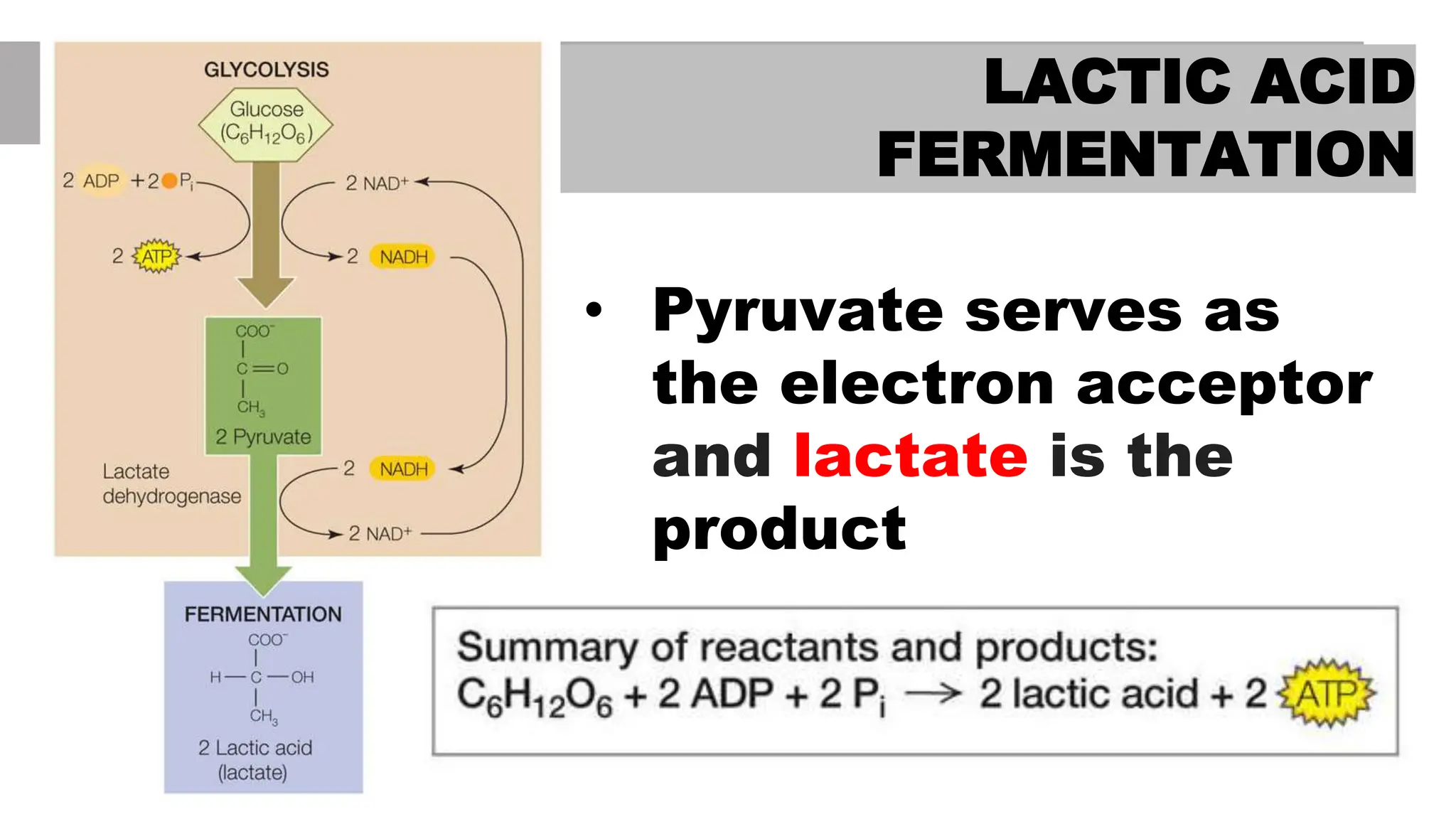
LACTIC ACID
FERMENTATION
• Pyruvate serves as
the electron acceptor
and lactate is the
product
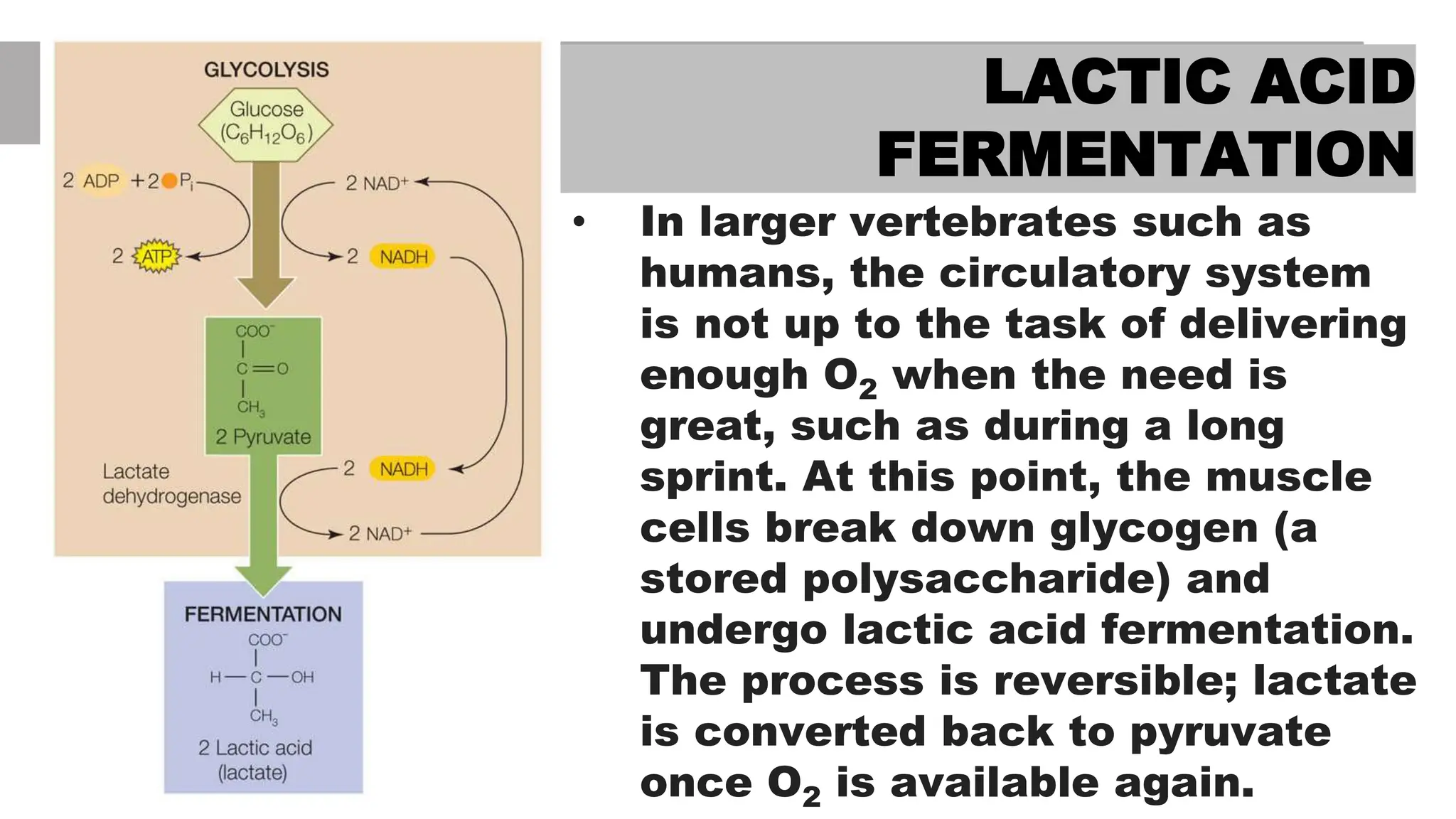
LACTIC ACID
FERMENTATION
• In larger vertebrates such as
humans, the circulatory system
is not up to the task of delivering
enough O2 when the need is
great, such as during a long
sprint. At this point, the muscle
cells break down glycogen (a
stored polysaccharide) and
undergo lactic acid fermentation.
The process is reversible; lactate
is converted back to pyruvate
once O2 is available again.
ALCOHOLIC
FERMENTATION
• Pyruvate is converted
to acetaldehyde, and
CO2 is released.
FERMENTATION
What are the final electron acceptors in
this process?
• Pyruvate (lactic acid fermentation)
• Acetaldehyde (alcoholic
fermentation)
ANAEROBIC RESPIRATION
• Why is replenishing NAD+ crucial to cellular
metabolism?
• Compare the sources and total energy yield
in terms of ATP per glucose in human cells in
the presence versus the absence of O2.
• Conditions can become anaerobic in a heart
muscle cell during a heart attack, because of
the inadequate supply of blood. If O2 is
restored, what will happen to the lactate
produced by the heart muscle?

Cellular Respiration: Anaerobic Respiration

  • 1.
    CELLULAR RESPIRATION metabolic pathwaythat breaks down glucose and produces ATP
  • 2.
    TYPES OF CELLULARRESPIRATION Aerobic Anaerobic Why is oxygen the determining factor of these respirations?
  • 3.
    TYPES OF CELLULARRESPIRATION Why is oxygen the determining factor of these respirations? In aerobic, oxygen is necessary to accept the electrons at the last part of the process, while in anaerobic, oxygen is not needed at all due to other electron acceptors present in the process.
  • 4.
    FERMENTATION: ANAEROBIC PROCESS Likeglycolysis, fermentation pathways occur in the cytoplasm.
  • 5.
    LACTIC ACID FERMENTATION • Pyruvateserves as the electron acceptor and lactate is the product
  • 6.
    LACTIC ACID FERMENTATION • Inlarger vertebrates such as humans, the circulatory system is not up to the task of delivering enough O2 when the need is great, such as during a long sprint. At this point, the muscle cells break down glycogen (a stored polysaccharide) and undergo lactic acid fermentation. The process is reversible; lactate is converted back to pyruvate once O2 is available again.
  • 7.
    ALCOHOLIC FERMENTATION • Pyruvate isconverted to acetaldehyde, and CO2 is released.
  • 8.
    FERMENTATION What are thefinal electron acceptors in this process? • Pyruvate (lactic acid fermentation) • Acetaldehyde (alcoholic fermentation)
  • 9.
    ANAEROBIC RESPIRATION • Whyis replenishing NAD+ crucial to cellular metabolism? • Compare the sources and total energy yield in terms of ATP per glucose in human cells in the presence versus the absence of O2. • Conditions can become anaerobic in a heart muscle cell during a heart attack, because of the inadequate supply of blood. If O2 is restored, what will happen to the lactate produced by the heart muscle?

Editor's Notes

  • #3 When asked to synthesize sources and research, many writers start to summarize individual sources. However, this is not the same as synthesis. In a summary, you share the key points from an individual source and then move on and summarize another source. In synthesis, you need to combine the information from those multiple sources and add your own analysis of the literature. This means that each of your paragraphs will include multiple sources and citations, as well as your own ideas and voice.
  • #4 When asked to synthesize sources and research, many writers start to summarize individual sources. However, this is not the same as synthesis. In a summary, you share the key points from an individual source and then move on and summarize another source. In synthesis, you need to combine the information from those multiple sources and add your own analysis of the literature. This means that each of your paragraphs will include multiple sources and citations, as well as your own ideas and voice.
  • #5 When asked to synthesize sources and research, many writers start to summarize individual sources. However, this is not the same as synthesis. In a summary, you share the key points from an individual source and then move on and summarize another source. In synthesis, you need to combine the information from those multiple sources and add your own analysis of the literature. This means that each of your paragraphs will include multiple sources and citations, as well as your own ideas and voice.
  • #6 When asked to synthesize sources and research, many writers start to summarize individual sources. However, this is not the same as synthesis. In a summary, you share the key points from an individual source and then move on and summarize another source. In synthesis, you need to combine the information from those multiple sources and add your own analysis of the literature. This means that each of your paragraphs will include multiple sources and citations, as well as your own ideas and voice.
  • #7 When asked to synthesize sources and research, many writers start to summarize individual sources. However, this is not the same as synthesis. In a summary, you share the key points from an individual source and then move on and summarize another source. In synthesis, you need to combine the information from those multiple sources and add your own analysis of the literature. This means that each of your paragraphs will include multiple sources and citations, as well as your own ideas and voice.
  • #8 When asked to synthesize sources and research, many writers start to summarize individual sources. However, this is not the same as synthesis. In a summary, you share the key points from an individual source and then move on and summarize another source. In synthesis, you need to combine the information from those multiple sources and add your own analysis of the literature. This means that each of your paragraphs will include multiple sources and citations, as well as your own ideas and voice.
  • #9 When asked to synthesize sources and research, many writers start to summarize individual sources. However, this is not the same as synthesis. In a summary, you share the key points from an individual source and then move on and summarize another source. In synthesis, you need to combine the information from those multiple sources and add your own analysis of the literature. This means that each of your paragraphs will include multiple sources and citations, as well as your own ideas and voice.
  • #10 When asked to synthesize sources and research, many writers start to summarize individual sources. However, this is not the same as synthesis. In a summary, you share the key points from an individual source and then move on and summarize another source. In synthesis, you need to combine the information from those multiple sources and add your own analysis of the literature. This means that each of your paragraphs will include multiple sources and citations, as well as your own ideas and voice.