Cell Structure
A Comprehensive Overview
Introduction to the Cell
• - The cell is the basic unit of life and the
building block of all living organisms.
• - Types of Cells:
• * Prokaryotic cells (e.g., bacteria).
• * Eukaryotic cells (e.g., plant and animal
cells).
Components of the Animal Cell
• 1. Plasma Membrane:
• - Controls movement of substances in and
out of the cell.
• - Double layer of phospholipids.
• 2. Nucleus:
• - Contains DNA and regulates cell activities.
• - Components: Nuclear envelope, nucleolus,
chromosomes.
Animal Cell Organelles (Continued)
• 4. Mitochondria:
• - Produces energy in the form of ATP.
• 5. Endoplasmic Reticulum (ER):
• - Rough ER: Synthesizes proteins (with
ribosomes).
• - Smooth ER: Involved in lipid synthesis.
• 6. Golgi Apparatus:
Components of the Plant Cell
• 1. Cell Wall:
• - Provides structural support and protection
(cellulose).
• 2. Chloroplasts:
• - Site of photosynthesis (contains
chlorophyll).
• 3. Central Vacuole:
Comparison Between Animal and
Plant Cells
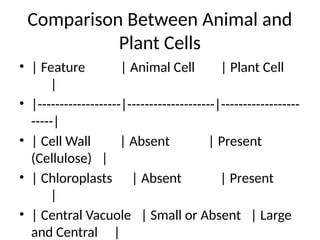
• | Feature | Animal Cell | Plant Cell
|
• |-------------------|--------------------|------------------
-----|
• | Cell Wall | Absent | Present
(Cellulose) |
• | Chloroplasts | Absent | Present
|
• | Central Vacuole | Small or Absent | Large
and Central |
Interactive Questions
• 1. What is the function of mitochondria?
• 2. What is the difference between rough and
smooth ER?
• 3. Which organelle is responsible for
photosynthesis in plant cells?
Conclusion
• - The cell is the fundamental unit of life,
crucial to understanding organism function.
• - Studying cells is essential for advancements
in medicine, agriculture, and science.

Cell_Structure_function Presentation.pptx

  • 1.
  • 2.
    Introduction to theCell • - The cell is the basic unit of life and the building block of all living organisms. • - Types of Cells: • * Prokaryotic cells (e.g., bacteria). • * Eukaryotic cells (e.g., plant and animal cells).
  • 3.
    Components of theAnimal Cell • 1. Plasma Membrane: • - Controls movement of substances in and out of the cell. • - Double layer of phospholipids. • 2. Nucleus: • - Contains DNA and regulates cell activities. • - Components: Nuclear envelope, nucleolus, chromosomes.
  • 4.
    Animal Cell Organelles(Continued) • 4. Mitochondria: • - Produces energy in the form of ATP. • 5. Endoplasmic Reticulum (ER): • - Rough ER: Synthesizes proteins (with ribosomes). • - Smooth ER: Involved in lipid synthesis. • 6. Golgi Apparatus:
  • 5.
    Components of thePlant Cell • 1. Cell Wall: • - Provides structural support and protection (cellulose). • 2. Chloroplasts: • - Site of photosynthesis (contains chlorophyll). • 3. Central Vacuole:
  • 6.
    Comparison Between Animaland Plant Cells • | Feature | Animal Cell | Plant Cell | • |-------------------|--------------------|------------------ -----| • | Cell Wall | Absent | Present (Cellulose) | • | Chloroplasts | Absent | Present | • | Central Vacuole | Small or Absent | Large and Central |
  • 7.
    Interactive Questions • 1.What is the function of mitochondria? • 2. What is the difference between rough and smooth ER? • 3. Which organelle is responsible for photosynthesis in plant cells?
  • 8.
    Conclusion • - Thecell is the fundamental unit of life, crucial to understanding organism function. • - Studying cells is essential for advancements in medicine, agriculture, and science.