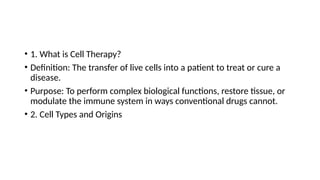
• 1. Whatis Cell Therapy?
• Definition: The transfer of live cells into a patient to treat or cure a
disease.
• Purpose: To perform complex biological functions, restore tissue, or
modulate the immune system in ways conventional drugs cannot.
• 2. Cell Types and Origins
3.
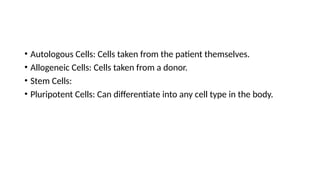
• Autologous Cells:Cells taken from the patient themselves.
• Allogeneic Cells: Cells taken from a donor.
• Stem Cells:
• Pluripotent Cells: Can differentiate into any cell type in the body.
4.
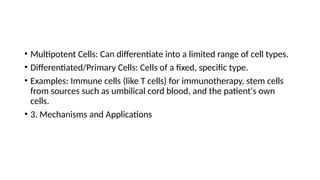
• Multipotent Cells:Can differentiate into a limited range of cell types.
• Differentiated/Primary Cells: Cells of a fixed, specific type.
• Examples: Immune cells (like T cells) for immunotherapy, stem cells
from sources such as umbilical cord blood, and the patient's own
cells.
• 3. Mechanisms and Applications
5.
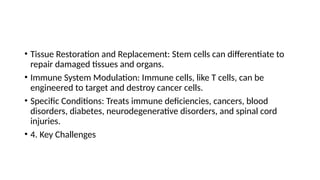
• Tissue Restorationand Replacement: Stem cells can differentiate to
repair damaged tissues and organs.
• Immune System Modulation: Immune cells, like T cells, can be
engineered to target and destroy cancer cells.
• Specific Conditions: Treats immune deficiencies, cancers, blood
disorders, diabetes, neurodegenerative disorders, and spinal cord
injuries.
• 4. Key Challenges
6.
• Manufacturing:
• GMP:Adherence to Good Manufacturing Practices for safety and
consistency.
• Cost of Goods (COGs): High costs due to complex processes and raw
materials.
• Scalability: "Scale-out" (for autologous) vs. "Scale-up" (for allogeneic).
7.
• Safety andRisk:
• Immune Rejection: Donor cells may be rejected by the recipient's
immune system.
• Tumorigenesis: The risk of cells forming tumors.
• Contamination: Ensuring products are free from microbes and
manufacturing residuals.
8.
• Clinical Translation:Bridging the gap from laboratory research to
effective clinical use.
• 5. Advanced Concepts
• Chimeric Antigen Receptor (CAR)-T Cells: Genetically modified T cells
that recognize specific cancer proteins.
• T Cell Receptor (TCR)-T Cells: T cells engineered to recognize
intracellular targets within cancer cells.
9.
• 6. Regulatoryand Ethical Considerations
• Donor Screening: Rigorous screening for transmissible diseases from
donors.
• Risk-Benefit Assessment: Thorough evaluation of risks and benefits
based on reliable scientific data from clinical trials.
• Informed Consent: Communicating residual risks to patients and
physicians.