Cell: The
Basic Unit
of Life
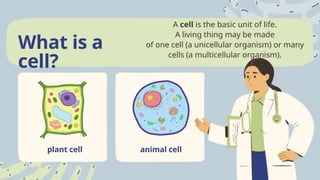
A cell is the basic unit of life.
A living thing may be made
of one cell (a unicellular organism) or many
cells (a multicellular organism).
What is a
cell?
plant cell animal cell
Who coined the term ‘cell’ and
how did he discover it?
Discoverin
g the Cell
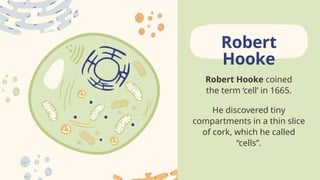
Robert Hooke coined
the term ‘cell’ in 1665.
He discovered tiny
compartments in a thin slice
of cork, which he called
“cells”.
Robert
Hooke
Cell Theory
and
Development
In 1836, Theodor Schwann
and Matthias Schleiden
proposed the idea that the
cell is the unit of structure
and function of all plants
and animals and that cells
form freely similar to how
crystals form.
Schwann summarized his
observations into three
conclusions about cells:
• the cell is the unit of structure,
physiology, and organization
in living things.
• the cell retains a dual
existence as a distinct entity
and a building block in the
construction of organisms.
• Cells form by free-cell
The third statement was
denounced later when Rudolf
Virchow’s experiment made a
powerful statement, “Omnis
cellula e cellula” (All cells only
arise from pre-existing cells)
• Cell is the basic structural as
well as functional unit for all
organisms.
• all organisms are composed
of one or more cells
•
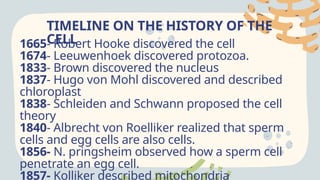
TIMELINE ON THE HISTORY OF THE
CELL
1665- Robert Hooke discovered the cell
1674- Leeuwenhoek discovered protozoa.
1833- Brown discovered the nucleus
1837- Hugo von Mohl discovered and described
chloroplast
1838- Schleiden and Schwann proposed the cell
theory
1840- Albrecht von Roelliker realized that sperm
cells and egg cells are also cells.
1856- N. pringsheim observed how a sperm cell
penetrate an egg cell.
1857- Kolliker described mitochondria
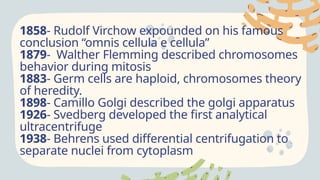
1858- Rudolf Virchow expounded on his famous
conclusion “omnis cellula e cellula”
1879- Walther Flemming described chromosomes
behavior during mitosis
1883- Germ cells are haploid, chromosomes theory
of heredity.
1898- Camillo Golgi described the golgi apparatus
1926- Svedberg developed the first analytical
ultracentrifuge
1938- Behrens used differential centrifugation to
separate nuclei from cytoplasm
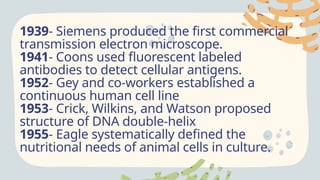
1939- Siemens produced the first commercial
transmission electron microscope.
1941- Coons used fluorescent labeled
antibodies to detect cellular antigens.
1952- Gey and co-workers established a
continuous human cell line
1953- Crick, Wilkins, and Watson proposed
structure of DNA double-helix
1955- Eagle systematically defined the
nutritional needs of animal cells in culture.
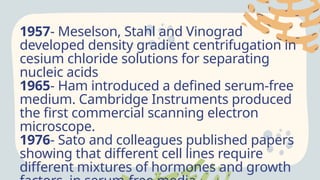
1957- Meselson, Stahl and Vinograd
developed density gradient centrifugation in
cesium chloride solutions for separating
nucleic acids
1965- Ham introduced a defined serum-free
medium. Cambridge Instruments produced
the first commercial scanning electron
microscope.
1976- Sato and colleagues published papers
showing that different cell lines require
different mixtures of hormones and growth
1981- transgenic mice and fruit flies are
produced. Mouse embryonic stem cell
line established.
1987- Creation of first knockout mouse
which contains an artificially introduced
mutation in their cells.
1998- Mice are cloned from somatic
cells.
2000- Human genome DNA sequence
draft.
CELL TYPES AND ORGANELLES
PROKARYOTIC CELLS
• small cells from bacteria and Archaea domains.
They do not contain membrane-bound nucleus or
other membrane-bound organelles.
EUKARYOTIC CELLS
• are complex cells in which a membrane-bound
nucleus and membrane bound organelles are
present. Examples of these cells are of Protista
(Amoeba and Paramecium), Plantae (Gymnosperm
pines, angiosperm flowering pants, mosses, and
ferns), Animalia (humans), and Fungi (yeast)

Cell The Basic Unit of Life.........pptx

  • 1.
  • 2.
    A cell isthe basic unit of life. A living thing may be made of one cell (a unicellular organism) or many cells (a multicellular organism). What is a cell? plant cell animal cell
  • 3.
    Who coined theterm ‘cell’ and how did he discover it? Discoverin g the Cell
  • 4.
    Robert Hooke coined theterm ‘cell’ in 1665. He discovered tiny compartments in a thin slice of cork, which he called “cells”. Robert Hooke
  • 5.
  • 6.
    In 1836, TheodorSchwann and Matthias Schleiden proposed the idea that the cell is the unit of structure and function of all plants and animals and that cells form freely similar to how crystals form.
  • 7.
    Schwann summarized his observationsinto three conclusions about cells: • the cell is the unit of structure, physiology, and organization in living things. • the cell retains a dual existence as a distinct entity and a building block in the construction of organisms. • Cells form by free-cell
  • 8.
    The third statementwas denounced later when Rudolf Virchow’s experiment made a powerful statement, “Omnis cellula e cellula” (All cells only arise from pre-existing cells) • Cell is the basic structural as well as functional unit for all organisms. • all organisms are composed of one or more cells •
  • 9.
    TIMELINE ON THEHISTORY OF THE CELL 1665- Robert Hooke discovered the cell 1674- Leeuwenhoek discovered protozoa. 1833- Brown discovered the nucleus 1837- Hugo von Mohl discovered and described chloroplast 1838- Schleiden and Schwann proposed the cell theory 1840- Albrecht von Roelliker realized that sperm cells and egg cells are also cells. 1856- N. pringsheim observed how a sperm cell penetrate an egg cell. 1857- Kolliker described mitochondria
  • 10.
    1858- Rudolf Virchowexpounded on his famous conclusion “omnis cellula e cellula” 1879- Walther Flemming described chromosomes behavior during mitosis 1883- Germ cells are haploid, chromosomes theory of heredity. 1898- Camillo Golgi described the golgi apparatus 1926- Svedberg developed the first analytical ultracentrifuge 1938- Behrens used differential centrifugation to separate nuclei from cytoplasm
  • 11.
    1939- Siemens producedthe first commercial transmission electron microscope. 1941- Coons used fluorescent labeled antibodies to detect cellular antigens. 1952- Gey and co-workers established a continuous human cell line 1953- Crick, Wilkins, and Watson proposed structure of DNA double-helix 1955- Eagle systematically defined the nutritional needs of animal cells in culture.
  • 12.
    1957- Meselson, Stahland Vinograd developed density gradient centrifugation in cesium chloride solutions for separating nucleic acids 1965- Ham introduced a defined serum-free medium. Cambridge Instruments produced the first commercial scanning electron microscope. 1976- Sato and colleagues published papers showing that different cell lines require different mixtures of hormones and growth
  • 13.
    1981- transgenic miceand fruit flies are produced. Mouse embryonic stem cell line established. 1987- Creation of first knockout mouse which contains an artificially introduced mutation in their cells. 1998- Mice are cloned from somatic cells. 2000- Human genome DNA sequence draft.
  • 14.
    CELL TYPES ANDORGANELLES PROKARYOTIC CELLS • small cells from bacteria and Archaea domains. They do not contain membrane-bound nucleus or other membrane-bound organelles. EUKARYOTIC CELLS • are complex cells in which a membrane-bound nucleus and membrane bound organelles are present. Examples of these cells are of Protista (Amoeba and Paramecium), Plantae (Gymnosperm pines, angiosperm flowering pants, mosses, and ferns), Animalia (humans), and Fungi (yeast)