Cell and its function
What is cell??
• Cell is the basic structural and
functional unit of organism.
•The organelles within cell are the
structure required for biological
processes, which include making protein
and extacting and utilizing usable energy
from food.
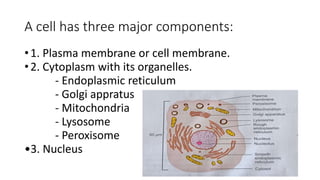
A cell has three major components:
•1. Plasma membrane or cell membrane.
•2. Cytoplasm with its organelles.
- Endoplasmic reticulum
- Golgi appratus
- Mitochondria
- Lysosome
- Peroxisome
•3. Nucleus
Plasma membrane
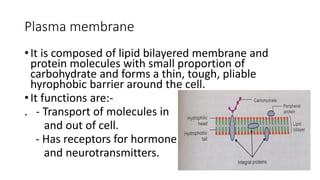
•It is composed of lipid bilayered membrane and
protein molecules with small proportion of
carbohydrate and forms a thin, tough, pliable
hyrophobic barrier around the cell.
•It functions are:-
. - Transport of molecules in
and out of cell.
- Has receptors for hormone
and neurotransmitters.
Cytoplasm and its organelles
•Cytoplasm is the internal volume bounded by
the plasma membrane.
•The clear fluid portion of the Cytoplasm in which
organelles are suspended is called Cytosol, which
contain dissolved proteins, electrolytes and
glucose.
• Five important organelles that are suspended in
the cytosol are:-
1. Endoplasmic reticulum
•The Endoplasmic reticulum is the interconnected,
folded network of tubular strucutres in the
cytoplasm.
• Functions:-
- Rough Endoplasmic reticulum is the site for
synthesis of proteins.
- Smooth endopasmic reticulum is involved in Lipid
synthesis, biosynthesis of steroid hormones and
removal of toxic substances.
2. Golgi Appratus
•It is a flat, membranous sac in which proteins are
processed, modified and prepared for export from
cell.
• Functions:-
- Protein which are synthesized in the endoplasmic
reticulum passed throught layers of the Golgi
appratus where enzymes in Golgi membranes catalyze
transfer of carbohydrates units to Protein to form
glycoprotein or to lipids to make glycolipids.
3.Mitochondria:-
•Mitochondria are organelle that supply energy for all
cellular metabolic activities, that's why known as
power plant of cell
• Muscle of the heart contains large number of
mitochondria.
•Erythrocytes are an exception which derive their ATP
from glycolysis due to lack of mitochondria.
•Its matrix is the site of most of the reactions of the
citric acid cycle and fatty acid oxidation. In contrast
Oxidative phosphorylation takes place in inner
mitochondrial membrane
4.lysosomes
•Lysosomes are organelles formed from Golgi
appratus.
• It is membrane bounded sacs containing as
many as forty different hydrolytic enzyme
include proteases, nucleases, glycosidases,
lipases, phosphates and sulfatases.
•All these enzymes works at acidic pH, so pH of
its matrix is about 5.
Function of Lysosome:-
•During development of foetus, lysosomes digest
the webbed tissues that join fingers and toes in
embryo.
•Involved in digestion of intra and extracellular
substances that must be removed.
5.Peroxisome:-
•They are membranous sacs containing enzyme. The
enzyme content of cellular Peroxisome varies
according to the need of the tissues.
• Functions:-
. - Contain enzymes used for detoxification.
- Also participates in degradation of very long chain
fatty acids and synthesis of glycerolipids,
plasmalogens and isoprenoid.
Nucleus:-
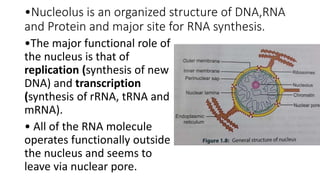
•Nucleus is the control center of the cell; it contain
the DNA organized into chromosomes which carry
genetic information.
•Surrounded by double membrane called nuclear
envelope, containing nuclear pores.
•Nuclear pores facilitate transport of molecules
between the Cytoplasm and nucleus.
• The space enclosed by Nuclear envelope is called
nucleoplasm, in which nucleolus is present.
•Nucleolus is an organized structure of DNA,RNA
and Protein and major site for RNA synthesis.
•The major functional role of
the nucleus is that of
replication (synthesis of new
DNA) and transcription
(synthesis of rRNA, tRNA and
mRNA).
• All of the RNA molecule
operates functionally outside
the nucleus and seems to
leave via nuclear pore.
Thank you

Cell and its function showing various organelles

  • 1.
    Cell and itsfunction What is cell?? • Cell is the basic structural and functional unit of organism. •The organelles within cell are the structure required for biological processes, which include making protein and extacting and utilizing usable energy from food.
  • 2.
    A cell hasthree major components: •1. Plasma membrane or cell membrane. •2. Cytoplasm with its organelles. - Endoplasmic reticulum - Golgi appratus - Mitochondria - Lysosome - Peroxisome •3. Nucleus
  • 3.
    Plasma membrane •It iscomposed of lipid bilayered membrane and protein molecules with small proportion of carbohydrate and forms a thin, tough, pliable hyrophobic barrier around the cell. •It functions are:- . - Transport of molecules in and out of cell. - Has receptors for hormone and neurotransmitters.
  • 4.
    Cytoplasm and itsorganelles •Cytoplasm is the internal volume bounded by the plasma membrane. •The clear fluid portion of the Cytoplasm in which organelles are suspended is called Cytosol, which contain dissolved proteins, electrolytes and glucose. • Five important organelles that are suspended in the cytosol are:-
  • 5.
    1. Endoplasmic reticulum •TheEndoplasmic reticulum is the interconnected, folded network of tubular strucutres in the cytoplasm. • Functions:- - Rough Endoplasmic reticulum is the site for synthesis of proteins. - Smooth endopasmic reticulum is involved in Lipid synthesis, biosynthesis of steroid hormones and removal of toxic substances.
  • 6.
    2. Golgi Appratus •Itis a flat, membranous sac in which proteins are processed, modified and prepared for export from cell. • Functions:- - Protein which are synthesized in the endoplasmic reticulum passed throught layers of the Golgi appratus where enzymes in Golgi membranes catalyze transfer of carbohydrates units to Protein to form glycoprotein or to lipids to make glycolipids.
  • 7.
    3.Mitochondria:- •Mitochondria are organellethat supply energy for all cellular metabolic activities, that's why known as power plant of cell • Muscle of the heart contains large number of mitochondria. •Erythrocytes are an exception which derive their ATP from glycolysis due to lack of mitochondria. •Its matrix is the site of most of the reactions of the citric acid cycle and fatty acid oxidation. In contrast Oxidative phosphorylation takes place in inner mitochondrial membrane
  • 8.
    4.lysosomes •Lysosomes are organellesformed from Golgi appratus. • It is membrane bounded sacs containing as many as forty different hydrolytic enzyme include proteases, nucleases, glycosidases, lipases, phosphates and sulfatases. •All these enzymes works at acidic pH, so pH of its matrix is about 5.
  • 9.
    Function of Lysosome:- •Duringdevelopment of foetus, lysosomes digest the webbed tissues that join fingers and toes in embryo. •Involved in digestion of intra and extracellular substances that must be removed.
  • 10.
    5.Peroxisome:- •They are membranoussacs containing enzyme. The enzyme content of cellular Peroxisome varies according to the need of the tissues. • Functions:- . - Contain enzymes used for detoxification. - Also participates in degradation of very long chain fatty acids and synthesis of glycerolipids, plasmalogens and isoprenoid.
  • 11.
    Nucleus:- •Nucleus is thecontrol center of the cell; it contain the DNA organized into chromosomes which carry genetic information. •Surrounded by double membrane called nuclear envelope, containing nuclear pores. •Nuclear pores facilitate transport of molecules between the Cytoplasm and nucleus. • The space enclosed by Nuclear envelope is called nucleoplasm, in which nucleolus is present.
  • 12.
    •Nucleolus is anorganized structure of DNA,RNA and Protein and major site for RNA synthesis. •The major functional role of the nucleus is that of replication (synthesis of new DNA) and transcription (synthesis of rRNA, tRNA and mRNA). • All of the RNA molecule operates functionally outside the nucleus and seems to leave via nuclear pore.
  • 13.