CE-HTML structure &
several CE real case &
virtual keyboard event


 Chen Jing Fung (Grace @ III)
        May 3th, 2011
CEA -2014 & CE-HTML
CEA-2014 – Much more than an HTML browser & Web Server
   Version History:
       Version A: Hitachi home electronics (~2007/7/5)
       Version B: Philips Intellectual Property & standards (~2010/12/21)
   CE-HTML: XML UI Listing on some electric appliances
       Such as their capability profile exchange
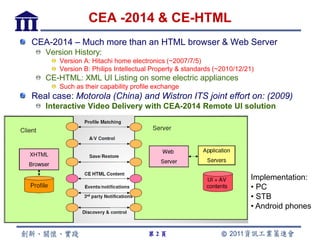
Real case: Motorola (China) and Wistron ITS joint effort on: (2009)
   Interactive Video Delivery with CEA-2014 Remote UI solution


                                                                        Implementation:
                                                                        • PC
                                                                        • STB
                                                                        • Android phones


                                     第2頁
Motorola: Interactive Video Delivery
                      - Problems and Solution

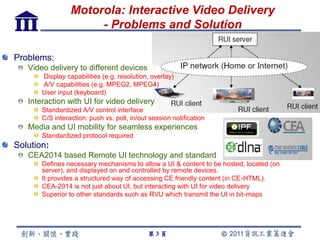
Problems:
   Video delivery to different devices
       Display capabilities (e.g. resolution, overlay)
       A/V capabilities (e.g. MPEG2, MPEG4)
       User input (keyboard)
   Interaction with UI for video delivery
       Standardized A/V control interface
       C/S interaction: push vs. poll, in/out session notification
   Media and UI mobility for seamless experiences
       Standardized protocol required
Solution:
   CEA2014 based Remote UI technology and standard
       Defines necessary mechanisms to allow a UI & content to be hosted, located (on
       server), and displayed on and controlled by remote devices.
       It provides a structured way of accessing CE friendly content (in CE-HTML).
       CEA-2014 is not just about UI, but interacting with UI for video delivery
       Superior to other standards such as RVU which transmit the UI in bit-maps


                                             第3頁
Multi-device connection structure
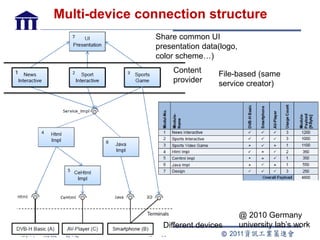
               Share common UI
               presentation data(logo,
               color scheme…)
                    Content     File-based (same
                    provider    service creator)


                                         @ 2010 Germany
                 Different devices       university lab’s work
              第4頁
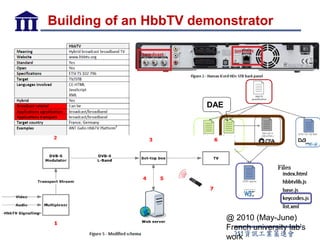
Building of an HbbTV demonstrator


                       DAE


                             @ 2010 (May-June)
                             French university lab’s
              第5頁
                             work
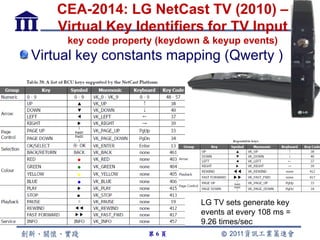
CEA-2014: LG NetCast TV (2010) –
    Virtual Key Identifiers for TV Input
     key code property (keydown & keyup events)
Virtual key constants mapping (Qwerty )


                               LG TV sets generate key
                               events at every 108 ms =
                               9.26 times/sec
                     第6頁
CEA 2014 communcation
  The CEA 2014 framework lets a user interface be
  remotely displayed on--and controlled by--devices or
  control points other than the hosting device. The most
  well-known UI update technique, XMLHttpRequest, is
  difficult to adopt in an audiovisual home-network
  domain, according to Samsung.
  Samsung researchers apply a plug-in object,
  NotifSocket, for dynamic Web UI updates using a
  persistent TCP connection to support burst event
  notifications. NotifSocket can share event notifications
  whenever a UI server needs to inform the UI client of a
  change of state or event.
  CEA 2014 now stipulates that XMLHttpRequest be
  defined for simple UI updates over the Internet, while
  NotifSocket is mandated to transfer burst UI updates.
http://www.eetimes.com/electronics-news/4068490/Home-net-papers-key-
on-delivery-biometrics-item-1
                                第7頁
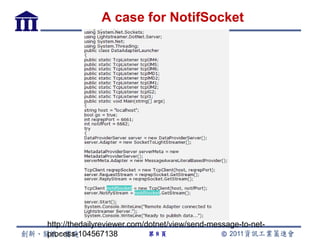
A case for NotifSocket


http://thedailyreviewer.com/dotnet/view/send-message-to-net-
process-104567138            第8頁
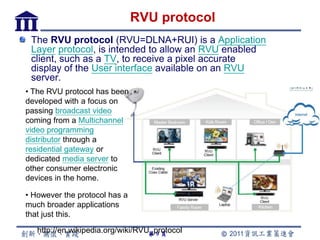
RVU protocol
 The RVU protocol (RVU=DLNA+RUI) is a Application
 Layer protocol, is intended to allow an RVU enabled
 client, such as a TV, to receive a pixel accurate
 display of the User interface available on an RVU
 server.
• The RVU protocol has been
developed with a focus on
passing broadcast video
coming from a Multichannel
video programming
distributor through a
residential gateway or
dedicated media server to
other consumer electronic
devices in the home.

• However the protocol has a
much broader applications
that just this.
   http://en.wikipedia.org/wiki/RVU_protocol
                                   第9頁
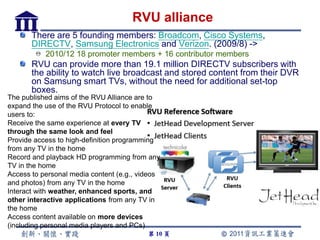
RVU alliance
       There are 5 founding members: Broadcom, Cisco Systems,
       DIRECTV, Samsung Electronics and Verizon. (2009/8) ->
           2010/12 18 promoter members + 16 contributor members
       RVU can provide more than 19.1 million DIRECTV subscribers with
       the ability to watch live broadcast and stored content from their DVR
       on Samsung smart TVs, without the need for additional set-top
       boxes.
The published aims of the RVU Alliance are to
expand the use of the RVU Protocol to enable
users to:
Receive the same experience at every TV
through the same look and feel
Provide access to high-definition programming
from any TV in the home
Record and playback HD programming from any
TV in the home
Access to personal media content (e.g., videos
and photos) from any TV in the home
Interact with weather, enhanced sports, and
other interactive applications from any TV in
the home
Access content available on more devices
(including personal media players and PCs)
                                          第 10 頁

CE html structure - vkevent

  • 1.
    CE-HTML structure & severalCE real case & virtual keyboard event Chen Jing Fung (Grace @ III) May 3th, 2011
  • 2.
    CEA -2014 &CE-HTML CEA-2014 – Much more than an HTML browser & Web Server Version History: Version A: Hitachi home electronics (~2007/7/5) Version B: Philips Intellectual Property & standards (~2010/12/21) CE-HTML: XML UI Listing on some electric appliances Such as their capability profile exchange Real case: Motorola (China) and Wistron ITS joint effort on: (2009) Interactive Video Delivery with CEA-2014 Remote UI solution Implementation: • PC • STB • Android phones 第2頁
  • 3.
    Motorola: Interactive VideoDelivery - Problems and Solution Problems: Video delivery to different devices Display capabilities (e.g. resolution, overlay) A/V capabilities (e.g. MPEG2, MPEG4) User input (keyboard) Interaction with UI for video delivery Standardized A/V control interface C/S interaction: push vs. poll, in/out session notification Media and UI mobility for seamless experiences Standardized protocol required Solution: CEA2014 based Remote UI technology and standard Defines necessary mechanisms to allow a UI & content to be hosted, located (on server), and displayed on and controlled by remote devices. It provides a structured way of accessing CE friendly content (in CE-HTML). CEA-2014 is not just about UI, but interacting with UI for video delivery Superior to other standards such as RVU which transmit the UI in bit-maps 第3頁
  • 4.
    Multi-device connection structure Share common UI presentation data(logo, color scheme…) Content File-based (same provider service creator) @ 2010 Germany Different devices university lab’s work 第4頁
  • 5.
    Building of anHbbTV demonstrator DAE @ 2010 (May-June) French university lab’s 第5頁 work
  • 6.
    CEA-2014: LG NetCastTV (2010) – Virtual Key Identifiers for TV Input key code property (keydown & keyup events) Virtual key constants mapping (Qwerty ) LG TV sets generate key events at every 108 ms = 9.26 times/sec 第6頁
  • 7.
    CEA 2014 communcation The CEA 2014 framework lets a user interface be remotely displayed on--and controlled by--devices or control points other than the hosting device. The most well-known UI update technique, XMLHttpRequest, is difficult to adopt in an audiovisual home-network domain, according to Samsung. Samsung researchers apply a plug-in object, NotifSocket, for dynamic Web UI updates using a persistent TCP connection to support burst event notifications. NotifSocket can share event notifications whenever a UI server needs to inform the UI client of a change of state or event. CEA 2014 now stipulates that XMLHttpRequest be defined for simple UI updates over the Internet, while NotifSocket is mandated to transfer burst UI updates. http://www.eetimes.com/electronics-news/4068490/Home-net-papers-key- on-delivery-biometrics-item-1 第7頁
  • 8.
    A case forNotifSocket http://thedailyreviewer.com/dotnet/view/send-message-to-net- process-104567138 第8頁
  • 9.
    RVU protocol TheRVU protocol (RVU=DLNA+RUI) is a Application Layer protocol, is intended to allow an RVU enabled client, such as a TV, to receive a pixel accurate display of the User interface available on an RVU server. • The RVU protocol has been developed with a focus on passing broadcast video coming from a Multichannel video programming distributor through a residential gateway or dedicated media server to other consumer electronic devices in the home. • However the protocol has a much broader applications that just this. http://en.wikipedia.org/wiki/RVU_protocol 第9頁
  • 10.
    RVU alliance There are 5 founding members: Broadcom, Cisco Systems, DIRECTV, Samsung Electronics and Verizon. (2009/8) -> 2010/12 18 promoter members + 16 contributor members RVU can provide more than 19.1 million DIRECTV subscribers with the ability to watch live broadcast and stored content from their DVR on Samsung smart TVs, without the need for additional set-top boxes. The published aims of the RVU Alliance are to expand the use of the RVU Protocol to enable users to: Receive the same experience at every TV through the same look and feel Provide access to high-definition programming from any TV in the home Record and playback HD programming from any TV in the home Access to personal media content (e.g., videos and photos) from any TV in the home Interact with weather, enhanced sports, and other interactive applications from any TV in the home Access content available on more devices (including personal media players and PCs) 第 10 頁