System x® and BladeCenter®


     Key uses for SSDs in servers today
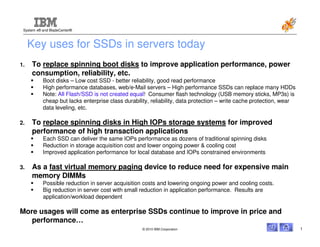
1.   To replace spinning boot disks to improve application performance, power
     consumption, reliability, etc.
           Boot disks – Low cost SSD - better reliability, good read performance
           High performance databases, web/e-Mail servers – High performance SSDs can replace many HDDs
           Note: All Flash/SSD is not created equal! Consumer flash technology (USB memory sticks, MP3s) is
           cheap but lacks enterprise class durability, reliability, data protection – write cache protection, wear
           data leveling, etc.

2.   To replace spinning disks in High IOPs storage systems for improved
     performance of high transaction applications
           Each SSD can deliver the same IOPs performance as dozens of traditional spinning disks
           Reduction in storage acquisition cost and lower ongoing power & cooling cost
           Improved application performance for local database and IOPs constrained environments

3.   As a fast virtual memory paging device to reduce need for expensive main
     memory DIMMs
           Possible reduction in server acquisition costs and lowering ongoing power and cooling costs.
           Big reduction in server cost with small reduction in application performance. Results are
           application/workload dependent

More usages will come as enterprise SSDs continue to improve in price and
   performance…
                                                   © 2010 IBM Corporation                                             1
IBM Modular and Blade Systems

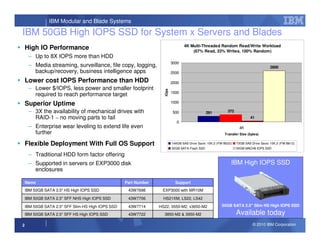
IBM 50GB High IOPS SSD for System x Servers and Blades
                                                                                 4K Multi-Threaded Random Read/Write Workload
    High IO Performance                                                              (67% Read, 33% Writes, 100% Random)
     – Up to 8X IOPS more than HDD
                                                                          3000
     – Media streaming, surveillance, file copy, logging,                                                                             2600
       backup/recovery, business intelligence apps                        2500

    Lower cost IOPS Performance than HDD                                  2000
     – Lower $/IOPS, less power and smaller footprint


                                                                   IOps
                                                                          1500
       required to reach performance target
                                                                          1000
    Superior Uptime
     – 3X the availability of mechanical drives with                      500                   291         372
       RAID-1 – no moving parts to fail                                                                                   41
                                                                             0
     – Enterprise wear leveling to extend life even                                                                4K
       further                                                                                            Transfer Size (bytes)

    Flexible Deployment With Full OS Support                              146GB SAS Drive Savio 10K.2 (FW B522)   73GB SAS Drive Savio 15K.2 (FW B612)
                                                                          32GB SATA Flash SSD                     50GB MACH8 IOPS SSD

     – Traditional HDD form factor offering
     – Supported in servers or EXP3000 disk                                                                   IBM High IOPS SSD
       enclosures

    Name                                           Part Number              Support
    IBM 50GB SATA 3.5" HS High IOPS SSD             43W7698       EXP3000 with MR10M

    IBM 50GB SATA 2.5" SFF NHS High IOPS SSD        43W7706        HS21XM, LS22, LS42

    IBM 50GB SATA 2.5" SFF Slim-HS High IOPS SSD    43W7714      HS22, 3550-M2, x3650-M2                50GB SATA 2.5" Slim HS High IOPS SSD

    IBM 50GB SATA 2.5" SFF HS High IOPS SSD         43W7722        3850-M2 & 3950-M2                              Available today
2                                                                                                                           © 2010 IBM Corporation
IBM Modular and Blade Systems


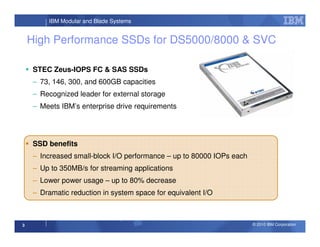
    High Performance SSDs for DS5000/8000 & SVC

     STEC Zeus-IOPS FC & SAS SSDs
     – 73, 146, 300, and 600GB capacities
     – Recognized leader for external storage
     – Meets IBM’s enterprise drive requirements


     SSD benefits
     – Increased small-block I/O performance – up to 80000 IOPs each
     – Up to 350MB/s for streaming applications
     – Lower power usage – up to 80% decrease
     – Dramatic reduction in system space for equivalent I/O


3                                                                      © 2010 IBM Corporation
System x® and BladeCenter®


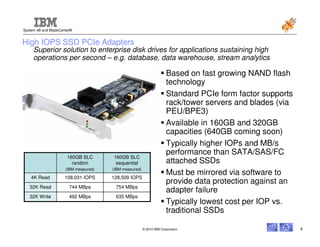
High IOPS SSD PCIe Adapters
     Superior solution to enterprise disk drives for applications sustaining high
     operations per second – e.g. database, data warehouse, stream analytics

                                                                      Based on fast growing NAND flash
                                                                      technology
                                                                      Standard PCIe form factor supports
                                                                      rack/tower servers and blades (via
                                                                      PEU/BPE3)
                                                                      Available in 160GB and 320GB
                                                                      capacities (640GB coming soon)
                                                                      Typically higher IOPs and MB/s
                                                                      performance than SATA/SAS/FC
                       160GB SLC       160GB SLC
                         random         sequential                    attached SSDs
                      (IBM measured)   (IBM measured)
                                                                      Must be mirrored via software to
    4K Read           108,031 IOPS     128,509 IOPS
                                                                      provide data protection against an
   32K Read             744 MBps        754 MBps
                                                                      adapter failure
   32K Write            492 MBps        635 MBps
                                                                      Typically lowest cost per IOP vs.
                                                                      traditional SSDs

                                                        © 2010 IBM Corporation                             4
System x® and BladeCenter®


Comparing SSD form factor – disk drive vs. PCI-E
Disk drive:                                           PCIe adapter:
   Low cost SSDs are good for boot -                     Adapter looks like a single disk to
   can exceed HDD performance on                         the OS and application.
   reads, though slow on writes
                                                                Can provide higher IOPs than
   High performance SSDs are 100-                               SSD due to higher bandwidth of
   1000x faster in random workloads                             PCIe vs. SAS, SATA, and FC
   than HDDs, but cost 10-100x more
   per GB                                                       Mirror 2 adapters using software
                                                                for fault tolerance - can be costly
   Can be used like HDDs in RAID
   arrays for fault tolerance and/or data                       Direct sharing of the adapter/data
   sharing                                                      by >1 server typically not
                                                                possible.
   RAID adapters/controllers can limit
   performance when many SSDs are
   used per adapter

                                       © 2010 IBM Corporation                                         5

IBM Solid State in eX5 servers

  • 1.
    System x® andBladeCenter® Key uses for SSDs in servers today 1. To replace spinning boot disks to improve application performance, power consumption, reliability, etc. Boot disks – Low cost SSD - better reliability, good read performance High performance databases, web/e-Mail servers – High performance SSDs can replace many HDDs Note: All Flash/SSD is not created equal! Consumer flash technology (USB memory sticks, MP3s) is cheap but lacks enterprise class durability, reliability, data protection – write cache protection, wear data leveling, etc. 2. To replace spinning disks in High IOPs storage systems for improved performance of high transaction applications Each SSD can deliver the same IOPs performance as dozens of traditional spinning disks Reduction in storage acquisition cost and lower ongoing power & cooling cost Improved application performance for local database and IOPs constrained environments 3. As a fast virtual memory paging device to reduce need for expensive main memory DIMMs Possible reduction in server acquisition costs and lowering ongoing power and cooling costs. Big reduction in server cost with small reduction in application performance. Results are application/workload dependent More usages will come as enterprise SSDs continue to improve in price and performance… © 2010 IBM Corporation 1
  • 2.
    IBM Modular andBlade Systems IBM 50GB High IOPS SSD for System x Servers and Blades 4K Multi-Threaded Random Read/Write Workload High IO Performance (67% Read, 33% Writes, 100% Random) – Up to 8X IOPS more than HDD 3000 – Media streaming, surveillance, file copy, logging, 2600 backup/recovery, business intelligence apps 2500 Lower cost IOPS Performance than HDD 2000 – Lower $/IOPS, less power and smaller footprint IOps 1500 required to reach performance target 1000 Superior Uptime – 3X the availability of mechanical drives with 500 291 372 RAID-1 – no moving parts to fail 41 0 – Enterprise wear leveling to extend life even 4K further Transfer Size (bytes) Flexible Deployment With Full OS Support 146GB SAS Drive Savio 10K.2 (FW B522) 73GB SAS Drive Savio 15K.2 (FW B612) 32GB SATA Flash SSD 50GB MACH8 IOPS SSD – Traditional HDD form factor offering – Supported in servers or EXP3000 disk IBM High IOPS SSD enclosures Name Part Number Support IBM 50GB SATA 3.5" HS High IOPS SSD 43W7698 EXP3000 with MR10M IBM 50GB SATA 2.5" SFF NHS High IOPS SSD 43W7706 HS21XM, LS22, LS42 IBM 50GB SATA 2.5" SFF Slim-HS High IOPS SSD 43W7714 HS22, 3550-M2, x3650-M2 50GB SATA 2.5" Slim HS High IOPS SSD IBM 50GB SATA 2.5" SFF HS High IOPS SSD 43W7722 3850-M2 & 3950-M2 Available today 2 © 2010 IBM Corporation
  • 3.
    IBM Modular andBlade Systems High Performance SSDs for DS5000/8000 & SVC STEC Zeus-IOPS FC & SAS SSDs – 73, 146, 300, and 600GB capacities – Recognized leader for external storage – Meets IBM’s enterprise drive requirements SSD benefits – Increased small-block I/O performance – up to 80000 IOPs each – Up to 350MB/s for streaming applications – Lower power usage – up to 80% decrease – Dramatic reduction in system space for equivalent I/O 3 © 2010 IBM Corporation
  • 4.
    System x® andBladeCenter® High IOPS SSD PCIe Adapters Superior solution to enterprise disk drives for applications sustaining high operations per second – e.g. database, data warehouse, stream analytics Based on fast growing NAND flash technology Standard PCIe form factor supports rack/tower servers and blades (via PEU/BPE3) Available in 160GB and 320GB capacities (640GB coming soon) Typically higher IOPs and MB/s performance than SATA/SAS/FC 160GB SLC 160GB SLC random sequential attached SSDs (IBM measured) (IBM measured) Must be mirrored via software to 4K Read 108,031 IOPS 128,509 IOPS provide data protection against an 32K Read 744 MBps 754 MBps adapter failure 32K Write 492 MBps 635 MBps Typically lowest cost per IOP vs. traditional SSDs © 2010 IBM Corporation 4
  • 5.
    System x® andBladeCenter® Comparing SSD form factor – disk drive vs. PCI-E Disk drive: PCIe adapter: Low cost SSDs are good for boot - Adapter looks like a single disk to can exceed HDD performance on the OS and application. reads, though slow on writes Can provide higher IOPs than High performance SSDs are 100- SSD due to higher bandwidth of 1000x faster in random workloads PCIe vs. SAS, SATA, and FC than HDDs, but cost 10-100x more per GB Mirror 2 adapters using software for fault tolerance - can be costly Can be used like HDDs in RAID arrays for fault tolerance and/or data Direct sharing of the adapter/data sharing by >1 server typically not possible. RAID adapters/controllers can limit performance when many SSDs are used per adapter © 2010 IBM Corporation 5