FUNDAMENTALS OF
CRIMINAL INVESTIGATION
CDI 1
Angel Queenie Z. Clerigo, RCrim
CRIMINAL INVESTIGATION-It is an art
which deals with the identity and location of
the criminal offender and the gathering and
providing evidence of guilt in a criminal
proceeding.
CRIMINAL INVESTIGATOR-is a person
who is charged with the duty of conducting
criminal investigation when a crime is
committed.
CRIMINAL INVESTIGATION
Is the art of using various techniques to identify and
locate perpetrator and then prove their guilt thru
criminal proceeding.
EXAMPLE OF VARIOUS TECHNIQUES
1. Emotional appeal - place the subject in the proper
frame of mind. The investigator should provide
emotional stimuli that will prompt the subject to
unburden himself by confiding.
Analyze the subject's personality and decide what
motivation would prompt him to tell the truth, and
then provide those motives through appropriate
emotional appeals.
CRIMINAL INVESTIGATION
Is the art of using various techniques to identify and locate
perpetrator and then prove their guilt thru criminal
proceeding.
EXAMPLE OF VARIOUS TECHNIQUES
2. Sympathetic Approach - the suspect may feel the
need for sympathy or friendship. He is apparently
in trouble. Gestures of friendship may win his
cooperation
3. Kindness - The simplest technique is to assume
that the suspect will confess if he is treated in a
kind and friendly manner.
CRIMINAL INVESTIGATION
Is the art of using various techniques to identify and locate
perpetrator and then prove their guilt thru criminal
proceeding.
EXAMPLE OF VARIOUS TECHNIQUES
4. Extenuation - the investigator indicates he does not
consider his subject's indiscretion a grave offense.
5. Shifting the Blame - the interrogator makes clear his belief
that the subject is obviously not the sort of person usually
gets mixed up in a crime like this. The interrogator could tell
from the start that he was not dealing with a fellow who is a
criminal by nature and choice. The trouble with the subject
lies in little weakness-perhaps he likes liquor, or he is
excessively fond of girls.
CRIMINAL INVESTIGATION
Is the art of using various techniques to identify and locate
perpetrator and then prove their guilt thru criminal
proceeding.
EXAMPLE OF VARIOUS TECHNIQUES
6. Mutt & Jeff (in police parlance sweet and sour) - two (2)
agents are employed, Mutt, the relentless investigator,
who is going to waste any time because he knows the
subject, is guilty. Jeff, on the other hand, is obviously a
kindhearted man.
A.PHASES OF CRIMINAL INVESTIGATION
1. The criminal is identified;
2. The criminal is traced and located;
3. The facts proving the guilt of the accused ----- are gathered
for court presentation.
(NOTE: it is necessary that at all time, these three phases
must exist. If you separate one, the other two will not
suffice, thus, it will defeat the intent and purpose of the
conduct of investigation.)
TOOLS OR THREE (3) I’s OF CRIMINAL
INVESTIGATION
INFORMATION- This refers to the knowledge or facts which the
investigator had gathered or acquired from persons or documents
which are pertinent or relevant to the commission or criminal
activities.
This is the most important of all the tools because it answers the question,
who did it?
INFORMATION CLASSIFIED AS TO SOURCES:
• Regular sources- records, files from government or non-
government agencies and news items, intercepted radio or
telephone messages and stored computer data.
• Cultivated sources- information furnished by informants or
informers.
• Grapevines sources- information coming from the underworld
characters such as prisoners or ex-convicts.
INFORMANTS- is any person who furnishes the police an
information relevant to the crime under investigation or
about the activities of the criminals or syndicates.
Informant may openly give the information or offer
himself to be a witness.
• CONFIDENTIAL INFORMANT- a person who provides the
police with confidential information concerning a past
crime or a projected & planned crime. The informant
does not want to be identified as the source of
information. Under the law, these types of informants
are protected & their identity could not be revealed by
the police even under the order of the Court unless an
exceptional case where there is a claim of the defense
that the informant framed-up the accused.
TYPES OF INFORMANTS :
• Anonymous Informant- a phone caller, letter writer or a
text sender. Never tell the informant that the investigator
already knows the information. The duty is to receive the
information & not to reveal to the caller any other
information or facts about the case.
• Rival-Elimination Informant- maintains identity being
anonymous. His purpose is to eliminate rival person or
gang due to competition or other motives such as revenge
& etc..
• False Informant- Usually reveals information of no
consequence, value or stuff connected with thin air. His
purpose is to appear to be on the side of the law & for
throwing out suspicion from himself or from his gang or
associates.
TYPES OF INFORMANTS :
• Frightened Informant- possesses fear or has self interest in
giving information to the police. He is motivated by anxiety &
self preservation of his well being & will furnish information
to protect himself or sustain self importance. This type is the
weakest link in the composition of criminal chain.
• Self-aggrandizing Informant- moves around the centers of
criminals, group or syndicate & delights in surprising the
police about bits of information. His information maybe of
value by way of authentication in the intelligence operation.
• Mercenary Informant- The informant has information for
sale. He may have been victimized in a double-cross or little
share in the loot or given a dirty deal & seeks revenge as well
as profit in his disclosure.
TYPES OF INFORMANTS :
• Double-crosser Informant- he uses his seeming desire to
divulge information as an excuse to talk to the police in order to
get more information from them than he gives. To counter this
kind of informant, the police apply deception method by giving
him false information that will lead to his capture.
• Women Informant- a female associate of the criminals, who was
roughed up, marginalized in the deal or being eased out from the
group. care must be given to this kind of informant because
women, given the skills & expertise are more dangerous than
men. They often give free romance that will result in blackmailing
the investigator or will result to an extended family for support.
• Legitimate Informant- desire to give an information that springs
from legitimate reasons. They may be a legitimate business
operator who abhor the presence of criminals in their trade &
parents who are afraid that their siblings will be influenced by
their friends who are suspected to be criminals. Others are
included where their desires to give information are impressed
with lawful motive.
MOTIVES OF
INFORMANTS:
• Vanity- the motive is for self-aggrandizement by
gaining favorable attention & importance by the
police.
• Civic Mindedness- imbued with the sense of duty
& obligation to assist the police in their task.
• Fear-is an engendered illusion of oppression from
enemies or from impending dangers.
• Repentance- those lesser criminals such as
accomplices or accessories who will have a change
in heart to unburden their conscience.
TOOLS OR THREE (3) I’s OF CRIMINAL
INVESTIGATION
 INFORMATION
 INTERROGATION
 INSTRUMENTATION
Tools of an Investigator in Gathering Facts
a) Information – Data gathered by an investigator from other
persons including the victim himself and from Public records;
Private records; and Modus Operandi file.
b)Interrogation and Interview – Questioning of witnesses,
suspects, and offended parties.
c) Instrumentation – Scientific examination of real evidence,
application of instrument and methods of the physical sciences
in detecting crime.
_________________ is any person who furnishes the
police an information relevant to the crime under
investigation or about the activities of the criminals or
syndicates.
Informant may openly give the information or offer
himself to be a witness.
INFORMANTS
INFORMANTS
_________________ are those persons who provide
information to the police on a regular basis. They are
either paid regularly or in a case to case basis, or none at
all.
They are cultivated & established by the police on a more
or less permanent character & as long as they are loyal
and useful to the police organization.
INFORMERS
THE PROVERBAL BASIS:
The saying that says: “It needs a thief to catch another
thief”. The history of the French police proved that this
saying is true. The elite French Sûreté, task to investigate
criminal cases, hired an ex-convict as an informer.
This ex-convict produced outstanding successes in the
solution of cases seemingly difficult to be solved.
The ex-convict later became the Chief of the French Surete
& the man was Vidocq.
SELECTION OF
INFORMERS
There is no hard and fixed rule in the selection of informers.
This is addressed to the sound discretion of the investigator. The
informer may be to a fixed period of assignment or into a case-to-
case basis.
The informer must be indoctrinated that they are not
immuned from arrest & prosecution if they commit crime. They
should not bring shame & dishonor to the police service. When
they will commit crimes, they should be punished like the rest.
All sectors of society must be covered, & their composition
must include but not limited to taxi drivers, jeepney & bus drivers,
vendors, conductors, waiters, dancers, ex-convicts, shady or
underworld characters, hostesses, bankers, security guards,
businessmen, prostitutes, the elite in the society & others.
They should be planted as moles or stole pigeons practically in
all corners of social order.
SELECTION OF
INFORMERS
CRITICAL AREAS IN DEPLOYMENT OF INFORMERS
• Within the ranks of criminals & criminal syndicates
• Associates & friends of criminals
• Places or hang-outs of criminals such as night clubs, bars,
hotels, billiard halls & other places
• Slums & residential places where criminals have their
contacts
• Detention centers such as local jails & National
penitentiaries, in many instances crimes were solved by
planting moles among detention prisoners in the holding
centers of investigative units thru agreements with prison
authorities.
• Places where criminals dispose their loots.
• WOMEN INFORMERS:
Most effective among informers because they could easily
penetrate the ranks of criminals with less suspicion. Besides they
could mingle with the crowd easily & could obtain information
more than their male counterparts, especially if their beauty
attracts attention.
They have easier access to women associates of male criminals.
However, care must be employed as they could easily double-
cross the police once they fall in love with criminals.
DUAL ROLE OF INFORMERS
• Identifying & tracing the whereabouts of the suspects
• Gathering of information that will lead to the location
and recovery of the evidence such as the loot or other
pieces of evidence relevant to criminal activities.
OTHER SOURCES:
• Government Records- Police files, NBI files, Bureau of Immigration
files, Comelec files, files from the local jails, National penitentiaries &
other government agencies.
• Private Records- from private offices & business & non-government
organizations.
• Intercepted Messages- from telephones, cell phones, radio
telecommunications & other means of communications.
• Records of Firearms & Explosive Unit concerning licensed holders
of firearms & authorized possessor of explosives.
• Fire Bursting- tracing the chain of possession of a firearm, from the
manufacturer, distributor, seller, and the last possessor. This could be
done thru the files of the FBI & other police agencies.
• Records of foreign & local manufacturers of vehicles concerning
the engine & chassis numbers of the suspected vehicles used in the
commission of crimes or are the subject of carnapping.
• Stored data on computers & Cell phones- Only experts must be
employed to retrieve the data.
INTERVIEW- is the questioning of a
person believed to possessed
information which are relevant to the
investigation of a crime or criminal
activities.
GOLDEN RULE IN INTERVIEW
 Never conduct or let anyone conduct an interview if
the interviewer has not gone to the crime scene.
 The questioning should be in agreement with the
facts and conditions at the crime scene.
 The questioning will lead wayward for the
interviewer who had not seen personally the crime
scene and he will not be in position to distinguish half-
truths, exaggerations or falsehood from the answers of
the person being interviewed.
Three Steps Involved in the Interview Process
o Preparing for the interview
o Conducting the interview
o Concluding the interview
Factors That Affect the Information Gathering Process
o Degree of Cooperation of the Victim or Witness
o Perceptive Ability of the Victim or Witness
o Emotional State of the Victim or Witness
o Skill of the Investigator
Interviewer Qualifications
An interviewer should possess the following
qualifications:
– Investigative knowledge
– Ability to interpret non-verbal indicators
– Ability to establish rapport with interview subjects
Preliminary Information to be Obtained Before Conducting
the Interview
o Nature of the crime
o Identity and background of the victim or witness
o Emotional state of the victim or witness
o Names of all parties involved
Common Emotional Reactions Experienced by a Victim of a
Serious Crime
o Denying an emotionally shocking or painful experience
o Extreme frustration (toward self, others, and/or police)
o Hesitation to blame the criminal
INTERROGATION- this is the process of
questioning witnesses and suspects to obtain
further information.
The effectiveness of interrogation depends with the
craft, logic and psychological insight with
information relevant to the case.
Interrogation used to describe the vigorous
questioning of one who is reluctant to divulge
information.
Note: Although the words “interview” and “interrogation” have
similar meanings, there are those who prefer to use
“interview” when questioning witness and informants, and
“interrogation” when questioning suspects.
A Philosophy of Interview and Interrogation:
The RIGHT officer, Asking the RIGHT questions, In the
RIGHT manner, At the RIGHT time and in the RIGHT
place, Will get the RIGHT answers.
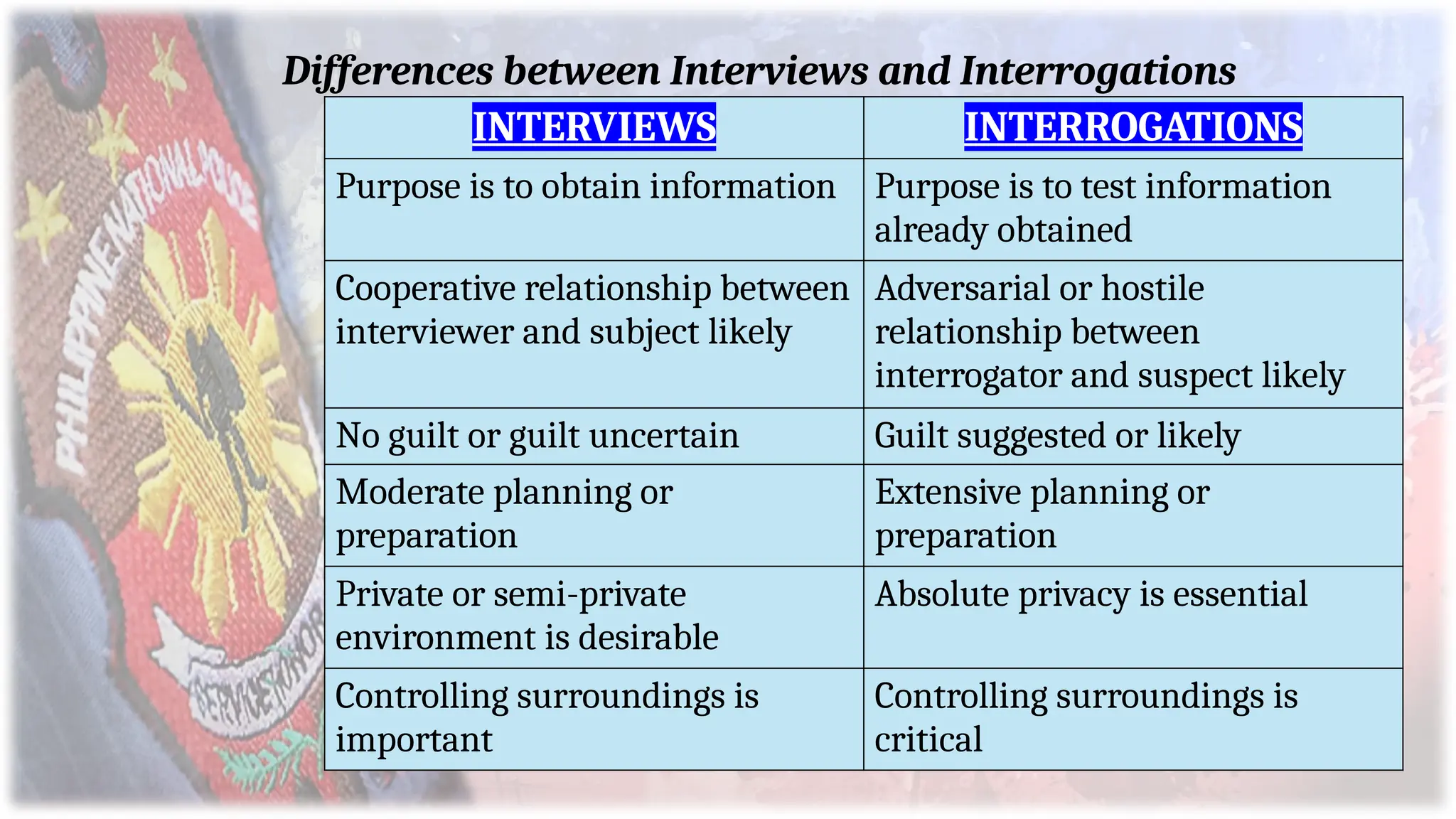
Differences between Interviews and Interrogations
INTERVIEWS INTERROGATIONS
Purpose is to obtain information Purpose is to test information
already obtained
Cooperative relationship between
interviewer and subject likely
Adversarial or hostile
relationship between
interrogator and suspect likely
No guilt or guilt uncertain Guilt suggested or likely
Moderate planning or
preparation
Extensive planning or
preparation
Private or semi-private
environment is desirable
Absolute privacy is essential
Controlling surroundings is
important
Controlling surroundings is
critical
TYPES OF INFORMANTS :

CDI1-Informant-FUNDAMENTALS OF CRIMINAL INVESTIGATION

  • 1.
    FUNDAMENTALS OF CRIMINAL INVESTIGATION CDI1 Angel Queenie Z. Clerigo, RCrim
  • 2.
    CRIMINAL INVESTIGATION-It isan art which deals with the identity and location of the criminal offender and the gathering and providing evidence of guilt in a criminal proceeding. CRIMINAL INVESTIGATOR-is a person who is charged with the duty of conducting criminal investigation when a crime is committed.
  • 3.
    CRIMINAL INVESTIGATION Is theart of using various techniques to identify and locate perpetrator and then prove their guilt thru criminal proceeding. EXAMPLE OF VARIOUS TECHNIQUES 1. Emotional appeal - place the subject in the proper frame of mind. The investigator should provide emotional stimuli that will prompt the subject to unburden himself by confiding. Analyze the subject's personality and decide what motivation would prompt him to tell the truth, and then provide those motives through appropriate emotional appeals.
  • 4.
    CRIMINAL INVESTIGATION Is theart of using various techniques to identify and locate perpetrator and then prove their guilt thru criminal proceeding. EXAMPLE OF VARIOUS TECHNIQUES 2. Sympathetic Approach - the suspect may feel the need for sympathy or friendship. He is apparently in trouble. Gestures of friendship may win his cooperation 3. Kindness - The simplest technique is to assume that the suspect will confess if he is treated in a kind and friendly manner.
  • 5.
    CRIMINAL INVESTIGATION Is theart of using various techniques to identify and locate perpetrator and then prove their guilt thru criminal proceeding. EXAMPLE OF VARIOUS TECHNIQUES 4. Extenuation - the investigator indicates he does not consider his subject's indiscretion a grave offense. 5. Shifting the Blame - the interrogator makes clear his belief that the subject is obviously not the sort of person usually gets mixed up in a crime like this. The interrogator could tell from the start that he was not dealing with a fellow who is a criminal by nature and choice. The trouble with the subject lies in little weakness-perhaps he likes liquor, or he is excessively fond of girls.
  • 6.
    CRIMINAL INVESTIGATION Is theart of using various techniques to identify and locate perpetrator and then prove their guilt thru criminal proceeding. EXAMPLE OF VARIOUS TECHNIQUES 6. Mutt & Jeff (in police parlance sweet and sour) - two (2) agents are employed, Mutt, the relentless investigator, who is going to waste any time because he knows the subject, is guilty. Jeff, on the other hand, is obviously a kindhearted man.
  • 7.
    A.PHASES OF CRIMINALINVESTIGATION 1. The criminal is identified; 2. The criminal is traced and located; 3. The facts proving the guilt of the accused ----- are gathered for court presentation. (NOTE: it is necessary that at all time, these three phases must exist. If you separate one, the other two will not suffice, thus, it will defeat the intent and purpose of the conduct of investigation.)
  • 8.
    TOOLS OR THREE(3) I’s OF CRIMINAL INVESTIGATION INFORMATION- This refers to the knowledge or facts which the investigator had gathered or acquired from persons or documents which are pertinent or relevant to the commission or criminal activities. This is the most important of all the tools because it answers the question, who did it? INFORMATION CLASSIFIED AS TO SOURCES: • Regular sources- records, files from government or non- government agencies and news items, intercepted radio or telephone messages and stored computer data. • Cultivated sources- information furnished by informants or informers. • Grapevines sources- information coming from the underworld characters such as prisoners or ex-convicts.
  • 9.
    INFORMANTS- is anyperson who furnishes the police an information relevant to the crime under investigation or about the activities of the criminals or syndicates. Informant may openly give the information or offer himself to be a witness. • CONFIDENTIAL INFORMANT- a person who provides the police with confidential information concerning a past crime or a projected & planned crime. The informant does not want to be identified as the source of information. Under the law, these types of informants are protected & their identity could not be revealed by the police even under the order of the Court unless an exceptional case where there is a claim of the defense that the informant framed-up the accused.
  • 10.
    TYPES OF INFORMANTS: • Anonymous Informant- a phone caller, letter writer or a text sender. Never tell the informant that the investigator already knows the information. The duty is to receive the information & not to reveal to the caller any other information or facts about the case. • Rival-Elimination Informant- maintains identity being anonymous. His purpose is to eliminate rival person or gang due to competition or other motives such as revenge & etc.. • False Informant- Usually reveals information of no consequence, value or stuff connected with thin air. His purpose is to appear to be on the side of the law & for throwing out suspicion from himself or from his gang or associates.
  • 11.
    TYPES OF INFORMANTS: • Frightened Informant- possesses fear or has self interest in giving information to the police. He is motivated by anxiety & self preservation of his well being & will furnish information to protect himself or sustain self importance. This type is the weakest link in the composition of criminal chain. • Self-aggrandizing Informant- moves around the centers of criminals, group or syndicate & delights in surprising the police about bits of information. His information maybe of value by way of authentication in the intelligence operation. • Mercenary Informant- The informant has information for sale. He may have been victimized in a double-cross or little share in the loot or given a dirty deal & seeks revenge as well as profit in his disclosure.
  • 12.
    TYPES OF INFORMANTS: • Double-crosser Informant- he uses his seeming desire to divulge information as an excuse to talk to the police in order to get more information from them than he gives. To counter this kind of informant, the police apply deception method by giving him false information that will lead to his capture. • Women Informant- a female associate of the criminals, who was roughed up, marginalized in the deal or being eased out from the group. care must be given to this kind of informant because women, given the skills & expertise are more dangerous than men. They often give free romance that will result in blackmailing the investigator or will result to an extended family for support. • Legitimate Informant- desire to give an information that springs from legitimate reasons. They may be a legitimate business operator who abhor the presence of criminals in their trade & parents who are afraid that their siblings will be influenced by their friends who are suspected to be criminals. Others are included where their desires to give information are impressed with lawful motive.
  • 13.
    MOTIVES OF INFORMANTS: • Vanity-the motive is for self-aggrandizement by gaining favorable attention & importance by the police. • Civic Mindedness- imbued with the sense of duty & obligation to assist the police in their task. • Fear-is an engendered illusion of oppression from enemies or from impending dangers. • Repentance- those lesser criminals such as accomplices or accessories who will have a change in heart to unburden their conscience.
  • 14.
    TOOLS OR THREE(3) I’s OF CRIMINAL INVESTIGATION  INFORMATION  INTERROGATION  INSTRUMENTATION
  • 15.
    Tools of anInvestigator in Gathering Facts a) Information – Data gathered by an investigator from other persons including the victim himself and from Public records; Private records; and Modus Operandi file. b)Interrogation and Interview – Questioning of witnesses, suspects, and offended parties. c) Instrumentation – Scientific examination of real evidence, application of instrument and methods of the physical sciences in detecting crime.
  • 16.
    _________________ is anyperson who furnishes the police an information relevant to the crime under investigation or about the activities of the criminals or syndicates. Informant may openly give the information or offer himself to be a witness. INFORMANTS INFORMANTS
  • 17.
    _________________ are thosepersons who provide information to the police on a regular basis. They are either paid regularly or in a case to case basis, or none at all. They are cultivated & established by the police on a more or less permanent character & as long as they are loyal and useful to the police organization. INFORMERS
  • 18.
    THE PROVERBAL BASIS: Thesaying that says: “It needs a thief to catch another thief”. The history of the French police proved that this saying is true. The elite French Sûreté, task to investigate criminal cases, hired an ex-convict as an informer. This ex-convict produced outstanding successes in the solution of cases seemingly difficult to be solved. The ex-convict later became the Chief of the French Surete & the man was Vidocq.
  • 19.
    SELECTION OF INFORMERS There isno hard and fixed rule in the selection of informers. This is addressed to the sound discretion of the investigator. The informer may be to a fixed period of assignment or into a case-to- case basis. The informer must be indoctrinated that they are not immuned from arrest & prosecution if they commit crime. They should not bring shame & dishonor to the police service. When they will commit crimes, they should be punished like the rest.
  • 20.
    All sectors ofsociety must be covered, & their composition must include but not limited to taxi drivers, jeepney & bus drivers, vendors, conductors, waiters, dancers, ex-convicts, shady or underworld characters, hostesses, bankers, security guards, businessmen, prostitutes, the elite in the society & others. They should be planted as moles or stole pigeons practically in all corners of social order. SELECTION OF INFORMERS
  • 21.
    CRITICAL AREAS INDEPLOYMENT OF INFORMERS • Within the ranks of criminals & criminal syndicates • Associates & friends of criminals • Places or hang-outs of criminals such as night clubs, bars, hotels, billiard halls & other places • Slums & residential places where criminals have their contacts • Detention centers such as local jails & National penitentiaries, in many instances crimes were solved by planting moles among detention prisoners in the holding centers of investigative units thru agreements with prison authorities. • Places where criminals dispose their loots.
  • 22.
    • WOMEN INFORMERS: Mosteffective among informers because they could easily penetrate the ranks of criminals with less suspicion. Besides they could mingle with the crowd easily & could obtain information more than their male counterparts, especially if their beauty attracts attention. They have easier access to women associates of male criminals. However, care must be employed as they could easily double- cross the police once they fall in love with criminals.
  • 23.
    DUAL ROLE OFINFORMERS • Identifying & tracing the whereabouts of the suspects • Gathering of information that will lead to the location and recovery of the evidence such as the loot or other pieces of evidence relevant to criminal activities.
  • 24.
    OTHER SOURCES: • GovernmentRecords- Police files, NBI files, Bureau of Immigration files, Comelec files, files from the local jails, National penitentiaries & other government agencies. • Private Records- from private offices & business & non-government organizations. • Intercepted Messages- from telephones, cell phones, radio telecommunications & other means of communications. • Records of Firearms & Explosive Unit concerning licensed holders of firearms & authorized possessor of explosives. • Fire Bursting- tracing the chain of possession of a firearm, from the manufacturer, distributor, seller, and the last possessor. This could be done thru the files of the FBI & other police agencies. • Records of foreign & local manufacturers of vehicles concerning the engine & chassis numbers of the suspected vehicles used in the commission of crimes or are the subject of carnapping. • Stored data on computers & Cell phones- Only experts must be employed to retrieve the data.
  • 25.
    INTERVIEW- is thequestioning of a person believed to possessed information which are relevant to the investigation of a crime or criminal activities.
  • 26.
    GOLDEN RULE ININTERVIEW  Never conduct or let anyone conduct an interview if the interviewer has not gone to the crime scene.  The questioning should be in agreement with the facts and conditions at the crime scene.  The questioning will lead wayward for the interviewer who had not seen personally the crime scene and he will not be in position to distinguish half- truths, exaggerations or falsehood from the answers of the person being interviewed.
  • 27.
    Three Steps Involvedin the Interview Process o Preparing for the interview o Conducting the interview o Concluding the interview Factors That Affect the Information Gathering Process o Degree of Cooperation of the Victim or Witness o Perceptive Ability of the Victim or Witness o Emotional State of the Victim or Witness o Skill of the Investigator
  • 28.
    Interviewer Qualifications An interviewershould possess the following qualifications: – Investigative knowledge – Ability to interpret non-verbal indicators – Ability to establish rapport with interview subjects Preliminary Information to be Obtained Before Conducting the Interview o Nature of the crime o Identity and background of the victim or witness o Emotional state of the victim or witness o Names of all parties involved
  • 29.
    Common Emotional ReactionsExperienced by a Victim of a Serious Crime o Denying an emotionally shocking or painful experience o Extreme frustration (toward self, others, and/or police) o Hesitation to blame the criminal
  • 30.
    INTERROGATION- this isthe process of questioning witnesses and suspects to obtain further information. The effectiveness of interrogation depends with the craft, logic and psychological insight with information relevant to the case. Interrogation used to describe the vigorous questioning of one who is reluctant to divulge information.
  • 31.
    Note: Although thewords “interview” and “interrogation” have similar meanings, there are those who prefer to use “interview” when questioning witness and informants, and “interrogation” when questioning suspects. A Philosophy of Interview and Interrogation: The RIGHT officer, Asking the RIGHT questions, In the RIGHT manner, At the RIGHT time and in the RIGHT place, Will get the RIGHT answers.
  • 32.
    Differences between Interviewsand Interrogations INTERVIEWS INTERROGATIONS Purpose is to obtain information Purpose is to test information already obtained Cooperative relationship between interviewer and subject likely Adversarial or hostile relationship between interrogator and suspect likely No guilt or guilt uncertain Guilt suggested or likely Moderate planning or preparation Extensive planning or preparation Private or semi-private environment is desirable Absolute privacy is essential Controlling surroundings is important Controlling surroundings is critical
  • 34.