
+
STUDY SKILLS PROJECT
“Only Connect”
Paul Smith - 9 February 2009
CDE Fellows’ Conference, Brunei Suite, SOAS
STUDY
SKILLS
+
STUDY SKILLS PROJECT
Principal Aims
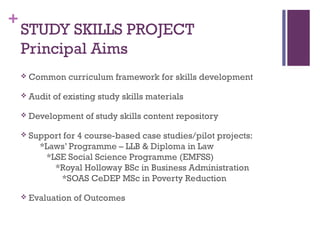
 Common curriculum framework for skills development
 Audit of existing study skills materials
 Development of study skills content repository
 Support for 4 course-based case studies/pilot projects:
*Laws’ Programme – LLB & Diploma in Law
*LSE Social Science Programme (EMFSS)
*Royal Holloway BSc in Business Administration
*SOAS CeDEP MSc in Poverty Reduction
 Evaluation of Outcomes
+
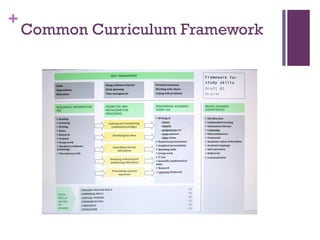
Common Curriculum Framework
+
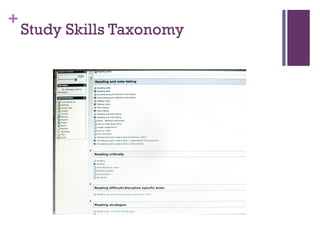
Study Skills Taxonomy
+
Two Useful Websites
http://elab.cde.london.ac.uk
http://www.goodstudyguide.co.uk
+
CeDEP Study Skills Pilot Project
 Piloted in three modules for 2009: Economics and Institutions
for Development; Understanding Poverty; NGO Management
 Aim to use reusable objects from the Study Skills repository
adapted for use within the specific modules
 Study Skills’ activities embedded within the module
elearning guide
 20 activities developed for each module, 2 per unit
 Learners encouraged to share ideas within the BLE, tutorial
discussion forums, and Study Director’s forum
 Supporting Audio file
+
SSPP Generic Headings
 Planning your study time for the
module
 Working with others and sharing
ideas
 Developing critical and
analytical skills
 Reading skills – appreciation
and summary, note-taking
 Writing skills – writing
succinctly and to the point,
essay writing
 ICT skills – use of internet, use of
mobile technologies
 Writing and retention, and the
application of knowledge
 Working with graphic
illustration
 What is assessment for?
Designing assessment tasks
 Studying for examinations –
specimen example and group
exercise
 Reviewing your skills portfolio
 Personal Development Plan
(PDP)
+
Example: Developing critical &
analytical skills
 Developing critical and analytical skills
 Please spend a few minutes reading the following paragraphs about what we mean when we
ask you to be able to deal with issues in a critical and analytical manner.
 What ‘being critical’ does not mean
 *Being critical is not the same as ‘criticising’ or ‘criticism’, i.e. making negative comments,
being ‘against’ something. In asking students to ‘be critical’, we are not saying that they should
always be expressing censure or disapproval.The meaning of ‘critical’ in the academic context
is thus different from everyday language.
 *Being critical may lead to criticism but being critical is the step before criticism, the point of
standing back, considering, observing, assessing.
 *Being critical does not mean adopting any specific political position.
 *Being critical is not the same as being rude.
 *Being critical does not mean automatically rejecting everything you hear or read. It means
assessing the value of what is offered and also looking for other approaches or perspectives.
+
Module Specific Activity: Example
Understanding Poverty
 You have now completed three sections of this unit and should have
some good understanding of different definitions of poverty from an
academic standpoint and, significantly, in section 3 that you have
just read, from the perspective of those who are actually in poverty.
Reflect back on this last section for a few moments: one of the
learning outcomes states that you should be able “to critically
evaluate some of the challenges related to participatory models”.
 Bearing in mind what you have read in the preceding paragraphs
for this activity note down in your My Notes box how you might
approach this. It requires critical and analytical ability. How will
you weigh up the different models and what do you see as the major
challenges?
+
Outcomes
The lessons to take from this activity are to:
 Understand the academic basis for being critical and
analytical and why this is seen as important
 Be able to take a set of approaches/models/schools of
thought, here in a social and political context, and to subject
these to critical, analytical thinking
 Apply these in a particular context: this could be in your real
life and it could be in an academic exercise like a TMA or an
exam.
+
Example: Graphic Illustration
 Working with graphic illustration
 The “application of number” is one of six key skills identified
by the United Kingdom government and business community
as essential to successful participation in a modern society.
This skill comprises “interpreting information involving
numbers, carrying out calculations, interpreting results and
presenting findings”. You should be able to “interpret
information presented in different graphical forms and to
produce these to present your own findings”.This is a skill
that you may well find valuable if you are preparing a
Research Report for the final stages of an MSc programme
with the CeDEP.
+
Module Specific Activity: Example
Economics for Development
 In this unit you have an early opportunity to assess the value and
importance of economic graphic representation. In Section 1.1 of
Unit 3 you are asked to consider the distinction between Total
Product (TP), Average Product (AP) and Marginal Product (MP):
 Without referring back to the text note down now in the My Notes
box how you would distinguish these terms. Now refer to the data
provided in the question towards the end of Section 1.1 Using this
data try to construct a graph that shows TP. On a separate graph try
to show AP and MP.You could certainly attempt this using MS Excel
if you are familiar with this. If you are not, this is a good opportunity
to explore it, using the help and guidance on your PC. Otherwise,
you can attempt to draw the graphs by hand.
 You are encouraged to share your efforts with others on the BLE and
this is also a good one to involve your tutor. Good luck.
+
Outcomes
 The lessons to take from this activity are to:
 Appreciate the value and importance of using graphic
representation as an aid to economic explanation
 Attempt to prepare two graphs on TP, and AP and MP, either
by using MS Excel or by hand
 Share your ideas with others.
+
Future Research Focus
 Within the CeDEP extend skills development to all modules
in electronic format
 Generically, rationalise and simplify the skills taxonomy to
make it more accessible (too many categories)
 Improve the skills platform (move from Moodle to…yet to be
decided) to improve access again
 Fill in skills’ gaps
 Share in a wider academic forum

CDE Conference 09/02/2009. P Smith: Study Skills

  • 1.
    + STUDY SKILLS PROJECT “OnlyConnect” Paul Smith - 9 February 2009 CDE Fellows’ Conference, Brunei Suite, SOAS STUDY SKILLS
  • 2.
    + STUDY SKILLS PROJECT PrincipalAims  Common curriculum framework for skills development  Audit of existing study skills materials  Development of study skills content repository  Support for 4 course-based case studies/pilot projects: *Laws’ Programme – LLB & Diploma in Law *LSE Social Science Programme (EMFSS) *Royal Holloway BSc in Business Administration *SOAS CeDEP MSc in Poverty Reduction  Evaluation of Outcomes
  • 3.
  • 4.
  • 5.
  • 6.
    + CeDEP Study SkillsPilot Project  Piloted in three modules for 2009: Economics and Institutions for Development; Understanding Poverty; NGO Management  Aim to use reusable objects from the Study Skills repository adapted for use within the specific modules  Study Skills’ activities embedded within the module elearning guide  20 activities developed for each module, 2 per unit  Learners encouraged to share ideas within the BLE, tutorial discussion forums, and Study Director’s forum  Supporting Audio file
  • 7.
    + SSPP Generic Headings Planning your study time for the module  Working with others and sharing ideas  Developing critical and analytical skills  Reading skills – appreciation and summary, note-taking  Writing skills – writing succinctly and to the point, essay writing  ICT skills – use of internet, use of mobile technologies  Writing and retention, and the application of knowledge  Working with graphic illustration  What is assessment for? Designing assessment tasks  Studying for examinations – specimen example and group exercise  Reviewing your skills portfolio  Personal Development Plan (PDP)
  • 8.
    + Example: Developing critical& analytical skills  Developing critical and analytical skills  Please spend a few minutes reading the following paragraphs about what we mean when we ask you to be able to deal with issues in a critical and analytical manner.  What ‘being critical’ does not mean  *Being critical is not the same as ‘criticising’ or ‘criticism’, i.e. making negative comments, being ‘against’ something. In asking students to ‘be critical’, we are not saying that they should always be expressing censure or disapproval.The meaning of ‘critical’ in the academic context is thus different from everyday language.  *Being critical may lead to criticism but being critical is the step before criticism, the point of standing back, considering, observing, assessing.  *Being critical does not mean adopting any specific political position.  *Being critical is not the same as being rude.  *Being critical does not mean automatically rejecting everything you hear or read. It means assessing the value of what is offered and also looking for other approaches or perspectives.
  • 9.
    + Module Specific Activity:Example Understanding Poverty  You have now completed three sections of this unit and should have some good understanding of different definitions of poverty from an academic standpoint and, significantly, in section 3 that you have just read, from the perspective of those who are actually in poverty. Reflect back on this last section for a few moments: one of the learning outcomes states that you should be able “to critically evaluate some of the challenges related to participatory models”.  Bearing in mind what you have read in the preceding paragraphs for this activity note down in your My Notes box how you might approach this. It requires critical and analytical ability. How will you weigh up the different models and what do you see as the major challenges?
  • 10.
    + Outcomes The lessons totake from this activity are to:  Understand the academic basis for being critical and analytical and why this is seen as important  Be able to take a set of approaches/models/schools of thought, here in a social and political context, and to subject these to critical, analytical thinking  Apply these in a particular context: this could be in your real life and it could be in an academic exercise like a TMA or an exam.
  • 11.
    + Example: Graphic Illustration Working with graphic illustration  The “application of number” is one of six key skills identified by the United Kingdom government and business community as essential to successful participation in a modern society. This skill comprises “interpreting information involving numbers, carrying out calculations, interpreting results and presenting findings”. You should be able to “interpret information presented in different graphical forms and to produce these to present your own findings”.This is a skill that you may well find valuable if you are preparing a Research Report for the final stages of an MSc programme with the CeDEP.
  • 12.
    + Module Specific Activity:Example Economics for Development  In this unit you have an early opportunity to assess the value and importance of economic graphic representation. In Section 1.1 of Unit 3 you are asked to consider the distinction between Total Product (TP), Average Product (AP) and Marginal Product (MP):  Without referring back to the text note down now in the My Notes box how you would distinguish these terms. Now refer to the data provided in the question towards the end of Section 1.1 Using this data try to construct a graph that shows TP. On a separate graph try to show AP and MP.You could certainly attempt this using MS Excel if you are familiar with this. If you are not, this is a good opportunity to explore it, using the help and guidance on your PC. Otherwise, you can attempt to draw the graphs by hand.  You are encouraged to share your efforts with others on the BLE and this is also a good one to involve your tutor. Good luck.
  • 13.
    + Outcomes  The lessonsto take from this activity are to:  Appreciate the value and importance of using graphic representation as an aid to economic explanation  Attempt to prepare two graphs on TP, and AP and MP, either by using MS Excel or by hand  Share your ideas with others.
  • 14.
    + Future Research Focus Within the CeDEP extend skills development to all modules in electronic format  Generically, rationalise and simplify the skills taxonomy to make it more accessible (too many categories)  Improve the skills platform (move from Moodle to…yet to be decided) to improve access again  Fill in skills’ gaps  Share in a wider academic forum

Editor's Notes

  • #3 The Project started in 2006 with a grant from the London External System and has been undertaken within the auspices of the Centre for Distance Education with a Project Team directed by Paul Smith (in his capacity as a Fellow of the CDE).
  • #4 This pedagogic model was developed by Richard Pearce et al to provide a common curriculum framework for all distance learning programmes within the London External System.
  • #5 A Skills Taxonomy has been developed with 30 categories and a number of sub-categories: for example, Reading.
  • #6 The CDE study skills site is currently in Moodle, but this is to be refined and migrated to a more user-friendly platform. The Good Study Guide site is an Open University resource, designed to be used in conjunction with The Good Study Guide, by Andrew Northedge, OU Press 2005.
  • #7 The Wye Project is the only case study of the four pilot schemes to incorporate reusable skills materials from the repository and to embed them within the module learning guide. C116 is New Institutional Economics; C119 is Understanding Poverty; C132 Is NGO Management.
  • #8 These generic headings have been adapted and modified from the original taxonomy of 30 headings.
  • #9 The generic material can be used in different modules, adapted by authors/tutors as required.
  • #10 The module specific activity is related to a specific section within a particular unit: here this is Unit 3 of C119 Section 3.
  • #11 Each activity has specified outcomes.