CDC to the Max!
CDC driving new technology
EMEA PUG Challenge 2017
Bronco Oostermeyer
Who am I?
Bronco Oostermeyer
OpenEdge since 1996, everything around Progress and more
NativeScript/Angular/Node.js/TypeScript
Progress, UNIT4, WALVIS
Who are we?
Flusso
• Biggest OpenEdge consultancy firm in NL
• Progress technologies
• Open Source (Java & ServiceMix, etc),
• Web Apps (Angular2, various app platforms)
• OutSystems
Agenda
• CDC
• Use cases
• High speed search engine
(CDC) To the Max!
Since we didn’t qualify for the World Cup 
The Challenge (for me)
• A Use Case for CDC, new in 11.7
• “nice feature, but what to do with it?”
• Come up with scenario which doesn’t suit a RDBMS
• Challenge you to think differently about your application
Change Data Capture
• It captures changes to data
• ALL changes
• Including originated from SQL
• Transparent
• Your current tables stay exact the way they are
• CDC data in new tables, same database
• Configurable rather than need for programming
• NOT trigger based
Licensing
• Standard in Enterprise DB advanced
• Add-on for
• Enterprise DB
• Workgroup DB
Steps
• Make dedicated storage area’s for CDC data & CDC index
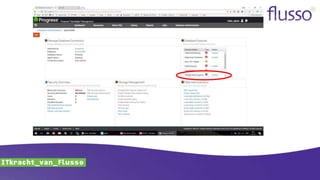
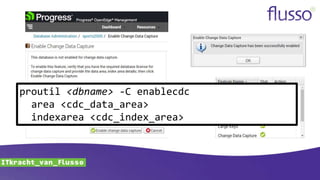
• Enable the CDC feature
• Assign storage area’s
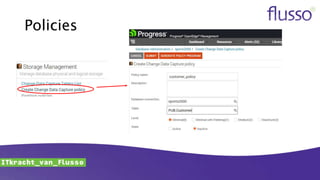
• Create policies
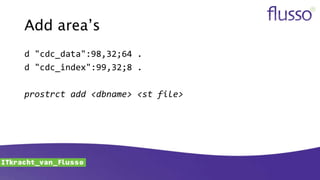
Add area’s
d "cdc_data":98,32;64 .
d "cdc_index":99,32;8 .
prostrct add <dbname> <st file>
proutil <dbname> -C enablecdc
area <cdc_data_area>
indexarea <cdc_index_area>
Policies
tracking changes
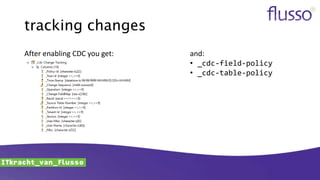
After enabling CDC you get: and:
• _cdc-field-policy
• _cdc-table-policy
tracking changes– level 0
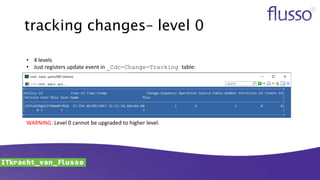
WARNING: Level 0 cannot be upgraded to higher level.
• 4 levels
• Just registers update event in _Cdc-Change-Tracking table:
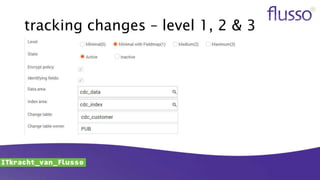
tracking changes – level 1, 2 & 3
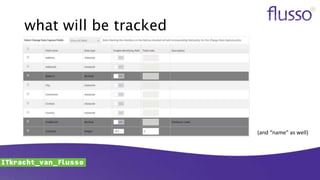
what will be tracked
(and “name” as well)
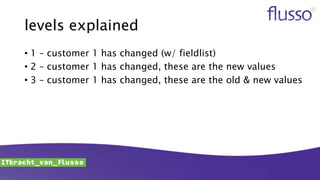
levels explained
• 1 – customer 1 has changed (w/ fieldlist)
• 2 – customer 1 has changed, these are the new values
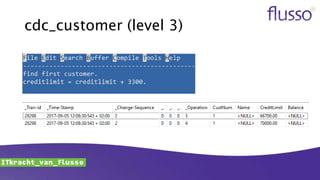
• 3 – customer 1 has changed, these are the old & new values
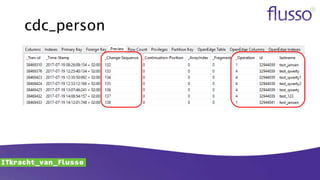
cdc_customer (level 3)
CDC Summary
• Capture all changes transparently
• dedicated table for storing changes
• a _change-sequence field to keep track off
CDC Use cases
• Friendly alternative for auditing (sort of)
• Off-loading changes to satellite systems
• Search engine
• Back-end for web
• Data warehouses
• High Availability/-Scalability
• …
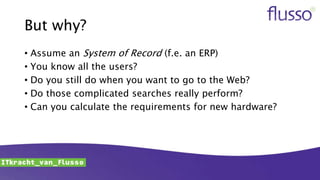
But why?
• Assume an System of Record (f.e. an ERP)
• You know all the users?
• Do you still do when you want to go to the Web?
• Do those complicated searches really perform?
• Can you calculate the requirements for new hardware?
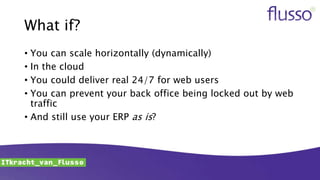
What if?
• You can scale horizontally (dynamically)
• In the cloud
• You could deliver real 24/7 for web users
• You can prevent your back office being locked out by web
traffic
• And still use your ERP as is?
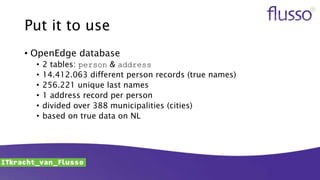
Put it to use
• OpenEdge database
• 2 tables: person & address
• 14.412.063 different person records (true names)
• 256.221 unique last names
• 1 address record per person
• divided over 388 municipalities (cities)
• based on true data on NL
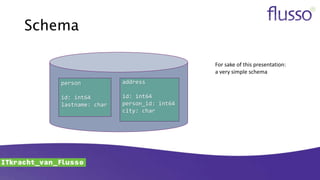
Schema
person
id: int64
lastname: char
address
id: int64
person_id: int64
city: char
For sake of this presentation:
a very simple schema
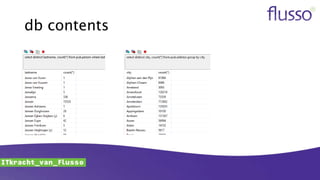
db contents
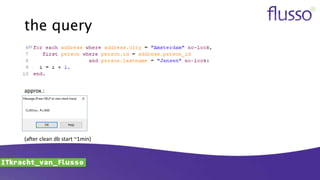
the query
approx.:
(after clean db start ~1min)
RDBMS vs NoSQL
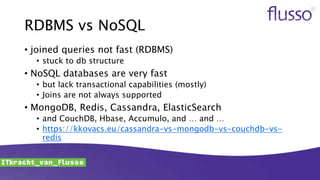
• joined queries not fast (RDBMS)
• stuck to db structure
• NoSQL databases are very fast
• but lack transactional capabilities (mostly)
• Joins are not always supported
• MongoDB, Redis, Cassandra, ElasticSearch
• and CouchDB, Hbase, Accumulo, and … and …
• https://kkovacs.eu/cassandra-vs-mongodb-vs-couchdb-vs-
redis
Enter MongoDB
person
address
cdc_person
cdc_address
[{
"id" : 6943896,
"lastname" : "Jansen",
"address" : {
"city" : "Amsterdam"
}
}, …]
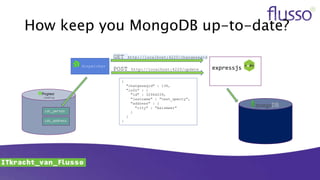
How keep you MongoDB up-to-date?
dispatcher
cdc_person
cdc_address
expressjsPOST http://localhost:4220/update
{
"changeseqid" : 136,
"info" : {
"id" : 32944039,
"lastname" : "test_qwerty",
"address" : {
"city" : "Aalsmeer"
}
}
}
GET http://localhost:4220/changeseqid
cdc_person
What more?
• The target system needs to keep track of processed changes
• The target system needs to be able to report last change id
• a search api
Technology Stack
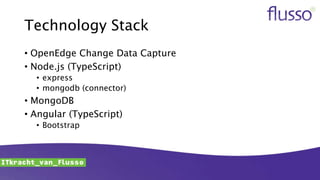
• OpenEdge Change Data Capture
• Node.js (TypeScript)
• express
• mongodb (connector)
• MongoDB
• Angular (TypeScript)
• Bootstrap
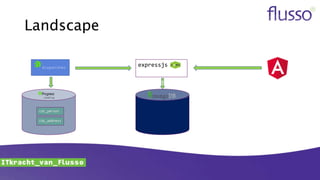
Landscape
dispatcher
cdc_person
cdc_address
h
tt
p
s:
/
/
gi
t
h
u
b
.c
o
m
/
b
f
v
/
bl
expressjs
h
tt
s:
/
/
gi
t
h
u
b
.c
o
m
/
b
f
v
/
bl
iz
s
e
a
rc
h
Demo
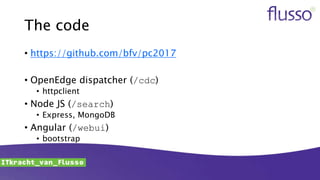
The code
• https://github.com/bfv/pc2017
• OpenEdge dispatcher (/cdc)
• httpclient
• Node JS (/search)
• Express, MongoDB
• Angular (/webui)
• bootstrap
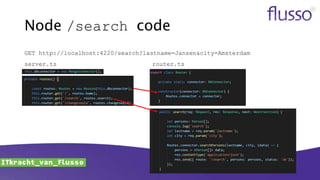
Node /search code
server.ts router.ts
GET http://localhost:4220/search?lastname=Jansen&city=Amsterdam
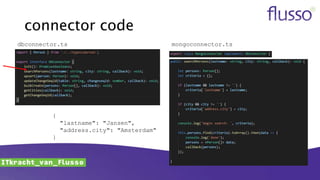
connector code
mongoconnector.tsdbconnector.ts
{
"lastname": "Jansen",
"address.city": "Amsterdam"
}
Result
[{
"id" : 6943896,
"lastname" : "Jansen",
"address" : {
"city" : "Amsterdam"
}
}, …]
But…
• cdc data is in normal tables (delta.df might wipe data)
• cdc configuration is dumped/loaded separately
Conclusion
• CDC is pretty easy to configure
• Resulting cdc table are readable
• Use change_sequence to keep track
• The possibilities are limited by your own fantasy
• Highly scalable cloud systems can be fed by CDC
• Enables new technology w/o starting all over
• Last advise: Think big, start small
Questions?
OpenEdge on Slack!
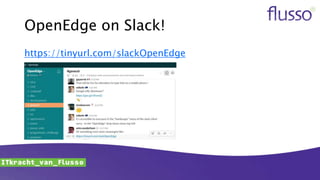
https://tinyurl.com/slackOpenEdge
Links
1. https://kkovacs.eu/cassandra-vs-mongodb-vs-couchdb-vs-redis
follow us on:

CDC to the Max!

Editor's Notes

  • #20 Note here the _change-sequence field. This give the possibility to go through your changes in the correct order AND a means to keep track what changes have been off-loaded to another system and which one not.