CC112
Computer
Programming - 1
JOSEPH REY G YBIOSA
BSIT - Instructor
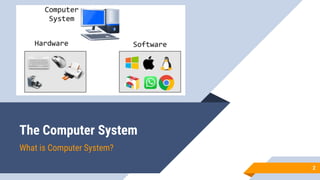
The Computer System
What is Computer System?
2
“The computer system is a
complex arrangement of
hardware and software
components that work together
to process and store
information.
3
3
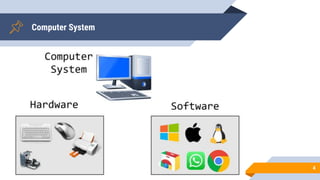
Computer System
4
What is a
Computer?
5
Computer
▰ A computer is an electronic device that processes and stores data
using a combination of hardware and software components.
▰ It performs complex calculations, executes programs, and allows
users to interact with it through input and output devices.
6
▰ CPU (Central Processing Unit)
▰ Memory
▰ Storage
▰ Input / Output Devices
Components of a Computer System
7
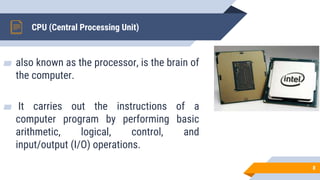
▰ also known as the processor, is the brain of
the computer.
▰ It carries out the instructions of a
computer program by performing basic
arithmetic, logical, control, and
input/output (I/O) operations.
CPU (Central Processing Unit)
8
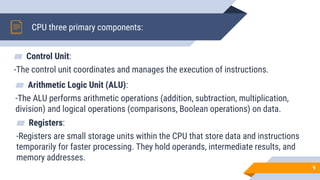
▰ Control Unit:
-The control unit coordinates and manages the execution of instructions.
CPU three primary components:
9
▰ Arithmetic Logic Unit (ALU):
-The ALU performs arithmetic operations (addition, subtraction, multiplication,
division) and logical operations (comparisons, Boolean operations) on data.
▰ Registers:
-Registers are small storage units within the CPU that store data and instructions
temporarily for faster processing. They hold operands, intermediate results, and
memory addresses.
10
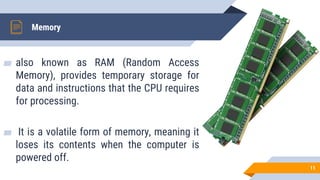
▰ also known as RAM (Random Access
Memory), provides temporary storage for
data and instructions that the CPU requires
for processing.
▰ It is a volatile form of memory, meaning it
loses its contents when the computer is
powered off.
Memory
11
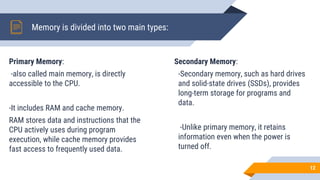
Memory is divided into two main types:
Primary Memory:
-also called main memory, is directly
accessible to the CPU.
-It includes RAM and cache memory.
RAM stores data and instructions that the
CPU actively uses during program
execution, while cache memory provides
fast access to frequently used data.
12
Secondary Memory:
-Secondary memory, such as hard drives
and solid-state drives (SSDs), provides
long-term storage for programs and
data.
-Unlike primary memory, it retains
information even when the power is
turned off.
Storage
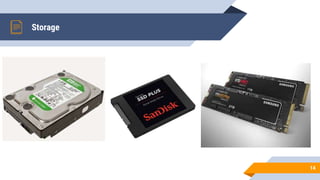
Storage devices, such as hard drives and solid-state drives (SSDs),
provide long-term storage for data and programs. They are classified
into two main types:
▰ Magnetic Storage: Traditional hard drives that use magnetic disks
to store data.
▰ Solid-State Storage: SSDs that use non-volatile memory chips to
store data.
13
Storage
14
Input/Output Devices
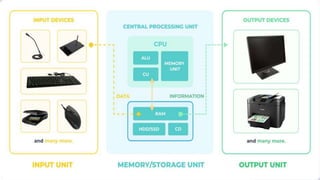
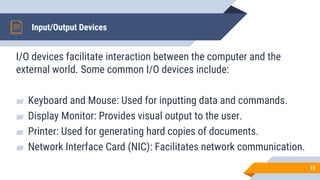
I/O devices facilitate interaction between the computer and the
external world. Some common I/O devices include:
▰ Keyboard and Mouse: Used for inputting data and commands.
▰ Display Monitor: Provides visual output to the user.
▰ Printer: Used for generating hard copies of documents.
▰ Network Interface Card (NIC): Facilitates network communication.
15
Interaction between Hardware and Software
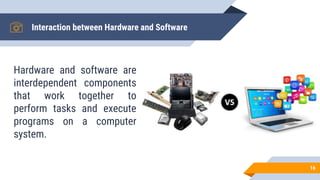
Hardware and software are
interdependent components
that work together to
perform tasks and execute
programs on a computer
system.
16
Memory is divided into two main types:
▰ Hardware: Hardware refers to the physical components of a computer system,
such as the CPU, memory, storage devices, and input/output devices. It
provides the necessary resources and processing power for software to run.
▰ Software: Software encompasses the programs, applications, and operating
systems that enable users to interact with the computer. It includes system
software (e.g., operating systems, drivers) and application software (e.g., word
processors, web browsers).
17
Hardware and software interact in the following ways:
▰ Execution of Instructions: The CPU executes instructions stored in memory,
performing operations specified by the software.
▰ Memory Management: The operating system manages memory allocation,
ensuring that software programs have the necessary memory space to run
efficiently.
▰ Device Interaction: Software communicates with input/output devices, allowing
users to interact with the computer system and receive output from it.
18
Hardware and software interact in the following ways:
▰ Device Drivers: Device drivers are software components that enable
communication between the operating system and hardware devices, ensuring
proper functioning and compatibility.
▰ Virtualization: Virtualization software creates virtual machines that emulate the
functionality of physical hardware, allowing multiple operating systems to run
simultaneously on a single computer.
19
Summary
▰ The components of a computer system, including the CPU, memory, storage, and
input/output devices, form the foundation for its operation.
▰ The CPU serves as the central processing unit, executing instructions and performing
calculations.
▰ Memory provides temporary storage for data and instructions, while storage devices
offer long-term storage.
▰ Input/output devices facilitate interaction between the computer and users.
▰ Hardware and software components work together, with software relying on hardware
resources for execution, and hardware being controlled and utilized by software
programs.
20
What is the
PRIMARY
&
SECONDARY
storage?
21
22
THANKS!

cc112 prog 1 topic 1.pptx

  • 1.
    CC112 Computer Programming - 1 JOSEPHREY G YBIOSA BSIT - Instructor
  • 2.
    The Computer System Whatis Computer System? 2
  • 3.
    “The computer systemis a complex arrangement of hardware and software components that work together to process and store information. 3 3
  • 4.
  • 5.
  • 6.
    Computer ▰ A computeris an electronic device that processes and stores data using a combination of hardware and software components. ▰ It performs complex calculations, executes programs, and allows users to interact with it through input and output devices. 6
  • 7.
    ▰ CPU (CentralProcessing Unit) ▰ Memory ▰ Storage ▰ Input / Output Devices Components of a Computer System 7
  • 8.
    ▰ also knownas the processor, is the brain of the computer. ▰ It carries out the instructions of a computer program by performing basic arithmetic, logical, control, and input/output (I/O) operations. CPU (Central Processing Unit) 8
  • 9.
    ▰ Control Unit: -Thecontrol unit coordinates and manages the execution of instructions. CPU three primary components: 9 ▰ Arithmetic Logic Unit (ALU): -The ALU performs arithmetic operations (addition, subtraction, multiplication, division) and logical operations (comparisons, Boolean operations) on data. ▰ Registers: -Registers are small storage units within the CPU that store data and instructions temporarily for faster processing. They hold operands, intermediate results, and memory addresses.
  • 10.
  • 11.
    ▰ also knownas RAM (Random Access Memory), provides temporary storage for data and instructions that the CPU requires for processing. ▰ It is a volatile form of memory, meaning it loses its contents when the computer is powered off. Memory 11
  • 12.
    Memory is dividedinto two main types: Primary Memory: -also called main memory, is directly accessible to the CPU. -It includes RAM and cache memory. RAM stores data and instructions that the CPU actively uses during program execution, while cache memory provides fast access to frequently used data. 12 Secondary Memory: -Secondary memory, such as hard drives and solid-state drives (SSDs), provides long-term storage for programs and data. -Unlike primary memory, it retains information even when the power is turned off.
  • 13.
    Storage Storage devices, suchas hard drives and solid-state drives (SSDs), provide long-term storage for data and programs. They are classified into two main types: ▰ Magnetic Storage: Traditional hard drives that use magnetic disks to store data. ▰ Solid-State Storage: SSDs that use non-volatile memory chips to store data. 13
  • 14.
  • 15.
    Input/Output Devices I/O devicesfacilitate interaction between the computer and the external world. Some common I/O devices include: ▰ Keyboard and Mouse: Used for inputting data and commands. ▰ Display Monitor: Provides visual output to the user. ▰ Printer: Used for generating hard copies of documents. ▰ Network Interface Card (NIC): Facilitates network communication. 15
  • 16.
    Interaction between Hardwareand Software Hardware and software are interdependent components that work together to perform tasks and execute programs on a computer system. 16
  • 17.
    Memory is dividedinto two main types: ▰ Hardware: Hardware refers to the physical components of a computer system, such as the CPU, memory, storage devices, and input/output devices. It provides the necessary resources and processing power for software to run. ▰ Software: Software encompasses the programs, applications, and operating systems that enable users to interact with the computer. It includes system software (e.g., operating systems, drivers) and application software (e.g., word processors, web browsers). 17
  • 18.
    Hardware and softwareinteract in the following ways: ▰ Execution of Instructions: The CPU executes instructions stored in memory, performing operations specified by the software. ▰ Memory Management: The operating system manages memory allocation, ensuring that software programs have the necessary memory space to run efficiently. ▰ Device Interaction: Software communicates with input/output devices, allowing users to interact with the computer system and receive output from it. 18
  • 19.
    Hardware and softwareinteract in the following ways: ▰ Device Drivers: Device drivers are software components that enable communication between the operating system and hardware devices, ensuring proper functioning and compatibility. ▰ Virtualization: Virtualization software creates virtual machines that emulate the functionality of physical hardware, allowing multiple operating systems to run simultaneously on a single computer. 19
  • 20.
    Summary ▰ The componentsof a computer system, including the CPU, memory, storage, and input/output devices, form the foundation for its operation. ▰ The CPU serves as the central processing unit, executing instructions and performing calculations. ▰ Memory provides temporary storage for data and instructions, while storage devices offer long-term storage. ▰ Input/output devices facilitate interaction between the computer and users. ▰ Hardware and software components work together, with software relying on hardware resources for execution, and hardware being controlled and utilized by software programs. 20
  • 21.
  • 22.