PRINCIPLE OF MATHEMATICAL INDUCTION
MATHS
2
PRINCIPLE OF MATHEMATICAL INDUCTION
Top Concepts
1. There are two types of reasoning—deductive and inductive.
2. In deduction, given a statement to be proven which is often called a conjecture or a
theorem, validdeductive steps are derived and a proof may or may not be established.
3. Deduction is the application of a general case to a particular case.
4. Inductive reasoning depends on working with each case and developing a conjecture by
observingincidence till each and every case is observed.
5. Induction is the generalisation from particular cases or facts.
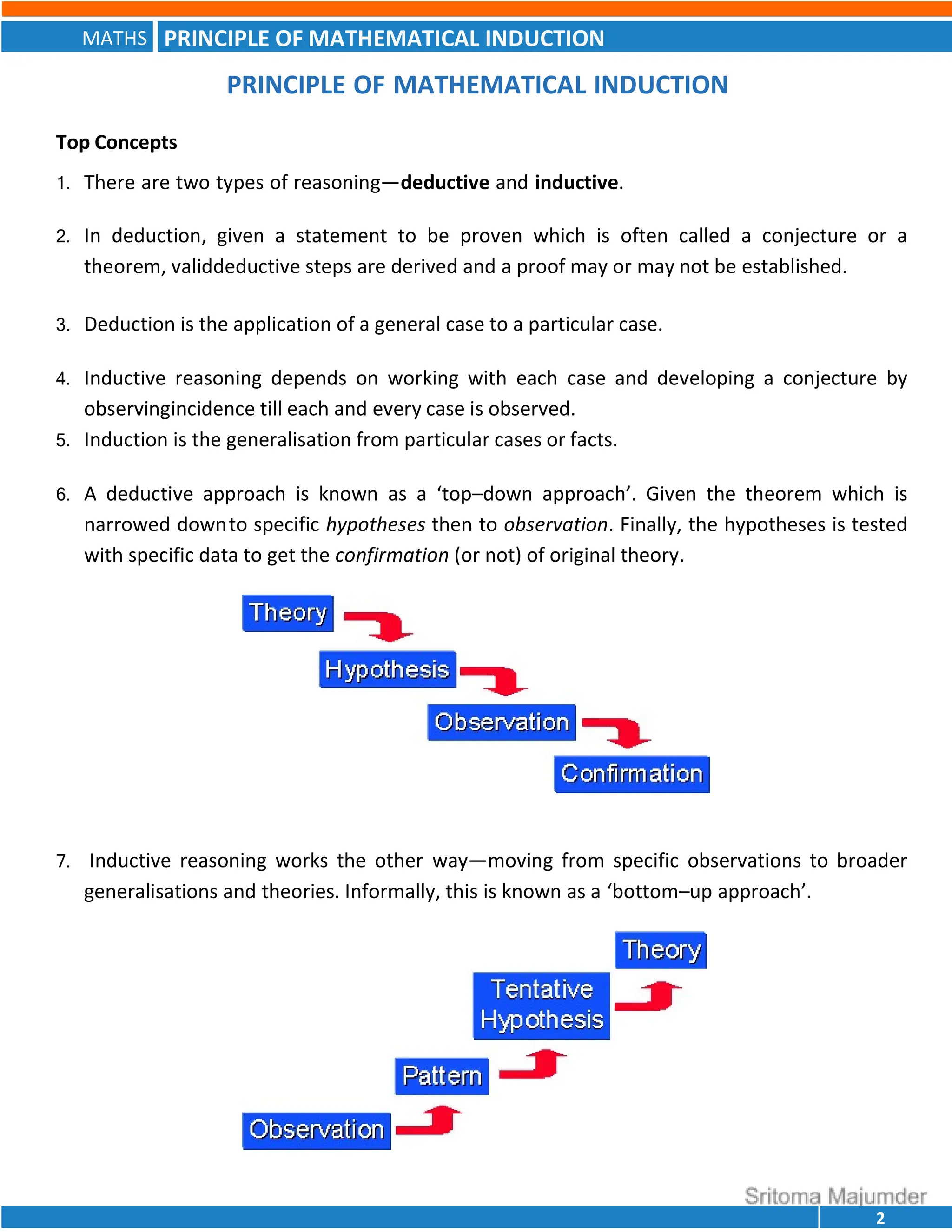
6. A deductive approach is known as a ‘top–down approach’. Given the theorem which is
narrowed downto specific hypotheses then to observation. Finally, the hypotheses is tested
with specific data to get the confirmation (or not) of original theory.
7. Inductive reasoning works the other way—moving from specific observations to broader
generalisations and theories. Informally, this is known as a ‘bottom–up approach’.
PRINCIPLE OF MATHEMATICAL INDUCTION
MATHS
3
8. To prove statements or results formulated in terms of n, where n is a positive integer, a
principle basedon inductive reasoning called the Principle of Mathematical Induction (PMI)
is used.
9. PMI is one such tool which can be used to prove a wide variety of mathematical statements.
Each ofsuch statements is assumed as
P(n) associated with a positive integer n for which the correctness of the case n = 1 is
examined.Then, assuming the truth of P(k) for some positive integer k, the truth of
P(k + 1) is established.
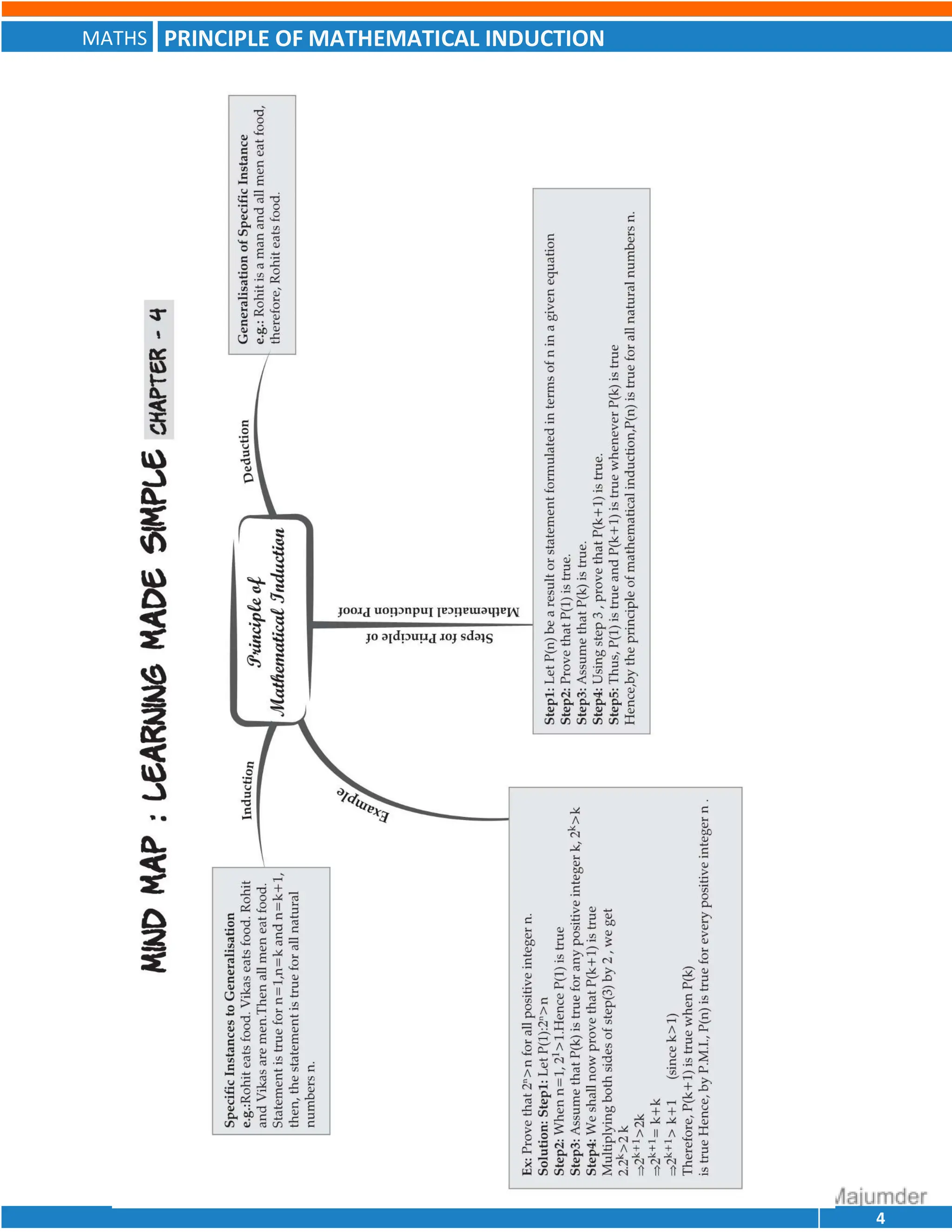
10. Let p(n) denote a mathematical statement such that
(1) p(1) is true.
(2) p(k + 1) is true whenever p(k) is true.
Then, the statement is true for all natural numbers n by PMI.
11. PMI is based on the Peano’s Axiom.
12. PMI is based on a series of well-defined steps, so it is necessary to verify all of them.
13. PMI can be used to prove the equality, inequalities and divisibility of natural numbers.
Key Formulae
1. Sum of n natural numbers: 1 + 2 + 3 + …. + n =
𝐧(𝐧 𝟏)
𝟐
2. Sum of n2 natural numbers: 12
+22
+32
+………n2
=
𝐧(𝐧 𝟏)(𝟐𝐧 𝟏)
𝟔
3. Sum of odd natural numbers: 1 + 3 + 5 + 7…… + (2n − 1) = n2
4. Steps of PMI
1. Denote the given statement in terms of n by P(n).
2. Check whether the proposition is true for n = 1.
3. Assume that the proposition result is true for n = k.
4. Using p(k), prove that the proposition is true for p(k + 1).
5. Rules of inequalities
a. If a < b and b < c, then a < c.
b. If a < b, then a + c < b + c.
c. If a < b and c > 0 which means c is positive, then ac < bc.
d. If a < b and c < 0 which means c is positive, then ac > bc.
PRINCIPLE OF MATHEMATICAL INDUCTION
MATHS
4
PRINCIPLE OF MATHEMATICAL INDUCTION
MATHEMATICS
Important Questions
Multiple Choice questions-
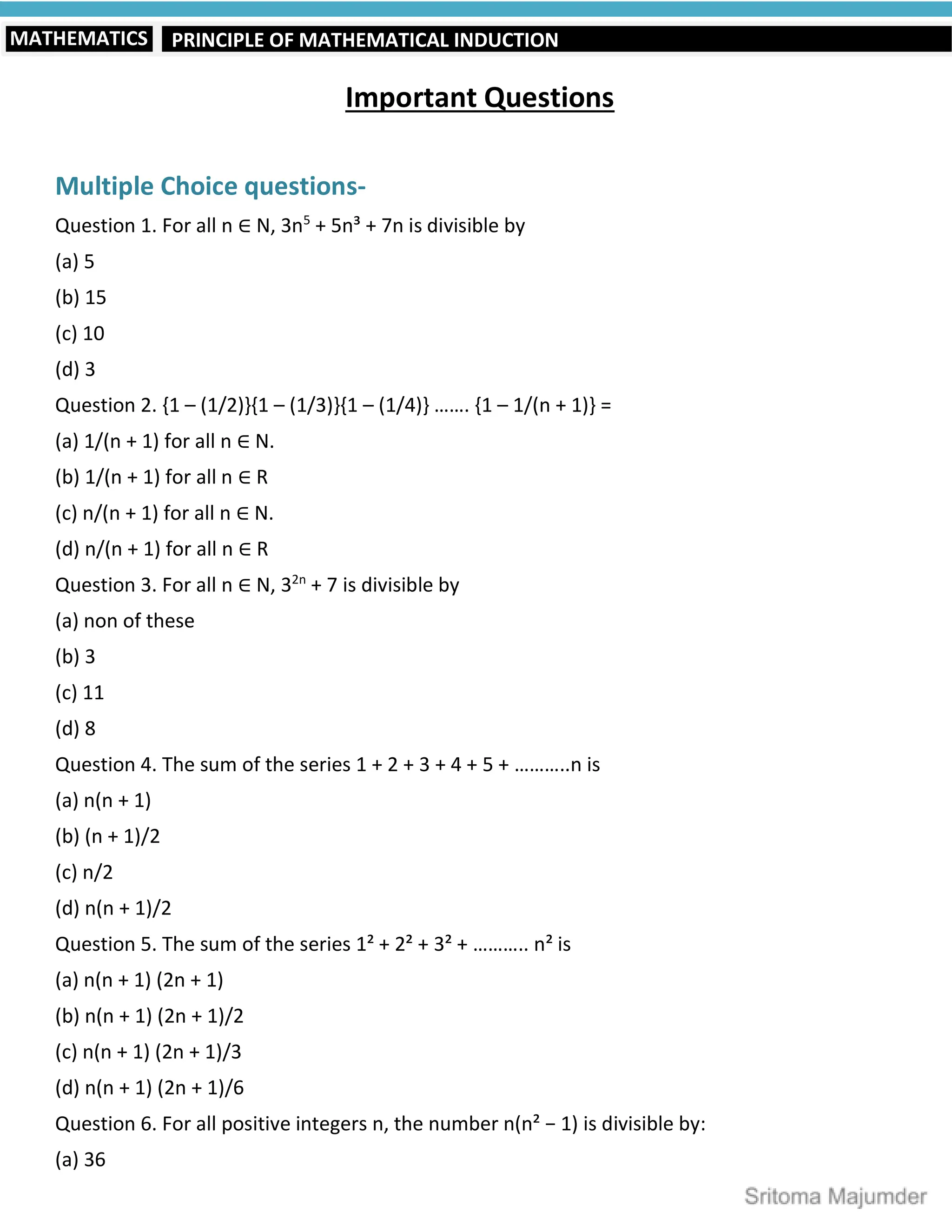
Question 1. For all n ∈ N, 3n5
+ 5n³ + 7n is divisible by
(a) 5
(b) 15
(c) 10
(d) 3
Question 2. {1 – (1/2)}{1 – (1/3)}{1 – (1/4)} ……. {1 – 1/(n + 1)} =
(a) 1/(n + 1) for all n ∈ N.
(b) 1/(n + 1) for all n ∈ R
(c) n/(n + 1) for all n ∈ N.
(d) n/(n + 1) for all n ∈ R
Question 3. For all n ∈ N, 32n
+ 7 is divisible by
(a) non of these
(b) 3
(c) 11
(d) 8
Question 4. The sum of the series 1 + 2 + 3 + 4 + 5 + ………..n is
(a) n(n + 1)
(b) (n + 1)/2
(c) n/2
(d) n(n + 1)/2
Question 5. The sum of the series 1² + 2² + 3² + ……….. n² is
(a) n(n + 1) (2n + 1)
(b) n(n + 1) (2n + 1)/2
(c) n(n + 1) (2n + 1)/3
(d) n(n + 1) (2n + 1)/6
Question 6. For all positive integers n, the number n(n² − 1) is divisible by:
(a) 36
PRINCIPLE OF MATHEMATICAL INDUCTION
MATHEMATICS
(b) 24
(c) 6
(d) 16
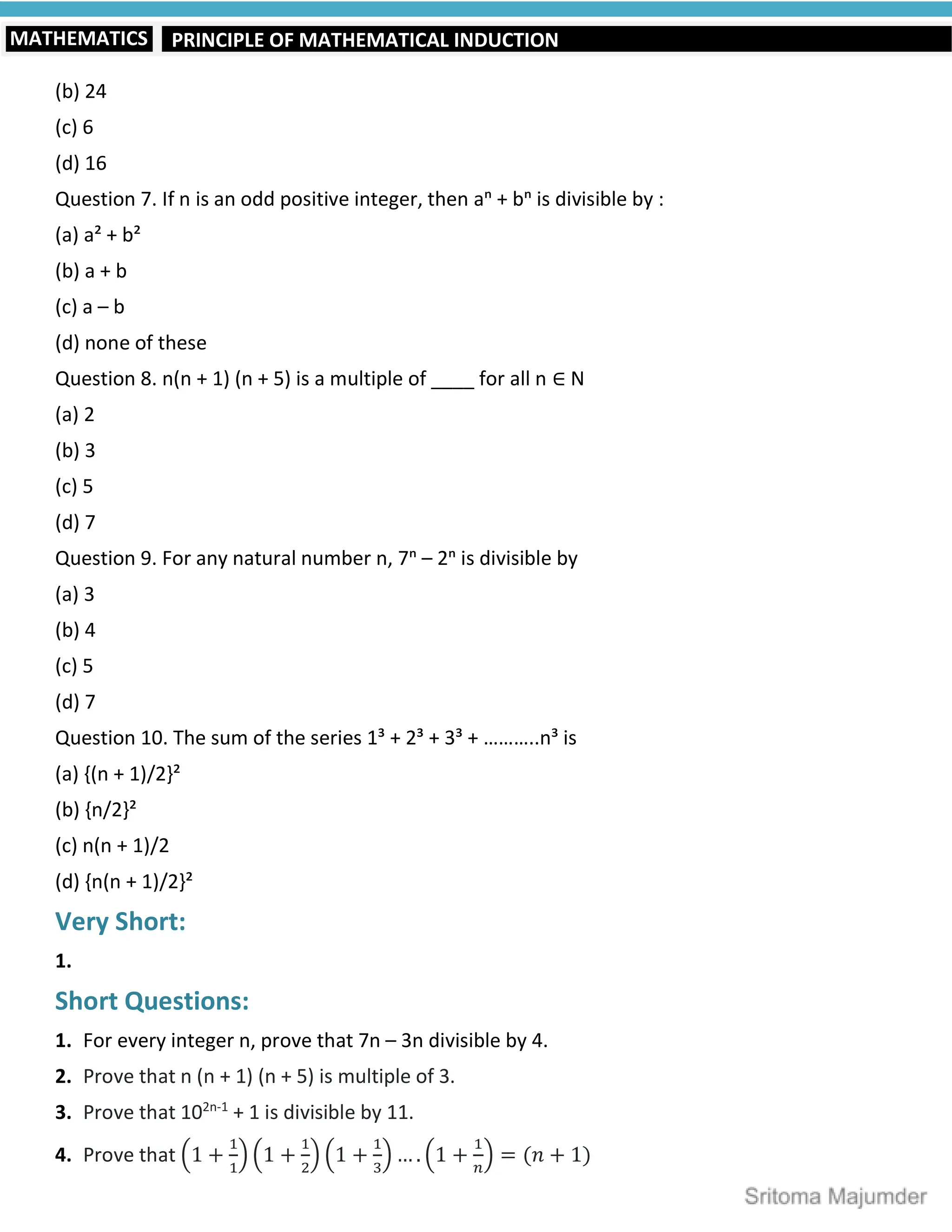
Question 7. If n is an odd positive integer, then aⁿ + bⁿ is divisible by :
(a) a² + b²
(b) a + b
(c) a – b
(d) none of these
Question 8. n(n + 1) (n + 5) is a multiple of ____ for all n ∈ N
(a) 2
(b) 3
(c) 5
(d) 7
Question 9. For any natural number n, 7ⁿ – 2ⁿ is divisible by
(a) 3
(b) 4
(c) 5
(d) 7
Question 10. The sum of the series 1³ + 2³ + 3³ + ………..n³ is
(a) {(n + 1)/2}²
(b) {n/2}²
(c) n(n + 1)/2
(d) {n(n + 1)/2}²
Very Short:
1.
Short Questions:
1. For every integer n, prove that 7n – 3n divisible by 4.
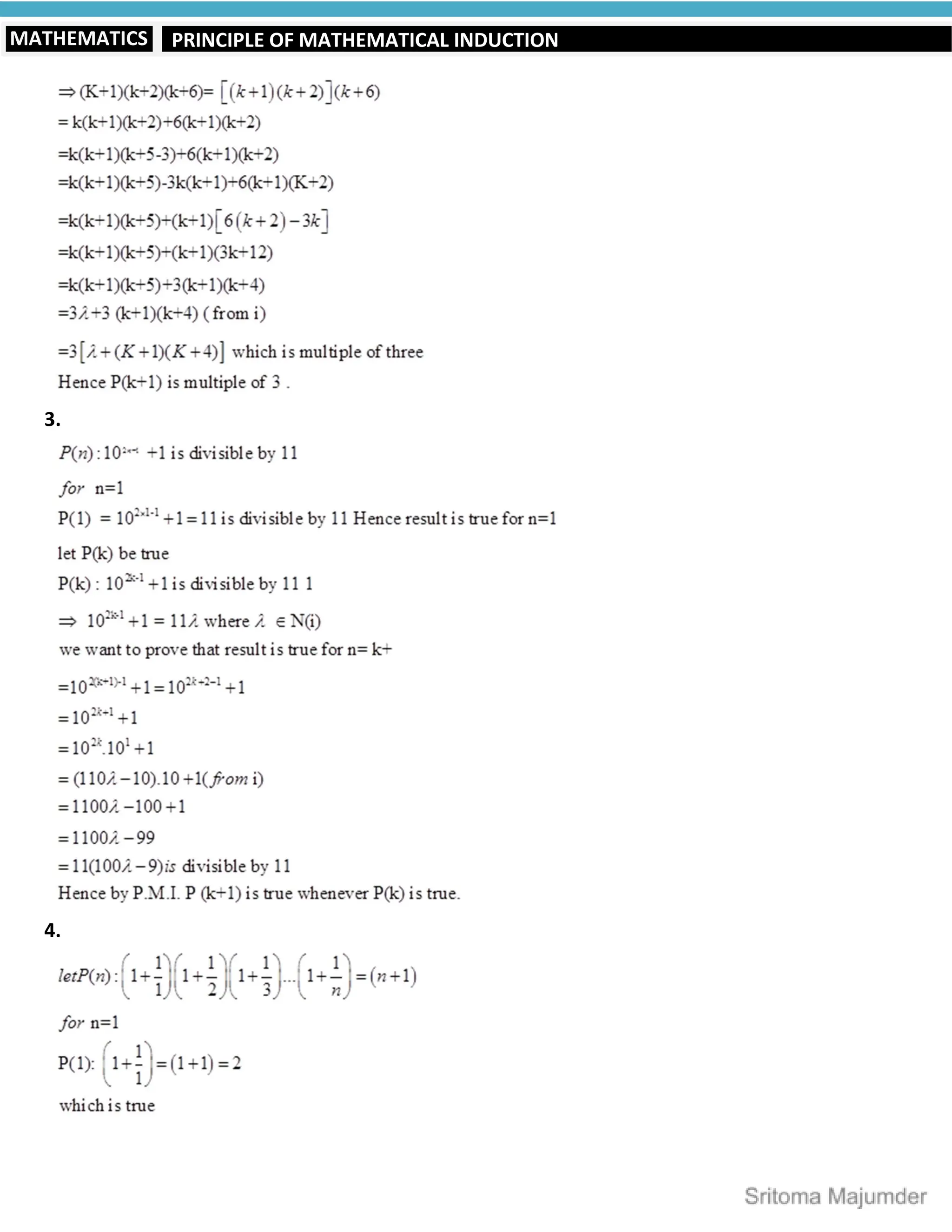
2. Prove that n (n + 1) (n + 5) is multiple of 3.
3. Prove that 102n-1
+ 1 is divisible by 11.
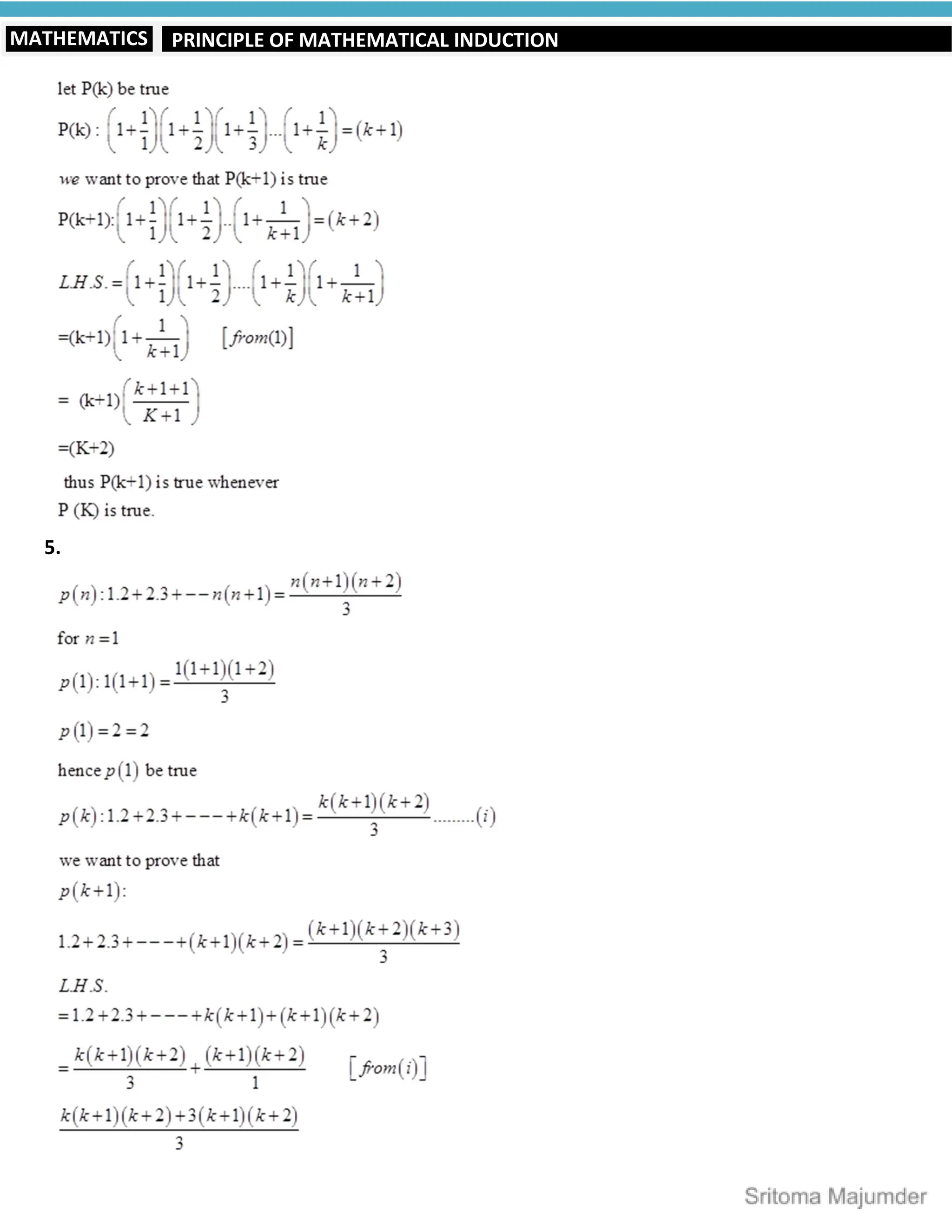
4. Prove that 1 + 1 + 1 + … . 1 + = (𝑛 + 1)
PRINCIPLE OF MATHEMATICAL INDUCTION
MATHEMATICS
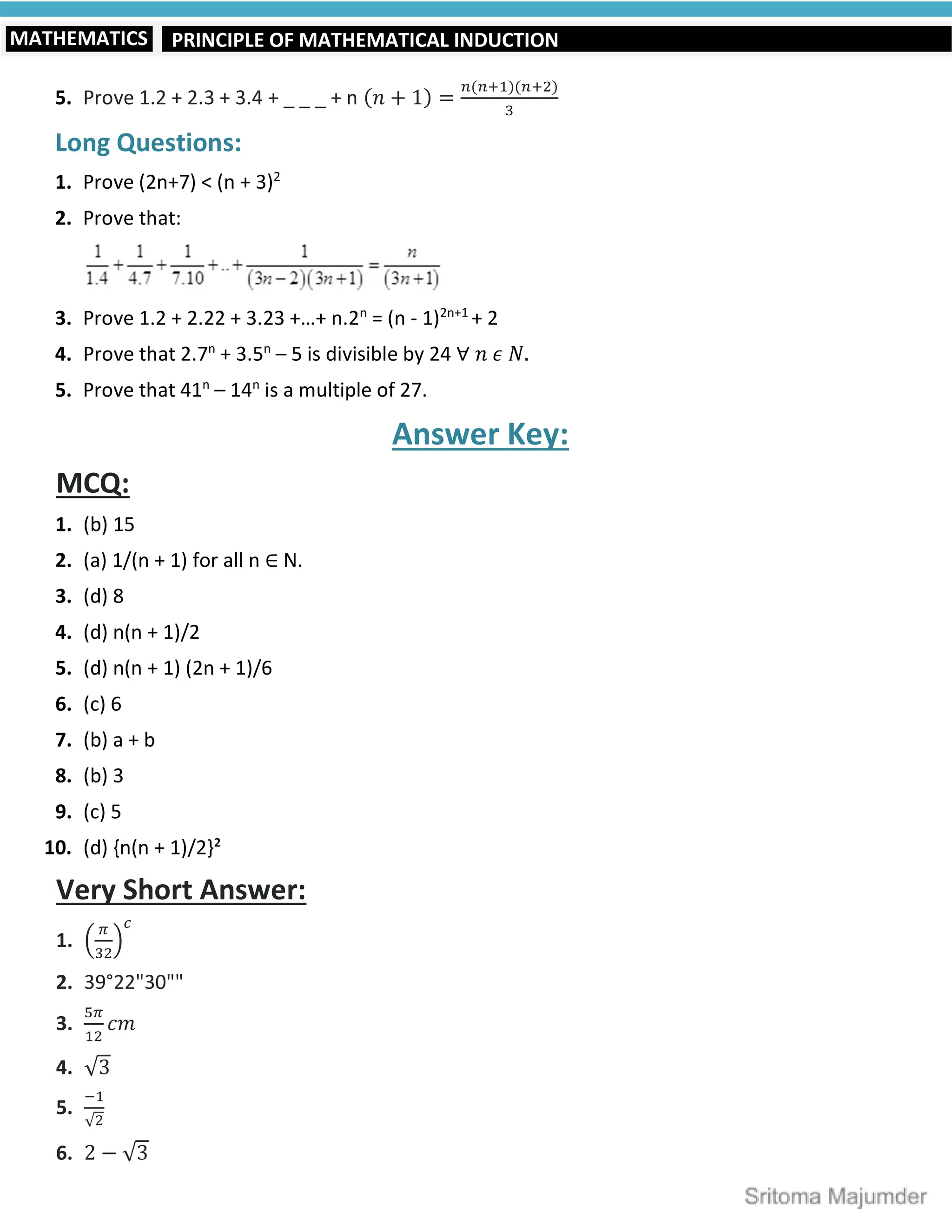
5. Prove 1.2 + 2.3 + 3.4 + _ _ _ + n (𝑛 + 1) =
( )( )
Long Questions:
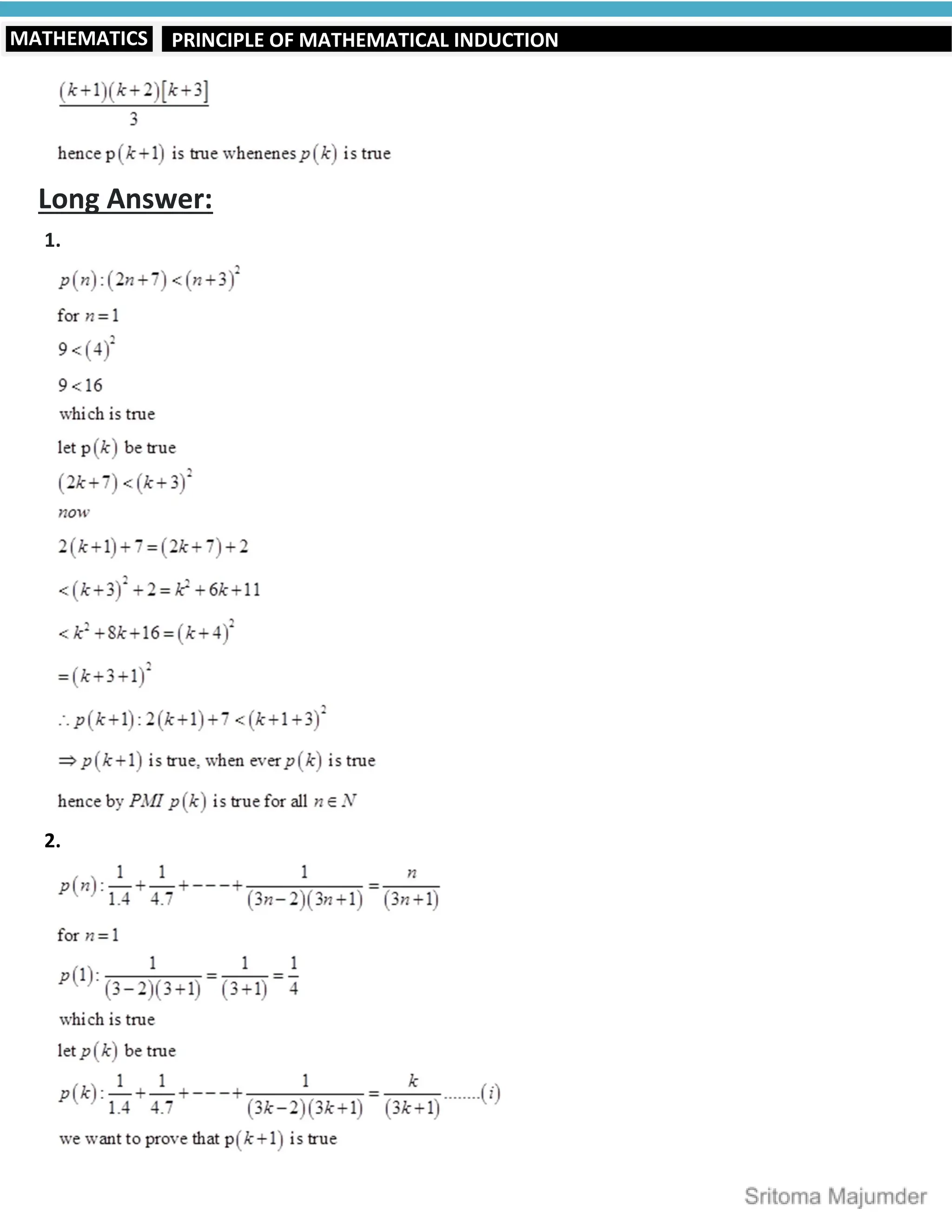
1. Prove (2n+7) < (n + 3)2
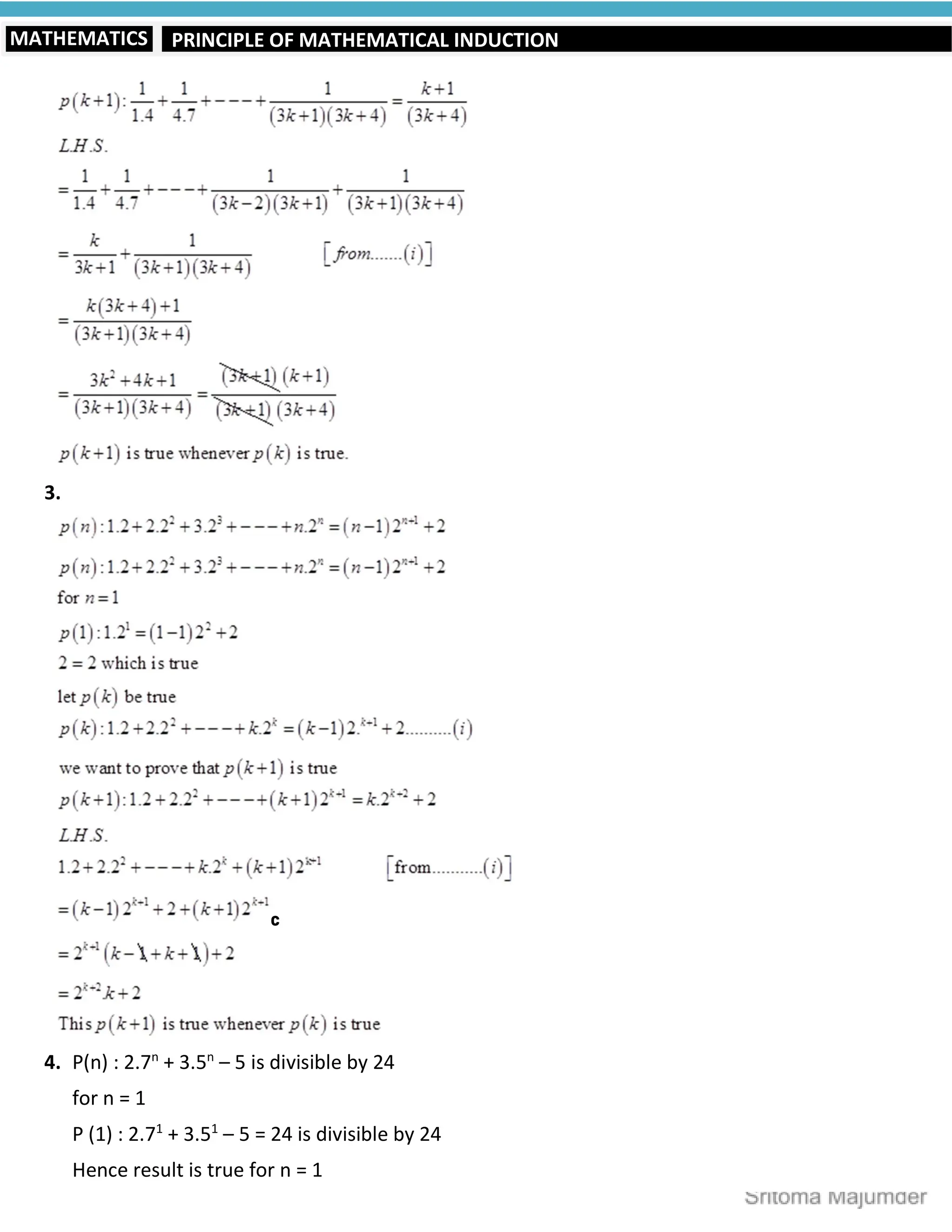
2. Prove that:
3. Prove 1.2 + 2.22 + 3.23 +…+ n.2n
= (n - 1)2n+1
+ 2
4. Prove that 2.7n
+ 3.5n
– 5 is divisible by 24 ∀ 𝑛 𝜖 𝑁.
5. Prove that 41n
– 14n
is a multiple of 27.
Answer Key:
MCQ:
1. (b) 15
2. (a) 1/(n + 1) for all n ∈ N.
3. (d) 8
4. (d) n(n + 1)/2
5. (d) n(n + 1) (2n + 1)/6
6. (c) 6
7. (b) a + b
8. (b) 3
9. (c) 5
10. (d) {n(n + 1)/2}²
Very Short Answer:
1.
2. 39°22"30""
3. 𝑐𝑚
4. √3
5.
√
6. 2 − √3
PRINCIPLE OF MATHEMATICAL INDUCTION
MATHEMATICS
7.
8. 45∘
9. 2 sin8θ cos4θ
10.sin 6x – sin2x
Short Answer:
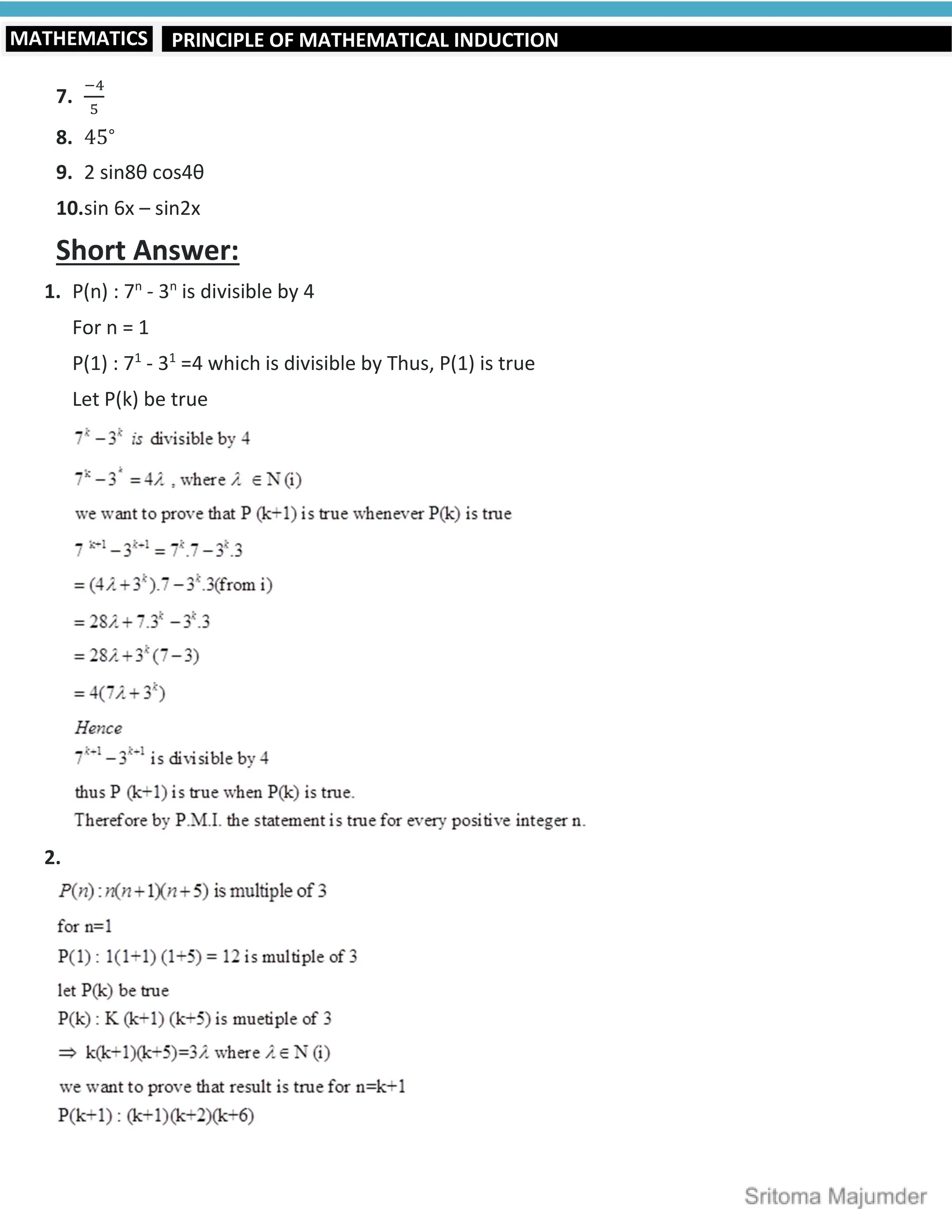
1. P(n) : 7n
- 3n
is divisible by 4
For n = 1
P(1) : 71
- 31
=4 which is divisible by Thus, P(1) is true
Let P(k) be true
2.
PRINCIPLE OF MATHEMATICAL INDUCTION
MATHEMATICS
3.
4.
PRINCIPLE OF MATHEMATICAL INDUCTION
MATHEMATICS
5.
PRINCIPLE OF MATHEMATICAL INDUCTION
MATHEMATICS
Long Answer:
1.
2.
PRINCIPLE OF MATHEMATICAL INDUCTION
MATHEMATICS
3.
c
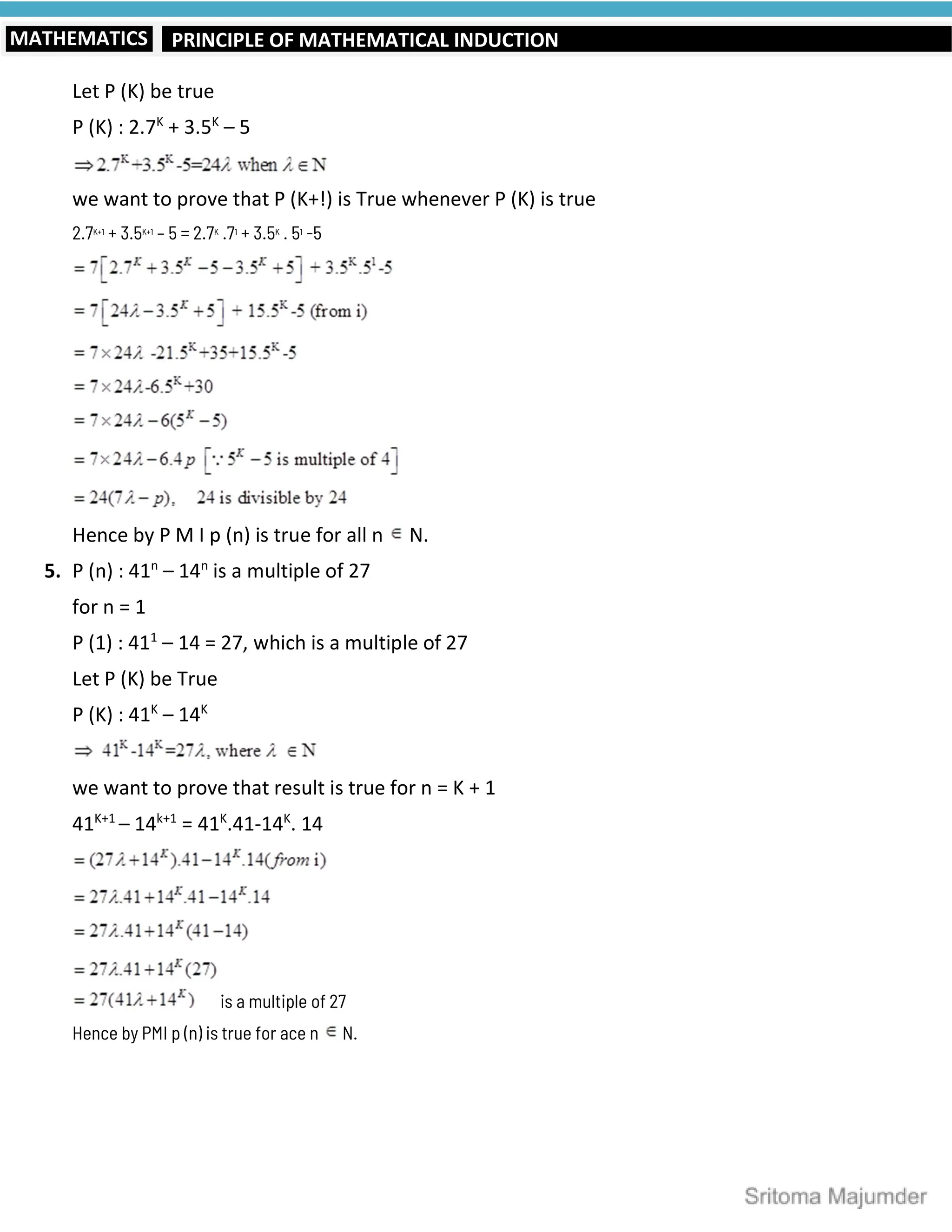
4. P(n) : 2.7n
+ 3.5n
– 5 is divisible by 24
for n = 1
P (1) : 2.71
+ 3.51
– 5 = 24 is divisible by 24
Hence result is true for n = 1
PRINCIPLE OF MATHEMATICAL INDUCTION
MATHEMATICS
Let P (K) be true
P (K) : 2.7K
+ 3.5K
– 5
we want to prove that P (K+!) is True whenever P (K) is true
2.7K+1
+ 3.5K+1
– 5 = 2.7K
.71
+ 3.5K
. 51
-5
Hence by P M I p (n) is true for all n N.
5. P (n) : 41n
– 14n
is a multiple of 27
for n = 1
P (1) : 411
– 14 = 27, which is a multiple of 27
Let P (K) be True
P (K) : 41K
– 14K
we want to prove that result is true for n = K + 1
41K+1
– 14k+1
= 41K
.41-14K
. 14
is a multiple of 27
Hence by PMI p (n) is true for ace n N.

CBSE Grade 11 Mathematics Ch 4 Principle Of Mathematical Induction Notes

  • 2.
    PRINCIPLE OF MATHEMATICALINDUCTION MATHS 2 PRINCIPLE OF MATHEMATICAL INDUCTION Top Concepts 1. There are two types of reasoning—deductive and inductive. 2. In deduction, given a statement to be proven which is often called a conjecture or a theorem, validdeductive steps are derived and a proof may or may not be established. 3. Deduction is the application of a general case to a particular case. 4. Inductive reasoning depends on working with each case and developing a conjecture by observingincidence till each and every case is observed. 5. Induction is the generalisation from particular cases or facts. 6. A deductive approach is known as a ‘top–down approach’. Given the theorem which is narrowed downto specific hypotheses then to observation. Finally, the hypotheses is tested with specific data to get the confirmation (or not) of original theory. 7. Inductive reasoning works the other way—moving from specific observations to broader generalisations and theories. Informally, this is known as a ‘bottom–up approach’.
  • 3.
    PRINCIPLE OF MATHEMATICALINDUCTION MATHS 3 8. To prove statements or results formulated in terms of n, where n is a positive integer, a principle basedon inductive reasoning called the Principle of Mathematical Induction (PMI) is used. 9. PMI is one such tool which can be used to prove a wide variety of mathematical statements. Each ofsuch statements is assumed as P(n) associated with a positive integer n for which the correctness of the case n = 1 is examined.Then, assuming the truth of P(k) for some positive integer k, the truth of P(k + 1) is established. 10. Let p(n) denote a mathematical statement such that (1) p(1) is true. (2) p(k + 1) is true whenever p(k) is true. Then, the statement is true for all natural numbers n by PMI. 11. PMI is based on the Peano’s Axiom. 12. PMI is based on a series of well-defined steps, so it is necessary to verify all of them. 13. PMI can be used to prove the equality, inequalities and divisibility of natural numbers. Key Formulae 1. Sum of n natural numbers: 1 + 2 + 3 + …. + n = 𝐧(𝐧 𝟏) 𝟐 2. Sum of n2 natural numbers: 12 +22 +32 +………n2 = 𝐧(𝐧 𝟏)(𝟐𝐧 𝟏) 𝟔 3. Sum of odd natural numbers: 1 + 3 + 5 + 7…… + (2n − 1) = n2 4. Steps of PMI 1. Denote the given statement in terms of n by P(n). 2. Check whether the proposition is true for n = 1. 3. Assume that the proposition result is true for n = k. 4. Using p(k), prove that the proposition is true for p(k + 1). 5. Rules of inequalities a. If a < b and b < c, then a < c. b. If a < b, then a + c < b + c. c. If a < b and c > 0 which means c is positive, then ac < bc. d. If a < b and c < 0 which means c is positive, then ac > bc.
  • 4.
    PRINCIPLE OF MATHEMATICALINDUCTION MATHS 4
  • 5.
    PRINCIPLE OF MATHEMATICALINDUCTION MATHEMATICS Important Questions Multiple Choice questions- Question 1. For all n ∈ N, 3n5 + 5n³ + 7n is divisible by (a) 5 (b) 15 (c) 10 (d) 3 Question 2. {1 – (1/2)}{1 – (1/3)}{1 – (1/4)} ……. {1 – 1/(n + 1)} = (a) 1/(n + 1) for all n ∈ N. (b) 1/(n + 1) for all n ∈ R (c) n/(n + 1) for all n ∈ N. (d) n/(n + 1) for all n ∈ R Question 3. For all n ∈ N, 32n + 7 is divisible by (a) non of these (b) 3 (c) 11 (d) 8 Question 4. The sum of the series 1 + 2 + 3 + 4 + 5 + ………..n is (a) n(n + 1) (b) (n + 1)/2 (c) n/2 (d) n(n + 1)/2 Question 5. The sum of the series 1² + 2² + 3² + ……….. n² is (a) n(n + 1) (2n + 1) (b) n(n + 1) (2n + 1)/2 (c) n(n + 1) (2n + 1)/3 (d) n(n + 1) (2n + 1)/6 Question 6. For all positive integers n, the number n(n² − 1) is divisible by: (a) 36
  • 6.
    PRINCIPLE OF MATHEMATICALINDUCTION MATHEMATICS (b) 24 (c) 6 (d) 16 Question 7. If n is an odd positive integer, then aⁿ + bⁿ is divisible by : (a) a² + b² (b) a + b (c) a – b (d) none of these Question 8. n(n + 1) (n + 5) is a multiple of ____ for all n ∈ N (a) 2 (b) 3 (c) 5 (d) 7 Question 9. For any natural number n, 7ⁿ – 2ⁿ is divisible by (a) 3 (b) 4 (c) 5 (d) 7 Question 10. The sum of the series 1³ + 2³ + 3³ + ………..n³ is (a) {(n + 1)/2}² (b) {n/2}² (c) n(n + 1)/2 (d) {n(n + 1)/2}² Very Short: 1. Short Questions: 1. For every integer n, prove that 7n – 3n divisible by 4. 2. Prove that n (n + 1) (n + 5) is multiple of 3. 3. Prove that 102n-1 + 1 is divisible by 11. 4. Prove that 1 + 1 + 1 + … . 1 + = (𝑛 + 1)
  • 7.
    PRINCIPLE OF MATHEMATICALINDUCTION MATHEMATICS 5. Prove 1.2 + 2.3 + 3.4 + _ _ _ + n (𝑛 + 1) = ( )( ) Long Questions: 1. Prove (2n+7) < (n + 3)2 2. Prove that: 3. Prove 1.2 + 2.22 + 3.23 +…+ n.2n = (n - 1)2n+1 + 2 4. Prove that 2.7n + 3.5n – 5 is divisible by 24 ∀ 𝑛 𝜖 𝑁. 5. Prove that 41n – 14n is a multiple of 27. Answer Key: MCQ: 1. (b) 15 2. (a) 1/(n + 1) for all n ∈ N. 3. (d) 8 4. (d) n(n + 1)/2 5. (d) n(n + 1) (2n + 1)/6 6. (c) 6 7. (b) a + b 8. (b) 3 9. (c) 5 10. (d) {n(n + 1)/2}² Very Short Answer: 1. 2. 39°22"30"" 3. 𝑐𝑚 4. √3 5. √ 6. 2 − √3
  • 8.
    PRINCIPLE OF MATHEMATICALINDUCTION MATHEMATICS 7. 8. 45∘ 9. 2 sin8θ cos4θ 10.sin 6x – sin2x Short Answer: 1. P(n) : 7n - 3n is divisible by 4 For n = 1 P(1) : 71 - 31 =4 which is divisible by Thus, P(1) is true Let P(k) be true 2.
  • 9.
    PRINCIPLE OF MATHEMATICALINDUCTION MATHEMATICS 3. 4.
  • 10.
    PRINCIPLE OF MATHEMATICALINDUCTION MATHEMATICS 5.
  • 11.
    PRINCIPLE OF MATHEMATICALINDUCTION MATHEMATICS Long Answer: 1. 2.
  • 12.
    PRINCIPLE OF MATHEMATICALINDUCTION MATHEMATICS 3. c 4. P(n) : 2.7n + 3.5n – 5 is divisible by 24 for n = 1 P (1) : 2.71 + 3.51 – 5 = 24 is divisible by 24 Hence result is true for n = 1
  • 13.
    PRINCIPLE OF MATHEMATICALINDUCTION MATHEMATICS Let P (K) be true P (K) : 2.7K + 3.5K – 5 we want to prove that P (K+!) is True whenever P (K) is true 2.7K+1 + 3.5K+1 – 5 = 2.7K .71 + 3.5K . 51 -5 Hence by P M I p (n) is true for all n N. 5. P (n) : 41n – 14n is a multiple of 27 for n = 1 P (1) : 411 – 14 = 27, which is a multiple of 27 Let P (K) be True P (K) : 41K – 14K we want to prove that result is true for n = K + 1 41K+1 – 14k+1 = 41K .41-14K . 14 is a multiple of 27 Hence by PMI p (n) is true for ace n N.