Willy Geurts CBRD Centre of Applied Research into  Brand Reputation and Design Management School of Communication Media &Music
 
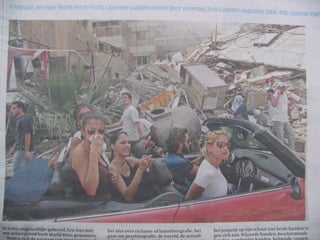
De bewegende blik   The moving gaze
 
Communities of Practice  around Visual Communication  Identity Meaning and Learning     Willy Geurts
What are the Practices? What are the Communities? What is Visual Communication? Who is involved in the field of Visual Communication?
 
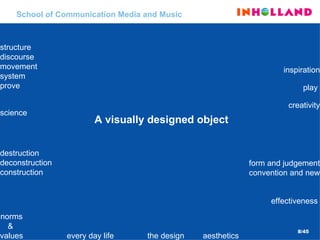
School of  Communication Media and Music A visually designed object the design   science destruction deconstruction  construction structure  discourse movement system prove every day life creativity play   inspiration aesthetics norms &  values form and judgement convention and new effectiveness
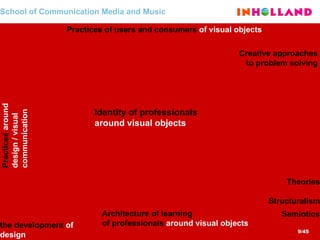
School of Communication Media and Music Identity of professionals  around visual objects the development  of  design Theories Structuralism Semiotics Creative approaches  to problem solving   Practices  around design / visual communication Architecture of learning of professionals  around visual objects Practices of users and consumers  of visual objects
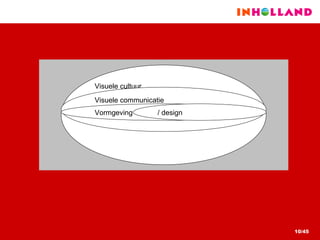
Visuele cultuur Visuele communicatie Vormgeving  / design
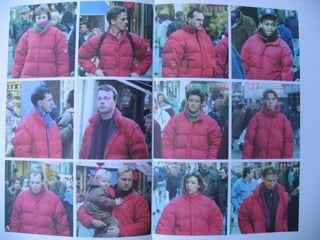
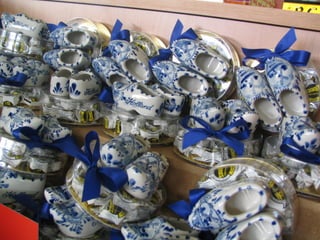
School of Communication Media and Music Definitions  visual culture Shared practices of a group, community or society, where meaning is made out of the visual, auditive and textual world of representations. Those aspects of culture that are manifested in a visual form – paintings, print work, pictures, film, television, video, advertisements, news, scientific images   Sturken en Cartwright: Practices of  Looking
 
Definitions  design Traffic in two directions: creative and analytic thinking. As applied creativity, as problem solving, as learning, as a social process, as play 1] Designed by men. Non-verbal communication. Design gives functional and emotional values to a product. [2] A plan to arrange elements in such a way that a specific aim will be reached best. [3] [1]  Dorst, Understanding design, 2003 [2] Van Thiel and Michels: De basis van design management, 1998  [3] Eames in Laurel: Design research, 2003
School  of Communication Media and Music Definitions of  design Design [4] as art Design as problem solving Design as a creative act Design as a group of related professions Design as industry Design as a process What is the relationship of design with economy and culture? [4]   Rachel Cooper, Mike Press, The Design Agenda , 1999
 
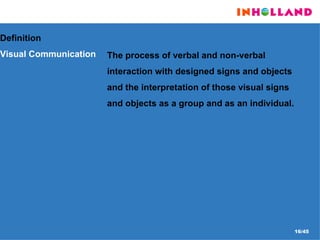
Definition  Visual Communication The process of verbal and non-verbal interaction with designed signs and objects and the interpretation of those visual signs and objects as a group and as an individual.
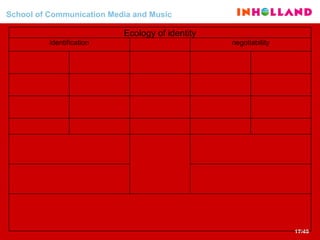
School of Communication Media and Music   negotiability     identification  Ecology of identity
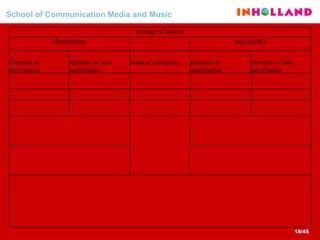
School of Communication Media and Music     Identities of non-participation   Identities of participation    Mode of belonging   Identities of non-participation   Identities of participation negotiability     identification  Ecology of identity
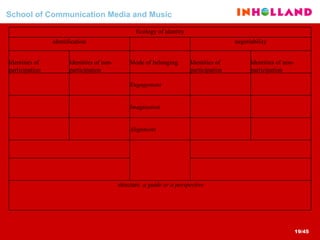
School of Communication Media and Music   structure   a guide or a perspective     Alignment   Imagination   Engagement   Identities of non-participation   Identities of participation    Mode of belonging   Identities of non-participation   Identities of participation negotiability     identification  Ecology of identity
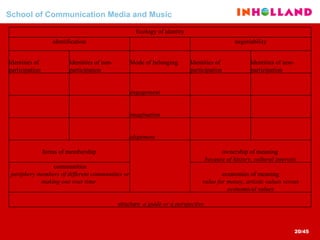
School of Communication Media and Music   structure   a guide or a perspective economies of meaning value for money, artistic values versus economical values   communities   periphery members of different communities or making one over time  ownership of meaning  because of history, cultural interests     forms of membership   alignment   imagination   engagement   Identities of non-participation   Identities of participation    Mode of belonging   Identities of non-participation   Identities of participation negotiability     identification  Ecology of identity
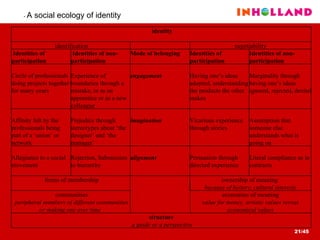
-  A social ecology of identity  structure   a guide or a perspective economies of meaning value for money, artistic values versus economical values   communities   peripheral members of different communities or making one over time  ownership of meaning  because of history, cultural interests     forms of membership     Literal compliance as in contracts    Persuasion through directed experience      alignment   Rejection, Submission to hierarchy   Allegiance to a social movement    Assumption that someone else understands what is going on   Vicarious experience through stories   imagination   Prejudice through stereotypes about ‘the designer’ and ‘the manager’   Affinity felt by the professionals being part of a ‘union’ or network   Marginality through having one’s ideas ignored, rejected, denied     Having one’s ideas adopted, understanding the products the other makes   engagement   Experience of boundaries through a mistake, or as an apprentice or as a new colleague   Circle of professionals doing projects together for many years   Identities of non-participation Identities of participation Mode of belonging   Identities of non-participation   Identities of participation negotiability     identification   identity  
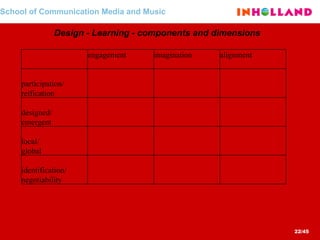
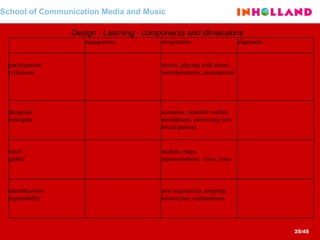
School of Communication Media and Music Design - Learning - components and dimensions   identification/ negotiability   local/ global   designed/ emergent   participation/ reification alignment imagination engagement    
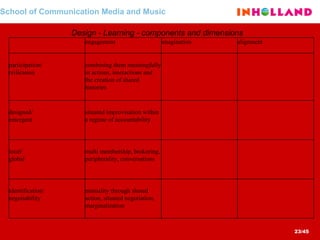
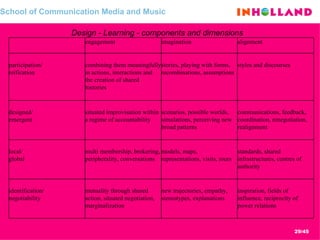
School of Communication Media and Music Design - Learning - components and dimensions   mutuality through shared action, situated negotiation, marginalization     identification/ negotiability   multi membership, brokering,  peripherality, conversations     local/ global   situated improvisation within a regime of accountability   designed/ emergent   combining them meaningfully in actions, interactions and the creation of shared histories     participation/ reification alignment imagination engagement    
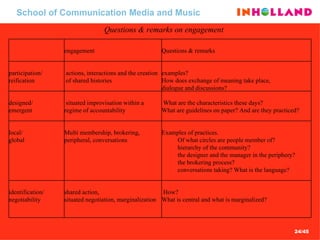
School of Communication Media and Music   Questions & remarks on engagement     How? What is central and what is marginalized?    shared action, situated negotiation, marginalization     identification/ negotiability Examples of practices. Of what circles are people member of?  hierarchy of the community? the designer and the manager in the periphery?  the brokering process?  conversations taking? What is the language?   Multi membership, brokering,  peripheral, conversations     local/ global     What are the characteristics these days? What are guidelines on paper? And are they practiced?   situated improvisation within a  regime of accountability   designed/ emergent   examples?  How does exchange of meaning take place,  dialogue and discussions?    actions, interactions and the creation  of shared histories     participation/ reification   Questions & remarks   engagement    
School of Communication Media and Music Design - Learning - components and dimensions   new trajectories, empathy, stereotypes, explanations   identification/ negotiability   models, maps, representations, visits, tours   local/ global   scenarios, possible worlds, simulations, perceiving new broad patterns   designed/ emergent   stories, playing with forms, recombinations, assumptions   participation/ reification alignment imagination engagement    
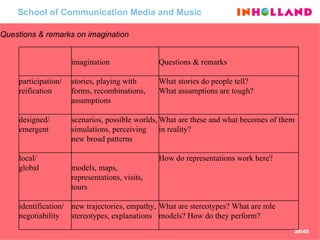
School of Communication Media and Music Questions & remarks on imagination   What are stereotypes? What are role models? How do they perform? new trajectories, empathy, stereotypes, explanations   identification/ negotiability How do representations work here?    models, maps, representations, visits, tours   local/ global What are these and what becomes of them in reality? scenarios, possible worlds, simulations, perceiving new broad patterns   designed/ emergent What stories do people tell? What assumptions are tough?  stories, playing with forms, recombinations, assumptions   participation/ reification   Questions & remarks   imagination    
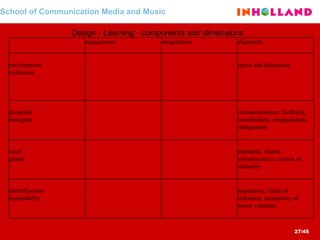
School of Communication Media and Music Design - Learning - components and dimensions   inspiration, fields of influence, reciprocity of power relations   identification/ negotiability   standards, shared infrastructures, centres of authority   local/ global   communications, feedback, coordination, renegotiation, realignment     designed/ emergent   styles and discourses   participation/ reification alignment imagination engagement    
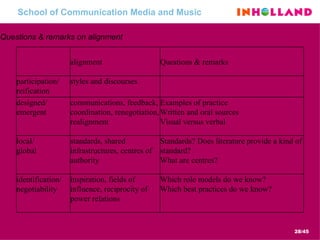
School of Communication Media and Music Questions & remarks on alignment Which role models do we know? Which best practices do we know? inspiration, fields of influence, reciprocity of power relations   identification/ negotiability Standards? Does literature provide a kind of standard? What are centres?    standards, shared infrastructures, centres of authority   local/ global Examples of practice Written and oral sources Visual versus verbal communications, feedback, coordination, renegotiation, realignment   designed/ emergent styles and discourses participation/ reification   Questions & remarks   alignment    
School of Communication Media and Music Design - Learning - components and dimensions   inspiration, fields of influence, reciprocity of power relations   new trajectories, empathy, stereotypes, explanations   mutuality through shared action, situated negotiation, marginalization     identification/ negotiability   standards, shared infrastructures, centres of authority   models, maps, representations, visits, tours   multi membership, brokering,  peripherality, conversations     local/ global   communications, feedback, coordination, renegotiation, realignment     scenarios, possible worlds, simulations, perceiving new broad patterns   situated improvisation within a regime of accountability   designed/ emergent   styles and discourses   stories, playing with forms, recombinations, assumptions   combining them meaningfully in actions, interactions and the creation of shared histories     participation/ reification alignment imagination engagement    
 
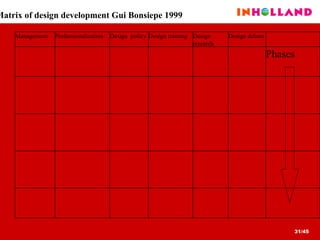
Matrix of design development Gui Bonsiepe 1999 Phases  Design debate Design research Design training Design  policy Professionalization  Management
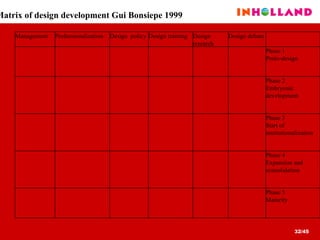
Matrix of design development Gui Bonsiepe 1999 Phase 5 Maturity Phase 4 Expansion and consolidation Phase 3 Start of institutionalization Phase 2 Embryonic development Phase 1 Proto-design Design debate Design research Design training Design  policy Professionalization  Management
 
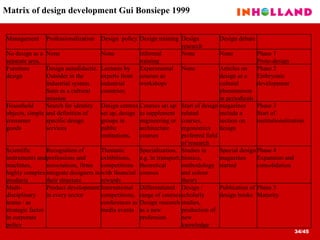
Matrix of design development Gui Bonsiepe 1999 Phase 5 Maturity Publication of design books Design / scholarly studies, production of new knowledge Differentiated range of courses Design research as a new profession International competitions, conferences as media events Product development in every sector Multi-disciplinary teams / as strategic factor in corporate policy Phase 4 Expansion and consolidation Special design magazines started Studies in bionics, methodology and colour theory Specialization, e.g. in transport, theoretical courses Thematic exhibitions, competitions with financial rewards Recognition of professions and associations, firms integrate designers in their structure Scientific instruments and machines, highly complex products Phase 3 Start of institutionalization magazines include a section on design  Start of design related courses, ergonomics preferred field of research Courses set up to supplement engineering or architecture courses Design centres set up, design groups in public institutions,  Search for identity and definition of specific design services Household objects, simple consumer goods  Phase 2 Embryonic development Articles on design as a cultural phenomenon in periodicals None Experimental courses as workshops  Lectures by experts from industrial countries;  Design autodidactic. Outsider in the industrial system. Seen as a cultural mission Furniture design Phase 1 Proto-design None None Informal training None None  No design as a separate area.  Design debate Design research Design training Design  policy Professionalization  Management
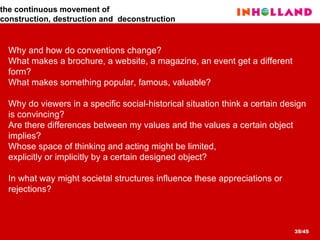
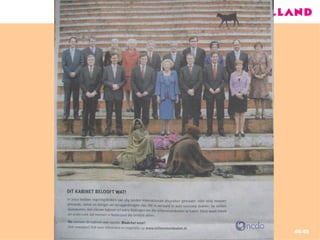
Why and how do conventions change?  What makes a brochure, a website, a magazine, an event get a different  form?  What makes something popular, famous, valuable?  Why do viewers in a specific social-historical situation think a certain design  is convincing? Are there differences between my values and the values a certain object  implies?  Whose space of thinking and acting might be limited,  explicitly or implicitly by a certain designed object? In what way might societal structures influence these appreciations or  rejections?   the  continuous movement of  construction, destruction and  deconstruction
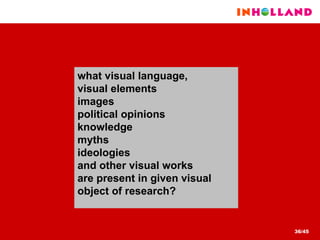
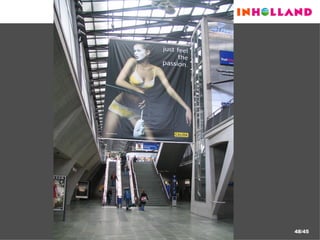
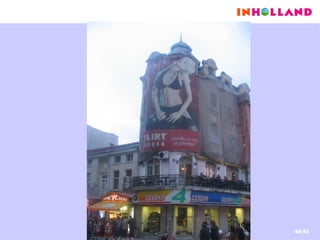
what visual language,  visual elements images political opinions knowledge myths ideologies and other visual works are present in given visual object of research?
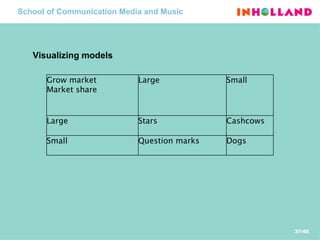
School of Communication Media and Music Visualizing models Dogs  Question marks Small  Cashcows Stars  Large  Small  Large  Grow market Market share
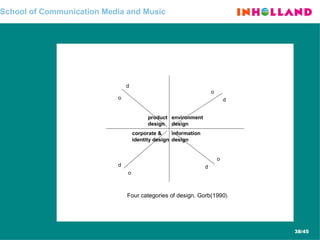
School of Communication Media and Music
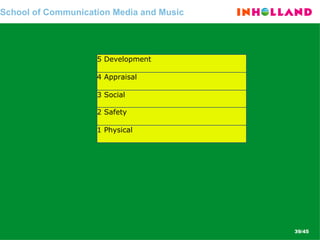
School of Communication Media and Music 1 Physical 2 Safety 3 Social 4 Appraisal  5 Development
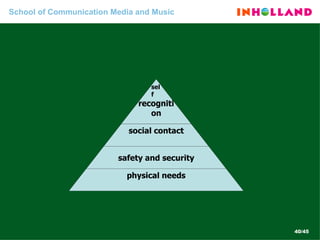
School of Communication Media and Music self recognition social contact safety and security physical needs
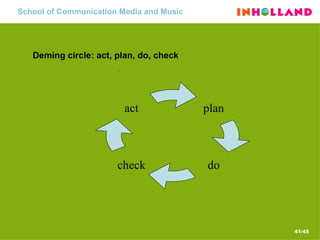
School of Communication Media and Music Deming circle: act, plan, do, check .  plan do check act
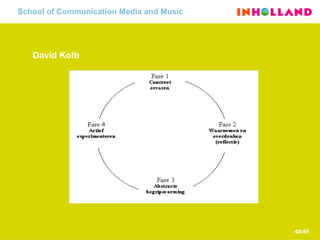
School of Communication Media and Music David Kolb
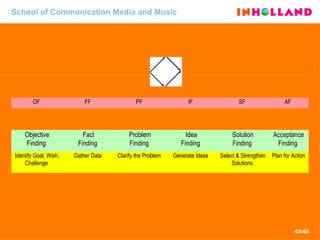
School of Communication Media and Music Plan for Action Select & Strengthen Solutions  Generate Ideas  Clarify the Problem  Gather Data  Identify Goal, Wish, Challenge  Acceptance Finding  Solution Finding   Idea Finding  Problem Finding  Fact Finding  Objective Finding  AF  SF  IF  PF  FF  OF
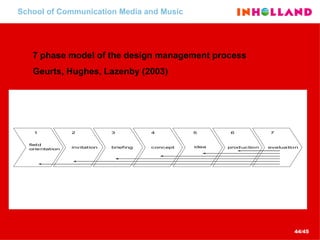
School of Communication Media and Music 7 phase model of the design management process Geurts, Hughes, Lazenby (2003)


Cbrd Lecture Rotterdam

  • 1.
    Willy Geurts CBRDCentre of Applied Research into Brand Reputation and Design Management School of Communication Media &Music
  • 2.
  • 3.
    De bewegende blik The moving gaze
  • 4.
  • 5.
    Communities of Practice around Visual Communication Identity Meaning and Learning   Willy Geurts
  • 6.
    What are thePractices? What are the Communities? What is Visual Communication? Who is involved in the field of Visual Communication?
  • 7.
  • 8.
    School of Communication Media and Music A visually designed object the design science destruction deconstruction construction structure discourse movement system prove every day life creativity play inspiration aesthetics norms & values form and judgement convention and new effectiveness
  • 9.
    School of CommunicationMedia and Music Identity of professionals around visual objects the development of design Theories Structuralism Semiotics Creative approaches to problem solving Practices around design / visual communication Architecture of learning of professionals around visual objects Practices of users and consumers of visual objects
  • 10.
    Visuele cultuur Visuelecommunicatie Vormgeving / design
  • 11.
    School of CommunicationMedia and Music Definitions visual culture Shared practices of a group, community or society, where meaning is made out of the visual, auditive and textual world of representations. Those aspects of culture that are manifested in a visual form – paintings, print work, pictures, film, television, video, advertisements, news, scientific images Sturken en Cartwright: Practices of Looking
  • 12.
  • 13.
    Definitions designTraffic in two directions: creative and analytic thinking. As applied creativity, as problem solving, as learning, as a social process, as play 1] Designed by men. Non-verbal communication. Design gives functional and emotional values to a product. [2] A plan to arrange elements in such a way that a specific aim will be reached best. [3] [1] Dorst, Understanding design, 2003 [2] Van Thiel and Michels: De basis van design management, 1998 [3] Eames in Laurel: Design research, 2003
  • 14.
    School ofCommunication Media and Music Definitions of design Design [4] as art Design as problem solving Design as a creative act Design as a group of related professions Design as industry Design as a process What is the relationship of design with economy and culture? [4] Rachel Cooper, Mike Press, The Design Agenda , 1999
  • 15.
  • 16.
    Definition VisualCommunication The process of verbal and non-verbal interaction with designed signs and objects and the interpretation of those visual signs and objects as a group and as an individual.
  • 17.
    School of CommunicationMedia and Music   negotiability     identification  Ecology of identity
  • 18.
    School of CommunicationMedia and Music     Identities of non-participation   Identities of participation    Mode of belonging   Identities of non-participation   Identities of participation negotiability     identification  Ecology of identity
  • 19.
    School of CommunicationMedia and Music   structure  a guide or a perspective     Alignment   Imagination   Engagement   Identities of non-participation   Identities of participation    Mode of belonging   Identities of non-participation   Identities of participation negotiability     identification  Ecology of identity
  • 20.
    School of CommunicationMedia and Music   structure  a guide or a perspective economies of meaning value for money, artistic values versus economical values   communities   periphery members of different communities or making one over time ownership of meaning because of history, cultural interests     forms of membership   alignment   imagination   engagement   Identities of non-participation   Identities of participation    Mode of belonging   Identities of non-participation   Identities of participation negotiability     identification  Ecology of identity
  • 21.
    - Asocial ecology of identity structure   a guide or a perspective economies of meaning value for money, artistic values versus economical values   communities   peripheral members of different communities or making one over time ownership of meaning because of history, cultural interests     forms of membership     Literal compliance as in contracts   Persuasion through directed experience     alignment   Rejection, Submission to hierarchy   Allegiance to a social movement   Assumption that someone else understands what is going on   Vicarious experience through stories   imagination   Prejudice through stereotypes about ‘the designer’ and ‘the manager’   Affinity felt by the professionals being part of a ‘union’ or network   Marginality through having one’s ideas ignored, rejected, denied     Having one’s ideas adopted, understanding the products the other makes   engagement   Experience of boundaries through a mistake, or as an apprentice or as a new colleague   Circle of professionals doing projects together for many years   Identities of non-participation Identities of participation Mode of belonging   Identities of non-participation   Identities of participation negotiability     identification   identity  
  • 22.
    School of CommunicationMedia and Music Design - Learning - components and dimensions   identification/ negotiability   local/ global   designed/ emergent   participation/ reification alignment imagination engagement    
  • 23.
    School of CommunicationMedia and Music Design - Learning - components and dimensions   mutuality through shared action, situated negotiation, marginalization     identification/ negotiability   multi membership, brokering, peripherality, conversations     local/ global   situated improvisation within a regime of accountability   designed/ emergent   combining them meaningfully in actions, interactions and the creation of shared histories     participation/ reification alignment imagination engagement    
  • 24.
    School of CommunicationMedia and Music   Questions & remarks on engagement     How? What is central and what is marginalized?   shared action, situated negotiation, marginalization     identification/ negotiability Examples of practices. Of what circles are people member of? hierarchy of the community? the designer and the manager in the periphery? the brokering process? conversations taking? What is the language?   Multi membership, brokering, peripheral, conversations     local/ global     What are the characteristics these days? What are guidelines on paper? And are they practiced?   situated improvisation within a regime of accountability   designed/ emergent   examples? How does exchange of meaning take place, dialogue and discussions?   actions, interactions and the creation of shared histories     participation/ reification   Questions & remarks   engagement    
  • 25.
    School of CommunicationMedia and Music Design - Learning - components and dimensions   new trajectories, empathy, stereotypes, explanations   identification/ negotiability   models, maps, representations, visits, tours   local/ global   scenarios, possible worlds, simulations, perceiving new broad patterns   designed/ emergent   stories, playing with forms, recombinations, assumptions   participation/ reification alignment imagination engagement    
  • 26.
    School of CommunicationMedia and Music Questions & remarks on imagination   What are stereotypes? What are role models? How do they perform? new trajectories, empathy, stereotypes, explanations   identification/ negotiability How do representations work here?   models, maps, representations, visits, tours   local/ global What are these and what becomes of them in reality? scenarios, possible worlds, simulations, perceiving new broad patterns   designed/ emergent What stories do people tell? What assumptions are tough? stories, playing with forms, recombinations, assumptions   participation/ reification   Questions & remarks   imagination    
  • 27.
    School of CommunicationMedia and Music Design - Learning - components and dimensions   inspiration, fields of influence, reciprocity of power relations   identification/ negotiability   standards, shared infrastructures, centres of authority   local/ global   communications, feedback, coordination, renegotiation, realignment     designed/ emergent   styles and discourses   participation/ reification alignment imagination engagement    
  • 28.
    School of CommunicationMedia and Music Questions & remarks on alignment Which role models do we know? Which best practices do we know? inspiration, fields of influence, reciprocity of power relations   identification/ negotiability Standards? Does literature provide a kind of standard? What are centres?   standards, shared infrastructures, centres of authority   local/ global Examples of practice Written and oral sources Visual versus verbal communications, feedback, coordination, renegotiation, realignment   designed/ emergent styles and discourses participation/ reification   Questions & remarks   alignment    
  • 29.
    School of CommunicationMedia and Music Design - Learning - components and dimensions   inspiration, fields of influence, reciprocity of power relations   new trajectories, empathy, stereotypes, explanations   mutuality through shared action, situated negotiation, marginalization     identification/ negotiability   standards, shared infrastructures, centres of authority   models, maps, representations, visits, tours   multi membership, brokering, peripherality, conversations     local/ global   communications, feedback, coordination, renegotiation, realignment     scenarios, possible worlds, simulations, perceiving new broad patterns   situated improvisation within a regime of accountability   designed/ emergent   styles and discourses   stories, playing with forms, recombinations, assumptions   combining them meaningfully in actions, interactions and the creation of shared histories     participation/ reification alignment imagination engagement    
  • 30.
  • 31.
    Matrix of designdevelopment Gui Bonsiepe 1999 Phases Design debate Design research Design training Design policy Professionalization Management
  • 32.
    Matrix of designdevelopment Gui Bonsiepe 1999 Phase 5 Maturity Phase 4 Expansion and consolidation Phase 3 Start of institutionalization Phase 2 Embryonic development Phase 1 Proto-design Design debate Design research Design training Design policy Professionalization Management
  • 33.
  • 34.
    Matrix of designdevelopment Gui Bonsiepe 1999 Phase 5 Maturity Publication of design books Design / scholarly studies, production of new knowledge Differentiated range of courses Design research as a new profession International competitions, conferences as media events Product development in every sector Multi-disciplinary teams / as strategic factor in corporate policy Phase 4 Expansion and consolidation Special design magazines started Studies in bionics, methodology and colour theory Specialization, e.g. in transport, theoretical courses Thematic exhibitions, competitions with financial rewards Recognition of professions and associations, firms integrate designers in their structure Scientific instruments and machines, highly complex products Phase 3 Start of institutionalization magazines include a section on design Start of design related courses, ergonomics preferred field of research Courses set up to supplement engineering or architecture courses Design centres set up, design groups in public institutions, Search for identity and definition of specific design services Household objects, simple consumer goods Phase 2 Embryonic development Articles on design as a cultural phenomenon in periodicals None Experimental courses as workshops Lectures by experts from industrial countries; Design autodidactic. Outsider in the industrial system. Seen as a cultural mission Furniture design Phase 1 Proto-design None None Informal training None None No design as a separate area. Design debate Design research Design training Design policy Professionalization Management
  • 35.
    Why and howdo conventions change? What makes a brochure, a website, a magazine, an event get a different form? What makes something popular, famous, valuable? Why do viewers in a specific social-historical situation think a certain design is convincing? Are there differences between my values and the values a certain object implies? Whose space of thinking and acting might be limited, explicitly or implicitly by a certain designed object? In what way might societal structures influence these appreciations or rejections? the continuous movement of construction, destruction and deconstruction
  • 36.
    what visual language, visual elements images political opinions knowledge myths ideologies and other visual works are present in given visual object of research?
  • 37.
    School of CommunicationMedia and Music Visualizing models Dogs Question marks Small Cashcows Stars Large Small Large Grow market Market share
  • 38.
    School of CommunicationMedia and Music
  • 39.
    School of CommunicationMedia and Music 1 Physical 2 Safety 3 Social 4 Appraisal 5 Development
  • 40.
    School of CommunicationMedia and Music self recognition social contact safety and security physical needs
  • 41.
    School of CommunicationMedia and Music Deming circle: act, plan, do, check . plan do check act
  • 42.
    School of CommunicationMedia and Music David Kolb
  • 43.
    School of CommunicationMedia and Music Plan for Action Select & Strengthen Solutions Generate Ideas Clarify the Problem Gather Data Identify Goal, Wish, Challenge Acceptance Finding Solution Finding Idea Finding Problem Finding Fact Finding Objective Finding AF SF IF PF FF OF
  • 44.
    School of CommunicationMedia and Music 7 phase model of the design management process Geurts, Hughes, Lazenby (2003)
  • 45.
  • 46.
  • 47.
  • 48.
  • 49.
  • 50.
  • 51.