Visual Communication Research Designs 1st
Edition Keith Kenney download
https://ebookbell.com/product/visual-communication-research-
designs-1st-edition-keith-kenney-2441946
Explore and download more ebooks at ebookbell.com
Here are some recommended products that we believe you will be
interested in. You can click the link to download.
Handbook Of Visual Communication Research Theory Methods And Media Ken
Smith Et Al
https://ebookbell.com/product/handbook-of-visual-communication-
research-theory-methods-and-media-ken-smith-et-al-4102358
Visual Communication Theory And Research A Mass Communication
Perspective 1st Edition Shahira Fahmy
https://ebookbell.com/product/visual-communication-theory-and-
research-a-mass-communication-perspective-1st-edition-shahira-
fahmy-5378516
Visual Communication Design An Introduction To Design Concepts In
Everyday Experience Meredith Davis
https://ebookbell.com/product/visual-communication-design-an-
introduction-to-design-concepts-in-everyday-experience-meredith-
davis-46697902
Visual Communication Insights And Strategies Janis Teruggi Page
https://ebookbell.com/product/visual-communication-insights-and-
strategies-janis-teruggi-page-48753520
Visual Communication David Machin Editor
https://ebookbell.com/product/visual-communication-david-machin-
editor-51008524
Visual Communication Images With Messages 8th Edition Paul Lester
https://ebookbell.com/product/visual-communication-images-with-
messages-8th-edition-paul-lester-22618296
Visual Communication More Than Meets The Eye Harry Jamieson
https://ebookbell.com/product/visual-communication-more-than-meets-
the-eye-harry-jamieson-2345076
Visual Communication From Theory To Practice Jonathan Baldwin Lucienne
Roberts
https://ebookbell.com/product/visual-communication-from-theory-to-
practice-jonathan-baldwin-lucienne-roberts-4138794
Visual Communication David Machin
https://ebookbell.com/product/visual-communication-david-
machin-6770144
Visual Communication Research
Designs
Visual Communication Research Designs offers detailed guidance for using a
variety of research methods to investigate visual communications. This book
embeds each method—interview, draw-and-write, diary, Photovoice, case study,
visual ethnography, focus group, discourse analysis, and content analysis—within
a research design. Chapters begin with a brief, engaging story, such as:
• Why people really include visuals on Facebook.
• Why Picasso could draw but barely pass elementary school.
• How camera phones can be used for intimate communication.
They then address key research components for each method, such as theoretical
perspective, units of analysis, sampling, data analysis, data display, quality
control, advantages/disadvantages, ethical issues, and the resources needed to
complete the research.
Author Keith Kenney provides a consistent voice as well as a variety of
perspectives from eleven contributors, each describing his/her work on a
particular research project. With this book, Kenney moves visual communication
away from a medium-centered approach (such as television or film) to a com-
munication-centered approach (including intrapersonal, interpersonal, group,
organization, public, and mass communication).
Providing explicit, practical guidance in an accessible, understandable format,
this book will facilitate more and better research about visual communication.
Keith Kenney (Ph.D. Michigan State University) is an associate professor in the
School of Journalism and Mass Communications at the University of South
Carolina. He is the founding editor of Visual Communication Quarterly, and
he served as an editor of the Handbook of Visual Communication. He continues
to shoot documentary-style photographs and videos.
Visual Communication
Research Designs
Keith Kenney
First published 2009
by Routledge
270 Madison Ave, New York, NY 10016
Simultaneously published in the UK
by Routledge
2 Park Square, Milton Park, Abingdon, Oxon OX14 4RN
Routledge is an imprint of the Taylor & Francis Group, an informa business
© 2009 Taylor & Francis
All rights reserved. No part of this book may be reprinted or reproduced or
utilized in any form or by any electronic, mechanical, or other means, now
known or hereafter invented, including photocopying and recording, or in
any information storage or retrieval system, without permission in writing
from the publishers.
Trademark Notice: Product or corporate names may be trademarks or
registered trademarks, and are used only for identification and explanation
without intent to infringe.
Library of Congress Cataloging in Publication Data
Kenney, Keith.
Visual communication research designs / by Keith Kenney.
p. cm.
Includes bibliographical references and index.
1. Visual communication. 2. Visual communication—Research.
3. Research—Methodology. I. Title.
P93.5.K46 2009
302.2¢22—dc22
2008025834
ISBN10: 0–415–98869–1 (hbk)
ISBN10: 0–415–98870–5 (pbk)
ISBN10: 0–203–93101–7 (ebk)
ISBN13: 978–0–415–98869–8 (hbk)
ISBN13: 978–0–415–98870–4 (pbk)
ISBN13: 978–0–203–93101–1 (ebk)
This edition published in the Taylor & Francis e-Library, 2008.
“To purchase your own copy of this or any of Taylor & Francis or Routledge’s
collection of thousands of eBooks please go to www.eBookstore.tandf.co.uk.”
ISBN 0-203-93101-7 Master e-book ISBN
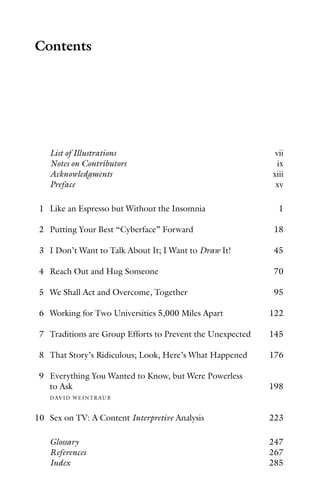
Contents
List of Illustrations vii
Notes on Contributors ix
Acknowledgments xiii
Preface xv
1 Like an Espresso but Without the Insomnia 1
2 Putting Your Best “Cyberface” Forward 18
3 I Don’t Want to Talk About It; I Want to Draw It! 45
4 Reach Out and Hug Someone 70
5 We Shall Act and Overcome, Together 95
6 Working for Two Universities 5,000 Miles Apart 122
7 Traditions are Group Efforts to Prevent the Unexpected 145
8 That Story’s Ridiculous; Look, Here’s What Happened 176
9 Everything You Wanted to Know, but Were Powerless
to Ask 198
DAVID WEINTRAUB
10 Sex on TV: A Content Interpretive Analysis 223
Glossary 247
References 267
Index 285
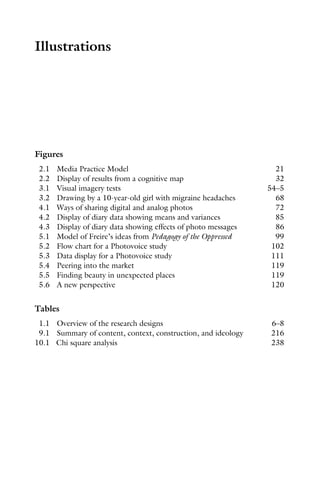
Illustrations
Figures
2.1 Media Practice Model 21
2.2 Display of results from a cognitive map 32
3.1 Visual imagery tests 54–5
3.2 Drawing by a 10-year-old girl with migraine headaches 68
4.1 Ways of sharing digital and analog photos 72
4.2 Display of diary data showing means and variances 85
4.3 Display of diary data showing effects of photo messages 86
5.1 Model of Freire’s ideas from Pedagogy of the Oppressed 99
5.2 Flow chart for a Photovoice study 102
5.3 Data display for a Photovoice study 111
5.4 Peering into the market 119
5.5 Finding beauty in unexpected places 119
5.6 A new perspective 120
Tables
1.1 Overview of the research designs 6–8
9.1 Summary of content, context, construction, and ideology 216
10.1 Chi square analysis 238
Contributors
Aaron Ahuvia is a professor of marketing at the University of Michigan-
Dearborn School of Management. He is former associate editor for the
Journal of Economic Psychology. His research looks at consumers’ involvement
with products and services they love, as well as the nature of contemporary
consumer culture. In addition to many academic publications, his research
has been quoted in Time, The New York Times, The Wall Street Journal, major
publications in Europe and Japan, and has appeared on public radio talk
shows as well as popular television shows, such as Oprah.
Craig Denton is Professor of Communication at the University of Utah, where
he directs the Documentary Studies Program and is on the Environmental
Humanities faculty. He is the author and photographer of Bear River: Last
Chance to Change Course, People of the West Desert: Finding Common Ground,
and West Desert: Photographs of Lake Bonneville Basin, among other books.
His current work, Hidden Water, photographically documents the uses and
misuses of surface water in Salt Lake Valley.
Nicole Ellison is an assistant professor in the Department of Telecom-
munication, Information Studies, and Media at Michigan State University.
Currently, she is exploring the social capital implications of Facebook use and
the nature of “friends” online. Her previous research has examined the
formation of virtual communities and the ways in which telecommuters use
information and communication technologies to calibrate the permeability
of their work/home boundaries, as explored in her 2004 book, Telework
and Social Change.
Eric Green is a doctoral candidate in the Clinical and Community Psychology
program at the University of South Carolina. Information about his research
on forced migration can be found at www.displacedcommunities.org. Upon
graduating he will begin a postdoctoral research fellowship at the NYU/
Bellevue Program for Survivors of Torture in New York City.
Lars-Christer Hydén is Professor of Health Communication at Linköping
University, Sweden. His main focus is on language and social interaction
especially in health settings and the role of narrative in the cultural interplay
of illness and health. Ongoing research is concerned with narration in
Alzheimer’s disease and aphasia. He has, together with Sonja Olin Lauritzen,
edited the book Medical Technologies and the Life World: The Social
Construction of Normality and with Jens Brockmeier the book Health, Illness,
Culture: Broken Narratives.
Keith Kenney is an associate professor in the School of Journalism and Mass
Communications at the University of South Carolina. In 1994, he was the
founding editor of Visual Communication Quarterly. He is an editor of
Handbook of Visual Communication, published by Lawrence Erlbaum in
2005. He continues to shoot documentary-style photographs and videos.
Wendy Kozol is Professor of Comparative American Studies at Oberlin
College. Her research and teaching interests include feminist theories
and methodologies, visual culture studies, transnationalism and popular
media, citizenship, militarization, and human rights activism. She is the
author of Life’s America: Family and Nation in Postwar Photojournalism and
has co-edited two anthologies (with Wendy Hesford): Haunting Violations:
Feminist Criticism and the Crisis of the “Real” and Just Advocacy: Women’s
Human Rights, Transnational Feminism and the Politics of Representation.
She is currently working on a new book tentatively titled Visible Wars and
American Nationalism: Militarization and Visual Culture in the Post-Cold
War Period.
Lawrence J. Mullen is an associate professor in the Hank Greenspun School
of Journalism and Media Studies at the University of Nevada Las Vegas. He
teaches and conducts research in the related areas of visual communication
and visual literacy.
Leysia Palen is an assistant professor in the Computer Science Department at
the University of Colorado, Boulder, where she is also a faculty affiliate with
the Technology, Learning and Society Institute (ATLAS), and the Institute
for Cognitive Science (ICS). Professor Palen was awarded a 2006 National
Science Federation Early CAREER grant to study information dissemination
in disaster events. She works on a broader stream of research concerning
computer-mediated interaction. She has been interviewed for articles in the
New Scientist, The New York Times, the Boston Globe, National Public Radio,
and other publications.
Carl Stafstrom, MD, PhD is Professor of Neurology and Pediatrics and
Chief of the Section of Pediatric Neurology at the University of Wisconsin
School of Medicine and Public Health, Madison. His research interests
include mechanisms of epilepsy in the developing brain, cognitive con-
sequences of seizures at different ages, dietary approaches to neurologic
disease, and the use of art to explore psychosocial adjustment issues in
children with neurologic disorders. He is the author of more than 200
scientific and medical articles, chapters, and commentaries. He is very active
x Contributors
in teaching medical students and residents and has received numerous
teaching awards.
Rob Walker is Director of the Centre for Applied Research in Education at the
University of East Anglia in the UK. His current research interests are in how
university students learn from complex sets of case evidence, in involving
children in the design of displays in museums and galleries, in the uses of
visual evidence in research, and in the design of educational spaces.
David Weintraub is an instructor in the School of Journalism and Mass
Communications at the University of South Carolina, where he teaches visual
communications and writing. He is the author of eight books on hiking and
kayaking in the San Francisco Bay Area and Cape Cod, and he has also written
many newspaper and magazine articles on photography and adventure travel.
Contributors xi
Acknowledgments
I thank my contributors, beginning with David Weintraub, who wrote a chapter,
and the following people, who wrote sidebars: Aaron Ahuvia, Craig Denton,
Nicole Ellison, Eric Green, Lars-Christer Hydén, Wendy Kozol, Lawrence J.
Mullen, Leysia Palen, Carl E. Stafstrom, and Rob Walker. Several additional
people helped me with this book. I thank my MA students Carrie McCullough
and Jiedi Sun for offering numerous, valuable editing suggestions. I thank my
colleague Scott Farrand for creating the graphics. And, most important, I thank
my wife, Susanna Melo, for suggesting ways to make the text easier to read and
for putting up with my absences on many weekends.
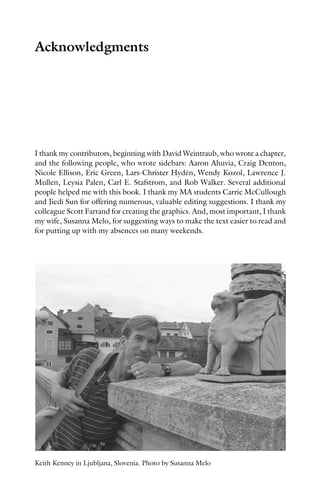
Keith Kenney in Ljubljana, Slovenia. Photo by Susanna Melo
Preface
More consumers are communicating visually than ever before. One reason has
to do with technology. Consumers buy, and use, digital cameras in mobile
phones, digital cameras that fit in your pocket, digital SLR (single-lens reflex)
cameras, and digital camcorders. Another reason has to do with the Internet.
I, and many others, spend hours connected to the Web. We check our e-mail
messages and see that people have sent us new pictures of their children or
vacation. We look for information, and in addition to written text, we find
photographs, audio slideshows, videos, and animations. We want to join in the
fun by creating our own profile on Facebook.com and our own home pages.
We want to share our pictures and videos with others.
In addition to consumers, more professionals are communicating visually
now than ever before. Newspapers, magazines, radio stations, and television
stations all use a full range of multimedia tools to attract viewers to their web-
sites. In addition to people who work for media industries, others also create or
interpret visuals as part of their jobs. If you work in business, you need visuals
to help sell your products. If you work in anthropology, biology, chemistry,
economics, or education, you also need to communicate visually. I could
continue listing professions, but you get the point.
If I am correct, and consumers and professionals are increasingly using visuals
to communicate, then more universities should offer more courses in visual
communication, and departments across a college campus should incorporate
visual communication ideas and practices into their existing courses. Indeed,
I believe both are happening.
If as a society we recognize the increasing importance of visual commu-
nication, then researchers should be conducting more research about visual
communication. Again, I think this is occurring. To support this assertion
I point to the creation of three new journals since 1994.
I begin with 1994 because that is when, with the help of many people,
Jim Gordon and I created Visual Communication Quarterly. I was the first
editor, and Jim was the publisher. Actually, the National Press Photographers
Association (NPPA) officially published the journal, but Jim convinced NPPA
that a research publication would serve the interests of photographers in the
newspaper and television industries as well as professors who teach visual
communication. Jim used part of his budget as editor of News Photographer
magazine to print the early issues of Visual Communication Quarterly and
to distribute them in News Photographer four times a year. Now, of course,
Lawrence Erlbaum publishes the journal. In addition to Visual Communication
Quarterly, two other journals were born: Journal of Visual Culture and Visual
Communication.
If courses and research related to visual communication have increased
since 1994, then you would expect that universities would be launching
PhD programs in order to produce professors who could teach those courses
and conduct those research studies. And you would be wrong. I do not believe
than any university in the United States, at least, has a doctoral program
emphasizing visual communication.
If not a doctoral program, then you would expect that scholars would be
writing books on how to conduct visual communication research, and, again,
you would be wrong. You can read books on visual research and you can read
books on communications research, but, until now, you could not read a book
that would explain how to conduct visual communications research.
So how have people like me, visual communications professors, learned to
teach and do research? I received an excellent education from Michigan State
University, but I never took a single course about visual communication during
my doctoral program. Most of my courses concerned quantitative research
methods and mass media theory.
After I graduated, I read everything I could that might help me understand
visual communication better. I read Roland Barthes, Sol Worth, John Berger,
Susan Sontag, Stuart Hall, John Collier, Howard Becker, Susanne Langer,
Nelson Goodman, among others. I read the Journal of Visual Sociology, Journal
of Visual Anthropology, and Journal of Visual Literacy.
When reading these books and journals, I encountered two problems.
One problem was how to apply my quantitative research training to conduct
research on the ideas about visuals. To meet this challenge I began to teach
myself about qualitative research designs. The other problem was how to apply
ideas from the fields of sociology, anthropology, and education to the field of
communication. To meet this challenge I simply read more and more about
communication.
In short, learning how to conduct visual communication research has been
hard. It still is a challenge, but I hope this book helps. By providing explicit,
practical guidance in a way that is easy to read, this book should enable more
people to conduct more and better research about visual communication.
I would like to think that professors teaching visual communication research
courses would assign this book to their students. I also hope that people teaching
research methods courses in journalism and mass communications courses
would recognize the value of studying the visual aspects of media and that
they would use this book in conjunction with a media research textbook. I hope
that professors who teach visual research in other fields, such as sociology,
anthropology, education, marketing, geography, tourism, nursing, and public
xvi Preface
health would recognize the connections between communications and their
particular field and that they would find useful the book’s detailed explanation
of ways to collect and analyze data. Finally, some professors teaching qualitative
research in the social sciences and humanities may choose to assign this book,
instead of their current textbook, because they understand the rising importance
of visual communication and they want to help their students investigate visuals
in our society.
Preface xvii
1 Like an Espresso but Without
the Insomnia
Explanation of the Title
Visual Communication Research Designs—the title’s meaning may seem
obvious, but I will be changing the meaning of some of these words, so please
read carefully.
First, I define communication as a social process. Communication is social
because it involves interactions between people. Communication is a process
because it consists of an ongoing series of exchanges. In these exchanges, one
person uses symbols to intentionally send a message; then others interpret
the message’s meaning and respond. With this definition, mass media are not
in the communication business. Mass media are in the information business,
the entertainment business, the persuasion business, and the money-making
business. People may seem to interact with the media when they talk back
to a TV program, and they may seem to be engaged in a process when they
become hooked on media content, but people are not really communicating
with a medium (TV), a company (CBS), a show (CSI Miami), or an actor
(David Caruso). On the other hand, I include mass media in this book because
so many people think of the media when they think of visual communication.
Next, I define visuals by example. Visuals include drawings, paintings,
photographs, videos, films, computer graphics, animations, and virtual reality
displays. Visuals do not include sculpture and architecture, which belong to the
plastic arts. Nor do visuals include the performing arts, such as music, theater,
and dance.
Next, I define visual communication as a social process in which people
exchange messages that include visuals. Visual communication differs from
visual display. You know something is a visual display when one person uses
visuals to express ideas or feelings, but that person does not particularly care
who sees the visuals, when they see the visuals, or whether they respond to the
visuals. Creators of the visuals, however, hope their audience will understand
at least some of their intended meaning.
Next is research. To conduct research means to investigate. Scholars may
use the scientific method to investigate a phenomenon or they may use some
other method, such as an analytic, critical, historical, or legal method, but their
goal is to advance human understanding. Their forms of data collection and
analysis are open to invention, and a critical community judges the value of
their efforts.
Rather than dividing research into scientific versus non-scientific camps,
however, I prefer to divide research into three groups: investigations based on
the natural sciences, the social sciences, and the humanities. To make some
gross generalizations, natural science researchers use experiments and other
quantitative methods to study the rules of nature. They accurately observe and
objectively measure things that they can see. Social science researchers study
people, not nature. They use interviews, observations, analysis of documents,
and other qualitative methods to interpret the meaning of people’s lives. Some
of the things they study, such as thoughts and feelings, cannot easily be
observed or measured. Humanities researchers also study people, but they do
not use scientific methods. Instead they use analytic or critical methods to
understand how culture influences people and how people influence culture.
Humanities include the fields of history, law, literature, languages, philosophy,
religion, the performing arts, and the visual arts.
I think of the social sciences as straddling the natural sciences and the
humanities because people interact with nature’s rules and they interact with
culture. When a natural force acts upon people or when people act upon
nature, then the natural sciences provide a suitable role model. On the other
hand, when culture influences people and when people influence culture, then
humanities provide a better model. Social scientists must pick from both
models and also must make compromises.
All three groups conduct research that is appropriate for their goals and
questions, but society does not value all three equally. Our culture currently
believes that natural sciences are superior to social sciences, which are superior
to the humanities. Since this is a culture-based belief and not one of nature’s
rules, it can change from place to place and time to time. Meanwhile, however,
the ways that natural science researchers advance human understanding have
more legitimacy, authority, power, and funding than the ways that humanities
researchers advance human understanding.
So where does the communication field fit into this three-group classifi-
cation? To me it seems obvious that communication can fit into the humanities
side of the social science group because communication is governed by culture
more than by nature’s rules. Many communications scholars want to follow
the natural science model, which has more authority and funding, but, as I
said, communication involves people and culture, not nature. If you agree,
then qualitative, analytic, and critical methods should be used to study
communication.
And where does visual communication fit? I believe visual communication,
as a subset of communication, fits into the humanities side of social science.
This idea, however, may disturb my school’s senior faculty members, who were
trained to use quantitative methods, not qualitative, analytic, or critical
methods. They might be thinking, “No tables with statistics? No levels of
2 Like an Espresso but Without the Insomnia
significance? No intercoder reliability?” They simply might not understand
how to conduct or evaluate such research, and they might be suspicious of the
unknown.
Next, I define a research design as a plan for how the investigation will be
conducted. As a plan, a research design deals with four problems: what ques-
tions to study, what information is relevant, how to collect that information,
and how to analyze the information. A research design, therefore, enables you
to link the investigation’s research questions with its conclusions.
Finally, we return to the beginning—visual communication research designs.
Confusion may arise about whether the phrase refers to research about visuals
or whether it refers to any research that uses visual technology. For this book,
the answer is both and more. You can use visual communication research
designs to study visuals that were created by participants or researchers. You
can also use visual communication research designs to study participant-created
visuals and researcher-created visuals. In this book:
• Three of the research designs involve a non-visual method (interviews,
discourse analysis, and interpretive analysis) to study visuals that people
had created without prompting from a researcher.
• Two designs involve a non-visual method (diaries, case study) to analyze
visuals that people knew a researcher would want to study.
• One research design involves a non-visual method (focus group) to study
visuals that the researchers had created.
• Two designs ask participants to create visuals (draw-and-write technique,
Photovoice).
• One research design requires that the researcher create visuals (visual
ethnography).
Goals
My contributors and I had several goals in mind as we wrote this book.
One, we want to tell you something new and interesting about visuals. To
meet this goal, we begin each chapter with a brief story. For example, we
explain:
• Why people really include visuals on Facebook.
• Why Picasso could draw but barely pass elementary school.
• How you can use camera phones for intimate communication.
• Why Zana Briski created the Oscar-winning documentary film Born into
Brothels.
• How a professor with Skype could serve on a virtual thesis committee.
• How Lauren Greenfield created the visuals for the book and film called
Thin.
• How prosecutors used visual persuasion to help convict Michael Skakel of
murder.
Like an Espresso but Without the Insomnia 3
• How photos in Life magazine maintained power relationships and ide-
ologies.
• How the media contribute to the sexualization of Miley Cyrus and other
girls.
In fact, you will find stories throughout the book about how people use
visuals.
Two, we advocate mending the split in communications programs. At the
university where I work, communication is taught in two completely separate
departments. You can study mass media, such as advertising, public relations,
television, and newspapers in the School of Journalism and Mass Communi-
cations; or you can study speech and rhetoric at the interpersonal or public
levels of communication in the English Department. This split may have
made sense at one time, but with the tremendous influence of the Internet, it
does more harm than good. We use the Internet as a worldwide mass medium
as well as to send and to receive personal e-mail messages. We also join chat
rooms, which resemble group or public communication. And we use intranets
for organizational communication. People are creating content and distrib-
uting content for one other family member, 20 friends, 200 employees, and
millions of strangers in multiple cultures. By explaining research designs at all
levels of communication, this book demonstrates the value of thinking about
communication as a single field, with a common set of theoretical perspectives
and methods.
Three, we want to tell you something new and interesting about research
designs. If your graduate program focuses on quantitative research, then use
this book to learn about the other types of research—qualitative and humanistic
research. If your graduate program focuses on qualitative research, then think
of this book—like espresso—as a stimulant. It will stimulate your interest in
additional research designs. You will learn how to use draw-and-tell, Photo-
voice, diaries, case studies, discourse analysis, and content interpretive analysis.
We hope you will be so excited after reading these chapters that you will lose
sleep thinking about when and how to apply them to your own research.
Four, we want to provide practical, systematic guidance on how to design
visual communication research studies. It seems obvious to us that you would
want to learn how to conduct visual communication research. Not only is such
work fun, it is also rewarding. Academia needs visual communication profes-
sors to teach all of its photography, graphics, video, and Web design courses.
Academia also wants to hire professors who can conduct research. Finding
visual communication teacher-researchers, however, is difficult because the
field is so new. In fact, no communications doctoral program emphasizes visual
communication. And even if such a program existed, students could not find
books to help them learn how to conduct visual communication research. Until
now. Visual Communication Research Designs is the first book that explains
how to design visual communication research studies.
To continue with our goals for this book, a fifth goal is to explain our ideas
4 Like an Espresso but Without the Insomnia
as clearly as possible. You may have already noticed some of our techniques.
First, we frequently number our points so that you can follow our thinking step
by step. Second, we use active voice, which means that you always know who
said or did something. Third, we use concrete examples to clarify and reinforce
our abstract points. Fourth, we boldface words when we first define them and
we include boldfaced words and their definitions in the glossary at the end of
the book. Fifth, we avoid wordiness so you will not have to sort through the
clutter to find the essential idea. Sixth, we use short sentences so that you will
not need to absorb too many ideas at once. Seventh, we hope you have noticed
the lack of jargon. Eighth, we include figures in order to visually as well as
verbally present our ideas.
Like all authors, we need goals when writing, but we also need to know if
we have met our goals. We will only know if we have succeeded if you either
buy this book or you send us an e-mail message. We hope you will do both.
Contact Keith Kenney at kkenney@sc.edu.
Organization
Most books about research design include a separate chapter about theory,
research questions, sampling, methods, analysis, and ethics. In this book, we
cover these same topics, and more, but not in separate chapters. Instead, we
have a theory section for each of the nine chapters. We also have a research
questions section for each of the nine chapters. In fact, we write about
15 different topics in each of the nine chapters.
The book’s format offers advantages and some potential disadvantages.
One advantage is that you can learn nine complete research designs from start
to finish rather than having to assemble parts of research designs from different
chapters. Another advantage is that you can easily compare research designs,
and, as you know, you can understand one thing better when you can compare
it to others. A third advantage is that each method for collecting data is directly
connected to a theoretical perspective. This is important because theory influ-
ences method and method influences theory. A possible disadvantage to this
format would be redundancy. We’ve tried to avoid redundancy by describing
a variety of theoretical perspectives, goals, methods, units of analysis, and so
on. Moreover, instead of repeating content, we simply refer you to the place
in the book where we discuss that topic. Another potential disadvantage is that
you may not realize there is no one right way to do anything in qualitative
research. We organized the material so that we explain one way of analyzing
data in Chapter 3, but that might not be the ONLY way to analyze such data.
You could try using the data analysis method covered in Chapter 4, for exam-
ple. Another potential disadvantage is that you may think that the qualitative
research process follows a straight line from beginning to end. It does not. A
graphic of the research process would include lots of arrows pointing in both
directions and looping around from the bottom up to the top. Each aspect of
the process would be connected to several other aspects.
Like an Espresso but Without the Insomnia 5
How
communication
and
media
influence
people’s
self-identities
A
visual
symbol
system’s
role
in
society,
Coordinated
Management
of
Meaning
Interpersonal
Process
Model
of
Intimacy
Paulo
Freire’s
ideas
How
video
improves
connection,
communication,
collaboration;
Social
Information
Processing;
Hyperpersonal
Interaction
Organizational
culture
Visual
persuasion
from
neurobiology,
narrative
studies
and
visual
media
studies
Interrelationship
of
discourse
and
power
Cultivation
theory;
social
modeling;
social
schema
Intrapersonal
Interpersonal,
face
to
face
Interpersonal,
distance,
phone
Group,
face
to
face
Group,
distance,
computer-
mediated
communication
Organization
Public
Mass
Mass
Putting
your
best
“cyberface”
forward
I
don’t
want
to
talk
about
it;
I
want
to
draw
it!
Reach
out
and
hug
someone
We
shall
act
and
overcome,
together
Working
for
two
universities
5,000
miles
apart
Traditions
are
group
efforts
to
prevent
the
unexpected
That
story’s
ridiculous;
look,
here’s
what
happened
Everything
you
wanted
to
know,
but
were
powerless
to
ask
Sex
on
TV:
a
content
interpretive
analysis
Table
1.1a
Overview
of
the
research
designs
2
3
4
5
6
7
8
9
10
Chapter
Title
Level
of
communication
Theoretical
perspectives
Basic
research:
learn
how
people
use
visuals
for
impression
management
Applied
research:
improve
communication
between
people
who
cannot
talk
Basic
and
applied:
learn
how
people
use
camera
phones
for
intimate
communication
Action
research:
empower
a
specific
community
Evaluation
research:
gauge
effectiveness
of
using
video
for
a
virtual
thesis
committee
Personal
or
applied:
visually
describe
the
culture
of
an
organization
or
a
social
group
Applied
research:
determine
how
people
might
use
visuals
to
create
a
story
at
a
trial
Basic
research:
determine
how
photos
and
texts
construct
a
particular
version
of
reality
Basic
research:
learn
the
nature
of
sexual
information
on
television
Interview
Visual-spatial
intelligence
tests;
draw-and-tell
Diaries
Photovoice
Case
study
Visual
ethnography
Focus
groups
Discourse
analysis
Variations
of
content
analysis
Goals
Methods
Note:
The
nine
chapters
cover
various
research
designs
for
studying
different
levels
of
visual
communication.
Themes
from
interviews
Visual
symbols
from
children’s
drawings
Entries
from
diaries;
or
answers
to
multiple-choice
questions
and
Likert
scales
Comments
on
the
community
from
group
discussions
Virtual
thesis
committee
Chunks
from
video
and
photographs
produced
by
the
researcher
Opinions
about
visuals
from
a
focus
group
Groups
of
photographs
and
written
texts
that
are
related
in
some
way
Character,
scenes,
or
shots
from
TV
programs
Purposeful
sample
of
12
people
with
social
networking
profiles
Convenience
sample
of
80
children
between
2nd
and
5th
grades
Purposeful
sample
of
10
couples,
who
communicate
intimately
10
volunteers
from
a
community
Purposeful
sample
of
one
or
more
virtual
theses
committees
Purposeful
sample
of
100–200
observations
and
30–50
interviews
Purposeful
sample
of
3–5
groups;
each
group
has
6–9
people
Purposeful
sample
Probability
sample
of
TV
programs
with
80
scenes
of
sexual
behavior
Units
of
analysis
Sampling
Table
1.1b
Overview
of
the
methods
and
analysis
sections
Note:
The
nine
chapters
cover
four
types
of
research—basic,
applied,
action,
and
evaluation
research—and
each
type
of
research
has
its
own
goals.
Methodologies
explain
how
evidence
will
be
collected;
data
reduction
and
analysis
produce
the
findings;
data
displays
enable
readers
to
draw
conclusions;
and
measures
of
quality
include:
credibility,
fittingness,
and
auditability.
2
3
4
5
6
7
8
9
10
Chapter
Code
themes
with
the
constant
comparative
method
Code
symbols;
rate
symbols;
create
metaphors
Code
answers
and
scales
from
diaries
Use
connection
strategy
Use
case
analysis
meetings;
pattern
matching
Code
activities’
structure,
timing,
space,
artifacts
and
troubles
Study
sequences
of
conversation;
answer
12
questions
Write
memos
to
keep
track
of
content,
context,
and
findings
Code
characters,
scenes,
or
shots
Data
analysis
Auditor;
naturalistic
and
analytic
generalizations;
check
for
representativeness
Triangulation;
intercoder
agreement
Member
checking;
check
for
reactivity
Collaboration
with
community
volunteers
Triangulating;
replications
Peer
reviewer;
thick
description;
negative
cases
Same
moderator
for
all
groups;
check
for
alternative
explanations
Persuasive
account
based
on
a
clear
step-by-step
analysis
Random
sample;
intercoder
agreement
Credibility,
transferability,
and
dependability
Cognitive
maps
Correlations
of
drawings
and
diagnoses;
drawings
and
visual
tests
Line
graph
of
changes
in
intimacy
over
time
List
of
projects
in
progress
or
completed
Case
dynamics
matrix
Video
and
photos
in
a
book,
DVD,
or
website
Vignettes
Table
with
headings
for
photos,
content,
context,
construction,
and
ideology
Content
analytic
summary
table
Data
displays
Table
1.1c
(Dis)advantages,
ethical
issues,
and
required
resources
You
obtain:
participants’
perspective,
face-to-face
interaction,
data
with
depth
and
nuance
Children
feel:
empowered,
comfortable;
they
give
more
information
and
lie
less
You
gain:
many
data
points
at
many
times,
less
biased
data
Participants:
collaborate,
learn,
benefit
directly,
see
their
photos
in
exhibitions
You:
build
and
extend
theory;
gain
confidence
in
findings
Viewers:
see
rich
visual
descriptions,
hear
natural
sounds,
hear
members’
voices
Participants:
feel
stimulated,
feel
empowered,
gain
mutual
support
Readers:
learn
how
photo/text
packages
express
ideological
values
You:
study
any
type
of
content,
repeatedly,
unobtrusively,
from
the
past
and
present
Advantages
2
3
4
5
6
7
8
9
10
Chapter
Respondents
may
forget,
distort,
misinterpret,
or
lie
Children
may
lack
drawing
skills,
copy
pictures,
reveal
too
much,
give
“right”
answers
You
may
receive
less
recognition;
your
group
may
feel
less
empowered
if
no
results
Researchers
may
receive
less
recognition;
participants
may
become
discouraged
Cannot
generalize
to
other
cases,
only
to
theory
Participants
may
react
to
you
and
your
cameras
The
group,
moderator,
and
researcher
all
affect
the
collection
and
interpretation
of
data
You
need
knowledge
from
many
different
academic
disciplines
You
may,
wrongly,
associate
frequency
of
content
with
significance
of
content
Disadvantages
Emotional
harm;
push
for
too
much
or
too
little
information;
power
imbalance
Children
and
voluntary
participation,
loss
of
privacy,
anxiety,
cognitive
dissonance
Proper
level
of
compensation;
invasion
of
privacy
Emotional
harm,
loss
of
privacy;
power
imbalance;
ownership
of
data
Investigator
biases
Informed
consent;
voluntary
participation;
power
imbalance;
illegal
activities
Confidentiality;
over-
disclosure
of
information
None
Investigator
biases
Ethical
issues
Time
for
training
to
conduct
interviews
and
analyze
interviews
Cooperation
from
children,
parents,
teachers,
principals;
expert
coders
Time
to
recruit
participants;
financial
incentives
for
participants
Money
for
photography,
facilitator,
participants,
and
projects
Time
for
triangulation
and
replication
Time
for
money
for
fieldwork;
photography
skills;
multi-tasking
skills
Money
for
room
hire,
snacks,
incentives,
transactions,
and
a
trained
moderator
Money
for
travel
to
archives
and
other
sites
Multiple
coders
who
have
expertise
or
who
regularly
view
your
content
Resources
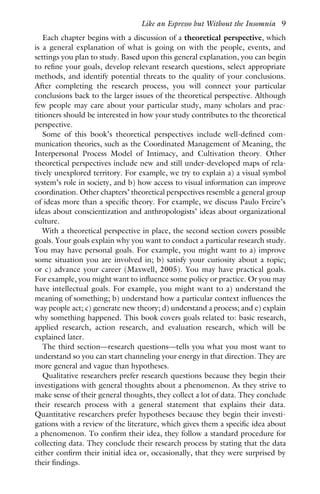
Each chapter begins with a discussion of a theoretical perspective, which
is a general explanation of what is going on with the people, events, and
settings you plan to study. Based upon this general explanation, you can begin
to refine your goals, develop relevant research questions, select appropriate
methods, and identify potential threats to the quality of your conclusions.
After completing the research process, you will connect your particular
conclusions back to the larger issues of the theoretical perspective. Although
few people may care about your particular study, many scholars and prac-
titioners should be interested in how your study contributes to the theoretical
perspective.
Some of this book’s theoretical perspectives include well-defined com-
munication theories, such as the Coordinated Management of Meaning, the
Interpersonal Process Model of Intimacy, and Cultivation theory. Other
theoretical perspectives include new and still under-developed maps of rela-
tively unexplored territory. For example, we try to explain a) a visual symbol
system’s role in society, and b) how access to visual information can improve
coordination. Other chapters’ theoretical perspectives resemble a general group
of ideas more than a specific theory. For example, we discuss Paulo Freire’s
ideas about conscientization and anthropologists’ ideas about organizational
culture.
With a theoretical perspective in place, the second section covers possible
goals. Your goals explain why you want to conduct a particular research study.
You may have personal goals. For example, you might want to a) improve
some situation you are involved in; b) satisfy your curiosity about a topic;
or c) advance your career (Maxwell, 2005). You may have practical goals.
For example, you might want to influence some policy or practice. Or you may
have intellectual goals. For example, you might want to a) understand the
meaning of something; b) understand how a particular context influences the
way people act; c) generate new theory; d) understand a process; and e) explain
why something happened. This book covers goals related to: basic research,
applied research, action research, and evaluation research, which will be
explained later.
The third section—research questions—tells you what you most want to
understand so you can start channeling your energy in that direction. They are
more general and vague than hypotheses.
Qualitative researchers prefer research questions because they begin their
investigations with general thoughts about a phenomenon. As they strive to
make sense of their general thoughts, they collect a lot of data. They conclude
their research process with a general statement that explains their data.
Quantitative researchers prefer hypotheses because they begin their investi-
gations with a review of the literature, which gives them a specific idea about
a phenomenon. To confirm their idea, they follow a standard procedure for
collecting data. They conclude their research process by stating that the data
either confirm their initial idea or, occasionally, that they were surprised by
their findings.
Like an Espresso but Without the Insomnia 9
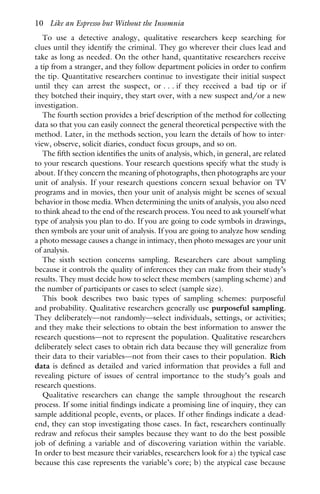
To use a detective analogy, qualitative researchers keep searching for
clues until they identify the criminal. They go wherever their clues lead and
take as long as needed. On the other hand, quantitative researchers receive
a tip from a stranger, and they follow department policies in order to confirm
the tip. Quantitative researchers continue to investigate their initial suspect
until they can arrest the suspect, or . . . if they received a bad tip or if
they botched their inquiry, they start over, with a new suspect and/or a new
investigation.
The fourth section provides a brief description of the method for collecting
data so that you can easily connect the general theoretical perspective with the
method. Later, in the methods section, you learn the details of how to inter-
view, observe, solicit diaries, conduct focus groups, and so on.
The fifth section identifies the units of analysis, which, in general, are related
to your research questions. Your research questions specify what the study is
about. If they concern the meaning of photographs, then photographs are your
unit of analysis. If your research questions concern sexual behavior on TV
programs and in movies, then your unit of analysis might be scenes of sexual
behavior in those media. When determining the units of analysis, you also need
to think ahead to the end of the research process. You need to ask yourself what
type of analysis you plan to do. If you are going to code symbols in drawings,
then symbols are your unit of analysis. If you are going to analyze how sending
a photo message causes a change in intimacy, then photo messages are your unit
of analysis.
The sixth section concerns sampling. Researchers care about sampling
because it controls the quality of inferences they can make from their study’s
results. They must decide how to select these members (sampling scheme) and
the number of participants or cases to select (sample size).
This book describes two basic types of sampling schemes: purposeful
and probability. Qualitative researchers generally use purposeful sampling.
They deliberately—not randomly—select individuals, settings, or activities;
and they make their selections to obtain the best information to answer the
research questions—not to represent the population. Qualitative researchers
deliberately select cases to obtain rich data because they will generalize from
their data to their variables—not from their cases to their population. Rich
data is defined as detailed and varied information that provides a full and
revealing picture of issues of central importance to the study’s goals and
research questions.
Qualitative researchers can change the sample throughout the research
process. If some initial findings indicate a promising line of inquiry, they can
sample additional people, events, or places. If other findings indicate a dead-
end, they can stop investigating those cases. In fact, researchers continually
redraw and refocus their samples because they want to do the best possible
job of defining a variable and of discovering variation within the variable.
In order to best measure their variables, researchers look for a) the typical case
because this case represents the variable’s core; b) the atypical case because
10 Like an Espresso but Without the Insomnia
this marks the variable’s outer boundaries; and c) the negative case because this
distinguishes the variable from its context and from other variables.
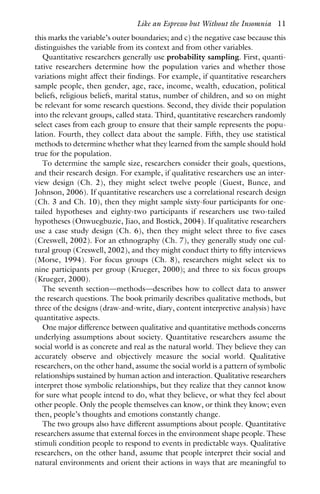
Quantitative researchers generally use probability sampling. First, quanti-
tative researchers determine how the population varies and whether those
variations might affect their findings. For example, if quantitative researchers
sample people, then gender, age, race, income, wealth, education, political
beliefs, religious beliefs, marital status, number of children, and so on might
be relevant for some research questions. Second, they divide their population
into the relevant groups, called stata. Third, quantitative researchers randomly
select cases from each group to ensure that their sample represents the popu-
lation. Fourth, they collect data about the sample. Fifth, they use statistical
methods to determine whether what they learned from the sample should hold
true for the population.
To determine the sample size, researchers consider their goals, questions,
and their research design. For example, if qualitative researchers use an inter-
view design (Ch. 2), they might select twelve people (Guest, Bunce, and
Johnson, 2006). If quantitative researchers use a correlational research design
(Ch. 3 and Ch. 10), then they might sample sixty-four participants for one-
tailed hypotheses and eighty-two participants if researchers use two-tailed
hypotheses (Onwuegbuzie, Jiao, and Bostick, 2004). If qualitative researchers
use a case study design (Ch. 6), then they might select three to five cases
(Creswell, 2002). For an ethnography (Ch. 7), they generally study one cul-
tural group (Creswell, 2002), and they might conduct thirty to fifty interviews
(Morse, 1994). For focus groups (Ch. 8), researchers might select six to
nine participants per group (Krueger, 2000); and three to six focus groups
(Krueger, 2000).
The seventh section—methods—describes how to collect data to answer
the research questions. The book primarily describes qualitative methods, but
three of the designs (draw-and-write, diary, content interpretive analysis) have
quantitative aspects.
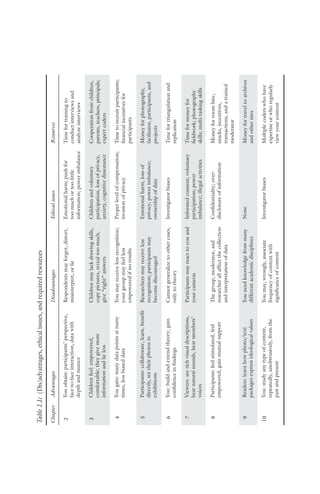
One major difference between qualitative and quantitative methods concerns
underlying assumptions about society. Quantitative researchers assume the
social world is as concrete and real as the natural world. They believe they can
accurately observe and objectively measure the social world. Qualitative
researchers, on the other hand, assume the social world is a pattern of symbolic
relationships sustained by human action and interaction. Qualitative researchers
interpret those symbolic relationships, but they realize that they cannot know
for sure what people intend to do, what they believe, or what they feel about
other people. Only the people themselves can know, or think they know; even
then, people’s thoughts and emotions constantly change.
The two groups also have different assumptions about people. Quantitative
researchers assume that external forces in the environment shape people. These
stimuli condition people to respond to events in predictable ways. Qualitative
researchers, on the other hand, assume that people interpret their social and
natural environments and orient their actions in ways that are meaningful to
Like an Espresso but Without the Insomnia 11
them. People use language, visuals, and other symbol systems to create and to
interpret their world of symbolic significance.
Because of their different assumptions, the two groups use different methods
to conduct research. Quantitative researchers conduct experiments on “sub-
jects” in a laboratory and they survey people whom they will never meet. They
follow standardized procedures and they use standard instruments so they can
assign numbers to pre-determined categories so they can compare their results
with other researchers’ results. Qualitative researchers, on the other hand, need
to spend a long time getting to know particular individuals and their complex
lives. They ask individuals questions and they observe individuals’ actions
at home or work in order to understand those individuals’ particular points
of view. Instead of putting their faith in a standard instrument, with proven
reliability and validity, qualitative researchers must trust themselves. They are
their research instruments. The study’s quality depends upon their skills,
including their ability to gain access and establish trust with the individuals they
study.
We describe the data collection process in an explicit, systematic manner so
you can confidently collect your own data. You should not, however, think of
the methods sections as cookbook recipes that will produce a “tasty” product.
You will need to substitute some ingredients and adjust cooking times because
you have a different personality and skill set from other qualitative researchers
and because the people you study differ from other people. But do not worry;
just get started; and you will improve with experience.
The eighth section focuses on data analysis. Data analysis transforms
mountains of data into pithy findings. It consists of examining, categorizing,
tabulating, or otherwise recombining evidence. Analysis is driven by your goals
and research questions. They determine how you organize the data, make sense
of this data, and end up with a useful interpretation.
Quantitative researchers, with their evidence represented by numbers, can
use various software programs and numerous standard statistical techniques to
analyze their data. They can present their findings succinctly in a table.
Qualitative researchers are not so lucky. Instead of working with numbers,
they work with words and visuals. Their hundreds of pages of transcripts and
hundreds of photographs, drawings, or pieces of video are neither standard-
ized nor easily entered into software programs. Some scholars (Miles and
Huberman, 1994) believe you need roughly two to five times as much time for
processing and ordering qualitative data than the time needed to collect it.
Moreover, there are no absolute rules for qualitative data analysis. As with data
collection, your training, skills, and insights—not a standard procedure—will
determine the quality of your data and analysis.
Qualitative analysts, however, have one advantage over their quantitative
peers. Instead of waiting to begin analysis until after all of the data have been
collected, qualitative analysts conduct provisional analyses early in the data
collection process. Based on this early analysis, researchers collect additional
data. They cycle back and forth between thinking about the existing data
12 Like an Espresso but Without the Insomnia
and generating strategies for collecting new, often better, data (Miles and
Huberman, 1994). As a result, qualitative analysts avoid missing blind spots in
their data collection, and their analysis becomes an ongoing process that
energizes their work.
To help you meet the challenge of analyzing different types of qualitative
data, we present some guidelines. These are guidelines, not recipes, and you
must use judgment when applying them. To develop such judgment, seek
opportunities to collaborate with more experienced analysts.
This book explains three major ways to analyze data: categorizing strategies,
connecting strategies, and memos. Categorizing means a) organizing the
data set; b) immersing yourself in the data; c) dividing the data into relevant
chunks (units of analysis); d) creating categories that you can use to answer
your research questions; e) assigning (coding) those chunks to different cate-
gories; f) interpreting the results of coding; and g) searching for alternative
interpretations. We suggest coding for interview data, draw-and-write data,
diary data, and the content interpretive analysis design.
You can also use connecting strategies to analyze data. Whereas catego-
rizing fractures the data set into smaller sub-sets, connecting assembles small
pieces until they form a large narrative, or story. We suggest connecting for the
Photovoice design, case study data, and focus group data.
You can also use memos to analyze data. Memos consist of your ideas
about the data. You don’t formally categorize the data, and you need not create
a story about the data, but as you informally do some of both, you write down
your ideas. We suggest memoing for discourse analysis. For our last research
design, visual ethnography, any or all of the analysis strategies would be
appropriate.
How do you know whether to use a categorizing or a connecting strategy?
One suggestion is to determine whether you are taking a variable-oriented
approach or a case-oriented approach. In a variable-oriented approach you
are interested in the correlations among variables in order to build or test
theory. You compare and contrast many cases. In a case-oriented approach,
you consider each case as a whole entity in a bounded context. You are very
interested in the details of each case. You look for associations, causes, and
effects within a case. Later you may compare and contrast a limited number of
cases in order to form more general explanations.
The ninth section concerns data displays, which are visual formats that
compress and organize data so that people can draw valid conclusions about
the data (Miles and Huberman, 1994). Researchers use two general formats:
a matrix display or a network display. Matrix displays show how two
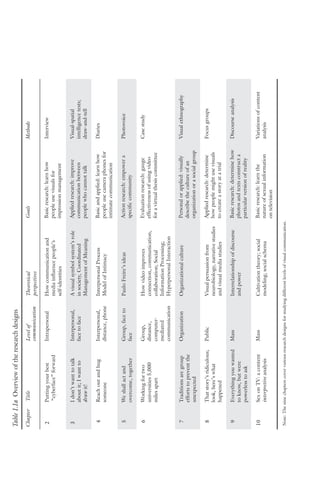
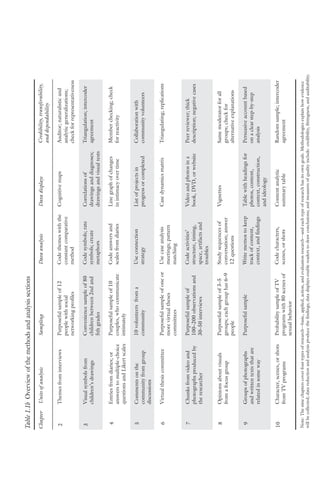
lists—set up as rows and columns—intersect. For example, in Table 1.1 you
can read across the rows to learn about a chapter and/or you can read
down the columns to learn about the parts of a research design. Since the
matrix covers nine chapters and fourteen parts of a research design, it has
126 cells. From reading these cells, you can learn all about the book. The
other display format, network displays, shows collections of nodes (points)
Like an Espresso but Without the Insomnia 13
connected by links (lines). This book explains several displays, including con-
tent analytic summary tables, context charts, case dynamics matrix, and causal
networks.
The tenth section explains how visual communication researchers take
steps to ensure the quality of their research. In a quantitative methods book,
quality would be assessed via reliability and validity. Reliability refers to the
consistency, stability, and dependability of a test (or other data-gathering
instrument). Investigators get comparable results every time they give the tests
to comparable subjects because they have developed consistent habits in giving
the test and scoring its results. They have managed to minimize the errors and
biases in the testing procedures. Reliability is different for qualitative research
because the researcher is more responsible for the data than the test or data-
gathering instrument. Validity means that the research instruments and tests
measure what they were intended to measure. Validity is different for quali-
tative research because researchers are trying to interpret people’s thoughts,
feelings, and behaviors. These may include many contradictions; they may
change; they may be unknown to the individuals; and they may be so nuanced
that researchers can never get them right.
This book, like many qualitative research books, uses credibility, trans-
ferability, and dependability to assess quality. A study has credibility when
researchers present such faithful descriptions or interpretations of a human
experience that the people having that experience would immediately recog-
nize it as their own. In addition, after reading the report, other researchers and
readers can recognize the experience when confronted with it. Transferability
concerns the range and limitations of the findings beyond the context in which
the study was done. To ensure transferability, qualitative researchers collect rich
data and then generalize from their data to their variables. Dependability
means that other researchers can clearly follow the reasoning used by the
study’s investigator. In addition, they can arrive at a similar conclusion given a
similar situation.
In addition, when judging the quality of a qualitative study, ask yourself
these questions. How much training and experience did the researcher
have? How familiar was the researcher with the people, events, and places he
or she studied? Could he or she draw people out? How much did people
alter their behavior when they became aware they were being studied?
Was the researcher dogged in investigating the phenomena? Did he or she
ward off premature closure? How candidly did the researcher write about
his or her potential bias and his or her experiences with data collection and
analysis?
The eleventh section explains how the Internet has affected visual com-
munication research designs. For example, one chapter explains the advantages
and disadvantages of e-interviews. Another chapter explains how PDAs
(personal digital assistant), wireless technology, and the Internet have trans-
formed the collection of diary data. Another explains how hyperlinked Web
sites improve the display of visual ethnographic research.
14 Like an Espresso but Without the Insomnia
The twelfth section explains the method’s advantages and disadvantages.
Interviewers, for example, provide insights into how people interpret events,
but people have poor or distorted recall and they may lie or withhold infor-
mation. Diaries provide accounts of events as they occurred in their natural
contexts, but people find them intrusive and burdensome. Case studies
produce solid findings and help build theory, but people may react to the
presence of researchers, and the results of case studies cannot be replicated
easily.
The thirteenth section discusses ethical issues researchers might encounter
when they use a particular research design.
All researchers who study people must obtain approval from their
Institutional Review Board (IRB). An IRB is a committee at U.S. colleges,
hospitals, and research institutes that is required by federal law to ensure that
research with humans is conducted in a responsible, ethical manner. To gain
IRB approval you must respond to these questions:
1. In relation to your goals: How will your research benefit the individuals
you will study? You do not want to marginalize or disempower partici-
pants.
2. In relation to your research questions: How will you explain the purpose
of your project to individuals? You do not want to deceive participants.
3. In relation to data collection: How will you gain access to your research
site and subjects, and what will your entry letter look like? How will you
obtain informed consent and what will your informed consent form
look like? What kinds of interactions will you have with your subjects?
What risks will subjects take—such as accidental disclosure of harmful
information—and how will you reduce those risks?
4. In relation to data analysis: How will you protect the anonymity of
individuals and incidents? You want to use aliases for individuals and places
to protect their identities. Who owns the data once it is collected and
analyzed? You want to make a personal agreement with participants about
the ownership of data. How will you guard your data? You want to explain
where the data will be kept and when (if) it will be destroyed. How will
you ensure an accurate account of the data? You want to use one or more
strategies to check the accuracy of the data with participants.
Visual communications researchers must always pay particular attention to
informed consent and to privacy.
Informed consent ensures that people not only agree and consent to
participating in the research of their own free choice, without pressure or
influence, but that they are fully informed about what it is they are consenting
to. Visual communication researchers must work harder than other researchers
to obtain informed consent because they must get consent not only from the
participants in their study, but also from others, who both appear in their
photographs/videos and who are affected by their visuals.
Like an Espresso but Without the Insomnia 15
A consent form includes (Creswell, 2003):
1. The right to participate voluntarily and the right to withdraw at any time,
so that the individual is not being coerced into participation.
2. The honest purpose of the study so that individuals understand the nature
of the research and its likely impact on them. When you anticipate that
your description of the group will be flattering, you can readily explain the
study’s purpose. On the other hand, if you anticipate that some members
of the group will resent the ethnographers’ description, then you may try
to hide the study’s true purpose. Avoid this impulse or your subjects will,
correctly, consider you unethical.
3. The procedures of the study, so that individuals can reasonably expect
what to anticipate in the research.
4. The right to ask questions, obtain a copy of the results, and have their
privacy protected.
5. The benefits of the study that will accrue to the individual.
6. Signatures of both the participant and the researcher agreeing to these
provisions.
Guarding informants’ privacy normally means that researchers offer them
confidentiality or anonymity. Confidentiality means that information about
participants is private and should only be revealed with participants’ consent.
Anonymity means that participants remain nameless. If visual researchers
want to publish or display photographs, videos, and drawings that identify
participants, then participants will lose their privacy, and without privacy,
people may not agree to participate. Visual researchers, therefore, may have
greater difficulties recruiting participants.
The fourteenth section concerns the resources, such as time, personnel, and
money, which you might need to complete the research design. When calcu-
lating which resources you may need, break down the study into manageable
tasks, such as: a) planning; b) meetings of research team; c) meetings among
principal investigators; d) site visits in the field for data gathering; e) data
analysis; and f) report writing. In addition, build in time and money for training
because, as mentioned earlier, the quality of a qualitative study is only as good
as the investigators who collect and analyze the data.
The fifteenth, and final, section provides advice. Think of this section as a
kind of summary with bullet points.
Distinctive Contributions of Visual Communication
Research Designs
In summary, we believe this book is distinctive in several ways:
1. We distinguish visual communication—a social process in which people
exchange messages that include visuals—from visual display—creating
visuals without knowing your audience and without receiving a reply.
16 Like an Espresso but Without the Insomnia
2. We position visual communication on the humanities side of social science.
3. We recommend studying visual communication at the intrapersonal,
interpersonal, group, organization, and public levels of communication,
as well as the mass communication level.
4. We offer guidance for creating nine research designs appropriate to the
study of visual communication.
5. We connect each research design with a theoretical perspective.
6. We use a consistent format for every chapter. This format provides
comprehensive coverage of fifteen aspects of a research design.
7. We include a glossary of terms and their definitions in relation to visual
communication research.
Like an Espresso but Without the Insomnia 17
2 Putting Your Best “Cyberface”
Forward
Theoretical Perspective
Mark Zuckerberg put Harvard’s class directory online because he thought it
might be interesting to have access to other students’ profiles. Other students
were also interested in seeing a photograph and some basic facts about their
classmates. In fact, so many students wanted to see others’ online profiles that
within twenty-four hours of its birth, February 4, 2004, Thefacebook.com had
between 1,200 and 1,500 registrants (Cassidy, 2006). Zuckerberg realized
that millions of young people might want to present themselves to others and
make friends in an online environment, so he opened the site to students from
other campuses. A year later, the social networking website Facebook.com was
the second-fastest growing major site on the Internet (Cassidy, 2006). Within
four years of its birth, Facebook had 70 million members, and according to
comScore Media Metrix, a company that tracks online traffic, Facebook was
the fifth most trafficked website in the world. Today users can join networks
organized by city, workplace, school, and region to interact with other people.
Almost half of Facebook users return to the site every day in order to
update their profiles, to read messages on their “wall” and to both read and
write messages on others’ walls. In other words, they stay in touch with their
online friends. Duncan Watts, a sociologist at Columbia University, compares
spending time on Facebook to hanging out at a mall. Both serve the essential
purpose of seeing and being seen. “You’re with your friends, but you’re also
creating the possibility that you’ll bump into someone else, in which case you
might meet them, or at least be noticed by them” (Cassidy, 2006).
Facebook is more than a social networking site. It is also an identity-building
site. An identity is a sense of self; it is a persistent understanding of one’s
physical, psychological, and social self. People shape and project their identities
on Facebook. In fact, Facebook has become “a platform for self-promotion, a
place to boast and preen and vie for others’ attention as much as for their
companionship,” writes John Cassidy for The New Yorker (Cassidy, 2006).
Imagine if you wanted to conduct a research study about the self-promotion
aspect of Facebook or another social networking site, such as LinkedIn
(20 million subscribers), Friendster (58 million), hi5 (70 million), Facebook
(70 million), or Myspace (110 million) (Wikipedia.org: list of social net-
working websites). How would you begin?
I suggest studying Erving Goffman’s ideas about impression management
for a general explanation of what is going on when people create their personal
profiles. Impression management consists of people’s efforts to both define
themselves and control information that others have about themselves in order
to influence others’ opinions. When people create social networking profiles,
they emphasize certain aspects of their personality in order to win the approval
of their peers. They are putting their best “cyberface” forward (Rosenbloom,
2008).
Erving Goffman, author of The Presentation of Self in Everyday Life
(Goffman, 1959), uses a theater analogy to explain impression management.
The word “theater” comes from the Greek “theatron,” which means “place of
seeing.” In theater, actors present themselves to others. In everyday life, people
also make self-presentations. Instead of following a script, however, people
decide by themselves how to perform in a front stage area for a particular
audience. Then people withdraw backstage, where they can put aside their
onstage role, check their appearance, and reapply make-up.
Impression management and Goffman’s theater analogy also seem to
apply to social networking profiles. People think about their identities. For
example, I think of myself as a photographer. Then people think about others
with similar identities. For example, I would consider how photographers
present themselves in public. Then people create a profile to present their
identity to others.
To continue the theater analogy, in addition to hearing actors talk to other
actors, we see them and their clothes, body language, and gestures. Similarly,
when people present themselves on Facebook, they talk about themselves
and they show visuals of themselves. They carefully write self-descriptions
about their political and religious affiliations, likes and dislikes, values, and
accomplishments in life. People publicize their social connections with talented
friends, successful sports teams, media role models, and popular musicians.
They also use lots of photographs and videos. For example, people upload
14 million photographs daily to Facebook. As a result, Facebook is by far the
largest photo site on the Web.
In the theater, actors sometimes perform more than one role within a
play. Similarly, people’s profiles also include more than one aspect of their
identity. For example, in addition to showing that I am a photographer, my
profile could show that I am a husband, father, teacher, researcher, runner, and
gardener.
In the theater, everyone in the audience sees all of the actors’ identities.
Similarly, everyone—friends, co-workers, complete strangers—sees all of a
person’s content on his or her website. Facebook users may not worry about
potential employers checking out their photographs because they consider such
snooping unethical. Employers, however, know they can use everything in the
public domain in order to evaluate you (Balakrishna, 2006). You should
Putting Your Best “Cyberface” Forward 19
assume that since employers can find your Facebook profile, they might before
deciding whether or not to hire you.
Unlike actors, you can, of course, limit access to some friends. For example,
one of your professors may be your “friend,” but you don’t want him or her
to see a photograph of you losing badly at beer pong. You cannot, however,
completely avoid embarrassment for two reasons. One, other Facebook users
can write and leave photographs on your wall, and several hours (or days) may
pass before you realize someone has posted an undesirable message. One
survey of Facebook users found that half had discovered unwanted pictures
linked to their profiles (Tufekci and Spence, 2007). Two, you lack complete
control because another user—imagine a “friend” named Henry—may post a
humiliating photograph of you on his profile. You don’t want everyone to see
you that way, so you remove your link to Henry’s profile, but you can’t force
Henry to remove your picture. Even worse, Henry may also have tagged the
photograph with your name. If so, people can use your name in a search and
quickly find the unflattering image. As one former Harvard student wrote:
“A single user with low privacy restrictions ‘overcomes/ruins’ all the protective
and restrictive steps taken by peers” (Cassidy, 2006).
In the theater, when a company stops putting on a particular play, actors
audition for a different role in different plays. In real life, when I leave one
group of people and I move to another location to interact with a different
group, then I can play a different role. In the online world, however, people
cannot change roles easily. They have one profile. One exception is Facebook’s
Limited Profile. It allows users to create a second profile that omits some of
the content from their original profile.
I hope you noticed that Goffman’s dramaturgical approach to impression
management includes both intrapersonal communication and interpersonal
communication.
People use intrapersonal communication when they think about themselves
and the role they should play. They try to maintain and enhance their self-
esteem by giving themselves pep talks and by recalling positive, rather than
negative, information about their past actions. In addition, people watch their
own actions, become aware of their own thoughts and feelings, and make
direct attempts at self-assessment in order to confirm their sense of self (Markus
and Wurf, 1987).
People use interpersonal communication to convey their identity to
others. They show their identity to members of their group in order to build
solidarity, and to those not in their group, in order to emphasize who does
not belong.
People also use interpersonal communication when they seek feedback
from their audiences. Sometimes people want to hear an honest assessment
of the role they have played; other times they are simply seeking approval. For
example, when people want to honestly evaluate themselves, they compare
themselves with superior others. When they want to make themselves feel
good, they compare themselves with inferior others (Markus and Wurf, 1987).
20 Putting Your Best “Cyberface” Forward
In addition to intrapersonal and interpersonal communication, the media
also affect people’s—especially teenagers’—self-identities. The Media Practice
Model begins with the assumption that adolescents are forging a cohesive
sense of self and figuring out where they fit in the world (Steele and Brown,
1995). As teenagers watch TV and listen to popular songs, they passively learn
about the common teen culture. From teen culture, adolescents begin to
realize they are similar and dissimilar to some other teens. Based upon this
developing sense of self, teenagers select particular media content to fulfill their
entertainment and information needs. As they become more actively involved
with the media, they begin to interpret its content. Then they begin to seek
out more specialized information from niche magazines, the Internet, news-
papers, and movies so they can apply this information and continue to build
their self-identities. Finally, they create Web pages to present their unique
identities to others.
Putting Your Best “Cyberface” Forward 21
Identity
Selection
Application
Interaction
M
O
T
I
V
A
T
I
O
N
A
T
T
E
N
T
I
O
N
I
N
C
O
R
P
O
R
A
T
I
O
N
/
A
P
P
R
O
PRIATION
E
V
A
L
U
A
T
I
O
N
/
I
N
T
E
R
P
R
E
T
A
T
I
O
N
Figure 2.1 Media Practice Model
Source: Steele and Brown (1995)
In addition to Goffman’s dramaturgical perspective and the Media Practice
Model, you might want to add some ideas about photography in order to
complete your theoretical perspective.
Facebook users may intuitively realize what researchers have proven: that
they should show photographs of themselves with friends who are either
physically or socially attractive. Women who were average in looks were rated
higher when viewed in a photograph in which they were posed alongside other
women who were more attractive (Melamed and Moss, 1975). Even later,
when these average-looking women were viewed with other average-looking
women, they continued to be perceived as more attractive. A second study
reports that photographs showing attractive friends positively affect viewers’
ratings of Facebook profile owners (Walther et al., 2008).
No wonder people sometimes cut out unattractive friends from photos
they wish to include on their websites. In a response to a New York Times
article about self-presentations in cyberspace, one reader, referring to his/her
homepage, writes: “Cropped my overweight friends out of the photo. Like
horizontal stripes, they made me look fatter.” Another letter writer said, half-
jokingly, “Cropped my overweight, handicapped, elderly, and unattractive
friends from the picture. Also removed friends who suffer from acne and those
who buy clothes from the Salvation Army. Funny how they no longer speak
to me.”
Facebook users might also intuitively understand that viewers associate
physical attractiveness with a positive personality. Research again supports this
bit of common sense. It indicates that our outer appearance plays an influential
role in determining how people think of us and respond to us. Especially for
initial encounters, the evidence overwhelmingly supports the notion that we
respond much more favorably to those we perceive as physically attractive than
to those we see as unattractive (Knapp and Hall, 2006).
To appear taller, skinnier, and better-looking than they are in reality, some
people alter photos. For example, in another response to the article about self-
presentations (Rosenbloom, 2008), one letter writer said, “My friends and
I have discussed the ‘fat girl face tilt,’ where we are pictured with our chins
pointing down (only focusing on one chin instead of the other two), or
pictures taken from above one’s head (slimming the face, emphasizing the
breasts).”
Goals
This chapter’s theoretic perspective explains how communication and the
media influence people’s self-identities. Now you need to specify your goals,
which you can begin to do by deciding whether you want to do basic research,
applied research, action research, or evaluation research. I suggest basic
research, which people conduct to generate or test theory and to discover
knowledge for its own sake. Basic researchers publish their reports in scholarly
journals.
22 Putting Your Best “Cyberface” Forward
For basic research, you might want to learn how people use visuals, in partic-
ular, for impression management. You could investigate how people think
about their visual identities, how people react to each other’s visual identities,
and how people borrow from the media when they create their visual identities.
You could research such matters for cyberspace or real life.
Research Questions
Theoretical perspectives and goals both set the stage for research questions.
For this chapter, you could investigate:
1. What were people thinking when they created their websites? What were
their intended purposes?
2. Do people’s gender, ethnicity, age, and socio-economic status affect the
way they think about making self-presentations online?
3. Do humble people create more realistic self-identities? If people create
ideal self-presentations, then how far can they go in fostering distorted
impressions before they label such behaviors as deceitful? How old can
the pictures be when people want to portray what they look like? How
much digital enhancement is permissible? Is it acceptable to include
attractive friends and edit out unattractive ones? Can/should people hire
professional photographers for websites? Do they think they will suffer any
negative consequences from creating ideal self-presentations?
4. Do people adjust their self-presentations based on feedback from real-
world friends, cyberspace friends, and others?
5. Do media influence people’s online self-presentations? Do niche maga-
zines, television, or other people’s websites have a greater influence? How
do people adjust their websites based upon the influences from media?
6. Do people use more words or more visual images when creating self-
presentations? How do they choose to use words or images?
7. Do people create websites showing more differentiated identities or less
differentiated identities?
8. How do people feel about researchers studying their homepages and
profiles on social networking sites? Should researchers get permission from
each owner of the website they study?
Brief Description
Researchers generally use interviews when they want to study individual’s
thoughts, feelings, and experiences. When they conduct such interviews,
researchers adopt the role of either a miner or a traveler (Kvale, 1996).
A miner interviewer tries to unearth valuable knowledge that is waiting in
the person’s interior. The miner interviewer digs for nuggets of information
that are unpolluted by any leading questions. The interviewer then purifies
these nuggets of information by drawing out essential meanings during
Putting Your Best “Cyberface” Forward 23
analysis. Finally, the interviewer measures the nuggets’ purity by correlating
information with either an objective real world or subjective inner experiences.
In contrast, the traveler interviewer roams freely, eliciting inhabitants’
stories without a structured list of questions. The journey not only yields new
knowledge, but it changes the traveler interviewer. Upon reflection, he or she
uncovers previously taken-for-granted values. At the end of the journey, he or
she interprets local inhabitants’ stories and retells them for people back home.
If the traveler interviewer works well, then these new narratives ring true.
The stories are aesthetically pleasing and affect people emotionally.
Oprah Winfrey resembles a miner interviewer. She asks questions, and the
person responds with information that seems authentic. When Oprah probes
deeper, the person’s self-defenses seem to fall away. Question by question,
Oprah gets the person to reveal his or her private self, and we learn about that
person’s ideas, attitudes, and feelings.
Social scientists, however, believe interviewees not only respond to ques-
tions, but they also make self-presentations (Abel and Stokoe, 2001; Lee and
Roth, 2004). For example, guests on Oprah’s show realize the show attracts a
huge audience. They want to take advantage of this opportunity to become
famous, so they present their self in whatever way they believe will be most
useful. In addition, guests have previously watched the program so they know
how guests should behave. They tailor their talk and body language to what
Oprah and the audience expect to hear and see.
Oprah also engages in self-presentation. She asks questions to get infor-
mation, but part of her never forgets about the television cameras and her
multi-million-dollar image. Researchers, therefore, cannot begin to analyze an
interview transcript before they have interpreted the interview as a combination
of information and self-presentation (Rapley, 2001).
Units of Analysis
Since the goal is to learn how people use visuals for impression management,
and since your method is to interview people, your unit of analysis might
be themes in those interviews. Themes are also known as categories, codes,
data-bits, chunks, and conceptual labels (Ryan and Bernard, 2003). For this
book, themes are defined as the fundamental concepts researchers are trying
to describe in order to answer their research questions. Themes appear in texts,
paintings, sounds, and movies. They come in many shapes and sizes. Some are
broad and sweeping, while others are more focused. In the beginning of
a study, however, you should try to identify as many smaller themes as possible.
Later you can decide to a) combine some smaller themes into larger ones;
b) drop some smaller themes from your analysis; or c) keep the smaller theme
because it is vital.
24 Putting Your Best “Cyberface” Forward
Sampling
In order to obtain an adequate quantity of your units of analysis—themes from
interviews—you need to draw a purposeful sample of at least twelve people. To
obtain the richest data, you would try to interview young and middle-aged
people; honest and less-than-honest people; people with a few online friends
and people with many friends; people who consume a lot of media and a little;
as well as people who are more and less visually oriented.
To find people who can provide rich data, you can use snowball sampling.
The snowball sampling process begins by asking knowledgeable people:
“Who knows a lot about what I’m researching? Whom should I talk with?”
These people tell you about others, who then suggest other people to inter-
view. For this study, start the snowball rolling with people with strong visual
self-presentations on their profiles.
Methods
In order to learn how people use visuals for impression management, you could
interview people who have created profiles on a social networking website. This
section explains: a) skills you need to conduct interviews; b) how to prepare
good questions; c) how to conduct an interview; and d) how to transcribe the
recorded interview.
Skills You Need
One important skill you need to develop is bracketing, defined as setting aside,
as much as humanly possible, past assumptions, preconceived ideas, and
personal experiences that seem so normal that you take them for granted.
Bracketing occurs throughout a study.
When asking questions, you bracket by remaining aware of how your
background experiences and scholarly knowledge may prejudice the way you
ask questions. To raise your awareness, ask a colleague to interview you using
the same questions you intend to ask others. Your answers should reveal some-
thing about your ideas and experiences. Later you can compare your answers
and respondents’ answers in order to decide whether your preconceptions may
have influenced the way you questioned others.
When analyzing the transcripts, you bracket by adopting a skeptical attitude.
During analysis, you may quickly note recurring patterns among separate pieces
of data. Based upon these patterns, you may then quickly jump to a conclusion.
Instead, you should notice the patterns, but remain open to disconfirming
evidence. Ashworth and Lucas (2000) recommend bracketing during analysis
by: a) writing summaries; b) looking for surprises; c) adopting a variety of
imaginary roles in the process of reading transcripts; d) reflecting through self-
interrogation; e) describing the participant’s experience in real or imaginary
letters to friends.
Putting Your Best “Cyberface” Forward 25
A second important skill is listening. Listening means not only hearing the
respondents’ exact words, but also making keen observations about what else
might be going on. You need to pick up on implied information, the emotions
behind their words, and the context of what they are saying. You must quickly
analyze this knowledge and then decide which additional questions to ask. By
listening well and remaining flexible, you improve your chances to learn
something unexpected.
A third skill involves learning background knowledge about the issues. In an
interview, you are doing more than recording a respondent in a mechanical
fashion. You are also interpreting the information on the fly. Without a firm
grasp of the issues, you would not notice if several sources contradict one
another. Nor would you know when to ask for additional information.
The effort needed for bracketing, listening, analyzing implied information,
and interpreting answers in terms of background knowledge will leave you
mentally and emotionally drained at the end of the day.
Preparing Good Questions
One way to get useful responses is to realize that the questions are for you more
than for the respondents. Questions are your reminders regarding the
information that needs to be collected and why (Yin, 2003). The purpose is to
keep you on track as data collection proceeds.
A second way to achieve worthwhile responses is to ask six types of questions
(Patton, 1990):
1. Questions about what a person does or has done.
2. Questions about what the person saw, heard, touched, tasted, and smelled.
3. Questions about a person’s opinions, goals, intentions, desires, and values.
4. Questions to learn about people’s emotional responses to their experiences
and thoughts.
5. Questions to elicit factual information and knowledge.
6. Questions about the person’s background, such as age, education,
occupation, residence, and so forth.
A third suggestion for obtaining helpful responses is to ask the six types of
questions in the following order (Patton, 1990). Begin with uncontroversial
questions about what the person (1) does and (2) senses, since such questions
encourage people to talk descriptively. After people have verbally relived their
experience, you can ask about their (3) opinions and (4) feelings. Hold off on
(5) knowledge questions because people need to provide some context before
they state the facts, and such information can be threatening to the speaker.
Spread boring (6) background and demographic questions throughout the
interview. Finally, ask present tense questions first because people answer those
with greater ease.
26 Putting Your Best “Cyberface” Forward
If you follow these recommendations in order to learn about people’s visual
self-presentations online, you might ask:
1. How do you choose the content for your home page? How do you decide
when to update it?
2. If I visited your webpage, what would I see? What would I hear? What do
people write when they leave comments?
3. What is your goal for your home page? What do you think about it? What
would you like to see happen?
4. To what extent are you satisfied with your home page? Do you feel anxious
when strangers visit it?
5. How many people visit your site? How long have you had this webpage?
What can people do on your site?
6. What are your age, education level, and job?
A fourth way to gain beneficial answers is to consider your opening ques-
tion carefully. If you ask an abstract question such as “What does this image
symbolize for you?” participants will struggle to respond. A better line of
questioning might be, “Can you tell me about the time when you took this
picture?” Such a question keeps the dialogue focused on a specific experience
rather than on an abstraction, which enables the respondent to provide a fuller,
more detailed description of an experience. A description uses words and
visuals to create a mental image of an event, scene, experience, sensation, or
emotion. It does not include judgments about whether what occurred was
good or bad, appropriate or inappropriate, or any other interpretive judgments.
A description simply illustrates what occurred.
A fifth suggestion is to ask “how” questions, not “why” questions. Although
you may normally ask “how come” people did something, “why” questions
often solicit a defensive response. Respondents may feel they need to justify
their actions, or they may not know the reasons. On the other hand, when
you ask “how” questions, respondents answer at length. They tell stories, give
reasons for whatever they have done, and talk about how other people’s actions
contributed to the outcome (Becker, 1998). For example, “How did you
decide what to say about yourself in your profile?” and “How did you convey
a certain impression of yourself with your profile?” By asking “how” you’ll
learn the steps in the process and website history.
Sixth, when wording questions in order to get rich responses, include pre-
suppositions (Patton, 1990). For example, ask “What comment had the
greatest impact on your perception of your webpage?” Such a question implies
that comments naturally affect people’s perceptions. You may also ask, “How
do the media influence your feelings about yourself and your friends?” This
question’s premise (the media influences your feelings) stimulates an answer
(about how the media influences your feelings) before you can decide whether
you agree with the premise.
Putting Your Best “Cyberface” Forward 27
If at all possible, you should pre-test your interview with people like your
planned interviewees. You want to determine if the questions work as intended,
and if not, how to revise the questions (Maxwell, 2005).
Conducting the Interview
During the interview, your role will be to create an atmosphere in which people
feel safe to talk freely about their experiences and feelings (Thompson,
Locander, and Pollio, 1989). To make respondents comfortable, researchers
attempt neutrality, which means they neither react favorably nor unfavorably
to people’s responses, but they appreciate people’s willingness to share ideas
and feelings with them. As one scholar writes, “What is essential in interviewing
is to maintain a working research partnership. You can get away with phrasing
questions awkwardly and with a variety of other errors that will make you wince
when you listen to the tape later. What you can’t get away with is failure to
work with the respondent as a partner in the production of useful material”
(Weiss, 1994: 119).
You will also need to be aware of the signals you consciously or uncon-
sciously send to interviewees. If you ask for elaboration of a story, they will
learn to provide more detailed responses. If you move from one question
to another without follow-up, they will learn to use more succinct, focused
responses.
You also need to remain alert to signals respondents consciously or uncon-
sciously send. If you trespass on some unpleasant areas of their lives, or areas
they do not want to talk about, they will send signals. Your response will
profoundly affect the interview. If you ignore the cue and plunge ahead, they
may lie, change the subject, or withdraw. If you defer, you may lose valuable
information. If you demonstrate that you received the message and will, at least
to some extent, respect their desires, the interview will continue. You can direct
respondents back to this unpleasant area later.
During the interview, try to avoid: long, complicated questions; yes-or-no
questions; vague questions; affectively worded questions; double-barreled
questions; thinking ahead to the next question; helping respondents search for
a good answer; interrupting; using jargon, labels, or any terms that the
respondent has not introduced; losing control of the interview; and fitting
answers to your preconceived ideas (Patton, 1990).
Transcribing the Recorded Interview
Interviewers generally audio record or videotape their interviews; transcribe the
recordings; code the transcription; and then interpret the codes.
The transcription stage may seem like a mechanical step, but qualitative
researchers disagree (Lapadat and Lindsay, 1999). Transcription represents a
recording, so researchers must decide “What is a useful transcription for my
research purposes?” (Kvale, 1996: 166). Then they should reveal the choices
they made about whether to include notes on respondents’ body language,
28 Putting Your Best “Cyberface” Forward
hesitations in conversation, the situation’s context, the interviewer’s questions,
and interviewers’ thoughts. Before transcribing, researchers also decide
whether the audience for the transcript is the original interviewees, other
researchers, or practitioners.
In addition to their conversations, researchers may also take notes for
three reasons. First, it helps them to check what people said earlier in order
to formulate new questions. Second, taking notes facilitates later analysis,
including locating important quotations from the tape itself. Third, they may
wish to avoid the time and cost of transcribing all of the interviews and, instead,
they may just expand their notes from the taped record whenever they need
more detail for their analyses.
Data Analysis
After you have interviewed your sample of people and transcribed the
recordings, you need to identify your units of analysis—themes—and then use
a categorizing strategy to code those themes. Coding is way of assigning units
of meaning to the information compiled during a study.
This chapter explains two general ways to create categories, and Chapter 10
suggests additional ways.
One way is to create a provisional list of categories before collecting any data.
This list comes from your theoretical perspective, goals, and research questions.
For a study of self-presentations online, you might use: a) ideal versus realistic
self-presentations; b) word-heavy or picture-heavy self-presentations; and
c) photos showing physically attractive, neutral, and unattractive individuals.
Creating a list of codes prior to collecting data forces researchers to tie research
questions directly to the data. Analysts, however, should redefine or discard
coding categories that seem ill-fitting, or overly abstract.
A second way involves creating categories after you have collected the data,
seen how it functions within the study’s context, and considered its variety.
This is essentially the “grounded” approach advocated by Glaser and Strauss
(1967). With this strategy, the categories fit the data better than the previous
generic-categories-for-many-uses strategy.
A variation of this grounded approach is called the constant comparative
method (Glaser and Strauss, 1967). With the constant comparative method,
researchers identify incidents, events, and activities; then they constantly com-
pare this information to an emerging category in order to develop and saturate
the category. They later combine categories into a theoretical explanation of
what happened (Glaser and Strauss, 1967). It includes twelve steps (Hycner,
1985).
First, data reduction begins by reading each typed transcript, becoming
sensitized to each participant’s train of thought, and taking notes. You want
a sense of the whole interview—the context—so you can more easily record
units of meaning later on. You dwell on what participants say as well as how
they say it. Meanwhile, in the back of your mind, ask “What does this tell me
Putting Your Best “Cyberface” Forward 29
about the way the person understands his/her self-presentation?” In other
words, what must this website mean to the participant? You may end up with
about half a page of notes for each person, which you can then use to develop
an individual profile to improve your empathetic understanding of the
participant’s experience.
Second, you become immersed in the data. Re-read the transcripts, but
instead of focusing on each individual’s experience, you want to compare
several people’s experiences. You might want to construct a table to facilitate
such comparisons.
Third, divide the transcripts into data units, which are blocks of information
with the same meaning; these units might take up several pages or could be
as short as a phrase. From these data units begin to develop a list of non-
repetitive, non-overlapping statements of what each person said. At this point,
do not think of the data in terms of your research questions. Just stay close to
the literal data, crystallize and condense what people said.
Fourth, during this process, quotes and small excerpts should be interpreted
within the context provided by a particular interview. Researchers have differ-
ent opinions about whether data units should be interpreted within the context
of one interview or the context of all the interviews. Some prefer to interpret
a quote from “Tom” in the context of his interview (Akerlind, 2005). Others
advocate taking the smaller chunks from each particular transcript and com-
bining chunks into a larger pool of meanings. These researchers worry that
working with separate transcripts focuses the analysis on the individual
interviewee rather than the group of interviewees (Akerlind, 2005).
Fifth, re-read the transcripts, this time looking for data units relevant to your
research questions. The resulting list of statements will be shorter than your
previous list because instead of summarizing everything someone said, you’ll
only include ideas related to your project. For example, look for statements
about strategies and game plans; different identities, roles, or aspects of the self;
differences between an individual online and in real life; ideal versus realistic
portrayals; symbols or metaphors; reactions or feedback; friends included or
excluded; privacy or worries.
Sixth, if you have not already done so, you need to train a panel of impartial
judges. They need to validate, modify, or invalidate your units of relevant
meaning because this work requires judgment, and judgment introduces the
potential for bias. Bias occurs when researchers could not bracket and they
could not remain neutral. It occurs when researchers bring a personal interest
to the study. They should either acknowledge how their backgrounds and
professional experiences may influence the collection and analysis of data, or
they need to design their studies to reduce such subjectivities. Your panel
of judges may include graduate students who participate in your project in
exchange for your help in their projects.
Seventh, your panel of judges confirms or changes your units of relevant
meaning. Then it eliminates any redundancies among the units of relevant
meaning.
30 Putting Your Best “Cyberface” Forward
Eighth, you and your panel of judges then try to cluster units of relevant
meaning and decide whether they represent a common theme. In the begin-
ning, compare meaning units with each other, but only look for similarities.
If several data units seem to belong together, then they may represent a theme.
For example, after grouping references to flattering, vanity, enhance, improve,
sexy, and attractive together, you might label these ideas “put your best
cyberface forward.”
Ninth, focus on dissimilarities among relevant meaning units. Re-read
the transcripts and ask: “What is Sally saying that is different from Fred?”
If, after comparing meaning units, you decide some units differ substantially
from the others, then you may have found a new theme. For example, after
further study, you might decide that flattering, vanity, enhance, improve, sexy,
and attractive do not really form a single theme. Instead, the attributes seem
to represent two or more themes. Vanity might be a description of a person’s
true self, which a person recognizes because of kidding from friends. Sexy and
attractive might describe aspects of the self a person wants to present to others
via some improvement and enhancement. Flattering might describe one type
of interaction that shapes a person’s self-image and self-presentation.
Tenth, to decide if the differences merit creating a new theme, you must
go back to the pool of transcripts, and compare this possible theme with
everything said in all of the interviews. In the context of all of the interviews,
does this possible theme resemble existing themes, or does this possible theme
differ substantially? Deciding can be difficult because sometimes people say
similar things, but their words have different meanings, or people say different
things, but their words have the same meaning. For example, several inter-
viewees may have talked about how they sometimes lie when presenting
themselves online, but some might be more forthright than others. Candid
people might say “deceit” or “trick,” while guarded people might say “spin”
or “strategy.” Moreover, although one person may have used strategy to refer
to a trick, another person may have said strategy and meant game plan. After
comparing each theme with data in all the transcripts, write a summary for each
interview, incorporating the themes you discovered.
Eleventh, at this point, ask your team of coders to repeat your efforts and
create their own lists of themes within the interviews. This task again requires
judgment and skill, which again means presuppositions might interfere with
the analysis process (Akerlind, 2005).
Twelfth, after everyone finishes coding, they meet together to compare their
results. During this meeting, each analyst refers back to the sorts of things
people said in the transcripts to justify his or her particular set of themes. When
two analysts use a different phrase for the same theme, they combine their
descriptions to form one theme. When two analysts use the same phrase for
different themes, they split their descriptions into two themes. The team then
focuses on the parts of transcripts that do not fit the proposed themes, and, if
necessary, the team debates themes that someone believes may not represent
any part of the transcripts. Then the team considers how a change in any one
Putting Your Best “Cyberface” Forward 31
Other documents randomly have
different content
but claimed rights which before he was willing to ignore; and the
South had no stauncher friend or more zealous advocate than he
during all those dark days of fratricidal strife, even to the close,
when drums ceased to beat and the battle-flags were furled.
"We start a new era. Vacation begins. The excitement in the land,
if possible, becomes more intense. There is volunteering for service,
drilling, hurrying on to the front. Everything is placed under
contribution to facilitate and render successful the mighty trial of
arms which is impending. The battle of Manassas is fought. The
South is the victor; yet the fruits are not what were desired and
anticipated. The war cloud, instead of vanishing, grows denser. The
evidences of a protracted and sanguinary conflict become manifest.
The trustees of the College, under existing circumstances, were
embarrassed. They knew not what to do; yet in the early part of July
they declared against the opening of the doors of the institution for
the coming year. Later on, however, they reversed this decision, and
the College began its fall session at the usual time. Several
important changes are here to be noticed. First, the number of
students was perceptibly smaller than usual; the whole body,
perhaps, did not exceed sixty-five or seventy. A few of these were
manifestly parties desiring to shirk military service; yet the great
majority was composed of persons under the age of conscription
and of persons who were already far advanced in their college
course and looked forward to a speedy graduation.
"Again: there was a change in the complexion or membership of
the Faculty. Professor Massie resigned to accept a call to
governmental work in Richmond, and Professor Turner was elected
to fill the Chair of Mathematics. He, however, resigned at the close
of the half session, and Professor Blankenship was chosen as his
successor. Professor Shepard resigned, and entered upon active
military service in the field. No one was appointed to fill his place, as
the exigencies of the case did not demand it.
"Once more: the style of the College was changed from a purely
literary to a semi-military institution. A regular uniform was
prescribed; drills were daily observed, and other things of a similar
character were enjoined, all looking to the preparation of the student
for the duties that awaited him in defence of his country.
"The Commencement exercises for this year were exceedingly
interesting and for the times very largely attended. Dr. James A.
Duncan delivered the address before the two societies. His presence
among the scenes of his boyhood was a joy to his old
acquaintances, and his address was highly appreciated for its worth
and for the sake of the man who delivered it."
The record of the meeting held March 9, 1864, given above,
closes the official history of the College prior to the surrender.
We give the names of the trustees following those who were
named in the charter of February, 1830, with date of their election:
NAME. STATE. YEAR.
NATHANIEL MASON,. . . . . Virginia, . . . . . . 1833
THOMAS ADAMS, . . . . . . Virginia, . . . . . . 1833
THOMAS WILLIAMS,. . . . . South Carolina, . . . 1833
ALEXANDER SPEAR,. . . . . Georgia,. . . . . . . 1834
W. H. ELLISON,. . . . . . Georgia,. . . . . . . 1834
Rev. WILLIAM CAPERS,. . . South Carolina, . . . 1834
Rev. W. M. KENNEDY, . . . South Carolina, . . . 1834
Rev. W. M. WIGHTMAN,. . . South Carolina, . . . 1834
GEORGE W. JEFFRIES, . . . North Carolina, . . . 1834
BEV. SYDNOR,. . . . . . . Virginia, . . . . . . 1834
Rev. I. A. FEW, . . . . . Georgia,. . . . . . . 1834
Rev. LOVICK PIERCE, . . . Georgia,. . . . . . . 1835
SEABORN JONES,. . . . . . Georgia,. . . . . . . 1835
J. C. POYTHRESS,. . . . . Georgia,. . . . . . . 1835
Rev. JAMES McADEN,. . . . Virginia, . . . . . . 1835
Rev. ABRAM PENN,. . . . . Virginia, . . . . . . 1835
WILLIS LEA, . . . . . . . Virginia, . . . . . . 1835
Bishop J. O. ANDREW,. . . Georgia,. . . . . . . 1835
HUGH A. GARLAND,. . . . . Virginia, . . . . . . 1835
Rev. STEPHEN OLIN,. . . . Virginia, . . . . . . 1835
HORACE PALMER,. . . . . . Virginia, . . . . . . 1837
Rev. JAMES JAMEISON,. . . North Carolina, . . . 1837
Rev. B. T. BLAKE, . . . . North Carolina, . . . 1837
M. M. MCPHERSON,. . . . . Georgia,. . . . . . . 1838
THOMAS W. WILLIAMS, . . . South Carolina, . . . 1838
S. K. HODGES, . . . . . . South Carolina, . . . 1838
L. C. GARLAND,. . . . . . Virginia, . . . . . . 1840
D'ARCY PAUL,. . . . . . . Virginia, . . . . . . 1840
A. A. CAMPBELL, . . . . . Virginia, . . . . . . 1840
Rev. D. S. DOGGETT,.. . . Virginia, . . . . . . 1841
Rev. A. M. FORSTER, . . . South Carolina, . . . 1841
Rev. HENRY B. COWLES, . . Virginia, . . . . . . 1842
GEORGE ROGERS,. . . . . . Virginia, . . . . . . 1842
EDWARD R. CHAMBERS, . . . Virginia, . . . . . . 1842
WILLIAM TOWNES, . . . . . Virginia, . . . . . . 1844
WESLEY YOUNG, . . . . . . North Carolina, . . . 1845
Rev. R. O. BURTON,. . . . North Carolina, . . . 1845
Rev. WILLIAM B. ROWZIE, . Virginia, . . . . . . 1845
ELLIS MALONE, . . . . . . North Carolina, . . . 1846
THOMAS BRANCH,. . . . . . Virginia, . . . . . . 1846
Rev. L. M. LEE, . . . . . Virginia, . . . . . . 1846
THOMAS W. HARRIS, . . . . North Carolina, . . . 1846
RICHARD B. BAPTIST, . . . Virginia, . . . . . . 1846
CHARLES R. EATON, . . . . North Carolina, . . . 1848
MASON L. WIGGINS, . . . . North Carolina, . . . 1848
CHARLES S. HUTCHESON, . . Virginia, . . . . . . 1848
WILLIAM IRBY, . . . . . . Virginia, . . . . . . 1848
JAMES J. DALY,. . . . . . Virginia, . . . . . . 1848
Rev. R. I. CARSON,. . . . North Carolina, . . . 1848
Rev. JAMES REID,. . . . . North Carolina, . . . 1848
G. W. S. PARHAM,. . . . . Virginia, . . . . . . 1848
GEORGE WILSON,. . . . . . Virginia, . . . . . . 1848
GEORGE D. BASKERVILLE,. . North Carolina, . . . 1848
Rev. ANTHONY DIBRELL, . . Virginia, . . . . . . 1849
Rev. WILLIAM CLOSS, . . . North Carolina, . . . 1852
Rev. THOMAS S. CAMPBELL,. North Carolina, . . . 1854
THOMAS H. CAMPBELL, . . . Virginia, . . . . . . 1854
RICHARD IRBY, . . . . . . Virginia, . . . . . . 1854
CHARLES SKINNER,. . . . . North Carolina, . . . 1854
Rev. GEORGE W. NOLLEY,. . Virginia, . . . . . . 1855
JOHN G. BOYD, . . . . . . Virginia, . . . . . . 1855
Rev. LEO ROSSER,. . . . . Virginia, . . . . . . 1855
Rev. J. P. MOORE, . . . . North Carolina, . . . 1855
Rev. R. E. G. ADAMS,. . . Virginia, . . . . . . 1855
Rev. P. W. ARCHER,… . . Virginia, . . . . . . 1855
Rev. N. F. REID,. . . . . North Carolina, . . . 1855
Rev. WILLIAM CARTER,. . . North Carolina, . . . 1855
Rev. J. E. EDWARDS, . . . Virginia, . . . . . . 1857
N. MILAM, . . . . . . . . North Carolina, . . . 1857
Rev. G. W. CARTER,. . . . Virginia, . . . . . . 1858
RICHARD M. SMITH, . . . . Virginia, . . . . . . 1858
Rev. JOHN C. BLACKWELL, . Virginia, . . . . . . 1858
THOMAS P. JERMAN, . . . . North Carolina, . . . 1858
LEROY M. WILSON,. . . . . Virginia, . . . . . . 1859
O. H. P. CORPREW, . . . . Virginia, . . . . . . 1859
WILLIAM A. SMITH, . . . . Virginia, . . . . . . 1860
W. T. SUTHERLIN, . . . . Virginia, . . . . . . 1860
Secretaries of the Board.
Rev. WILLIAM A. SMITH,
Rev. WILLIAM M. WIGHTMAN,
Rev. JOHN G. CLAIBORNE,
Rev. EDWARD WADSWORTH,
Rev. HENRY B. COWLES,
RICHARD B. BAPTIST,
RICHARD IRBY,
WILLIAM A. SHEPARD.
Treasurers.
JOHN W. LEWIS,
ALEXANDER BOYD,
BEVERLY SYDNOR,
LANDON C. GARLAND,
DAVID DUNCAN,
CHARLES B. STUART,
Rev. WILLIAM A. SMITH.
Agents.
Rev. H. G. LEIGH,
Rev. WILLIAM HAMMETT,
Rev. M. P. PARKS,
Rev. JOHN EARLY,
Rev. WILLIAM A. SMITH,
Rev. THOMAS CROWDER,
Rev. JOHN A. MILLER,
Rev. JOHN KERR,
Rev. S. S. BRYANT,
Rev. R. O. BURTON,
Rev. WILLIAM B. ROWZIE,
Rev. R. I. CARSON,
Rev. BENJAMIN R. DUVAL,
Rev. N. THOMAS,
Rev. HENRY B. COWLES.
Rev. JOHN EARLY,
Chairman Board of Trustees, 1831.
President " " 1833 to 1872.
In the body of the history sufficient prominence has not been
given to a number of the Professors and Agents. They in many
instances richly deserved this prominence, but it seemed to be
impossible to get portraits of them. A search for some of them for
years failed to secure them.
The good work, as agents, of Rev. B. R. Duval and Rev. N.
Thomas, more particularly the former, deserved a much more
extended notice and commendation.
WAR HISTORY.
The war history of the College and its Professors and sons is and
must remain very imperfect. It is impossible for the writer to gather
up the scattered threads of this history. No approximate estimate
can be given of the number who went into military service, nor of
the casualties which befell them. That many of them were killed and
wounded and many died of sickness is well known.
Six Randolph-Macon men were enrolled in one company, and the
casualties which befell these are here given from actual data.
Whether this is a fair sample of the rest is not known with certainty.
There is no reason why it should not be assumed as a fair average.
In Company G, Eighteenth Virginia Regiment, Army Northern
Virginia, the following casualties occurred, viz.:
Richard Irby, class of 1844, first lieutenant and captain, wounded
twice at Second Manassas, 1862.
Samuel Hardy, class of 1846, first lieutenant, lost an arm and
disabled at Gaines' Mill, 1862.
Richard Ferguson, class of 1858, first lieutenant (and adjutant of
the regiment, 1863), wounded at Gaines' Mill, Frazier's Farm, Second
Manassas, and captured inside the cemetery wall at Gettysburg; in
prison to the close of the war.
Edward H. Muse, class of 1861, second lieutenant, wounded at
Frazier's farm, Gettysburg, and Sailor's Creek.
Anthony Dibrell Crenshaw, class of 1858, third lieutenant, killed at
Five Forks, 1865, and buried on the field.
Benjamin I. Scott, class of 1860, corporal, killed near Boonsboro,
Md., 1862, and left on the field.
The writer can give the history and portraits of these, because he
had the honor to command the company in which they served, and
preserved their records and portraits.
The College premises were occupied after the close of the war for
some time by the Federal forces. The main building was used as
headquarters of the Freedman's Bureau, and the rooms filled with
the "wards of the nation." The damage done to the property was
assessed at about five thousand dollars, which is unpaid to this day,
and will doubtless so remain to the end of time.
This closes the ante-bellum record.
[Illustration: OFFICERS COMPANY G, EIGHTEENTH VIRGINIA
REGIMENT. No. 1.
Captain Richard Irby. No. 2. Lieut. Richard Ferguson. No. 3. Lieut. S.
Hardy. No. 4. Lieut. E. H. Muse. No. 5. Lieut. A. D. Crenshaw. No. 6.
Corpl. B. I. Scott.]
INTERLUDE.
BEFORE entering upon the subsequent history of the College, this
writer would take this occasion to refer to one of many omissions,
which he has noted in revising the pages already printed, a point of
special interest and importance. This is the religious element in
Randolph-Macon College.
The College was the child of the Methodist Church, established, in
large measure, to educate young men for the ministry in accordance
with the ideas and usages of the church of that day. Religion was the
first and foremost consideration—religion as taught and emphasized
by the Methodist Church—religion allied with education. At the first
opening of the College a chaplain was appointed for it by the
Conference, a man who was as complete a model of the Methodist
minister as could be found, William B. Rowzie, a walking, living
epistle of Christ, "known and read of all men." One better than he
could not have been found to inaugurate the religious life of the
College.
Never in the history of the church in Virginia has Methodism, in its
spirit and economy, been more thoroughly exemplified than it has
been at Randolph-Macon. The morning and evening sacrifice of
prayer and praise noted every day of work. Preaching in the chapel
was had twice on Sabbath and prayer service was held on
Wednesday evenings. Students were required to attend morning and
evening prayer and Sunday morning service. Besides this, the
members of the church were organized into classes with leaders,
according to Methodist usage, and class-meetings were regularly
held once a week. Thus was exhibited a complete practical example
of Methodist economy as prescribed in the Discipline. The result and
fruit of this work was a high state of religious life. Every year, or
oftener, this life took the form of great religious activity, and
sweeping revivals occurred, bringing well-nigh all in the College and
many outside under spiritual influence, and many converts into the
church. There were few years, if any, when some such revival did
not take place. Of many it could be said, "This and that man was
born there"; many who not only became Christians themselves, but
went forth from the College to preach the gospel throughout the
Southern land. Many here were drilled in Methodist usages, and thus
prepared to become class leaders, stewards and Sunday-school
teachers and superintendents after they left College. A large
proportion of these became presidents of colleges and principals of
high schools and academies, in which they inaugurated the same
system of "religion in earnest." These schools shared the same
benign and gracious influences, and in turn became "fountains in the
desert," from whence "streams broke out," reaching even to the
ends of the earth, "making glad the city of our God," and causing
"the wilderness to bloom and blossom as the rose."
It may be thought strange that fathers belonging to other
churches and others not religious were ever found sending their
sons to a college which was thus permeated with religious life as
taught and practiced by Methodists. But in many cases they did send
them.
This writer, whose acquaintance with the College extends over a
period of nearly sixty years, makes bold to say that he has never
known a student to change his church membership during all that
time and become a Methodist. He has known class-leaders who had
been at home Presbyterians and Episcopalians, but after leaving
College they resumed their work in their fathers' churches, none the
worse for having for a time worked in "Methodist traces."
As to calculating the ultimate effects of all these causes and
influences in time and eternity, it were as vain to try to calculate or
measure them as it would be
"To bind the sweet influences of the Pleiades
Or loose the bands of Orion."
COLLEGE HISTORY AFTER THE WAR.
THE period immediately succeeding the surrender of the
Confederate army at Appomatox was one of the darkest and most
discouraging that any civilized people was ever called to face.
Virginia had been for four years the battle-ground over which great
armies had marched and counter-marched and fought. Every home
had felt the torture that "tried men's souls." Widows gathered their
fatherless children around them to share the last crust of bread
together, not knowing whether even that much could be found to-
morrow. For miles along the highways over which the armies had
marched, the bare chimneys only, marked the sites where
comfortable houses had sheltered happy households. The farmer
had his land left—that could not be carried away; but few had any
teams to break the ground, and many had not the seed needed to
sow the fields. The last cow was in many cases driven away or killed.
A noted Federal general had boastfully reported to the general-in-
chief that so completely had he devastated the fairest and most
fertile section of the State that a crow could not travel over it
without carrying his rations with him.
Richmond, the capital city, after withstanding two sieges
successfully, had been, in large part, made a bank of ashes.
Petersburg, beleaguered so long, was a scarred and battered wreck.
Fredericksburg, Winchester, Norfolk, and many other towns, were
little better off. Some of the railroads were stripped of their rails—all
of them in bad plight and almost without any equipment for
business, if any business were to be found. The labor system, which
had for centuries been used to cultivate the land and gather the
crops, had been at one stroke subverted, and virtually destroyed.
None had been found for months afterward to take its place. With
the people at large it was a struggle for existence and a fight with
famine.
One of the saddest scenes this writer ever witnessed was at
Nottoway courthouse. A few days after the surrender at
Appomattoax, he was summoned with other citizens of the county to
attend a meeting called to confer with the military officers as to the
best plans to be devised to prevent suffering among the people. Just
as he entered the courthouse, where a number of people were
assembled, he saw a venerable man of more than three-score years
and ten standing before the officer, with tears streaming down his
furrowed cheeks, and heard him say: "Every scrap of meat, every
grain of corn, everything in the way of food I had, has been taken
from me. I know not where I shall get my meat or bread to-
morrow." This man had been for many years one of the foremost
men in the county, a Senator in the General Assembly of Virginia,
and for many years a Trustee of Randolph-Macon College.
But poverty and penury were not all. The people were humiliated
and despondent. Their State, "the mother of States and statesmen,"
had now the tyrant's heel upon her neck, and was styled "District"
(No. 1), a "conquered province"—her governor, first a refugee, then
a prisoner. Military satraps filled the seats of judges and magistrates.
The ignorant slave was often shown more deference than his former
cultured master. Most of the flower of the manhood of the State had
died by the sword or disease. The boys and girls of the next
generation were growing up without the means of education, and
helping to eak out a living for their widowed mothers.
Such, in brief, was the condition of Virginia in the period
succeeding the close of the war.
What could the Trustees of the College do under such
circumstances as now surrounded them? The endowment gathered
at such an expenditure of time and labor was in large part lost. The
investments made were in bonds and stocks of more than uncertain
value, some not worth the paper on which they were printed. The
College buildings, libraries and laboratories had all been impaired
and damaged by non-use or abuse. There was no money in hand to
repair and refit them. Our own people were too poor to furnish it.
Those who had devastated the property, and added injury to insult,
could not be expected to restore what they had destroyed.
Nevertheless, it had been but a few months after the surrender
before a meeting of the Board was called to be held in Petersburg,
August 23, 1865.
At this meeting a quorum was lacking, and the Board adjourned to
meet on
September 13 following, at the residence of Richard Irby, in
Nottoway.
This adjourned meeting was held, and a quorum was present.
One of the first matters attended to was the appointment of a
committee consisting of President W. A. Smith and four others "to
estimate the damage to the College incurred by the occupation of it
by the United States troops after the surrender, and in behalf of the
Trustees to make application to the proper authorities of the
government for payment."
On motion of D'Arcy Paul it was—
Resolved, That all the Professor's chairs be declared vacant.
A provisional arrangement was made to open the College for
school purposes, but this arrangement was not carried out.
A further plan was provided for taking care of the College
property, and the Board adjourned.
The next meeting of the Board was held at the College July 11,
1866, with eighteen members in attendance. The chairman of the
committee appointed at the last meeting to assess and press claim
for damages to College, reported that the committee had not been
encouraged in their efforts by the military authorities in Virginia.
Judge E. R. Chambers was appointed to prosecute the claim.
It may save time here to say, as has been said before, that this
claim was never recognized by the government.
The Finance Committee made a report of the Endowment fund
and liabilities of the College:
Bonds of the city of Petersburg and interest, . . . . . . $19,000
Bonds of the State of Virginia, . . . . . . . . . . . . . . 3,000
———-
(Classed available),. . . . . . . . . . . . . . . . . . . $22,000
Bonds Southside Railroad Company, guaranteed
by city of Petersburg,. . . . . . .$15,800
Stock Petersburg Railroad Company, 8,000
———-
$23,800
———-
$45,800
———-
Private or personal Endowment bonds, . . . . . . . . . . .$24,900
Legacy of W. B. Jones, . . . . . . . . . . . . . . . . . . . .500
———-
$25,400
=======
Confederate bonds, . . . . . . . . . . . . . . . . . . . $37,000
Confederate currency, . . . . . . . . . . . . . . . . . . . 7,536
———-
$44,536
=======
Leaving out the Confederate bonds, which were worthless, the
balance
of available and possible assets were $71,200
Liabilities as far as known, . . . . . . . . . . . . . . . 8,854
———-
Net assets, . . . . . . . . . . . . . . . . . . . . . . . $62,346
This, under all the circumstances, might be considered a favorable
showing, and the credit of it is due to the faithful Investing Agent,
who also showed his skill and faithfulness by bringing through the
war the "Savings and Insurance Company," of which he was
president, free from wreck.
The resolution of the Virginia Conference in regard to the removal
of the College had been allowed to sleep since the committee's
report, in March, 1864. It was again brought forward by the
following resolution, offered by Richard M. Smith, Esq.:
"Resolved, That a committee of ——— be appointed to ascertain
what accommodations and on what terms and what inducements
generally can be obtained for transferring Randolph-Macon College
to Petersburg, Richmond, Lynchburg, or any other place, and also
the earliest day at which accommodations can be at command, and
report to an adjourned meeting of this Board."
This resolution was defeated by a vote of 12 to 6.
The following, offered by Judge E. R. Chambers, was then
adopted:
"Resolved, That it is inexpedient and injudicious to change the
location of the College."
The ayes and noes on this were recorded, as follows:
Ayes.—William Townes, Sr., C. S. Hutcheson, W. B. Rowzie, William
Townes, Jr., William Carter, T. P. Jerman, R. B. Baptist, N. Head. J. P.
Moore, O. H. P. Corprew, N. Alexander, E. R. Chambers, L. M. Wilson
—13.
Noes.—Richard Irby, D. S. Doggett, R. M. Smith, J. C. Granbery, T.
S. Campbell, J. C. Blackwell—6.
Dr. W. A. Smith, at his own request, was excused from voting.
It was resolved to take steps to re-open the College as soon as
practicable.
The degree of A. M. was conferred, under the law, on the
following: Leroy S. Edwards, Thomas J. Overby, and J. Davidson
Blackwell, A. B.'s of former years.
Dr. William A. Smith tendered his resignation as President of the
College, to take effect at once. The resignation was accepted by the
Board, and resolutions were adopted expressing the high
appreciation of him and his work, which had extended over a period
of nearly twenty years.
The Board resolved to adjourn to meet again on the 18th of
August following to elect a president and three professors. The
salaries of these were fixed—Guaranteed, to the President, $1,000;
to the professors, $750 each, and, in addition, the tuition fees of the
students in attendance.
At the adjourned meeting, August 15, 1866, the following
elections were made:
RICHARD W. JONES, A. M., Professor of Mathematics.
O. H. P. CORPREW, A. M., Professor of Ancient Languages.
Rev. JOHN C. BLACKWELL, A. M., D. D., Professor of Chemistry.
ERNEST LA GARDE, Professor of Modern Languages.
The election of a President was postponed to an adjourned
meeting, and Dr. John C. Blackwell was appointed to act as President
until a president should be elected.
At an adjourned meeting held October 16, 1866, on the
nomination of William Townes, Sr., Col. Thomas Carter Johnson, A.
M. (Class 1842), was elected President and Professor of Moral
Philosophy.
The Board then adjourned to meet at the session of the Virginia
Annual
Conference, November 22, 1866. Colonel Johnson was then a citizen
of
Montgomery, Ala., practicing law. He accepted the office tendered,
but did not take the position until near the close of the year.
At the adjourned meeting held at Norfolk, November 22, 1866, the
Board, on motion of Dr. William A. Smith, resolved to establish "The
School of Commercial Science" in the College. This was never done.
At this meeting a representative from Ashland, Hanover county,
Va., presented a communication from owners of property in that
town offering to sell certain property in case the Board should
determine to move the College. A committee, consisting of D'Arcy
Paul, R. M. Smith and D. S. Doggett, were appointed to investigate
and report in regard to the matter.
At the adjourned meeting in December, held at the College,
President-elect Johnson appeared before the Board and was formally
inducted into office. He was requested to visit the Baltimore
Conference of the Methodist Episcopal Church, South, which had
recently adhered to the Southern Church, and endeavor to secure
the patronage and co-operation of that Conference; also, to visit
Baltimore and other cities with a view to securing financial help for
the College.
An overture was also made to the North Carolina Conference with
a view to the restoration of former relations and the securing of its
patronage.
President Johnson subsequently reported the result of his visit to
the Baltimore Conference, and submitted the action of that body,
which was as follows:
"BALTIMORE CONFERENCE, M. E. CHURCH, SOUTH.
"REPORT OF COMMITTEE ON COLLEGES.
"The Committee on Colleges submit the following report:
"Resolved, 1. That the Conference accepts the proposition of the
Board of Trustees of Randolph-Macon College to give its patronage
to said institution and to participate equally with the other
patronizing Conferences in its government and privileges, and we
hereby nominate four suitable persons to be elected Trustees from
this Conference to represent our interests on said Board.
"Resolved, 2. That when a Trustee shall locate, it shall be his duty
to resign.
"Resolved, 3. That we will give the full weight of our influence in
extending the patronage of Randolph-Macon College."
"(Signed) S. S. ROSZEL, Chairman."
These resolutions were adopted by the Conference March, 1867.
On the recommendation of the Baltimore Conference the following
gentlemen were elected Trustees of Randolph-Macon College, viz.:
Rev. S.
S. Roszel, Rev. John Poisal, Rev. S. S. Register, and Rev. John
Landstreet.
At the first annual meeting of the Trustees held at the College,
June 25, 1867, after President Johnson had assumed control, eleven
Trustees were in attendance.
Ex-President W. A. Smith had gone to Central College, Fayette,
Missouri, of which he had been elected President.
The President's report stated that the attendance for the session
of 1866-'67 had been in all forty-five students; a large proportion of
them were on scholarships. The net receipts from fees were
necessarily very small.
The degree of D. D. was conferred on the following: Rev. Nelson
Head,
Rev. John E. Edwards, and Rev. W. W. Bennett, of the Virginia
Conference; Rev. Samuel S. Register, Rev. S. S. Roszel, Rev. John
Poisal, and Rev. John S. Martin, of the Baltimore Conference; Bishop
Enoch M. Marvin, of the M. E. Church, South, and Rev. Smith W.
Moore, of
the Tennessee Conference.
The degree of LL. D. was conferred on Bishop George F. Pierce, M.
E.
Church, South, and Hon. James F. Dowdell and William F. Samford,
of
Alabama.
The degree of A. M. was conferred on Thomas J. Jarvis, of North
Carolina (class of 1860).
REMOVAL OF THE COLLEGE.
The College year, 1867-68, was not a prosperous one. The financial
condition of the country was anything but favorable to a successful
year. The dissatisfaction with the location of the College had been
increasing since 1863. At the annual meeting in 1868 it was to
culminate. The President had become convinced that something
must be done or the College would have to close its doors. Some
who had opposed removal heretofore now favored it.
In the notice for the meeting a special request was made for a full
meeting, and the object was generally understood. The meeting
commenced its session June 24, 1868. There were present the
following: Revs. James Jamieson, H. B. Cowles, Robert O. Burton, W.
B. Rowzie, L. M. Lee, T. S. Campbell, Geo. W. Nolley, L. Rosser, J. P.
Moore, Wm. Carter, John E. Edwards, J. C. Blackwell, Nelson Head,
J. C. Granbery, John Landstreet, and Messrs. N. Alexander, D. Paul,
E. R. Chambers, Wm. Townes, Sr., Thos. Branch, R. B. Baptist, J. J.
Daly, R. Irby, R. M. Smith, T. P. Jerman, T. M. Jones, T. C. Johnson,
C. S. Hutcheson, W. Townes, Jr., and O. H. P. Corprew—thirty in all.
President T. C. Johnson presided, and Professor Corprew was
secretary. The feeling prevailed generally that this meeting would
decide the question of removal. There was early skirmishing by the
opposing sides, and it was some time before the decisive vote was
reached and taken.
Finally, the motion of Dr. J. E. Edwards, which was as follows:
"Resolved, That in the judgment of the Board of Trustees for the
greater prosperity of the institution, Randolph-Macon College should
be removed from its present to a more accessible and eligible
location"—was adopted by the following vote:
Ayes.—Paul, Cowles, Burton, Rowzie, Branch, Lee. T. S. Campbell,
Irby, Nolley, Rosser, Edwards, R. M. Smith, Jerman, Blackwell, Head,
Granbery, Jones, Johnson, and Landstreet—19.
Noes.—Alexander, Chambers, Townes, Sr., Baptist, Daly, Moore,
Carter, Townes, Jr., and Corprew—9.
[Illustration: REV. JOHN ELLIS EDWARDS, A. M., D. D., Virginia
Conference, M.E. Church, South.]
On motion of D'Arcy Paul, the Board took steps to secure the
authority of the constituted authorities for the necessary change of
the charter, so as to allow the change of location.
On motion of Dr. J. E. Edwards it was—
"Resolved, That so soon as the gentlemen (Messrs. Branch, Irby,
Snyder and Watts) who have purchased the property and premises
at Ashland are prepared to make a tender of the same to the
Trustees for the use of Randolph-Macon College, free from any
encumbrance as to title, and so soon as the legal authority is
secured for the transfer of the institution, the Trustees bind and
pledge themselves to make the transfer and removal to Ashland; and
also pledge themselves further to open the next session of the
College exercises at that place; provided the above-named
conditions are complied with in time to enable the Trustees to carry
out this pledge."
A committee, consisting of D. Paul, R. M. Smith, Drs. L. M. Lee, J.
E. Edwards and N. Head, were appointed to secure the legal
authority to remove the College to Ashland, and to secure proper
title to the property to be used for the location of the College.
The President was authorized to employ an Agent to have the
furniture, libraries, apparatus, etc., removed to Ashland.
Thus ended the struggle in regard to moving the College. The
majority, while taking this step, which they deemed absolutely
necessary in order to carry out the object sought in the
establishment of the College, took it with the greatest reluctance.
They could not grieve so generous a people as those living in the
vicinity of the College without feelings of the utmost regret and pain.
The minority could not see what had been the pride of the
community and section taken away, without feelings of sorrow. Many
of them had for many years been the strongest and warmest friends
of the College, and had often manifested their friendship by
generous acts and steadfast devotion to it in adversity and
prosperity.
After transacting a few items of business, one of which was the
conferring the degree of D. D. on Rev. Robert S. Moran, of the North
Carolina Conference, the Board adjourned to meet again in
Centenary
Church, Richmond, Va., July 29, 1868.
After the adjournment of the Board the opponents to the removal
of the College sued out an injunction restraining the Board from
taking the step contemplated.
When the adjourned meeting of the Board assembled in
Centenary Church, Richmond, July 29, 1868, this action was
reported, "whereupon a motion was adopted to appoint a committee
to wait on General Stoneman, in charge of the District."
This committee addressed the following communication to General
Stoneman:
"RICHMOND, VA., July 29, 1868.
"Major-Gen. Stoneman, Commanding General District No. 1:
"SIR,—We are instructed by the Trustees of Randolph-Macon
College, now in adjourned session in this city, to acknowledge the
receipt of your letter of the 8th instant, addressed to a previous
committee of this Board, touching the interests of the College under
their management.
"Since the communication on behalf of the Trustees, to which your
letter of the 8th instant was in reply, a contingency then
contemplated has arrived. A minority of the Trustees have sued out
an injunction restraining the Board from making the contemplated
removal of the College, the writ being returnable on the first Monday
in August at Charlotte Courthouse for hearing before Judge Marshall.
We are advised that the suit will prove very tedious as well as very
expensive, and will thus operate very disadvantageously to the
interests of the College whatever the decision. We therefore add to
the former application made to you in behalf of the Trustees, that
you will issue an order protecting us, both from obstruction and from
delay, through these appeals to the courts, until such time as the
legislative authority of the State, of which you are at present the
sole representative, shall be regularly organized and open to the
application usual in such cases.
"Very respectfully yours,
(Signed) "J. EARLY, ETC., ETC.,
"Committee."
To this communication General Stoneman submitted the following
reply:
"HEADQUARTERS FIRST MILITARY DISTRICT,
"RICHMOND, VA., July 29, 1868.
"GENTLEMEN: I am directed by the commanding General to
acknowledge the receipt of your letter of this date in relation to the
subject of the removal of Randolph-Macon College, and in reply
thereto, to inform you that authority is hereby given to the Trustees
of that College to remove that institution, with all the appurtenances
and fixtures thereunto belonging, to such place and at such time as
the majority of the Trustees may think proper, this removal to be
subject to the conditions set forth in a former letter from these
headquarters, dated the 8th instant.*
*This letter is not found in the record.
"I am, gentlemen, very respectfully,
(Signed) "S. F. CHALFIN,
"Assistant Adjutant-General"
"To Messrs. John Early, D. S. Doggett, Richard Irby, R. M. Smith,
and others, Committee of the Trustees of Randolph-Macon College."
The owners of the property at Ashland, who had purchased the
same for the Trustees, submitted the conditions on which they
proposed to turn it over to the Trustees, and the same were, on
motion, accepted. This property embraced all the buildings then
standing on the thirteen acres, now constituting the campus of the
College at Ashland, with some other lots adjacent. Thus the location
was provided for the College with accommodations for professors
and students, and the way was cleared for the removal of the
College to it.
At this juncture President Johnson submitted the following
communication:
"RICHMOND, VA., July 30, 1868.
"Gentlemen of the Board of Trustees of Randolph-Macon College:
"The experiment upon which you are about to enter, with my aid
and approbation, seems to me to demand that you should have the
widest field for the choice of a man to fill the position I now hold.
The general troubled condition of the country, excluding many
distinguished men from the arena of politics, in which the talent of
Virginia and the South has heretofore been employed, and also the
returning to this State of many unemployed scholars and literary
men, affords you a wide field of selection for this purpose. I feel that
in your straitened condition, having to make a new appeal for
students and for friends to re-endow your College, you are entitled
to every possible advantage in your arduous undertaking. A son of
the College, I love her too well, and the church which has founded
and supported her in the past, to stand in the way of any possible
effort that may give prestige to your labors to put her once more on
the high road to prosperity.
"With this view and the kindest wishes to every member of the
Board, I hereby resign the presidency of the College.
"Very truly, your obedient servant,
(Signed) "THOMAS C. JOHNSON."
On motion of Rev. J. C. Granbery, the following resolution was
unanimously adopted:
"Resolved, That in accepting the resignation of President Johnson
it is due to ourselves as well as to him that we express the high
esteem which we feel for him as a Christian gentleman and our
admiration of the great zeal and fidelity with which he has
discharged the duties of his oflice at a most critical and
embarrassing juncture in the history of the College, also our warm
appreciation of the disinterested and generous motives which have
prompted him to tender his resignation."
On motion of Dr. N. Head—
"Resolved, That in the absence of a Legislature having obtained
authority from General Stoneman to do so, the College be removed
from Mecklenburg county to Ashland, in Hanover county, Va., and
that a session of the College be opened at that place on the first day
of October next.
"Resolved, That in deciding to change the site of Randolph-Macon
College this Board has been actuated only by the solemn conviction
that it was imperatively demanded by the educational interests of
the church and community at large, and that the opposition which
has been offered to this action by a minority of the Trustees is
deeply deplored by their colleagues of the Board, who here now and
hereby respectfully request that those members will withdraw that
opposition, as injurious to the interests dear alike to all, this earnest
and fraternal appeal being prompted and encouraged by the very
high esteem and respect entertained for the gentlemen to whom it is
addressed by their associates of the Board."
On motion of Richard Irby—
"Resolved, That this Board holds itself in readiness to make such
arrangements as will secure to the county of Mecklenburg a High
School at the present site of Randolph-Macon College on terms such
as may be desired, said school to be a preparatory school to the
College."
Preparatory steps were taken to have the College furniture,
libraries, etc., removed at once to Ashland.
The Board then proceeded to fill the place of President, vacated
by the resignation of President Johnson.
Dr. Landon C. Garland, of the University of Mississippi, was
unanimously elected President.
A committee of nine members was appointed, who were
authorized, in conjunction with Dr. Garland, to elect the professors of
the College; and in the event that Dr. Garland declines to accept the
presidency, then said committee shall be authorized to elect another
man to be President.
The following were then, on nomination, elected to constitute said
committee, viz.: Bishop John Early, Bishop D. S. Doggett, Drs. N.
Head,
L. M. Lee, J. E. Edwards, L. Rosser, Rev. H. B. Cowles, Rev. J. C.
Granbery, and Richard Irby.
Professors Corprew, Jones, Blackwell, and La Garde severally
submitted their resignations.
The duty of removing the College and preparing the buildings and
premises at Ashland, and making other necessary arrangements,
was devolved on the "Executive Committee, which consisted of
Richard Irby, Dr. N. Head, D'Arcy Paul, Thomas Branch, and Rev. T.
S. Campbell.
THOMAS CARTER JOHNSON.
In Memoriam.
Colonel Thomas C. Johnson was born near Lynchburg, Va., on the
22nd of March, 1820. He was converted and joined the Methodist
Church in his seventeenth year. In 1842 he graduated with the
highest honors of his class at Randolph-Macon College. In the fall of
the same year he was married to Martha R. Scott, daughter of H. B.
Scott, of Nelson county, Va., and was soon after appointed Professor
of Mathematics and Natural Sciences in the Female Collegiate
Institute in Buckingham county. This position he filled ten months,
when he removed to Potosi, Washington county, Mo., whither the
parents of his wife had preceded him. Here he accepted a position in
a classical school, in the meantime assiduously prosecuting the study
of law. He was soon after admitted to the bar, and took a position
with the foremost in the ranks of the profession in his district. The
year 1849 was an eventful one. He conceived the idea of building
the Iron Mountain railroad, and suggested it to the people of the
county. He was by them nominated and elected to the General
Assembly for the purpose of securing the passage of a bill for the
establishment of that road.
In June, 1849, the cholera raged in Potosi. He was stricken down,
and, while violently ill, his wife and infant daughter died of this
disease. The following winter he served in the Missouri Legislature,
and secured the passage of the bill for the Iron Mountain road. He
was subsequently largely concerned in developing and mapping the
entire railroad system in that State.
In 1851 he removed to St. Louis, and was appointed land agent
and attorney for the Pacific railroad. In the year 1853 he was
married, the second time, to Pattie B. Scott, eldest daughter of Rev.
Robert Scott, deceased, of the Virginia Conference. He was elected
in 1858 a member of the Missouri State Senate from the city of St.
Louis. In this body he at once took a prominent position, and was a
member of nearly every important committee of the body. In the
session of 1860-'61 he was chairman of the Committee on Federal
Relations, at that time the most important committee of the Senate.
He was decidedly conservative in his views, and anxious to secure
the preservation of the Union, if it could be done consistently with
the rights of the South; but when the Peace Congress proved a
failure, the Crittenden Compromise was rejected, and Virginia
seceded, he became a secessionist, and was heart and soul with the
South throughout the struggle. His position and opinions on the
vexed question forced him to leave Missouri. Without hesitation he
sacrificed all for his principles, left his family in St. Louis, and joined
the forces under General Sterling Price, on whose staff he served for
two years as volunteer aid. Being convinced that the many reverses
in that department, at that period, were due in a great measure to
lack and inferiority of transportation, he called the attention of the
authorities at Richmond to this point. He was soon after authorized
to establish the Confederate Transportation Works at Columbus, Ga.
To this important interest he directed his whole energies, and
succeeded in establishing one of the best arranged, most extensive
and complete machine shops in the Confederacy. This position he
retained until the close of the War, when he removed with his family
to Montgomery, Ala., and returned to the practice of law. While there
he was elected to the Presidency of Randolph-Macon College. On
reaching Virginia and entering upon his duties he found great
difficulties in his path. But with characteristic energy he at once
addressed himself to the task of re-establishing the College. Nearly
two years of unremitted toil, under the most discouraging
circumstances, convinced him that success could never crown his
efforts at that location. He felt that to make the College a success it
must be removed to a more accessible point. Fortunately, just at this
juncture of affairs, the hotel property at Ashland was thrown upon
the market. With his quick foresight, Colonel Johnson realized the
importance of securing this eligible location.
It was not to be expected that the removal of the College would
be accomplished without strong opposition on the part of some of its
warmest friends. But in the midst of the contest Colonel Johnson
bore himself like a Christian gentleman. He could appreciate the
views of others, while he felt that the very existence of the
institution depended on its removal to a more suitable site. We
believe, indeed we have reason to know, that he entertained for
those who opposed him in his plans no other feelings than those of
friendship and Christian affection. To his particular friends, who were
often indignant at the hard speeches uttered against him, he would
reply, "Never mind, I keep my heart right before God." Believing that
he was acting for the best he went forward like a true and earnest
man in what he regarded as the path of duty.
Having seen the removal of the College determined upon, to
relieve the Trustees of all the embarrassment in the election of a
Faculty, he generously came forward and tendered his resignation,
and soon after started to the West, the scene of his early labors and
successes. It was while en route to St. Louis (on August 8, 1868,)
that he met with the terrible accident that in a few hours closed his
noble and useful life. The death of Colonel Johnson was a calamity
to our church and to our country. He had passed the period of life
when men are seized by ambition and borne off in pursuit of wealth
or fame. He had gained both; the former he had lost in standing for
his native land and State rights; the latter he still possessed in a
more valuable form, as purified by the power and faith of his
religion. Repeatedly has he said to the writer, "I only wish to live to
do good." To the Christian education of the young men of the South
he was ardently devoted, and to this work we know he wished to
devote the energies of a manly and mature intellect.
The spontaneous tributes to the memory of this good man will
best show how he was appreciated by those who knew him.
In a letter now before us from Rev. Charles K. Marshall, D. D., of
Mississippi, to his bereaved family, that eminent minister says: "From
my first acquaintance to this hour my affections took to and clung
around him as one of the highest and noblest types of exalted
manhood, as a true, steadfast, appreciating friend; and as a brother
in Christ with whose inward spirit it was a joy to commune. Few men
cherished so high and sacred views of the dignity and ends of life.
Usefulness was the keynote of his being. Unselfish, wide-minded,
spiritual, transparent, pure, he was a living epistle known and read
of all. His life was hid in Christ, and the highest ambition of his soul
was to live to and for Christ."
Rev. Dr. Deems, of New York, says: "His abilities and virtues
rendered him one of the most useful men I have ever known. Every
interview I have had with him since our acquaintance began has
served to deepen my respect for the loftiness of his character."
Bishop McTyeire, who was a fellow-student with him at Randolph-
Macon, says: "In church and state it seemed to me he was just such
an one as we need now. With gratitude I remember his high
Christian influence as a student. Our meeting and reunion at
Montgomery, twenty-five years after, was one of the most pleasing
events of my life. Who of us has not coveted his gifts?"
Such is the testimony, voluntarily given, by this eminent minister.
We are enabled to give a more detailed account of this sad event
from a letter written by the proprietor of the hotel at Mattoon:
"When Mr. Johnson came out of the saloon of the sleeping car, the
conductor told him to 'hurry up.' Thinking he would be left if he did
not make haste, Mr. J. went quickly forward through the car, and
was just in the act of stepping across to the forward car when the
cars separated, and he fell on the track, and before he could recover
himself he was struck by the rear car and fatally injured. His right
leg was crushed in two places and his back broken. As soon as
possible he was taken from under the car. His first words were, 'My
friends, my name is Thomas C. Johnson, of Boydton, Va.; take your
pencil and write it down.' A stretcher was then procured, and he was
Welcome to our website – the perfect destination for book lovers and
knowledge seekers. We believe that every book holds a new world,
offering opportunities for learning, discovery, and personal growth.
That’s why we are dedicated to bringing you a diverse collection of
books, ranging from classic literature and specialized publications to
self-development guides and children's books.
More than just a book-buying platform, we strive to be a bridge
connecting you with timeless cultural and intellectual values. With an
elegant, user-friendly interface and a smart search system, you can
quickly find the books that best suit your interests. Additionally,
our special promotions and home delivery services help you save time
and fully enjoy the joy of reading.
Join us on a journey of knowledge exploration, passion nurturing, and
personal growth every day!
ebookbell.com


Visual Communication Research Designs 1st Edition Keith Kenney

  • 1.
    Visual Communication ResearchDesigns 1st Edition Keith Kenney download https://ebookbell.com/product/visual-communication-research- designs-1st-edition-keith-kenney-2441946 Explore and download more ebooks at ebookbell.com
  • 2.
    Here are somerecommended products that we believe you will be interested in. You can click the link to download. Handbook Of Visual Communication Research Theory Methods And Media Ken Smith Et Al https://ebookbell.com/product/handbook-of-visual-communication- research-theory-methods-and-media-ken-smith-et-al-4102358 Visual Communication Theory And Research A Mass Communication Perspective 1st Edition Shahira Fahmy https://ebookbell.com/product/visual-communication-theory-and- research-a-mass-communication-perspective-1st-edition-shahira- fahmy-5378516 Visual Communication Design An Introduction To Design Concepts In Everyday Experience Meredith Davis https://ebookbell.com/product/visual-communication-design-an- introduction-to-design-concepts-in-everyday-experience-meredith- davis-46697902 Visual Communication Insights And Strategies Janis Teruggi Page https://ebookbell.com/product/visual-communication-insights-and- strategies-janis-teruggi-page-48753520
  • 3.
    Visual Communication DavidMachin Editor https://ebookbell.com/product/visual-communication-david-machin- editor-51008524 Visual Communication Images With Messages 8th Edition Paul Lester https://ebookbell.com/product/visual-communication-images-with- messages-8th-edition-paul-lester-22618296 Visual Communication More Than Meets The Eye Harry Jamieson https://ebookbell.com/product/visual-communication-more-than-meets- the-eye-harry-jamieson-2345076 Visual Communication From Theory To Practice Jonathan Baldwin Lucienne Roberts https://ebookbell.com/product/visual-communication-from-theory-to- practice-jonathan-baldwin-lucienne-roberts-4138794 Visual Communication David Machin https://ebookbell.com/product/visual-communication-david- machin-6770144
  • 6.
    Visual Communication Research Designs VisualCommunication Research Designs offers detailed guidance for using a variety of research methods to investigate visual communications. This book embeds each method—interview, draw-and-write, diary, Photovoice, case study, visual ethnography, focus group, discourse analysis, and content analysis—within a research design. Chapters begin with a brief, engaging story, such as: • Why people really include visuals on Facebook. • Why Picasso could draw but barely pass elementary school. • How camera phones can be used for intimate communication. They then address key research components for each method, such as theoretical perspective, units of analysis, sampling, data analysis, data display, quality control, advantages/disadvantages, ethical issues, and the resources needed to complete the research. Author Keith Kenney provides a consistent voice as well as a variety of perspectives from eleven contributors, each describing his/her work on a particular research project. With this book, Kenney moves visual communication away from a medium-centered approach (such as television or film) to a com- munication-centered approach (including intrapersonal, interpersonal, group, organization, public, and mass communication). Providing explicit, practical guidance in an accessible, understandable format, this book will facilitate more and better research about visual communication. Keith Kenney (Ph.D. Michigan State University) is an associate professor in the School of Journalism and Mass Communications at the University of South Carolina. He is the founding editor of Visual Communication Quarterly, and he served as an editor of the Handbook of Visual Communication. He continues to shoot documentary-style photographs and videos.
  • 8.
  • 9.
    First published 2009 byRoutledge 270 Madison Ave, New York, NY 10016 Simultaneously published in the UK by Routledge 2 Park Square, Milton Park, Abingdon, Oxon OX14 4RN Routledge is an imprint of the Taylor & Francis Group, an informa business © 2009 Taylor & Francis All rights reserved. No part of this book may be reprinted or reproduced or utilized in any form or by any electronic, mechanical, or other means, now known or hereafter invented, including photocopying and recording, or in any information storage or retrieval system, without permission in writing from the publishers. Trademark Notice: Product or corporate names may be trademarks or registered trademarks, and are used only for identification and explanation without intent to infringe. Library of Congress Cataloging in Publication Data Kenney, Keith. Visual communication research designs / by Keith Kenney. p. cm. Includes bibliographical references and index. 1. Visual communication. 2. Visual communication—Research. 3. Research—Methodology. I. Title. P93.5.K46 2009 302.2¢22—dc22 2008025834 ISBN10: 0–415–98869–1 (hbk) ISBN10: 0–415–98870–5 (pbk) ISBN10: 0–203–93101–7 (ebk) ISBN13: 978–0–415–98869–8 (hbk) ISBN13: 978–0–415–98870–4 (pbk) ISBN13: 978–0–203–93101–1 (ebk) This edition published in the Taylor & Francis e-Library, 2008. “To purchase your own copy of this or any of Taylor & Francis or Routledge’s collection of thousands of eBooks please go to www.eBookstore.tandf.co.uk.” ISBN 0-203-93101-7 Master e-book ISBN
  • 10.
    Contents List of Illustrationsvii Notes on Contributors ix Acknowledgments xiii Preface xv 1 Like an Espresso but Without the Insomnia 1 2 Putting Your Best “Cyberface” Forward 18 3 I Don’t Want to Talk About It; I Want to Draw It! 45 4 Reach Out and Hug Someone 70 5 We Shall Act and Overcome, Together 95 6 Working for Two Universities 5,000 Miles Apart 122 7 Traditions are Group Efforts to Prevent the Unexpected 145 8 That Story’s Ridiculous; Look, Here’s What Happened 176 9 Everything You Wanted to Know, but Were Powerless to Ask 198 DAVID WEINTRAUB 10 Sex on TV: A Content Interpretive Analysis 223 Glossary 247 References 267 Index 285
  • 12.
    Illustrations Figures 2.1 Media PracticeModel 21 2.2 Display of results from a cognitive map 32 3.1 Visual imagery tests 54–5 3.2 Drawing by a 10-year-old girl with migraine headaches 68 4.1 Ways of sharing digital and analog photos 72 4.2 Display of diary data showing means and variances 85 4.3 Display of diary data showing effects of photo messages 86 5.1 Model of Freire’s ideas from Pedagogy of the Oppressed 99 5.2 Flow chart for a Photovoice study 102 5.3 Data display for a Photovoice study 111 5.4 Peering into the market 119 5.5 Finding beauty in unexpected places 119 5.6 A new perspective 120 Tables 1.1 Overview of the research designs 6–8 9.1 Summary of content, context, construction, and ideology 216 10.1 Chi square analysis 238
  • 14.
    Contributors Aaron Ahuvia isa professor of marketing at the University of Michigan- Dearborn School of Management. He is former associate editor for the Journal of Economic Psychology. His research looks at consumers’ involvement with products and services they love, as well as the nature of contemporary consumer culture. In addition to many academic publications, his research has been quoted in Time, The New York Times, The Wall Street Journal, major publications in Europe and Japan, and has appeared on public radio talk shows as well as popular television shows, such as Oprah. Craig Denton is Professor of Communication at the University of Utah, where he directs the Documentary Studies Program and is on the Environmental Humanities faculty. He is the author and photographer of Bear River: Last Chance to Change Course, People of the West Desert: Finding Common Ground, and West Desert: Photographs of Lake Bonneville Basin, among other books. His current work, Hidden Water, photographically documents the uses and misuses of surface water in Salt Lake Valley. Nicole Ellison is an assistant professor in the Department of Telecom- munication, Information Studies, and Media at Michigan State University. Currently, she is exploring the social capital implications of Facebook use and the nature of “friends” online. Her previous research has examined the formation of virtual communities and the ways in which telecommuters use information and communication technologies to calibrate the permeability of their work/home boundaries, as explored in her 2004 book, Telework and Social Change. Eric Green is a doctoral candidate in the Clinical and Community Psychology program at the University of South Carolina. Information about his research on forced migration can be found at www.displacedcommunities.org. Upon graduating he will begin a postdoctoral research fellowship at the NYU/ Bellevue Program for Survivors of Torture in New York City. Lars-Christer Hydén is Professor of Health Communication at Linköping University, Sweden. His main focus is on language and social interaction especially in health settings and the role of narrative in the cultural interplay
  • 15.
    of illness andhealth. Ongoing research is concerned with narration in Alzheimer’s disease and aphasia. He has, together with Sonja Olin Lauritzen, edited the book Medical Technologies and the Life World: The Social Construction of Normality and with Jens Brockmeier the book Health, Illness, Culture: Broken Narratives. Keith Kenney is an associate professor in the School of Journalism and Mass Communications at the University of South Carolina. In 1994, he was the founding editor of Visual Communication Quarterly. He is an editor of Handbook of Visual Communication, published by Lawrence Erlbaum in 2005. He continues to shoot documentary-style photographs and videos. Wendy Kozol is Professor of Comparative American Studies at Oberlin College. Her research and teaching interests include feminist theories and methodologies, visual culture studies, transnationalism and popular media, citizenship, militarization, and human rights activism. She is the author of Life’s America: Family and Nation in Postwar Photojournalism and has co-edited two anthologies (with Wendy Hesford): Haunting Violations: Feminist Criticism and the Crisis of the “Real” and Just Advocacy: Women’s Human Rights, Transnational Feminism and the Politics of Representation. She is currently working on a new book tentatively titled Visible Wars and American Nationalism: Militarization and Visual Culture in the Post-Cold War Period. Lawrence J. Mullen is an associate professor in the Hank Greenspun School of Journalism and Media Studies at the University of Nevada Las Vegas. He teaches and conducts research in the related areas of visual communication and visual literacy. Leysia Palen is an assistant professor in the Computer Science Department at the University of Colorado, Boulder, where she is also a faculty affiliate with the Technology, Learning and Society Institute (ATLAS), and the Institute for Cognitive Science (ICS). Professor Palen was awarded a 2006 National Science Federation Early CAREER grant to study information dissemination in disaster events. She works on a broader stream of research concerning computer-mediated interaction. She has been interviewed for articles in the New Scientist, The New York Times, the Boston Globe, National Public Radio, and other publications. Carl Stafstrom, MD, PhD is Professor of Neurology and Pediatrics and Chief of the Section of Pediatric Neurology at the University of Wisconsin School of Medicine and Public Health, Madison. His research interests include mechanisms of epilepsy in the developing brain, cognitive con- sequences of seizures at different ages, dietary approaches to neurologic disease, and the use of art to explore psychosocial adjustment issues in children with neurologic disorders. He is the author of more than 200 scientific and medical articles, chapters, and commentaries. He is very active x Contributors
  • 16.
    in teaching medicalstudents and residents and has received numerous teaching awards. Rob Walker is Director of the Centre for Applied Research in Education at the University of East Anglia in the UK. His current research interests are in how university students learn from complex sets of case evidence, in involving children in the design of displays in museums and galleries, in the uses of visual evidence in research, and in the design of educational spaces. David Weintraub is an instructor in the School of Journalism and Mass Communications at the University of South Carolina, where he teaches visual communications and writing. He is the author of eight books on hiking and kayaking in the San Francisco Bay Area and Cape Cod, and he has also written many newspaper and magazine articles on photography and adventure travel. Contributors xi
  • 18.
    Acknowledgments I thank mycontributors, beginning with David Weintraub, who wrote a chapter, and the following people, who wrote sidebars: Aaron Ahuvia, Craig Denton, Nicole Ellison, Eric Green, Lars-Christer Hydén, Wendy Kozol, Lawrence J. Mullen, Leysia Palen, Carl E. Stafstrom, and Rob Walker. Several additional people helped me with this book. I thank my MA students Carrie McCullough and Jiedi Sun for offering numerous, valuable editing suggestions. I thank my colleague Scott Farrand for creating the graphics. And, most important, I thank my wife, Susanna Melo, for suggesting ways to make the text easier to read and for putting up with my absences on many weekends. Keith Kenney in Ljubljana, Slovenia. Photo by Susanna Melo
  • 20.
    Preface More consumers arecommunicating visually than ever before. One reason has to do with technology. Consumers buy, and use, digital cameras in mobile phones, digital cameras that fit in your pocket, digital SLR (single-lens reflex) cameras, and digital camcorders. Another reason has to do with the Internet. I, and many others, spend hours connected to the Web. We check our e-mail messages and see that people have sent us new pictures of their children or vacation. We look for information, and in addition to written text, we find photographs, audio slideshows, videos, and animations. We want to join in the fun by creating our own profile on Facebook.com and our own home pages. We want to share our pictures and videos with others. In addition to consumers, more professionals are communicating visually now than ever before. Newspapers, magazines, radio stations, and television stations all use a full range of multimedia tools to attract viewers to their web- sites. In addition to people who work for media industries, others also create or interpret visuals as part of their jobs. If you work in business, you need visuals to help sell your products. If you work in anthropology, biology, chemistry, economics, or education, you also need to communicate visually. I could continue listing professions, but you get the point. If I am correct, and consumers and professionals are increasingly using visuals to communicate, then more universities should offer more courses in visual communication, and departments across a college campus should incorporate visual communication ideas and practices into their existing courses. Indeed, I believe both are happening. If as a society we recognize the increasing importance of visual commu- nication, then researchers should be conducting more research about visual communication. Again, I think this is occurring. To support this assertion I point to the creation of three new journals since 1994. I begin with 1994 because that is when, with the help of many people, Jim Gordon and I created Visual Communication Quarterly. I was the first editor, and Jim was the publisher. Actually, the National Press Photographers Association (NPPA) officially published the journal, but Jim convinced NPPA that a research publication would serve the interests of photographers in the newspaper and television industries as well as professors who teach visual
  • 21.
    communication. Jim usedpart of his budget as editor of News Photographer magazine to print the early issues of Visual Communication Quarterly and to distribute them in News Photographer four times a year. Now, of course, Lawrence Erlbaum publishes the journal. In addition to Visual Communication Quarterly, two other journals were born: Journal of Visual Culture and Visual Communication. If courses and research related to visual communication have increased since 1994, then you would expect that universities would be launching PhD programs in order to produce professors who could teach those courses and conduct those research studies. And you would be wrong. I do not believe than any university in the United States, at least, has a doctoral program emphasizing visual communication. If not a doctoral program, then you would expect that scholars would be writing books on how to conduct visual communication research, and, again, you would be wrong. You can read books on visual research and you can read books on communications research, but, until now, you could not read a book that would explain how to conduct visual communications research. So how have people like me, visual communications professors, learned to teach and do research? I received an excellent education from Michigan State University, but I never took a single course about visual communication during my doctoral program. Most of my courses concerned quantitative research methods and mass media theory. After I graduated, I read everything I could that might help me understand visual communication better. I read Roland Barthes, Sol Worth, John Berger, Susan Sontag, Stuart Hall, John Collier, Howard Becker, Susanne Langer, Nelson Goodman, among others. I read the Journal of Visual Sociology, Journal of Visual Anthropology, and Journal of Visual Literacy. When reading these books and journals, I encountered two problems. One problem was how to apply my quantitative research training to conduct research on the ideas about visuals. To meet this challenge I began to teach myself about qualitative research designs. The other problem was how to apply ideas from the fields of sociology, anthropology, and education to the field of communication. To meet this challenge I simply read more and more about communication. In short, learning how to conduct visual communication research has been hard. It still is a challenge, but I hope this book helps. By providing explicit, practical guidance in a way that is easy to read, this book should enable more people to conduct more and better research about visual communication. I would like to think that professors teaching visual communication research courses would assign this book to their students. I also hope that people teaching research methods courses in journalism and mass communications courses would recognize the value of studying the visual aspects of media and that they would use this book in conjunction with a media research textbook. I hope that professors who teach visual research in other fields, such as sociology, anthropology, education, marketing, geography, tourism, nursing, and public xvi Preface
  • 22.
    health would recognizethe connections between communications and their particular field and that they would find useful the book’s detailed explanation of ways to collect and analyze data. Finally, some professors teaching qualitative research in the social sciences and humanities may choose to assign this book, instead of their current textbook, because they understand the rising importance of visual communication and they want to help their students investigate visuals in our society. Preface xvii
  • 24.
    1 Like anEspresso but Without the Insomnia Explanation of the Title Visual Communication Research Designs—the title’s meaning may seem obvious, but I will be changing the meaning of some of these words, so please read carefully. First, I define communication as a social process. Communication is social because it involves interactions between people. Communication is a process because it consists of an ongoing series of exchanges. In these exchanges, one person uses symbols to intentionally send a message; then others interpret the message’s meaning and respond. With this definition, mass media are not in the communication business. Mass media are in the information business, the entertainment business, the persuasion business, and the money-making business. People may seem to interact with the media when they talk back to a TV program, and they may seem to be engaged in a process when they become hooked on media content, but people are not really communicating with a medium (TV), a company (CBS), a show (CSI Miami), or an actor (David Caruso). On the other hand, I include mass media in this book because so many people think of the media when they think of visual communication. Next, I define visuals by example. Visuals include drawings, paintings, photographs, videos, films, computer graphics, animations, and virtual reality displays. Visuals do not include sculpture and architecture, which belong to the plastic arts. Nor do visuals include the performing arts, such as music, theater, and dance. Next, I define visual communication as a social process in which people exchange messages that include visuals. Visual communication differs from visual display. You know something is a visual display when one person uses visuals to express ideas or feelings, but that person does not particularly care who sees the visuals, when they see the visuals, or whether they respond to the visuals. Creators of the visuals, however, hope their audience will understand at least some of their intended meaning. Next is research. To conduct research means to investigate. Scholars may use the scientific method to investigate a phenomenon or they may use some other method, such as an analytic, critical, historical, or legal method, but their
  • 25.
    goal is toadvance human understanding. Their forms of data collection and analysis are open to invention, and a critical community judges the value of their efforts. Rather than dividing research into scientific versus non-scientific camps, however, I prefer to divide research into three groups: investigations based on the natural sciences, the social sciences, and the humanities. To make some gross generalizations, natural science researchers use experiments and other quantitative methods to study the rules of nature. They accurately observe and objectively measure things that they can see. Social science researchers study people, not nature. They use interviews, observations, analysis of documents, and other qualitative methods to interpret the meaning of people’s lives. Some of the things they study, such as thoughts and feelings, cannot easily be observed or measured. Humanities researchers also study people, but they do not use scientific methods. Instead they use analytic or critical methods to understand how culture influences people and how people influence culture. Humanities include the fields of history, law, literature, languages, philosophy, religion, the performing arts, and the visual arts. I think of the social sciences as straddling the natural sciences and the humanities because people interact with nature’s rules and they interact with culture. When a natural force acts upon people or when people act upon nature, then the natural sciences provide a suitable role model. On the other hand, when culture influences people and when people influence culture, then humanities provide a better model. Social scientists must pick from both models and also must make compromises. All three groups conduct research that is appropriate for their goals and questions, but society does not value all three equally. Our culture currently believes that natural sciences are superior to social sciences, which are superior to the humanities. Since this is a culture-based belief and not one of nature’s rules, it can change from place to place and time to time. Meanwhile, however, the ways that natural science researchers advance human understanding have more legitimacy, authority, power, and funding than the ways that humanities researchers advance human understanding. So where does the communication field fit into this three-group classifi- cation? To me it seems obvious that communication can fit into the humanities side of the social science group because communication is governed by culture more than by nature’s rules. Many communications scholars want to follow the natural science model, which has more authority and funding, but, as I said, communication involves people and culture, not nature. If you agree, then qualitative, analytic, and critical methods should be used to study communication. And where does visual communication fit? I believe visual communication, as a subset of communication, fits into the humanities side of social science. This idea, however, may disturb my school’s senior faculty members, who were trained to use quantitative methods, not qualitative, analytic, or critical methods. They might be thinking, “No tables with statistics? No levels of 2 Like an Espresso but Without the Insomnia
  • 26.
    significance? No intercoderreliability?” They simply might not understand how to conduct or evaluate such research, and they might be suspicious of the unknown. Next, I define a research design as a plan for how the investigation will be conducted. As a plan, a research design deals with four problems: what ques- tions to study, what information is relevant, how to collect that information, and how to analyze the information. A research design, therefore, enables you to link the investigation’s research questions with its conclusions. Finally, we return to the beginning—visual communication research designs. Confusion may arise about whether the phrase refers to research about visuals or whether it refers to any research that uses visual technology. For this book, the answer is both and more. You can use visual communication research designs to study visuals that were created by participants or researchers. You can also use visual communication research designs to study participant-created visuals and researcher-created visuals. In this book: • Three of the research designs involve a non-visual method (interviews, discourse analysis, and interpretive analysis) to study visuals that people had created without prompting from a researcher. • Two designs involve a non-visual method (diaries, case study) to analyze visuals that people knew a researcher would want to study. • One research design involves a non-visual method (focus group) to study visuals that the researchers had created. • Two designs ask participants to create visuals (draw-and-write technique, Photovoice). • One research design requires that the researcher create visuals (visual ethnography). Goals My contributors and I had several goals in mind as we wrote this book. One, we want to tell you something new and interesting about visuals. To meet this goal, we begin each chapter with a brief story. For example, we explain: • Why people really include visuals on Facebook. • Why Picasso could draw but barely pass elementary school. • How you can use camera phones for intimate communication. • Why Zana Briski created the Oscar-winning documentary film Born into Brothels. • How a professor with Skype could serve on a virtual thesis committee. • How Lauren Greenfield created the visuals for the book and film called Thin. • How prosecutors used visual persuasion to help convict Michael Skakel of murder. Like an Espresso but Without the Insomnia 3
  • 27.
    • How photosin Life magazine maintained power relationships and ide- ologies. • How the media contribute to the sexualization of Miley Cyrus and other girls. In fact, you will find stories throughout the book about how people use visuals. Two, we advocate mending the split in communications programs. At the university where I work, communication is taught in two completely separate departments. You can study mass media, such as advertising, public relations, television, and newspapers in the School of Journalism and Mass Communi- cations; or you can study speech and rhetoric at the interpersonal or public levels of communication in the English Department. This split may have made sense at one time, but with the tremendous influence of the Internet, it does more harm than good. We use the Internet as a worldwide mass medium as well as to send and to receive personal e-mail messages. We also join chat rooms, which resemble group or public communication. And we use intranets for organizational communication. People are creating content and distrib- uting content for one other family member, 20 friends, 200 employees, and millions of strangers in multiple cultures. By explaining research designs at all levels of communication, this book demonstrates the value of thinking about communication as a single field, with a common set of theoretical perspectives and methods. Three, we want to tell you something new and interesting about research designs. If your graduate program focuses on quantitative research, then use this book to learn about the other types of research—qualitative and humanistic research. If your graduate program focuses on qualitative research, then think of this book—like espresso—as a stimulant. It will stimulate your interest in additional research designs. You will learn how to use draw-and-tell, Photo- voice, diaries, case studies, discourse analysis, and content interpretive analysis. We hope you will be so excited after reading these chapters that you will lose sleep thinking about when and how to apply them to your own research. Four, we want to provide practical, systematic guidance on how to design visual communication research studies. It seems obvious to us that you would want to learn how to conduct visual communication research. Not only is such work fun, it is also rewarding. Academia needs visual communication profes- sors to teach all of its photography, graphics, video, and Web design courses. Academia also wants to hire professors who can conduct research. Finding visual communication teacher-researchers, however, is difficult because the field is so new. In fact, no communications doctoral program emphasizes visual communication. And even if such a program existed, students could not find books to help them learn how to conduct visual communication research. Until now. Visual Communication Research Designs is the first book that explains how to design visual communication research studies. To continue with our goals for this book, a fifth goal is to explain our ideas 4 Like an Espresso but Without the Insomnia
  • 28.
    as clearly aspossible. You may have already noticed some of our techniques. First, we frequently number our points so that you can follow our thinking step by step. Second, we use active voice, which means that you always know who said or did something. Third, we use concrete examples to clarify and reinforce our abstract points. Fourth, we boldface words when we first define them and we include boldfaced words and their definitions in the glossary at the end of the book. Fifth, we avoid wordiness so you will not have to sort through the clutter to find the essential idea. Sixth, we use short sentences so that you will not need to absorb too many ideas at once. Seventh, we hope you have noticed the lack of jargon. Eighth, we include figures in order to visually as well as verbally present our ideas. Like all authors, we need goals when writing, but we also need to know if we have met our goals. We will only know if we have succeeded if you either buy this book or you send us an e-mail message. We hope you will do both. Contact Keith Kenney at kkenney@sc.edu. Organization Most books about research design include a separate chapter about theory, research questions, sampling, methods, analysis, and ethics. In this book, we cover these same topics, and more, but not in separate chapters. Instead, we have a theory section for each of the nine chapters. We also have a research questions section for each of the nine chapters. In fact, we write about 15 different topics in each of the nine chapters. The book’s format offers advantages and some potential disadvantages. One advantage is that you can learn nine complete research designs from start to finish rather than having to assemble parts of research designs from different chapters. Another advantage is that you can easily compare research designs, and, as you know, you can understand one thing better when you can compare it to others. A third advantage is that each method for collecting data is directly connected to a theoretical perspective. This is important because theory influ- ences method and method influences theory. A possible disadvantage to this format would be redundancy. We’ve tried to avoid redundancy by describing a variety of theoretical perspectives, goals, methods, units of analysis, and so on. Moreover, instead of repeating content, we simply refer you to the place in the book where we discuss that topic. Another potential disadvantage is that you may not realize there is no one right way to do anything in qualitative research. We organized the material so that we explain one way of analyzing data in Chapter 3, but that might not be the ONLY way to analyze such data. You could try using the data analysis method covered in Chapter 4, for exam- ple. Another potential disadvantage is that you may think that the qualitative research process follows a straight line from beginning to end. It does not. A graphic of the research process would include lots of arrows pointing in both directions and looping around from the bottom up to the top. Each aspect of the process would be connected to several other aspects. Like an Espresso but Without the Insomnia 5
  • 29.
    How communication and media influence people’s self-identities A visual symbol system’s role in society, Coordinated Management of Meaning Interpersonal Process Model of Intimacy Paulo Freire’s ideas How video improves connection, communication, collaboration; Social Information Processing; Hyperpersonal Interaction Organizational culture Visual persuasion from neurobiology, narrative studies and visual media studies Interrelationship of discourse and power Cultivation theory; social modeling; social schema Intrapersonal Interpersonal, face to face Interpersonal, distance, phone Group, face to face Group, distance, computer- mediated communication Organization Public Mass Mass Putting your best “cyberface” forward I don’t want to talk about it; I want to draw it! Reach out and hug someone We shall act and overcome, together Working for two universities 5,000 miles apart Traditions are group efforts to prevent the unexpected That story’s ridiculous; look, here’s what happened Everything you wanted to know, but were powerless to ask Sex on TV: a content interpretive analysis Table 1.1a Overview of the research designs 2 3 4 5 6 7 8 9 10 Chapter Title Level of communication Theoretical perspectives Basic research: learn how people use visuals for impression management Applied research: improve communication between people who cannot talk Basic and applied: learn how people use camera phones for intimate communication Action research: empower a specific community Evaluation research: gauge effectiveness of using video for a virtual thesis committee Personal or applied: visually describe the culture of an organization or a social group Applied research: determine how people might use visuals to create a story at a trial Basic research: determine how photos and texts construct a particular version of reality Basic research: learn the nature of sexual information on television Interview Visual-spatial intelligence tests; draw-and-tell Diaries Photovoice Case study Visual ethnography Focus groups Discourse analysis Variations of content analysis Goals Methods Note: The nine chapters cover various research designs for studying different levels of visual communication.
  • 30.
    Themes from interviews Visual symbols from children’s drawings Entries from diaries; or answers to multiple-choice questions and Likert scales Comments on the community from group discussions Virtual thesis committee Chunks from video and photographs produced by the researcher Opinions about visuals from a focus group Groups of photographs and written texts that are related in some way Character, scenes, or shots from TV programs Purposeful sample of 12 people with social networking profiles Convenience sample of 80 children between 2nd and 5th grades Purposeful sample of 10 couples, who communicate intimately 10 volunteers from a community Purposeful sample of one or more virtual theses committees Purposeful sample of 100–200 observations and 30–50 interviews Purposeful sample of 3–5 groups; each group has 6–9 people Purposeful sample Probability sample of TV programs with 80 scenes of sexual behavior Units of analysis Sampling Table 1.1b Overview of the methods and analysis sections Note: The nine chapters cover four types of research—basic, applied, action, and evaluation research—and each type of research has its own goals. Methodologies explain how evidence will be collected; data reduction and analysis produce the findings; data displays enable readers to draw conclusions; and measures of quality include: credibility, fittingness, and auditability. 2 3 4 5 6 7 8 9 10 Chapter Code themes with the constant comparative method Code symbols; rate symbols; create metaphors Code answers and scales from diaries Use connection strategy Use case analysis meetings; pattern matching Code activities’ structure, timing, space, artifacts and troubles Study sequences of conversation; answer 12 questions Write memos to keep track of content, context, and findings Code characters, scenes, or shots Data analysis Auditor; naturalistic and analytic generalizations; check for representativeness Triangulation; intercoder agreement Member checking; check for reactivity Collaboration with community volunteers Triangulating; replications Peer reviewer; thick description; negative cases Same moderator for all groups; check for alternative explanations Persuasive account based on a clear step-by-step analysis Random sample; intercoder agreement Credibility, transferability, and dependability Cognitive maps Correlations of drawings and diagnoses; drawings and visual tests Line graph of changes in intimacy over time List of projects in progress or completed Case dynamics matrix Video and photos in a book, DVD, or website Vignettes Table with headings for photos, content, context, construction, and ideology Content analytic summary table Data displays
  • 31.
    Table 1.1c (Dis)advantages, ethical issues, and required resources You obtain: participants’ perspective, face-to-face interaction, data with depth and nuance Children feel: empowered, comfortable; they give more information and lie less You gain: many data points at many times, less biased data Participants: collaborate, learn, benefit directly, see their photos in exhibitions You: build and extend theory; gain confidence in findings Viewers: see rich visual descriptions, hear natural sounds, hear members’ voices Participants: feel stimulated, feel empowered, gain mutual support Readers: learn how photo/text packages express ideological values You: study any type of content, repeatedly, unobtrusively, from the past and present Advantages 2 3 4 5 6 7 8 9 10 Chapter Respondents may forget, distort, misinterpret, or lie Children may lack drawing skills, copy pictures, reveal too much, give “right” answers You may receive less recognition; your group may feel less empowered if no results Researchers may receive less recognition; participants may become discouraged Cannot generalize to other cases, only to theory Participants may react to you and your cameras The group, moderator, and researcher all affect the collection and interpretation of data You need knowledge from many different academic disciplines You may, wrongly, associate frequency of content with significance of content Disadvantages Emotional harm; push for too much or too little information; power imbalance Children and voluntary participation, loss of privacy, anxiety, cognitive dissonance Proper level of compensation; invasion of privacy Emotional harm, loss of privacy; power imbalance; ownership of data Investigator biases Informed consent; voluntary participation; power imbalance; illegal activities Confidentiality; over- disclosure of information None Investigator biases Ethical issues Time for training to conduct interviews and analyze interviews Cooperation from children, parents, teachers, principals; expert coders Time to recruit participants; financial incentives for participants Money for photography, facilitator, participants, and projects Time for triangulation and replication Time for money for fieldwork; photography skills; multi-tasking skills Money for room hire, snacks, incentives, transactions, and a trained moderator Money for travel to archives and other sites Multiple coders who have expertise or who regularly view your content Resources
  • 32.
    Each chapter beginswith a discussion of a theoretical perspective, which is a general explanation of what is going on with the people, events, and settings you plan to study. Based upon this general explanation, you can begin to refine your goals, develop relevant research questions, select appropriate methods, and identify potential threats to the quality of your conclusions. After completing the research process, you will connect your particular conclusions back to the larger issues of the theoretical perspective. Although few people may care about your particular study, many scholars and prac- titioners should be interested in how your study contributes to the theoretical perspective. Some of this book’s theoretical perspectives include well-defined com- munication theories, such as the Coordinated Management of Meaning, the Interpersonal Process Model of Intimacy, and Cultivation theory. Other theoretical perspectives include new and still under-developed maps of rela- tively unexplored territory. For example, we try to explain a) a visual symbol system’s role in society, and b) how access to visual information can improve coordination. Other chapters’ theoretical perspectives resemble a general group of ideas more than a specific theory. For example, we discuss Paulo Freire’s ideas about conscientization and anthropologists’ ideas about organizational culture. With a theoretical perspective in place, the second section covers possible goals. Your goals explain why you want to conduct a particular research study. You may have personal goals. For example, you might want to a) improve some situation you are involved in; b) satisfy your curiosity about a topic; or c) advance your career (Maxwell, 2005). You may have practical goals. For example, you might want to influence some policy or practice. Or you may have intellectual goals. For example, you might want to a) understand the meaning of something; b) understand how a particular context influences the way people act; c) generate new theory; d) understand a process; and e) explain why something happened. This book covers goals related to: basic research, applied research, action research, and evaluation research, which will be explained later. The third section—research questions—tells you what you most want to understand so you can start channeling your energy in that direction. They are more general and vague than hypotheses. Qualitative researchers prefer research questions because they begin their investigations with general thoughts about a phenomenon. As they strive to make sense of their general thoughts, they collect a lot of data. They conclude their research process with a general statement that explains their data. Quantitative researchers prefer hypotheses because they begin their investi- gations with a review of the literature, which gives them a specific idea about a phenomenon. To confirm their idea, they follow a standard procedure for collecting data. They conclude their research process by stating that the data either confirm their initial idea or, occasionally, that they were surprised by their findings. Like an Espresso but Without the Insomnia 9
  • 33.
    To use adetective analogy, qualitative researchers keep searching for clues until they identify the criminal. They go wherever their clues lead and take as long as needed. On the other hand, quantitative researchers receive a tip from a stranger, and they follow department policies in order to confirm the tip. Quantitative researchers continue to investigate their initial suspect until they can arrest the suspect, or . . . if they received a bad tip or if they botched their inquiry, they start over, with a new suspect and/or a new investigation. The fourth section provides a brief description of the method for collecting data so that you can easily connect the general theoretical perspective with the method. Later, in the methods section, you learn the details of how to inter- view, observe, solicit diaries, conduct focus groups, and so on. The fifth section identifies the units of analysis, which, in general, are related to your research questions. Your research questions specify what the study is about. If they concern the meaning of photographs, then photographs are your unit of analysis. If your research questions concern sexual behavior on TV programs and in movies, then your unit of analysis might be scenes of sexual behavior in those media. When determining the units of analysis, you also need to think ahead to the end of the research process. You need to ask yourself what type of analysis you plan to do. If you are going to code symbols in drawings, then symbols are your unit of analysis. If you are going to analyze how sending a photo message causes a change in intimacy, then photo messages are your unit of analysis. The sixth section concerns sampling. Researchers care about sampling because it controls the quality of inferences they can make from their study’s results. They must decide how to select these members (sampling scheme) and the number of participants or cases to select (sample size). This book describes two basic types of sampling schemes: purposeful and probability. Qualitative researchers generally use purposeful sampling. They deliberately—not randomly—select individuals, settings, or activities; and they make their selections to obtain the best information to answer the research questions—not to represent the population. Qualitative researchers deliberately select cases to obtain rich data because they will generalize from their data to their variables—not from their cases to their population. Rich data is defined as detailed and varied information that provides a full and revealing picture of issues of central importance to the study’s goals and research questions. Qualitative researchers can change the sample throughout the research process. If some initial findings indicate a promising line of inquiry, they can sample additional people, events, or places. If other findings indicate a dead- end, they can stop investigating those cases. In fact, researchers continually redraw and refocus their samples because they want to do the best possible job of defining a variable and of discovering variation within the variable. In order to best measure their variables, researchers look for a) the typical case because this case represents the variable’s core; b) the atypical case because 10 Like an Espresso but Without the Insomnia
  • 34.
    this marks thevariable’s outer boundaries; and c) the negative case because this distinguishes the variable from its context and from other variables. Quantitative researchers generally use probability sampling. First, quanti- tative researchers determine how the population varies and whether those variations might affect their findings. For example, if quantitative researchers sample people, then gender, age, race, income, wealth, education, political beliefs, religious beliefs, marital status, number of children, and so on might be relevant for some research questions. Second, they divide their population into the relevant groups, called stata. Third, quantitative researchers randomly select cases from each group to ensure that their sample represents the popu- lation. Fourth, they collect data about the sample. Fifth, they use statistical methods to determine whether what they learned from the sample should hold true for the population. To determine the sample size, researchers consider their goals, questions, and their research design. For example, if qualitative researchers use an inter- view design (Ch. 2), they might select twelve people (Guest, Bunce, and Johnson, 2006). If quantitative researchers use a correlational research design (Ch. 3 and Ch. 10), then they might sample sixty-four participants for one- tailed hypotheses and eighty-two participants if researchers use two-tailed hypotheses (Onwuegbuzie, Jiao, and Bostick, 2004). If qualitative researchers use a case study design (Ch. 6), then they might select three to five cases (Creswell, 2002). For an ethnography (Ch. 7), they generally study one cul- tural group (Creswell, 2002), and they might conduct thirty to fifty interviews (Morse, 1994). For focus groups (Ch. 8), researchers might select six to nine participants per group (Krueger, 2000); and three to six focus groups (Krueger, 2000). The seventh section—methods—describes how to collect data to answer the research questions. The book primarily describes qualitative methods, but three of the designs (draw-and-write, diary, content interpretive analysis) have quantitative aspects. One major difference between qualitative and quantitative methods concerns underlying assumptions about society. Quantitative researchers assume the social world is as concrete and real as the natural world. They believe they can accurately observe and objectively measure the social world. Qualitative researchers, on the other hand, assume the social world is a pattern of symbolic relationships sustained by human action and interaction. Qualitative researchers interpret those symbolic relationships, but they realize that they cannot know for sure what people intend to do, what they believe, or what they feel about other people. Only the people themselves can know, or think they know; even then, people’s thoughts and emotions constantly change. The two groups also have different assumptions about people. Quantitative researchers assume that external forces in the environment shape people. These stimuli condition people to respond to events in predictable ways. Qualitative researchers, on the other hand, assume that people interpret their social and natural environments and orient their actions in ways that are meaningful to Like an Espresso but Without the Insomnia 11
  • 35.
    them. People uselanguage, visuals, and other symbol systems to create and to interpret their world of symbolic significance. Because of their different assumptions, the two groups use different methods to conduct research. Quantitative researchers conduct experiments on “sub- jects” in a laboratory and they survey people whom they will never meet. They follow standardized procedures and they use standard instruments so they can assign numbers to pre-determined categories so they can compare their results with other researchers’ results. Qualitative researchers, on the other hand, need to spend a long time getting to know particular individuals and their complex lives. They ask individuals questions and they observe individuals’ actions at home or work in order to understand those individuals’ particular points of view. Instead of putting their faith in a standard instrument, with proven reliability and validity, qualitative researchers must trust themselves. They are their research instruments. The study’s quality depends upon their skills, including their ability to gain access and establish trust with the individuals they study. We describe the data collection process in an explicit, systematic manner so you can confidently collect your own data. You should not, however, think of the methods sections as cookbook recipes that will produce a “tasty” product. You will need to substitute some ingredients and adjust cooking times because you have a different personality and skill set from other qualitative researchers and because the people you study differ from other people. But do not worry; just get started; and you will improve with experience. The eighth section focuses on data analysis. Data analysis transforms mountains of data into pithy findings. It consists of examining, categorizing, tabulating, or otherwise recombining evidence. Analysis is driven by your goals and research questions. They determine how you organize the data, make sense of this data, and end up with a useful interpretation. Quantitative researchers, with their evidence represented by numbers, can use various software programs and numerous standard statistical techniques to analyze their data. They can present their findings succinctly in a table. Qualitative researchers are not so lucky. Instead of working with numbers, they work with words and visuals. Their hundreds of pages of transcripts and hundreds of photographs, drawings, or pieces of video are neither standard- ized nor easily entered into software programs. Some scholars (Miles and Huberman, 1994) believe you need roughly two to five times as much time for processing and ordering qualitative data than the time needed to collect it. Moreover, there are no absolute rules for qualitative data analysis. As with data collection, your training, skills, and insights—not a standard procedure—will determine the quality of your data and analysis. Qualitative analysts, however, have one advantage over their quantitative peers. Instead of waiting to begin analysis until after all of the data have been collected, qualitative analysts conduct provisional analyses early in the data collection process. Based on this early analysis, researchers collect additional data. They cycle back and forth between thinking about the existing data 12 Like an Espresso but Without the Insomnia
  • 36.
    and generating strategiesfor collecting new, often better, data (Miles and Huberman, 1994). As a result, qualitative analysts avoid missing blind spots in their data collection, and their analysis becomes an ongoing process that energizes their work. To help you meet the challenge of analyzing different types of qualitative data, we present some guidelines. These are guidelines, not recipes, and you must use judgment when applying them. To develop such judgment, seek opportunities to collaborate with more experienced analysts. This book explains three major ways to analyze data: categorizing strategies, connecting strategies, and memos. Categorizing means a) organizing the data set; b) immersing yourself in the data; c) dividing the data into relevant chunks (units of analysis); d) creating categories that you can use to answer your research questions; e) assigning (coding) those chunks to different cate- gories; f) interpreting the results of coding; and g) searching for alternative interpretations. We suggest coding for interview data, draw-and-write data, diary data, and the content interpretive analysis design. You can also use connecting strategies to analyze data. Whereas catego- rizing fractures the data set into smaller sub-sets, connecting assembles small pieces until they form a large narrative, or story. We suggest connecting for the Photovoice design, case study data, and focus group data. You can also use memos to analyze data. Memos consist of your ideas about the data. You don’t formally categorize the data, and you need not create a story about the data, but as you informally do some of both, you write down your ideas. We suggest memoing for discourse analysis. For our last research design, visual ethnography, any or all of the analysis strategies would be appropriate. How do you know whether to use a categorizing or a connecting strategy? One suggestion is to determine whether you are taking a variable-oriented approach or a case-oriented approach. In a variable-oriented approach you are interested in the correlations among variables in order to build or test theory. You compare and contrast many cases. In a case-oriented approach, you consider each case as a whole entity in a bounded context. You are very interested in the details of each case. You look for associations, causes, and effects within a case. Later you may compare and contrast a limited number of cases in order to form more general explanations. The ninth section concerns data displays, which are visual formats that compress and organize data so that people can draw valid conclusions about the data (Miles and Huberman, 1994). Researchers use two general formats: a matrix display or a network display. Matrix displays show how two lists—set up as rows and columns—intersect. For example, in Table 1.1 you can read across the rows to learn about a chapter and/or you can read down the columns to learn about the parts of a research design. Since the matrix covers nine chapters and fourteen parts of a research design, it has 126 cells. From reading these cells, you can learn all about the book. The other display format, network displays, shows collections of nodes (points) Like an Espresso but Without the Insomnia 13
  • 37.
    connected by links(lines). This book explains several displays, including con- tent analytic summary tables, context charts, case dynamics matrix, and causal networks. The tenth section explains how visual communication researchers take steps to ensure the quality of their research. In a quantitative methods book, quality would be assessed via reliability and validity. Reliability refers to the consistency, stability, and dependability of a test (or other data-gathering instrument). Investigators get comparable results every time they give the tests to comparable subjects because they have developed consistent habits in giving the test and scoring its results. They have managed to minimize the errors and biases in the testing procedures. Reliability is different for qualitative research because the researcher is more responsible for the data than the test or data- gathering instrument. Validity means that the research instruments and tests measure what they were intended to measure. Validity is different for quali- tative research because researchers are trying to interpret people’s thoughts, feelings, and behaviors. These may include many contradictions; they may change; they may be unknown to the individuals; and they may be so nuanced that researchers can never get them right. This book, like many qualitative research books, uses credibility, trans- ferability, and dependability to assess quality. A study has credibility when researchers present such faithful descriptions or interpretations of a human experience that the people having that experience would immediately recog- nize it as their own. In addition, after reading the report, other researchers and readers can recognize the experience when confronted with it. Transferability concerns the range and limitations of the findings beyond the context in which the study was done. To ensure transferability, qualitative researchers collect rich data and then generalize from their data to their variables. Dependability means that other researchers can clearly follow the reasoning used by the study’s investigator. In addition, they can arrive at a similar conclusion given a similar situation. In addition, when judging the quality of a qualitative study, ask yourself these questions. How much training and experience did the researcher have? How familiar was the researcher with the people, events, and places he or she studied? Could he or she draw people out? How much did people alter their behavior when they became aware they were being studied? Was the researcher dogged in investigating the phenomena? Did he or she ward off premature closure? How candidly did the researcher write about his or her potential bias and his or her experiences with data collection and analysis? The eleventh section explains how the Internet has affected visual com- munication research designs. For example, one chapter explains the advantages and disadvantages of e-interviews. Another chapter explains how PDAs (personal digital assistant), wireless technology, and the Internet have trans- formed the collection of diary data. Another explains how hyperlinked Web sites improve the display of visual ethnographic research. 14 Like an Espresso but Without the Insomnia
  • 38.
    The twelfth sectionexplains the method’s advantages and disadvantages. Interviewers, for example, provide insights into how people interpret events, but people have poor or distorted recall and they may lie or withhold infor- mation. Diaries provide accounts of events as they occurred in their natural contexts, but people find them intrusive and burdensome. Case studies produce solid findings and help build theory, but people may react to the presence of researchers, and the results of case studies cannot be replicated easily. The thirteenth section discusses ethical issues researchers might encounter when they use a particular research design. All researchers who study people must obtain approval from their Institutional Review Board (IRB). An IRB is a committee at U.S. colleges, hospitals, and research institutes that is required by federal law to ensure that research with humans is conducted in a responsible, ethical manner. To gain IRB approval you must respond to these questions: 1. In relation to your goals: How will your research benefit the individuals you will study? You do not want to marginalize or disempower partici- pants. 2. In relation to your research questions: How will you explain the purpose of your project to individuals? You do not want to deceive participants. 3. In relation to data collection: How will you gain access to your research site and subjects, and what will your entry letter look like? How will you obtain informed consent and what will your informed consent form look like? What kinds of interactions will you have with your subjects? What risks will subjects take—such as accidental disclosure of harmful information—and how will you reduce those risks? 4. In relation to data analysis: How will you protect the anonymity of individuals and incidents? You want to use aliases for individuals and places to protect their identities. Who owns the data once it is collected and analyzed? You want to make a personal agreement with participants about the ownership of data. How will you guard your data? You want to explain where the data will be kept and when (if) it will be destroyed. How will you ensure an accurate account of the data? You want to use one or more strategies to check the accuracy of the data with participants. Visual communications researchers must always pay particular attention to informed consent and to privacy. Informed consent ensures that people not only agree and consent to participating in the research of their own free choice, without pressure or influence, but that they are fully informed about what it is they are consenting to. Visual communication researchers must work harder than other researchers to obtain informed consent because they must get consent not only from the participants in their study, but also from others, who both appear in their photographs/videos and who are affected by their visuals. Like an Espresso but Without the Insomnia 15
  • 39.
    A consent formincludes (Creswell, 2003): 1. The right to participate voluntarily and the right to withdraw at any time, so that the individual is not being coerced into participation. 2. The honest purpose of the study so that individuals understand the nature of the research and its likely impact on them. When you anticipate that your description of the group will be flattering, you can readily explain the study’s purpose. On the other hand, if you anticipate that some members of the group will resent the ethnographers’ description, then you may try to hide the study’s true purpose. Avoid this impulse or your subjects will, correctly, consider you unethical. 3. The procedures of the study, so that individuals can reasonably expect what to anticipate in the research. 4. The right to ask questions, obtain a copy of the results, and have their privacy protected. 5. The benefits of the study that will accrue to the individual. 6. Signatures of both the participant and the researcher agreeing to these provisions. Guarding informants’ privacy normally means that researchers offer them confidentiality or anonymity. Confidentiality means that information about participants is private and should only be revealed with participants’ consent. Anonymity means that participants remain nameless. If visual researchers want to publish or display photographs, videos, and drawings that identify participants, then participants will lose their privacy, and without privacy, people may not agree to participate. Visual researchers, therefore, may have greater difficulties recruiting participants. The fourteenth section concerns the resources, such as time, personnel, and money, which you might need to complete the research design. When calcu- lating which resources you may need, break down the study into manageable tasks, such as: a) planning; b) meetings of research team; c) meetings among principal investigators; d) site visits in the field for data gathering; e) data analysis; and f) report writing. In addition, build in time and money for training because, as mentioned earlier, the quality of a qualitative study is only as good as the investigators who collect and analyze the data. The fifteenth, and final, section provides advice. Think of this section as a kind of summary with bullet points. Distinctive Contributions of Visual Communication Research Designs In summary, we believe this book is distinctive in several ways: 1. We distinguish visual communication—a social process in which people exchange messages that include visuals—from visual display—creating visuals without knowing your audience and without receiving a reply. 16 Like an Espresso but Without the Insomnia
  • 40.
    2. We positionvisual communication on the humanities side of social science. 3. We recommend studying visual communication at the intrapersonal, interpersonal, group, organization, and public levels of communication, as well as the mass communication level. 4. We offer guidance for creating nine research designs appropriate to the study of visual communication. 5. We connect each research design with a theoretical perspective. 6. We use a consistent format for every chapter. This format provides comprehensive coverage of fifteen aspects of a research design. 7. We include a glossary of terms and their definitions in relation to visual communication research. Like an Espresso but Without the Insomnia 17
  • 41.
    2 Putting YourBest “Cyberface” Forward Theoretical Perspective Mark Zuckerberg put Harvard’s class directory online because he thought it might be interesting to have access to other students’ profiles. Other students were also interested in seeing a photograph and some basic facts about their classmates. In fact, so many students wanted to see others’ online profiles that within twenty-four hours of its birth, February 4, 2004, Thefacebook.com had between 1,200 and 1,500 registrants (Cassidy, 2006). Zuckerberg realized that millions of young people might want to present themselves to others and make friends in an online environment, so he opened the site to students from other campuses. A year later, the social networking website Facebook.com was the second-fastest growing major site on the Internet (Cassidy, 2006). Within four years of its birth, Facebook had 70 million members, and according to comScore Media Metrix, a company that tracks online traffic, Facebook was the fifth most trafficked website in the world. Today users can join networks organized by city, workplace, school, and region to interact with other people. Almost half of Facebook users return to the site every day in order to update their profiles, to read messages on their “wall” and to both read and write messages on others’ walls. In other words, they stay in touch with their online friends. Duncan Watts, a sociologist at Columbia University, compares spending time on Facebook to hanging out at a mall. Both serve the essential purpose of seeing and being seen. “You’re with your friends, but you’re also creating the possibility that you’ll bump into someone else, in which case you might meet them, or at least be noticed by them” (Cassidy, 2006). Facebook is more than a social networking site. It is also an identity-building site. An identity is a sense of self; it is a persistent understanding of one’s physical, psychological, and social self. People shape and project their identities on Facebook. In fact, Facebook has become “a platform for self-promotion, a place to boast and preen and vie for others’ attention as much as for their companionship,” writes John Cassidy for The New Yorker (Cassidy, 2006). Imagine if you wanted to conduct a research study about the self-promotion aspect of Facebook or another social networking site, such as LinkedIn (20 million subscribers), Friendster (58 million), hi5 (70 million), Facebook
  • 42.
    (70 million), orMyspace (110 million) (Wikipedia.org: list of social net- working websites). How would you begin? I suggest studying Erving Goffman’s ideas about impression management for a general explanation of what is going on when people create their personal profiles. Impression management consists of people’s efforts to both define themselves and control information that others have about themselves in order to influence others’ opinions. When people create social networking profiles, they emphasize certain aspects of their personality in order to win the approval of their peers. They are putting their best “cyberface” forward (Rosenbloom, 2008). Erving Goffman, author of The Presentation of Self in Everyday Life (Goffman, 1959), uses a theater analogy to explain impression management. The word “theater” comes from the Greek “theatron,” which means “place of seeing.” In theater, actors present themselves to others. In everyday life, people also make self-presentations. Instead of following a script, however, people decide by themselves how to perform in a front stage area for a particular audience. Then people withdraw backstage, where they can put aside their onstage role, check their appearance, and reapply make-up. Impression management and Goffman’s theater analogy also seem to apply to social networking profiles. People think about their identities. For example, I think of myself as a photographer. Then people think about others with similar identities. For example, I would consider how photographers present themselves in public. Then people create a profile to present their identity to others. To continue the theater analogy, in addition to hearing actors talk to other actors, we see them and their clothes, body language, and gestures. Similarly, when people present themselves on Facebook, they talk about themselves and they show visuals of themselves. They carefully write self-descriptions about their political and religious affiliations, likes and dislikes, values, and accomplishments in life. People publicize their social connections with talented friends, successful sports teams, media role models, and popular musicians. They also use lots of photographs and videos. For example, people upload 14 million photographs daily to Facebook. As a result, Facebook is by far the largest photo site on the Web. In the theater, actors sometimes perform more than one role within a play. Similarly, people’s profiles also include more than one aspect of their identity. For example, in addition to showing that I am a photographer, my profile could show that I am a husband, father, teacher, researcher, runner, and gardener. In the theater, everyone in the audience sees all of the actors’ identities. Similarly, everyone—friends, co-workers, complete strangers—sees all of a person’s content on his or her website. Facebook users may not worry about potential employers checking out their photographs because they consider such snooping unethical. Employers, however, know they can use everything in the public domain in order to evaluate you (Balakrishna, 2006). You should Putting Your Best “Cyberface” Forward 19
  • 43.
    assume that sinceemployers can find your Facebook profile, they might before deciding whether or not to hire you. Unlike actors, you can, of course, limit access to some friends. For example, one of your professors may be your “friend,” but you don’t want him or her to see a photograph of you losing badly at beer pong. You cannot, however, completely avoid embarrassment for two reasons. One, other Facebook users can write and leave photographs on your wall, and several hours (or days) may pass before you realize someone has posted an undesirable message. One survey of Facebook users found that half had discovered unwanted pictures linked to their profiles (Tufekci and Spence, 2007). Two, you lack complete control because another user—imagine a “friend” named Henry—may post a humiliating photograph of you on his profile. You don’t want everyone to see you that way, so you remove your link to Henry’s profile, but you can’t force Henry to remove your picture. Even worse, Henry may also have tagged the photograph with your name. If so, people can use your name in a search and quickly find the unflattering image. As one former Harvard student wrote: “A single user with low privacy restrictions ‘overcomes/ruins’ all the protective and restrictive steps taken by peers” (Cassidy, 2006). In the theater, when a company stops putting on a particular play, actors audition for a different role in different plays. In real life, when I leave one group of people and I move to another location to interact with a different group, then I can play a different role. In the online world, however, people cannot change roles easily. They have one profile. One exception is Facebook’s Limited Profile. It allows users to create a second profile that omits some of the content from their original profile. I hope you noticed that Goffman’s dramaturgical approach to impression management includes both intrapersonal communication and interpersonal communication. People use intrapersonal communication when they think about themselves and the role they should play. They try to maintain and enhance their self- esteem by giving themselves pep talks and by recalling positive, rather than negative, information about their past actions. In addition, people watch their own actions, become aware of their own thoughts and feelings, and make direct attempts at self-assessment in order to confirm their sense of self (Markus and Wurf, 1987). People use interpersonal communication to convey their identity to others. They show their identity to members of their group in order to build solidarity, and to those not in their group, in order to emphasize who does not belong. People also use interpersonal communication when they seek feedback from their audiences. Sometimes people want to hear an honest assessment of the role they have played; other times they are simply seeking approval. For example, when people want to honestly evaluate themselves, they compare themselves with superior others. When they want to make themselves feel good, they compare themselves with inferior others (Markus and Wurf, 1987). 20 Putting Your Best “Cyberface” Forward
  • 44.
    In addition tointrapersonal and interpersonal communication, the media also affect people’s—especially teenagers’—self-identities. The Media Practice Model begins with the assumption that adolescents are forging a cohesive sense of self and figuring out where they fit in the world (Steele and Brown, 1995). As teenagers watch TV and listen to popular songs, they passively learn about the common teen culture. From teen culture, adolescents begin to realize they are similar and dissimilar to some other teens. Based upon this developing sense of self, teenagers select particular media content to fulfill their entertainment and information needs. As they become more actively involved with the media, they begin to interpret its content. Then they begin to seek out more specialized information from niche magazines, the Internet, news- papers, and movies so they can apply this information and continue to build their self-identities. Finally, they create Web pages to present their unique identities to others. Putting Your Best “Cyberface” Forward 21 Identity Selection Application Interaction M O T I V A T I O N A T T E N T I O N I N C O R P O R A T I O N / A P P R O PRIATION E V A L U A T I O N / I N T E R P R E T A T I O N Figure 2.1 Media Practice Model Source: Steele and Brown (1995)
  • 45.
    In addition toGoffman’s dramaturgical perspective and the Media Practice Model, you might want to add some ideas about photography in order to complete your theoretical perspective. Facebook users may intuitively realize what researchers have proven: that they should show photographs of themselves with friends who are either physically or socially attractive. Women who were average in looks were rated higher when viewed in a photograph in which they were posed alongside other women who were more attractive (Melamed and Moss, 1975). Even later, when these average-looking women were viewed with other average-looking women, they continued to be perceived as more attractive. A second study reports that photographs showing attractive friends positively affect viewers’ ratings of Facebook profile owners (Walther et al., 2008). No wonder people sometimes cut out unattractive friends from photos they wish to include on their websites. In a response to a New York Times article about self-presentations in cyberspace, one reader, referring to his/her homepage, writes: “Cropped my overweight friends out of the photo. Like horizontal stripes, they made me look fatter.” Another letter writer said, half- jokingly, “Cropped my overweight, handicapped, elderly, and unattractive friends from the picture. Also removed friends who suffer from acne and those who buy clothes from the Salvation Army. Funny how they no longer speak to me.” Facebook users might also intuitively understand that viewers associate physical attractiveness with a positive personality. Research again supports this bit of common sense. It indicates that our outer appearance plays an influential role in determining how people think of us and respond to us. Especially for initial encounters, the evidence overwhelmingly supports the notion that we respond much more favorably to those we perceive as physically attractive than to those we see as unattractive (Knapp and Hall, 2006). To appear taller, skinnier, and better-looking than they are in reality, some people alter photos. For example, in another response to the article about self- presentations (Rosenbloom, 2008), one letter writer said, “My friends and I have discussed the ‘fat girl face tilt,’ where we are pictured with our chins pointing down (only focusing on one chin instead of the other two), or pictures taken from above one’s head (slimming the face, emphasizing the breasts).” Goals This chapter’s theoretic perspective explains how communication and the media influence people’s self-identities. Now you need to specify your goals, which you can begin to do by deciding whether you want to do basic research, applied research, action research, or evaluation research. I suggest basic research, which people conduct to generate or test theory and to discover knowledge for its own sake. Basic researchers publish their reports in scholarly journals. 22 Putting Your Best “Cyberface” Forward
  • 46.
    For basic research,you might want to learn how people use visuals, in partic- ular, for impression management. You could investigate how people think about their visual identities, how people react to each other’s visual identities, and how people borrow from the media when they create their visual identities. You could research such matters for cyberspace or real life. Research Questions Theoretical perspectives and goals both set the stage for research questions. For this chapter, you could investigate: 1. What were people thinking when they created their websites? What were their intended purposes? 2. Do people’s gender, ethnicity, age, and socio-economic status affect the way they think about making self-presentations online? 3. Do humble people create more realistic self-identities? If people create ideal self-presentations, then how far can they go in fostering distorted impressions before they label such behaviors as deceitful? How old can the pictures be when people want to portray what they look like? How much digital enhancement is permissible? Is it acceptable to include attractive friends and edit out unattractive ones? Can/should people hire professional photographers for websites? Do they think they will suffer any negative consequences from creating ideal self-presentations? 4. Do people adjust their self-presentations based on feedback from real- world friends, cyberspace friends, and others? 5. Do media influence people’s online self-presentations? Do niche maga- zines, television, or other people’s websites have a greater influence? How do people adjust their websites based upon the influences from media? 6. Do people use more words or more visual images when creating self- presentations? How do they choose to use words or images? 7. Do people create websites showing more differentiated identities or less differentiated identities? 8. How do people feel about researchers studying their homepages and profiles on social networking sites? Should researchers get permission from each owner of the website they study? Brief Description Researchers generally use interviews when they want to study individual’s thoughts, feelings, and experiences. When they conduct such interviews, researchers adopt the role of either a miner or a traveler (Kvale, 1996). A miner interviewer tries to unearth valuable knowledge that is waiting in the person’s interior. The miner interviewer digs for nuggets of information that are unpolluted by any leading questions. The interviewer then purifies these nuggets of information by drawing out essential meanings during Putting Your Best “Cyberface” Forward 23
  • 47.
    analysis. Finally, theinterviewer measures the nuggets’ purity by correlating information with either an objective real world or subjective inner experiences. In contrast, the traveler interviewer roams freely, eliciting inhabitants’ stories without a structured list of questions. The journey not only yields new knowledge, but it changes the traveler interviewer. Upon reflection, he or she uncovers previously taken-for-granted values. At the end of the journey, he or she interprets local inhabitants’ stories and retells them for people back home. If the traveler interviewer works well, then these new narratives ring true. The stories are aesthetically pleasing and affect people emotionally. Oprah Winfrey resembles a miner interviewer. She asks questions, and the person responds with information that seems authentic. When Oprah probes deeper, the person’s self-defenses seem to fall away. Question by question, Oprah gets the person to reveal his or her private self, and we learn about that person’s ideas, attitudes, and feelings. Social scientists, however, believe interviewees not only respond to ques- tions, but they also make self-presentations (Abel and Stokoe, 2001; Lee and Roth, 2004). For example, guests on Oprah’s show realize the show attracts a huge audience. They want to take advantage of this opportunity to become famous, so they present their self in whatever way they believe will be most useful. In addition, guests have previously watched the program so they know how guests should behave. They tailor their talk and body language to what Oprah and the audience expect to hear and see. Oprah also engages in self-presentation. She asks questions to get infor- mation, but part of her never forgets about the television cameras and her multi-million-dollar image. Researchers, therefore, cannot begin to analyze an interview transcript before they have interpreted the interview as a combination of information and self-presentation (Rapley, 2001). Units of Analysis Since the goal is to learn how people use visuals for impression management, and since your method is to interview people, your unit of analysis might be themes in those interviews. Themes are also known as categories, codes, data-bits, chunks, and conceptual labels (Ryan and Bernard, 2003). For this book, themes are defined as the fundamental concepts researchers are trying to describe in order to answer their research questions. Themes appear in texts, paintings, sounds, and movies. They come in many shapes and sizes. Some are broad and sweeping, while others are more focused. In the beginning of a study, however, you should try to identify as many smaller themes as possible. Later you can decide to a) combine some smaller themes into larger ones; b) drop some smaller themes from your analysis; or c) keep the smaller theme because it is vital. 24 Putting Your Best “Cyberface” Forward
  • 48.
    Sampling In order toobtain an adequate quantity of your units of analysis—themes from interviews—you need to draw a purposeful sample of at least twelve people. To obtain the richest data, you would try to interview young and middle-aged people; honest and less-than-honest people; people with a few online friends and people with many friends; people who consume a lot of media and a little; as well as people who are more and less visually oriented. To find people who can provide rich data, you can use snowball sampling. The snowball sampling process begins by asking knowledgeable people: “Who knows a lot about what I’m researching? Whom should I talk with?” These people tell you about others, who then suggest other people to inter- view. For this study, start the snowball rolling with people with strong visual self-presentations on their profiles. Methods In order to learn how people use visuals for impression management, you could interview people who have created profiles on a social networking website. This section explains: a) skills you need to conduct interviews; b) how to prepare good questions; c) how to conduct an interview; and d) how to transcribe the recorded interview. Skills You Need One important skill you need to develop is bracketing, defined as setting aside, as much as humanly possible, past assumptions, preconceived ideas, and personal experiences that seem so normal that you take them for granted. Bracketing occurs throughout a study. When asking questions, you bracket by remaining aware of how your background experiences and scholarly knowledge may prejudice the way you ask questions. To raise your awareness, ask a colleague to interview you using the same questions you intend to ask others. Your answers should reveal some- thing about your ideas and experiences. Later you can compare your answers and respondents’ answers in order to decide whether your preconceptions may have influenced the way you questioned others. When analyzing the transcripts, you bracket by adopting a skeptical attitude. During analysis, you may quickly note recurring patterns among separate pieces of data. Based upon these patterns, you may then quickly jump to a conclusion. Instead, you should notice the patterns, but remain open to disconfirming evidence. Ashworth and Lucas (2000) recommend bracketing during analysis by: a) writing summaries; b) looking for surprises; c) adopting a variety of imaginary roles in the process of reading transcripts; d) reflecting through self- interrogation; e) describing the participant’s experience in real or imaginary letters to friends. Putting Your Best “Cyberface” Forward 25
  • 49.
    A second importantskill is listening. Listening means not only hearing the respondents’ exact words, but also making keen observations about what else might be going on. You need to pick up on implied information, the emotions behind their words, and the context of what they are saying. You must quickly analyze this knowledge and then decide which additional questions to ask. By listening well and remaining flexible, you improve your chances to learn something unexpected. A third skill involves learning background knowledge about the issues. In an interview, you are doing more than recording a respondent in a mechanical fashion. You are also interpreting the information on the fly. Without a firm grasp of the issues, you would not notice if several sources contradict one another. Nor would you know when to ask for additional information. The effort needed for bracketing, listening, analyzing implied information, and interpreting answers in terms of background knowledge will leave you mentally and emotionally drained at the end of the day. Preparing Good Questions One way to get useful responses is to realize that the questions are for you more than for the respondents. Questions are your reminders regarding the information that needs to be collected and why (Yin, 2003). The purpose is to keep you on track as data collection proceeds. A second way to achieve worthwhile responses is to ask six types of questions (Patton, 1990): 1. Questions about what a person does or has done. 2. Questions about what the person saw, heard, touched, tasted, and smelled. 3. Questions about a person’s opinions, goals, intentions, desires, and values. 4. Questions to learn about people’s emotional responses to their experiences and thoughts. 5. Questions to elicit factual information and knowledge. 6. Questions about the person’s background, such as age, education, occupation, residence, and so forth. A third suggestion for obtaining helpful responses is to ask the six types of questions in the following order (Patton, 1990). Begin with uncontroversial questions about what the person (1) does and (2) senses, since such questions encourage people to talk descriptively. After people have verbally relived their experience, you can ask about their (3) opinions and (4) feelings. Hold off on (5) knowledge questions because people need to provide some context before they state the facts, and such information can be threatening to the speaker. Spread boring (6) background and demographic questions throughout the interview. Finally, ask present tense questions first because people answer those with greater ease. 26 Putting Your Best “Cyberface” Forward
  • 50.
    If you followthese recommendations in order to learn about people’s visual self-presentations online, you might ask: 1. How do you choose the content for your home page? How do you decide when to update it? 2. If I visited your webpage, what would I see? What would I hear? What do people write when they leave comments? 3. What is your goal for your home page? What do you think about it? What would you like to see happen? 4. To what extent are you satisfied with your home page? Do you feel anxious when strangers visit it? 5. How many people visit your site? How long have you had this webpage? What can people do on your site? 6. What are your age, education level, and job? A fourth way to gain beneficial answers is to consider your opening ques- tion carefully. If you ask an abstract question such as “What does this image symbolize for you?” participants will struggle to respond. A better line of questioning might be, “Can you tell me about the time when you took this picture?” Such a question keeps the dialogue focused on a specific experience rather than on an abstraction, which enables the respondent to provide a fuller, more detailed description of an experience. A description uses words and visuals to create a mental image of an event, scene, experience, sensation, or emotion. It does not include judgments about whether what occurred was good or bad, appropriate or inappropriate, or any other interpretive judgments. A description simply illustrates what occurred. A fifth suggestion is to ask “how” questions, not “why” questions. Although you may normally ask “how come” people did something, “why” questions often solicit a defensive response. Respondents may feel they need to justify their actions, or they may not know the reasons. On the other hand, when you ask “how” questions, respondents answer at length. They tell stories, give reasons for whatever they have done, and talk about how other people’s actions contributed to the outcome (Becker, 1998). For example, “How did you decide what to say about yourself in your profile?” and “How did you convey a certain impression of yourself with your profile?” By asking “how” you’ll learn the steps in the process and website history. Sixth, when wording questions in order to get rich responses, include pre- suppositions (Patton, 1990). For example, ask “What comment had the greatest impact on your perception of your webpage?” Such a question implies that comments naturally affect people’s perceptions. You may also ask, “How do the media influence your feelings about yourself and your friends?” This question’s premise (the media influences your feelings) stimulates an answer (about how the media influences your feelings) before you can decide whether you agree with the premise. Putting Your Best “Cyberface” Forward 27
  • 51.
    If at allpossible, you should pre-test your interview with people like your planned interviewees. You want to determine if the questions work as intended, and if not, how to revise the questions (Maxwell, 2005). Conducting the Interview During the interview, your role will be to create an atmosphere in which people feel safe to talk freely about their experiences and feelings (Thompson, Locander, and Pollio, 1989). To make respondents comfortable, researchers attempt neutrality, which means they neither react favorably nor unfavorably to people’s responses, but they appreciate people’s willingness to share ideas and feelings with them. As one scholar writes, “What is essential in interviewing is to maintain a working research partnership. You can get away with phrasing questions awkwardly and with a variety of other errors that will make you wince when you listen to the tape later. What you can’t get away with is failure to work with the respondent as a partner in the production of useful material” (Weiss, 1994: 119). You will also need to be aware of the signals you consciously or uncon- sciously send to interviewees. If you ask for elaboration of a story, they will learn to provide more detailed responses. If you move from one question to another without follow-up, they will learn to use more succinct, focused responses. You also need to remain alert to signals respondents consciously or uncon- sciously send. If you trespass on some unpleasant areas of their lives, or areas they do not want to talk about, they will send signals. Your response will profoundly affect the interview. If you ignore the cue and plunge ahead, they may lie, change the subject, or withdraw. If you defer, you may lose valuable information. If you demonstrate that you received the message and will, at least to some extent, respect their desires, the interview will continue. You can direct respondents back to this unpleasant area later. During the interview, try to avoid: long, complicated questions; yes-or-no questions; vague questions; affectively worded questions; double-barreled questions; thinking ahead to the next question; helping respondents search for a good answer; interrupting; using jargon, labels, or any terms that the respondent has not introduced; losing control of the interview; and fitting answers to your preconceived ideas (Patton, 1990). Transcribing the Recorded Interview Interviewers generally audio record or videotape their interviews; transcribe the recordings; code the transcription; and then interpret the codes. The transcription stage may seem like a mechanical step, but qualitative researchers disagree (Lapadat and Lindsay, 1999). Transcription represents a recording, so researchers must decide “What is a useful transcription for my research purposes?” (Kvale, 1996: 166). Then they should reveal the choices they made about whether to include notes on respondents’ body language, 28 Putting Your Best “Cyberface” Forward
  • 52.
    hesitations in conversation,the situation’s context, the interviewer’s questions, and interviewers’ thoughts. Before transcribing, researchers also decide whether the audience for the transcript is the original interviewees, other researchers, or practitioners. In addition to their conversations, researchers may also take notes for three reasons. First, it helps them to check what people said earlier in order to formulate new questions. Second, taking notes facilitates later analysis, including locating important quotations from the tape itself. Third, they may wish to avoid the time and cost of transcribing all of the interviews and, instead, they may just expand their notes from the taped record whenever they need more detail for their analyses. Data Analysis After you have interviewed your sample of people and transcribed the recordings, you need to identify your units of analysis—themes—and then use a categorizing strategy to code those themes. Coding is way of assigning units of meaning to the information compiled during a study. This chapter explains two general ways to create categories, and Chapter 10 suggests additional ways. One way is to create a provisional list of categories before collecting any data. This list comes from your theoretical perspective, goals, and research questions. For a study of self-presentations online, you might use: a) ideal versus realistic self-presentations; b) word-heavy or picture-heavy self-presentations; and c) photos showing physically attractive, neutral, and unattractive individuals. Creating a list of codes prior to collecting data forces researchers to tie research questions directly to the data. Analysts, however, should redefine or discard coding categories that seem ill-fitting, or overly abstract. A second way involves creating categories after you have collected the data, seen how it functions within the study’s context, and considered its variety. This is essentially the “grounded” approach advocated by Glaser and Strauss (1967). With this strategy, the categories fit the data better than the previous generic-categories-for-many-uses strategy. A variation of this grounded approach is called the constant comparative method (Glaser and Strauss, 1967). With the constant comparative method, researchers identify incidents, events, and activities; then they constantly com- pare this information to an emerging category in order to develop and saturate the category. They later combine categories into a theoretical explanation of what happened (Glaser and Strauss, 1967). It includes twelve steps (Hycner, 1985). First, data reduction begins by reading each typed transcript, becoming sensitized to each participant’s train of thought, and taking notes. You want a sense of the whole interview—the context—so you can more easily record units of meaning later on. You dwell on what participants say as well as how they say it. Meanwhile, in the back of your mind, ask “What does this tell me Putting Your Best “Cyberface” Forward 29
  • 53.
    about the waythe person understands his/her self-presentation?” In other words, what must this website mean to the participant? You may end up with about half a page of notes for each person, which you can then use to develop an individual profile to improve your empathetic understanding of the participant’s experience. Second, you become immersed in the data. Re-read the transcripts, but instead of focusing on each individual’s experience, you want to compare several people’s experiences. You might want to construct a table to facilitate such comparisons. Third, divide the transcripts into data units, which are blocks of information with the same meaning; these units might take up several pages or could be as short as a phrase. From these data units begin to develop a list of non- repetitive, non-overlapping statements of what each person said. At this point, do not think of the data in terms of your research questions. Just stay close to the literal data, crystallize and condense what people said. Fourth, during this process, quotes and small excerpts should be interpreted within the context provided by a particular interview. Researchers have differ- ent opinions about whether data units should be interpreted within the context of one interview or the context of all the interviews. Some prefer to interpret a quote from “Tom” in the context of his interview (Akerlind, 2005). Others advocate taking the smaller chunks from each particular transcript and com- bining chunks into a larger pool of meanings. These researchers worry that working with separate transcripts focuses the analysis on the individual interviewee rather than the group of interviewees (Akerlind, 2005). Fifth, re-read the transcripts, this time looking for data units relevant to your research questions. The resulting list of statements will be shorter than your previous list because instead of summarizing everything someone said, you’ll only include ideas related to your project. For example, look for statements about strategies and game plans; different identities, roles, or aspects of the self; differences between an individual online and in real life; ideal versus realistic portrayals; symbols or metaphors; reactions or feedback; friends included or excluded; privacy or worries. Sixth, if you have not already done so, you need to train a panel of impartial judges. They need to validate, modify, or invalidate your units of relevant meaning because this work requires judgment, and judgment introduces the potential for bias. Bias occurs when researchers could not bracket and they could not remain neutral. It occurs when researchers bring a personal interest to the study. They should either acknowledge how their backgrounds and professional experiences may influence the collection and analysis of data, or they need to design their studies to reduce such subjectivities. Your panel of judges may include graduate students who participate in your project in exchange for your help in their projects. Seventh, your panel of judges confirms or changes your units of relevant meaning. Then it eliminates any redundancies among the units of relevant meaning. 30 Putting Your Best “Cyberface” Forward
  • 54.
    Eighth, you andyour panel of judges then try to cluster units of relevant meaning and decide whether they represent a common theme. In the begin- ning, compare meaning units with each other, but only look for similarities. If several data units seem to belong together, then they may represent a theme. For example, after grouping references to flattering, vanity, enhance, improve, sexy, and attractive together, you might label these ideas “put your best cyberface forward.” Ninth, focus on dissimilarities among relevant meaning units. Re-read the transcripts and ask: “What is Sally saying that is different from Fred?” If, after comparing meaning units, you decide some units differ substantially from the others, then you may have found a new theme. For example, after further study, you might decide that flattering, vanity, enhance, improve, sexy, and attractive do not really form a single theme. Instead, the attributes seem to represent two or more themes. Vanity might be a description of a person’s true self, which a person recognizes because of kidding from friends. Sexy and attractive might describe aspects of the self a person wants to present to others via some improvement and enhancement. Flattering might describe one type of interaction that shapes a person’s self-image and self-presentation. Tenth, to decide if the differences merit creating a new theme, you must go back to the pool of transcripts, and compare this possible theme with everything said in all of the interviews. In the context of all of the interviews, does this possible theme resemble existing themes, or does this possible theme differ substantially? Deciding can be difficult because sometimes people say similar things, but their words have different meanings, or people say different things, but their words have the same meaning. For example, several inter- viewees may have talked about how they sometimes lie when presenting themselves online, but some might be more forthright than others. Candid people might say “deceit” or “trick,” while guarded people might say “spin” or “strategy.” Moreover, although one person may have used strategy to refer to a trick, another person may have said strategy and meant game plan. After comparing each theme with data in all the transcripts, write a summary for each interview, incorporating the themes you discovered. Eleventh, at this point, ask your team of coders to repeat your efforts and create their own lists of themes within the interviews. This task again requires judgment and skill, which again means presuppositions might interfere with the analysis process (Akerlind, 2005). Twelfth, after everyone finishes coding, they meet together to compare their results. During this meeting, each analyst refers back to the sorts of things people said in the transcripts to justify his or her particular set of themes. When two analysts use a different phrase for the same theme, they combine their descriptions to form one theme. When two analysts use the same phrase for different themes, they split their descriptions into two themes. The team then focuses on the parts of transcripts that do not fit the proposed themes, and, if necessary, the team debates themes that someone believes may not represent any part of the transcripts. Then the team considers how a change in any one Putting Your Best “Cyberface” Forward 31
  • 55.
    Other documents randomlyhave different content
  • 56.
    but claimed rightswhich before he was willing to ignore; and the South had no stauncher friend or more zealous advocate than he during all those dark days of fratricidal strife, even to the close, when drums ceased to beat and the battle-flags were furled. "We start a new era. Vacation begins. The excitement in the land, if possible, becomes more intense. There is volunteering for service, drilling, hurrying on to the front. Everything is placed under contribution to facilitate and render successful the mighty trial of arms which is impending. The battle of Manassas is fought. The South is the victor; yet the fruits are not what were desired and anticipated. The war cloud, instead of vanishing, grows denser. The evidences of a protracted and sanguinary conflict become manifest. The trustees of the College, under existing circumstances, were embarrassed. They knew not what to do; yet in the early part of July they declared against the opening of the doors of the institution for the coming year. Later on, however, they reversed this decision, and the College began its fall session at the usual time. Several important changes are here to be noticed. First, the number of students was perceptibly smaller than usual; the whole body, perhaps, did not exceed sixty-five or seventy. A few of these were manifestly parties desiring to shirk military service; yet the great majority was composed of persons under the age of conscription and of persons who were already far advanced in their college course and looked forward to a speedy graduation. "Again: there was a change in the complexion or membership of the Faculty. Professor Massie resigned to accept a call to governmental work in Richmond, and Professor Turner was elected to fill the Chair of Mathematics. He, however, resigned at the close of the half session, and Professor Blankenship was chosen as his
  • 57.
    successor. Professor Shepardresigned, and entered upon active military service in the field. No one was appointed to fill his place, as the exigencies of the case did not demand it. "Once more: the style of the College was changed from a purely literary to a semi-military institution. A regular uniform was prescribed; drills were daily observed, and other things of a similar character were enjoined, all looking to the preparation of the student for the duties that awaited him in defence of his country. "The Commencement exercises for this year were exceedingly interesting and for the times very largely attended. Dr. James A. Duncan delivered the address before the two societies. His presence among the scenes of his boyhood was a joy to his old acquaintances, and his address was highly appreciated for its worth and for the sake of the man who delivered it." The record of the meeting held March 9, 1864, given above, closes the official history of the College prior to the surrender. We give the names of the trustees following those who were named in the charter of February, 1830, with date of their election: NAME. STATE. YEAR. NATHANIEL MASON,. . . . . Virginia, . . . . . . 1833 THOMAS ADAMS, . . . . . . Virginia, . . . . . . 1833 THOMAS WILLIAMS,. . . . . South Carolina, . . . 1833 ALEXANDER SPEAR,. . . . . Georgia,. . . . . . . 1834 W. H. ELLISON,. . . . . . Georgia,. . . . . . . 1834 Rev. WILLIAM CAPERS,. . . South Carolina, . . . 1834 Rev. W. M. KENNEDY, . . . South Carolina, . . . 1834 Rev. W. M. WIGHTMAN,. . . South Carolina, . . . 1834
  • 58.
    GEORGE W. JEFFRIES,. . . North Carolina, . . . 1834 BEV. SYDNOR,. . . . . . . Virginia, . . . . . . 1834 Rev. I. A. FEW, . . . . . Georgia,. . . . . . . 1834 Rev. LOVICK PIERCE, . . . Georgia,. . . . . . . 1835 SEABORN JONES,. . . . . . Georgia,. . . . . . . 1835 J. C. POYTHRESS,. . . . . Georgia,. . . . . . . 1835 Rev. JAMES McADEN,. . . . Virginia, . . . . . . 1835 Rev. ABRAM PENN,. . . . . Virginia, . . . . . . 1835 WILLIS LEA, . . . . . . . Virginia, . . . . . . 1835 Bishop J. O. ANDREW,. . . Georgia,. . . . . . . 1835 HUGH A. GARLAND,. . . . . Virginia, . . . . . . 1835 Rev. STEPHEN OLIN,. . . . Virginia, . . . . . . 1835 HORACE PALMER,. . . . . . Virginia, . . . . . . 1837 Rev. JAMES JAMEISON,. . . North Carolina, . . . 1837 Rev. B. T. BLAKE, . . . . North Carolina, . . . 1837 M. M. MCPHERSON,. . . . . Georgia,. . . . . . . 1838 THOMAS W. WILLIAMS, . . . South Carolina, . . . 1838 S. K. HODGES, . . . . . . South Carolina, . . . 1838 L. C. GARLAND,. . . . . . Virginia, . . . . . . 1840 D'ARCY PAUL,. . . . . . . Virginia, . . . . . . 1840 A. A. CAMPBELL, . . . . . Virginia, . . . . . . 1840 Rev. D. S. DOGGETT,.. . . Virginia, . . . . . . 1841 Rev. A. M. FORSTER, . . . South Carolina, . . . 1841 Rev. HENRY B. COWLES, . . Virginia, . . . . . . 1842 GEORGE ROGERS,. . . . . . Virginia, . . . . . . 1842 EDWARD R. CHAMBERS, . . . Virginia, . . . . . . 1842 WILLIAM TOWNES, . . . . . Virginia, . . . . . . 1844 WESLEY YOUNG, . . . . . . North Carolina, . . . 1845 Rev. R. O. BURTON,. . . . North Carolina, . . . 1845 Rev. WILLIAM B. ROWZIE, . Virginia, . . . . . . 1845
  • 59.
    ELLIS MALONE, .. . . . . North Carolina, . . . 1846 THOMAS BRANCH,. . . . . . Virginia, . . . . . . 1846 Rev. L. M. LEE, . . . . . Virginia, . . . . . . 1846 THOMAS W. HARRIS, . . . . North Carolina, . . . 1846 RICHARD B. BAPTIST, . . . Virginia, . . . . . . 1846 CHARLES R. EATON, . . . . North Carolina, . . . 1848 MASON L. WIGGINS, . . . . North Carolina, . . . 1848 CHARLES S. HUTCHESON, . . Virginia, . . . . . . 1848 WILLIAM IRBY, . . . . . . Virginia, . . . . . . 1848 JAMES J. DALY,. . . . . . Virginia, . . . . . . 1848 Rev. R. I. CARSON,. . . . North Carolina, . . . 1848 Rev. JAMES REID,. . . . . North Carolina, . . . 1848 G. W. S. PARHAM,. . . . . Virginia, . . . . . . 1848 GEORGE WILSON,. . . . . . Virginia, . . . . . . 1848 GEORGE D. BASKERVILLE,. . North Carolina, . . . 1848 Rev. ANTHONY DIBRELL, . . Virginia, . . . . . . 1849 Rev. WILLIAM CLOSS, . . . North Carolina, . . . 1852 Rev. THOMAS S. CAMPBELL,. North Carolina, . . . 1854 THOMAS H. CAMPBELL, . . . Virginia, . . . . . . 1854 RICHARD IRBY, . . . . . . Virginia, . . . . . . 1854 CHARLES SKINNER,. . . . . North Carolina, . . . 1854 Rev. GEORGE W. NOLLEY,. . Virginia, . . . . . . 1855 JOHN G. BOYD, . . . . . . Virginia, . . . . . . 1855 Rev. LEO ROSSER,. . . . . Virginia, . . . . . . 1855 Rev. J. P. MOORE, . . . . North Carolina, . . . 1855 Rev. R. E. G. ADAMS,. . . Virginia, . . . . . . 1855 Rev. P. W. ARCHER,… . . Virginia, . . . . . . 1855 Rev. N. F. REID,. . . . . North Carolina, . . . 1855 Rev. WILLIAM CARTER,. . . North Carolina, . . . 1855 Rev. J. E. EDWARDS, . . . Virginia, . . . . . . 1857
  • 60.
    N. MILAM, .. . . . . . . North Carolina, . . . 1857 Rev. G. W. CARTER,. . . . Virginia, . . . . . . 1858 RICHARD M. SMITH, . . . . Virginia, . . . . . . 1858 Rev. JOHN C. BLACKWELL, . Virginia, . . . . . . 1858 THOMAS P. JERMAN, . . . . North Carolina, . . . 1858 LEROY M. WILSON,. . . . . Virginia, . . . . . . 1859 O. H. P. CORPREW, . . . . Virginia, . . . . . . 1859 WILLIAM A. SMITH, . . . . Virginia, . . . . . . 1860 W. T. SUTHERLIN, . . . . Virginia, . . . . . . 1860 Secretaries of the Board. Rev. WILLIAM A. SMITH, Rev. WILLIAM M. WIGHTMAN, Rev. JOHN G. CLAIBORNE, Rev. EDWARD WADSWORTH, Rev. HENRY B. COWLES, RICHARD B. BAPTIST, RICHARD IRBY, WILLIAM A. SHEPARD. Treasurers. JOHN W. LEWIS, ALEXANDER BOYD, BEVERLY SYDNOR, LANDON C. GARLAND, DAVID DUNCAN, CHARLES B. STUART, Rev. WILLIAM A. SMITH. Agents.
  • 61.
    Rev. H. G.LEIGH, Rev. WILLIAM HAMMETT, Rev. M. P. PARKS, Rev. JOHN EARLY, Rev. WILLIAM A. SMITH, Rev. THOMAS CROWDER, Rev. JOHN A. MILLER, Rev. JOHN KERR, Rev. S. S. BRYANT, Rev. R. O. BURTON, Rev. WILLIAM B. ROWZIE, Rev. R. I. CARSON, Rev. BENJAMIN R. DUVAL, Rev. N. THOMAS, Rev. HENRY B. COWLES. Rev. JOHN EARLY, Chairman Board of Trustees, 1831. President " " 1833 to 1872. In the body of the history sufficient prominence has not been given to a number of the Professors and Agents. They in many instances richly deserved this prominence, but it seemed to be impossible to get portraits of them. A search for some of them for years failed to secure them. The good work, as agents, of Rev. B. R. Duval and Rev. N. Thomas, more particularly the former, deserved a much more extended notice and commendation. WAR HISTORY.
  • 62.
    The war historyof the College and its Professors and sons is and must remain very imperfect. It is impossible for the writer to gather up the scattered threads of this history. No approximate estimate can be given of the number who went into military service, nor of the casualties which befell them. That many of them were killed and wounded and many died of sickness is well known. Six Randolph-Macon men were enrolled in one company, and the casualties which befell these are here given from actual data. Whether this is a fair sample of the rest is not known with certainty. There is no reason why it should not be assumed as a fair average. In Company G, Eighteenth Virginia Regiment, Army Northern Virginia, the following casualties occurred, viz.: Richard Irby, class of 1844, first lieutenant and captain, wounded twice at Second Manassas, 1862. Samuel Hardy, class of 1846, first lieutenant, lost an arm and disabled at Gaines' Mill, 1862. Richard Ferguson, class of 1858, first lieutenant (and adjutant of the regiment, 1863), wounded at Gaines' Mill, Frazier's Farm, Second Manassas, and captured inside the cemetery wall at Gettysburg; in prison to the close of the war. Edward H. Muse, class of 1861, second lieutenant, wounded at Frazier's farm, Gettysburg, and Sailor's Creek. Anthony Dibrell Crenshaw, class of 1858, third lieutenant, killed at Five Forks, 1865, and buried on the field.
  • 63.
    Benjamin I. Scott,class of 1860, corporal, killed near Boonsboro, Md., 1862, and left on the field. The writer can give the history and portraits of these, because he had the honor to command the company in which they served, and preserved their records and portraits. The College premises were occupied after the close of the war for some time by the Federal forces. The main building was used as headquarters of the Freedman's Bureau, and the rooms filled with the "wards of the nation." The damage done to the property was assessed at about five thousand dollars, which is unpaid to this day, and will doubtless so remain to the end of time. This closes the ante-bellum record. [Illustration: OFFICERS COMPANY G, EIGHTEENTH VIRGINIA REGIMENT. No. 1. Captain Richard Irby. No. 2. Lieut. Richard Ferguson. No. 3. Lieut. S. Hardy. No. 4. Lieut. E. H. Muse. No. 5. Lieut. A. D. Crenshaw. No. 6. Corpl. B. I. Scott.] INTERLUDE. BEFORE entering upon the subsequent history of the College, this writer would take this occasion to refer to one of many omissions, which he has noted in revising the pages already printed, a point of special interest and importance. This is the religious element in Randolph-Macon College.
  • 64.
    The College wasthe child of the Methodist Church, established, in large measure, to educate young men for the ministry in accordance with the ideas and usages of the church of that day. Religion was the first and foremost consideration—religion as taught and emphasized by the Methodist Church—religion allied with education. At the first opening of the College a chaplain was appointed for it by the Conference, a man who was as complete a model of the Methodist minister as could be found, William B. Rowzie, a walking, living epistle of Christ, "known and read of all men." One better than he could not have been found to inaugurate the religious life of the College. Never in the history of the church in Virginia has Methodism, in its spirit and economy, been more thoroughly exemplified than it has been at Randolph-Macon. The morning and evening sacrifice of prayer and praise noted every day of work. Preaching in the chapel was had twice on Sabbath and prayer service was held on Wednesday evenings. Students were required to attend morning and evening prayer and Sunday morning service. Besides this, the members of the church were organized into classes with leaders, according to Methodist usage, and class-meetings were regularly held once a week. Thus was exhibited a complete practical example of Methodist economy as prescribed in the Discipline. The result and fruit of this work was a high state of religious life. Every year, or oftener, this life took the form of great religious activity, and sweeping revivals occurred, bringing well-nigh all in the College and many outside under spiritual influence, and many converts into the church. There were few years, if any, when some such revival did not take place. Of many it could be said, "This and that man was born there"; many who not only became Christians themselves, but went forth from the College to preach the gospel throughout the
  • 65.
    Southern land. Manyhere were drilled in Methodist usages, and thus prepared to become class leaders, stewards and Sunday-school teachers and superintendents after they left College. A large proportion of these became presidents of colleges and principals of high schools and academies, in which they inaugurated the same system of "religion in earnest." These schools shared the same benign and gracious influences, and in turn became "fountains in the desert," from whence "streams broke out," reaching even to the ends of the earth, "making glad the city of our God," and causing "the wilderness to bloom and blossom as the rose." It may be thought strange that fathers belonging to other churches and others not religious were ever found sending their sons to a college which was thus permeated with religious life as taught and practiced by Methodists. But in many cases they did send them. This writer, whose acquaintance with the College extends over a period of nearly sixty years, makes bold to say that he has never known a student to change his church membership during all that time and become a Methodist. He has known class-leaders who had been at home Presbyterians and Episcopalians, but after leaving College they resumed their work in their fathers' churches, none the worse for having for a time worked in "Methodist traces." As to calculating the ultimate effects of all these causes and influences in time and eternity, it were as vain to try to calculate or measure them as it would be "To bind the sweet influences of the Pleiades Or loose the bands of Orion."
  • 66.
    COLLEGE HISTORY AFTERTHE WAR. THE period immediately succeeding the surrender of the Confederate army at Appomatox was one of the darkest and most discouraging that any civilized people was ever called to face. Virginia had been for four years the battle-ground over which great armies had marched and counter-marched and fought. Every home had felt the torture that "tried men's souls." Widows gathered their fatherless children around them to share the last crust of bread together, not knowing whether even that much could be found to- morrow. For miles along the highways over which the armies had marched, the bare chimneys only, marked the sites where comfortable houses had sheltered happy households. The farmer had his land left—that could not be carried away; but few had any teams to break the ground, and many had not the seed needed to sow the fields. The last cow was in many cases driven away or killed. A noted Federal general had boastfully reported to the general-in- chief that so completely had he devastated the fairest and most fertile section of the State that a crow could not travel over it without carrying his rations with him. Richmond, the capital city, after withstanding two sieges successfully, had been, in large part, made a bank of ashes. Petersburg, beleaguered so long, was a scarred and battered wreck. Fredericksburg, Winchester, Norfolk, and many other towns, were little better off. Some of the railroads were stripped of their rails—all of them in bad plight and almost without any equipment for business, if any business were to be found. The labor system, which had for centuries been used to cultivate the land and gather the crops, had been at one stroke subverted, and virtually destroyed.
  • 67.
    None had beenfound for months afterward to take its place. With the people at large it was a struggle for existence and a fight with famine. One of the saddest scenes this writer ever witnessed was at Nottoway courthouse. A few days after the surrender at Appomattoax, he was summoned with other citizens of the county to attend a meeting called to confer with the military officers as to the best plans to be devised to prevent suffering among the people. Just as he entered the courthouse, where a number of people were assembled, he saw a venerable man of more than three-score years and ten standing before the officer, with tears streaming down his furrowed cheeks, and heard him say: "Every scrap of meat, every grain of corn, everything in the way of food I had, has been taken from me. I know not where I shall get my meat or bread to- morrow." This man had been for many years one of the foremost men in the county, a Senator in the General Assembly of Virginia, and for many years a Trustee of Randolph-Macon College. But poverty and penury were not all. The people were humiliated and despondent. Their State, "the mother of States and statesmen," had now the tyrant's heel upon her neck, and was styled "District" (No. 1), a "conquered province"—her governor, first a refugee, then a prisoner. Military satraps filled the seats of judges and magistrates. The ignorant slave was often shown more deference than his former cultured master. Most of the flower of the manhood of the State had died by the sword or disease. The boys and girls of the next generation were growing up without the means of education, and helping to eak out a living for their widowed mothers.
  • 68.
    Such, in brief,was the condition of Virginia in the period succeeding the close of the war. What could the Trustees of the College do under such circumstances as now surrounded them? The endowment gathered at such an expenditure of time and labor was in large part lost. The investments made were in bonds and stocks of more than uncertain value, some not worth the paper on which they were printed. The College buildings, libraries and laboratories had all been impaired and damaged by non-use or abuse. There was no money in hand to repair and refit them. Our own people were too poor to furnish it. Those who had devastated the property, and added injury to insult, could not be expected to restore what they had destroyed. Nevertheless, it had been but a few months after the surrender before a meeting of the Board was called to be held in Petersburg, August 23, 1865. At this meeting a quorum was lacking, and the Board adjourned to meet on September 13 following, at the residence of Richard Irby, in Nottoway. This adjourned meeting was held, and a quorum was present. One of the first matters attended to was the appointment of a committee consisting of President W. A. Smith and four others "to estimate the damage to the College incurred by the occupation of it by the United States troops after the surrender, and in behalf of the Trustees to make application to the proper authorities of the government for payment." On motion of D'Arcy Paul it was—
  • 69.
    Resolved, That allthe Professor's chairs be declared vacant. A provisional arrangement was made to open the College for school purposes, but this arrangement was not carried out. A further plan was provided for taking care of the College property, and the Board adjourned. The next meeting of the Board was held at the College July 11, 1866, with eighteen members in attendance. The chairman of the committee appointed at the last meeting to assess and press claim for damages to College, reported that the committee had not been encouraged in their efforts by the military authorities in Virginia. Judge E. R. Chambers was appointed to prosecute the claim. It may save time here to say, as has been said before, that this claim was never recognized by the government. The Finance Committee made a report of the Endowment fund and liabilities of the College: Bonds of the city of Petersburg and interest, . . . . . . $19,000 Bonds of the State of Virginia, . . . . . . . . . . . . . . 3,000 ———- (Classed available),. . . . . . . . . . . . . . . . . . . $22,000 Bonds Southside Railroad Company, guaranteed by city of Petersburg,. . . . . . .$15,800 Stock Petersburg Railroad Company, 8,000 ———- $23,800 ———-
  • 70.
    $45,800 ———- Private or personalEndowment bonds, . . . . . . . . . . .$24,900 Legacy of W. B. Jones, . . . . . . . . . . . . . . . . . . . .500 ———- $25,400 ======= Confederate bonds, . . . . . . . . . . . . . . . . . . . $37,000 Confederate currency, . . . . . . . . . . . . . . . . . . . 7,536 ———- $44,536 ======= Leaving out the Confederate bonds, which were worthless, the balance of available and possible assets were $71,200 Liabilities as far as known, . . . . . . . . . . . . . . . 8,854 ———- Net assets, . . . . . . . . . . . . . . . . . . . . . . . $62,346 This, under all the circumstances, might be considered a favorable showing, and the credit of it is due to the faithful Investing Agent, who also showed his skill and faithfulness by bringing through the war the "Savings and Insurance Company," of which he was president, free from wreck. The resolution of the Virginia Conference in regard to the removal of the College had been allowed to sleep since the committee's report, in March, 1864. It was again brought forward by the following resolution, offered by Richard M. Smith, Esq.:
  • 71.
    "Resolved, That acommittee of ——— be appointed to ascertain what accommodations and on what terms and what inducements generally can be obtained for transferring Randolph-Macon College to Petersburg, Richmond, Lynchburg, or any other place, and also the earliest day at which accommodations can be at command, and report to an adjourned meeting of this Board." This resolution was defeated by a vote of 12 to 6. The following, offered by Judge E. R. Chambers, was then adopted: "Resolved, That it is inexpedient and injudicious to change the location of the College." The ayes and noes on this were recorded, as follows: Ayes.—William Townes, Sr., C. S. Hutcheson, W. B. Rowzie, William Townes, Jr., William Carter, T. P. Jerman, R. B. Baptist, N. Head. J. P. Moore, O. H. P. Corprew, N. Alexander, E. R. Chambers, L. M. Wilson —13. Noes.—Richard Irby, D. S. Doggett, R. M. Smith, J. C. Granbery, T. S. Campbell, J. C. Blackwell—6. Dr. W. A. Smith, at his own request, was excused from voting. It was resolved to take steps to re-open the College as soon as practicable. The degree of A. M. was conferred, under the law, on the following: Leroy S. Edwards, Thomas J. Overby, and J. Davidson Blackwell, A. B.'s of former years.
  • 72.
    Dr. William A.Smith tendered his resignation as President of the College, to take effect at once. The resignation was accepted by the Board, and resolutions were adopted expressing the high appreciation of him and his work, which had extended over a period of nearly twenty years. The Board resolved to adjourn to meet again on the 18th of August following to elect a president and three professors. The salaries of these were fixed—Guaranteed, to the President, $1,000; to the professors, $750 each, and, in addition, the tuition fees of the students in attendance. At the adjourned meeting, August 15, 1866, the following elections were made: RICHARD W. JONES, A. M., Professor of Mathematics. O. H. P. CORPREW, A. M., Professor of Ancient Languages. Rev. JOHN C. BLACKWELL, A. M., D. D., Professor of Chemistry. ERNEST LA GARDE, Professor of Modern Languages. The election of a President was postponed to an adjourned meeting, and Dr. John C. Blackwell was appointed to act as President until a president should be elected. At an adjourned meeting held October 16, 1866, on the nomination of William Townes, Sr., Col. Thomas Carter Johnson, A. M. (Class 1842), was elected President and Professor of Moral Philosophy. The Board then adjourned to meet at the session of the Virginia Annual Conference, November 22, 1866. Colonel Johnson was then a citizen
  • 73.
    of Montgomery, Ala., practicinglaw. He accepted the office tendered, but did not take the position until near the close of the year. At the adjourned meeting held at Norfolk, November 22, 1866, the Board, on motion of Dr. William A. Smith, resolved to establish "The School of Commercial Science" in the College. This was never done. At this meeting a representative from Ashland, Hanover county, Va., presented a communication from owners of property in that town offering to sell certain property in case the Board should determine to move the College. A committee, consisting of D'Arcy Paul, R. M. Smith and D. S. Doggett, were appointed to investigate and report in regard to the matter. At the adjourned meeting in December, held at the College, President-elect Johnson appeared before the Board and was formally inducted into office. He was requested to visit the Baltimore Conference of the Methodist Episcopal Church, South, which had recently adhered to the Southern Church, and endeavor to secure the patronage and co-operation of that Conference; also, to visit Baltimore and other cities with a view to securing financial help for the College. An overture was also made to the North Carolina Conference with a view to the restoration of former relations and the securing of its patronage. President Johnson subsequently reported the result of his visit to the Baltimore Conference, and submitted the action of that body, which was as follows:
  • 74.
    "BALTIMORE CONFERENCE, M.E. CHURCH, SOUTH. "REPORT OF COMMITTEE ON COLLEGES. "The Committee on Colleges submit the following report: "Resolved, 1. That the Conference accepts the proposition of the Board of Trustees of Randolph-Macon College to give its patronage to said institution and to participate equally with the other patronizing Conferences in its government and privileges, and we hereby nominate four suitable persons to be elected Trustees from this Conference to represent our interests on said Board. "Resolved, 2. That when a Trustee shall locate, it shall be his duty to resign. "Resolved, 3. That we will give the full weight of our influence in extending the patronage of Randolph-Macon College." "(Signed) S. S. ROSZEL, Chairman." These resolutions were adopted by the Conference March, 1867. On the recommendation of the Baltimore Conference the following gentlemen were elected Trustees of Randolph-Macon College, viz.: Rev. S. S. Roszel, Rev. John Poisal, Rev. S. S. Register, and Rev. John Landstreet. At the first annual meeting of the Trustees held at the College, June 25, 1867, after President Johnson had assumed control, eleven Trustees were in attendance.
  • 75.
    Ex-President W. A.Smith had gone to Central College, Fayette, Missouri, of which he had been elected President. The President's report stated that the attendance for the session of 1866-'67 had been in all forty-five students; a large proportion of them were on scholarships. The net receipts from fees were necessarily very small. The degree of D. D. was conferred on the following: Rev. Nelson Head, Rev. John E. Edwards, and Rev. W. W. Bennett, of the Virginia Conference; Rev. Samuel S. Register, Rev. S. S. Roszel, Rev. John Poisal, and Rev. John S. Martin, of the Baltimore Conference; Bishop Enoch M. Marvin, of the M. E. Church, South, and Rev. Smith W. Moore, of the Tennessee Conference. The degree of LL. D. was conferred on Bishop George F. Pierce, M. E. Church, South, and Hon. James F. Dowdell and William F. Samford, of Alabama. The degree of A. M. was conferred on Thomas J. Jarvis, of North Carolina (class of 1860). REMOVAL OF THE COLLEGE. The College year, 1867-68, was not a prosperous one. The financial condition of the country was anything but favorable to a successful year. The dissatisfaction with the location of the College had been
  • 76.
    increasing since 1863.At the annual meeting in 1868 it was to culminate. The President had become convinced that something must be done or the College would have to close its doors. Some who had opposed removal heretofore now favored it. In the notice for the meeting a special request was made for a full meeting, and the object was generally understood. The meeting commenced its session June 24, 1868. There were present the following: Revs. James Jamieson, H. B. Cowles, Robert O. Burton, W. B. Rowzie, L. M. Lee, T. S. Campbell, Geo. W. Nolley, L. Rosser, J. P. Moore, Wm. Carter, John E. Edwards, J. C. Blackwell, Nelson Head, J. C. Granbery, John Landstreet, and Messrs. N. Alexander, D. Paul, E. R. Chambers, Wm. Townes, Sr., Thos. Branch, R. B. Baptist, J. J. Daly, R. Irby, R. M. Smith, T. P. Jerman, T. M. Jones, T. C. Johnson, C. S. Hutcheson, W. Townes, Jr., and O. H. P. Corprew—thirty in all. President T. C. Johnson presided, and Professor Corprew was secretary. The feeling prevailed generally that this meeting would decide the question of removal. There was early skirmishing by the opposing sides, and it was some time before the decisive vote was reached and taken. Finally, the motion of Dr. J. E. Edwards, which was as follows: "Resolved, That in the judgment of the Board of Trustees for the greater prosperity of the institution, Randolph-Macon College should be removed from its present to a more accessible and eligible location"—was adopted by the following vote: Ayes.—Paul, Cowles, Burton, Rowzie, Branch, Lee. T. S. Campbell, Irby, Nolley, Rosser, Edwards, R. M. Smith, Jerman, Blackwell, Head, Granbery, Jones, Johnson, and Landstreet—19.
  • 77.
    Noes.—Alexander, Chambers, Townes,Sr., Baptist, Daly, Moore, Carter, Townes, Jr., and Corprew—9. [Illustration: REV. JOHN ELLIS EDWARDS, A. M., D. D., Virginia Conference, M.E. Church, South.] On motion of D'Arcy Paul, the Board took steps to secure the authority of the constituted authorities for the necessary change of the charter, so as to allow the change of location. On motion of Dr. J. E. Edwards it was— "Resolved, That so soon as the gentlemen (Messrs. Branch, Irby, Snyder and Watts) who have purchased the property and premises at Ashland are prepared to make a tender of the same to the Trustees for the use of Randolph-Macon College, free from any encumbrance as to title, and so soon as the legal authority is secured for the transfer of the institution, the Trustees bind and pledge themselves to make the transfer and removal to Ashland; and also pledge themselves further to open the next session of the College exercises at that place; provided the above-named conditions are complied with in time to enable the Trustees to carry out this pledge." A committee, consisting of D. Paul, R. M. Smith, Drs. L. M. Lee, J. E. Edwards and N. Head, were appointed to secure the legal authority to remove the College to Ashland, and to secure proper title to the property to be used for the location of the College. The President was authorized to employ an Agent to have the furniture, libraries, apparatus, etc., removed to Ashland.
  • 78.
    Thus ended thestruggle in regard to moving the College. The majority, while taking this step, which they deemed absolutely necessary in order to carry out the object sought in the establishment of the College, took it with the greatest reluctance. They could not grieve so generous a people as those living in the vicinity of the College without feelings of the utmost regret and pain. The minority could not see what had been the pride of the community and section taken away, without feelings of sorrow. Many of them had for many years been the strongest and warmest friends of the College, and had often manifested their friendship by generous acts and steadfast devotion to it in adversity and prosperity. After transacting a few items of business, one of which was the conferring the degree of D. D. on Rev. Robert S. Moran, of the North Carolina Conference, the Board adjourned to meet again in Centenary Church, Richmond, Va., July 29, 1868. After the adjournment of the Board the opponents to the removal of the College sued out an injunction restraining the Board from taking the step contemplated. When the adjourned meeting of the Board assembled in Centenary Church, Richmond, July 29, 1868, this action was reported, "whereupon a motion was adopted to appoint a committee to wait on General Stoneman, in charge of the District." This committee addressed the following communication to General Stoneman:
  • 79.
    "RICHMOND, VA., July29, 1868. "Major-Gen. Stoneman, Commanding General District No. 1: "SIR,—We are instructed by the Trustees of Randolph-Macon College, now in adjourned session in this city, to acknowledge the receipt of your letter of the 8th instant, addressed to a previous committee of this Board, touching the interests of the College under their management. "Since the communication on behalf of the Trustees, to which your letter of the 8th instant was in reply, a contingency then contemplated has arrived. A minority of the Trustees have sued out an injunction restraining the Board from making the contemplated removal of the College, the writ being returnable on the first Monday in August at Charlotte Courthouse for hearing before Judge Marshall. We are advised that the suit will prove very tedious as well as very expensive, and will thus operate very disadvantageously to the interests of the College whatever the decision. We therefore add to the former application made to you in behalf of the Trustees, that you will issue an order protecting us, both from obstruction and from delay, through these appeals to the courts, until such time as the legislative authority of the State, of which you are at present the sole representative, shall be regularly organized and open to the application usual in such cases. "Very respectfully yours, (Signed) "J. EARLY, ETC., ETC., "Committee."
  • 80.
    To this communicationGeneral Stoneman submitted the following reply: "HEADQUARTERS FIRST MILITARY DISTRICT, "RICHMOND, VA., July 29, 1868. "GENTLEMEN: I am directed by the commanding General to acknowledge the receipt of your letter of this date in relation to the subject of the removal of Randolph-Macon College, and in reply thereto, to inform you that authority is hereby given to the Trustees of that College to remove that institution, with all the appurtenances and fixtures thereunto belonging, to such place and at such time as the majority of the Trustees may think proper, this removal to be subject to the conditions set forth in a former letter from these headquarters, dated the 8th instant.* *This letter is not found in the record. "I am, gentlemen, very respectfully, (Signed) "S. F. CHALFIN, "Assistant Adjutant-General" "To Messrs. John Early, D. S. Doggett, Richard Irby, R. M. Smith, and others, Committee of the Trustees of Randolph-Macon College." The owners of the property at Ashland, who had purchased the same for the Trustees, submitted the conditions on which they proposed to turn it over to the Trustees, and the same were, on motion, accepted. This property embraced all the buildings then standing on the thirteen acres, now constituting the campus of the
  • 81.
    College at Ashland,with some other lots adjacent. Thus the location was provided for the College with accommodations for professors and students, and the way was cleared for the removal of the College to it. At this juncture President Johnson submitted the following communication: "RICHMOND, VA., July 30, 1868. "Gentlemen of the Board of Trustees of Randolph-Macon College: "The experiment upon which you are about to enter, with my aid and approbation, seems to me to demand that you should have the widest field for the choice of a man to fill the position I now hold. The general troubled condition of the country, excluding many distinguished men from the arena of politics, in which the talent of Virginia and the South has heretofore been employed, and also the returning to this State of many unemployed scholars and literary men, affords you a wide field of selection for this purpose. I feel that in your straitened condition, having to make a new appeal for students and for friends to re-endow your College, you are entitled to every possible advantage in your arduous undertaking. A son of the College, I love her too well, and the church which has founded and supported her in the past, to stand in the way of any possible effort that may give prestige to your labors to put her once more on the high road to prosperity. "With this view and the kindest wishes to every member of the Board, I hereby resign the presidency of the College. "Very truly, your obedient servant,
  • 82.
    (Signed) "THOMAS C.JOHNSON." On motion of Rev. J. C. Granbery, the following resolution was unanimously adopted: "Resolved, That in accepting the resignation of President Johnson it is due to ourselves as well as to him that we express the high esteem which we feel for him as a Christian gentleman and our admiration of the great zeal and fidelity with which he has discharged the duties of his oflice at a most critical and embarrassing juncture in the history of the College, also our warm appreciation of the disinterested and generous motives which have prompted him to tender his resignation." On motion of Dr. N. Head— "Resolved, That in the absence of a Legislature having obtained authority from General Stoneman to do so, the College be removed from Mecklenburg county to Ashland, in Hanover county, Va., and that a session of the College be opened at that place on the first day of October next. "Resolved, That in deciding to change the site of Randolph-Macon College this Board has been actuated only by the solemn conviction that it was imperatively demanded by the educational interests of the church and community at large, and that the opposition which has been offered to this action by a minority of the Trustees is deeply deplored by their colleagues of the Board, who here now and hereby respectfully request that those members will withdraw that opposition, as injurious to the interests dear alike to all, this earnest and fraternal appeal being prompted and encouraged by the very
  • 83.
    high esteem andrespect entertained for the gentlemen to whom it is addressed by their associates of the Board." On motion of Richard Irby— "Resolved, That this Board holds itself in readiness to make such arrangements as will secure to the county of Mecklenburg a High School at the present site of Randolph-Macon College on terms such as may be desired, said school to be a preparatory school to the College." Preparatory steps were taken to have the College furniture, libraries, etc., removed at once to Ashland. The Board then proceeded to fill the place of President, vacated by the resignation of President Johnson. Dr. Landon C. Garland, of the University of Mississippi, was unanimously elected President. A committee of nine members was appointed, who were authorized, in conjunction with Dr. Garland, to elect the professors of the College; and in the event that Dr. Garland declines to accept the presidency, then said committee shall be authorized to elect another man to be President. The following were then, on nomination, elected to constitute said committee, viz.: Bishop John Early, Bishop D. S. Doggett, Drs. N. Head, L. M. Lee, J. E. Edwards, L. Rosser, Rev. H. B. Cowles, Rev. J. C. Granbery, and Richard Irby.
  • 84.
    Professors Corprew, Jones,Blackwell, and La Garde severally submitted their resignations. The duty of removing the College and preparing the buildings and premises at Ashland, and making other necessary arrangements, was devolved on the "Executive Committee, which consisted of Richard Irby, Dr. N. Head, D'Arcy Paul, Thomas Branch, and Rev. T. S. Campbell. THOMAS CARTER JOHNSON. In Memoriam. Colonel Thomas C. Johnson was born near Lynchburg, Va., on the 22nd of March, 1820. He was converted and joined the Methodist Church in his seventeenth year. In 1842 he graduated with the highest honors of his class at Randolph-Macon College. In the fall of the same year he was married to Martha R. Scott, daughter of H. B. Scott, of Nelson county, Va., and was soon after appointed Professor of Mathematics and Natural Sciences in the Female Collegiate Institute in Buckingham county. This position he filled ten months, when he removed to Potosi, Washington county, Mo., whither the parents of his wife had preceded him. Here he accepted a position in a classical school, in the meantime assiduously prosecuting the study of law. He was soon after admitted to the bar, and took a position with the foremost in the ranks of the profession in his district. The year 1849 was an eventful one. He conceived the idea of building the Iron Mountain railroad, and suggested it to the people of the
  • 85.
    county. He wasby them nominated and elected to the General Assembly for the purpose of securing the passage of a bill for the establishment of that road. In June, 1849, the cholera raged in Potosi. He was stricken down, and, while violently ill, his wife and infant daughter died of this disease. The following winter he served in the Missouri Legislature, and secured the passage of the bill for the Iron Mountain road. He was subsequently largely concerned in developing and mapping the entire railroad system in that State. In 1851 he removed to St. Louis, and was appointed land agent and attorney for the Pacific railroad. In the year 1853 he was married, the second time, to Pattie B. Scott, eldest daughter of Rev. Robert Scott, deceased, of the Virginia Conference. He was elected in 1858 a member of the Missouri State Senate from the city of St. Louis. In this body he at once took a prominent position, and was a member of nearly every important committee of the body. In the session of 1860-'61 he was chairman of the Committee on Federal Relations, at that time the most important committee of the Senate. He was decidedly conservative in his views, and anxious to secure the preservation of the Union, if it could be done consistently with the rights of the South; but when the Peace Congress proved a failure, the Crittenden Compromise was rejected, and Virginia seceded, he became a secessionist, and was heart and soul with the South throughout the struggle. His position and opinions on the vexed question forced him to leave Missouri. Without hesitation he sacrificed all for his principles, left his family in St. Louis, and joined the forces under General Sterling Price, on whose staff he served for two years as volunteer aid. Being convinced that the many reverses
  • 86.
    in that department,at that period, were due in a great measure to lack and inferiority of transportation, he called the attention of the authorities at Richmond to this point. He was soon after authorized to establish the Confederate Transportation Works at Columbus, Ga. To this important interest he directed his whole energies, and succeeded in establishing one of the best arranged, most extensive and complete machine shops in the Confederacy. This position he retained until the close of the War, when he removed with his family to Montgomery, Ala., and returned to the practice of law. While there he was elected to the Presidency of Randolph-Macon College. On reaching Virginia and entering upon his duties he found great difficulties in his path. But with characteristic energy he at once addressed himself to the task of re-establishing the College. Nearly two years of unremitted toil, under the most discouraging circumstances, convinced him that success could never crown his efforts at that location. He felt that to make the College a success it must be removed to a more accessible point. Fortunately, just at this juncture of affairs, the hotel property at Ashland was thrown upon the market. With his quick foresight, Colonel Johnson realized the importance of securing this eligible location. It was not to be expected that the removal of the College would be accomplished without strong opposition on the part of some of its warmest friends. But in the midst of the contest Colonel Johnson bore himself like a Christian gentleman. He could appreciate the views of others, while he felt that the very existence of the institution depended on its removal to a more suitable site. We believe, indeed we have reason to know, that he entertained for those who opposed him in his plans no other feelings than those of friendship and Christian affection. To his particular friends, who were often indignant at the hard speeches uttered against him, he would
  • 87.
    reply, "Never mind,I keep my heart right before God." Believing that he was acting for the best he went forward like a true and earnest man in what he regarded as the path of duty. Having seen the removal of the College determined upon, to relieve the Trustees of all the embarrassment in the election of a Faculty, he generously came forward and tendered his resignation, and soon after started to the West, the scene of his early labors and successes. It was while en route to St. Louis (on August 8, 1868,) that he met with the terrible accident that in a few hours closed his noble and useful life. The death of Colonel Johnson was a calamity to our church and to our country. He had passed the period of life when men are seized by ambition and borne off in pursuit of wealth or fame. He had gained both; the former he had lost in standing for his native land and State rights; the latter he still possessed in a more valuable form, as purified by the power and faith of his religion. Repeatedly has he said to the writer, "I only wish to live to do good." To the Christian education of the young men of the South he was ardently devoted, and to this work we know he wished to devote the energies of a manly and mature intellect. The spontaneous tributes to the memory of this good man will best show how he was appreciated by those who knew him. In a letter now before us from Rev. Charles K. Marshall, D. D., of Mississippi, to his bereaved family, that eminent minister says: "From my first acquaintance to this hour my affections took to and clung around him as one of the highest and noblest types of exalted manhood, as a true, steadfast, appreciating friend; and as a brother in Christ with whose inward spirit it was a joy to commune. Few men cherished so high and sacred views of the dignity and ends of life.
  • 88.
    Usefulness was thekeynote of his being. Unselfish, wide-minded, spiritual, transparent, pure, he was a living epistle known and read of all. His life was hid in Christ, and the highest ambition of his soul was to live to and for Christ." Rev. Dr. Deems, of New York, says: "His abilities and virtues rendered him one of the most useful men I have ever known. Every interview I have had with him since our acquaintance began has served to deepen my respect for the loftiness of his character." Bishop McTyeire, who was a fellow-student with him at Randolph- Macon, says: "In church and state it seemed to me he was just such an one as we need now. With gratitude I remember his high Christian influence as a student. Our meeting and reunion at Montgomery, twenty-five years after, was one of the most pleasing events of my life. Who of us has not coveted his gifts?" Such is the testimony, voluntarily given, by this eminent minister. We are enabled to give a more detailed account of this sad event from a letter written by the proprietor of the hotel at Mattoon: "When Mr. Johnson came out of the saloon of the sleeping car, the conductor told him to 'hurry up.' Thinking he would be left if he did not make haste, Mr. J. went quickly forward through the car, and was just in the act of stepping across to the forward car when the cars separated, and he fell on the track, and before he could recover himself he was struck by the rear car and fatally injured. His right leg was crushed in two places and his back broken. As soon as possible he was taken from under the car. His first words were, 'My friends, my name is Thomas C. Johnson, of Boydton, Va.; take your pencil and write it down.' A stretcher was then procured, and he was
  • 89.
    Welcome to ourwebsite – the perfect destination for book lovers and knowledge seekers. We believe that every book holds a new world, offering opportunities for learning, discovery, and personal growth. That’s why we are dedicated to bringing you a diverse collection of books, ranging from classic literature and specialized publications to self-development guides and children's books. More than just a book-buying platform, we strive to be a bridge connecting you with timeless cultural and intellectual values. With an elegant, user-friendly interface and a smart search system, you can quickly find the books that best suit your interests. Additionally, our special promotions and home delivery services help you save time and fully enjoy the joy of reading. Join us on a journey of knowledge exploration, passion nurturing, and personal growth every day! ebookbell.com