1
CB-IMNCI
5 major childhood
killer diseases Presenter:
Nisha Thapa
Nita Shrestha
2
General Objective
■ At the end of session, participants will be able to know about the childhood 5
major killer disease (CB-IMNCI).
3
Specific Objectives
At the end of session, participants must be able to:
■ enlist 5 major childhood killer disease.
■ define all 5 killer disease.
■ classify according to CB-IMNCI.
■ describe treatment according to CB-IMNCI.
PNEUMONIA
■ Pneumonia is an acute inflammation of lungs parenchyma that
impairs gas exchange.
■ It is the leading cause of mortality in children below 5yrs of age.
Child’s age Fast respiration rate
• 0 to 2 months 60 or more breaths per minute
• 2 months to 12months 50 or more breaths per minute
• 12months to 5years 40 or more breaths per minute
4
SIGNS CLASSIFICATION TREATMENT
• Any general danger signs
OR,
• Stridor in calm child
Severe Pneumonia
OR,
very severe disease
• Give DIAZEPAM if
convulsion
• Rapid assessment
• Provide pre referral
treatment
• Give first dose of
appropriate antibiotic.
• Prevent or Treat for low
blood sugar.
• Keep child warm and
REFER urgently.
5
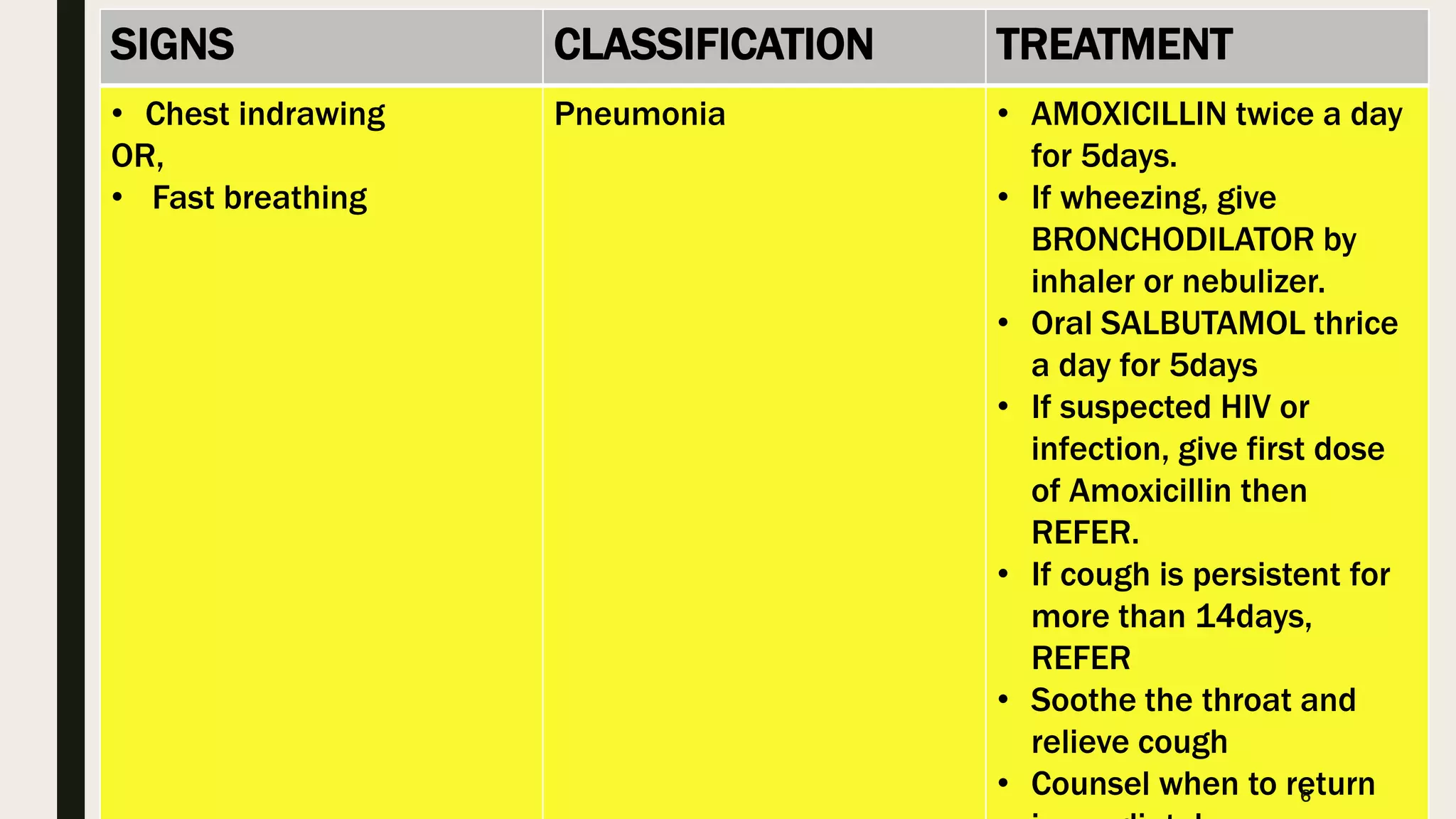
SIGNS CLASSIFICATION TREATMENT
• Chest indrawing
OR,
• Fast breathing
Pneumonia • AMOXICILLIN twice a day
for 5days.
• If wheezing, give
BRONCHODILATOR by
inhaler or nebulizer.
• Oral SALBUTAMOL thrice
a day for 5days
• If suspected HIV or
infection, give first dose
of Amoxicillin then
REFER.
• If cough is persistent for
more than 14days,
REFER
• Soothe the throat and
relieve cough
• Counsel when to return
6
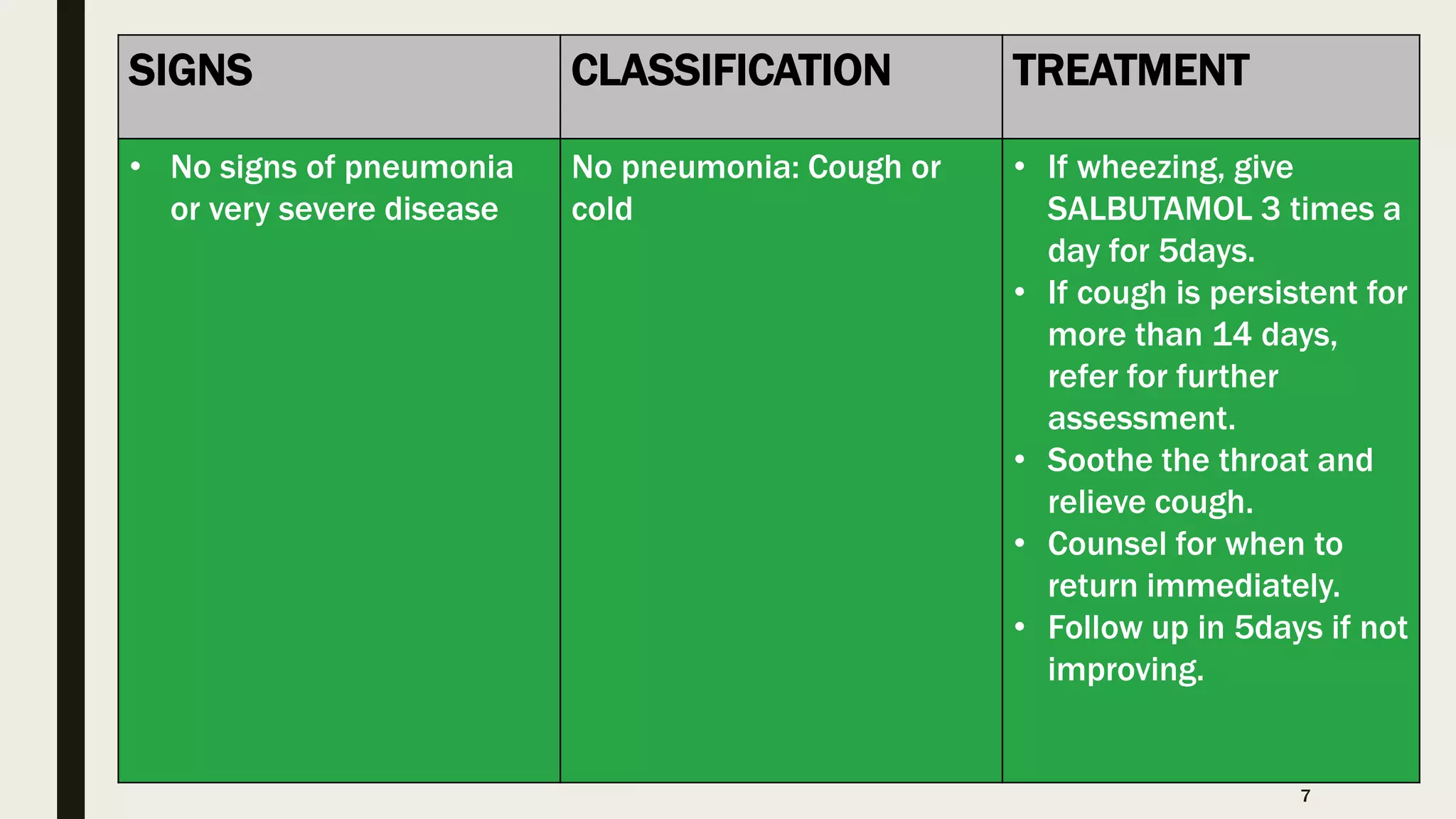
SIGNS CLASSIFICATION TREATMENT
• No signs of pneumonia
or very severe disease
No pneumonia: Cough or
cold
• If wheezing, give
SALBUTAMOL 3 times a
day for 5days.
• If cough is persistent for
more than 14 days,
refer for further
assessment.
• Soothe the throat and
relieve cough.
• Counsel for when to
return immediately.
• Follow up in 5days if not
improving.
7
DIARRHOEA
■ Diarrhoea is condition in which there is unusual frequent passage
of loose stool, 3 or more times in 24hrs.
■ Diarrhoea for less than 14days is called Acute Diarrhoea.
■ Diarrhoea for 14days or more is called Persistent Diarrhoea.
8
SIGNS CLASSIFICATION TREATMENT
Two of the following signs:
• Lethargic or unconscious.
• Sunken eyes.
• Unable to drink or drink
slowly.
• Skin pinch goes back very
slowly.
Severe dehydration • If no other severe
classification then,
• Treat with ORS
according to
treatment plan ‘C’
OR,
• If other severe
classification then
• REFER urgently along
with ORS and
frequent breast
feeding.
• Give appropriate
antibiotic for child more
than 2yrs and if from
chlorea risk area.
9
SIGNS CLASSIFICATION TREATMENT
Two of the following signs:
• Restless, irritable
• Sunken eyes
• Drinks eagerly
• Skin pinch goes back
slowly.
Some dehydration • Give fluids, Zinc and food
according to treatment
plan ‘B’.
• If other severe
classification then,
REFER urgently along
with ORS and frequent
breast feeding.
• Counsel caregiver when
to return immediately.
• If no improvement
,follow up in 5days for
evaluation.
10
SIGNS CLASSIFICATION TREATMENT
• No signs of dehydration No dehydration • Give fluids, Zinc and food
according to treatment
plan ‘A’ at home
• Counsel caregiver when
to return immediately.
• If no improvement ,follow
up in 5days for
evaluation.
11
SIGNS CLASSIFICATION TREATMENT
• Severe OR some
dehydration signs
Severe Persistent
Diarrhoea
• If no other severe
classification, treat
dehydration then REFER
• If other severe
classification, REFER
urgently with ORS and
breastfeeding
• Give single dose of
Vitamin A
• If mouth sores or severe
pneumonia or severe
disease or very low
weight, assess for HIV
and manage accordingly
12
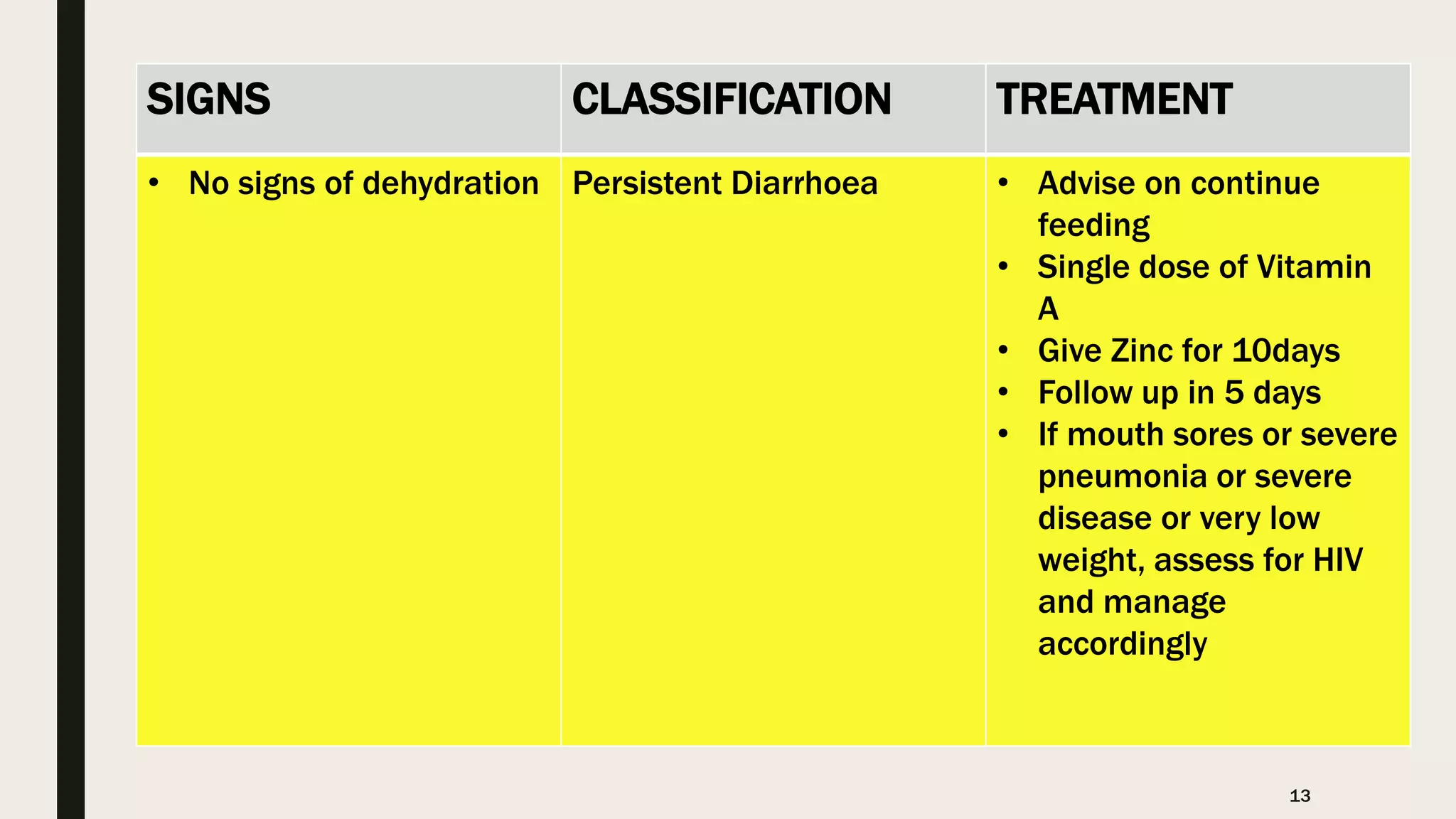
SIGNS CLASSIFICATION TREATMENT
• No signs of dehydration Persistent Diarrhoea • Advise on continue
feeding
• Single dose of Vitamin
A
• Give Zinc for 10days
• Follow up in 5 days
• If mouth sores or severe
pneumonia or severe
disease or very low
weight, assess for HIV
and manage
accordingly
13
SIGNS CLASSIFICATION TREATMENT
• Blood in stool Dysentery • Treat for 3days with
CIPROFLOXACIN for
Shigella
• Give Zinc tab for 10days
in any type of diarrhoea
• Follow up in 3days
14
MEASLES
■ Measles is a communicable disease caused by a RNA virus
belonging to Paramyxo virus family and characterized by fever,
cough, coryza, lacrimation, koplik spots in the pre-eruptive phase
and maculopapular rash starting on 4th or 5th day of illness.
■ Children from 6months to 2years are mostly affected.
■ Measles affect the epithelial tissue of lungs, intestine, stomach,
eyes, mouth and throat and decreases the immune system
making the child more susceptible to other infections.
15
SIGNS CLASSIFICATION TREATMENT
• Any general danger sign
OR,
• Pneumonia OR,
• Symptomatic HIV
infection OR,
• Clouding of cornea OR,
• Deep or extensive mouth
ulcers
Suspected Complicated
measles
• Give additional dose of
Vitamin A
• If clouding of the cornea
or pus draining from the
eye, apply
CHLORAMPHENICOL eye
oint.
• Give first dose of
AMOXICILLIN unless child
is receiving IM
CEFTRIAXONE for another
reason.
• REFER urgently.
• Immunize all close
contacts over 6mths of
age within 72hrs of
16
SIGNS CLASSIFICATION TREATMENT
• Measles symptoms
present and,
• Measles test positive.
Measles • Give additional dose of
vit. A
• If pus draining from eye,
treat eye infection with
CHLORAMPHENICOL eye
oint for 7days.
• If mouth ulcer, treat with
CHLORHEXIDINE.
• Notify EPI coordinator,
and complete necessary
forms.
• Isolate the child from
other children for 5 days
• Immunize all close
contacts over 6mths of
age within 72hrs of
exposure.
17
SIGNS CLASSIFICATION TREATMENT
• Measles test results not
available and
• Measles symptoms
present
Suspected measles • Give additional dose of
vitamin A
• Notify EPI coordinator,
and complete necessary
forms.
• Take specimens as
advised by EPI
coordinator, and send
these to the NICD.
• Isolate the child from
other children for 5 days
• Immunize all close
contacts over 6mths of
age within 72hrs of
exposure.
• Follow up in 2days
18
MALARIA
■ malaria is a life threatening disease caused by Plasmodium
parasites that are transmitted to people through the bites of
infected female Anopheles mosquitoes.
■ Among the other species, Plasmodium falciparum is of greatest
threat that cause child mortality.
■ If left untreated, malaria fever can progress to severe complicated
malaria and even death within 24hrs of period.
19
HIGH/LOW- MALARIA RISK area
SIGNS CLASSIFICATION TREATMENT
• Any general danger sign,
OR,
• Stiff neck
OR,
• Any Danger sign with
Microscopic /RDT positive
Severe complicated
malaria or high grade fever
• Prepare a blood smear in
a slide . Give single dose
of RECTAL ARTISUNATE
then refer along with
slide.
• Give first dose of
appropriate antibiotic.
• Test and treat or prevent
low blood sugar
• Give one dose of
PARACETAMOL for fever
38degree celcius or
above .
20
SIGNS CLASSIFICATION TREATMENT
• Microscopic /RDT and
Falciparum positive
Falciparum Malaria • If age < 12 mths, treat
with QUININE SULPHATE.
• If age > 12 mths, treat
with ACT (ARTEMISININ
COMBINATION THERAPY)
• Give one dose of
PARACETAMOL for fever
38 degree celcius or
above.
• Advise caregiver when to
return immediately.
• Follow up in 3days . If
fever persists everyday
then REFER for further
evaluation.
21
SIGNS CLASSIFICATION TREATMENT
• Microscopic /RDT
positive and Falciparum
Negative
Malaria without falciparum
(vivax)
• Treat with CHOROQUINE
for vivax malaria.
• Give single dose of
PARACETAMOL for fever
38 degree celcius or
above
• Advise caregiver when to
return immediately.
• Follow up in 3days . If
fever persists everyday
then REFER for further
evaluation.
22
SIGNS CLASSIFICATION TREATMENT
• Runny nose
OR,
• Measles
OR,
• Other causes of fever
AND
• Microscopic/RDT
Negative
Fever: no signs of malaria • Give single dose of
PARACETAMOL for fever
38 degree celcius or
above
• Advise caregiver when to
return immediately
• Follow up in 3days , if
fever persists everyday.
• If fever persists for more
than 7 days then REFER
for further evaluation.
23
NO MALARIA RISK area
SIGNS CLASSIFICATION TREATMENT
• Any danger signs
OR,
• Stiff neck
High grade fever • Give first dose of
AMPICILLIN IM
• Prevent low blood sugar
• Give single dose of
PARACETAMOL if fever
38.5 degree celcius or
more.
• REFER urgently
24
SIGNS CLASSIFICATION TREATMENT
• Any other cause of fever fever • Give single dose of
PARACETAMOL if fever
38.5 degree celsius or
more.
• Advise caregiver when to
return immediately
• Follow up in 3days , if
fever persists everyday.
• If fever persists for more
than 7 days then REFER
for further evaluation.
• Treat other cause of
fever.
25
MALNUTRITION
■ Malnutrition refers to deficiencies or excesses in nutrient intake,
imbalance of essential nutrients or impaired nutrient utilization.
■ According to NDHS 2011, 11% of under 5 children are affected by
severe malnutrition, 41% are affected by stunting and 29% are
underweight.
26
SIGNS CLASSIFICATION TREATMENT
• Visible weight loss
OR,
• Pitting oedema in both
feet OR,
• MUAC <11.5cm (red)
OR,
• Low weight for age (< -
3 SD)
Severe acute malnutrition • Give single dose of
vitamin A. In
kwashiorker, give
vitamin A after the
edema is subsided.
• REFER urgently
27
SIGNS CLASSIFICATION TREATMENT
• MUAC 11.5-12.5cm
(Yellow) or,
• Low weight for age (< -2
to -3 SD)
Moderate Acute
malnutrition
• REFER URGENTLY if
develops any medical
complication
• Assess the child’s
feeding and counsel the
caregiver on the feeding
recommendations
• If any feeding problems,
follow up in 5 days.
• Advise when to return
immediately
• If low weight for age,
follow up in 30days.
• ALBENDAZOLE if child is
>1yr and is not given the
dose in previous 6mths.
• Vitamin A 28
SIGNS CLASSIFICATION TREATMENT
• MUAC 12.5cm or more
(Green) or,
• Average weight for age or
• Average weight for height
No malnutrition • Assess the child’s
feeding and counsel the
caregiver on the feeding
recommendations
• If any feeding problems,
follow up in 5 days for
observation.
• Advise caregiver when to
return immediately
29
REFERENCES
■ Ghimire B. A textbook of Community Health Nursing. 7th ed. Kathmandu:
vidyarthi publication; 2018. P.246-54.
■ Shrestha T. Essential Child Health Nirsing. 2nd ed. Kathmandu: medhavi
publication; 2021. P.659-66.
■ CB-IMNCI booklet and app.
30
31

CBIMNCI (5MAJOR KILLER DISEASE) .pptx

  • 1.
  • 2.
    CB-IMNCI 5 major childhood killerdiseases Presenter: Nisha Thapa Nita Shrestha 2
  • 3.
    General Objective ■ Atthe end of session, participants will be able to know about the childhood 5 major killer disease (CB-IMNCI). 3 Specific Objectives At the end of session, participants must be able to: ■ enlist 5 major childhood killer disease. ■ define all 5 killer disease. ■ classify according to CB-IMNCI. ■ describe treatment according to CB-IMNCI.
  • 4.
    PNEUMONIA ■ Pneumonia isan acute inflammation of lungs parenchyma that impairs gas exchange. ■ It is the leading cause of mortality in children below 5yrs of age. Child’s age Fast respiration rate • 0 to 2 months 60 or more breaths per minute • 2 months to 12months 50 or more breaths per minute • 12months to 5years 40 or more breaths per minute 4
  • 5.
    SIGNS CLASSIFICATION TREATMENT •Any general danger signs OR, • Stridor in calm child Severe Pneumonia OR, very severe disease • Give DIAZEPAM if convulsion • Rapid assessment • Provide pre referral treatment • Give first dose of appropriate antibiotic. • Prevent or Treat for low blood sugar. • Keep child warm and REFER urgently. 5
  • 6.
    SIGNS CLASSIFICATION TREATMENT •Chest indrawing OR, • Fast breathing Pneumonia • AMOXICILLIN twice a day for 5days. • If wheezing, give BRONCHODILATOR by inhaler or nebulizer. • Oral SALBUTAMOL thrice a day for 5days • If suspected HIV or infection, give first dose of Amoxicillin then REFER. • If cough is persistent for more than 14days, REFER • Soothe the throat and relieve cough • Counsel when to return 6
  • 7.
    SIGNS CLASSIFICATION TREATMENT •No signs of pneumonia or very severe disease No pneumonia: Cough or cold • If wheezing, give SALBUTAMOL 3 times a day for 5days. • If cough is persistent for more than 14 days, refer for further assessment. • Soothe the throat and relieve cough. • Counsel for when to return immediately. • Follow up in 5days if not improving. 7
  • 8.
    DIARRHOEA ■ Diarrhoea iscondition in which there is unusual frequent passage of loose stool, 3 or more times in 24hrs. ■ Diarrhoea for less than 14days is called Acute Diarrhoea. ■ Diarrhoea for 14days or more is called Persistent Diarrhoea. 8
  • 9.
    SIGNS CLASSIFICATION TREATMENT Twoof the following signs: • Lethargic or unconscious. • Sunken eyes. • Unable to drink or drink slowly. • Skin pinch goes back very slowly. Severe dehydration • If no other severe classification then, • Treat with ORS according to treatment plan ‘C’ OR, • If other severe classification then • REFER urgently along with ORS and frequent breast feeding. • Give appropriate antibiotic for child more than 2yrs and if from chlorea risk area. 9
  • 10.
    SIGNS CLASSIFICATION TREATMENT Twoof the following signs: • Restless, irritable • Sunken eyes • Drinks eagerly • Skin pinch goes back slowly. Some dehydration • Give fluids, Zinc and food according to treatment plan ‘B’. • If other severe classification then, REFER urgently along with ORS and frequent breast feeding. • Counsel caregiver when to return immediately. • If no improvement ,follow up in 5days for evaluation. 10
  • 11.
    SIGNS CLASSIFICATION TREATMENT •No signs of dehydration No dehydration • Give fluids, Zinc and food according to treatment plan ‘A’ at home • Counsel caregiver when to return immediately. • If no improvement ,follow up in 5days for evaluation. 11
  • 12.
    SIGNS CLASSIFICATION TREATMENT •Severe OR some dehydration signs Severe Persistent Diarrhoea • If no other severe classification, treat dehydration then REFER • If other severe classification, REFER urgently with ORS and breastfeeding • Give single dose of Vitamin A • If mouth sores or severe pneumonia or severe disease or very low weight, assess for HIV and manage accordingly 12
  • 13.
    SIGNS CLASSIFICATION TREATMENT •No signs of dehydration Persistent Diarrhoea • Advise on continue feeding • Single dose of Vitamin A • Give Zinc for 10days • Follow up in 5 days • If mouth sores or severe pneumonia or severe disease or very low weight, assess for HIV and manage accordingly 13
  • 14.
    SIGNS CLASSIFICATION TREATMENT •Blood in stool Dysentery • Treat for 3days with CIPROFLOXACIN for Shigella • Give Zinc tab for 10days in any type of diarrhoea • Follow up in 3days 14
  • 15.
    MEASLES ■ Measles isa communicable disease caused by a RNA virus belonging to Paramyxo virus family and characterized by fever, cough, coryza, lacrimation, koplik spots in the pre-eruptive phase and maculopapular rash starting on 4th or 5th day of illness. ■ Children from 6months to 2years are mostly affected. ■ Measles affect the epithelial tissue of lungs, intestine, stomach, eyes, mouth and throat and decreases the immune system making the child more susceptible to other infections. 15
  • 16.
    SIGNS CLASSIFICATION TREATMENT •Any general danger sign OR, • Pneumonia OR, • Symptomatic HIV infection OR, • Clouding of cornea OR, • Deep or extensive mouth ulcers Suspected Complicated measles • Give additional dose of Vitamin A • If clouding of the cornea or pus draining from the eye, apply CHLORAMPHENICOL eye oint. • Give first dose of AMOXICILLIN unless child is receiving IM CEFTRIAXONE for another reason. • REFER urgently. • Immunize all close contacts over 6mths of age within 72hrs of 16
  • 17.
    SIGNS CLASSIFICATION TREATMENT •Measles symptoms present and, • Measles test positive. Measles • Give additional dose of vit. A • If pus draining from eye, treat eye infection with CHLORAMPHENICOL eye oint for 7days. • If mouth ulcer, treat with CHLORHEXIDINE. • Notify EPI coordinator, and complete necessary forms. • Isolate the child from other children for 5 days • Immunize all close contacts over 6mths of age within 72hrs of exposure. 17
  • 18.
    SIGNS CLASSIFICATION TREATMENT •Measles test results not available and • Measles symptoms present Suspected measles • Give additional dose of vitamin A • Notify EPI coordinator, and complete necessary forms. • Take specimens as advised by EPI coordinator, and send these to the NICD. • Isolate the child from other children for 5 days • Immunize all close contacts over 6mths of age within 72hrs of exposure. • Follow up in 2days 18
  • 19.
    MALARIA ■ malaria isa life threatening disease caused by Plasmodium parasites that are transmitted to people through the bites of infected female Anopheles mosquitoes. ■ Among the other species, Plasmodium falciparum is of greatest threat that cause child mortality. ■ If left untreated, malaria fever can progress to severe complicated malaria and even death within 24hrs of period. 19
  • 20.
    HIGH/LOW- MALARIA RISKarea SIGNS CLASSIFICATION TREATMENT • Any general danger sign, OR, • Stiff neck OR, • Any Danger sign with Microscopic /RDT positive Severe complicated malaria or high grade fever • Prepare a blood smear in a slide . Give single dose of RECTAL ARTISUNATE then refer along with slide. • Give first dose of appropriate antibiotic. • Test and treat or prevent low blood sugar • Give one dose of PARACETAMOL for fever 38degree celcius or above . 20
  • 21.
    SIGNS CLASSIFICATION TREATMENT •Microscopic /RDT and Falciparum positive Falciparum Malaria • If age < 12 mths, treat with QUININE SULPHATE. • If age > 12 mths, treat with ACT (ARTEMISININ COMBINATION THERAPY) • Give one dose of PARACETAMOL for fever 38 degree celcius or above. • Advise caregiver when to return immediately. • Follow up in 3days . If fever persists everyday then REFER for further evaluation. 21
  • 22.
    SIGNS CLASSIFICATION TREATMENT •Microscopic /RDT positive and Falciparum Negative Malaria without falciparum (vivax) • Treat with CHOROQUINE for vivax malaria. • Give single dose of PARACETAMOL for fever 38 degree celcius or above • Advise caregiver when to return immediately. • Follow up in 3days . If fever persists everyday then REFER for further evaluation. 22
  • 23.
    SIGNS CLASSIFICATION TREATMENT •Runny nose OR, • Measles OR, • Other causes of fever AND • Microscopic/RDT Negative Fever: no signs of malaria • Give single dose of PARACETAMOL for fever 38 degree celcius or above • Advise caregiver when to return immediately • Follow up in 3days , if fever persists everyday. • If fever persists for more than 7 days then REFER for further evaluation. 23
  • 24.
    NO MALARIA RISKarea SIGNS CLASSIFICATION TREATMENT • Any danger signs OR, • Stiff neck High grade fever • Give first dose of AMPICILLIN IM • Prevent low blood sugar • Give single dose of PARACETAMOL if fever 38.5 degree celcius or more. • REFER urgently 24
  • 25.
    SIGNS CLASSIFICATION TREATMENT •Any other cause of fever fever • Give single dose of PARACETAMOL if fever 38.5 degree celsius or more. • Advise caregiver when to return immediately • Follow up in 3days , if fever persists everyday. • If fever persists for more than 7 days then REFER for further evaluation. • Treat other cause of fever. 25
  • 26.
    MALNUTRITION ■ Malnutrition refersto deficiencies or excesses in nutrient intake, imbalance of essential nutrients or impaired nutrient utilization. ■ According to NDHS 2011, 11% of under 5 children are affected by severe malnutrition, 41% are affected by stunting and 29% are underweight. 26
  • 27.
    SIGNS CLASSIFICATION TREATMENT •Visible weight loss OR, • Pitting oedema in both feet OR, • MUAC <11.5cm (red) OR, • Low weight for age (< - 3 SD) Severe acute malnutrition • Give single dose of vitamin A. In kwashiorker, give vitamin A after the edema is subsided. • REFER urgently 27
  • 28.
    SIGNS CLASSIFICATION TREATMENT •MUAC 11.5-12.5cm (Yellow) or, • Low weight for age (< -2 to -3 SD) Moderate Acute malnutrition • REFER URGENTLY if develops any medical complication • Assess the child’s feeding and counsel the caregiver on the feeding recommendations • If any feeding problems, follow up in 5 days. • Advise when to return immediately • If low weight for age, follow up in 30days. • ALBENDAZOLE if child is >1yr and is not given the dose in previous 6mths. • Vitamin A 28
  • 29.
    SIGNS CLASSIFICATION TREATMENT •MUAC 12.5cm or more (Green) or, • Average weight for age or • Average weight for height No malnutrition • Assess the child’s feeding and counsel the caregiver on the feeding recommendations • If any feeding problems, follow up in 5 days for observation. • Advise caregiver when to return immediately 29
  • 30.
    REFERENCES ■ Ghimire B.A textbook of Community Health Nursing. 7th ed. Kathmandu: vidyarthi publication; 2018. P.246-54. ■ Shrestha T. Essential Child Health Nirsing. 2nd ed. Kathmandu: medhavi publication; 2021. P.659-66. ■ CB-IMNCI booklet and app. 30
  • 31.