CATHOLIC
SOCIAL
TEACHINGS
CATHOLIC SOCIAL TEACHINGS
 -It presents the Catholic Christian response to
basic modern social problems.
 - It is a body of social teachings containing
principles for actions and guidelines for
practice to help us respond to our social
responsibility in view of urgent social needs.
 It is the source of wisdom and insights to help
us acquire a truly Christian faith-vision of social
justice and peace.
CATHOLIC SOCIAL TEACHINGS
 The Church’s body of teaching on social
realities based on the Gospel, Church
Tradition, reason and human experience.
 CST is ordinarily assumed to be relatively
new in the Church, but the truth is that,
since the time of Church inception, the
Church has always been engaged in
reflecting on social realities and practical
teaching for the social good of the
people.
Role of the Church in promoting the
CST?
 It is the reliable source of guidance and
inspiration in living a moral life
 -It is concern with social issues
 -It is the moral center of our society
 - It has a right and duty to speak about
the moral implications of any
economic, political and cultural issues
based on the Gospel values.
The Role of the Church in the Society
 The Church as the Moral Center
 -It strengthen the spiritual and moral fiber
of society (CFC 1161)
 The Church through its leaders, proposes
moral principles that guides us in our
decisions and actions
The Role of the Church in the Society
 The Church is called to contribute to the
purification of reason and to the
reawakening of those moral forces
without which just structures are neither
established nor proven effective in the
long run”----- Pope Benedict XVI ( Deus
Caritas Est 29)
Role of CBCP in dealing with social problems?
 What is the -CBCP offers the relevant
aspects of the Christian moral perspective
dealing with the issue at hand.
After 10 years of PCP II (Second Plenary
Council of the Philippines), what are the
innovations made by the Philippine Church?
 -NPCCR (National Pastoral Consultations
on Church Renewal) evaluated how far it
has fulfilled the vision-mission it had
proposed in PCP II and its National
Pastoral Plan.
The Role of the Clergy and the Laity
 Clergy:
They are responsible for evangelizing the faithful ,
bringing the Gospel values into the specific issues of
the day, and clarifying the moral implications of the
current events, and roles of the social structures.
 laity
They are responsible for incorporating the Gospel
values into their families, schools, workplaces and
into the very structures of society.
 Leaders and laity share the same mission of
spreading the Gospel in all areas of human life.
Bothe act as leaven in human society.
Church and State
Separation/Relation
 -It protects freedom of religion
 -Bill of Rights Article 3, Section 5 of the
1987 Philippine Constitution.
 -“No law shall be made respecting an
establishment of religion or prohibiting the
free exercise thereof.”
 -There is no imposed religion in the society
Sources of CST
 Social Encyclicals by different popes
 Gaudium et Spes (Church in the Modern
World) of Vatican II
 Justice in the World (Synod of Bishops,
1971)
 Interviews with pope
 Studies of Vatican congregations
 Statements from different national
episcopal conferences
Sources of CST
 Homilies of bishops and priests
 CBCP-timely pastoral letters on various
social issues (poverty, education,
gambling, population growth, elections,
ecology)
CST as Church’s Best kept
Secret
Characteristics of CST
1. PERMANENT- CST is timeless, never go out of date
in their fundamentals
A. human dignity and solidarity
B. Social justice and Christian love
C. Active non-violence and peace
D. Preferential option for the poor
E. Value of human work
F. Universal destination of the goods of the earth
G. Stewardship and integrity of creation
H. People empowerment
I. Authentic and holistic human development
2. DEVELOPING
Signs of the times
 It is the process or intelligible method for
coming to a thorough understanding of
the situation
 How does the Church “ read the signs of
the times” and reach conclusions as to
the kind of social responsibility current
Christian discipleship demands?
Methods and Sources of CST
1. Sacred Scripture- together with Sacred
Tradition , make up a single deposit of the
Word of God
2. Tradition
3. Reason
4. Human Experience
Reading the signs of the Times
(para 4 of the Vatican II Gaudium
et Spes)
 Is the process or intelligible method of
arriving at a thorough understanding of
the situation
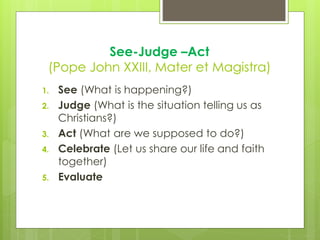
See-Judge –Act
(Pope John XXIII, Mater et Magistra)
1. See (What is happening?)
2. Judge (What is the situation telling us as
Christians?)
3. Act (What are we supposed to do?)
4. Celebrate (Let us share our life and faith
together)
5. Evaluate

Catholic social-teachings

  • 1.
  • 2.
    CATHOLIC SOCIAL TEACHINGS -It presents the Catholic Christian response to basic modern social problems.  - It is a body of social teachings containing principles for actions and guidelines for practice to help us respond to our social responsibility in view of urgent social needs.  It is the source of wisdom and insights to help us acquire a truly Christian faith-vision of social justice and peace.
  • 3.
    CATHOLIC SOCIAL TEACHINGS The Church’s body of teaching on social realities based on the Gospel, Church Tradition, reason and human experience.  CST is ordinarily assumed to be relatively new in the Church, but the truth is that, since the time of Church inception, the Church has always been engaged in reflecting on social realities and practical teaching for the social good of the people.
  • 5.
    Role of theChurch in promoting the CST?  It is the reliable source of guidance and inspiration in living a moral life  -It is concern with social issues  -It is the moral center of our society  - It has a right and duty to speak about the moral implications of any economic, political and cultural issues based on the Gospel values.
  • 6.
    The Role ofthe Church in the Society  The Church as the Moral Center  -It strengthen the spiritual and moral fiber of society (CFC 1161)  The Church through its leaders, proposes moral principles that guides us in our decisions and actions
  • 7.
    The Role ofthe Church in the Society  The Church is called to contribute to the purification of reason and to the reawakening of those moral forces without which just structures are neither established nor proven effective in the long run”----- Pope Benedict XVI ( Deus Caritas Est 29)
  • 8.
    Role of CBCPin dealing with social problems?  What is the -CBCP offers the relevant aspects of the Christian moral perspective dealing with the issue at hand.
  • 9.
    After 10 yearsof PCP II (Second Plenary Council of the Philippines), what are the innovations made by the Philippine Church?  -NPCCR (National Pastoral Consultations on Church Renewal) evaluated how far it has fulfilled the vision-mission it had proposed in PCP II and its National Pastoral Plan.
  • 10.
    The Role ofthe Clergy and the Laity  Clergy: They are responsible for evangelizing the faithful , bringing the Gospel values into the specific issues of the day, and clarifying the moral implications of the current events, and roles of the social structures.  laity They are responsible for incorporating the Gospel values into their families, schools, workplaces and into the very structures of society.  Leaders and laity share the same mission of spreading the Gospel in all areas of human life. Bothe act as leaven in human society.
  • 11.
    Church and State Separation/Relation -It protects freedom of religion  -Bill of Rights Article 3, Section 5 of the 1987 Philippine Constitution.  -“No law shall be made respecting an establishment of religion or prohibiting the free exercise thereof.”  -There is no imposed religion in the society
  • 12.
    Sources of CST Social Encyclicals by different popes  Gaudium et Spes (Church in the Modern World) of Vatican II  Justice in the World (Synod of Bishops, 1971)  Interviews with pope  Studies of Vatican congregations  Statements from different national episcopal conferences
  • 13.
    Sources of CST Homilies of bishops and priests  CBCP-timely pastoral letters on various social issues (poverty, education, gambling, population growth, elections, ecology)
  • 14.
    CST as Church’sBest kept Secret
  • 15.
    Characteristics of CST 1.PERMANENT- CST is timeless, never go out of date in their fundamentals A. human dignity and solidarity B. Social justice and Christian love C. Active non-violence and peace D. Preferential option for the poor E. Value of human work F. Universal destination of the goods of the earth G. Stewardship and integrity of creation H. People empowerment I. Authentic and holistic human development 2. DEVELOPING
  • 16.
    Signs of thetimes  It is the process or intelligible method for coming to a thorough understanding of the situation  How does the Church “ read the signs of the times” and reach conclusions as to the kind of social responsibility current Christian discipleship demands?
  • 17.
    Methods and Sourcesof CST 1. Sacred Scripture- together with Sacred Tradition , make up a single deposit of the Word of God 2. Tradition 3. Reason 4. Human Experience
  • 18.
    Reading the signsof the Times (para 4 of the Vatican II Gaudium et Spes)  Is the process or intelligible method of arriving at a thorough understanding of the situation
  • 19.
    See-Judge –Act (Pope JohnXXIII, Mater et Magistra) 1. See (What is happening?) 2. Judge (What is the situation telling us as Christians?) 3. Act (What are we supposed to do?) 4. Celebrate (Let us share our life and faith together) 5. Evaluate