CL 12:
SECOND QUARTER
OF THE FIRST
SEMESTER
MODULES 5-8
BIBLICAL SCRIPTURES OF THE
WEEK:
1. Leviticus 19: 18
2. Matthew 22: 37 – 40
3. MATTHEW 28: 20
4. EPHESIANS 1: 3 – 12
5. Genesis 1: 27 – 31
LEARNING OBJECTIVES:
Targets: In this unit, the standards are:
 1. Realize and understand that through and by the Holy
Spirit who impels everyone in the church today toward
mission and ministry.
 2. Imitate the steadfastness of the early church by good
free words and deeds to witness true discipleship and
actively participate in the continuance of Christ’s
mission in the world today in our parish.
 3. Praise and thank God through prayers especially in
the Sacrament of the Holy Eucharist
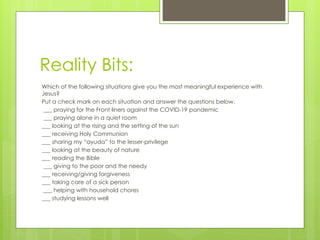
Reality Bits:
Which of the following situations give you the most meaningful experience with
Jesus?
Put a check mark on each situation and answer the questions below.
___ praying for the Front liners against the COVID-19 pandemic
___ praying alone in a quiet room
___ looking at the rising and the setting of the sun
___ receiving Holy Communion
___ sharing my “ayuda” to the lesser-privilege
___ looking at the beauty of nature
___ reading the Bible
___ giving to the poor and the needy
___ receiving/giving forgiveness
___ taking care of a sick person
___ helping with household chores
___ studying lessons well
ESTABLISHMENTS AND MODELS
OF THE CHURCH
 CFC 660
 “The Risen Christ’s presence, both
personal and communal, is the abiding
source of our authentic Christian moral
discernment and strength for our daily
living out our Christian Faith.”
Truths to Remember:
 1. Christ’s ministry is the ultimate horn for
Church’s mission continued and
developed by, for and through the
apostles and their successors. This ministry
is to be continued until the end of time by
all baptized members called to form a
community of loving service to one
another.
2. The Models of the Church:
 The Church is an Institution – the church lives out the
role of Jesus as a prophet, Priest, and King
 The Church as a Sacrament – the church is a sign of
intimate union with God and and of the unity of
humankind
 The Church as a Community of the People of God –
called by Jesus to fellowship of life, love, and truth
 The Church as Herald – it announces and proclaim
the good news of salvation that God offers to
everyone
SOCIAL TEACHINGS OF THE
CHURCH
Catechism of the Catholic
Church (CCC) #2422
 “The Social Teaching of the Church
comprises of body of doctrine which is
articulated as the Church interprets the
events in the course of history in the light
of the whole of what has been revealed
by Jesus Christ.”
 Like a voice in universal conscience, they
offer guidance to the Christian people on:
Life and Work, Right to Property, Rights of
Workers, Human Labour, Collaboration,
and Justice through Charity, Subsidiarity,
Ecological System, Communication, and
Care for our common home, the Earth.
The key themes of Catholic Social
Teachings of the Church:
 1. Dignity of the Human Person
 2. Love and Justice
 3. Dignity of Work
 4. Ecological Responsibility/Private
Property
 5. Preferential Option for the poor
REMEMBER:
 “Catholic Social Teachings stresses that
how we organize society in economics,
politics, and law or policy directly affects
human dignity and community. Society
often proclaims the importance of
individualism, but Catholic Social
Teaching argues that human beings are
fulfilled in community and family”.
Lesson 7: The Social Teachings
of the Church
 In this unit, the standards are:
 Content Standard: Doctrine Explain how the Church continues
the mission of Christ in the present secular world Morals Be
guided by the Church Social Teaching in their commitment to
a particular way of helping our country improve Worship
Deepen and strengthen their prayer and sacramental life as
they respond to the social problems of our times and
appreciate their being members of the Church
 Performance Standard: The learner will be able to demonstrate
an understanding of the right to a just share in our daily living
 Formation Standard: The learner will become service – oriented
and committed to his/her values and duties as member of the
church
In this unit, the standards are:
 1. Understand the truth that Justice is
grounded on God Himself
 2. Promote Justice all times in my daily
living by being fair and honest
 3. Pray unceasingly for justice to reign in
our land and the conversion of those who
are involved in injustice
CFC 683
 The inviolable dignity of every human
person……is the most precious possession
of an individual; whose value comes not
from what a person “has” as much as
from what a person is.
WHO ARE YOU?
 I am the image of God
 I am unique and unrepeatable
 I am Rational
 I am different from the animals
 I am good
 I am most profoundly related to God
 I am loved
 I am capable of loving others
 I am free My ultimate goal is God
 “Man was created to the image and
likeness of God and is capable of
knowing and loving his Creator and was
appointed by Him as master of all earthly
creatures that he might subdue them and
use them to God’s Glory.

CL 12 MODULESSSSS 5-8 (SECOND QUARTER).pptx

  • 1.
    CL 12: SECOND QUARTER OFTHE FIRST SEMESTER MODULES 5-8
  • 2.
    BIBLICAL SCRIPTURES OFTHE WEEK: 1. Leviticus 19: 18 2. Matthew 22: 37 – 40 3. MATTHEW 28: 20 4. EPHESIANS 1: 3 – 12 5. Genesis 1: 27 – 31
  • 3.
    LEARNING OBJECTIVES: Targets: Inthis unit, the standards are:  1. Realize and understand that through and by the Holy Spirit who impels everyone in the church today toward mission and ministry.  2. Imitate the steadfastness of the early church by good free words and deeds to witness true discipleship and actively participate in the continuance of Christ’s mission in the world today in our parish.  3. Praise and thank God through prayers especially in the Sacrament of the Holy Eucharist
  • 4.
    Reality Bits: Which ofthe following situations give you the most meaningful experience with Jesus? Put a check mark on each situation and answer the questions below. ___ praying for the Front liners against the COVID-19 pandemic ___ praying alone in a quiet room ___ looking at the rising and the setting of the sun ___ receiving Holy Communion ___ sharing my “ayuda” to the lesser-privilege ___ looking at the beauty of nature ___ reading the Bible ___ giving to the poor and the needy ___ receiving/giving forgiveness ___ taking care of a sick person ___ helping with household chores ___ studying lessons well
  • 5.
    ESTABLISHMENTS AND MODELS OFTHE CHURCH  CFC 660  “The Risen Christ’s presence, both personal and communal, is the abiding source of our authentic Christian moral discernment and strength for our daily living out our Christian Faith.”
  • 6.
    Truths to Remember: 1. Christ’s ministry is the ultimate horn for Church’s mission continued and developed by, for and through the apostles and their successors. This ministry is to be continued until the end of time by all baptized members called to form a community of loving service to one another.
  • 7.
    2. The Modelsof the Church:  The Church is an Institution – the church lives out the role of Jesus as a prophet, Priest, and King  The Church as a Sacrament – the church is a sign of intimate union with God and and of the unity of humankind  The Church as a Community of the People of God – called by Jesus to fellowship of life, love, and truth  The Church as Herald – it announces and proclaim the good news of salvation that God offers to everyone
  • 8.
  • 9.
    Catechism of theCatholic Church (CCC) #2422  “The Social Teaching of the Church comprises of body of doctrine which is articulated as the Church interprets the events in the course of history in the light of the whole of what has been revealed by Jesus Christ.”
  • 10.
     Like avoice in universal conscience, they offer guidance to the Christian people on: Life and Work, Right to Property, Rights of Workers, Human Labour, Collaboration, and Justice through Charity, Subsidiarity, Ecological System, Communication, and Care for our common home, the Earth.
  • 11.
    The key themesof Catholic Social Teachings of the Church:  1. Dignity of the Human Person  2. Love and Justice  3. Dignity of Work  4. Ecological Responsibility/Private Property  5. Preferential Option for the poor
  • 12.
    REMEMBER:  “Catholic SocialTeachings stresses that how we organize society in economics, politics, and law or policy directly affects human dignity and community. Society often proclaims the importance of individualism, but Catholic Social Teaching argues that human beings are fulfilled in community and family”.
  • 13.
    Lesson 7: TheSocial Teachings of the Church  In this unit, the standards are:  Content Standard: Doctrine Explain how the Church continues the mission of Christ in the present secular world Morals Be guided by the Church Social Teaching in their commitment to a particular way of helping our country improve Worship Deepen and strengthen their prayer and sacramental life as they respond to the social problems of our times and appreciate their being members of the Church  Performance Standard: The learner will be able to demonstrate an understanding of the right to a just share in our daily living  Formation Standard: The learner will become service – oriented and committed to his/her values and duties as member of the church
  • 14.
    In this unit,the standards are:  1. Understand the truth that Justice is grounded on God Himself  2. Promote Justice all times in my daily living by being fair and honest  3. Pray unceasingly for justice to reign in our land and the conversion of those who are involved in injustice
  • 15.
    CFC 683  Theinviolable dignity of every human person……is the most precious possession of an individual; whose value comes not from what a person “has” as much as from what a person is.
  • 16.
    WHO ARE YOU? I am the image of God  I am unique and unrepeatable  I am Rational  I am different from the animals  I am good  I am most profoundly related to God  I am loved  I am capable of loving others  I am free My ultimate goal is God
  • 17.
     “Man wascreated to the image and likeness of God and is capable of knowing and loving his Creator and was appointed by Him as master of all earthly creatures that he might subdue them and use them to God’s Glory.