Sustainable Development, SDGs
and engaging with the future
Helsinki, Finland
08 June 2016
New practice has
been incentivised by
the SDGs
• International and especially national innovative practice
• New scale, participants, issues, methods and
institutions/actors
• Innovations goes both ways
Post-2015 agenda
led to interest in SF
• International Consultations and national-led experimentation
• Core to the role of government and governance. SDG16:
“effective, accountable and inclusive institutions”
The link between SD
and Strategic
Foresight
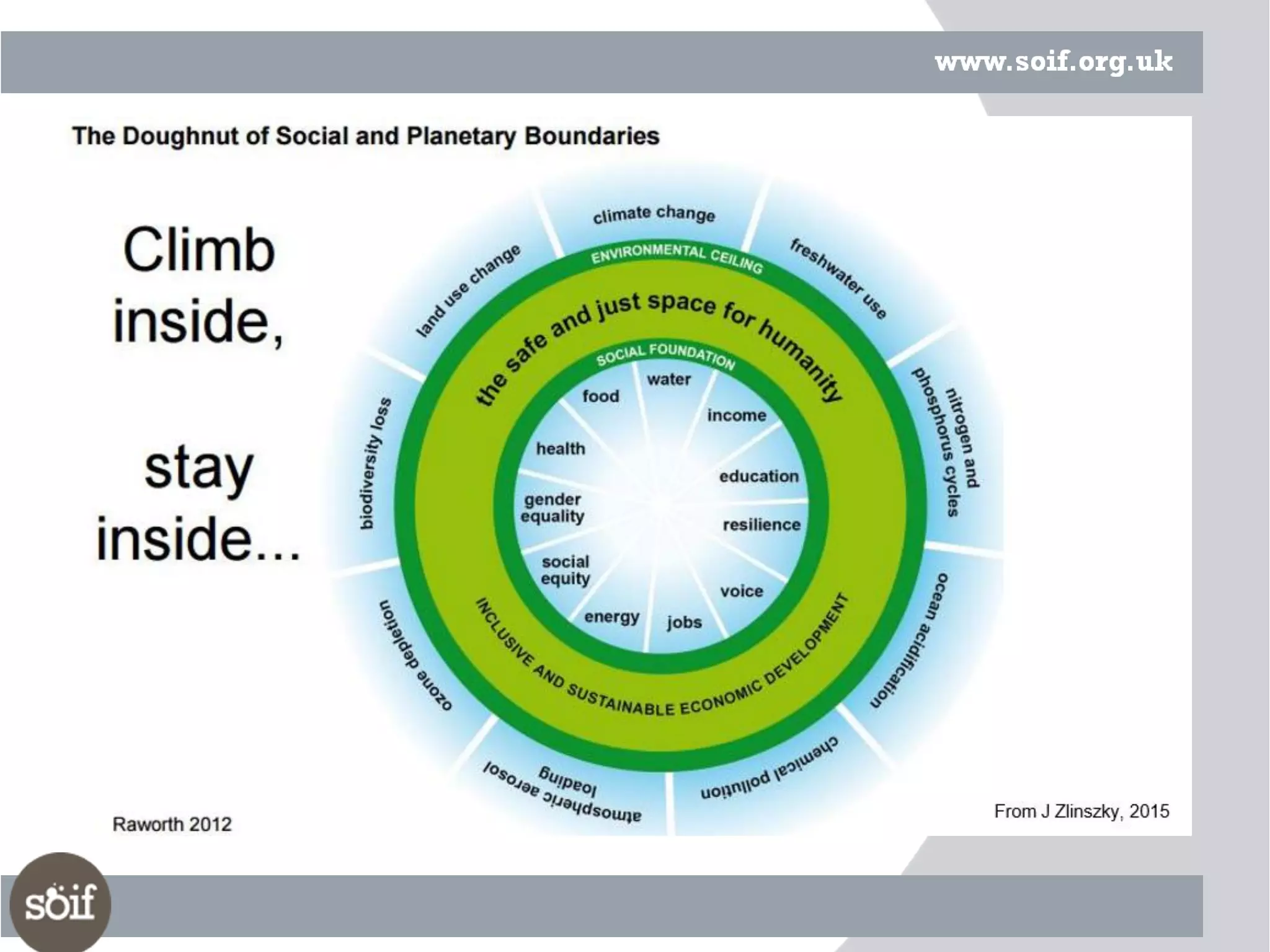
• SDs engages with certain and uncertain futures: Limits to
Growth, Planetary Boundaries, the Doughnut
• SDGs framework as a huge global strategic foresight exercise –
transformational and cash-strapped!
How does SD challenge Foresight – improve synergies
Virtuous dynamic:
How we do foresight
must change and is
changing
• SDGs has changed what we need from the foresight field
• International process modelling new behaviour and new
participative, longer-term, flexible way of policy-making
• Incorporate complex adaptive systems, design, emergence
3
Quick Intro
“Effective, Accountable
and Inclusive
Institutions”
-“The Post-2015 national consultations
have shown the potential of participative
dialogues about the futures as a powerful
tool. An inspiring narrative and a vision
for all”
New scale, participants, focus, methods, institutions
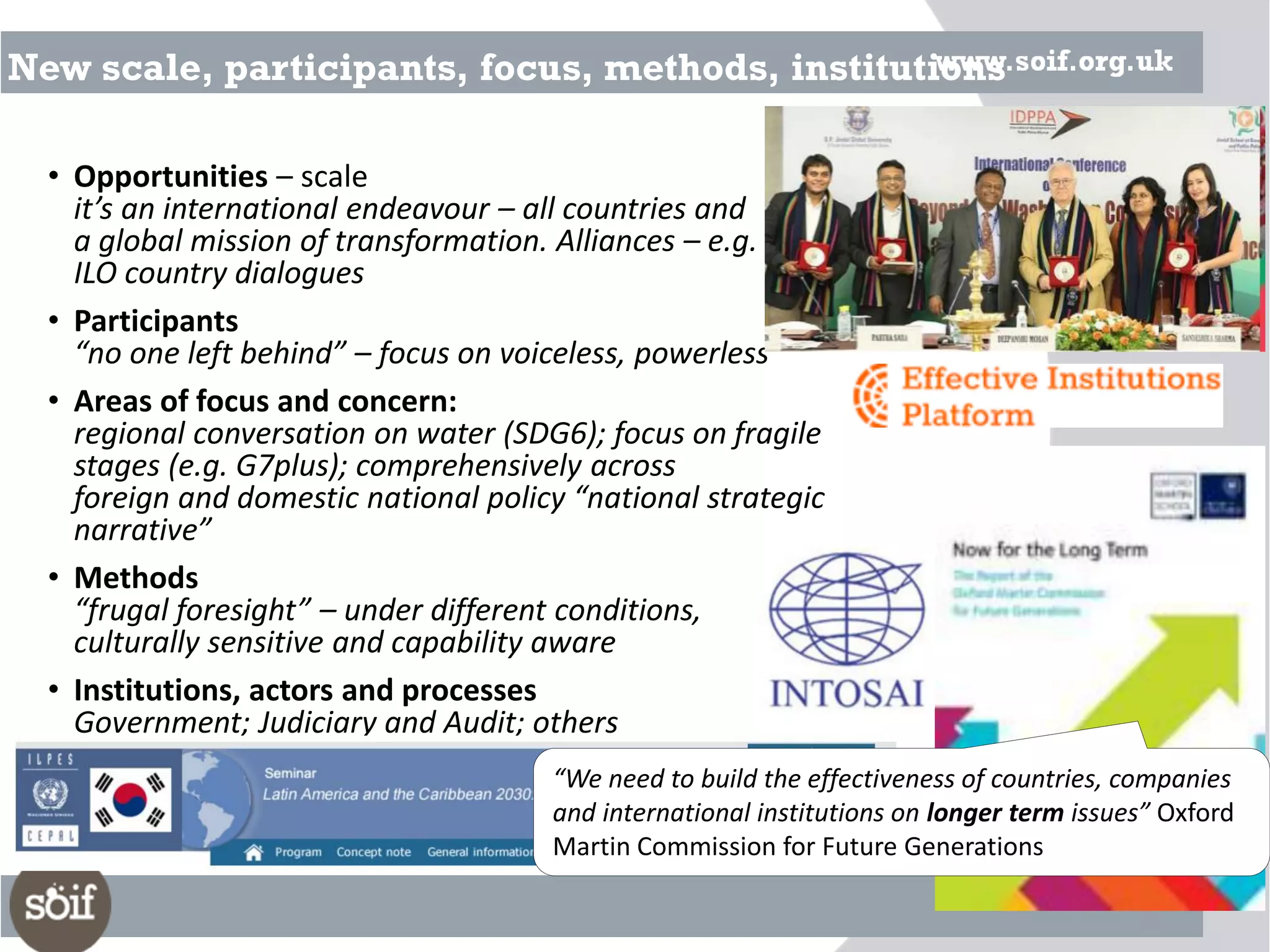
• Opportunities – scale
it’s an international endeavour – all countries and
a global mission of transformation. Alliances – e.g.
ILO country dialogues
• Participants
“no one left behind” – focus on voiceless, powerless
• Areas of focus and concern:
regional conversation on water (SDG6); focus on fragile
stages (e.g. G7plus); comprehensively across
foreign and domestic national policy “national strategic
narrative”
• Methods
“frugal foresight” – under different conditions,
culturally sensitive and capability aware
• Institutions, actors and processes
Government; Judiciary and Audit; others
“We need to build the effectiveness of countries, companies
and international institutions on longer term issues” Oxford
Martin Commission for Future Generations
Final messages – building on the synergies
Outstanding Challenges
• Moving beyond linear and technocratic
• Measuring indicators and targets
• Mixed picture on capability building
• Insufficient focus on impact
• Joining up across areas with different language
Agenda for change
• Principles for using foresight in a new global agenda
• Critical to each country – resonate… government-led process,
citizen and business-led content
• Seize the 2016 moment
• Institute for Empowered Futures
11
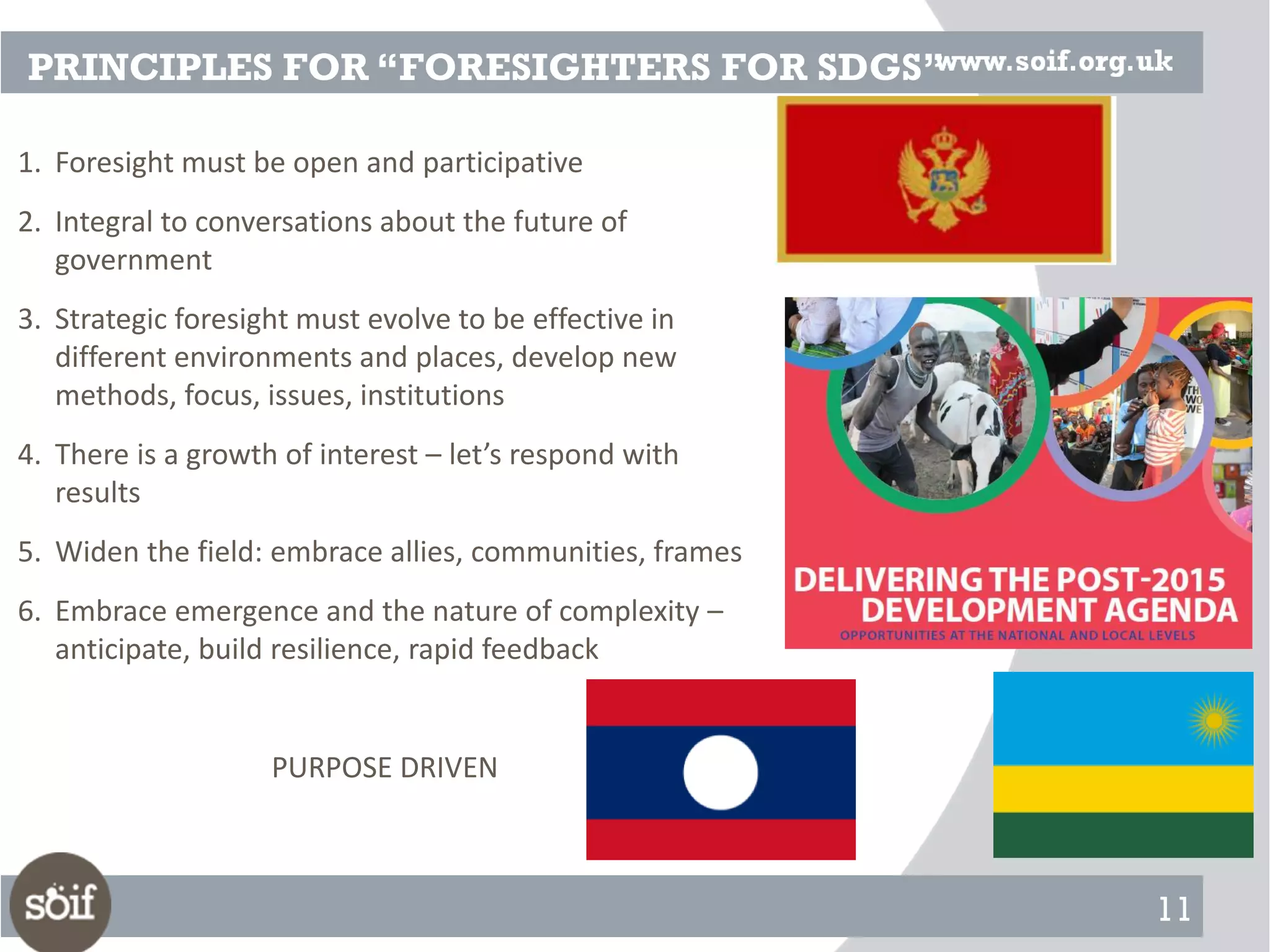
PRINCIPLES FOR “FORESIGHTERS FOR SDGS”
1. Foresight must be open and participative
2. Integral to conversations about the future of
government
3. Strategic foresight must evolve to be effective in
different environments and places, develop new
methods, focus, issues, institutions
4. There is a growth of interest – let’s respond with
results
5. Widen the field: embrace allies, communities, frames
6. Embrace emergence and the nature of complexity –
anticipate, build resilience, rapid feedback
PURPOSE DRIVEN

Catarina Tully: Sustainable development, SDGs and engaging with the future

  • 1.
    Sustainable Development, SDGs andengaging with the future Helsinki, Finland 08 June 2016
  • 2.
    New practice has beenincentivised by the SDGs • International and especially national innovative practice • New scale, participants, issues, methods and institutions/actors • Innovations goes both ways Post-2015 agenda led to interest in SF • International Consultations and national-led experimentation • Core to the role of government and governance. SDG16: “effective, accountable and inclusive institutions” The link between SD and Strategic Foresight • SDs engages with certain and uncertain futures: Limits to Growth, Planetary Boundaries, the Doughnut • SDGs framework as a huge global strategic foresight exercise – transformational and cash-strapped! How does SD challenge Foresight – improve synergies Virtuous dynamic: How we do foresight must change and is changing • SDGs has changed what we need from the foresight field • International process modelling new behaviour and new participative, longer-term, flexible way of policy-making • Incorporate complex adaptive systems, design, emergence
  • 3.
  • 7.
    “Effective, Accountable and Inclusive Institutions” -“ThePost-2015 national consultations have shown the potential of participative dialogues about the futures as a powerful tool. An inspiring narrative and a vision for all”
  • 8.
    New scale, participants,focus, methods, institutions • Opportunities – scale it’s an international endeavour – all countries and a global mission of transformation. Alliances – e.g. ILO country dialogues • Participants “no one left behind” – focus on voiceless, powerless • Areas of focus and concern: regional conversation on water (SDG6); focus on fragile stages (e.g. G7plus); comprehensively across foreign and domestic national policy “national strategic narrative” • Methods “frugal foresight” – under different conditions, culturally sensitive and capability aware • Institutions, actors and processes Government; Judiciary and Audit; others “We need to build the effectiveness of countries, companies and international institutions on longer term issues” Oxford Martin Commission for Future Generations
  • 9.
    Final messages –building on the synergies Outstanding Challenges • Moving beyond linear and technocratic • Measuring indicators and targets • Mixed picture on capability building • Insufficient focus on impact • Joining up across areas with different language Agenda for change • Principles for using foresight in a new global agenda • Critical to each country – resonate… government-led process, citizen and business-led content • Seize the 2016 moment • Institute for Empowered Futures
  • 11.
    11 PRINCIPLES FOR “FORESIGHTERSFOR SDGS” 1. Foresight must be open and participative 2. Integral to conversations about the future of government 3. Strategic foresight must evolve to be effective in different environments and places, develop new methods, focus, issues, institutions 4. There is a growth of interest – let’s respond with results 5. Widen the field: embrace allies, communities, frames 6. Embrace emergence and the nature of complexity – anticipate, build resilience, rapid feedback PURPOSE DRIVEN