RECAP
IDENTIFY ON WHAT PARTICULAR NUMBER IS
THE FOLLOWING GOAT IN THE HERD.
IDENTIFY ON WHAT PARTICULAR NUMBER IS
THE FOLLOWING GOAT IN THE HERD.
CASTRATION
Lien Rednug
Echevarria
Jimmy
Carbona Jr.
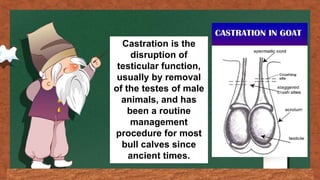
Castration is the
disruption of
testicular function,
usually by removal
of the testes of male
animals, and has
been a routine
management
procedure for most
bull calves since
ancient times.
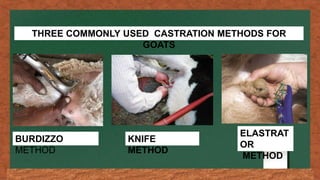
BURDIZZO
METHOD
KNIFE
METHOD
ELASTRAT
OR
METHOD
THREE COMMONLY USED CASTRATION METHODS FOR
GOATS
BURDIZZO METHOD
The Burdizzo (emasculatome) crushes the
spermatic cord and stops the blood supply to
the testes. Without this blood supply, the
testicles atrophy (shrivel up) but the scrotum
remains intact. It is a bloodless technique and
less painful than surgical castration.
KNIFE METHOD
Technique and sanitation are important,
but using a sharp knife to remove a small
testicle, pulling on the spermatic cord and
scraping those blood vessels with the knife
(to reduce bleeding) creates minimal
stress.” This method is quick and sanitary,
and the calves heal quickly.
ELASTRATOR METHOD
The Elastrator castration method is also a common
method of castration for goat. This method uses a
small rubber band that cuts off the circulation to the
testicles, causing necrosis to the testicles, which
eventually fall off with the band after 3-6 weeks.
Ideally this should be placed on goats no more than 2
weeks of age to ensure correct placement of ring. DO
NOT USE ELASTRATOR RINGS UNLESS BOTH TESTICLES
ARE IN THE SCROTUM
Ideally this should be placed on goats no more than
2 weeks of age to ensure correct placement of ring.
DO NOT USE ELASTRATOR RINGS UNLESS BOTH
TESTICLES ARE IN THE SCROTUM
IMPORTANCE OF
CASTRATION
1. Prevention of inbreeding
Inbreeding leads to poor growth rate,
poor food conversion ratio, and some
other genetic defects.
2. Prevention of unwanted
pregnancies.
3. Safety of employees, producers, and
other animals.
4. Reduced taint odour or goaty smell
in the meat of male animals.
5. Improved weight development and
carcass quality.

CASTRATION.pptx

  • 1.
  • 2.
    IDENTIFY ON WHATPARTICULAR NUMBER IS THE FOLLOWING GOAT IN THE HERD.
  • 3.
    IDENTIFY ON WHATPARTICULAR NUMBER IS THE FOLLOWING GOAT IN THE HERD.
  • 4.
  • 5.
    Castration is the disruptionof testicular function, usually by removal of the testes of male animals, and has been a routine management procedure for most bull calves since ancient times.
  • 6.
  • 7.
    BURDIZZO METHOD The Burdizzo(emasculatome) crushes the spermatic cord and stops the blood supply to the testes. Without this blood supply, the testicles atrophy (shrivel up) but the scrotum remains intact. It is a bloodless technique and less painful than surgical castration.
  • 8.
    KNIFE METHOD Technique andsanitation are important, but using a sharp knife to remove a small testicle, pulling on the spermatic cord and scraping those blood vessels with the knife (to reduce bleeding) creates minimal stress.” This method is quick and sanitary, and the calves heal quickly.
  • 9.
    ELASTRATOR METHOD The Elastratorcastration method is also a common method of castration for goat. This method uses a small rubber band that cuts off the circulation to the testicles, causing necrosis to the testicles, which eventually fall off with the band after 3-6 weeks. Ideally this should be placed on goats no more than 2 weeks of age to ensure correct placement of ring. DO NOT USE ELASTRATOR RINGS UNLESS BOTH TESTICLES ARE IN THE SCROTUM
  • 10.
    Ideally this shouldbe placed on goats no more than 2 weeks of age to ensure correct placement of ring. DO NOT USE ELASTRATOR RINGS UNLESS BOTH TESTICLES ARE IN THE SCROTUM
  • 11.
    IMPORTANCE OF CASTRATION 1. Preventionof inbreeding Inbreeding leads to poor growth rate, poor food conversion ratio, and some other genetic defects. 2. Prevention of unwanted pregnancies. 3. Safety of employees, producers, and other animals.
  • 12.
    4. Reduced taintodour or goaty smell in the meat of male animals. 5. Improved weight development and carcass quality.