
CASSAVA OR TAPIOCA CULTIVATION EXTENDING TO THE DESERTS AND
THE WEST TO MEET THE
WORLD FOOD CRISIS

DR. RAJU M. MATHEW &
MRS. RANI RAJU
STRATEGIC IMPORTANCE OF CASSAVA
• Cassava or Tapioca or Kappa, traditionally known as a tropical crop, is widely
cultivated in Kerala (India), Sri Lanka, Malaysia, Indonesia and several African
countries. Till recently, cassava has been considered as a poor man’s daily
bread without much strategic importance, though it has several industrial
applications as a raw material.
• The world is faced with an alarming decline of the production of rice, wheat,
potato, sugar cane, cereals, and apple on the one hand and wide use of
agriculture products, including food grains for producing bio-fuels. This has
made millions of the people to live in hunger without any food and also the
unprecedented rise of price of food products all over the world.
• The search for alternative food products has lead the Food and Agriculture
Organization (FAO) of the United Nations to identify and declare Cassava or
Tapioca as the wonder crop of the 21st century to feed the hungry millions
besides making use of it as industrial a raw material with so many uses. The
European Union is a major importer of cassava. The following links give more
details about cassava and FAO on cassava:
•
•
•

http://business.inquirer.net/124301/cassava-is-future-global-crop-says-un
http://www.fao.org/news/story/en/item/176780/icode/#.UkwZLucpcjg.facebook
http://climate-l.iisd.org/news/fao-approach-leads-to-sustainable-increases-in-cassavafarming/
EXPANDING CASSAVA CULTIVATION
• Cassava or tapioca, a native of Brazil, is generally cultivated in the
subtropical areas with a sufficient rain fall for yielding better crops. It
needs a lot of direct sunlight besides fertile land. Under shades, its
growth is slow and it is weak too. However, it is not as water-intensive
as paddy or sugar cane.
• For the expansion of the cultivation of cash crops like rubber and oil
palms in the traditional area of cultivation of cassava is a great threat for
its extensive cultivation.
• There is a need to find out alternative areas of cassava cultivation to
feed the growing hungry millions and meeting industrial raw material
needs. This has made us to conduct experiments in cassava cultivation in
the UAE without any green house.
• Even though so many expats from Kerala in the UAE have ventured
cassava cultivation in a very small scale, that too in a fancy way, nobody
has done it in a scientific way with documentation so as to conduct
further studies.
• The following slides give some basic details about our limited
experiment on cassava cultivation outside a green house in the UAE
exploring the possibility of expanding cassava cultivation in the vast
desert region noted with direct sunlight and fertile land provided there
is a minimum amount of water available for irrigation.
OUR EARLY ATTEMPT IN CASSAVA CULTIVATION
• In Jan. 2008, we shifted our residence to the sub-urban residential
area of Al Ain in the Emirates of Abu Dhabi in a rented small villa.
We, myself and my wife, Rani are the only expats in this area.
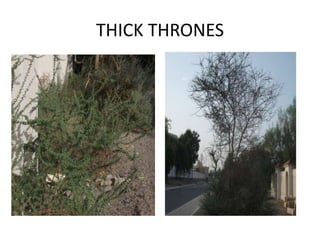
• There were only thick thorny plants near our house without any
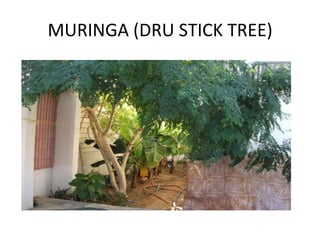
flowers or butterflies. Rani planted a beguine villa plant and a
branch of muringa (drum stick) tree and we watered them daily.
For the next two years, there was not much growth for those
plants, though in the third year, they brought out some flowers.
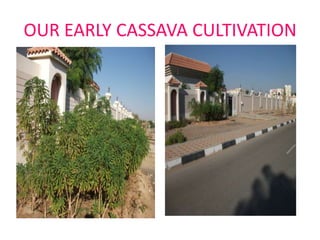
• Clearing the thorns, we planted some cassava stems that we got
from our friends in Al Ain. Though their growth was bit slow, after
14 months, we got tapioca and the yield was not very bad.
• Knowing our interest in agriculture, the Imam of the nearby
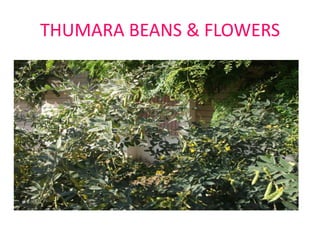
mosque gave us some seeds of ‘thumara’, a bushy type beans. We
planted them; after two years they started to flower and give yield.
Some Pakistani and Bengala Desh workers brought manures for us.
• Our interest in farming was just a hobby – gardening and we did not
bother much about its economic or strategic importance.
SUPPLEMENTRY FOOD ITEMS
• When tapioca is presented or introduced as a major
food for the millions all over the world, it needs
supplementary food items like fish, especially sardine,
and beans like thumara or soya beans that can be
cultivated along with cassava.
• Hundreds of food products can be produced from
tapioca, besides animal feeds and several industrial
products. Further research on these areas are required
along with popularizing tapioca as a major food and
industrial raw material with strategic importance in the
21st century.
THICK THRONES
THE FIRST FLOWERS
CASSAVA AND VEGETABLES
• Once a land is made suitable for cassava cultivation,
along with it, different verities of vegetables, such as
ladies’ finger, ash guard, bitter guard, snake guard, soya
beans, long beans, thumara beans, red cheera and etc.
can also be cultivated. All beans plants have the
nitrogen fixation potentialities. These vegetables can
turn the tapioca as a balanced or enriched food.
• Along with cassava, we produce different types of
vegetables in a purely organic way. Their flowers attract
different types of butterflies, dragon flies, honey bees
and also honey sucking birds. Their photographs are
also given in the following slides.
MURINGA (DRU STICK TREE)
OUR EARLY CASSAVA CULTIVATION
THUMARA BEANS & FLOWERS
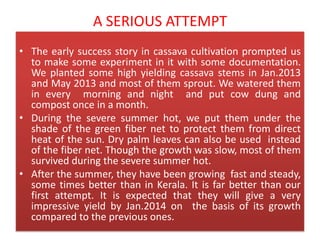
A SERIOUS ATTEMPT
• The early success story in cassava cultivation prompted us
to make some experiment in it with some documentation.
We planted some high yielding cassava stems in Jan.2013
and May 2013 and most of them sprout. We watered them
in every morning and night and put cow dung and
compost once in a month.
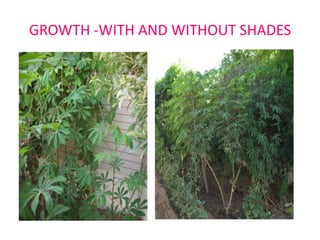
• During the severe summer hot, we put them under the
shade of the green fiber net to protect them from direct
heat of the sun. Dry palm leaves can also be used instead
of the fiber net. Though the growth was slow, most of them
survived during the severe summer hot.
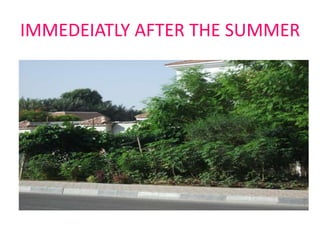
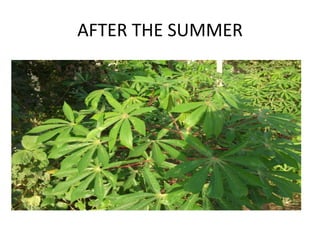
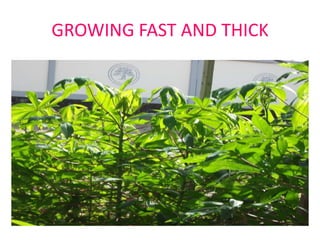
• After the summer, they have been growing fast and steady,
some times better than in Kerala. It is far better than our
first attempt. It is expected that they will give a very
impressive yield by Jan.2014 on the basis of its growth
compared to the previous ones.
IMMEDEIATLY AFTER THE SUMMER
DESERT SOIL FOR CASSAVA
• Desert soil and the abundant sun light are very much
suitable for cassava cultivation provided water is there to
irrigate daily. Growth is fast, especially after the summer, if
cultivated either on January or May. During the extreme
hot, some sort of shades can be provided to protect the
cassava.
• Some fast growing trees or bushes like drum stick or
thumara beans can be planted one year ahead of cassava
cultivation. Thumara beans are a very good complement to
tapioca to make a balanced food. Both the leaves and
beans of the drum stick tree have medicinal properties and
very good for controlling obesity, high blood pleasure,
diabetes, cancer and cholesterol. Soya beans and some
vegetables can also be cultivated along with cassava.
AFTER THE SUMMER
GROWING FAST AND THICK
GROWTH -WITH AND WITHOUT SHADES
CASSAVA AND THE ARAB SCHOOL BOYS
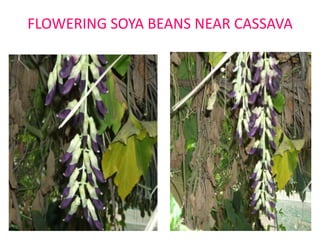
FLOWERING SOYA BEANS NEAR CASSAVA
LONG BEANS NEAR THE CASSAVA
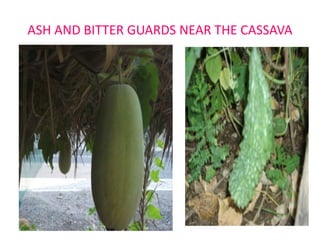
ASH AND BITTER GUARDS NEAR THE CASSAVA
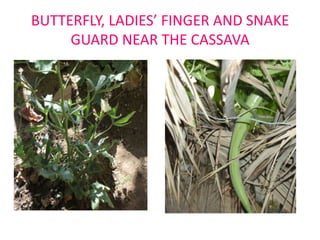
BUTTERFLY, LADIES’ FINGER AND SNAKE
GUARD NEAR THE CASSAVA
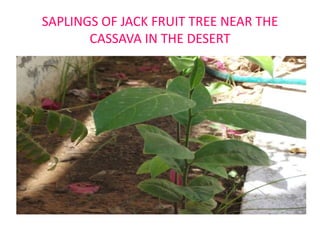
SAPLINGS OF JACK FRUIT TREE NEAR THE
CASSAVA IN THE DESERT
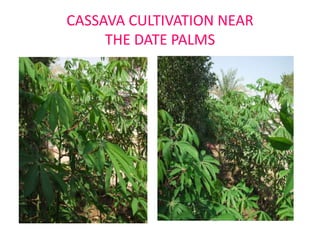
CASSAVA CULTIVATION NEAR
THE DATE PALMS
CASSAVA CULTIVATION IN THE WEST
• For the global warming, some of the western countries like
the UK, France and etc are acquiring some of characteristics
of sub-tropical regions. That is why; their production of
wheat , apple, potato, grapes and etc. is on decline. Cassava
can be cultivated in areas where a lot of sun light is
available. For the western countries, suitable verities of
cassava can be identified out of over a hundred types.
• Immediate global strategies must be formulated and
implemented in expanding cassava cultivation in nontraditional areas, including the western and desert regions
and thereby at least a ten fold increase in tapioca
production to feed the hungry millions and providing
valuable raw materials for industry also. Value-added
animal feeds can also be produced from this wonder crop
of the twenty first century. Oman, the UAE, Saudi Arabia
and etc can be emerged as major cassava cultivating
countries in the near future.

CASSAVA OR TAPIOCA TO FEED THE HUNGRY MILLIONS - EXTENDING CASSAVA CULTIVATION EVEN IN THE WEST AND THE DESERT REGIONS

  • 1.
    CASSAVA OR TAPIOCACULTIVATION EXTENDING TO THE DESERTS AND THE WEST TO MEET THE WORLD FOOD CRISIS DR. RAJU M. MATHEW & MRS. RANI RAJU
  • 2.
    STRATEGIC IMPORTANCE OFCASSAVA • Cassava or Tapioca or Kappa, traditionally known as a tropical crop, is widely cultivated in Kerala (India), Sri Lanka, Malaysia, Indonesia and several African countries. Till recently, cassava has been considered as a poor man’s daily bread without much strategic importance, though it has several industrial applications as a raw material. • The world is faced with an alarming decline of the production of rice, wheat, potato, sugar cane, cereals, and apple on the one hand and wide use of agriculture products, including food grains for producing bio-fuels. This has made millions of the people to live in hunger without any food and also the unprecedented rise of price of food products all over the world. • The search for alternative food products has lead the Food and Agriculture Organization (FAO) of the United Nations to identify and declare Cassava or Tapioca as the wonder crop of the 21st century to feed the hungry millions besides making use of it as industrial a raw material with so many uses. The European Union is a major importer of cassava. The following links give more details about cassava and FAO on cassava: • • • http://business.inquirer.net/124301/cassava-is-future-global-crop-says-un http://www.fao.org/news/story/en/item/176780/icode/#.UkwZLucpcjg.facebook http://climate-l.iisd.org/news/fao-approach-leads-to-sustainable-increases-in-cassavafarming/
  • 3.
    EXPANDING CASSAVA CULTIVATION •Cassava or tapioca, a native of Brazil, is generally cultivated in the subtropical areas with a sufficient rain fall for yielding better crops. It needs a lot of direct sunlight besides fertile land. Under shades, its growth is slow and it is weak too. However, it is not as water-intensive as paddy or sugar cane. • For the expansion of the cultivation of cash crops like rubber and oil palms in the traditional area of cultivation of cassava is a great threat for its extensive cultivation. • There is a need to find out alternative areas of cassava cultivation to feed the growing hungry millions and meeting industrial raw material needs. This has made us to conduct experiments in cassava cultivation in the UAE without any green house. • Even though so many expats from Kerala in the UAE have ventured cassava cultivation in a very small scale, that too in a fancy way, nobody has done it in a scientific way with documentation so as to conduct further studies. • The following slides give some basic details about our limited experiment on cassava cultivation outside a green house in the UAE exploring the possibility of expanding cassava cultivation in the vast desert region noted with direct sunlight and fertile land provided there is a minimum amount of water available for irrigation.
  • 4.
    OUR EARLY ATTEMPTIN CASSAVA CULTIVATION • In Jan. 2008, we shifted our residence to the sub-urban residential area of Al Ain in the Emirates of Abu Dhabi in a rented small villa. We, myself and my wife, Rani are the only expats in this area. • There were only thick thorny plants near our house without any flowers or butterflies. Rani planted a beguine villa plant and a branch of muringa (drum stick) tree and we watered them daily. For the next two years, there was not much growth for those plants, though in the third year, they brought out some flowers. • Clearing the thorns, we planted some cassava stems that we got from our friends in Al Ain. Though their growth was bit slow, after 14 months, we got tapioca and the yield was not very bad. • Knowing our interest in agriculture, the Imam of the nearby mosque gave us some seeds of ‘thumara’, a bushy type beans. We planted them; after two years they started to flower and give yield. Some Pakistani and Bengala Desh workers brought manures for us. • Our interest in farming was just a hobby – gardening and we did not bother much about its economic or strategic importance.
  • 5.
    SUPPLEMENTRY FOOD ITEMS •When tapioca is presented or introduced as a major food for the millions all over the world, it needs supplementary food items like fish, especially sardine, and beans like thumara or soya beans that can be cultivated along with cassava. • Hundreds of food products can be produced from tapioca, besides animal feeds and several industrial products. Further research on these areas are required along with popularizing tapioca as a major food and industrial raw material with strategic importance in the 21st century.
  • 6.
  • 7.
  • 8.
    CASSAVA AND VEGETABLES •Once a land is made suitable for cassava cultivation, along with it, different verities of vegetables, such as ladies’ finger, ash guard, bitter guard, snake guard, soya beans, long beans, thumara beans, red cheera and etc. can also be cultivated. All beans plants have the nitrogen fixation potentialities. These vegetables can turn the tapioca as a balanced or enriched food. • Along with cassava, we produce different types of vegetables in a purely organic way. Their flowers attract different types of butterflies, dragon flies, honey bees and also honey sucking birds. Their photographs are also given in the following slides.
  • 9.
  • 10.
    OUR EARLY CASSAVACULTIVATION
  • 11.
  • 12.
    A SERIOUS ATTEMPT •The early success story in cassava cultivation prompted us to make some experiment in it with some documentation. We planted some high yielding cassava stems in Jan.2013 and May 2013 and most of them sprout. We watered them in every morning and night and put cow dung and compost once in a month. • During the severe summer hot, we put them under the shade of the green fiber net to protect them from direct heat of the sun. Dry palm leaves can also be used instead of the fiber net. Though the growth was slow, most of them survived during the severe summer hot. • After the summer, they have been growing fast and steady, some times better than in Kerala. It is far better than our first attempt. It is expected that they will give a very impressive yield by Jan.2014 on the basis of its growth compared to the previous ones.
  • 13.
  • 14.
    DESERT SOIL FORCASSAVA • Desert soil and the abundant sun light are very much suitable for cassava cultivation provided water is there to irrigate daily. Growth is fast, especially after the summer, if cultivated either on January or May. During the extreme hot, some sort of shades can be provided to protect the cassava. • Some fast growing trees or bushes like drum stick or thumara beans can be planted one year ahead of cassava cultivation. Thumara beans are a very good complement to tapioca to make a balanced food. Both the leaves and beans of the drum stick tree have medicinal properties and very good for controlling obesity, high blood pleasure, diabetes, cancer and cholesterol. Soya beans and some vegetables can also be cultivated along with cassava.
  • 15.
  • 16.
  • 17.
    GROWTH -WITH ANDWITHOUT SHADES
  • 18.
    CASSAVA AND THEARAB SCHOOL BOYS
  • 19.
  • 20.
    LONG BEANS NEARTHE CASSAVA
  • 21.
    ASH AND BITTERGUARDS NEAR THE CASSAVA
  • 22.
    BUTTERFLY, LADIES’ FINGERAND SNAKE GUARD NEAR THE CASSAVA
  • 23.
    SAPLINGS OF JACKFRUIT TREE NEAR THE CASSAVA IN THE DESERT
  • 24.
  • 25.
    CASSAVA CULTIVATION INTHE WEST • For the global warming, some of the western countries like the UK, France and etc are acquiring some of characteristics of sub-tropical regions. That is why; their production of wheat , apple, potato, grapes and etc. is on decline. Cassava can be cultivated in areas where a lot of sun light is available. For the western countries, suitable verities of cassava can be identified out of over a hundred types. • Immediate global strategies must be formulated and implemented in expanding cassava cultivation in nontraditional areas, including the western and desert regions and thereby at least a ten fold increase in tapioca production to feed the hungry millions and providing valuable raw materials for industry also. Value-added animal feeds can also be produced from this wonder crop of the twenty first century. Oman, the UAE, Saudi Arabia and etc can be emerged as major cassava cultivating countries in the near future.