HD Truck Fuel Economy Task Group
Key Issues for Phase 2 of EPA/NHTSA Rule
Bill Van Amburg, CALSTART
Leadership Circle
Auburn Hills, MI
June 5, 2013
HD Truck Fuel Economy Task Group
Goals:
» In advance of rule development, discuss key issues
for industry and users
» Make sure beneficial fuel saving technology
included in rule design
» Seek areas of agreement; identify key areas of
concern
» Work collaboratively to develop recommendations
» Provide feedback to regulators
2
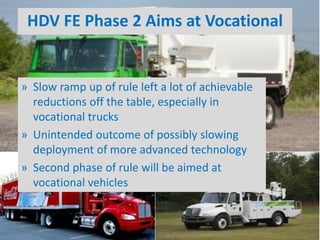
HDV FE Phase 2 Aims at Vocational
» Slow ramp up of rule left a lot of achievable
reductions off the table, especially in
vocational trucks
» Unintended outcome of possibly slowing
deployment of more advanced technology
» Second phase of rule will be aimed at
vocational vehicles
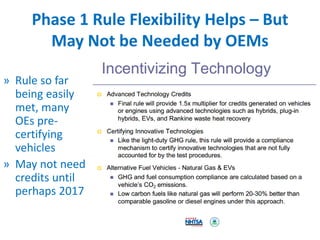
Phase 1 Rule Flexibility Helps – But
May Not be Needed by OEMs
» Rule so far
being easily
met, many
OEs pre-
certifying
vehicles
» May not need
credits until
perhaps 2017
Phase 2 Commitments in Phase 1 Rule
» Focus on energy security and environmental goals
» Preserve industry’s ability to meet market needs with a diverse range of
vehicles
» Continue our collaborative outreach with stakeholders
» Set more stringent standards based on forcing advanced technologies such as
waste heat recovery, hybrids, EVs
» Consider a range of test procedure and protocol approaches:
» Chassis dynamometer testing for certification or model validation?
» Is there a need to continue using separate engine standards?
» Do we make our vehicle simulation compliance tool more sophisticated?
» Consider bringing forward the “WP.29” Global Technical Regulation, including
a new World Harmonized Duty Cycle
» Consider expanding credit trading across the heavy-duty sector
5
DRAFT & DELIBERATIVE
Potential Approach for Phase 2
» Build on successes of Phase 1
» Maintain single national program regulatory structure
» Continue stakeholder outreach, EPA focus on GHGs
» Recognize that this is a highly technical rule
» Phase 1 got existing technologies off the shelf and on to new vehicles
» Phase 2 should consider forcing new and advanced cost-effective technologies
» Identify the new technologies that should be fully recognized
» Waste-heat recovery, hybrids, full electric vehicles, advanced transmissions, intelligent vehicle controls,
and heat rejection management, others?
» Refine our test procedures and vehicle simulation model for certification
» To equitably recognize these new technologies; as integrated into a complete vehicle
» Conduct baseline and advanced technology testing
» To validate test procedures and model refinements
» To assess emissions reductions
» Assess technology costs and benefits
» Consider options for stringencies and timing, including “phase-ins”
» Consider updating flexibilities
» To ensure a smooth transition to Phase 2, promote innovation, and achieve lowest costs
6
DRAFT & DELIBERATIVE
Some Emerging Questions for
Phase 2
» We are in the very early stages of assessing these
» This is NOT a comprehensive list:
» Should we continue with separate engine standards in Phase 2?
» Should trailers be included in Phase 2 in some way?
» Should we create more vocational vehicle categories and duty cycles?
» Should we consider vehicle labeling or other consumer information
approaches?
» Should we consider incentives for alternative fuels/CNG?
7
DRAFT & DELIBERATIVE
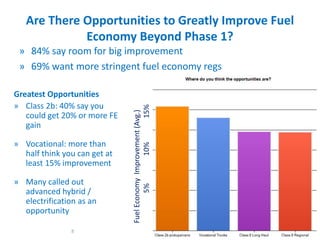
Are There Opportunities to Greatly Improve Fuel
Economy Beyond Phase 1?
» 84% say room for big improvement
» 69% want more stringent fuel economy regs
Greatest Opportunities
» Class 2b: 40% say you
could get 20% or more FE
gain
» Vocational: more than
half think you can get at
least 15% improvement
» Many called out
advanced hybrid /
electrification as an
opportunity
FuelEconomyImprovement(Avg.)
5%10%15%
8
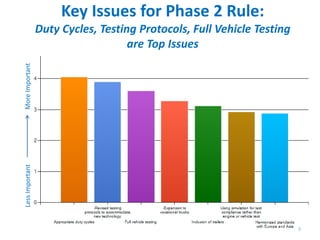
Key Issues for Phase 2 Rule:
Duty Cycles, Testing Protocols, Full Vehicle Testing
are Top Issues
LessImportantMoreImportant
9
Duty Cycles Matter for Measuring and
Testing Truck Efficiency!
» 46% of respondents said duty cycles are “critical/must have”
» 87% said they were “very important” or “critical/must have”
» 89% say tech would benefit from representative duty cycle
Most respondents say need more duty cycles – though
recognize difficulties
» 2/3 liked 5 duty cycle “straw man”
» Some wanted fewer – maybe 3 representative duty cycles
» Many said “no two fleets are the same” and too difficult /
costly to try to “pigeonhole” fleets
Consensus Points in Task Group
Activities to Date
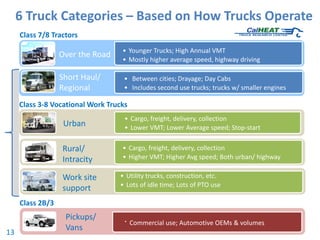
» Support Limited Vocational truck segmentation
based on how vehicles broadly used (CalHEAT
example)
» Support compiling and recommending limited
number (3-6) of Duty Cycles that are sufficient to
cover the basic applications while allowing new
technology to demonstrate its worth
» Believe there are some duty cycles so custom
they must be included – Possibly extreme cycles,
such as refuse variations
Consensus to Date
» 3-4 Vocational segments based on CalHEAT
findings are acceptable and outline way trucks
generally used
» Duty cycles are critical to successful Phase 2
» However: want to recommend fewest number of
meaningful “cycles” that “bound’ how a truck
generally used (cannot specifically match how
EVERY truck is specifically used) – 80% solution
» Accepted by industry and fleets as adequate
6 Truck Categories – Based on How Trucks Operate
• Younger Trucks; High Annual VMT
• Mostly higher average speed, highway driving
• Between cities; Drayage; Day Cabs
• Includes second use trucks; trucks w/ smaller engines
Over the Road
Short Haul/
Regional
• Cargo, freight, delivery, collection
• Lower VMT; Lower Average speed; Stop-start
Urban
• Cargo, freight, delivery, collection
• Higher VMT; Higher Avg speed; Both urban/ highway
Rural/
Intracity
• Utility trucks, construction, etc.
• Lots of idle time; Lots of PTO use
Work site
support
∙ Commercial use; Automotive OEMs & volumes
Pickups/
Vans
Class 2B/3
Class 3-8 Vocational Work Trucks
Class 7/8 Tractors
13
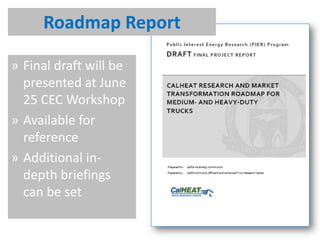
» Final draft will be
presented at June
25 CEC Workshop
» Available for
reference
» Additional in-
depth briefings
can be set
Roadmap Report
Task Group: Possible Approach for
Certification
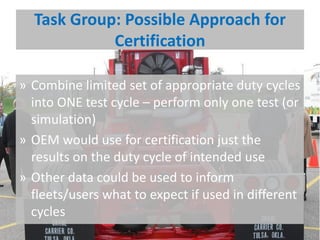
» Combine limited set of appropriate duty cycles
into ONE test cycle – perform only one test (or
simulation)
» OEM would use for certification just the
results on the duty cycle of intended use
» Other data could be used to inform
fleets/users what to expect if used in different
cycles
Key Issues
» Compile and recommend 3-6 specific Duty
Cycles that are sufficient to cover the basic
applications while allowing new technology to
demonstrate its worth
» Tech such as transmissions, aero, light weighting,
hybrid, thermal recovery, work site idling
» Are there some duty cycles so custom they
must be included?
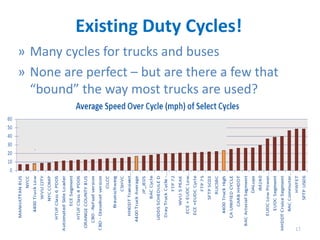
Existing Duty Cycles!
» Many cycles for trucks and buses
» None are perfect – but are there a few that
“bound” the way most trucks are used?
17
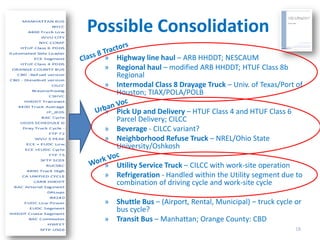
Possible Consolidation
» Highway line haul – ARB HHDDT; NESCAUM
» Regional haul – modified ARB HHDDT; HTUF Class 8b
Regional
» Intermodal Class 8 Drayage Truck – Univ. of Texas/Port of
Houston; TIAX/POLA/POLB
» Pick Up and Delivery – HTUF Class 4 and HTUF Class 6
Parcel Delivery; CILCC
» Beverage - CILCC variant?
» Neighborhood Refuse Truck – NREL/Ohio State
University/Oshkosh
» Utility Service Truck – CILCC with work-site operation
» Refrigeration - Handled within the Utility segment due to
combination of driving cycle and work-site cycle
» Shuttle Bus – (Airport, Rental, Municipal) – truck cycle or
bus cycle?
» Transit Bus – Manhattan; Orange County: CBD
18
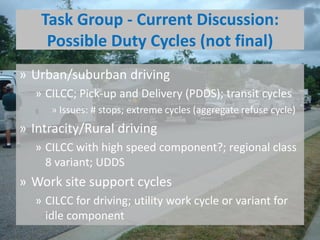
Task Group - Current Discussion:
Possible Duty Cycles (not final)
» Urban/suburban driving
» CILCC; Pick-up and Delivery (PDDS); transit cycles
» Issues: # stops; extreme cycles (aggregate refuse cycle)
» Intracity/Rural driving
» CILCC with high speed component?; regional class
8 variant; UDDS
» Work site support cycles
» CILCC for driving; utility work cycle or variant for
idle component
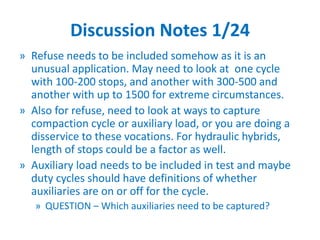
Discussion Notes 1/24
» Refuse needs to be included somehow as it is an
unusual application. May need to look at one cycle
with 100-200 stops, and another with 300-500 and
another with up to 1500 for extreme circumstances.
» Also for refuse, need to look at ways to capture
compaction cycle or auxiliary load, or you are doing a
disservice to these vocations. For hydraulic hybrids,
length of stops could be a factor as well.
» Auxiliary load needs to be included in test and maybe
duty cycles should have definitions of whether
auxiliaries are on or off for the cycle.
» QUESTION – Which auxiliaries need to be captured?
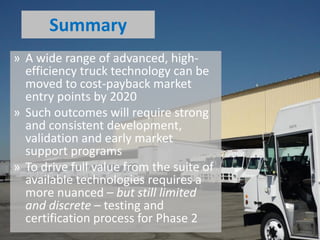
» A wide range of advanced, high-
efficiency truck technology can be
moved to cost-payback market
entry points by 2020
» Such outcomes will require strong
and consistent development,
validation and early market
support programs
» To drive full value from the suite of
available technologies requires a
more nuanced – but still limited
and discrete – testing and
certification process for Phase 2
Summary
CALSTART
Clean Transportation Technologies
and Solutions

CALSTART Presentation - VanAmburg (HDV Emissions)

  • 1.
    HD Truck FuelEconomy Task Group Key Issues for Phase 2 of EPA/NHTSA Rule Bill Van Amburg, CALSTART Leadership Circle Auburn Hills, MI June 5, 2013
  • 2.
    HD Truck FuelEconomy Task Group Goals: » In advance of rule development, discuss key issues for industry and users » Make sure beneficial fuel saving technology included in rule design » Seek areas of agreement; identify key areas of concern » Work collaboratively to develop recommendations » Provide feedback to regulators 2
  • 3.
    HDV FE Phase2 Aims at Vocational » Slow ramp up of rule left a lot of achievable reductions off the table, especially in vocational trucks » Unintended outcome of possibly slowing deployment of more advanced technology » Second phase of rule will be aimed at vocational vehicles
  • 4.
    Phase 1 RuleFlexibility Helps – But May Not be Needed by OEMs » Rule so far being easily met, many OEs pre- certifying vehicles » May not need credits until perhaps 2017
  • 5.
    Phase 2 Commitmentsin Phase 1 Rule » Focus on energy security and environmental goals » Preserve industry’s ability to meet market needs with a diverse range of vehicles » Continue our collaborative outreach with stakeholders » Set more stringent standards based on forcing advanced technologies such as waste heat recovery, hybrids, EVs » Consider a range of test procedure and protocol approaches: » Chassis dynamometer testing for certification or model validation? » Is there a need to continue using separate engine standards? » Do we make our vehicle simulation compliance tool more sophisticated? » Consider bringing forward the “WP.29” Global Technical Regulation, including a new World Harmonized Duty Cycle » Consider expanding credit trading across the heavy-duty sector 5 DRAFT & DELIBERATIVE
  • 6.
    Potential Approach forPhase 2 » Build on successes of Phase 1 » Maintain single national program regulatory structure » Continue stakeholder outreach, EPA focus on GHGs » Recognize that this is a highly technical rule » Phase 1 got existing technologies off the shelf and on to new vehicles » Phase 2 should consider forcing new and advanced cost-effective technologies » Identify the new technologies that should be fully recognized » Waste-heat recovery, hybrids, full electric vehicles, advanced transmissions, intelligent vehicle controls, and heat rejection management, others? » Refine our test procedures and vehicle simulation model for certification » To equitably recognize these new technologies; as integrated into a complete vehicle » Conduct baseline and advanced technology testing » To validate test procedures and model refinements » To assess emissions reductions » Assess technology costs and benefits » Consider options for stringencies and timing, including “phase-ins” » Consider updating flexibilities » To ensure a smooth transition to Phase 2, promote innovation, and achieve lowest costs 6 DRAFT & DELIBERATIVE
  • 7.
    Some Emerging Questionsfor Phase 2 » We are in the very early stages of assessing these » This is NOT a comprehensive list: » Should we continue with separate engine standards in Phase 2? » Should trailers be included in Phase 2 in some way? » Should we create more vocational vehicle categories and duty cycles? » Should we consider vehicle labeling or other consumer information approaches? » Should we consider incentives for alternative fuels/CNG? 7 DRAFT & DELIBERATIVE
  • 8.
    Are There Opportunitiesto Greatly Improve Fuel Economy Beyond Phase 1? » 84% say room for big improvement » 69% want more stringent fuel economy regs Greatest Opportunities » Class 2b: 40% say you could get 20% or more FE gain » Vocational: more than half think you can get at least 15% improvement » Many called out advanced hybrid / electrification as an opportunity FuelEconomyImprovement(Avg.) 5%10%15% 8
  • 9.
    Key Issues forPhase 2 Rule: Duty Cycles, Testing Protocols, Full Vehicle Testing are Top Issues LessImportantMoreImportant 9
  • 10.
    Duty Cycles Matterfor Measuring and Testing Truck Efficiency! » 46% of respondents said duty cycles are “critical/must have” » 87% said they were “very important” or “critical/must have” » 89% say tech would benefit from representative duty cycle Most respondents say need more duty cycles – though recognize difficulties » 2/3 liked 5 duty cycle “straw man” » Some wanted fewer – maybe 3 representative duty cycles » Many said “no two fleets are the same” and too difficult / costly to try to “pigeonhole” fleets
  • 11.
    Consensus Points inTask Group Activities to Date » Support Limited Vocational truck segmentation based on how vehicles broadly used (CalHEAT example) » Support compiling and recommending limited number (3-6) of Duty Cycles that are sufficient to cover the basic applications while allowing new technology to demonstrate its worth » Believe there are some duty cycles so custom they must be included – Possibly extreme cycles, such as refuse variations
  • 12.
    Consensus to Date »3-4 Vocational segments based on CalHEAT findings are acceptable and outline way trucks generally used » Duty cycles are critical to successful Phase 2 » However: want to recommend fewest number of meaningful “cycles” that “bound’ how a truck generally used (cannot specifically match how EVERY truck is specifically used) – 80% solution » Accepted by industry and fleets as adequate
  • 13.
    6 Truck Categories– Based on How Trucks Operate • Younger Trucks; High Annual VMT • Mostly higher average speed, highway driving • Between cities; Drayage; Day Cabs • Includes second use trucks; trucks w/ smaller engines Over the Road Short Haul/ Regional • Cargo, freight, delivery, collection • Lower VMT; Lower Average speed; Stop-start Urban • Cargo, freight, delivery, collection • Higher VMT; Higher Avg speed; Both urban/ highway Rural/ Intracity • Utility trucks, construction, etc. • Lots of idle time; Lots of PTO use Work site support ∙ Commercial use; Automotive OEMs & volumes Pickups/ Vans Class 2B/3 Class 3-8 Vocational Work Trucks Class 7/8 Tractors 13
  • 14.
    » Final draftwill be presented at June 25 CEC Workshop » Available for reference » Additional in- depth briefings can be set Roadmap Report
  • 15.
    Task Group: PossibleApproach for Certification » Combine limited set of appropriate duty cycles into ONE test cycle – perform only one test (or simulation) » OEM would use for certification just the results on the duty cycle of intended use » Other data could be used to inform fleets/users what to expect if used in different cycles
  • 16.
    Key Issues » Compileand recommend 3-6 specific Duty Cycles that are sufficient to cover the basic applications while allowing new technology to demonstrate its worth » Tech such as transmissions, aero, light weighting, hybrid, thermal recovery, work site idling » Are there some duty cycles so custom they must be included?
  • 17.
    Existing Duty Cycles! »Many cycles for trucks and buses » None are perfect – but are there a few that “bound” the way most trucks are used? 17
  • 18.
    Possible Consolidation » Highwayline haul – ARB HHDDT; NESCAUM » Regional haul – modified ARB HHDDT; HTUF Class 8b Regional » Intermodal Class 8 Drayage Truck – Univ. of Texas/Port of Houston; TIAX/POLA/POLB » Pick Up and Delivery – HTUF Class 4 and HTUF Class 6 Parcel Delivery; CILCC » Beverage - CILCC variant? » Neighborhood Refuse Truck – NREL/Ohio State University/Oshkosh » Utility Service Truck – CILCC with work-site operation » Refrigeration - Handled within the Utility segment due to combination of driving cycle and work-site cycle » Shuttle Bus – (Airport, Rental, Municipal) – truck cycle or bus cycle? » Transit Bus – Manhattan; Orange County: CBD 18
  • 19.
    Task Group -Current Discussion: Possible Duty Cycles (not final) » Urban/suburban driving » CILCC; Pick-up and Delivery (PDDS); transit cycles » Issues: # stops; extreme cycles (aggregate refuse cycle) » Intracity/Rural driving » CILCC with high speed component?; regional class 8 variant; UDDS » Work site support cycles » CILCC for driving; utility work cycle or variant for idle component
  • 20.
    Discussion Notes 1/24 »Refuse needs to be included somehow as it is an unusual application. May need to look at one cycle with 100-200 stops, and another with 300-500 and another with up to 1500 for extreme circumstances. » Also for refuse, need to look at ways to capture compaction cycle or auxiliary load, or you are doing a disservice to these vocations. For hydraulic hybrids, length of stops could be a factor as well. » Auxiliary load needs to be included in test and maybe duty cycles should have definitions of whether auxiliaries are on or off for the cycle. » QUESTION – Which auxiliaries need to be captured?
  • 21.
    » A widerange of advanced, high- efficiency truck technology can be moved to cost-payback market entry points by 2020 » Such outcomes will require strong and consistent development, validation and early market support programs » To drive full value from the suite of available technologies requires a more nuanced – but still limited and discrete – testing and certification process for Phase 2 Summary
  • 22.