SCIBS and TeachUNICEF: International Mindedness
Betsy Root, UNICEF Global Citizenship Fellow, Atlanta
Workshop Objectives
• Define Global Citizenship and International
Mindedness
• Discuss the importance of global education
• Become familiar with TeachUNICEF and other
global education resources
UNICEF 101
Global Citizenship Defined
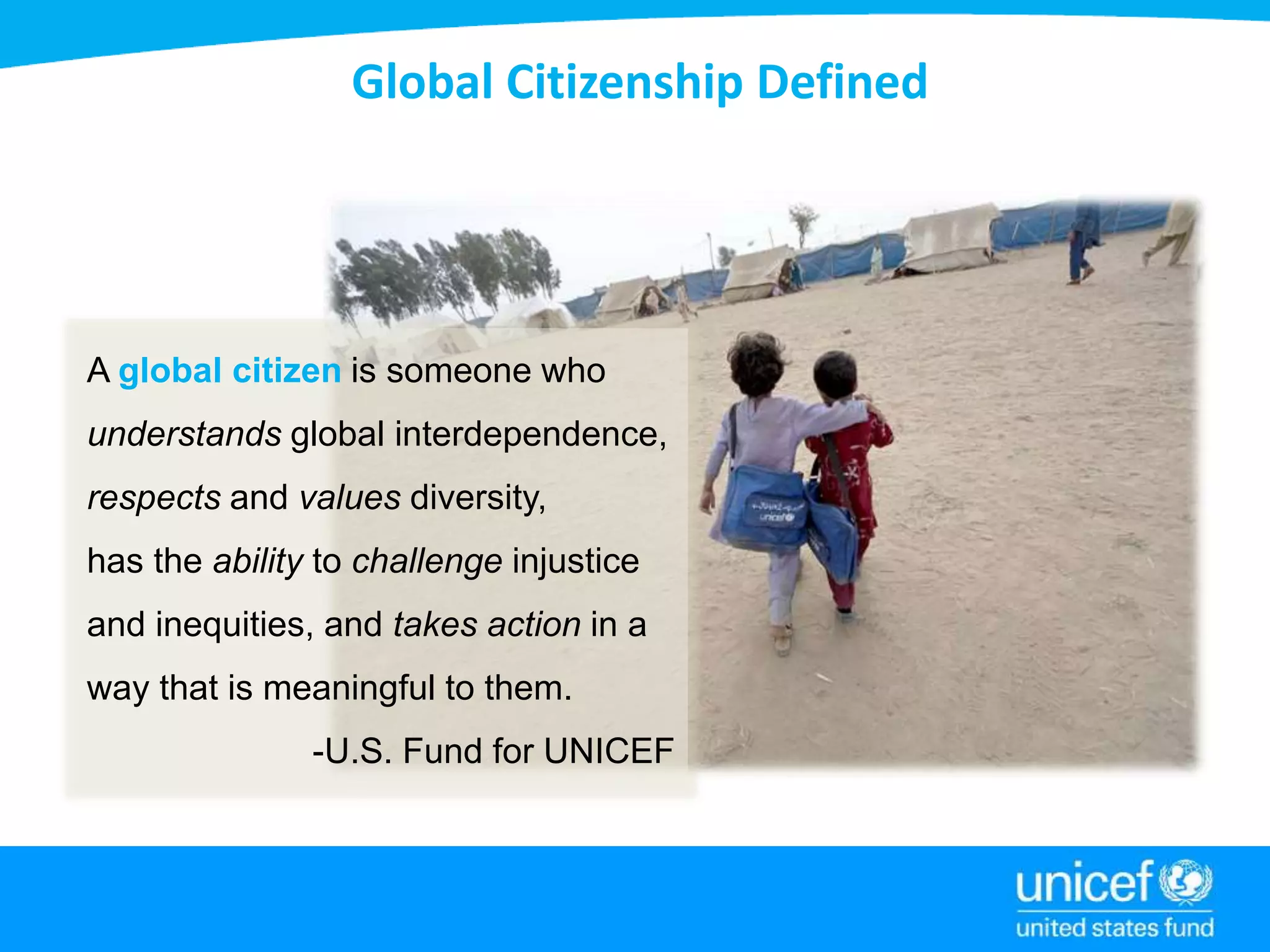
A global citizen is someone who
understands global interdependence,
respects and values diversity,
has the ability to challenge injustice
and inequities, and takes action in a
way that is meaningful to them.
-U.S. Fund for UNICEF
International Mindedness
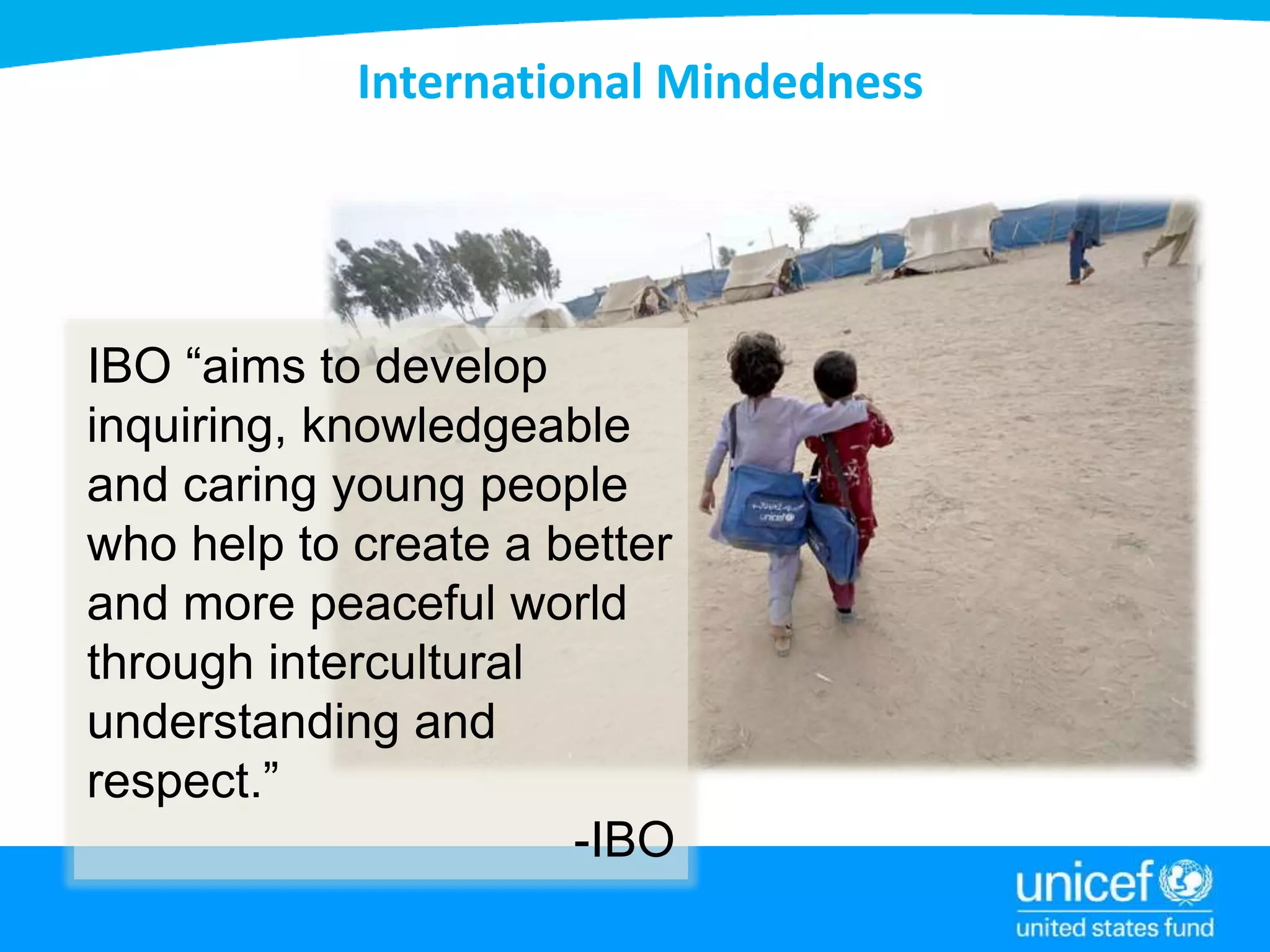
IBO “aims to develop
inquiring, knowledgeable
and caring young people
who help to create a better
and more peaceful world
through intercultural
understanding and
respect.”
-IBO
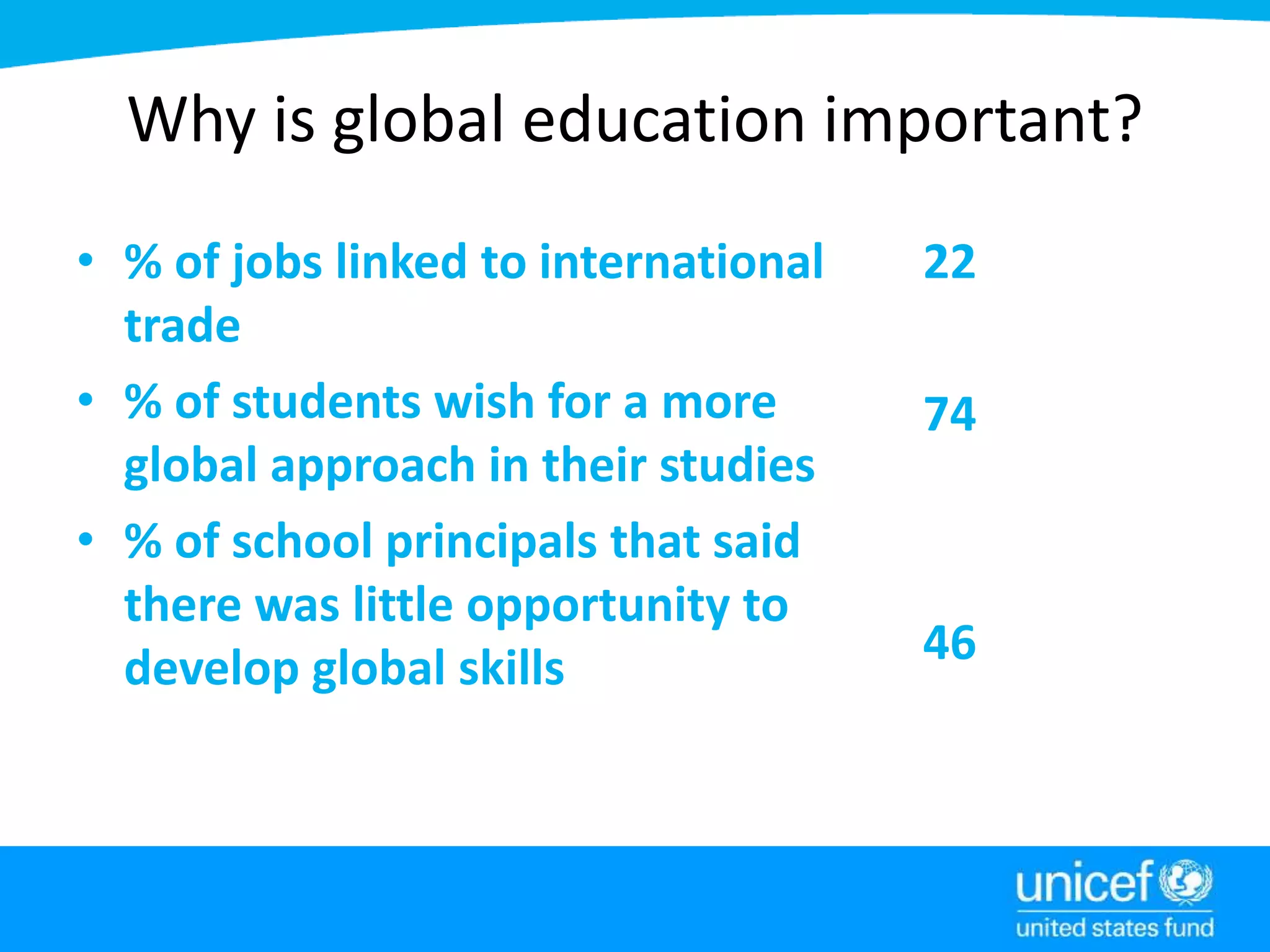
Why is global education important?
• % of jobs linked to international
trade
• % of students wish for a more
global approach in their studies
• % of school principals that said
there was little opportunity to
develop global skills
22
74
46
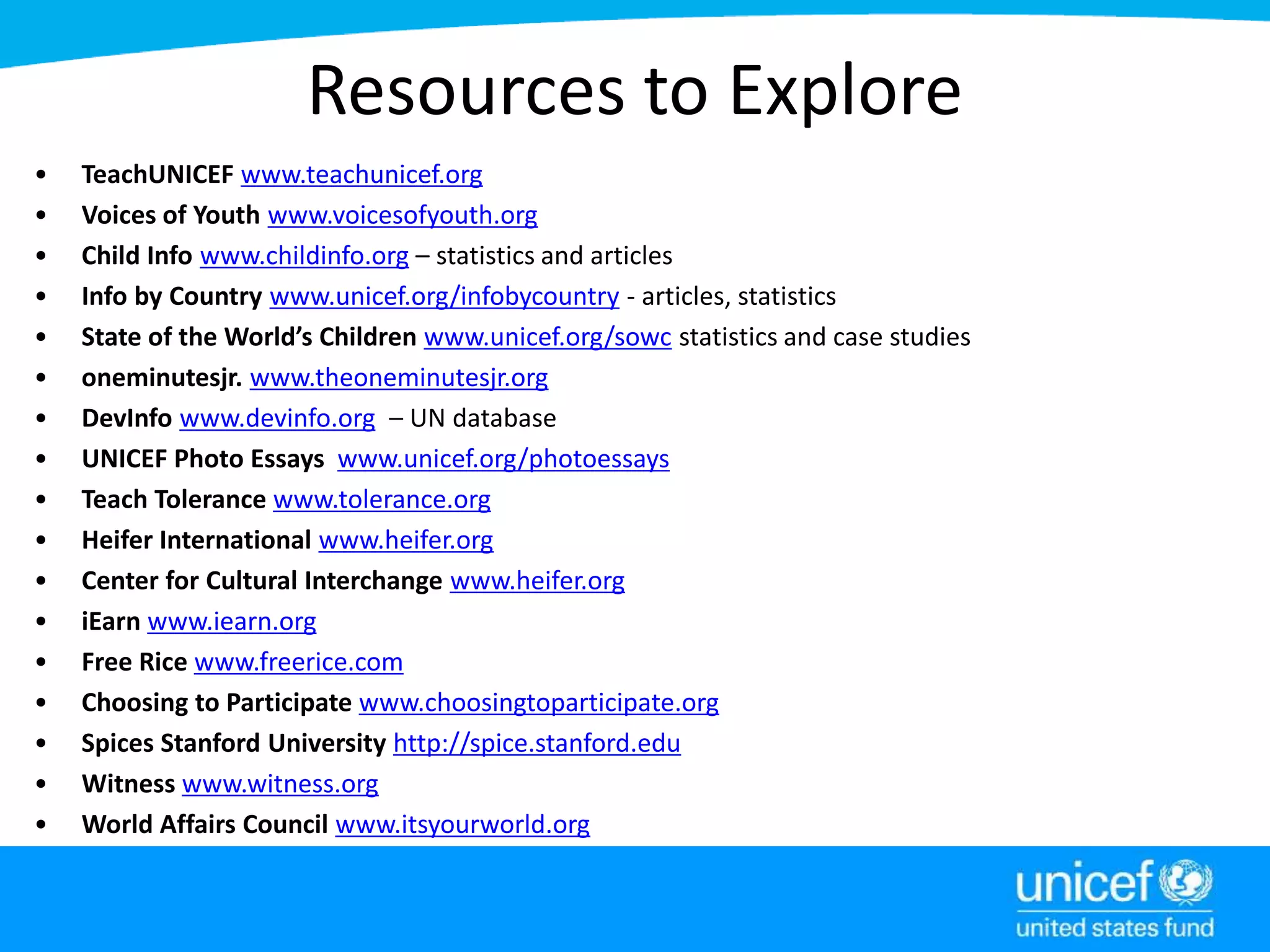
Resources to Explore
• TeachUNICEF www.teachunicef.org
• Voices of Youth www.voicesofyouth.org
• Child Info www.childinfo.org – statistics and articles
• Info by Country www.unicef.org/infobycountry - articles, statistics
• State of the World’s Children www.unicef.org/sowc statistics and case studies
• oneminutesjr. www.theoneminutesjr.org
• DevInfo www.devinfo.org – UN database
• UNICEF Photo Essays www.unicef.org/photoessays
• Teach Tolerance www.tolerance.org
• Heifer International www.heifer.org
• Center for Cultural Interchange www.heifer.org
• iEarn www.iearn.org
• Free Rice www.freerice.com
• Choosing to Participate www.choosingtoparticipate.org
• Spices Stanford University http://spice.stanford.edu
• Witness www.witness.org
• World Affairs Council www.itsyourworld.org
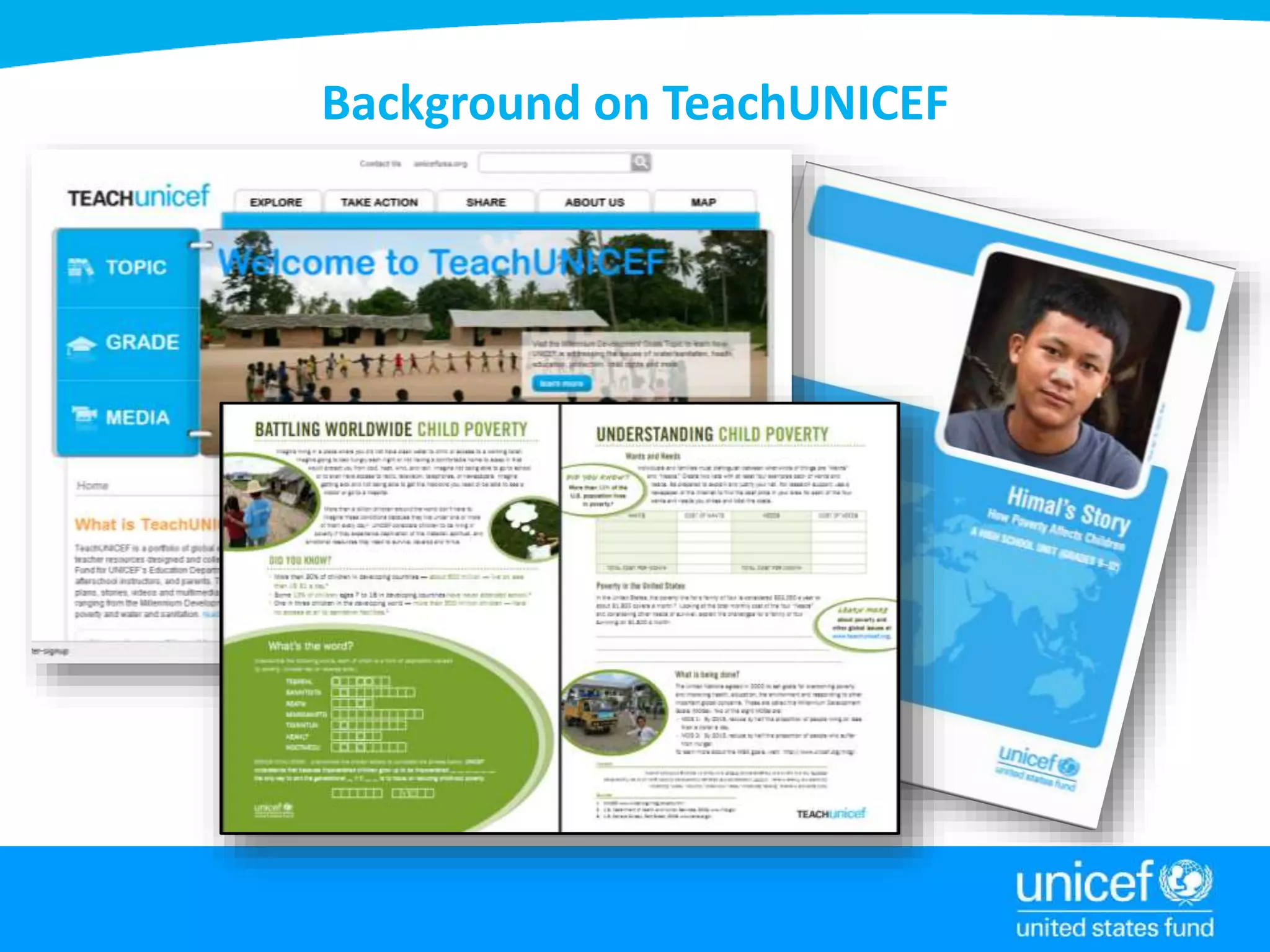
Background on TeachUNICEF
Breakout session
• In groups, select 1 TeachUNICEF unit that you
want to explore.
• Browse your unit and look for answers to the
guiding questions.
• Select 1-2 people to present your findings with
the larger group.
• If you have time, make a list of other helpful
resources and/or global service learning projects
that you’ve done in your classroom
Questions or Comments?
Thank you!
Betsy Root
U.S. Fund for UNICEF
Southeast Regional Office
broot@unicefusa.org

Casie and teach unicef teachunicef - ib educators

  • 1.
    SCIBS and TeachUNICEF:International Mindedness Betsy Root, UNICEF Global Citizenship Fellow, Atlanta
  • 2.
    Workshop Objectives • DefineGlobal Citizenship and International Mindedness • Discuss the importance of global education • Become familiar with TeachUNICEF and other global education resources
  • 3.
  • 4.
    Global Citizenship Defined Aglobal citizen is someone who understands global interdependence, respects and values diversity, has the ability to challenge injustice and inequities, and takes action in a way that is meaningful to them. -U.S. Fund for UNICEF
  • 6.
    International Mindedness IBO “aimsto develop inquiring, knowledgeable and caring young people who help to create a better and more peaceful world through intercultural understanding and respect.” -IBO
  • 7.
    Why is globaleducation important? • % of jobs linked to international trade • % of students wish for a more global approach in their studies • % of school principals that said there was little opportunity to develop global skills 22 74 46
  • 8.
    Resources to Explore •TeachUNICEF www.teachunicef.org • Voices of Youth www.voicesofyouth.org • Child Info www.childinfo.org – statistics and articles • Info by Country www.unicef.org/infobycountry - articles, statistics • State of the World’s Children www.unicef.org/sowc statistics and case studies • oneminutesjr. www.theoneminutesjr.org • DevInfo www.devinfo.org – UN database • UNICEF Photo Essays www.unicef.org/photoessays • Teach Tolerance www.tolerance.org • Heifer International www.heifer.org • Center for Cultural Interchange www.heifer.org • iEarn www.iearn.org • Free Rice www.freerice.com • Choosing to Participate www.choosingtoparticipate.org • Spices Stanford University http://spice.stanford.edu • Witness www.witness.org • World Affairs Council www.itsyourworld.org
  • 9.
  • 10.
    Breakout session • Ingroups, select 1 TeachUNICEF unit that you want to explore. • Browse your unit and look for answers to the guiding questions. • Select 1-2 people to present your findings with the larger group. • If you have time, make a list of other helpful resources and/or global service learning projects that you’ve done in your classroom
  • 11.
    Questions or Comments? Thankyou! Betsy Root U.S. Fund for UNICEF Southeast Regional Office broot@unicefusa.org

Editor's Notes

  • #4 New Strategic Plan Focus Areas: Health: increase the survival of all mothers and all newborns HIV and AIDS WASH Nutrition Education: greater focus on quality of education and gender equality in education Child Protection: Improved prevention of and response to violence, abuse and exploitation of children; strengthened support for their protection by families and communities Social Inclusion: reduce multidimensional child poverty and exclusion   Cross Cutting Areas: Equity: Reach all children regardless of distance, poverty, other barriers. This approach promotes stability and produces greater results. Also important because in the most disadvantaged areas, children’s rights are being most violated. Gender: focus on education for girls, security and protection for girls, example of a program in Uganda that provides education for pregnant women. Humanitarian action: Building resilience in communities requires bringing humanitarian and development efforts closer together. Example 1: using humanitarian response to promote nutrition & vaccine distribution. Example 2: Community based development helps vulnerable communities prepare for a disaster. Climate Change/Environment Children with disabilities
  • #5 What’s 1 word that comes to mind when you think of “global citizenship”? Show 1 min clip of M4D winning vide on global citizenship, Power of One.
  • #6 What’s 1 word that comes to mind when you think of “global citizenship”? Show 1 min clip of M4D winning vide on global citizenship, Power of One.
  • #8 Employment: Census data 2009, 22% of jobs linked to international trade. Employers want more emphasis on: Civic knowledge Cultural diversity Problem solving Ethical decision-making Critical thinking Real-world application of knowledge Solving Global Challenges: In “Becoming Citizens of the World,” Vivien Stewart, former Vice President for Education at the Asia Society, outlines the importance of creating more globally competent citizens: “Every major issue that people face—from environmental degradation and global warming, to pandemic diseases, to energy and water shortages, to terrorism and weapons proliferation—has an international dimension. Solving these problems will require international cooperation among governments, professional organizations, and corporations.” Diversity: Cities and rural areas are becoming more diverse and international Students Believe it is Important: In a 2012 Global Competency Poll of 500 high school graduates aged 18 to 24 in the United States, 80 percent of respondents agreed the jobs are becoming more international in nature, 79 percent identified the ability to interact with people from the other cultures as a necessary skill, and 60 percent said they would be better employees if they knew more about world affairs. Despite the recognized importance of these skills, a vast majority reported that their 6-12 schools failed to teach them global competency skills, and three-quarters wished they had. Students believe it is important, but there is a gap in what schools provide (note: IB schools are different) Principal stat: 2009 Study by the Harvard Graduate School of Education
  • #10 What is teachUNICEF?