 Types of problems faced by individuals and
families : Individual differences and needs- family
assessment in case work practice.
Theories and approaches : psycho-social approach,
functional approach, problem solving approach, crisis
intervention, family intervention, behavioural
modification, transactional analysis and holistic approach.
 Social Case Work:
 Social Case Work, a primary method of social work, is concerned with
the adjustment and development of individual towards more satisfying
human relations. Better family life, improved schools, better housing,
more hospitals and medical care facilities, protected economic
conditions and better relations between religious groups help the
individual in his adjustment and development. But his adjustment and
development depend on the use of these resources by him. Sometimes
due to certain factors, internal or external, he fails to avail existing
facilities. In such situations, social caseworker helps him. Thus, social
casework is one to one relationship, which works in helping the
individual for his adjustment and development.
 Every individual reacts differently to his social, economic and
physical environments and as such problems of one individual
are different from those of another. The practice of casework is a
humanistic attempt for helping people who have difficulty in
coping with the problems of daily living. Its one of the direct
methods of social work which uses the case-by-case approach
for dealing with individuals or families as regards their
problems of social functioning. Case work, aims at
individualized services in the field of social work in order to
help the client toad just with the environments.

 Mary Richmond (1917)
 Social case work is the art of bringing about better
adjustments in the social relationship of individual men or
women or children
 Strode (1948)
 Social case work is the process of assisting the individual
to best possible social adjustment through the use of social
case study, social resources and knowledge from relative
fields of learning.
Introduction
PÀÄlÄA§ ªÀÄvÀÄÛ ªÀåQÛUÀ¼À°è ¸ÀªÀĸÉåUÀ¼À «zsÀUÀ¼ÀÄ ¸ÁPÀµÀÄÖ PÀAqÀħgÀÄvÀÛªÉ.
PÀÄlÄA§ JzÀj¸ÀĪÀ ¸ÀªÀĸÉåAiÀÄÄ ªÀåQÛUÀ½UÉ ¹Ã«ÄvÀªÁVgÀÄvÀÛzÉ. ªÀÄvÀÄÛ ªÀåQÛ
JzÀÄj¸ÀĪÀ ¸ÀªÀĸÉå PÀÄlÄA§PÉÌ ¹Ã«ÄvÀªÁVgÀÄvÀÛzÉ. DzÀÝjAzÀ PÀÄlÄA§ªÀÅ ¸ÁPÀµÀÄÖ
¸ÀªÀĸÉåUÀ¼À£ÀÄߣÀ JzÀÄj¸ÀÄvÀÛªÉ. EzÀÄ PÉêÀ® M§â ªÀåQÛ ªÀiÁvÀæ ¸ÀªÀĸÉåAiÀÄ£ÀÄß
JzÀÄj¸ÀzÉ, MAzÀÄ PÀÄlÄA§ ¸ÀªÀĸÉåAiÀÄ£ÀÄß JzÀÄj¸ÀÄvÀÛzÉ. EAvÀºÀ ¸ÀªÀĸÉåUÀ¼ÉAzÀgÉ,
KPÁAVvÀ£À, «ªÁºÀ «ZÉÒÃzsÀ£À, ªÀiÁzÀPÀ ªÀ¸ÀÄÛUÀ¼À Cr¥ÁAiÀÄ, ¤AzÀ£É »ÃUÉ ºÀ®ªÁgÀÄ
¸ÀªÀĸÉåUÀ¼ÀÄPÀÄlÄA§zÀ°èEgÀÄvÀÛªÉ.
EAvÀºÀ ¸ÀªÀĸÉåUÀ¼ÀÄ ªÀåQÛ ªÀÄvÀÄÛ PÀÄlÄA§UÀ¼À°è PÀAqÀħgÀÄvÀÛªÉ. »ÃUÉ
PÀÄlÄA§ªÀÄvÀÄÛ ªÀåQÛ¸ÀªÀĸÉåAiÀÄÄ ««zsÀjÃwAiÀÄzÁÝVgÀÄvÀÛªÉ.
 Separation
 Divorce
 An alcoholic or drug addicted parent
 An abused parent
 An abusive parent
 Parents who nag or criticize
 Parents who are over protective.
 Parents who fight
 A parent’s remarriage
 Separation can often be a couple’s first step towards trying to improve
their relationship although it can also be the first step towards a
breakup or divorce.
 Don’t blame yourself for your parents’ separation. They are adults and
are trying to work out problems between them the best way they know
how.
Divorce of your parents may leave you feeling anxious, withdrawn or
depressed. These intense feelings may express themselves as shame, anger,
grief or poor performance in school.
 Some kids describe their parents’ divorce as the most painful experience of
their childhood. So allow yourself to feel the pain, but try to keep making the
best choices you can to take care of yourself and also to be fair to your parents.
 Remember that your parents are also going through a difficult
time. Both of them are still your parents and you should never have to
take sides if you don’t want to.
 It helps to talk. If you can’t tell your parents how you feel, find
another adult you can trust like a friend’s parent, school counsellor or
relative.

An alcoholic or drug addicted parent can make you sad or anxious. If
they are struggling with addiction, they are probably not able to care
for you well or give you much attention. This can be very difficult to
deal with.
 Remember, it’s not your fault – even if your parent tries to blame you
for their problems. The best way to cope is to talk to someone you trust
who might convince your parent to get help.
 Take care of yourself as well, and try to talk to someone about how the
problem has been affecting you.
An abused parent’s low self-esteem may keep them from seeking help to
escape their abusive relationship. They may be anxious and depressed
and take it out on you.
 Again, talk to someone you can trust – someone who might be willing
to talk to your parent and get them the help they need before the
situation gets worse.
 You may find it helpful to speak to a counsellor at school, who help you
see the problem from a different point of view and help you find
resources.
 An abusive parent has no right to abuse you. Child abuse is against the
law. This includes abuse of any minors (under 18).
 No parent, step-parent, relative or friend of the family is allowed to
abuse you – physically, sexually or emotionally.
 Don't feel badly about looking out for yourself. Tell someone right away
– an adult you trust. If they don't help, tell someone else until you find
help. Remember that it is never your fault when someone abuses you.
Their behaviour is wrong, and not related to anything you did.
If you being abused and you are 15 or under, Children's Aid can help.
 Parents who nag or criticize can make you frustrated or
angry. Sometimes parents have a hard time realizing
that you are growing up and becoming more
independent.
 It can help to keep your parents on your side by showing
love, appreciation and interest in them and being as
pleasant to them as you want them to be to you. Parents
want to know you’re listening.
 Show that you listen and understand their criticism by repeating
what they say in a respectful way. Get them to talk about what
they did as teenagers – this may remind them of what you’re
going through.
 Sometimes parents criticize you too much or even put you
down. Try talking to your parents or writing them a letter about
how you feel. If that doesn’t work, talk to an adult you trust
about it.
Parents who are overprotective usually make rules because they
love you and don't want you to get hurt. Keep them up on the
important things going on in your life and introduce them to
your friends.
 Show them that you understand their fears. For example, “I
understand you think it’s not safe for me to go out late on
Saturday night but I promise to tell you where I’m going and
who I’m going with."
 If you can’t talk to them without getting upset, write a letter. Let
them know you are thinking about how they feel, and then spell
out your own point of view.
Parents who fight can be upsetting or disturbing. When they
are calm, tell your parents that their fighting bothers you. Try
to understand each parent's point of view – don’t feel you
have to take sides. If they are insensitive to your feelings, go
for a walk, phone a friend or do something else to avoid
watching them fight.

 If their fights are physical, you should talk to an adult you
trust like a relative, a counsellor or a family friend before it
gets out of control – especially if there is a danger that you or
your siblings will get hurt.
 If your home isn't a safe place and you are 15 or under,
Children's Aid can help. Find an Ontario Children's Aid in
your area here.
A parent's remarriage can be confusing and stressful. It might help to
do something nice for your step-parent, to break the ice. Let them
know you understand that they are in love and need time alone with
your parent. If you feel left out, talk to your parent and find a
compromise.
 Remember that your step-parent is not replacing your other parent.
This can be a difficult time for your other parent, but try not to get
caught up with their feelings too much. You shouldn’t have to take sides
between your parents if you don’t want to.
 If your step-parent is unkind or disrespectful to you, talk to your
parent or an adult you trust.
 The present research developed and tested a new individual-difference
measure of the need for affect, which is the motivation to approach or
avoid emotion-inducing situations. The first phase of the research
developed the need for affect scale. The second phase revealed that the
need for affect is related to a number of individual differences in
cognitive processes (e.g., need for cognition, need for closure),
emotional processes (e.g., affect intensity, repression-sensitization),
behavioral inhibition and activation (e.g., sensation seeking), and
aspects of personality (Big Five dimensions) in the expected directions,
while not being redundant with them.
 The third phase of the research indicated that, compared to
people low in the need for affect, people high in the need for
affect are more likely to (a) possess extreme attitudes across
a variety of issues, (b) choose to view emotional movies, and
(c) become involved in an emotion-inducing event (the death
of Princess Diana). Overall, the results indicate that the need
for affect is an important construct in understanding
emotion-related processes.
 Psycho – social approach
ACCORDING TO MARY RICHMAND ( 1917) the case worker must secure
all and every fact that taken together through lagical and inferential
reasoning, would reveal be clients personality and his situation for
appropriate intervention (treatment an axhaustive collection of facts
about the client and his situation his called study – the first step
(process ) in the continuum.
psyco- social study is an on going process which begins with the first
knowledge of the case, take place in every interview, and extends over
the entire contact. It may be defined as that part of the case work
process which brings together the facts about a case and his distinctly
different from the assessment of the meaning of th facts .
 Psyco-social study involves exploration,observation, and documentation of
both objective and subjective facts from a veriety of sources.
 individual and society are complimentary to each other. A group of
individuals will form a society . If the individual is not good then the
society also will be the so, in order to make a better society we must make
a good individual.
 1. The human being ( personality psychology )
 social work is concerned with the human being, his problems, conflicts,
difficuties, needs and wants, his attitudes and feelings ,etc..
 it is not possible to understand and / or to help pepole without knowing,
motivating forces, and possible influences on his behaviour.
 knowledge his also necessary to predict to a certain extent somebodies
future behaviour.
 Each men his an individual, his unique, not uniform, this means that he has
to be treated as subject and not as object.
 This does not mean that there or no common traites, interests , abilities, in
different persons. Uniquness is determind by the combination of verious
factors ,and by the individual development and background of each
person.
 Knowledge about human beings as such is also required understand
groups and communities, which consists of individuals.
 2. dimenstions of the personality ( human being is a bio-social organism):
 the actual behaviour and appearences of a person is a result of both the
biological and social factors differences between individual or due to
differences in the inherited constitution or disposition and the influences
of the environment. It is of great importance to know which part of
behaviour of person his determind by biological and which part by social
factors, as education or training can only be successful. If directed towards
those parts of the personality which are formed by social factors, As only
these can he changed.
 There is an interrelationship and interdependency between
physiological and psychological processes in the human being. Man
can’t be divided into to separate parts, namely, body and mind.
 A) psychic developments and reactions are directed and influenced by
glands and hormones.
 B) if the body is suffering, both the physiological and psychological
behaviour
 Structural functionalism is a broad perspective in sociology
and anthropology which sets out to interpret society as a
structure with interrelated parts. Functionalism addresses
society as a whole in terms of the function of its constituent
elements; namely norms, customs, traditions and institutions. A
common analogy, popularized by Herbert Spencer, presents
these parts of society as "organs" that work toward the proper
functioning of the "body" as a whole
 .[1] In the most basic terms, it simply emphasizes "the effort to
impute, as rigorously as possible, to each feature, custom, or
practice, its effect on the functioning of a supposedly stable,
cohesive system." For Talcott Parsons, "structural-functionalism"
came to describe a particular stage in the methodological
development of social science, rather than a specific school of
thought.
 [2][3] Parsons called his own theory for action theory and argued
again and again that the term structural-functionalism was a
misleading and inappropriate label to use as a name of his theory.
 Crisis intervention is an important social work method culturally
indian people come together in crisis. People are approach able in
crisis. There fore intervention is easily possible. In crisis people are
available to saggestion therefore it is very necessary to make
conseious use of a crisis situation. It is send that a crisis situation
should be relolved in six weeks. This make the crisis intervention a
short term planned treatment. This approach falls on active
participation of the worker with emphosis on ‘reach out rather then
wait and watch out’.
 many proffestional take the view that if the client believes that he
or she must be seen immediately than the client is in emergency. If the
client can wait for 24 to 72 hours, the client is in a crisis. However if
the client can wait for a longer time perhaps he or she just has the
problem .
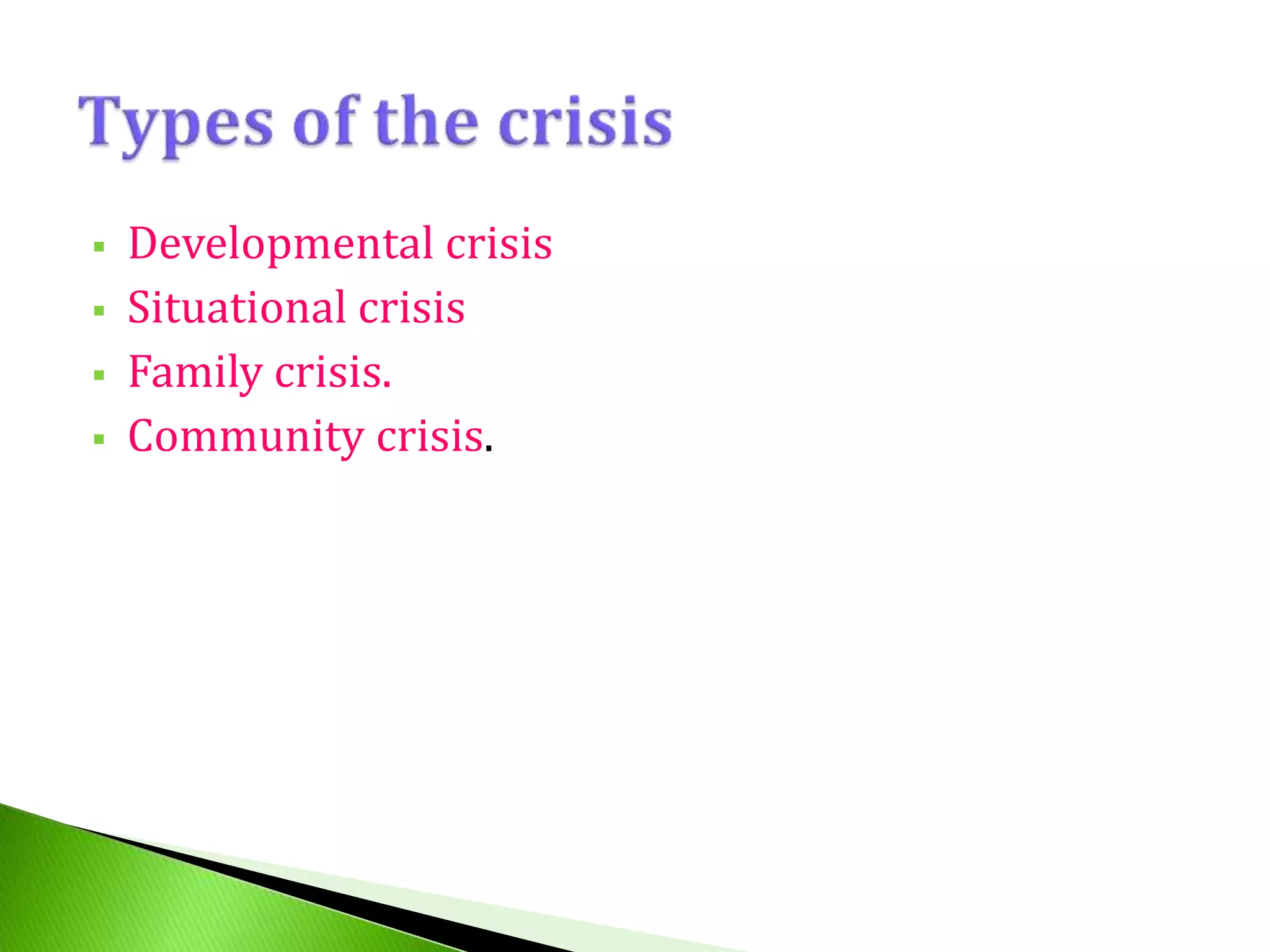
 Developmental crisis
 Situational crisis
 Family crisis.
 Community crisis.
 Behavioral modification theory is based upon the principals of
learning and conditioning propounded by pavlov and thorndike .
 The reseraches of BF skinner helped develop the behavior
modification approach further. The first paper delinged solely with
behavioral modification in a social work gernal apeared in 1968
 in essency behavior modification can be defined as the planed.
Systematic application of experimentaly established principals of
learning to the modification of maladaptive behavior, facialy to
decrasing undesired behaviors and incrising desired behaviors .
 the goals of behavior modification are congruent with the goals of
social work. In fact, the behavioral appraoch deals by and large only
with problems in functioning on the grounds

Case work paper presentation

  • 1.
     Types ofproblems faced by individuals and families : Individual differences and needs- family assessment in case work practice. Theories and approaches : psycho-social approach, functional approach, problem solving approach, crisis intervention, family intervention, behavioural modification, transactional analysis and holistic approach.
  • 2.
     Social CaseWork:  Social Case Work, a primary method of social work, is concerned with the adjustment and development of individual towards more satisfying human relations. Better family life, improved schools, better housing, more hospitals and medical care facilities, protected economic conditions and better relations between religious groups help the individual in his adjustment and development. But his adjustment and development depend on the use of these resources by him. Sometimes due to certain factors, internal or external, he fails to avail existing facilities. In such situations, social caseworker helps him. Thus, social casework is one to one relationship, which works in helping the individual for his adjustment and development.
  • 3.
     Every individualreacts differently to his social, economic and physical environments and as such problems of one individual are different from those of another. The practice of casework is a humanistic attempt for helping people who have difficulty in coping with the problems of daily living. Its one of the direct methods of social work which uses the case-by-case approach for dealing with individuals or families as regards their problems of social functioning. Case work, aims at individualized services in the field of social work in order to help the client toad just with the environments. 
  • 4.
     Mary Richmond(1917)  Social case work is the art of bringing about better adjustments in the social relationship of individual men or women or children  Strode (1948)  Social case work is the process of assisting the individual to best possible social adjustment through the use of social case study, social resources and knowledge from relative fields of learning.
  • 5.
    Introduction PÀÄlÄA§ ªÀÄvÀÄÛ ªÀåQÛUÀ¼À°è¸ÀªÀĸÉåUÀ¼À «zsÀUÀ¼ÀÄ ¸ÁPÀµÀÄÖ PÀAqÀħgÀÄvÀÛªÉ. PÀÄlÄA§ JzÀj¸ÀĪÀ ¸ÀªÀĸÉåAiÀÄÄ ªÀåQÛUÀ½UÉ ¹Ã«ÄvÀªÁVgÀÄvÀÛzÉ. ªÀÄvÀÄÛ ªÀåQÛ JzÀÄj¸ÀĪÀ ¸ÀªÀĸÉå PÀÄlÄA§PÉÌ ¹Ã«ÄvÀªÁVgÀÄvÀÛzÉ. DzÀÝjAzÀ PÀÄlÄA§ªÀÅ ¸ÁPÀµÀÄÖ ¸ÀªÀĸÉåUÀ¼À£ÀÄߣÀ JzÀÄj¸ÀÄvÀÛªÉ. EzÀÄ PÉêÀ® M§â ªÀåQÛ ªÀiÁvÀæ ¸ÀªÀĸÉåAiÀÄ£ÀÄß JzÀÄj¸ÀzÉ, MAzÀÄ PÀÄlÄA§ ¸ÀªÀĸÉåAiÀÄ£ÀÄß JzÀÄj¸ÀÄvÀÛzÉ. EAvÀºÀ ¸ÀªÀĸÉåUÀ¼ÉAzÀgÉ, KPÁAVvÀ£À, «ªÁºÀ «ZÉÒÃzsÀ£À, ªÀiÁzÀPÀ ªÀ¸ÀÄÛUÀ¼À Cr¥ÁAiÀÄ, ¤AzÀ£É »ÃUÉ ºÀ®ªÁgÀÄ ¸ÀªÀĸÉåUÀ¼ÀÄPÀÄlÄA§zÀ°èEgÀÄvÀÛªÉ. EAvÀºÀ ¸ÀªÀĸÉåUÀ¼ÀÄ ªÀåQÛ ªÀÄvÀÄÛ PÀÄlÄA§UÀ¼À°è PÀAqÀħgÀÄvÀÛªÉ. »ÃUÉ PÀÄlÄA§ªÀÄvÀÄÛ ªÀåQÛ¸ÀªÀĸÉåAiÀÄÄ ««zsÀjÃwAiÀÄzÁÝVgÀÄvÀÛªÉ.
  • 6.
     Separation  Divorce An alcoholic or drug addicted parent  An abused parent  An abusive parent  Parents who nag or criticize  Parents who are over protective.  Parents who fight  A parent’s remarriage
  • 7.
     Separation canoften be a couple’s first step towards trying to improve their relationship although it can also be the first step towards a breakup or divorce.  Don’t blame yourself for your parents’ separation. They are adults and are trying to work out problems between them the best way they know how.
  • 8.
    Divorce of yourparents may leave you feeling anxious, withdrawn or depressed. These intense feelings may express themselves as shame, anger, grief or poor performance in school.  Some kids describe their parents’ divorce as the most painful experience of their childhood. So allow yourself to feel the pain, but try to keep making the best choices you can to take care of yourself and also to be fair to your parents.
  • 9.
     Remember thatyour parents are also going through a difficult time. Both of them are still your parents and you should never have to take sides if you don’t want to.  It helps to talk. If you can’t tell your parents how you feel, find another adult you can trust like a friend’s parent, school counsellor or relative.
  • 10.
     An alcoholic ordrug addicted parent can make you sad or anxious. If they are struggling with addiction, they are probably not able to care for you well or give you much attention. This can be very difficult to deal with.  Remember, it’s not your fault – even if your parent tries to blame you for their problems. The best way to cope is to talk to someone you trust who might convince your parent to get help.  Take care of yourself as well, and try to talk to someone about how the problem has been affecting you.
  • 11.
    An abused parent’slow self-esteem may keep them from seeking help to escape their abusive relationship. They may be anxious and depressed and take it out on you.  Again, talk to someone you can trust – someone who might be willing to talk to your parent and get them the help they need before the situation gets worse.  You may find it helpful to speak to a counsellor at school, who help you see the problem from a different point of view and help you find resources.
  • 12.
     An abusiveparent has no right to abuse you. Child abuse is against the law. This includes abuse of any minors (under 18).  No parent, step-parent, relative or friend of the family is allowed to abuse you – physically, sexually or emotionally.  Don't feel badly about looking out for yourself. Tell someone right away – an adult you trust. If they don't help, tell someone else until you find help. Remember that it is never your fault when someone abuses you. Their behaviour is wrong, and not related to anything you did. If you being abused and you are 15 or under, Children's Aid can help.
  • 13.
     Parents whonag or criticize can make you frustrated or angry. Sometimes parents have a hard time realizing that you are growing up and becoming more independent.  It can help to keep your parents on your side by showing love, appreciation and interest in them and being as pleasant to them as you want them to be to you. Parents want to know you’re listening.
  • 14.
     Show thatyou listen and understand their criticism by repeating what they say in a respectful way. Get them to talk about what they did as teenagers – this may remind them of what you’re going through.  Sometimes parents criticize you too much or even put you down. Try talking to your parents or writing them a letter about how you feel. If that doesn’t work, talk to an adult you trust about it.
  • 15.
    Parents who areoverprotective usually make rules because they love you and don't want you to get hurt. Keep them up on the important things going on in your life and introduce them to your friends.  Show them that you understand their fears. For example, “I understand you think it’s not safe for me to go out late on Saturday night but I promise to tell you where I’m going and who I’m going with."  If you can’t talk to them without getting upset, write a letter. Let them know you are thinking about how they feel, and then spell out your own point of view.
  • 16.
    Parents who fightcan be upsetting or disturbing. When they are calm, tell your parents that their fighting bothers you. Try to understand each parent's point of view – don’t feel you have to take sides. If they are insensitive to your feelings, go for a walk, phone a friend or do something else to avoid watching them fight. 
  • 17.
     If theirfights are physical, you should talk to an adult you trust like a relative, a counsellor or a family friend before it gets out of control – especially if there is a danger that you or your siblings will get hurt.  If your home isn't a safe place and you are 15 or under, Children's Aid can help. Find an Ontario Children's Aid in your area here.
  • 18.
    A parent's remarriagecan be confusing and stressful. It might help to do something nice for your step-parent, to break the ice. Let them know you understand that they are in love and need time alone with your parent. If you feel left out, talk to your parent and find a compromise.  Remember that your step-parent is not replacing your other parent. This can be a difficult time for your other parent, but try not to get caught up with their feelings too much. You shouldn’t have to take sides between your parents if you don’t want to.  If your step-parent is unkind or disrespectful to you, talk to your parent or an adult you trust.
  • 19.
     The presentresearch developed and tested a new individual-difference measure of the need for affect, which is the motivation to approach or avoid emotion-inducing situations. The first phase of the research developed the need for affect scale. The second phase revealed that the need for affect is related to a number of individual differences in cognitive processes (e.g., need for cognition, need for closure), emotional processes (e.g., affect intensity, repression-sensitization), behavioral inhibition and activation (e.g., sensation seeking), and aspects of personality (Big Five dimensions) in the expected directions, while not being redundant with them.
  • 20.
     The thirdphase of the research indicated that, compared to people low in the need for affect, people high in the need for affect are more likely to (a) possess extreme attitudes across a variety of issues, (b) choose to view emotional movies, and (c) become involved in an emotion-inducing event (the death of Princess Diana). Overall, the results indicate that the need for affect is an important construct in understanding emotion-related processes.
  • 21.
     Psycho –social approach ACCORDING TO MARY RICHMAND ( 1917) the case worker must secure all and every fact that taken together through lagical and inferential reasoning, would reveal be clients personality and his situation for appropriate intervention (treatment an axhaustive collection of facts about the client and his situation his called study – the first step (process ) in the continuum. psyco- social study is an on going process which begins with the first knowledge of the case, take place in every interview, and extends over the entire contact. It may be defined as that part of the case work process which brings together the facts about a case and his distinctly different from the assessment of the meaning of th facts .
  • 22.
     Psyco-social studyinvolves exploration,observation, and documentation of both objective and subjective facts from a veriety of sources.  individual and society are complimentary to each other. A group of individuals will form a society . If the individual is not good then the society also will be the so, in order to make a better society we must make a good individual.  1. The human being ( personality psychology )  social work is concerned with the human being, his problems, conflicts, difficuties, needs and wants, his attitudes and feelings ,etc..  it is not possible to understand and / or to help pepole without knowing, motivating forces, and possible influences on his behaviour.  knowledge his also necessary to predict to a certain extent somebodies future behaviour.
  • 23.
     Each menhis an individual, his unique, not uniform, this means that he has to be treated as subject and not as object.  This does not mean that there or no common traites, interests , abilities, in different persons. Uniquness is determind by the combination of verious factors ,and by the individual development and background of each person.  Knowledge about human beings as such is also required understand groups and communities, which consists of individuals.  2. dimenstions of the personality ( human being is a bio-social organism):  the actual behaviour and appearences of a person is a result of both the biological and social factors differences between individual or due to differences in the inherited constitution or disposition and the influences of the environment. It is of great importance to know which part of behaviour of person his determind by biological and which part by social factors, as education or training can only be successful. If directed towards those parts of the personality which are formed by social factors, As only these can he changed.
  • 24.
     There isan interrelationship and interdependency between physiological and psychological processes in the human being. Man can’t be divided into to separate parts, namely, body and mind.  A) psychic developments and reactions are directed and influenced by glands and hormones.  B) if the body is suffering, both the physiological and psychological behaviour
  • 25.
     Structural functionalismis a broad perspective in sociology and anthropology which sets out to interpret society as a structure with interrelated parts. Functionalism addresses society as a whole in terms of the function of its constituent elements; namely norms, customs, traditions and institutions. A common analogy, popularized by Herbert Spencer, presents these parts of society as "organs" that work toward the proper functioning of the "body" as a whole
  • 26.
     .[1] Inthe most basic terms, it simply emphasizes "the effort to impute, as rigorously as possible, to each feature, custom, or practice, its effect on the functioning of a supposedly stable, cohesive system." For Talcott Parsons, "structural-functionalism" came to describe a particular stage in the methodological development of social science, rather than a specific school of thought.  [2][3] Parsons called his own theory for action theory and argued again and again that the term structural-functionalism was a misleading and inappropriate label to use as a name of his theory.
  • 27.
     Crisis interventionis an important social work method culturally indian people come together in crisis. People are approach able in crisis. There fore intervention is easily possible. In crisis people are available to saggestion therefore it is very necessary to make conseious use of a crisis situation. It is send that a crisis situation should be relolved in six weeks. This make the crisis intervention a short term planned treatment. This approach falls on active participation of the worker with emphosis on ‘reach out rather then wait and watch out’.  many proffestional take the view that if the client believes that he or she must be seen immediately than the client is in emergency. If the client can wait for 24 to 72 hours, the client is in a crisis. However if the client can wait for a longer time perhaps he or she just has the problem .
  • 28.
     Developmental crisis Situational crisis  Family crisis.  Community crisis.
  • 29.
     Behavioral modificationtheory is based upon the principals of learning and conditioning propounded by pavlov and thorndike .  The reseraches of BF skinner helped develop the behavior modification approach further. The first paper delinged solely with behavioral modification in a social work gernal apeared in 1968  in essency behavior modification can be defined as the planed. Systematic application of experimentaly established principals of learning to the modification of maladaptive behavior, facialy to decrasing undesired behaviors and incrising desired behaviors .  the goals of behavior modification are congruent with the goals of social work. In fact, the behavioral appraoch deals by and large only with problems in functioning on the grounds

Editor's Notes