RESTRUCTURING AT
MAYEKAWA

Abhay Kumar
Ankit Katiyar
Dharm Jaiswal
Shailendra Shankar Gautam
Sharad Srivastava

12810001
12810010
12810029
12810075
12810076
Background


In past, Japanese manufacturers emphasized on either:







Expand market share
Increase sales volume

Strategies adopted are price leadership, introducing new
products and diversifications. It caused an increase in
investment. The result was inflated break even point and
lesser profits.
In order to compensate for low profits, they have
engaged in Kaizan activities. However it demands two
conditions to be fulfilled:



High and continuous growth of the economy
Existence of a mass market
Background (Contd…)








After recent economic slowdown, they could not get
either of the conditions favorable.
To reduce the Break Even point (BEP), companied has
resorted to reduction of workforce (particularly white
collar workers and managers). They have also cut down
all investment.
It created distrust and company loses excellent people.
This causes a negative effect on competitiveness of the
firm and situation even gets worse. Therefore there is
further need to reduce BEP.
Recently several companies have adopted a new
approach. They not only have profits but are also
innovative and customer focused. – 2 1 C Co m p a ny
Mayekawa – An Introduction


The family-owned company, formed in 1924.



Employs 3,300 people worldwide.



Industrial refrigeration equipment: 50% of the global market.





Reputation for creating innovative niches in other markets.
When a customer asked Mayekawa to help automate the
deboning of chickens, then done manually by hundreds of
workers, the company spent 10 years developing a robot that
pulls meat off bones. The result captured an entirely new
market.
Mayekawa has become a strong world-wide business-tobusiness brand in fields as diverse as biotechnology,
electrical engineering and thermal technologies.“
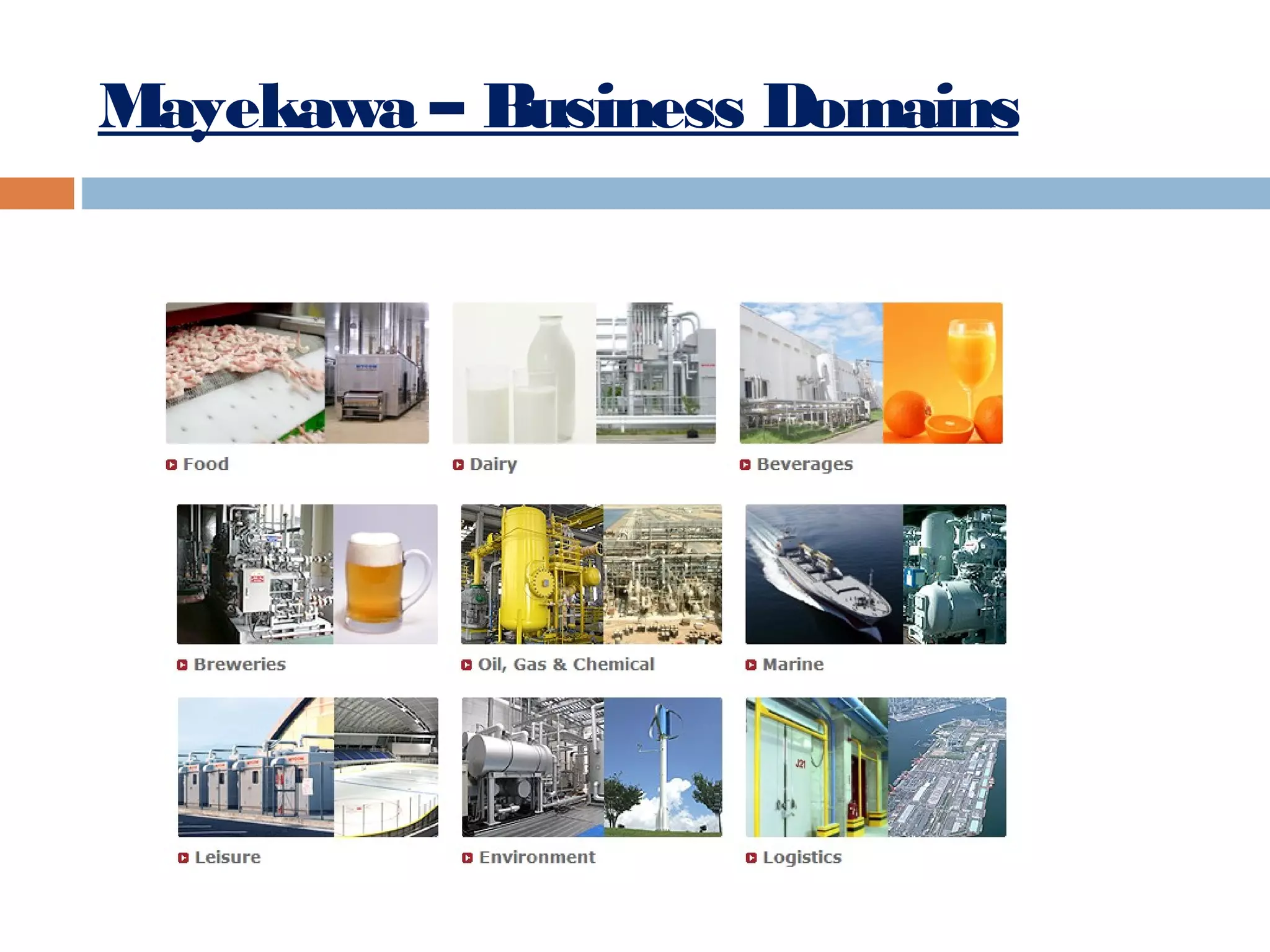
Mayekawa – Business Domains
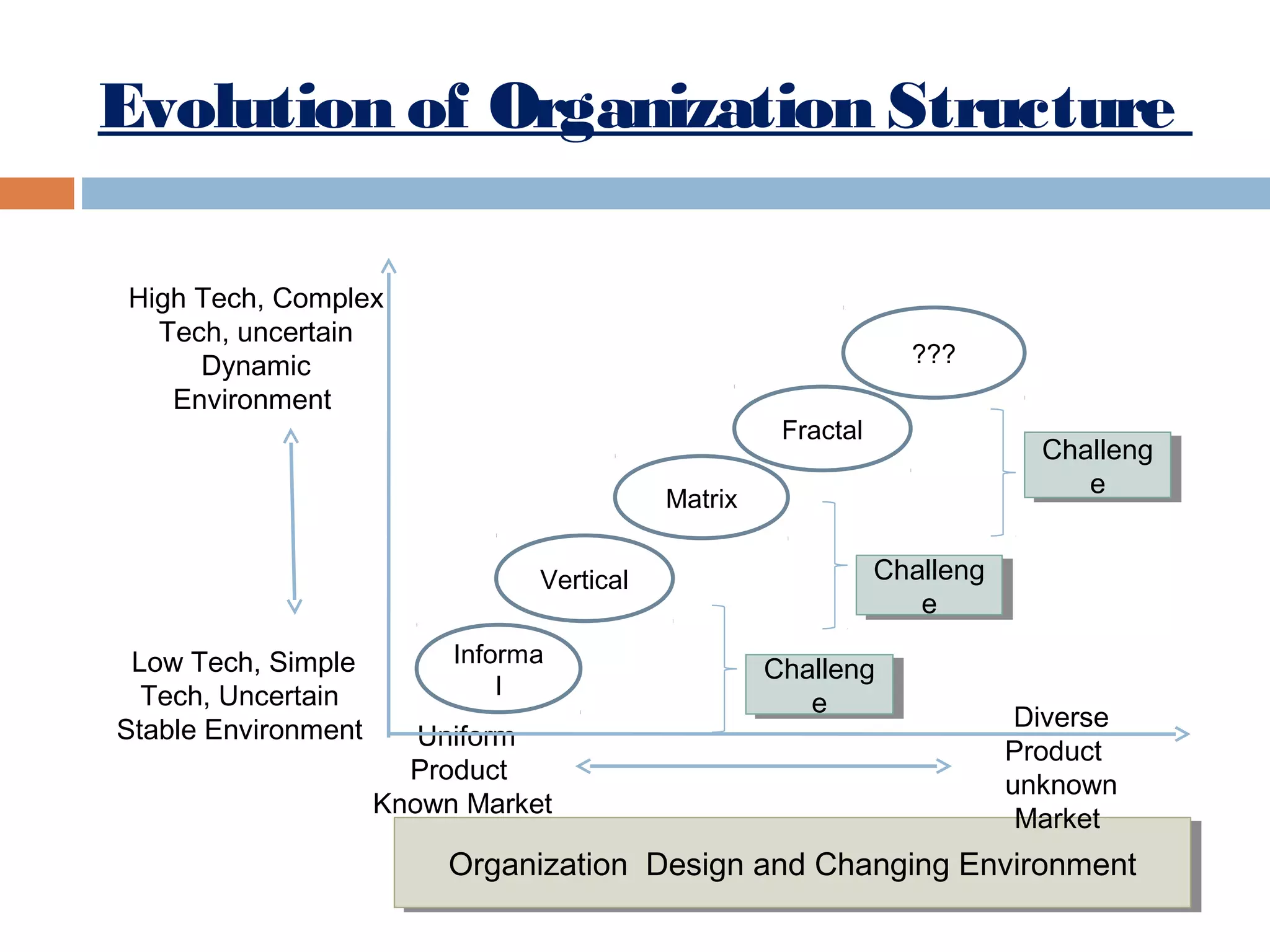
Evolution of Organization Structure
High Tech, Complex
Tech, uncertain
Dynamic
Environment

???
Fractal

Challeng
Challeng
e
e

Matrix
Vertical

Low Tech, Simple
Tech, Uncertain
Stable Environment

Informa
l

Uniform
Product
Known Market

Challeng
Challeng
e
e
Challeng
Challeng
ee

Diverse
Product
unknown
Market

Organization Design and Changing Environment
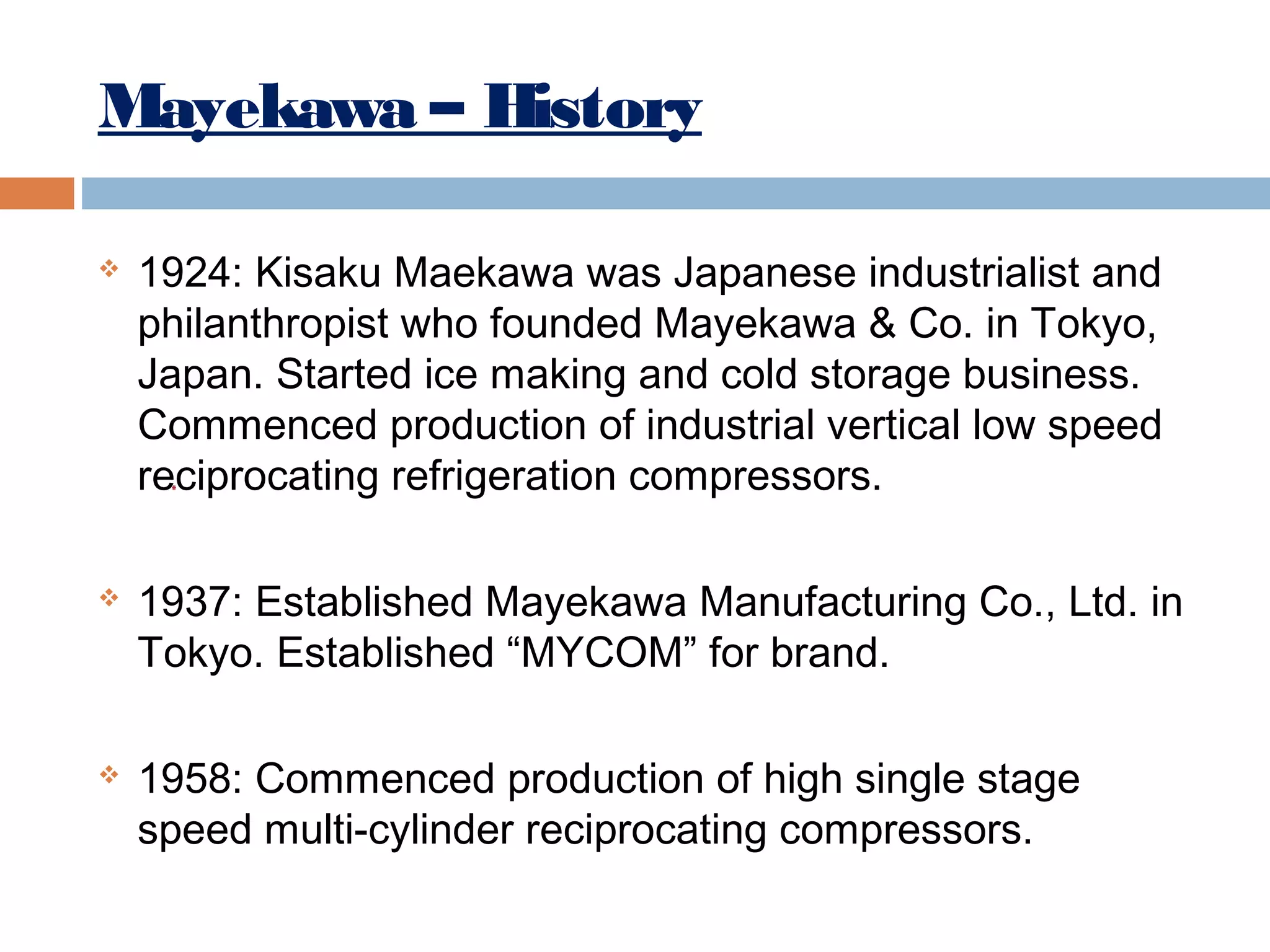
Mayekawa – History






1924: Kisaku Maekawa was Japanese industrialist and
philanthropist who founded Mayekawa & Co. in Tokyo,
Japan. Started ice making and cold storage business.
Commenced production of industrial vertical low speed
reciprocating refrigeration compressors.
1937: Established Mayekawa Manufacturing Co., Ltd. in
Tokyo. Established “MYCOM” for brand.
1958: Commenced production of high single stage
speed multi-cylinder reciprocating compressors.
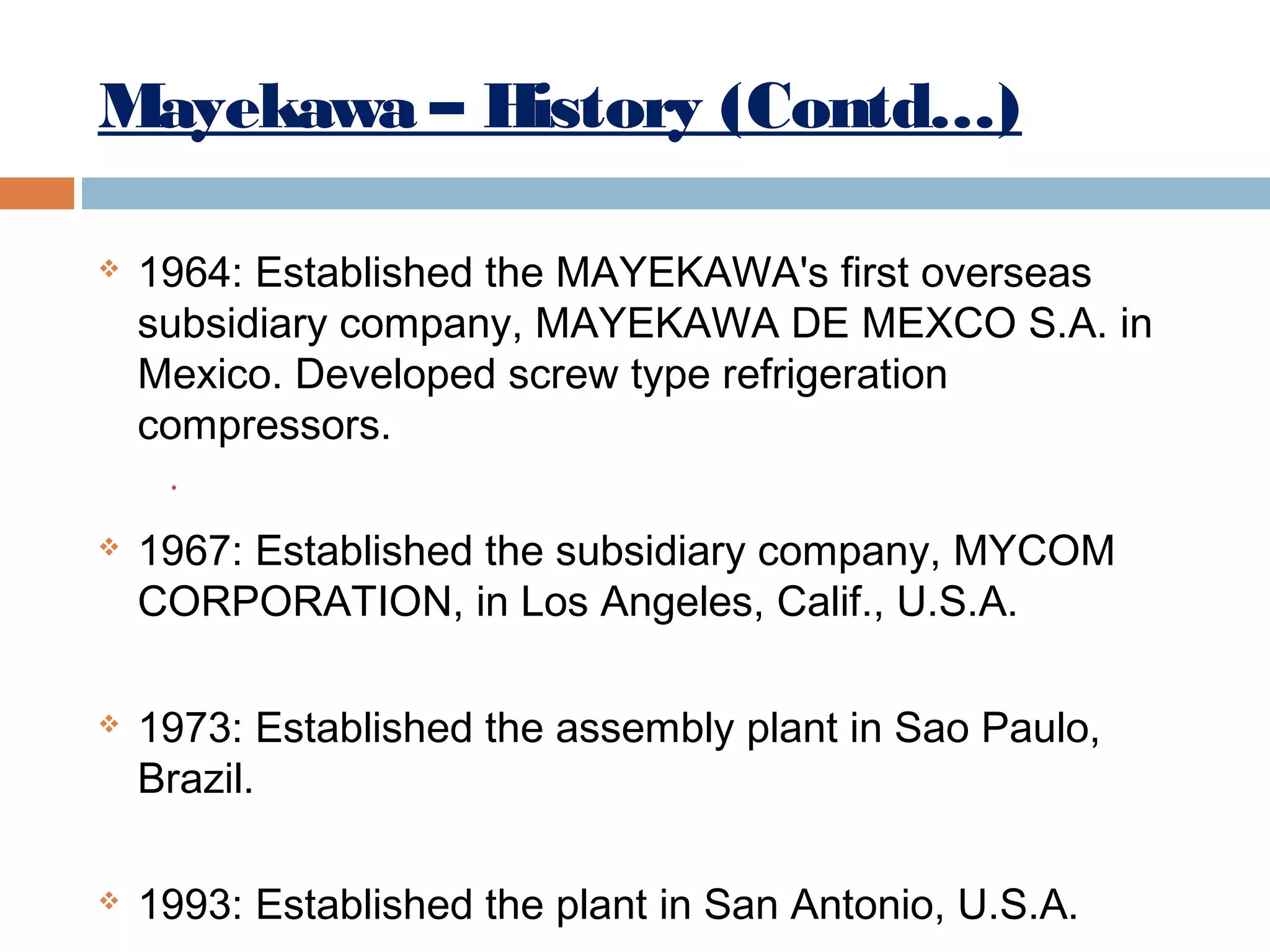
Mayekawa – History (Contd…)








1964: Established the MAYEKAWA's first overseas
subsidiary company, MAYEKAWA DE MEXCO S.A. in
Mexico. Developed screw type refrigeration
compressors.
1967: Established the subsidiary company, MYCOM
CORPORATION, in Los Angeles, Calif., U.S.A.
1973: Established the assembly plant in Sao Paulo,
Brazil.
1993: Established the plant in San Antonio, U.S.A.
Mayekawa – History (Contd…)


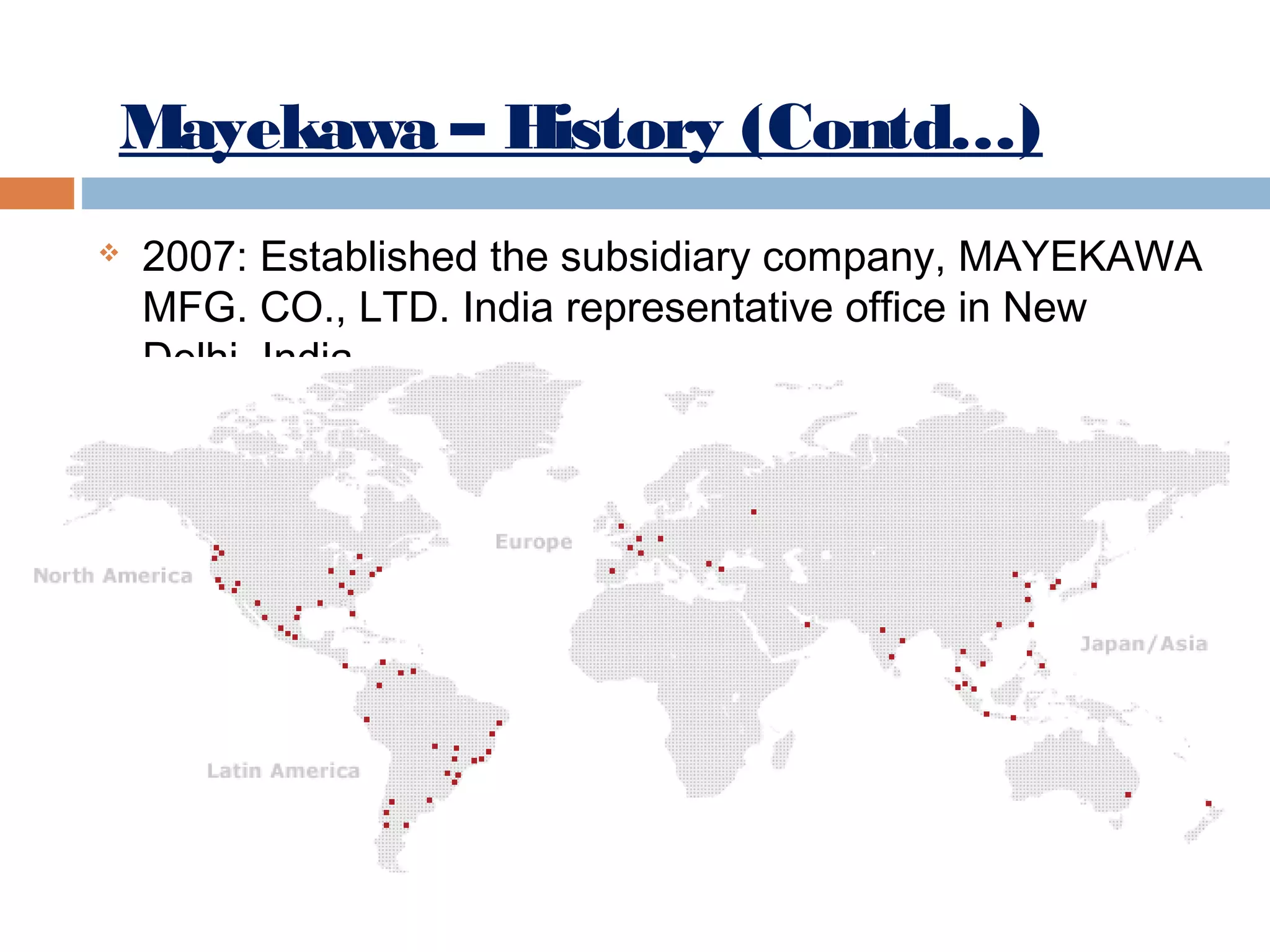
2007: Established the subsidiary company, MAYEKAWA
MFG. CO., LTD. India representative office in New
Delhi, India.
History of Mayekawa’s Organization
Phases – Summary


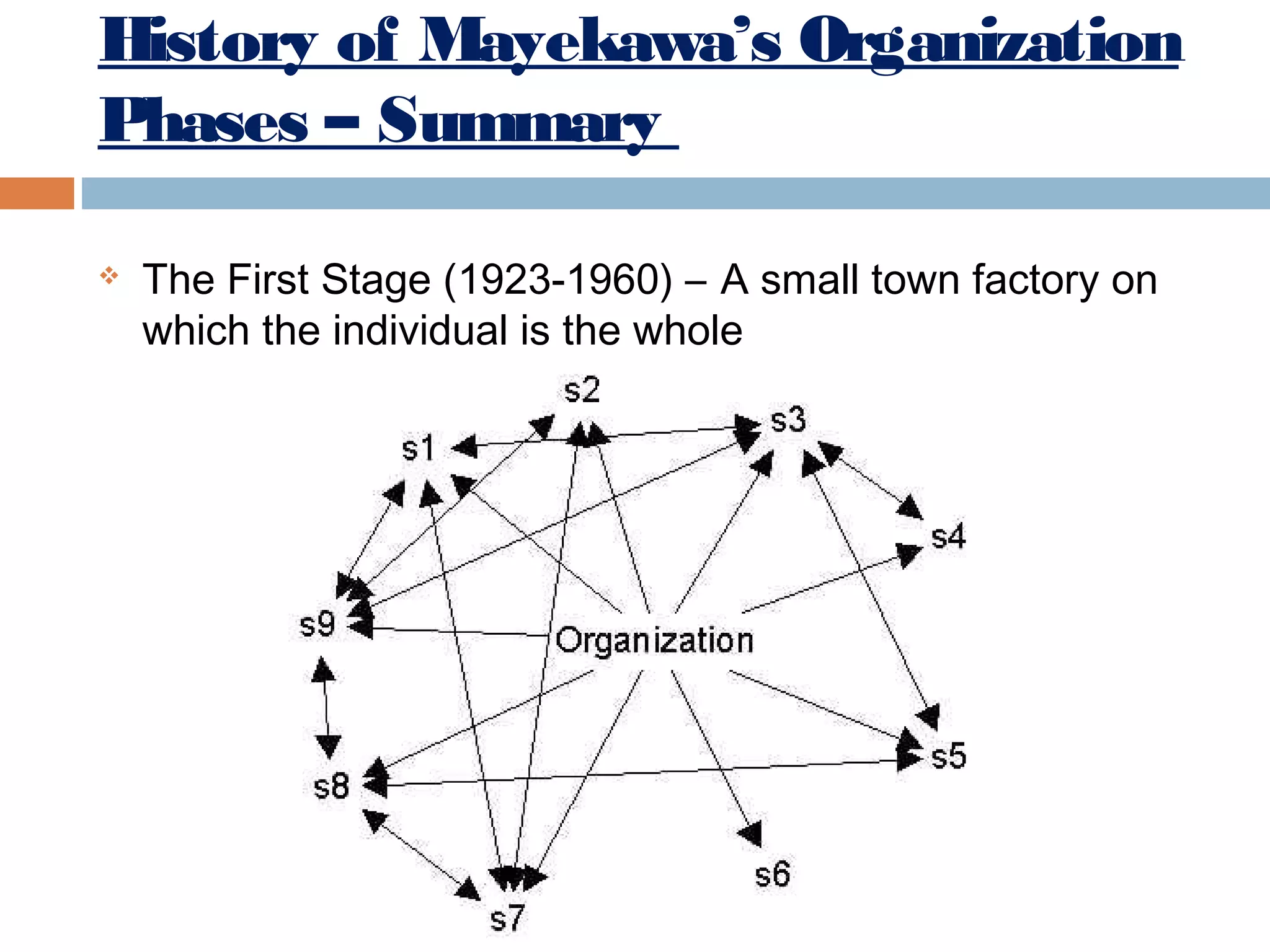
The First Stage (1923-1960) – A small town factory on
which the individual is the whole
History of Mayekawa’s Organization
Phases – Summary (Contd…)


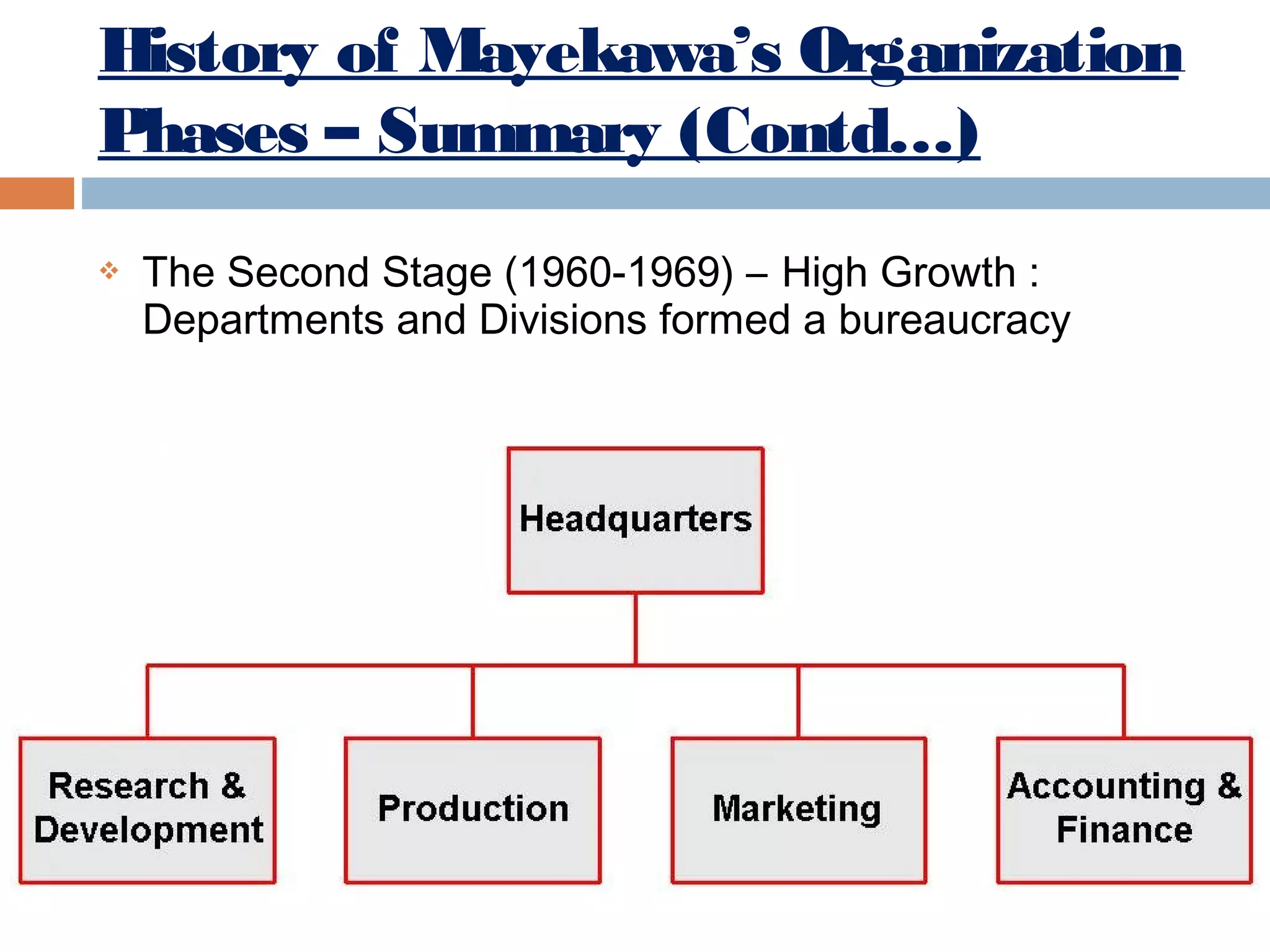
The Second Stage (1960-1969) – High Growth :
Departments and Divisions formed a bureaucracy
History of Mayekawa’s Organization
Phases – Summary (Contd…)


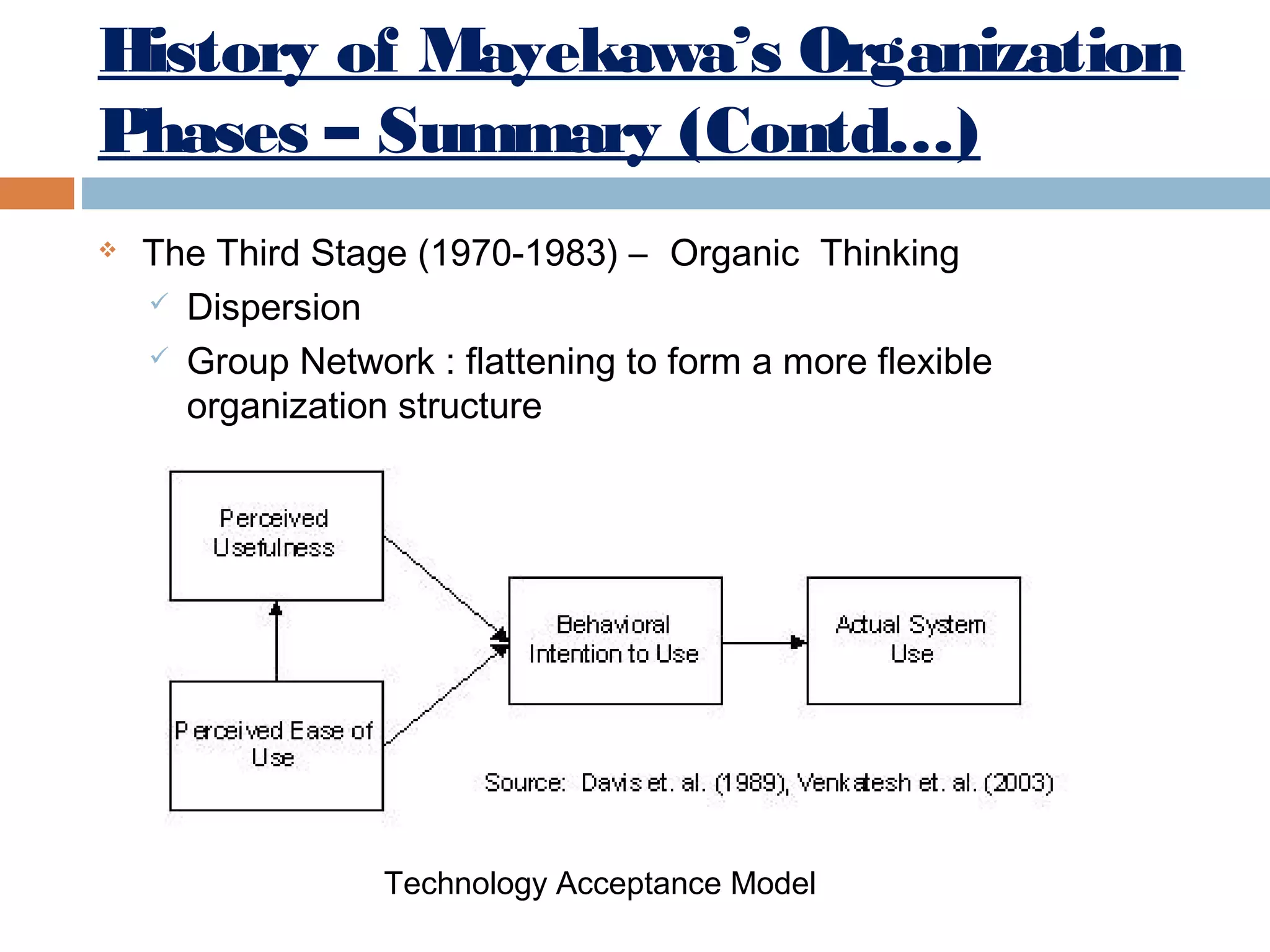
The Third Stage (1970-1983) – Organic Thinking
 Dispersion
 Group Network : flattening to form a more flexible
organization structure

Technology Acceptance Model
History of Mayekawa’s Organization
Phases – Summary (Contd…)


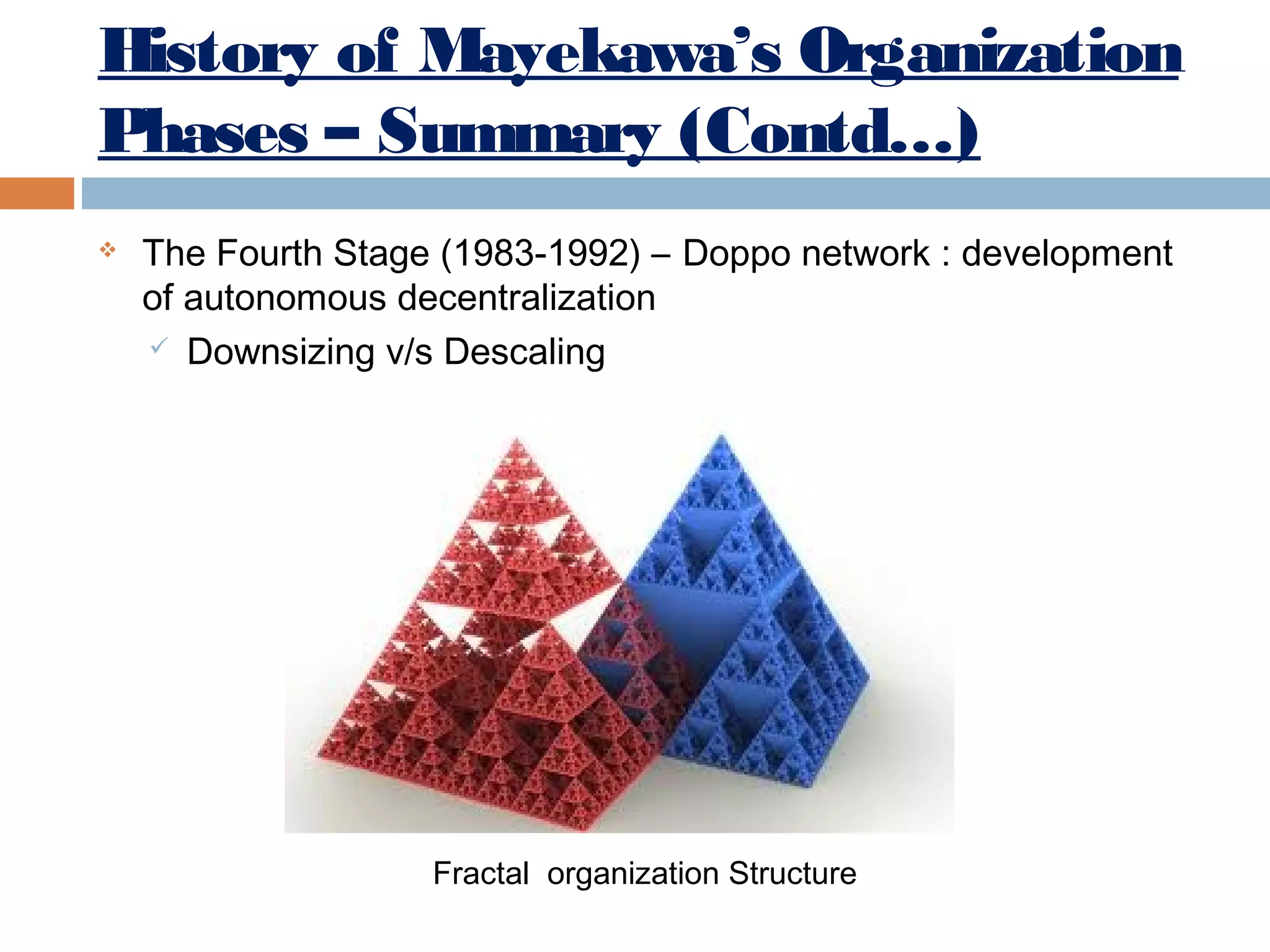
The Fourth Stage (1983-1992) – Doppo network : development
of autonomous decentralization
 Downsizing v/s Descaling

Fractal organization Structure
History of Mayekawa’s Organization
Phases – Summary (Contd…)


The Fifth Stage (1992 – now) – Doppo – Block –
Zensha network


IIT Roorkee Department
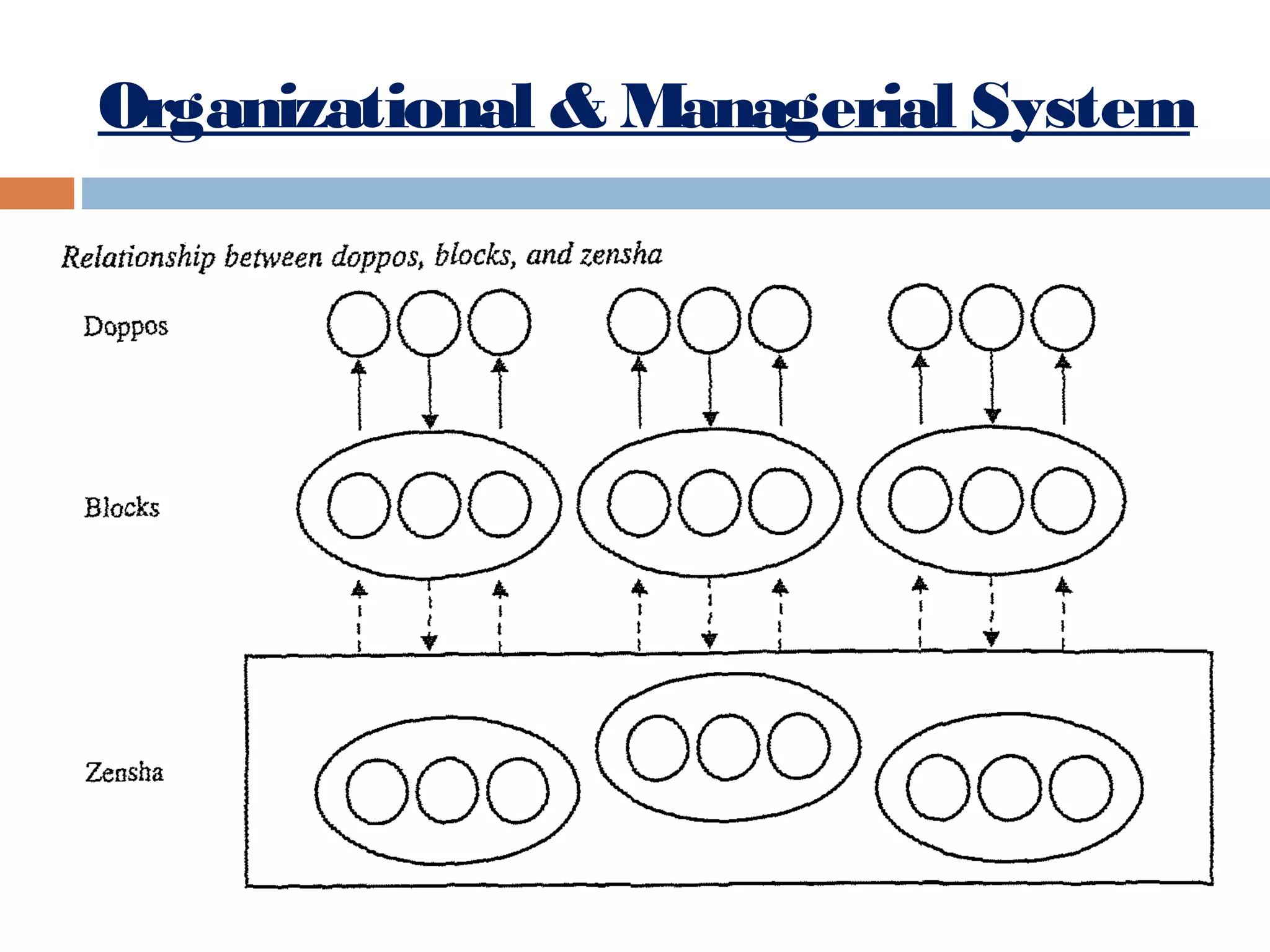
Organizational & Managerial System
Relationship between Doppo, Block
and Zensha within Mayekawa


DOPPO – The Customer Adaptive Units



Legally independent companies



Strength of 10-20 people







Responsible for marketing, sales, engineering,
manufacturing, accounting after service and general affairs.
Total doppos in 1993 were 100 (78 – domestic and 22 –
overseas)
Every doppo is very original, detailed and comprehensive in
approaching each customer
The Doppo-Block Network










The Doppos belong to one or more forums called Blocks
depending on the type of market they serve or the region in
which they operate
All participants in block activities are representatives of their
doppos
Role is not governance but assistance and exchange between
legally independent companies
Blocks decide how to bail out a member doppo with a problem,
technical or otherwise
Blocks are a link between each doppo and the overall company -
Zensha – Functions of Headquarters










Headquarters – president Masao Mayekawa, the staff, the
R&D, almost 160 persons in total
Provide support to Doppos and not boss them
Takes care of PR , Mayekawa welfare system, retirement
funds, insurance etc.
Acts as the bank for all the doppos, receiving funds,
disbursing loans, and staking new doppo start-ups
Most important function is the care and feeding of the
Mayekawa culture
Common features of Mayekawa








Core Technology
Shared respect for the primary values – thrift, hard work,
craft pride, teamwork, and local initiative
No rules from headquarters policy reinforces the culture
Each doppo creates rules to adapt to the environment in
which it finds itself
Coordination and Communication








Written communication should be few in numbers and short
in length.
Two types of communication exist:
 Standardized data processed by computer
 Information interpreted by person
Most formal communication within Mayekawa is related to
preparing and sharing business plans.
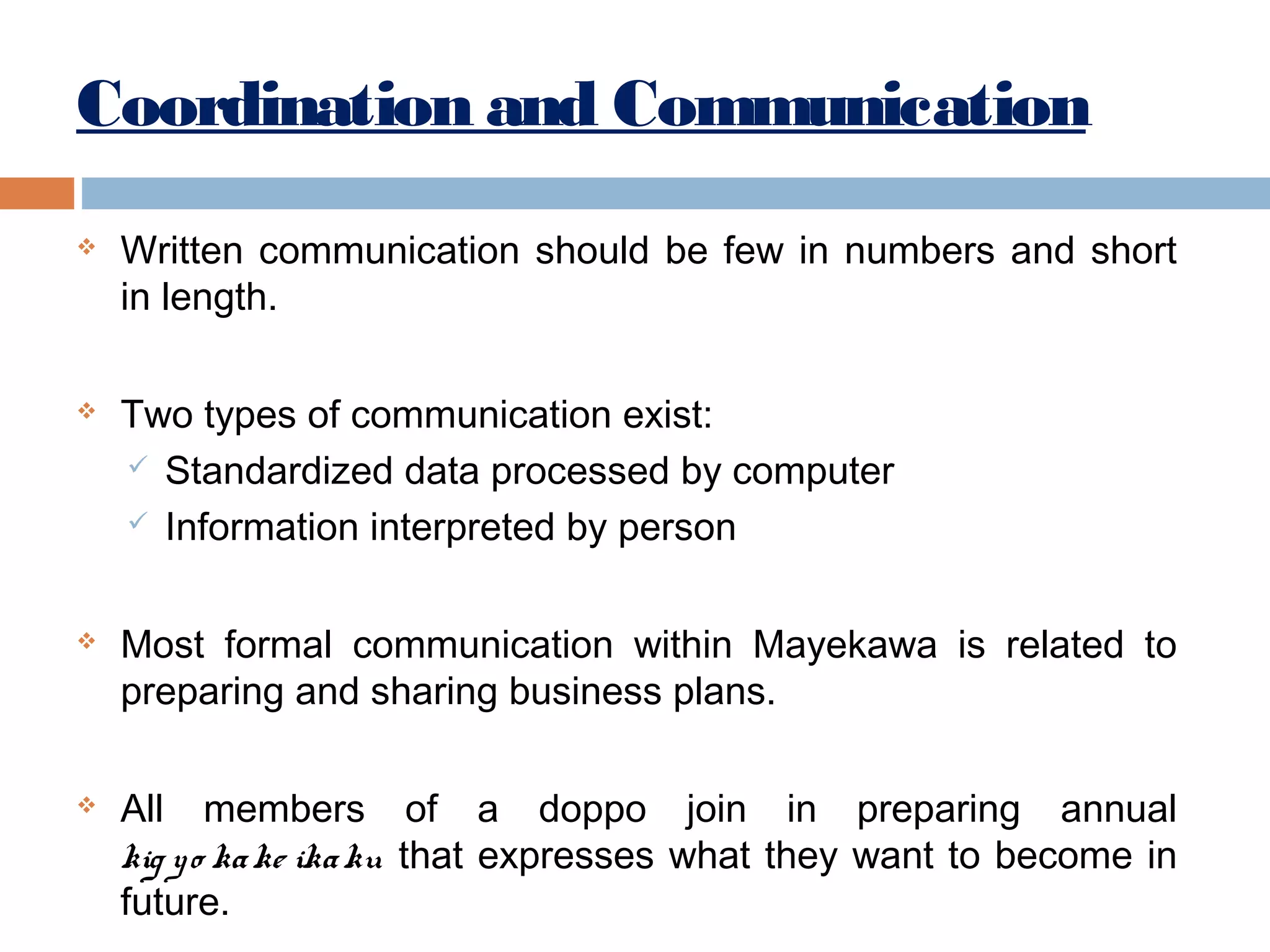
All members of a doppo join in preparing annual
kig y o ka ke ika ku that expresses what they want to become in
future.
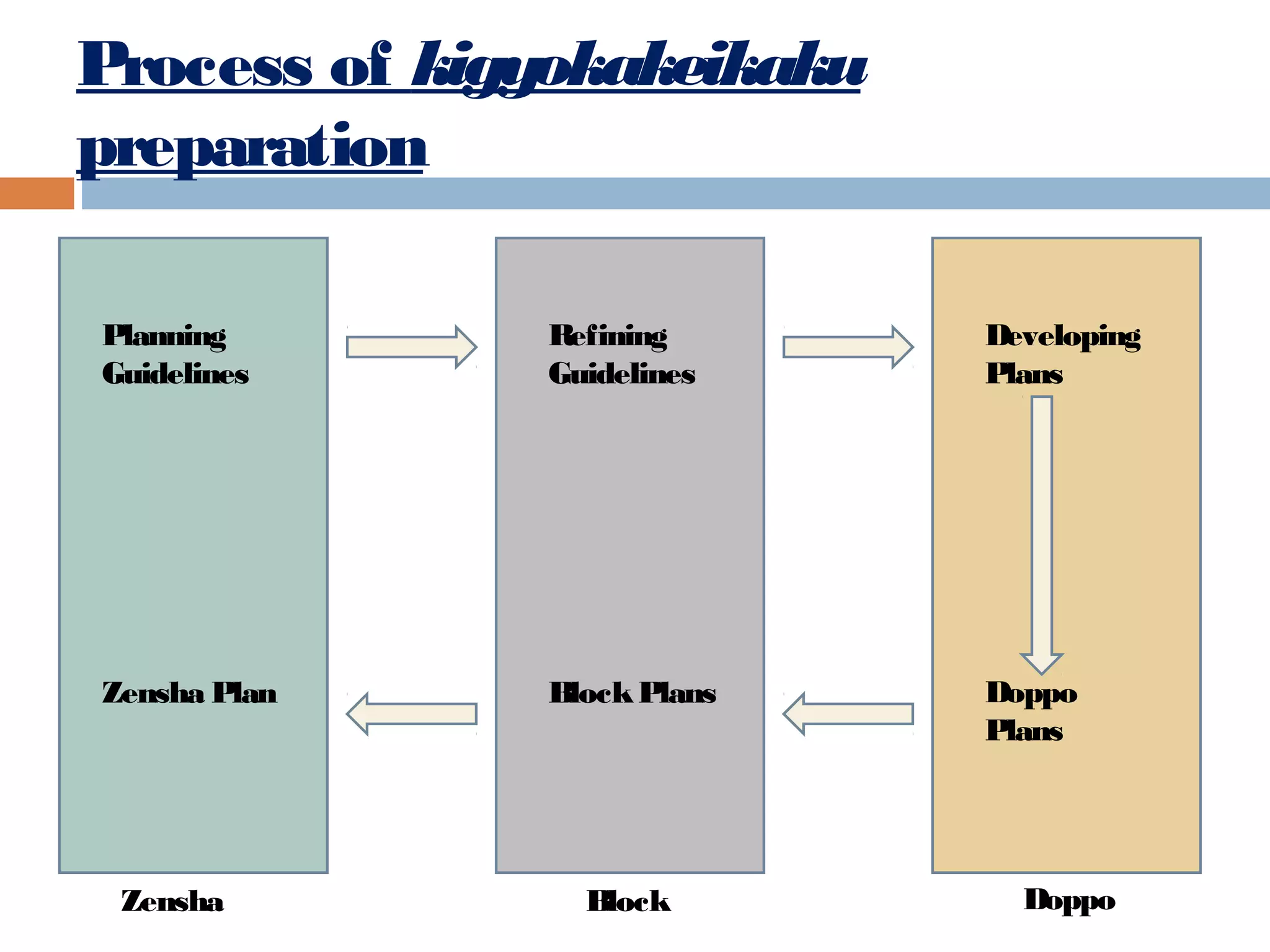
Process of kigyokakeikaku
preparation
Planning
Guidelines

Refining
Guidelines

Developing
Plans

Zensha Plan

Block Plans

Doppo
Plans

Zensha

Block

Doppo
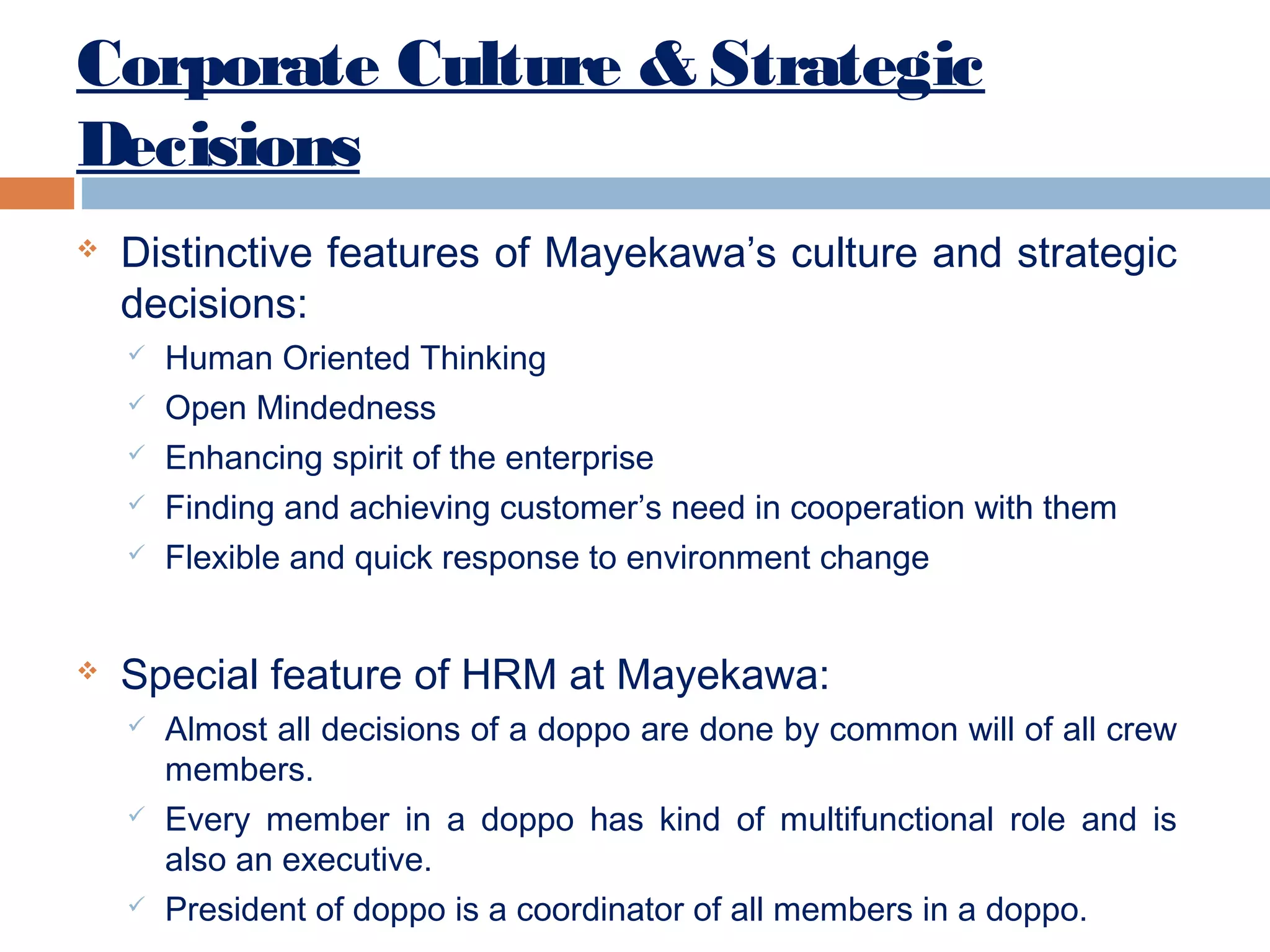
Corporate Culture & Strategic
Decisions


Distinctive features of Mayekawa’s culture and strategic
decisions:








Human Oriented Thinking
Open Mindedness
Enhancing spirit of the enterprise
Finding and achieving customer’s need in cooperation with them
Flexible and quick response to environment change

Special feature of HRM at Mayekawa:






Almost all decisions of a doppo are done by common will of all crew
members.
Every member in a doppo has kind of multifunctional role and is
also an executive.
President of doppo is a coordinator of all members in a doppo.
Conclusion


A company that is always striving for survival is:









Agile to change
Making full use of entrepreneurship

In order to increase productivity under knowledge based
society, “morale” of the people is the key.
Fragmented and specialized work needs rethinking.
A holonic management system is the tool for the
tomorrow.

Organisation Case Study - Restructuring at Mayekawa

  • 1.
    RESTRUCTURING AT MAYEKAWA Abhay Kumar AnkitKatiyar Dharm Jaiswal Shailendra Shankar Gautam Sharad Srivastava 12810001 12810010 12810029 12810075 12810076
  • 2.
    Background  In past, Japanesemanufacturers emphasized on either:     Expand market share Increase sales volume Strategies adopted are price leadership, introducing new products and diversifications. It caused an increase in investment. The result was inflated break even point and lesser profits. In order to compensate for low profits, they have engaged in Kaizan activities. However it demands two conditions to be fulfilled:   High and continuous growth of the economy Existence of a mass market
  • 3.
    Background (Contd…)     After recenteconomic slowdown, they could not get either of the conditions favorable. To reduce the Break Even point (BEP), companied has resorted to reduction of workforce (particularly white collar workers and managers). They have also cut down all investment. It created distrust and company loses excellent people. This causes a negative effect on competitiveness of the firm and situation even gets worse. Therefore there is further need to reduce BEP. Recently several companies have adopted a new approach. They not only have profits but are also innovative and customer focused. – 2 1 C Co m p a ny
  • 4.
    Mayekawa – AnIntroduction  The family-owned company, formed in 1924.  Employs 3,300 people worldwide.  Industrial refrigeration equipment: 50% of the global market.   Reputation for creating innovative niches in other markets. When a customer asked Mayekawa to help automate the deboning of chickens, then done manually by hundreds of workers, the company spent 10 years developing a robot that pulls meat off bones. The result captured an entirely new market. Mayekawa has become a strong world-wide business-tobusiness brand in fields as diverse as biotechnology, electrical engineering and thermal technologies.“
  • 5.
  • 6.
    Evolution of OrganizationStructure High Tech, Complex Tech, uncertain Dynamic Environment ??? Fractal Challeng Challeng e e Matrix Vertical Low Tech, Simple Tech, Uncertain Stable Environment Informa l Uniform Product Known Market Challeng Challeng e e Challeng Challeng ee Diverse Product unknown Market Organization Design and Changing Environment Organization Design and Changing Environment
  • 7.
    Mayekawa – History    1924:Kisaku Maekawa was Japanese industrialist and philanthropist who founded Mayekawa & Co. in Tokyo, Japan. Started ice making and cold storage business. Commenced production of industrial vertical low speed reciprocating refrigeration compressors. 1937: Established Mayekawa Manufacturing Co., Ltd. in Tokyo. Established “MYCOM” for brand. 1958: Commenced production of high single stage speed multi-cylinder reciprocating compressors.
  • 8.
    Mayekawa – History(Contd…)     1964: Established the MAYEKAWA's first overseas subsidiary company, MAYEKAWA DE MEXCO S.A. in Mexico. Developed screw type refrigeration compressors. 1967: Established the subsidiary company, MYCOM CORPORATION, in Los Angeles, Calif., U.S.A. 1973: Established the assembly plant in Sao Paulo, Brazil. 1993: Established the plant in San Antonio, U.S.A.
  • 9.
    Mayekawa – History(Contd…)  2007: Established the subsidiary company, MAYEKAWA MFG. CO., LTD. India representative office in New Delhi, India.
  • 10.
    History of Mayekawa’sOrganization Phases – Summary  The First Stage (1923-1960) – A small town factory on which the individual is the whole
  • 11.
    History of Mayekawa’sOrganization Phases – Summary (Contd…)  The Second Stage (1960-1969) – High Growth : Departments and Divisions formed a bureaucracy
  • 12.
    History of Mayekawa’sOrganization Phases – Summary (Contd…)  The Third Stage (1970-1983) – Organic Thinking  Dispersion  Group Network : flattening to form a more flexible organization structure Technology Acceptance Model
  • 13.
    History of Mayekawa’sOrganization Phases – Summary (Contd…)  The Fourth Stage (1983-1992) – Doppo network : development of autonomous decentralization  Downsizing v/s Descaling Fractal organization Structure
  • 14.
    History of Mayekawa’sOrganization Phases – Summary (Contd…)  The Fifth Stage (1992 – now) – Doppo – Block – Zensha network  IIT Roorkee Department
  • 15.
  • 16.
    Relationship between Doppo,Block and Zensha within Mayekawa  DOPPO – The Customer Adaptive Units  Legally independent companies  Strength of 10-20 people    Responsible for marketing, sales, engineering, manufacturing, accounting after service and general affairs. Total doppos in 1993 were 100 (78 – domestic and 22 – overseas) Every doppo is very original, detailed and comprehensive in approaching each customer
  • 17.
    The Doppo-Block Network      TheDoppos belong to one or more forums called Blocks depending on the type of market they serve or the region in which they operate All participants in block activities are representatives of their doppos Role is not governance but assistance and exchange between legally independent companies Blocks decide how to bail out a member doppo with a problem, technical or otherwise Blocks are a link between each doppo and the overall company -
  • 18.
    Zensha – Functionsof Headquarters      Headquarters – president Masao Mayekawa, the staff, the R&D, almost 160 persons in total Provide support to Doppos and not boss them Takes care of PR , Mayekawa welfare system, retirement funds, insurance etc. Acts as the bank for all the doppos, receiving funds, disbursing loans, and staking new doppo start-ups Most important function is the care and feeding of the Mayekawa culture
  • 19.
    Common features ofMayekawa     Core Technology Shared respect for the primary values – thrift, hard work, craft pride, teamwork, and local initiative No rules from headquarters policy reinforces the culture Each doppo creates rules to adapt to the environment in which it finds itself
  • 20.
    Coordination and Communication     Writtencommunication should be few in numbers and short in length. Two types of communication exist:  Standardized data processed by computer  Information interpreted by person Most formal communication within Mayekawa is related to preparing and sharing business plans. All members of a doppo join in preparing annual kig y o ka ke ika ku that expresses what they want to become in future.
  • 21.
  • 22.
    Corporate Culture &Strategic Decisions  Distinctive features of Mayekawa’s culture and strategic decisions:       Human Oriented Thinking Open Mindedness Enhancing spirit of the enterprise Finding and achieving customer’s need in cooperation with them Flexible and quick response to environment change Special feature of HRM at Mayekawa:    Almost all decisions of a doppo are done by common will of all crew members. Every member in a doppo has kind of multifunctional role and is also an executive. President of doppo is a coordinator of all members in a doppo.
  • 23.
    Conclusion  A company thatis always striving for survival is:      Agile to change Making full use of entrepreneurship In order to increase productivity under knowledge based society, “morale” of the people is the key. Fragmented and specialized work needs rethinking. A holonic management system is the tool for the tomorrow.