The Measure of Lifewww.uscom.com.au
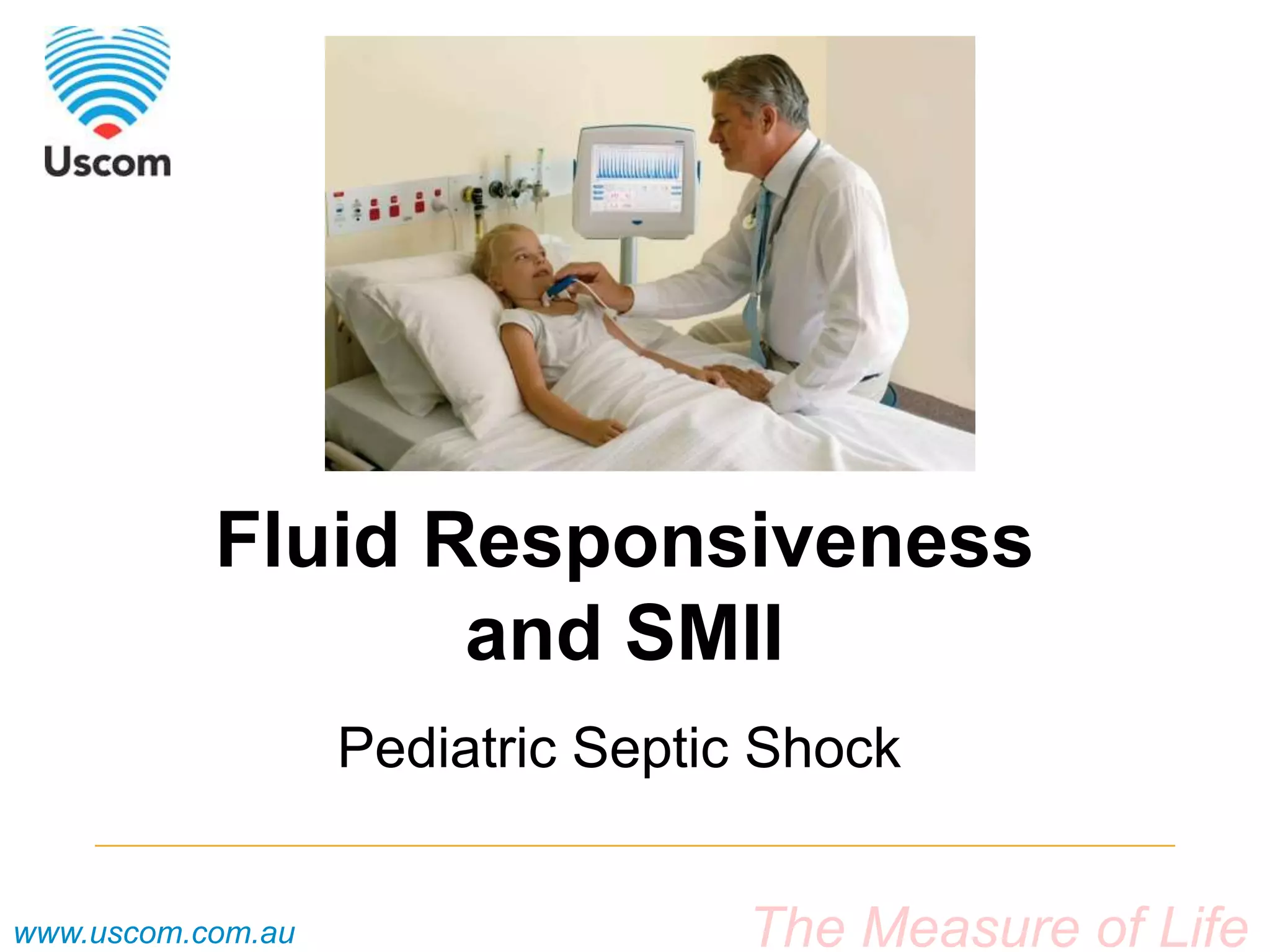
Fluid Responsiveness
and SMII
Pediatric Septic Shock
The Measure of Lifewww.uscom.com.au
Smith Madigan Inotropy Index
(SMII)
• When the heart is unable to meet the demands of
the body then the heart has failed
• Whether the cause is myocardial infarction,
valvular disease or arrhythmia
• Heart failure is inadequate blood pressure and or
blood flow - CI < 2.4 l/min/m2
• Potential Energy (PE) is blood pressure and
Kinetic Energy (KE) is blood flow.
• PE + KE = SMI ; SMI / BSA = SMII
• SMII is a measure of the heart’s energy or power
The Measure of Lifewww.uscom.com.au
Causes of a Low Stroke Volume
• Low SV, and consequently low CI, may be due to:
• Hypovolemia - inadequate preload in response to a
volume challenge
• Hypovolemia and hypocontractility - low preload and
myocardial depression which may not respond to fluid
alone
• The non-responders are on a lower, flatter Frank-Starling curve
• Inotropes are needed to increase SV in the face of cardiac
failure, when there is enough preload
• Hypocontractility – Myocardial depression with
normovolemia
The Measure of Lifewww.uscom.com.au
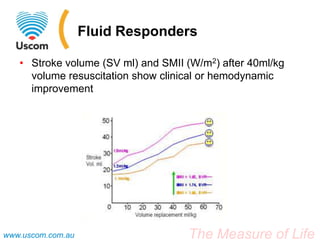
Fluid Responders
• Stroke volume (SV ml) and SMII (W/m2) after 40ml/kg
volume resuscitation show clinical or hemodynamic
improvement
The Measure of Lifewww.uscom.com.au
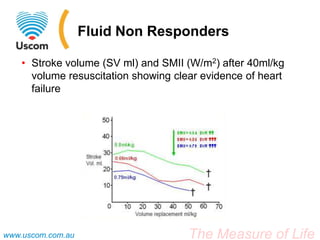
Fluid Non Responders
• Stroke volume (SV ml) and SMII (W/m2) after 40ml/kg
volume resuscitation showing clear evidence of heart
failure
The Measure of Lifewww.uscom.com.au
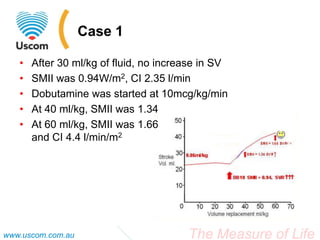
Case 1
• After 30 ml/kg of fluid, no increase in SV
• SMII was 0.94W/m2, CI 2.35 l/min
• Dobutamine was started at 10mcg/kg/min
• At 40 ml/kg, SMII was 1.34
• At 60 ml/kg, SMII was 1.66
and CI 4.4 l/min/m2
The Measure of Lifewww.uscom.com.au
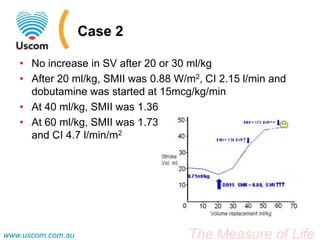
Case 2
• No increase in SV after 20 or 30 ml/kg
• After 20 ml/kg, SMII was 0.88 W/m2, CI 2.15 l/min and
dobutamine was started at 15mcg/kg/min
• At 40 ml/kg, SMII was 1.36
• At 60 ml/kg, SMII was 1.73
and CI 4.7 l/min/m2
The Measure of Lifewww.uscom.com.au
Which Inotrope?
• Both of the non-responders had very high SVRI
values of 3,300 d.s.cm-5 and 3,450 d.s.cm-5
• A vaso-dilating inotrope, dobutamine, was
chosen
• A vasoconstricting inotrope would be more
appropriate for a low SVR/high CI
The Measure of Lifewww.uscom.com.au
Which Inotrope?
• A rational choice of inotrope can be made on the
basis of the CI, SMII and SVRI
• We should ask three questions:
1). Is the CI high, low or normal?
2). Is the SVRI high, low or normal.
3). Is the SMII normal or low?
• Is there a need to increase inotropy?
• Is vasodilation or vasoconstriction necessary?
The Measure of Lifewww.uscom.com.au
Conclusion
USCOM
• Measures the energy of the heart
• Identifies patients who need an inotrope to
optimise SVI and CI
• Identifies which inotrope to use
• Measurement of SVI, SMII and SVRI
guides appropriate, effective and rapid
management

Case Study - Pediatric - Septic Shock - Fluid Responsiveness and SMII

  • 1.
    The Measure ofLifewww.uscom.com.au Fluid Responsiveness and SMII Pediatric Septic Shock
  • 2.
    The Measure ofLifewww.uscom.com.au Smith Madigan Inotropy Index (SMII) • When the heart is unable to meet the demands of the body then the heart has failed • Whether the cause is myocardial infarction, valvular disease or arrhythmia • Heart failure is inadequate blood pressure and or blood flow - CI < 2.4 l/min/m2 • Potential Energy (PE) is blood pressure and Kinetic Energy (KE) is blood flow. • PE + KE = SMI ; SMI / BSA = SMII • SMII is a measure of the heart’s energy or power
  • 3.
    The Measure ofLifewww.uscom.com.au Causes of a Low Stroke Volume • Low SV, and consequently low CI, may be due to: • Hypovolemia - inadequate preload in response to a volume challenge • Hypovolemia and hypocontractility - low preload and myocardial depression which may not respond to fluid alone • The non-responders are on a lower, flatter Frank-Starling curve • Inotropes are needed to increase SV in the face of cardiac failure, when there is enough preload • Hypocontractility – Myocardial depression with normovolemia
  • 4.
    The Measure ofLifewww.uscom.com.au Fluid Responders • Stroke volume (SV ml) and SMII (W/m2) after 40ml/kg volume resuscitation show clinical or hemodynamic improvement
  • 5.
    The Measure ofLifewww.uscom.com.au Fluid Non Responders • Stroke volume (SV ml) and SMII (W/m2) after 40ml/kg volume resuscitation showing clear evidence of heart failure
  • 6.
    The Measure ofLifewww.uscom.com.au Case 1 • After 30 ml/kg of fluid, no increase in SV • SMII was 0.94W/m2, CI 2.35 l/min • Dobutamine was started at 10mcg/kg/min • At 40 ml/kg, SMII was 1.34 • At 60 ml/kg, SMII was 1.66 and CI 4.4 l/min/m2
  • 7.
    The Measure ofLifewww.uscom.com.au Case 2 • No increase in SV after 20 or 30 ml/kg • After 20 ml/kg, SMII was 0.88 W/m2, CI 2.15 l/min and dobutamine was started at 15mcg/kg/min • At 40 ml/kg, SMII was 1.36 • At 60 ml/kg, SMII was 1.73 and CI 4.7 l/min/m2
  • 8.
    The Measure ofLifewww.uscom.com.au Which Inotrope? • Both of the non-responders had very high SVRI values of 3,300 d.s.cm-5 and 3,450 d.s.cm-5 • A vaso-dilating inotrope, dobutamine, was chosen • A vasoconstricting inotrope would be more appropriate for a low SVR/high CI
  • 9.
    The Measure ofLifewww.uscom.com.au Which Inotrope? • A rational choice of inotrope can be made on the basis of the CI, SMII and SVRI • We should ask three questions: 1). Is the CI high, low or normal? 2). Is the SVRI high, low or normal. 3). Is the SMII normal or low? • Is there a need to increase inotropy? • Is vasodilation or vasoconstriction necessary?
  • 10.
    The Measure ofLifewww.uscom.com.au Conclusion USCOM • Measures the energy of the heart • Identifies patients who need an inotrope to optimise SVI and CI • Identifies which inotrope to use • Measurement of SVI, SMII and SVRI guides appropriate, effective and rapid management