


General objective of case study
 The general objective of conducting the case study is to
identify the case of cholangitis with Choledocholithiasis
and to explore its causes, sighs and symptoms,
managements, prognosis, nursing management and to
provide holistic nursing care following nursing theory.
Objectives of case study
 To collect bio-demography information and present/past history of
the client.
 To obtain detail knowledge about disease condition including
cause, signs & symptoms, complications, medical and nursing
management.
 To gain knowledge upon various diagnostic procedures performed
regarding the disease.
 To observe patient progress and management of case.
 To provide holistic nursing care using appropriate nursing theory.
 To identify special gadgets used in patient care
 To collaborate with the patient, family and health team members
in the continuing home-based care of the patient
 To provide health teaching to patient and visitors regarding the
disease condition, its management, including importance of fluid
and diet modification, and follow-up.
Rationale for the selection of case
 Choledocholithiasis may not immediately obstruct major bile duct;
asymptomatic stones are found in about 10% of patients at the time
of surgical cholecystectomy.
 Choledocholithiasis is one of the problem encountered in Nepal.
 the presence of Choledocholithiasis correlates with patient age and
is; 5%, 15% and 35% in patient <60, 60-79 and >80 years of age,
respectively.
Methodology
 History taking and interviewing to the patient and her visitors.
 Observation and physical examination to the patient.
 Review of the patient’s record chart, lab investigation reports.
 Discussion with teachers, senior staffs, doctors and friends.
 Using various text books and references of the medicine and related
internet search technology.
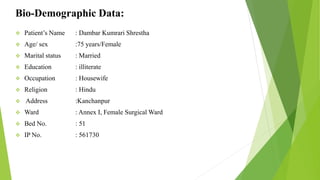
Bio-Demographic Data:
 Patient’s Name : Dambar Kumrari Shrestha
 Age/ sex :75 years/Female
 Marital status : Married
 Education : illiterate
 Occupation : Housewife
 Religion : Hindu
 Address :Kanchanpur
 Ward : Annex I, Female Surgical Ward
 Bed No. : 51
 IP No. : 561730
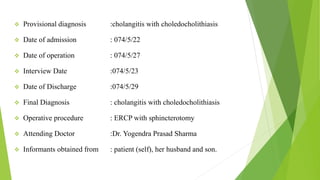
 Provisional diagnosis :cholangitis with choledocholithiasis
 Date of admission : 074/5/22
 Date of operation : 074/5/27
 Interview Date :074/5/23
 Date of Discharge :074/5/29
 Final Diagnosis : cholangitis with choledocholithiasis
 Operative procedure : ERCP with sphincterotomy
 Attending Doctor :Dr. Yogendra Prasad Sharma
 Informants obtained from : patient (self), her husband and son.
2. Chief complain
 At present:
 Fever, pain in epigastric
region and difficulty in
breathing.
 Pain abdomen in epigastric,
right hypochondriac region
since 12 days.
 H/o fever 4-5 days.
 Decreased urination.
 On/off constipation.
Present illness history
 My patient suddenly developed epigastric pain, abdominal pain and constipation
since 2 days so she was taken to Kailai Hospital Pvt. Ltd. Dhangadi on 2074/5/20.
On that hospital she was diagnosed obstructed jaundice, and on USSG- ?
Choledochal cyst with dilated CBD.
 26 years back, open cholecystectomy was done in my patient, hence the Dr., she was
consulted advised her to follow up in the higher center for better management, so
she was admitted to B & B hospital on 2074/5/20 with the diagnosis of cholangitis
with Choledocholithiasis. MRCP showed calculus, polypoidal lesion in distal CBD,
so she was planned for ERCP.
 Due to poor economic condition, she was referred to TUTH, on 074/5/22.
Past health history
 She had taken all the immunization as per EPI schedule of
Nepal.
 Not known of any food, drugs allergy.
 She was admitted in hospital 26 years back for open
cholecystectomy. After treatment, she was discharged with
proper advices from the medical personnel.
 History of any chronic illness: patient was under diabetes
medication.
 Family history: there is no any history of chronic illness
in maternal and parental family but patient is under
diabetic medicine.
Psychological history
 Patient’s reaction to illness:
 She was worried about the pain, and vomiting and also worry
about different diagnostic procedure carried out during
hospitalization.
 Patient’s coping pattern:
 She coped illness by expressing her feelings to her son and
asking a question about diagnostic procedure, prognosis, time
of discharge to ward staff and doctor.
 patient’s value of health:
 Its very important to take care of own health despite of age.
 Patient’s perception of the care giver:
 She thinks that nurses are caring and giving health education
effectively but some nurses behave rudely, and some doctors
are cooperative.
Sociological history
Family relationship:
 Client's position in the family: she use to help in little bit
household work, she is not head of the family.
 Person living with client (support system): her husband, son and
grand daughter were caring her in hospital.
 Recent family crisis or change: as she has been hospitalized, and
her sun and husband both are with her, her son was not able to go
for his work, this might lead to further economical crisis.
Menstrual history
 Menarche: 14 years of age.
 Menopause- 49 years of age.
 Obstetric history:
 Antenatal check up- not done
 Postnatal check up- not done
 Place of delivery- home
 Types of delivery- spontaneous vaginal delivery
 Any complication- no
Personal history
 Smoking and alcohol consuming habit: she has smoking and
alcohol consuming history before but she stop smoking habit
since 2 years.
 Dietary habits: She is a non-vegetarian and does not have much
food likes or dislikes. She was having soft during my care period
from the hospital. She was fond of the hospital diet.
 The patient has a normal bowel habit before her
illness. She passes bowel every morning and
empties her bladder as per need. But due to illnss
and hospitalization her elimination pattern was
irregular and her chief complain is also
constipation.
Environmental history:
 Type of family: joint family
 No of family: 7
 Type of house: Pakki
 No of rooms: 3
 Kitchen: separate
 Fuel used: LP gas
 Drinking water: water supply
 Toilet: water seal toilet
 Drainage system: closed system
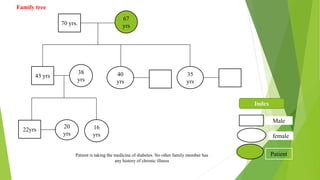
67
yrs
43 yrs 40
yrs
35
yrs
38
yrs
22yrs
20
yrs
16
yrs
70 yrs.
Family tree
Male
Patient
female
Index
Patient is taking the medicine of diabetes. No other family member has
any history of chronic illness
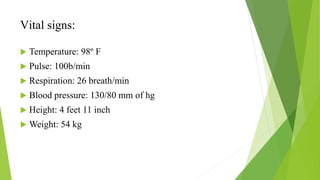
Vital signs:
 Temperature: 98º F
 Pulse: 100b/min
 Respiration: 26 breath/min
 Blood pressure: 130/80 mm of hg
 Height: 4 feet 11 inch
 Weight: 54 kg
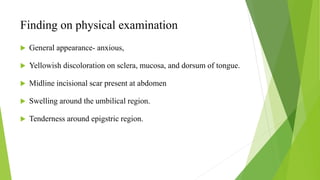
Finding on physical examination
 General appearance- anxious,
 Yellowish discoloration on sclera, mucosa, and dorsum of tongue.
 Midline incisional scar present at abdomen
 Swelling around the umbilical region.
 Tenderness around epigstric region.
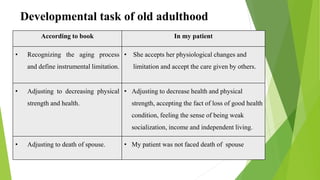
Developmental task of old adulthood
According to book In my patient
• Recognizing the aging process
and define instrumental limitation.
• She accepts her physiological changes and
limitation and accept the care given by others.
• Adjusting to decreasing physical
strength and health.
• Adjusting to decrease health and physical
strength, accepting the fact of loss of good health
condition, feeling the sense of being weak
socialization, income and independent living.
• Adjusting to death of spouse. • My patient was not faced death of spouse
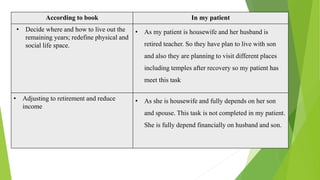
According to book In my patient
• Decide where and how to live out the
remaining years; redefine physical and
social life space.
• As my patient is housewife and her husband is
retired teacher. So they have plan to live with son
and also they are planning to visit different places
including temples after recovery so my patient has
meet this task
• Adjusting to retirement and reduce
income
• As she is housewife and fully depends on her son
and spouse. This task is not completed in my patient.
She is fully depend financially on husband and son.
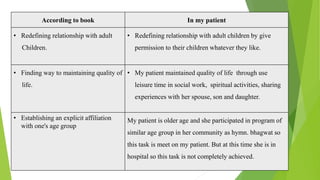
According to book In my patient
• Redefining relationship with adult
Children.
• Redefining relationship with adult children by give
permission to their children whatever they like.
• Finding way to maintaining quality of
life.
• My patient maintained quality of life through use
leisure time in social work, spiritual activities, sharing
experiences with her spouse, son and daughter.
• Establishing an explicit affiliation
with one's age group
My patient is older age and she participated in program of
similar age group in her community as hymn. bhagwat so
this task is meet on my patient. But at this time she is in
hospital so this task is not completely achieved.
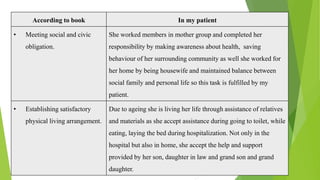
According to book In my patient
• Meeting social and civic
obligation.
She worked members in mother group and completed her
responsibility by making awareness about health, saving
behaviour of her surrounding community as well she worked for
her home by being housewife and maintained balance between
social family and personal life so this task is fulfilled by my
patient.
• Establishing satisfactory
physical living arrangement.
Due to ageing she is living her life through assistance of relatives
and materials as she accept assistance during going to toilet, while
eating, laying the bed during hospitalization. Not only in the
hospital but also in home, she accept the help and support
provided by her son, daughter in law and grand son and grand
daughter.
DISEASE SECTION
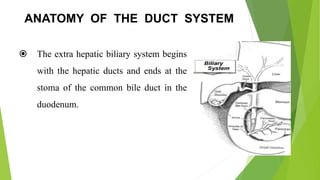
ANATOMY OF THE DUCT SYSTEM
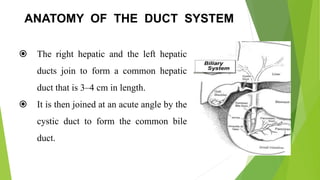
 The extra hepatic biliary system begins
with the hepatic ducts and ends at the
stoma of the common bile duct in the
duodenum.
ANATOMY OF THE DUCT SYSTEM
 The right hepatic and the left hepatic
ducts join to form a common hepatic
duct that is 3–4 cm in length.
 It is then joined at an acute angle by the
cystic duct to form the common bile
duct.
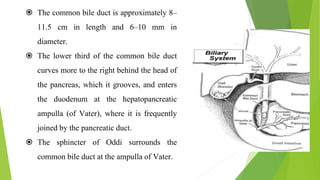
 The common bile duct is approximately 8–
11.5 cm in length and 6–10 mm in
diameter.
 The lower third of the common bile duct
curves more to the right behind the head of
the pancreas, which it grooves, and enters
the duodenum at the hepatopancreatic
ampulla (of Vater), where it is frequently
joined by the pancreatic duct.
 The sphincter of Oddi surrounds the
common bile duct at the ampulla of Vater.
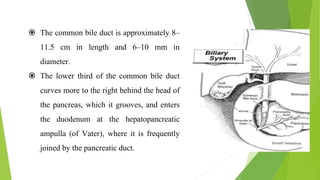
 The common bile duct is approximately 8–
11.5 cm in length and 6–10 mm in
diameter.
 The lower third of the common bile duct
curves more to the right behind the head of
the pancreas, which it grooves, and enters
the duodenum at the hepatopancreatic
ampulla (of Vater), where it is frequently
joined by the pancreatic duct.
Bile
 Bile or gall is a dark green to yellowish brown fluid, produced by the
liver that aids the digestion of lipids in the small intestine.
 In humans, bile is produced continuously by the liver (liver bile), and
stored and concentrated in the gallbladder (gallbladder bile).
 Bile as it leaves the liver is composed of 97% water, 1-2% bile salts and
1% pigments, cholesterol and fatty acid.
 The rate of bile secretion is controlled by cholecystokinin (CCK) which
is released from the duodenal mucosa, with feeding there is increased
production of bile.
 After eating, this stored bile is discharged into the duodenum.
 The composition of gallbladder bile is 97% water, 0.7% bile salts, 0.2%
bilirubin, 0.51% fats (cholesterol, fatty acids and lecithin), and 200
meq/l inorganic salts.
Introduction to disease
 Choledocholithiasis is defined as stones in the common bile duct.
Common bile duct arise from the gall bladder or hepatic duct.
 Common duct stones can occur in the absence of gall bladder and
are classified as primary. Cholangitis is inflammation of the bile
duct.
 Choledocholithiasis may be identified in 5-10% of patient’s
undergoing elective cholecystectomy.
 Common duct stones can be classified into two types: primary and secondary.
 Primary stones form de novo in the common duct as a result of biliary infection
or stasis.
 Secondary stones are identical in composition to gallbladder stones and
presumably migrate from the gallbladder. Some of the stones exit the gallbladder
and gets trapped in the CBD to cause Choledocholithiasis (secondary stones).
 Up to 15% of individuals with gallstones (cholelithiasis) have associated
Choledocholithiasis. Uncommonly, stones may be formed within the common bile
duct itself (primary stones)
 primary bile duct stones are formed in the intrahepatic
or extra hepatic bile ducts. they are more prevalent in
Asian populations. these stones usually are brown
pigment stones. bacterial colonization of bile and bile
stasis play important roles in the pathogenesis of these
stones
Incidence and prevalence
 In the Western world, most stones in the common bile duct arise
from the passing of gallbladder stones into the common bile duct.
Stones in the common duct occur in 10% to 15% of people who
have gallbladder stones.
 The Choledocholithiasis has an incidence of 8-20% in patients
with cholelithiasis.
 Choledocholithiasis develops in about 10%-20% of patients with
gallbladder stones and the literature suggests that at least 3%-10% of
patients undergoing cholecystectomy will have common bile duct
(CBD) stones.
 Among the study conducted from 2010 to 2011 by Pradhan SI, Shah S,
Maharjan S, Shah JN in Bir Hospital and Patan Hodpital of the 52
patient who had already open cholecystectomy, among them 1.9% have
Choledocholithiasis
 Up to 10% of patients with gallstones have common bile duct stones.
Common bile duct stones have been discovered days to several years after
surgery in as many as 5% of patients who have undergone cholecystectomy.
(Hermann RE. The spectrum of biliary stone disease. Am J Surg. 1989, 158:
171-173.)
 According to Mishra T, Lakshmi KK, Peddi KK (2016), Prevalence of
Cholelithiasis and Choledocholithiasis was 21.76 and 9.63 %.
 Among the 757 patient in Annex I TUTH, 17 patient were admitted with the
diagnosis of cholangitis with Choledocholithiasis. (2073 Baishakh to Chaitra)
 Among the 2074 patient in surgical ward of Western Regional
Hospital, Pokhara, 274 patient were admitted with the diagnosis
of Cholelithiasis. Among them, 6 patient were diagnosed
Choledocholithiasis during intra-operative period.
Predisposing and risk factors
 Individuals who have had cholecystectomy are at risk to
develop Choledocholithiasis.
 Any individual with a history of Cholelithiasis is also at
risk to develop Choledocholithiasis.
 Any individual who has gallstone disease (cholelithiasis) is at risk
for Choledocholithiasis (or Gallstone in the Bile Duct). It is more
common in the elderly adults, than in children or younger adults.
the presence of Choledocholithiasis correlates with patient age
and is; 5%, 15% and 35% in patient <60, 60-79 and >80 years of
age, respectively
Causes
Choledocholithiasis occurs due to one of the two mechanisms:
 Stones that get formed within the common bile duct itself, which is seen
in individuals without a gallbladder (which was surgically removed
through a procedure termed cholecystectomy) and in individuals with
bile duct infection.
 Gallstones formed in the gallbladder move out and get trapped in the
common bile duct (CBD).
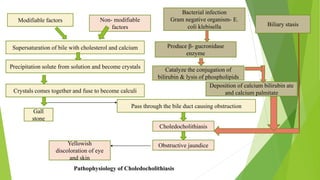
Modifiable factors Non- modifiable
factors
Supersaturation of bile with cholesterol and calcium
Precipitation solute from solution and become crystals
Crystals comes together and fuse to become calculi
Gall
stone
Pass through the bile duct causing obstruction
Choledocholithiasis
Obstructive jaundiceYellowish
discoloration of eye
and skin
Pathophysiology of Choledocholithiasis
Biliary stasis
Bacterial infection
Gram negative organism- E.
coli klebisella
Produce β- gucronidase
enzyme
Deposition of calcium bilirubin ate
and calcium palmitate
Catalyze the conjugation of
bilirubin & lysis of phospholipids
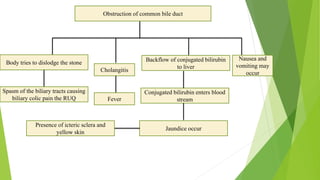
Obstruction of common bile duct
Body tries to dislodge the stone
Spasm of the biliary tracts causing
biliary colic pain the RUQ
Nausea and
vomiting may
occur
Conjugated bilirubin enters blood
stream
Cholangitis
Fever
Backflow of conjugated bilirubin
to liver
Jaundice occur
Presence of icteric sclera and
yellow skin
Clinical manifestation
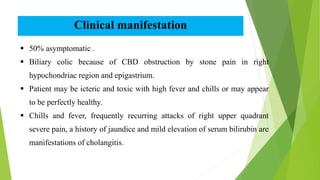
 50% asymptomatic .
 Biliary colic because of CBD obstruction by stone pain in right
hypochondriac region and epigastrium.
 Patient may be icteric and toxic with high fever and chills or may appear
to be perfectly healthy.
 Chills and fever, frequently recurring attacks of right upper quadrant
severe pain, a history of jaundice and mild elevation of serum bilirubin are
manifestations of cholangitis.
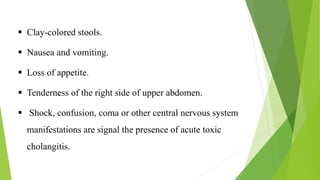
 Clay-colored stools.
 Nausea and vomiting.
 Loss of appetite.
 Tenderness of the right side of upper abdomen.
 Shock, confusion, coma or other central nervous system
manifestations are signal the presence of acute toxic
cholangitis.
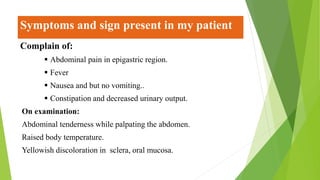
Symptoms and sign present in my patient
Complain of:
 Abdominal pain in epigastric region.
 Fever
 Nausea and but no vomiting..
 Constipation and decreased urinary output.
On examination:
Abdominal tenderness while palpating the abdomen.
Raised body temperature.
Yellowish discoloration in sclera, oral mucosa.
Diagnosis according to book
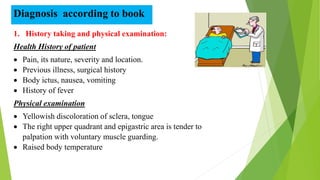
1. History taking and physical examination:
Health History of patient
 Pain, its nature, severity and location.
 Previous illness, surgical history
 Body ictus, nausea, vomiting
 History of fever
Physical examination
 Yellowish discoloration of sclera, tongue
 The right upper quadrant and epigastric area is tender to
palpation with voluntary muscle guarding.
 Raised body temperature
 Complete blood count with
differential count
 Liver function test.
 Blood cultures.
 Pancreatic enzyme test .
 prothrombin time. etc.
Laboratory investigation:
 Ultrasonography
 CT scan
 Endoscopic retrograde cholangiography (ERCP) is indicated by
persistent jaundice) or bile duct dilation on ultrasonography-
diagnostic and therapeutic procedure ; allows visualization and
endoscopic sphincterotomy when indicated.
Imaging test
Diagnostic test in done in my patient
1. Health history and physical examination
 Pain- pain in right quadrant region since 12 days with
increased in severity.
 Fever for 2 days.
 No history of vomiting.
 Constipation on/off
 Open cholecystectomy 26 years back.
 Diabetes Mellitus under medication.
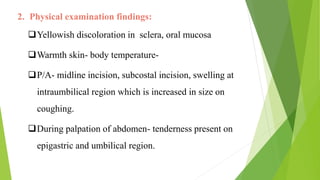
2. Physical examination findings:
Yellowish discoloration in sclera, oral mucosa
Warmth skin- body temperature-
P/A- midline incision, subcostal incision, swelling at
intraumbilical region which is increased in size on
coughing.
During palpation of abdomen- tenderness present on
epigastric and umbilical region.
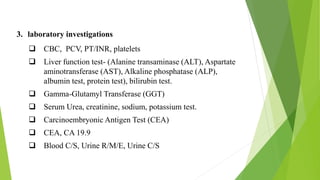
3. laboratory investigations
 CBC, PCV, PT/INR, platelets
 Liver function test- (Alanine transaminase (ALT), Aspartate
aminotransferase (AST), Alkaline phosphatase (ALP),
albumin test, protein test), bilirubin test.
 Gamma-Glutamyl Transferase (GGT)
 Serum Urea, creatinine, sodium, potassium test.
 Carcinoembryonic Antigen Test (CEA)
 CEA, CA 19.9
 Blood C/S, Urine R/M/E, Urine C/S
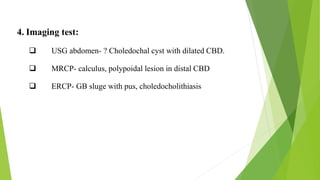
4. Imaging test:
 USG abdomen- ? Choledochal cyst with dilated CBD.
 MRCP- calculus, polypoidal lesion in distal CBD
 ERCP- GB sluge with pus, choledocholithiasis
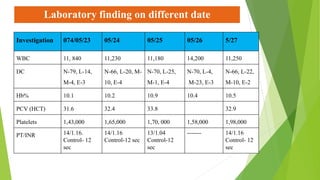
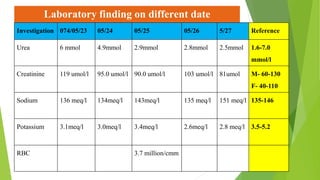
Laboratory finding on different date
Investigation 074/05/23 05/24 05/25 05/26 5/27
WBC 11, 840 11,230 11,180 14,200 11,250
DC N-79, L-14,
M-4, E-3
N-66, L-20, M-
10, E-4
N-70, L-25,
M-1, E-4
N-70, L-4,
M-23, E-3
N-66, L-22,
M-10, E-2
Hb% 10.1 10.2 10.9 10.4 10.5
PCV (HCT) 31.6 32.4 33.8 32.9
Platelets 1,43,000 1,65,000 1,70, 000 1,58,000 1,98,000
PT/INR 14/1.16.
Control- 12
sec
14/1.16
Control-12 sec
13/1.04
Control-12
sec
------- 14/1.16
Control- 12
sec
Laboratory finding on different date
Investigation 074/05/23 05/24 05/25 05/26 5/27 Reference
Urea 6 mmol 4.9mmol 2.9mmol 2.8mmol 2.5mmol 1.6-7.0
mmol/l
Creatinine 119 umol/l 95.0 umol/l 90.0 umol/l 103 umol/l 81umol M- 60-130
F- 40-110
Sodium 136 meq/l 134meq/l 143meq/l 135 meq/l 151 meq/l 135-146
Potassium 3.1meq/l 3.0meq/l 3.4meq/l 2.6meq/l 2.8 meq/l 3.5-5.2
RBC 3.7 million/cmm
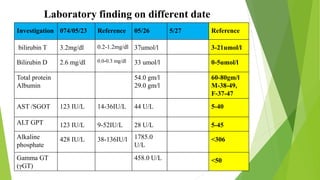
Laboratory finding on different date
Investigation 074/05/23 Reference 05/26 5/27 Reference
bilirubin T 3.2mg/dl 0.2-1.2mg/dl 37umol/l 3-21umol/l
Bilirubin D 2.6 mg/dl 0.0-0.3 mg/dl 33 umol/l 0-5umol/l
Total protein
Albumin
54.0 gm/l
29.0 gm/l
60-80gm/l
M-38-49,
F-37-47
AST /SGOT 123 IU/L 14-36IU/L 44 U/L 5-40
ALT GPT 123 IU/L 9-52IU/L 28 U/L 5-45
Alkaline
phosphate
428 IU/L 38-136IU/l 1785.0
U/L
<306
Gamma GT
(γGT)
458.0 U/L <50
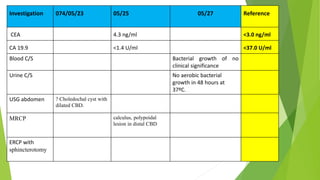
Investigation 074/05/23 05/25 05/27 Reference
CEA 4.3 ng/ml <3.0 ng/ml
CA 19.9 <1.4 U/ml <37.0 U/ml
Blood C/S Bacterial growth of no
clinical significance
Urine C/S No aerobic bacterial
growth in 48 hours at
37ºC.
USG abdomen ? Choledochal cyst with
dilated CBD.
MRCP calculus, polypoidal
lesion in distal CBD
ERCP with
sphincterotomy
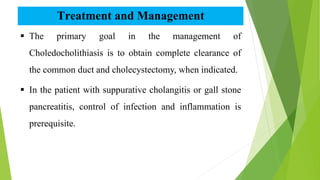
Treatment and Management
 The primary goal in the management of
Choledocholithiasis is to obtain complete clearance of
the common duct and cholecystectomy, when indicated.
 In the patient with suppurative cholangitis or gall stone
pancreatitis, control of infection and inflammation is
prerequisite.
Medical management
 Pain management- intramuscular or intravenous analgesics may be
administered on schedule.
 Antacid are given to neutralize gastric hyperacidity and to reduce
associated pain.
 Antiemetic are given to minimizes nausea and vomiting.
 Antibiotics are administered to reduce the likelihood of infection.
(cholangitis)- antimicrobial agent eg mezlocillin IV along with either
metronidazole or Gentamycin IV should given.
 Nitroglycerine may reduce biliary colic as well.
 Monitor fluid and electrolyte balance:
 During an acute attack of biliary colic, the patient
remain on NPO status, with IV fluids administered to
maintain hydration.
 Diet progresses according to the client’s tolerance.
 The client is advice to avoid foods that precipitate
biliary colic. Instruction may include avoiding a fatty
meal or a large meal after fasting.
 Surgical management
 Indication for surgical management of common duct
calculi may include emergency intervention, which is
rare unless severe ascending cholangitis is present.
 Surgical management in some form is necessary for
symptomatic Choledocholithiasis.
 The removal of stones may be accomplished surgically in clients with an
intact gall bladder by cholecystectomy and choledochotomy.
 Common duct stones in a client with previously had a cholecystectomy
are best treated by endoscopic papillotomy with extraction is preferable to
trans-abdominal surgery.
 Choledochostomy consists of opening the common duct surgically,
removing of stones and inserting T tube for drainage. Choledochostomy
may be performed in conjunction with cholecystectomy. Otherwise,
cholecystectomy may be necessary at a later date.
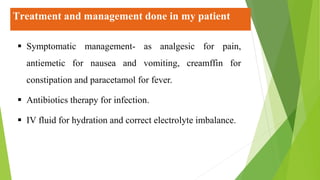
Treatment and management done in my patient
 Symptomatic management- as analgesic for pain,
antiemetic for nausea and vomiting, creamffin for
constipation and paracetamol for fever.
 Antibiotics therapy for infection.
 IV fluid for hydration and correct electrolyte imbalance.
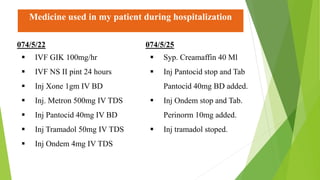
Medicine used in my patient during hospitalization
074/5/22
 IVF GIK 100mg/hr
 IVF NS II pint 24 hours
 Inj Xone 1gm IV BD
 Inj. Metron 500mg IV TDS
 Inj Pantocid 40mg IV BD
 Inj Tramadol 50mg IV TDS
 Inj Ondem 4mg IV TDS
074/5/25
 Syp. Creamaffin 40 Ml
 Inj Pantocid stop and Tab
Pantocid 40mg BD added.
 Inj Ondem stop and Tab.
Perinorm 10mg added.
 Inj tramadol stoped.
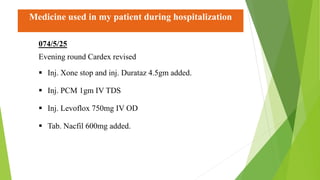
Medicine used in my patient during hospitalization
074/5/25
Evening round Cardex revised
 Inj. Xone stop and inj. Durataz 4.5gm added.
 Inj. PCM 1gm IV TDS
 Inj. Levoflox 750mg IV OD
 Tab. Nacfil 600mg added.
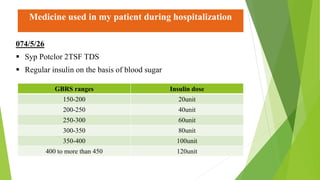
Medicine used in my patient during hospitalization
074/5/26
 Syp Potclor 2TSF TDS
 Regular insulin on the basis of blood sugar
GBRS ranges Insulin dose
150-200 20unit
200-250 40unit
250-300 60unit
300-350 80unit
350-400 100unit
400 to more than 450 120unit
Medicine used in my patient during hospitalization
074/5/27
 Inj. PCM stop and Tab. PCM 1gm PO TDS added.
 Inj. Levoflox stop and Tab. Levoflox 750mg PO OD
added.
Surgical management done in my patient:
ERCP and Sphincterotomy
Nursing management according to book
Assessment
 Should focused on subjective and objective data.
 Noting the client’s response to medication.
 Assess the client’s manifesting carefully to help determine the
diagnosis
 Check vital signs at regular intervals to document inflammation
associated with stones.
 Assess the client’s knowledge of the diagnostic process.
 Closely monitor the client for manifestation of obstruction of
biliary tract
Diagnosis, outcomes, intervention
 Explain about the un going procedures as well as the disease
condition including preoperative and postoperative care
 Promote comfort by providing analgesics, oral hygiene and
positioning.
 Maintaining hydration
 Preventing injury : if the jaundice is present than the prothrombin
level is low so the patient should be prescribed with vit K (prior
surgery), until the prothrombin returns to normal and the nurse
must observe for the bleeding
 Post operatively care
 vitals monitoring, positioning, IV fluid intake, I/O maintain, deep
breathing and coughing exercise, teaching about nutrition,
monitoring bleeding and abdominal distension.
Nursing management
based on Nursing
theory in patient
Nursing management based on nursing theory
 Mrs. Dambar Kumari Shrestha was admitted for the
second time with same problem before 26 years.
 She was anxious about the out come of disease as well
as adjusting to new environment.
 So I applied Peplau’s Theory: Interpersonal relationship
with the mutual understanding of patient and family
members while caring her.
 According to Peplau, Nursing is therapeutic in that is a healing art,
assisting in individual who is sick or in need of health care.
 Nursing can be viewed as an interpersonal process because it involves
interaction between two or more individuals with a common goal.
 In nursing, this common goal provides the incentive for the therapeutic
process in which the nurse and patient respect each other as individuals,
both of them learning and growing as a result of the interaction.
Peplau identifies four sequential phase in
interpersonal relationship:
 Orientation phase.
 Identification phase
 Exploitation phase
 Resolution phase
 Orientation phase- nurse and patient come together as strangers;
meeting initiated by patient who express felt need work together to
recognize, clarify and define facts related to need. It is also called
problem defining phase.
 Identification phase- interdependent goal setting, patient has feeling
of belonging and selectively responds to those who can meet needs.
Each patient responds differently in his phase. Selection of
appropriate professional assistance.
Exploitation phase:
 Patient actively seeking and drawing on knowledge and expertise
of those who can help, use of professional assistance for problem
soling alternatives.
Resolution phase
 occurs after other phases are successfully completed and have
been met, leads to termination.
Assessment (orientation phase)
 General condition of the patient is not fair, as she complain of
abdominal pain, nausea and she in NPO.
 History of smoking and alcohol consume but discontinue 2 years back.
 Assess respiratory status- increased respiration rate, deep shallow
respiration with decreased oxygen saturation level, no wheezing sound
on auscultation.
 Nutritional status- patient in in NPO, complaint of nausea ,
 Pain assessment- complain of sever pain.
Nursing diagnosis
 Acute pain, and discomfort related to biliary obstruction and
inflammation of biliary tract as evidence by verbal complain.
 Alteration in body temperature related to inflammation of
biliary tract and pain.
 impaired gas exchange related to pain, anxiety, high abdominal
surgical incision as evidenced by decreased oxygen saturation
level,
 Ineffective coping related to nausea
 Impaired skin integrity related to pruritus secondary to biliary
obstruction.
 Deficient knowledge related to disease condition.
 Risk for nutritional status less than body requirement related to
nothing per oral, nausea as well as inadequate bile secretion
and obstruction of biliary tract.
 Risk for fluid volume deficient
 Risk for injury related to medication during the procedure and
possible introduction of bacteria into the common bile duct.
Planning and goal/ identification phase
The goals for the patient include:
 Relief of pain and discomfort.
 Alleviate the body temperature.
 The client will experience adequate respiratory function as
evidenced by normal rate and depth of respiration, oxymetery
result with in normal range.
 Patient identifies personal strengths and accepts support through
the nursing relationship.
 The client will maintain skin integrity as evidence by absence of
redness and irritation and no skin break down.
 patient will explain disease state, recognizes need for
medications, understands treatment.
 The client will not experience fluid volume deficit as evidence
by normal skin turgor, moist mucus membrane, and Blood
pressure and pulse with in normal range for client.
 The client will maintain an adequate nutritional status as
evidenced by weight within normal range for client, and no
further decline in strength and activity tolerance.
 The client will remain free from injury and infection
following endoscopic retrograde stone removal as
evidenced by the airway remaining patent without
aspiration and absence and manifestation of infection.
Implementation/ exploitation phase
 Administration of pain medication, antipyretic medication
as ordered.
 Provide comfort measures.
 Administer oxygen as ordered.
 Provide nebulization as ordered.
 Administered IV fluids and electrolytes as ordered and
maintain intake and output chart.
 Assist patient set realistic goals and identify personal skills and
knowledge.
 Provide chances to express concerns, fears, feeling, and
expectations.
 Use empathetic communication.
 Know signs of itching and scratching.
 Assess changes in body temperature, specifically increased in
body temperature.
 Positioning change, back care
Evaluation/ resolution phase
 Verbalized the reduce pain
 Decreased body temperature .
 Demonstrate appropriate respiratory function
 Exhibit normal kin integrity.
 Absence of complication
Discharge planning and teaching
Adequate fluid intake.
Diet
Personal hygiene
Rest and sleep
Exercise
Prevention of infection
Medication
Follow up
Prognosis
 Blockage and infection caused by stones in the
biliary tract can be life threatening. However, with
prompt diagnosis and treatment, the outcome is
usually very good.
Possible complication
 Biliary cirrhosis
 Cholangitis
 Pancreatitis
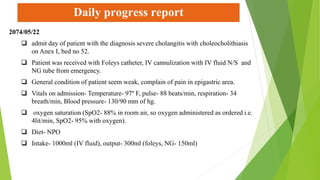
Daily progress report
2074/05/22
 admit day of patient with the diagnosis severe cholangitis with choleocholithiasis
on Anex I, bed no 52.
 Patient was received with Foleys catheter, IV cannulization with IV fluid N/S and
NG tube from emergency.
 General condition of patient seem weak, complain of pain in epigastric area.
 Vitals on admission- Temperature- 97º F, pulse- 88 beats/min, respiration- 34
breath/min, Blood pressure- 130/90 mm of hg.
 oxygen saturation (SpO2- 88% in room air, so oxygen administered as ordered i.e.
4lit/min, SpO2- 95% with oxygen).
 Diet- NPO
 Intake- 1000ml (IV fluid), output- 300ml (foleys, NG- 150ml)
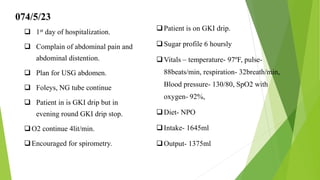
074/5/23
 1st day of hospitalization.
 Complain of abdominal pain and
abdominal distention.
 Plan for USG abdomen.
 Foleys, NG tube continue
 Patient in is GKI drip but in
evening round GKI drip stop.
O2 continue 4lit/min.
Encouraged for spirometry.
Patient is on GKI drip.
Sugar profile 6 hoursly
Vitals – temperature- 97ºF, pulse-
88beats/min, respiration- 32breath/min,
Blood pressure- 130/80, SpO2 with
oxygen- 92%,
Diet- NPO
Intake- 1645ml
Output- 1375ml
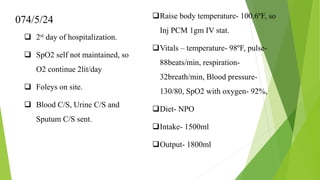
074/5/24
 2st day of hospitalization.
 SpO2 self not maintained, so
O2 continue 2lit/day
 Foleys on site.
 Blood C/S, Urine C/S and
Sputum C/S sent.
Raise body temperature- 100.6ºF, so
Inj PCM 1gm IV stat.
Vitals – temperature- 98ºF, pulse-
88beats/min, respiration-
32breath/min, Blood pressure-
130/80, SpO2 with oxygen- 92%,
Diet- NPO
Intake- 1500ml
Output- 1800ml
074/5/25
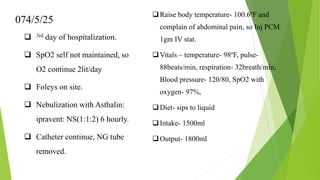
 3rd day of hospitalization.
 SpO2 self not maintained, so
O2 continue 2lit/day
 Foleys on site.
 Nebulization with Asthalin:
ipravent: NS(1:1:2) 6 hourly.
 Catheter continue, NG tube
removed.
Raise body temperature- 100.6ºF and
complain of abdominal pain, so Inj PCM
1gm IV stat.
Vitals – temperature- 98ºF, pulse-
88beats/min, respiration- 32breath/min,
Blood pressure- 120/80, SpO2 with
oxygen- 97%,
Diet- sips to liquid
Intake- 1500ml
Output- 1800ml
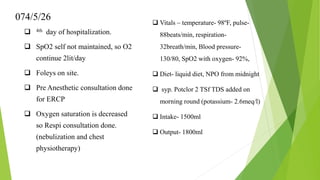
074/5/26
 4th day of hospitalization.
 SpO2 self not maintained, so O2
continue 2lit/day
 Foleys on site.
 Pre Anesthetic consultation done
for ERCP
 Oxygen saturation is decreased
so Respi consultation done.
(nebulization and chest
physiotherapy)
 Vitals – temperature- 98ºF, pulse-
88beats/min, respiration-
32breath/min, Blood pressure-
130/80, SpO2 with oxygen- 92%,
 Diet- liquid diet, NPO from midnight
 syp. Potclor 2 TSf TDS added on
morning round (potassium- 2.6meq/l)
 Intake- 1500ml
 Output- 1800ml
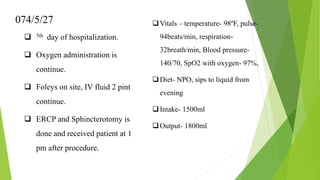
074/5/27
 5th day of hospitalization.
 Oxygen administration is
continue.
 Foleys on site, IV fluid 2 pint
continue.
 ERCP and Sphincterotomy is
done and received patient at 1
pm after procedure.
Vitals – temperature- 98ºF, pulse-
94beats/min, respiration-
32breath/min, Blood pressure-
140/70, SpO2 with oxygen- 97%,
Diet- NPO, sips to liquid from
evening
Intake- 1500ml
Output- 1800ml
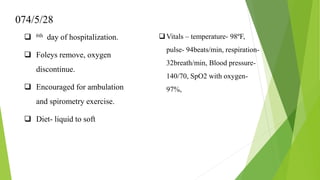
074/5/28
 6th day of hospitalization.
 Foleys remove, oxygen
discontinue.
 Encouraged for ambulation
and spirometry exercise.
 Diet- liquid to soft
Vitals – temperature- 98ºF,
pulse- 94beats/min, respiration-
32breath/min, Blood pressure-
140/70, SpO2 with oxygen-
97%,
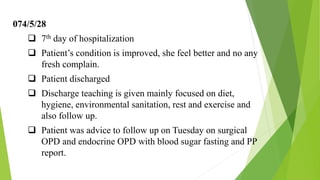
074/5/28
 7th day of hospitalization
 Patient’s condition is improved, she feel better and no any
fresh complain.
 Patient discharged
 Discharge teaching is given mainly focused on diet,
hygiene, environmental sanitation, rest and exercise and
also follow up.
 Patient was advice to follow up on Tuesday on surgical
OPD and endocrine OPD with blood sugar fasting and PP
report.
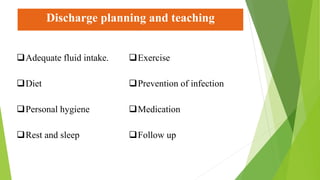
Discharge planning and teaching
Adequate fluid intake.
Diet
Personal hygiene
Rest and sleep
Exercise
Prevention of infection
Medication
Follow up
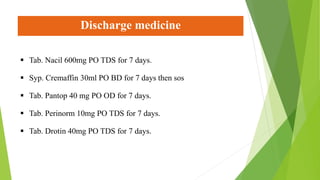
Discharge medicine
 Tab. Nacil 600mg PO TDS for 7 days.
 Syp. Cremaffin 30ml PO BD for 7 days then sos
 Tab. Pantop 40 mg PO OD for 7 days.
 Tab. Perinorm 10mg PO TDS for 7 days.
 Tab. Drotin 40mg PO TDS for 7 days.
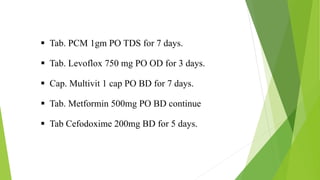
 Tab. PCM 1gm PO TDS for 7 days.
 Tab. Levoflox 750 mg PO OD for 3 days.
 Cap. Multivit 1 cap PO BD for 7 days.
 Tab. Metformin 500mg PO BD continue
 Tab Cefodoxime 200mg BD for 5 days.
Diversional therapy according to book
 Diversional therapy “is a client centered practice and recognizes
that leisure and recreational experiences are the light of all
individual.
 activities are designed to support, challenge, and enhance the
psychological, emotional and physical well being of individuals.
 These are often quite diverse and can range from games, outing,
computers gentle exercise, music, arts and craft.
Diversional therapy in my patient
 Gentle exercise
 Deep breathing and coughing exercise
 Talking with other patient
 Listening music (lok dohori, bhajan) by mobile phone.
 Gossiping with her
 Allowing her husband, son, grandson to talk with her.
Special gadget used in my patient
 Sphygmomanometer
 Stethoscope
 X-ray Machine
 Thermometer
 Pulse oxymeter
 Nebulizer
 Glucometer
 Incentive spirometer
Learned from the case study
1. I learned many things from the case study which are as following:
2. Identification the complete health need, developmental task and
compared it with normal one.
3. Provide comprehensive nursing care by suing nursing theories to the
patient
4. Assist in different type of diagnostic procedure for the patient
5. Analyze the concept and approach to nursing practice according to
trend and technology.
6. Identification the factors influencing nursing practice.
7. Identified the plan, implement and evaluate the educational
need of the patient and patient family.
8. Develop therapeutic relationship to the patient and family and
understand their religion, culture, customs and health care
belief and practices.
9. Develop competency in handing various gadgets which are
used to patient.
References
1. Adhikari, R. D. (2010). Nursing theories and Models, 2010. Kathmandu:
Makalu Publication House.
2. Black ,M, Joyce,. and Hawka H. Jane (2009),Medical Surgical Nursing;
Clinical Management for Positive Outcome, 8th ed, volume-1. Elesevier, a
division of Reed Eleviser India Private Limited.
3. Bland, K., I., & Buchlle, M. W., & Csendea, A. etal. (2009). General
Surgery: principle and Practice 2nd ed.
4. Brunner & Suddarths, (2008),Text Book of Medical Surgical Nursing, 11th
edition, volume 2.
5. BT, Basavanthappa. (2011). Essential Medical-Surgical Nursing, 1st ed. Jaypee
Brothers Medical Publishers (P) Ltd.
6. Dirksen, L. & Bucher, (2014). Medical- Surgical Nursing, 9th ed. Elsevier,
Mosby.
7. Fauci, A.S., Kaspeer, D. L. & Longo, D. L. etal (17th ed). Harrison’s Principles
of internal Medicine
8. http://img.medscape.com/pi/iphone/medscapeapp/html/A172216-business.html
9. http://www.med.upenn.edu/gastro/documents/MedClinNAcholedocholithiasis2
008.pdf
10.http://www.medicotips.com/2012/10/cholelithiasis-and-choledocholelithiasi.html
11.http://www.merckmanuals.com/professional/hepatic-and-biliary-
disorders/gallbladder-and-bile-duct-isorders/choledocholithiasis-and-cholangitis.
12.http://www.nytimes.com/health/guides/disease/choledocholithiasis/overview.html
13.https://en.wikipedia.org/wiki/Bile
14.https://www.ncbi.nlm.nih.gov/books/NBK441961/
15.Thapa, U. (2012). A text book of common Health problem of adulthood, 2nd ed.
Kathmandu: Nepal. Makalu publication house.
Cholelithiasis - Choledocholithiasis

Cholelithiasis - Choledocholithiasis

  • 2.
    General objective ofcase study  The general objective of conducting the case study is to identify the case of cholangitis with Choledocholithiasis and to explore its causes, sighs and symptoms, managements, prognosis, nursing management and to provide holistic nursing care following nursing theory.
  • 3.
    Objectives of casestudy  To collect bio-demography information and present/past history of the client.  To obtain detail knowledge about disease condition including cause, signs & symptoms, complications, medical and nursing management.  To gain knowledge upon various diagnostic procedures performed regarding the disease.  To observe patient progress and management of case.
  • 4.
     To provideholistic nursing care using appropriate nursing theory.  To identify special gadgets used in patient care  To collaborate with the patient, family and health team members in the continuing home-based care of the patient  To provide health teaching to patient and visitors regarding the disease condition, its management, including importance of fluid and diet modification, and follow-up.
  • 5.
    Rationale for theselection of case  Choledocholithiasis may not immediately obstruct major bile duct; asymptomatic stones are found in about 10% of patients at the time of surgical cholecystectomy.  Choledocholithiasis is one of the problem encountered in Nepal.  the presence of Choledocholithiasis correlates with patient age and is; 5%, 15% and 35% in patient <60, 60-79 and >80 years of age, respectively.
  • 6.
    Methodology  History takingand interviewing to the patient and her visitors.  Observation and physical examination to the patient.  Review of the patient’s record chart, lab investigation reports.  Discussion with teachers, senior staffs, doctors and friends.  Using various text books and references of the medicine and related internet search technology.
  • 7.
    Bio-Demographic Data:  Patient’sName : Dambar Kumrari Shrestha  Age/ sex :75 years/Female  Marital status : Married  Education : illiterate  Occupation : Housewife  Religion : Hindu  Address :Kanchanpur  Ward : Annex I, Female Surgical Ward  Bed No. : 51  IP No. : 561730
  • 8.
     Provisional diagnosis:cholangitis with choledocholithiasis  Date of admission : 074/5/22  Date of operation : 074/5/27  Interview Date :074/5/23  Date of Discharge :074/5/29  Final Diagnosis : cholangitis with choledocholithiasis  Operative procedure : ERCP with sphincterotomy  Attending Doctor :Dr. Yogendra Prasad Sharma  Informants obtained from : patient (self), her husband and son.
  • 9.
    2. Chief complain At present:  Fever, pain in epigastric region and difficulty in breathing.  Pain abdomen in epigastric, right hypochondriac region since 12 days.  H/o fever 4-5 days.  Decreased urination.  On/off constipation.
  • 10.
    Present illness history My patient suddenly developed epigastric pain, abdominal pain and constipation since 2 days so she was taken to Kailai Hospital Pvt. Ltd. Dhangadi on 2074/5/20. On that hospital she was diagnosed obstructed jaundice, and on USSG- ? Choledochal cyst with dilated CBD.  26 years back, open cholecystectomy was done in my patient, hence the Dr., she was consulted advised her to follow up in the higher center for better management, so she was admitted to B & B hospital on 2074/5/20 with the diagnosis of cholangitis with Choledocholithiasis. MRCP showed calculus, polypoidal lesion in distal CBD, so she was planned for ERCP.  Due to poor economic condition, she was referred to TUTH, on 074/5/22.
  • 11.
    Past health history She had taken all the immunization as per EPI schedule of Nepal.  Not known of any food, drugs allergy.  She was admitted in hospital 26 years back for open cholecystectomy. After treatment, she was discharged with proper advices from the medical personnel.  History of any chronic illness: patient was under diabetes medication.
  • 12.
     Family history:there is no any history of chronic illness in maternal and parental family but patient is under diabetic medicine.
  • 13.
    Psychological history  Patient’sreaction to illness:  She was worried about the pain, and vomiting and also worry about different diagnostic procedure carried out during hospitalization.  Patient’s coping pattern:  She coped illness by expressing her feelings to her son and asking a question about diagnostic procedure, prognosis, time of discharge to ward staff and doctor.
  • 14.
     patient’s valueof health:  Its very important to take care of own health despite of age.  Patient’s perception of the care giver:  She thinks that nurses are caring and giving health education effectively but some nurses behave rudely, and some doctors are cooperative.
  • 15.
    Sociological history Family relationship: Client's position in the family: she use to help in little bit household work, she is not head of the family.  Person living with client (support system): her husband, son and grand daughter were caring her in hospital.  Recent family crisis or change: as she has been hospitalized, and her sun and husband both are with her, her son was not able to go for his work, this might lead to further economical crisis.
  • 16.
    Menstrual history  Menarche:14 years of age.  Menopause- 49 years of age.  Obstetric history:  Antenatal check up- not done  Postnatal check up- not done  Place of delivery- home  Types of delivery- spontaneous vaginal delivery  Any complication- no
  • 17.
    Personal history  Smokingand alcohol consuming habit: she has smoking and alcohol consuming history before but she stop smoking habit since 2 years.  Dietary habits: She is a non-vegetarian and does not have much food likes or dislikes. She was having soft during my care period from the hospital. She was fond of the hospital diet.
  • 18.
     The patienthas a normal bowel habit before her illness. She passes bowel every morning and empties her bladder as per need. But due to illnss and hospitalization her elimination pattern was irregular and her chief complain is also constipation.
  • 19.
    Environmental history:  Typeof family: joint family  No of family: 7  Type of house: Pakki  No of rooms: 3  Kitchen: separate  Fuel used: LP gas  Drinking water: water supply  Toilet: water seal toilet  Drainage system: closed system
  • 20.
    67 yrs 43 yrs 40 yrs 35 yrs 38 yrs 22yrs 20 yrs 16 yrs 70yrs. Family tree Male Patient female Index Patient is taking the medicine of diabetes. No other family member has any history of chronic illness
  • 21.
    Vital signs:  Temperature:98º F  Pulse: 100b/min  Respiration: 26 breath/min  Blood pressure: 130/80 mm of hg  Height: 4 feet 11 inch  Weight: 54 kg
  • 22.
    Finding on physicalexamination  General appearance- anxious,  Yellowish discoloration on sclera, mucosa, and dorsum of tongue.  Midline incisional scar present at abdomen  Swelling around the umbilical region.  Tenderness around epigstric region.
  • 23.
    Developmental task ofold adulthood According to book In my patient • Recognizing the aging process and define instrumental limitation. • She accepts her physiological changes and limitation and accept the care given by others. • Adjusting to decreasing physical strength and health. • Adjusting to decrease health and physical strength, accepting the fact of loss of good health condition, feeling the sense of being weak socialization, income and independent living. • Adjusting to death of spouse. • My patient was not faced death of spouse
  • 24.
    According to bookIn my patient • Decide where and how to live out the remaining years; redefine physical and social life space. • As my patient is housewife and her husband is retired teacher. So they have plan to live with son and also they are planning to visit different places including temples after recovery so my patient has meet this task • Adjusting to retirement and reduce income • As she is housewife and fully depends on her son and spouse. This task is not completed in my patient. She is fully depend financially on husband and son.
  • 25.
    According to bookIn my patient • Redefining relationship with adult Children. • Redefining relationship with adult children by give permission to their children whatever they like. • Finding way to maintaining quality of life. • My patient maintained quality of life through use leisure time in social work, spiritual activities, sharing experiences with her spouse, son and daughter. • Establishing an explicit affiliation with one's age group My patient is older age and she participated in program of similar age group in her community as hymn. bhagwat so this task is meet on my patient. But at this time she is in hospital so this task is not completely achieved.
  • 26.
    According to bookIn my patient • Meeting social and civic obligation. She worked members in mother group and completed her responsibility by making awareness about health, saving behaviour of her surrounding community as well she worked for her home by being housewife and maintained balance between social family and personal life so this task is fulfilled by my patient. • Establishing satisfactory physical living arrangement. Due to ageing she is living her life through assistance of relatives and materials as she accept assistance during going to toilet, while eating, laying the bed during hospitalization. Not only in the hospital but also in home, she accept the help and support provided by her son, daughter in law and grand son and grand daughter.
  • 27.
  • 28.
    ANATOMY OF THEDUCT SYSTEM  The extra hepatic biliary system begins with the hepatic ducts and ends at the stoma of the common bile duct in the duodenum.
  • 29.
    ANATOMY OF THEDUCT SYSTEM  The right hepatic and the left hepatic ducts join to form a common hepatic duct that is 3–4 cm in length.  It is then joined at an acute angle by the cystic duct to form the common bile duct.
  • 30.
     The commonbile duct is approximately 8– 11.5 cm in length and 6–10 mm in diameter.  The lower third of the common bile duct curves more to the right behind the head of the pancreas, which it grooves, and enters the duodenum at the hepatopancreatic ampulla (of Vater), where it is frequently joined by the pancreatic duct.  The sphincter of Oddi surrounds the common bile duct at the ampulla of Vater.
  • 31.
     The commonbile duct is approximately 8– 11.5 cm in length and 6–10 mm in diameter.  The lower third of the common bile duct curves more to the right behind the head of the pancreas, which it grooves, and enters the duodenum at the hepatopancreatic ampulla (of Vater), where it is frequently joined by the pancreatic duct.
  • 32.
    Bile  Bile orgall is a dark green to yellowish brown fluid, produced by the liver that aids the digestion of lipids in the small intestine.  In humans, bile is produced continuously by the liver (liver bile), and stored and concentrated in the gallbladder (gallbladder bile).  Bile as it leaves the liver is composed of 97% water, 1-2% bile salts and 1% pigments, cholesterol and fatty acid.
  • 33.
     The rateof bile secretion is controlled by cholecystokinin (CCK) which is released from the duodenal mucosa, with feeding there is increased production of bile.  After eating, this stored bile is discharged into the duodenum.  The composition of gallbladder bile is 97% water, 0.7% bile salts, 0.2% bilirubin, 0.51% fats (cholesterol, fatty acids and lecithin), and 200 meq/l inorganic salts.
  • 34.
    Introduction to disease Choledocholithiasis is defined as stones in the common bile duct. Common bile duct arise from the gall bladder or hepatic duct.  Common duct stones can occur in the absence of gall bladder and are classified as primary. Cholangitis is inflammation of the bile duct.  Choledocholithiasis may be identified in 5-10% of patient’s undergoing elective cholecystectomy.
  • 35.
     Common ductstones can be classified into two types: primary and secondary.  Primary stones form de novo in the common duct as a result of biliary infection or stasis.  Secondary stones are identical in composition to gallbladder stones and presumably migrate from the gallbladder. Some of the stones exit the gallbladder and gets trapped in the CBD to cause Choledocholithiasis (secondary stones).  Up to 15% of individuals with gallstones (cholelithiasis) have associated Choledocholithiasis. Uncommonly, stones may be formed within the common bile duct itself (primary stones)
  • 36.
     primary bileduct stones are formed in the intrahepatic or extra hepatic bile ducts. they are more prevalent in Asian populations. these stones usually are brown pigment stones. bacterial colonization of bile and bile stasis play important roles in the pathogenesis of these stones
  • 37.
    Incidence and prevalence In the Western world, most stones in the common bile duct arise from the passing of gallbladder stones into the common bile duct. Stones in the common duct occur in 10% to 15% of people who have gallbladder stones.  The Choledocholithiasis has an incidence of 8-20% in patients with cholelithiasis.
  • 38.
     Choledocholithiasis developsin about 10%-20% of patients with gallbladder stones and the literature suggests that at least 3%-10% of patients undergoing cholecystectomy will have common bile duct (CBD) stones.  Among the study conducted from 2010 to 2011 by Pradhan SI, Shah S, Maharjan S, Shah JN in Bir Hospital and Patan Hodpital of the 52 patient who had already open cholecystectomy, among them 1.9% have Choledocholithiasis
  • 39.
     Up to10% of patients with gallstones have common bile duct stones. Common bile duct stones have been discovered days to several years after surgery in as many as 5% of patients who have undergone cholecystectomy. (Hermann RE. The spectrum of biliary stone disease. Am J Surg. 1989, 158: 171-173.)  According to Mishra T, Lakshmi KK, Peddi KK (2016), Prevalence of Cholelithiasis and Choledocholithiasis was 21.76 and 9.63 %.  Among the 757 patient in Annex I TUTH, 17 patient were admitted with the diagnosis of cholangitis with Choledocholithiasis. (2073 Baishakh to Chaitra)
  • 40.
     Among the2074 patient in surgical ward of Western Regional Hospital, Pokhara, 274 patient were admitted with the diagnosis of Cholelithiasis. Among them, 6 patient were diagnosed Choledocholithiasis during intra-operative period.
  • 41.
    Predisposing and riskfactors  Individuals who have had cholecystectomy are at risk to develop Choledocholithiasis.  Any individual with a history of Cholelithiasis is also at risk to develop Choledocholithiasis.
  • 42.
     Any individualwho has gallstone disease (cholelithiasis) is at risk for Choledocholithiasis (or Gallstone in the Bile Duct). It is more common in the elderly adults, than in children or younger adults. the presence of Choledocholithiasis correlates with patient age and is; 5%, 15% and 35% in patient <60, 60-79 and >80 years of age, respectively
  • 43.
    Causes Choledocholithiasis occurs dueto one of the two mechanisms:  Stones that get formed within the common bile duct itself, which is seen in individuals without a gallbladder (which was surgically removed through a procedure termed cholecystectomy) and in individuals with bile duct infection.  Gallstones formed in the gallbladder move out and get trapped in the common bile duct (CBD).
  • 44.
    Modifiable factors Non-modifiable factors Supersaturation of bile with cholesterol and calcium Precipitation solute from solution and become crystals Crystals comes together and fuse to become calculi Gall stone Pass through the bile duct causing obstruction Choledocholithiasis Obstructive jaundiceYellowish discoloration of eye and skin Pathophysiology of Choledocholithiasis Biliary stasis Bacterial infection Gram negative organism- E. coli klebisella Produce β- gucronidase enzyme Deposition of calcium bilirubin ate and calcium palmitate Catalyze the conjugation of bilirubin & lysis of phospholipids
  • 45.
    Obstruction of commonbile duct Body tries to dislodge the stone Spasm of the biliary tracts causing biliary colic pain the RUQ Nausea and vomiting may occur Conjugated bilirubin enters blood stream Cholangitis Fever Backflow of conjugated bilirubin to liver Jaundice occur Presence of icteric sclera and yellow skin
  • 46.
    Clinical manifestation  50%asymptomatic .  Biliary colic because of CBD obstruction by stone pain in right hypochondriac region and epigastrium.  Patient may be icteric and toxic with high fever and chills or may appear to be perfectly healthy.  Chills and fever, frequently recurring attacks of right upper quadrant severe pain, a history of jaundice and mild elevation of serum bilirubin are manifestations of cholangitis.
  • 47.
     Clay-colored stools. Nausea and vomiting.  Loss of appetite.  Tenderness of the right side of upper abdomen.  Shock, confusion, coma or other central nervous system manifestations are signal the presence of acute toxic cholangitis.
  • 48.
    Symptoms and signpresent in my patient Complain of:  Abdominal pain in epigastric region.  Fever  Nausea and but no vomiting..  Constipation and decreased urinary output. On examination: Abdominal tenderness while palpating the abdomen. Raised body temperature. Yellowish discoloration in sclera, oral mucosa.
  • 49.
    Diagnosis according tobook 1. History taking and physical examination: Health History of patient  Pain, its nature, severity and location.  Previous illness, surgical history  Body ictus, nausea, vomiting  History of fever Physical examination  Yellowish discoloration of sclera, tongue  The right upper quadrant and epigastric area is tender to palpation with voluntary muscle guarding.  Raised body temperature
  • 50.
     Complete bloodcount with differential count  Liver function test.  Blood cultures.  Pancreatic enzyme test .  prothrombin time. etc. Laboratory investigation:
  • 51.
     Ultrasonography  CTscan  Endoscopic retrograde cholangiography (ERCP) is indicated by persistent jaundice) or bile duct dilation on ultrasonography- diagnostic and therapeutic procedure ; allows visualization and endoscopic sphincterotomy when indicated. Imaging test
  • 52.
    Diagnostic test indone in my patient 1. Health history and physical examination  Pain- pain in right quadrant region since 12 days with increased in severity.  Fever for 2 days.  No history of vomiting.  Constipation on/off  Open cholecystectomy 26 years back.  Diabetes Mellitus under medication.
  • 53.
    2. Physical examinationfindings: Yellowish discoloration in sclera, oral mucosa Warmth skin- body temperature- P/A- midline incision, subcostal incision, swelling at intraumbilical region which is increased in size on coughing. During palpation of abdomen- tenderness present on epigastric and umbilical region.
  • 54.
    3. laboratory investigations CBC, PCV, PT/INR, platelets  Liver function test- (Alanine transaminase (ALT), Aspartate aminotransferase (AST), Alkaline phosphatase (ALP), albumin test, protein test), bilirubin test.  Gamma-Glutamyl Transferase (GGT)  Serum Urea, creatinine, sodium, potassium test.  Carcinoembryonic Antigen Test (CEA)  CEA, CA 19.9  Blood C/S, Urine R/M/E, Urine C/S
  • 55.
    4. Imaging test: USG abdomen- ? Choledochal cyst with dilated CBD.  MRCP- calculus, polypoidal lesion in distal CBD  ERCP- GB sluge with pus, choledocholithiasis
  • 56.
    Laboratory finding ondifferent date Investigation 074/05/23 05/24 05/25 05/26 5/27 WBC 11, 840 11,230 11,180 14,200 11,250 DC N-79, L-14, M-4, E-3 N-66, L-20, M- 10, E-4 N-70, L-25, M-1, E-4 N-70, L-4, M-23, E-3 N-66, L-22, M-10, E-2 Hb% 10.1 10.2 10.9 10.4 10.5 PCV (HCT) 31.6 32.4 33.8 32.9 Platelets 1,43,000 1,65,000 1,70, 000 1,58,000 1,98,000 PT/INR 14/1.16. Control- 12 sec 14/1.16 Control-12 sec 13/1.04 Control-12 sec ------- 14/1.16 Control- 12 sec
  • 57.
    Laboratory finding ondifferent date Investigation 074/05/23 05/24 05/25 05/26 5/27 Reference Urea 6 mmol 4.9mmol 2.9mmol 2.8mmol 2.5mmol 1.6-7.0 mmol/l Creatinine 119 umol/l 95.0 umol/l 90.0 umol/l 103 umol/l 81umol M- 60-130 F- 40-110 Sodium 136 meq/l 134meq/l 143meq/l 135 meq/l 151 meq/l 135-146 Potassium 3.1meq/l 3.0meq/l 3.4meq/l 2.6meq/l 2.8 meq/l 3.5-5.2 RBC 3.7 million/cmm
  • 58.
    Laboratory finding ondifferent date Investigation 074/05/23 Reference 05/26 5/27 Reference bilirubin T 3.2mg/dl 0.2-1.2mg/dl 37umol/l 3-21umol/l Bilirubin D 2.6 mg/dl 0.0-0.3 mg/dl 33 umol/l 0-5umol/l Total protein Albumin 54.0 gm/l 29.0 gm/l 60-80gm/l M-38-49, F-37-47 AST /SGOT 123 IU/L 14-36IU/L 44 U/L 5-40 ALT GPT 123 IU/L 9-52IU/L 28 U/L 5-45 Alkaline phosphate 428 IU/L 38-136IU/l 1785.0 U/L <306 Gamma GT (γGT) 458.0 U/L <50
  • 59.
    Investigation 074/05/23 05/2505/27 Reference CEA 4.3 ng/ml <3.0 ng/ml CA 19.9 <1.4 U/ml <37.0 U/ml Blood C/S Bacterial growth of no clinical significance Urine C/S No aerobic bacterial growth in 48 hours at 37ºC. USG abdomen ? Choledochal cyst with dilated CBD. MRCP calculus, polypoidal lesion in distal CBD ERCP with sphincterotomy
  • 60.
    Treatment and Management The primary goal in the management of Choledocholithiasis is to obtain complete clearance of the common duct and cholecystectomy, when indicated.  In the patient with suppurative cholangitis or gall stone pancreatitis, control of infection and inflammation is prerequisite.
  • 61.
    Medical management  Painmanagement- intramuscular or intravenous analgesics may be administered on schedule.  Antacid are given to neutralize gastric hyperacidity and to reduce associated pain.  Antiemetic are given to minimizes nausea and vomiting.  Antibiotics are administered to reduce the likelihood of infection. (cholangitis)- antimicrobial agent eg mezlocillin IV along with either metronidazole or Gentamycin IV should given.  Nitroglycerine may reduce biliary colic as well.
  • 62.
     Monitor fluidand electrolyte balance:  During an acute attack of biliary colic, the patient remain on NPO status, with IV fluids administered to maintain hydration.  Diet progresses according to the client’s tolerance.  The client is advice to avoid foods that precipitate biliary colic. Instruction may include avoiding a fatty meal or a large meal after fasting.
  • 63.
     Surgical management Indication for surgical management of common duct calculi may include emergency intervention, which is rare unless severe ascending cholangitis is present.  Surgical management in some form is necessary for symptomatic Choledocholithiasis.
  • 64.
     The removalof stones may be accomplished surgically in clients with an intact gall bladder by cholecystectomy and choledochotomy.  Common duct stones in a client with previously had a cholecystectomy are best treated by endoscopic papillotomy with extraction is preferable to trans-abdominal surgery.  Choledochostomy consists of opening the common duct surgically, removing of stones and inserting T tube for drainage. Choledochostomy may be performed in conjunction with cholecystectomy. Otherwise, cholecystectomy may be necessary at a later date.
  • 65.
    Treatment and managementdone in my patient  Symptomatic management- as analgesic for pain, antiemetic for nausea and vomiting, creamffin for constipation and paracetamol for fever.  Antibiotics therapy for infection.  IV fluid for hydration and correct electrolyte imbalance.
  • 66.
    Medicine used inmy patient during hospitalization 074/5/22  IVF GIK 100mg/hr  IVF NS II pint 24 hours  Inj Xone 1gm IV BD  Inj. Metron 500mg IV TDS  Inj Pantocid 40mg IV BD  Inj Tramadol 50mg IV TDS  Inj Ondem 4mg IV TDS 074/5/25  Syp. Creamaffin 40 Ml  Inj Pantocid stop and Tab Pantocid 40mg BD added.  Inj Ondem stop and Tab. Perinorm 10mg added.  Inj tramadol stoped.
  • 67.
    Medicine used inmy patient during hospitalization 074/5/25 Evening round Cardex revised  Inj. Xone stop and inj. Durataz 4.5gm added.  Inj. PCM 1gm IV TDS  Inj. Levoflox 750mg IV OD  Tab. Nacfil 600mg added.
  • 68.
    Medicine used inmy patient during hospitalization 074/5/26  Syp Potclor 2TSF TDS  Regular insulin on the basis of blood sugar GBRS ranges Insulin dose 150-200 20unit 200-250 40unit 250-300 60unit 300-350 80unit 350-400 100unit 400 to more than 450 120unit
  • 69.
    Medicine used inmy patient during hospitalization 074/5/27  Inj. PCM stop and Tab. PCM 1gm PO TDS added.  Inj. Levoflox stop and Tab. Levoflox 750mg PO OD added.
  • 70.
    Surgical management donein my patient: ERCP and Sphincterotomy
  • 71.
    Nursing management accordingto book Assessment  Should focused on subjective and objective data.  Noting the client’s response to medication.  Assess the client’s manifesting carefully to help determine the diagnosis  Check vital signs at regular intervals to document inflammation associated with stones.  Assess the client’s knowledge of the diagnostic process.  Closely monitor the client for manifestation of obstruction of biliary tract
  • 72.
    Diagnosis, outcomes, intervention Explain about the un going procedures as well as the disease condition including preoperative and postoperative care  Promote comfort by providing analgesics, oral hygiene and positioning.  Maintaining hydration  Preventing injury : if the jaundice is present than the prothrombin level is low so the patient should be prescribed with vit K (prior surgery), until the prothrombin returns to normal and the nurse must observe for the bleeding  Post operatively care  vitals monitoring, positioning, IV fluid intake, I/O maintain, deep breathing and coughing exercise, teaching about nutrition, monitoring bleeding and abdominal distension.
  • 73.
    Nursing management based onNursing theory in patient
  • 74.
    Nursing management basedon nursing theory  Mrs. Dambar Kumari Shrestha was admitted for the second time with same problem before 26 years.  She was anxious about the out come of disease as well as adjusting to new environment.  So I applied Peplau’s Theory: Interpersonal relationship with the mutual understanding of patient and family members while caring her.
  • 75.
     According toPeplau, Nursing is therapeutic in that is a healing art, assisting in individual who is sick or in need of health care.  Nursing can be viewed as an interpersonal process because it involves interaction between two or more individuals with a common goal.  In nursing, this common goal provides the incentive for the therapeutic process in which the nurse and patient respect each other as individuals, both of them learning and growing as a result of the interaction.
  • 76.
    Peplau identifies foursequential phase in interpersonal relationship:  Orientation phase.  Identification phase  Exploitation phase  Resolution phase
  • 77.
     Orientation phase-nurse and patient come together as strangers; meeting initiated by patient who express felt need work together to recognize, clarify and define facts related to need. It is also called problem defining phase.  Identification phase- interdependent goal setting, patient has feeling of belonging and selectively responds to those who can meet needs. Each patient responds differently in his phase. Selection of appropriate professional assistance.
  • 78.
    Exploitation phase:  Patientactively seeking and drawing on knowledge and expertise of those who can help, use of professional assistance for problem soling alternatives. Resolution phase  occurs after other phases are successfully completed and have been met, leads to termination.
  • 79.
    Assessment (orientation phase) General condition of the patient is not fair, as she complain of abdominal pain, nausea and she in NPO.  History of smoking and alcohol consume but discontinue 2 years back.  Assess respiratory status- increased respiration rate, deep shallow respiration with decreased oxygen saturation level, no wheezing sound on auscultation.  Nutritional status- patient in in NPO, complaint of nausea ,  Pain assessment- complain of sever pain.
  • 80.
    Nursing diagnosis  Acutepain, and discomfort related to biliary obstruction and inflammation of biliary tract as evidence by verbal complain.  Alteration in body temperature related to inflammation of biliary tract and pain.  impaired gas exchange related to pain, anxiety, high abdominal surgical incision as evidenced by decreased oxygen saturation level,  Ineffective coping related to nausea
  • 81.
     Impaired skinintegrity related to pruritus secondary to biliary obstruction.  Deficient knowledge related to disease condition.  Risk for nutritional status less than body requirement related to nothing per oral, nausea as well as inadequate bile secretion and obstruction of biliary tract.  Risk for fluid volume deficient  Risk for injury related to medication during the procedure and possible introduction of bacteria into the common bile duct.
  • 82.
    Planning and goal/identification phase The goals for the patient include:  Relief of pain and discomfort.  Alleviate the body temperature.  The client will experience adequate respiratory function as evidenced by normal rate and depth of respiration, oxymetery result with in normal range.  Patient identifies personal strengths and accepts support through the nursing relationship.
  • 83.
     The clientwill maintain skin integrity as evidence by absence of redness and irritation and no skin break down.  patient will explain disease state, recognizes need for medications, understands treatment.  The client will not experience fluid volume deficit as evidence by normal skin turgor, moist mucus membrane, and Blood pressure and pulse with in normal range for client.
  • 84.
     The clientwill maintain an adequate nutritional status as evidenced by weight within normal range for client, and no further decline in strength and activity tolerance.  The client will remain free from injury and infection following endoscopic retrograde stone removal as evidenced by the airway remaining patent without aspiration and absence and manifestation of infection.
  • 85.
    Implementation/ exploitation phase Administration of pain medication, antipyretic medication as ordered.  Provide comfort measures.  Administer oxygen as ordered.  Provide nebulization as ordered.  Administered IV fluids and electrolytes as ordered and maintain intake and output chart.
  • 86.
     Assist patientset realistic goals and identify personal skills and knowledge.  Provide chances to express concerns, fears, feeling, and expectations.  Use empathetic communication.  Know signs of itching and scratching.  Assess changes in body temperature, specifically increased in body temperature.  Positioning change, back care
  • 87.
    Evaluation/ resolution phase Verbalized the reduce pain  Decreased body temperature .  Demonstrate appropriate respiratory function  Exhibit normal kin integrity.  Absence of complication
  • 88.
    Discharge planning andteaching Adequate fluid intake. Diet Personal hygiene Rest and sleep Exercise Prevention of infection Medication Follow up
  • 89.
    Prognosis  Blockage andinfection caused by stones in the biliary tract can be life threatening. However, with prompt diagnosis and treatment, the outcome is usually very good.
  • 90.
    Possible complication  Biliarycirrhosis  Cholangitis  Pancreatitis
  • 91.
    Daily progress report 2074/05/22 admit day of patient with the diagnosis severe cholangitis with choleocholithiasis on Anex I, bed no 52.  Patient was received with Foleys catheter, IV cannulization with IV fluid N/S and NG tube from emergency.  General condition of patient seem weak, complain of pain in epigastric area.  Vitals on admission- Temperature- 97º F, pulse- 88 beats/min, respiration- 34 breath/min, Blood pressure- 130/90 mm of hg.  oxygen saturation (SpO2- 88% in room air, so oxygen administered as ordered i.e. 4lit/min, SpO2- 95% with oxygen).  Diet- NPO  Intake- 1000ml (IV fluid), output- 300ml (foleys, NG- 150ml)
  • 92.
    074/5/23  1st dayof hospitalization.  Complain of abdominal pain and abdominal distention.  Plan for USG abdomen.  Foleys, NG tube continue  Patient in is GKI drip but in evening round GKI drip stop. O2 continue 4lit/min. Encouraged for spirometry. Patient is on GKI drip. Sugar profile 6 hoursly Vitals – temperature- 97ºF, pulse- 88beats/min, respiration- 32breath/min, Blood pressure- 130/80, SpO2 with oxygen- 92%, Diet- NPO Intake- 1645ml Output- 1375ml
  • 93.
    074/5/24  2st dayof hospitalization.  SpO2 self not maintained, so O2 continue 2lit/day  Foleys on site.  Blood C/S, Urine C/S and Sputum C/S sent. Raise body temperature- 100.6ºF, so Inj PCM 1gm IV stat. Vitals – temperature- 98ºF, pulse- 88beats/min, respiration- 32breath/min, Blood pressure- 130/80, SpO2 with oxygen- 92%, Diet- NPO Intake- 1500ml Output- 1800ml
  • 94.
    074/5/25  3rd dayof hospitalization.  SpO2 self not maintained, so O2 continue 2lit/day  Foleys on site.  Nebulization with Asthalin: ipravent: NS(1:1:2) 6 hourly.  Catheter continue, NG tube removed. Raise body temperature- 100.6ºF and complain of abdominal pain, so Inj PCM 1gm IV stat. Vitals – temperature- 98ºF, pulse- 88beats/min, respiration- 32breath/min, Blood pressure- 120/80, SpO2 with oxygen- 97%, Diet- sips to liquid Intake- 1500ml Output- 1800ml
  • 95.
    074/5/26  4th dayof hospitalization.  SpO2 self not maintained, so O2 continue 2lit/day  Foleys on site.  Pre Anesthetic consultation done for ERCP  Oxygen saturation is decreased so Respi consultation done. (nebulization and chest physiotherapy)  Vitals – temperature- 98ºF, pulse- 88beats/min, respiration- 32breath/min, Blood pressure- 130/80, SpO2 with oxygen- 92%,  Diet- liquid diet, NPO from midnight  syp. Potclor 2 TSf TDS added on morning round (potassium- 2.6meq/l)  Intake- 1500ml  Output- 1800ml
  • 96.
    074/5/27  5th dayof hospitalization.  Oxygen administration is continue.  Foleys on site, IV fluid 2 pint continue.  ERCP and Sphincterotomy is done and received patient at 1 pm after procedure. Vitals – temperature- 98ºF, pulse- 94beats/min, respiration- 32breath/min, Blood pressure- 140/70, SpO2 with oxygen- 97%, Diet- NPO, sips to liquid from evening Intake- 1500ml Output- 1800ml
  • 97.
    074/5/28  6th dayof hospitalization.  Foleys remove, oxygen discontinue.  Encouraged for ambulation and spirometry exercise.  Diet- liquid to soft Vitals – temperature- 98ºF, pulse- 94beats/min, respiration- 32breath/min, Blood pressure- 140/70, SpO2 with oxygen- 97%,
  • 98.
    074/5/28  7th dayof hospitalization  Patient’s condition is improved, she feel better and no any fresh complain.  Patient discharged  Discharge teaching is given mainly focused on diet, hygiene, environmental sanitation, rest and exercise and also follow up.  Patient was advice to follow up on Tuesday on surgical OPD and endocrine OPD with blood sugar fasting and PP report.
  • 99.
    Discharge planning andteaching Adequate fluid intake. Diet Personal hygiene Rest and sleep Exercise Prevention of infection Medication Follow up
  • 100.
    Discharge medicine  Tab.Nacil 600mg PO TDS for 7 days.  Syp. Cremaffin 30ml PO BD for 7 days then sos  Tab. Pantop 40 mg PO OD for 7 days.  Tab. Perinorm 10mg PO TDS for 7 days.  Tab. Drotin 40mg PO TDS for 7 days.
  • 101.
     Tab. PCM1gm PO TDS for 7 days.  Tab. Levoflox 750 mg PO OD for 3 days.  Cap. Multivit 1 cap PO BD for 7 days.  Tab. Metformin 500mg PO BD continue  Tab Cefodoxime 200mg BD for 5 days.
  • 102.
    Diversional therapy accordingto book  Diversional therapy “is a client centered practice and recognizes that leisure and recreational experiences are the light of all individual.  activities are designed to support, challenge, and enhance the psychological, emotional and physical well being of individuals.  These are often quite diverse and can range from games, outing, computers gentle exercise, music, arts and craft.
  • 103.
    Diversional therapy inmy patient  Gentle exercise  Deep breathing and coughing exercise  Talking with other patient  Listening music (lok dohori, bhajan) by mobile phone.  Gossiping with her  Allowing her husband, son, grandson to talk with her.
  • 104.
    Special gadget usedin my patient  Sphygmomanometer  Stethoscope  X-ray Machine  Thermometer  Pulse oxymeter  Nebulizer  Glucometer  Incentive spirometer
  • 105.
    Learned from thecase study 1. I learned many things from the case study which are as following: 2. Identification the complete health need, developmental task and compared it with normal one. 3. Provide comprehensive nursing care by suing nursing theories to the patient 4. Assist in different type of diagnostic procedure for the patient 5. Analyze the concept and approach to nursing practice according to trend and technology.
  • 106.
    6. Identification thefactors influencing nursing practice. 7. Identified the plan, implement and evaluate the educational need of the patient and patient family. 8. Develop therapeutic relationship to the patient and family and understand their religion, culture, customs and health care belief and practices. 9. Develop competency in handing various gadgets which are used to patient.
  • 107.
    References 1. Adhikari, R.D. (2010). Nursing theories and Models, 2010. Kathmandu: Makalu Publication House. 2. Black ,M, Joyce,. and Hawka H. Jane (2009),Medical Surgical Nursing; Clinical Management for Positive Outcome, 8th ed, volume-1. Elesevier, a division of Reed Eleviser India Private Limited. 3. Bland, K., I., & Buchlle, M. W., & Csendea, A. etal. (2009). General Surgery: principle and Practice 2nd ed. 4. Brunner & Suddarths, (2008),Text Book of Medical Surgical Nursing, 11th edition, volume 2.
  • 108.
    5. BT, Basavanthappa.(2011). Essential Medical-Surgical Nursing, 1st ed. Jaypee Brothers Medical Publishers (P) Ltd. 6. Dirksen, L. & Bucher, (2014). Medical- Surgical Nursing, 9th ed. Elsevier, Mosby. 7. Fauci, A.S., Kaspeer, D. L. & Longo, D. L. etal (17th ed). Harrison’s Principles of internal Medicine 8. http://img.medscape.com/pi/iphone/medscapeapp/html/A172216-business.html 9. http://www.med.upenn.edu/gastro/documents/MedClinNAcholedocholithiasis2 008.pdf
  • 109.