T r u s t

t h e

E x p e r t s

Integration of Supply Chain Management (SCM)
and Financial Accounting at GSB (FA)

Abaan Hassan the CTO of the Gulf Sabah Bank was in a quandary. The project to integrate Supply Chain Management
(SCM), with Financial Accounting (FA) through the Oracle ERP system was not shaping up according to plan.
He had plumbed for Oracle, wishing to streamline GSB processes for a greater control
over SCM. This would result in accurate daily balance sheets as demanded by the
management. Risks had to be reduced and managed through a hierarchical approval
process, guarding against erroneous execution of contracts, leading to diligent
monitoring of costs.
He was now under pressure from his CFO to bring the project back on track and he
realized that only way forward was to look for an independent pure-play testing
service with the requisite track record
Tedious as it may prove out to be, Abaan decided to float a tender of sorts. He sent
out a Request for Proposal (RFP) to known testing vendors who operated in the
Middle East and Asia region.

The Gulf Sabah Bank
(GSB) is a commercial
bank established by the
local investment council,
responsible
to
the
government of the country.
It complies with the Islamic
Sharia
principles
and
regulations and operates
with an authorized capital
of AED 5 billion and a paid
up capital of AED 1.5 billion
System Requirements
Keeping in view the developments in the
banking technology and IT infrastructure space,
the chosen vendor had to ensure that the
Oracle ERP system was well integrated with the
bank’s core banking solution (CBS) and card
processing system.

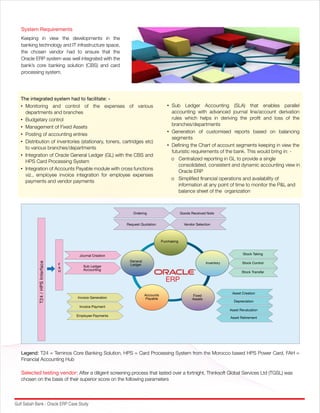
The integrated system had to facilitate: • Monitoring and control of the expenses of various
departments and branches
• Budgetary control
• Management of Fixed Assets
• Posting of accounting entries
• Distribution of inventories (stationary, toners, cartridges etc)
to various branches/departments
• Integration of Oracle General Ledger (GL) with the CBS and
HPS Card Processing System
• Integration of Accounts Payable module with cross functions
viz., employee invoice integration for employee expenses
payments and vendor payments

• Sub Ledger Accounting (SLA) that enables parallel
accounting with advanced journal line/account derivation
rules which helps in deriving the profit and loss of the
branches/departments
• Generation of customised reports based on balancing
segments
• Defining the Chart of account segments keeping in view the
futuristic requirements of the bank. This would bring in: o Centralized reporting in GL to provide a single
consolidated, consistent and dynamic accounting view in
Oracle ERP
o Simplified financial operations and availability of
information at any point of time to monitor the P&L and
balance sheet of the organization

Ordering

Goods Received Note

Request Quotation

Vendor Selection

Purchasing
Stock Taking

T24 / HPS Interface

Journal Creation
F
A
H

Sub Ledger
Accounting

General
Ledger

Inventory

Stock Control
Stock Transfer

ERP
Invoice Generation
Invoice Payment
Employee Payments

Accounts
Payable

Fixed
Assets

Asset Creation
Depreciation
Asset Revaluation
Asset Retirement

Legend: T24 = Teminos Core Banking Solution, HPS = Card Processing System from the Morocco based HPS Power Card, FAH =
Financial Accounting Hub

Selected testing vendor: After a diligent screening process that lasted over a fortnight, Thinksoft Global Services Ltd (TGSL) was
chosen on the basis of their superior score on the following parameters

Gulf Sabah Bank - Oracle ERP Case Study
• Specialized capability in financial software testing
• Expertise in testing leading core banking products B@NCS,
T24, Flexcube, Finnacle, MidasPlus etc
• Domain focused test methodologies
• Disciplined test management system
• End-to-end test planning and execution including testing of
interfaces
• Ability to conceptualize and strategize testing in sync with
the business functionalities

Early Diagnosis: From a preliminary study, it was obvious to
TGSL that the system was being fouled by the following
factors:

• Manual updating of the system by the finance control dept.
• Monitoring the financial aspects of the bank not being under
one roof resulting in administrative delays. Consequently,
when an invoice was rejected by the approver no notification
was received by the initiator regarding the rejection in his
work-list
• Delay in daily reporting of corporate balance sheet
information as it had to be extracted from the Core Banking
Solution – T24

Need for rigorous testing: Considering the variability of user
requirements that was permitted, it was soon evident that the
Oracle ERP Application would have to be rigorously tested on
the following:
• Various customizations which were being frequently
addressed in accordance with the request of the client.
• The functional statement generators being used for
generating the customized reports
• The need for control at the system level, towards
streamlining back-dated posting of journals in the books of
accounts
• The need for monitoring the concurrent programs and end of
day operations, for consolidated reporting of financial
information
• The large number of day-to-day transactions being
transferred from the Sub-Ledger accounts to Oracle General
Ledger from T24 & HPS through the Financial Accounting
Hub

The Thinksoft Methodology: TGSL approached the
assignment along the following lines:
• Carrying out a comprehensive study of existing business
processes at the Bank

• Selection of wrong GL codes by branch users during the
posting of accounting entries. Consequently, on creating
purchase requests for say ‘Project Forms’, at the final
approval level, the user receives the notification "Failed to
reserve funds for Purchase Requisition". Instead of this the
notification should be at the initiator level

• Designing a comprehensive test strategy in consultation with
concerned stakeholders; factoring in the complexity and
availability of functional modules and the project deadlines

• Non-Integration of the payments module in Oracle ERP with
the CBS -T24

• Using real time business transactions in the testing process
to ensure the software readiness

• Stocks had to be physically maintained in the absence of a
financially validated daily stock report

• Putting in place a robust defect management process

Early hurdles and insights: On proceeding further, TGSL
soon realized that they had to deal with: -

• Having the testware reviewed by subject matter experts
(SMEs)
• Executing a rigorous Risk Based Testing (RBT) process

• Orienting all stakeholders to the use of test management
tools to ensure that they were in sync with the defect
management process. This helped in the speedy
dissemination of information relating to progress in testing
and quick turnaround of clarifications and defect fixes

• Inadequate documentation of functional specifications,
especially at the Financial Accounting Hub (FAH), where the
T24-CBS and HPS Card Processing System are to be
integrated with Oracle ERP

• Ensuring timely escalations of problems, supported by
detailed and relevant metrics

• The Chart of Accounts segment values were being
added/modified periodically which resulted in revisiting the
journals according to the new segment values

• Walking the business users through the Oracle ERP and
defects encountered during test execution

• Generation of customized reports in the requisite GSB
formats
• Updating of existing Fixed Assets details

Gulf Sabah Bank - Oracle ERP Case Study

• Carrying out a functional analysis, to assess the application
readiness that helped the bank to decide on ‘go-live’

• Designing test cases and test conditions in such a way that
even the new business users could test the critical
functionalities with the objective of increasing the
effectiveness and efficiency of testing
Modules Tested
Unique

Common

• Financial Accounting Hub (FAH)
• Oracle
Learning
Management
(OLM)
Integration with Purchasing
• Payment Integration with T24
• Self Service Human Resource integration with
Accounts Payable

•
•
•
•
•
•
•

E Procurement
Procurement contract
Purchasing
Inventory management
Accounts Payable
Fixed Assets
General Ledger(Chart of Accounts)

Value Additions:
• Identifying critical gaps in various areas, such as functional
requirements and business workflow, leveraging TGSL’s eye
for detail and knowledge of business practices
• Accommodating the frequent changes made in the Project
execution approach
• Owing to the flexibility in process and approach, by Reduced
cost of rework, owing to early detection of defects enabled
through Thinksoft test management process
• Improved product capabilities through suggested process
changes and new features
• Highlighted the organization in- built mechanism to handle
the resource movements and resource expenses by
identifying the workflow notification errors

T r u s t

t h e

Execution statistics: TGSL deployed a team of 11 from the
beginning to complete the assignment in 3 months. Abaan and
his CFO were then more than pleased to also award the UAT
contract also to TGSL

E x p e r t s

For more details, visit www. thinksoftglobal.com
Disclaimer: All the documentation and other material contained herein is the property of Thinksoft Global Services and all intellectual property rights in and to the same are owned by Thinksoft Global Services.
You shall not, unless previously authorized by Thinksoft Global Services in writing, copy, reproduce, market, license, lease or in any other way, dispose of, or utilize for profit, or exercise any ownership rights
over the same. In no event, unless required by applicable law or agreed to in writing, shall Thinksoft Global Services, or any person be liable for any loss, expense or damage, of any type or nature arising out
of the use of, or inability to use any material contained herein. Any such material is provided “as is”, without warranty of any type or nature, either express or implied. All names, logos are used for identification
purposes only and are trademarks or registered trademarks of their respective companies

Gulf Sabah Bank - Oracle ERP Case Study

Integration of supply chain management_Gulf Sabah Bank

  • 1.
    T r us t t h e E x p e r t s Integration of Supply Chain Management (SCM) and Financial Accounting at GSB (FA) Abaan Hassan the CTO of the Gulf Sabah Bank was in a quandary. The project to integrate Supply Chain Management (SCM), with Financial Accounting (FA) through the Oracle ERP system was not shaping up according to plan. He had plumbed for Oracle, wishing to streamline GSB processes for a greater control over SCM. This would result in accurate daily balance sheets as demanded by the management. Risks had to be reduced and managed through a hierarchical approval process, guarding against erroneous execution of contracts, leading to diligent monitoring of costs. He was now under pressure from his CFO to bring the project back on track and he realized that only way forward was to look for an independent pure-play testing service with the requisite track record Tedious as it may prove out to be, Abaan decided to float a tender of sorts. He sent out a Request for Proposal (RFP) to known testing vendors who operated in the Middle East and Asia region. The Gulf Sabah Bank (GSB) is a commercial bank established by the local investment council, responsible to the government of the country. It complies with the Islamic Sharia principles and regulations and operates with an authorized capital of AED 5 billion and a paid up capital of AED 1.5 billion
  • 2.
    System Requirements Keeping inview the developments in the banking technology and IT infrastructure space, the chosen vendor had to ensure that the Oracle ERP system was well integrated with the bank’s core banking solution (CBS) and card processing system. The integrated system had to facilitate: • Monitoring and control of the expenses of various departments and branches • Budgetary control • Management of Fixed Assets • Posting of accounting entries • Distribution of inventories (stationary, toners, cartridges etc) to various branches/departments • Integration of Oracle General Ledger (GL) with the CBS and HPS Card Processing System • Integration of Accounts Payable module with cross functions viz., employee invoice integration for employee expenses payments and vendor payments • Sub Ledger Accounting (SLA) that enables parallel accounting with advanced journal line/account derivation rules which helps in deriving the profit and loss of the branches/departments • Generation of customised reports based on balancing segments • Defining the Chart of account segments keeping in view the futuristic requirements of the bank. This would bring in: o Centralized reporting in GL to provide a single consolidated, consistent and dynamic accounting view in Oracle ERP o Simplified financial operations and availability of information at any point of time to monitor the P&L and balance sheet of the organization Ordering Goods Received Note Request Quotation Vendor Selection Purchasing Stock Taking T24 / HPS Interface Journal Creation F A H Sub Ledger Accounting General Ledger Inventory Stock Control Stock Transfer ERP Invoice Generation Invoice Payment Employee Payments Accounts Payable Fixed Assets Asset Creation Depreciation Asset Revaluation Asset Retirement Legend: T24 = Teminos Core Banking Solution, HPS = Card Processing System from the Morocco based HPS Power Card, FAH = Financial Accounting Hub Selected testing vendor: After a diligent screening process that lasted over a fortnight, Thinksoft Global Services Ltd (TGSL) was chosen on the basis of their superior score on the following parameters Gulf Sabah Bank - Oracle ERP Case Study
  • 3.
    • Specialized capabilityin financial software testing • Expertise in testing leading core banking products B@NCS, T24, Flexcube, Finnacle, MidasPlus etc • Domain focused test methodologies • Disciplined test management system • End-to-end test planning and execution including testing of interfaces • Ability to conceptualize and strategize testing in sync with the business functionalities Early Diagnosis: From a preliminary study, it was obvious to TGSL that the system was being fouled by the following factors: • Manual updating of the system by the finance control dept. • Monitoring the financial aspects of the bank not being under one roof resulting in administrative delays. Consequently, when an invoice was rejected by the approver no notification was received by the initiator regarding the rejection in his work-list • Delay in daily reporting of corporate balance sheet information as it had to be extracted from the Core Banking Solution – T24 Need for rigorous testing: Considering the variability of user requirements that was permitted, it was soon evident that the Oracle ERP Application would have to be rigorously tested on the following: • Various customizations which were being frequently addressed in accordance with the request of the client. • The functional statement generators being used for generating the customized reports • The need for control at the system level, towards streamlining back-dated posting of journals in the books of accounts • The need for monitoring the concurrent programs and end of day operations, for consolidated reporting of financial information • The large number of day-to-day transactions being transferred from the Sub-Ledger accounts to Oracle General Ledger from T24 & HPS through the Financial Accounting Hub The Thinksoft Methodology: TGSL approached the assignment along the following lines: • Carrying out a comprehensive study of existing business processes at the Bank • Selection of wrong GL codes by branch users during the posting of accounting entries. Consequently, on creating purchase requests for say ‘Project Forms’, at the final approval level, the user receives the notification "Failed to reserve funds for Purchase Requisition". Instead of this the notification should be at the initiator level • Designing a comprehensive test strategy in consultation with concerned stakeholders; factoring in the complexity and availability of functional modules and the project deadlines • Non-Integration of the payments module in Oracle ERP with the CBS -T24 • Using real time business transactions in the testing process to ensure the software readiness • Stocks had to be physically maintained in the absence of a financially validated daily stock report • Putting in place a robust defect management process Early hurdles and insights: On proceeding further, TGSL soon realized that they had to deal with: - • Having the testware reviewed by subject matter experts (SMEs) • Executing a rigorous Risk Based Testing (RBT) process • Orienting all stakeholders to the use of test management tools to ensure that they were in sync with the defect management process. This helped in the speedy dissemination of information relating to progress in testing and quick turnaround of clarifications and defect fixes • Inadequate documentation of functional specifications, especially at the Financial Accounting Hub (FAH), where the T24-CBS and HPS Card Processing System are to be integrated with Oracle ERP • Ensuring timely escalations of problems, supported by detailed and relevant metrics • The Chart of Accounts segment values were being added/modified periodically which resulted in revisiting the journals according to the new segment values • Walking the business users through the Oracle ERP and defects encountered during test execution • Generation of customized reports in the requisite GSB formats • Updating of existing Fixed Assets details Gulf Sabah Bank - Oracle ERP Case Study • Carrying out a functional analysis, to assess the application readiness that helped the bank to decide on ‘go-live’ • Designing test cases and test conditions in such a way that even the new business users could test the critical functionalities with the objective of increasing the effectiveness and efficiency of testing
  • 4.
    Modules Tested Unique Common • FinancialAccounting Hub (FAH) • Oracle Learning Management (OLM) Integration with Purchasing • Payment Integration with T24 • Self Service Human Resource integration with Accounts Payable • • • • • • • E Procurement Procurement contract Purchasing Inventory management Accounts Payable Fixed Assets General Ledger(Chart of Accounts) Value Additions: • Identifying critical gaps in various areas, such as functional requirements and business workflow, leveraging TGSL’s eye for detail and knowledge of business practices • Accommodating the frequent changes made in the Project execution approach • Owing to the flexibility in process and approach, by Reduced cost of rework, owing to early detection of defects enabled through Thinksoft test management process • Improved product capabilities through suggested process changes and new features • Highlighted the organization in- built mechanism to handle the resource movements and resource expenses by identifying the workflow notification errors T r u s t t h e Execution statistics: TGSL deployed a team of 11 from the beginning to complete the assignment in 3 months. Abaan and his CFO were then more than pleased to also award the UAT contract also to TGSL E x p e r t s For more details, visit www. thinksoftglobal.com Disclaimer: All the documentation and other material contained herein is the property of Thinksoft Global Services and all intellectual property rights in and to the same are owned by Thinksoft Global Services. You shall not, unless previously authorized by Thinksoft Global Services in writing, copy, reproduce, market, license, lease or in any other way, dispose of, or utilize for profit, or exercise any ownership rights over the same. In no event, unless required by applicable law or agreed to in writing, shall Thinksoft Global Services, or any person be liable for any loss, expense or damage, of any type or nature arising out of the use of, or inability to use any material contained herein. Any such material is provided “as is”, without warranty of any type or nature, either express or implied. All names, logos are used for identification purposes only and are trademarks or registered trademarks of their respective companies Gulf Sabah Bank - Oracle ERP Case Study