7-Eleven in Taiwan:
Adaptation of Convenience Stores to New
Market Environments
Jinglun Yu 825-145-170
Ran Wu 825-118-003
Liudmila Shumilina 825-120-066
Xudong Hua 825-114-796
Victor Khurumov 825-869-860
Oguejiofor Luke Obi 824-380-604
Introduction
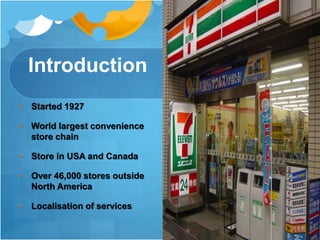
• Started 1927
• World largest convenience
store chain
• Store in USA and Canada
• Over 46,000 stores outside
North America
• Localisation of services
How the concept convenience-store
evolved in the United States
• service from 7am to 11pm 24/7
• changes in work and routines in the
United States
• more convenience
An universal concept or not ?
• Specific location
• Have a distinctive logo
• Product choice and differentiation
• Floor plan
Adjustments to the local market
• Vertical zoning
• Special products
Three major features that created standard for
7-Eleven in US:
• 1. The stores in the 7-Eleven chain were separated from one another by
long distances
• 2. Areas where people congregated, such as street corners, became the
natural sites for 7- Eleven locations, which, for similar reasons, veered
toward gas stations in the United States. Most of 7-Eleven are detached
buildings that often was constructed from a scratch according to the
standard concept.
• 3. 7-Eleven stores were largely located in U.S. rural areas, where
population density was low. As a result, customers invariably drove to a
store”
7-Eleven standards in US
• Space
• Shape
• Floor plan
• Product choice
7-Eleven in Taiwan
• Individualized in floor plans and building types
• Twice smaller than in US
• Customized product assortment
Localization
• Localization
Localization should be understood as a process
rather than a goal. One thing to adapt to their current
environment and do change, based on the actual
situation, try to find their own way.
• Localization of 7-Eleven in Taiwan strengthened the
concept of convenience stores.
Localization
• Wide coverage--- 5000 stores in Taiwan, close to
residential area, open 24 hours, 70% of customers
walk to stores within 10 minutes.
• Do good to reduce capital cost and operation stress.
• Steps to achieve localization:
a) Add local flavor food (i.e. oden)
b) 7-11 offered several handy services
(payment, delivery, APPs)
Competitive Advantages
• Factor conditions
• Uni-President Enterprises
Corporation
• The largest food
production company in
Taiwan
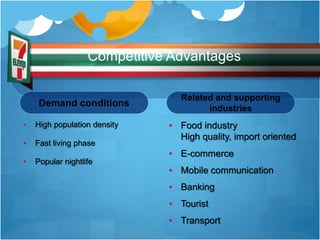
Demand conditions
• High population density
• Fast living phase
• Popular nightlife
Related and supporting
industries
• Food industry
High quality, import oriented
• E-commerce
• Mobile communication
• Banking
• Tourist
• Transport
Competitive Advantages
• Firm strategy, structure and rivalry
Vast number of
services
High density of
stores
Non-rest
business hours
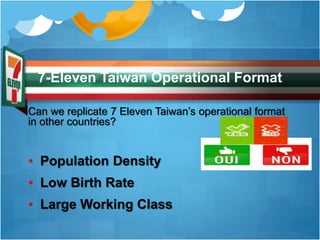
7-Eleven Taiwan Operational Format
Can we replicate 7 Eleven Taiwan’s operational format
in other countries?
• Population Density
• Low Birth Rate
• Large Working Class
Lesson Learned
• The convenience store emerged on the demand of the
customers for a rapid and easy access to the merchandises
they wanted in a hurry.
• 7-Eleven Taiwan has the same universal characteristics as it
has in the US, the convenient location, wide variety of quality
products and fast customer service. However, the real reason
that drove the success is the product localization and service
differentiation.
• Franchise is an excellent way of expending business to other
countries when the business is very cohesive to the life style of
people like convenience stores.
Lesson Learned
• The success of 7-Eleven Taiwan doesn’t mean the same
model can be copied to other countries and regions
simply. So when expending the business to another
country or region, be careful about where the host
country is, who the residents are and what does the
consumers there really need.
case study 2

case study 2

  • 1.
    7-Eleven in Taiwan: Adaptationof Convenience Stores to New Market Environments Jinglun Yu 825-145-170 Ran Wu 825-118-003 Liudmila Shumilina 825-120-066 Xudong Hua 825-114-796 Victor Khurumov 825-869-860 Oguejiofor Luke Obi 824-380-604
  • 2.
    Introduction • Started 1927 •World largest convenience store chain • Store in USA and Canada • Over 46,000 stores outside North America • Localisation of services
  • 3.
    How the conceptconvenience-store evolved in the United States • service from 7am to 11pm 24/7 • changes in work and routines in the United States • more convenience
  • 4.
    An universal conceptor not ? • Specific location • Have a distinctive logo • Product choice and differentiation • Floor plan
  • 5.
    Adjustments to thelocal market • Vertical zoning • Special products
  • 6.
    Three major featuresthat created standard for 7-Eleven in US: • 1. The stores in the 7-Eleven chain were separated from one another by long distances • 2. Areas where people congregated, such as street corners, became the natural sites for 7- Eleven locations, which, for similar reasons, veered toward gas stations in the United States. Most of 7-Eleven are detached buildings that often was constructed from a scratch according to the standard concept. • 3. 7-Eleven stores were largely located in U.S. rural areas, where population density was low. As a result, customers invariably drove to a store”
  • 7.
    7-Eleven standards inUS • Space • Shape • Floor plan • Product choice
  • 8.
    7-Eleven in Taiwan •Individualized in floor plans and building types • Twice smaller than in US • Customized product assortment
  • 9.
    Localization • Localization Localization shouldbe understood as a process rather than a goal. One thing to adapt to their current environment and do change, based on the actual situation, try to find their own way. • Localization of 7-Eleven in Taiwan strengthened the concept of convenience stores.
  • 10.
    Localization • Wide coverage---5000 stores in Taiwan, close to residential area, open 24 hours, 70% of customers walk to stores within 10 minutes. • Do good to reduce capital cost and operation stress. • Steps to achieve localization: a) Add local flavor food (i.e. oden) b) 7-11 offered several handy services (payment, delivery, APPs)
  • 11.
    Competitive Advantages • Factorconditions • Uni-President Enterprises Corporation • The largest food production company in Taiwan
  • 12.
    Demand conditions • Highpopulation density • Fast living phase • Popular nightlife Related and supporting industries • Food industry High quality, import oriented • E-commerce • Mobile communication • Banking • Tourist • Transport Competitive Advantages
  • 13.
    Competitive Advantages • Firmstrategy, structure and rivalry Vast number of services High density of stores Non-rest business hours
  • 14.
    7-Eleven Taiwan OperationalFormat Can we replicate 7 Eleven Taiwan’s operational format in other countries? • Population Density • Low Birth Rate • Large Working Class
  • 15.
    Lesson Learned • Theconvenience store emerged on the demand of the customers for a rapid and easy access to the merchandises they wanted in a hurry. • 7-Eleven Taiwan has the same universal characteristics as it has in the US, the convenient location, wide variety of quality products and fast customer service. However, the real reason that drove the success is the product localization and service differentiation. • Franchise is an excellent way of expending business to other countries when the business is very cohesive to the life style of people like convenience stores.
  • 16.
    Lesson Learned • Thesuccess of 7-Eleven Taiwan doesn’t mean the same model can be copied to other countries and regions simply. So when expending the business to another country or region, be careful about where the host country is, who the residents are and what does the consumers there really need.