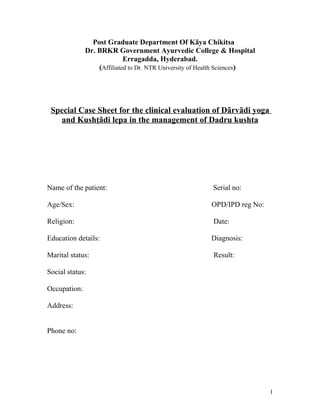
Post Graduate Department Of Kãya Chikitsa 
Dr. BRKR Government Ayurvedic College & Hospital 
Erragadda, Hyderabad. 
(Affiliated to Dr. NTR University of Health Sciences) 
Special Case Sheet for the clinical evaluation of Dãrvãdi yoga 
and Kushţãdi lepa in the management of Dadru kushta 
Name of the patient: Serial no: 
Age/Sex: OPD/IPD reg No: 
Religion: Date: 
Education details: Diagnosis: 
Marital status: Result: 
Social status: 
Occupation: 
Address: 
Phone no: 
1
Chief complaints with duration: 
(Pradhãna Vedhana with Avadhi) 
Associated Complaints: 
(Anubandha Lakshanas) 
History of Present illness: 
(Roga Vruttãntam) 
Mode of onset of lesion(s) - 
Site of lesion(s) - 
Characteristic of lesion(s) - Intermittent / Progressive 
Earlier similar episodes (if present any) - Yes / No 
H/o any aggravating / relieving factors - Yes / No 
If yes, 
1. Food - veg / non veg 
2. Season - rainy / winter / summer 
3. Others - 
H/o Photo allergy/ any allergic skin reactions 
History of Past illness: 
(Rogi Pũrva Vruttãntam) 
Family History: 
(Parivãrika Ithihas) 
2
Treatment History: 
(Chikitsa Vruttãntam) 
Personal History: 
(Vyakti gata Charithra) 
1. Diet - Veg / Non veg / Mixed 
2. Addictions - Alcohol / Smoking / Others / No addictions 
3. Appetite - Good / Average / Poor 
4. Sleep - Sound / Disturbed 
5. Micturition - Free / Dysuria / Polyuria / Oliguria 
6. Bowels - Regular / Irregular / Constipated / Loose stools 
Menstrual History: 
Obstetric History: 
General Examination: (vitals) Systemic Examination: 
1. BP - 1. CNS - 
2. Pulse - 2. CVS - 
3. Temp - 3. RS - 
4. Resp.rate - 4. GIT - 
5. Built - 5. GUS - 
6. P/A - 6.MS /LS - 
3
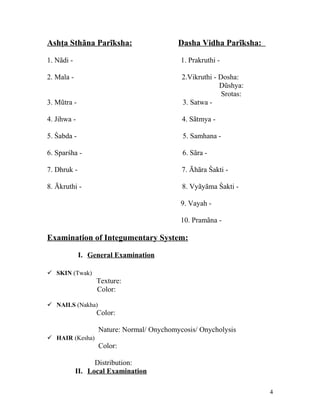
Ashţa Sthãna Parĩksha: Dasha Vidha Parĩksha: 
1. Nãdi - 1. Prakruthi - 
2. Mala - 2.Vikruthi - Dosha: 
Dũshya: 
Srotas: 
3. Mũtra - 3. Satwa - 
4. Jihwa - 4. Sãtmya - 
5. Śabda - 5. Samhana - 
6. Sparśha - 6. Sãra - 
7. Dhruk - 7. Āhãra Śakti - 
8. Ākruthi - 8. Vyãyãma Śakti - 
9. Vayah - 
10. Pramãna - 
Examination of Integumentary System: 
I. General Examination 
 SKIN (Twak) 
Texture: 
Color: 
 NAILS (Nakha) 
Color: 
Nature: Normal/ Onychomycosis/ Onycholysis 
 HAIR (Kesha) 
Color: 
Distribution: 
II. Local Examination 
4
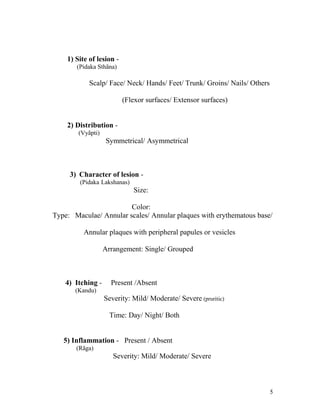
1) Site of lesion - 
(Pidaka Sthãna) 
Scalp/ Face/ Neck/ Hands/ Feet/ Trunk/ Groins/ Nails/ Others 
(Flexor surfaces/ Extensor surfaces) 
2) Distribution - 
(Vyãpti) 
Symmetrical/ Asymmetrical 
3) Character of lesion - 
(Pidaka Lakshanas) 
Size: 
Color: 
Type: Maculae/ Annular scales/ Annular plaques with erythematous base/ 
Annular plaques with peripheral papules or vesicles 
Arrangement: Single/ Grouped 
4) Itching - Present /Absent 
(Kandu) 
Severity: Mild/ Moderate/ Severe (pruritic) 
Time: Day/ Night/ Both 
5) Inflammation - Present / Absent 
(Rãga) 
Severity: Mild/ Moderate/ Severe 
5
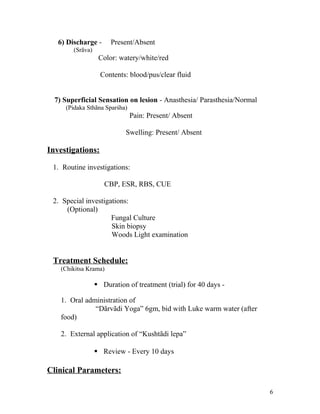
6) Discharge - Present/Absent 
(Srãva) 
Color: watery/white/red 
Contents: blood/pus/clear fluid 
7) Superficial Sensation on lesion - Anasthesia/ Parasthesia/Normal 
(Pidaka Sthãna Sparśha) 
Pain: Present/ Absent 
Swelling: Present/ Absent 
Investigations: 
1. Routine investigations: 
CBP, ESR, RBS, CUE 
2. Special investigations: 
(Optional) 
Fungal Culture 
Skin biopsy 
Woods Light examination 
Treatment Schedule: 
(Chikitsa Krama) 
 Duration of treatment (trial) for 40 days - 
1. Oral administration of 
“Dãrvãdi Yoga” 6gm, bid with Luke warm water (after 
food) 
2. External application of “Kushtãdi lepa” 
 Review - Every 10 days 
Clinical Parameters: 
6
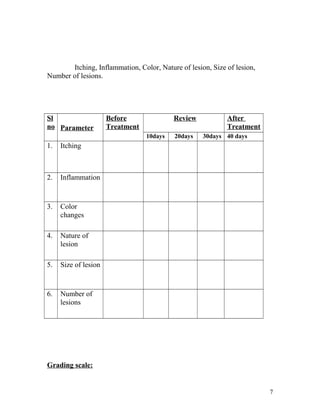
Itching, Inflammation, Color, Nature of lesion, Size of lesion, 
Number of lesions. 
Sl 
no Parameter 
Before 
Treatment 
Review 
After 
Treatment 
10days 20days 30days 40 days 
1. Itching 
2. Inflammation 
3. Color 
changes 
4. Nature of 
lesion 
5. Size of lesion 
6. Number of 
lesions 
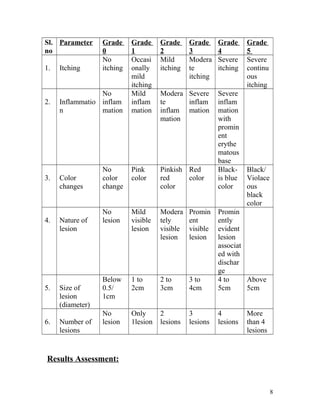
Grading scale: 
7
Sl. 
no 
Parameter Grade 
0 
Grade 
1 
Grade 
2 
Grade 
3 
Grade 
4 
Grade 
5 
1. Itching 
No 
itching 
Occasi 
onally 
mild 
itching 
Mild 
itching 
Modera 
te 
itching 
Severe 
itching 
Severe 
continu 
ous 
itching 
2. Inflammatio 
n 
No 
inflam 
mation 
Mild 
inflam 
mation 
Modera 
te 
inflam 
mation 
Severe 
inflam 
mation 
Severe 
inflam 
mation 
with 
promin 
ent 
erythe 
matous 
base 
3. Color 
changes 
No 
color 
change 
Pink 
color 
Pinkish 
red 
color 
Red 
color 
Black-is 
blue 
color 
Black/ 
Violace 
ous 
black 
color 
4. Nature of 
lesion 
No 
lesion 
Mild 
visible 
lesion 
Modera 
tely 
visible 
lesion 
Promin 
ent 
visible 
lesion 
Promin 
ently 
evident 
lesion 
associat 
ed with 
dischar 
ge 
5. Size of 
lesion 
(diameter) 
Below 
0.5/ 
1cm 
1 to 
2cm 
2 to 
3cm 
3 to 
4cm 
4 to 
5cm 
Above 
5cm 
6. Number of 
lesions 
No 
lesion 
Only 
1lesion 
2 
lesions 
3 
lesions 
4 
lesions 
More 
than 4 
lesions 
Results Assessment: 
8
Finally over all result is calculated by taking average of all parameter 
results. 
Sl. 
no 
Parameter Before 
treatment 
After 
treatment 
% of 
improvement 
1. Itching 
2. Inflammation 
3. Color 
changes 
4. Nature of 
lesion 
5. Size of 
lesion 
6. Number of 
lesions 
Percentage Result 
Below 40 % - Poor 
40 to 60 % - Average 
60 to 80 % - Good 
80 to 90 % - Very good 
90 to 100 % - Excellent 
(Reduction from initial treatment) 
Date of Commencement of treatment: 
Date of Completion of Treatment: 
Over all Response to Treatment: Poor/Average/Good/very good/Excellent 
Signature of PG scholar Signature of Guide 
9
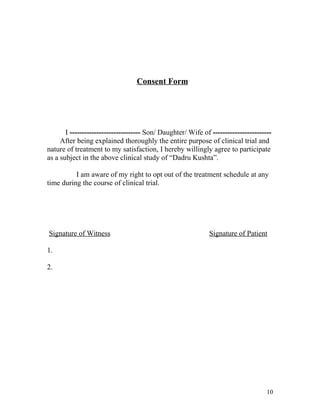
Consent Form 
I ----------------------------- Son/ Daughter/ Wife of ------------------------ 
After being explained thoroughly the entire purpose of clinical trial and 
nature of treatment to my satisfaction, I hereby willingly agree to participate 
as a subject in the above clinical study of “Dadru Kushta”. 
I am aware of my right to opt out of the treatment schedule at any 
time during the course of clinical trial. 
Signature of Witness Signature of Patient 
1. 
2. 
10

Clinical case sheet format for Dadru Kushta (Ay)/ Fungal Infections

  • 1.
    Post Graduate DepartmentOf Kãya Chikitsa Dr. BRKR Government Ayurvedic College & Hospital Erragadda, Hyderabad. (Affiliated to Dr. NTR University of Health Sciences) Special Case Sheet for the clinical evaluation of Dãrvãdi yoga and Kushţãdi lepa in the management of Dadru kushta Name of the patient: Serial no: Age/Sex: OPD/IPD reg No: Religion: Date: Education details: Diagnosis: Marital status: Result: Social status: Occupation: Address: Phone no: 1
  • 2.
    Chief complaints withduration: (Pradhãna Vedhana with Avadhi) Associated Complaints: (Anubandha Lakshanas) History of Present illness: (Roga Vruttãntam) Mode of onset of lesion(s) - Site of lesion(s) - Characteristic of lesion(s) - Intermittent / Progressive Earlier similar episodes (if present any) - Yes / No H/o any aggravating / relieving factors - Yes / No If yes, 1. Food - veg / non veg 2. Season - rainy / winter / summer 3. Others - H/o Photo allergy/ any allergic skin reactions History of Past illness: (Rogi Pũrva Vruttãntam) Family History: (Parivãrika Ithihas) 2
  • 3.
    Treatment History: (ChikitsaVruttãntam) Personal History: (Vyakti gata Charithra) 1. Diet - Veg / Non veg / Mixed 2. Addictions - Alcohol / Smoking / Others / No addictions 3. Appetite - Good / Average / Poor 4. Sleep - Sound / Disturbed 5. Micturition - Free / Dysuria / Polyuria / Oliguria 6. Bowels - Regular / Irregular / Constipated / Loose stools Menstrual History: Obstetric History: General Examination: (vitals) Systemic Examination: 1. BP - 1. CNS - 2. Pulse - 2. CVS - 3. Temp - 3. RS - 4. Resp.rate - 4. GIT - 5. Built - 5. GUS - 6. P/A - 6.MS /LS - 3
  • 4.
    Ashţa Sthãna Parĩksha:Dasha Vidha Parĩksha: 1. Nãdi - 1. Prakruthi - 2. Mala - 2.Vikruthi - Dosha: Dũshya: Srotas: 3. Mũtra - 3. Satwa - 4. Jihwa - 4. Sãtmya - 5. Śabda - 5. Samhana - 6. Sparśha - 6. Sãra - 7. Dhruk - 7. Āhãra Śakti - 8. Ākruthi - 8. Vyãyãma Śakti - 9. Vayah - 10. Pramãna - Examination of Integumentary System: I. General Examination  SKIN (Twak) Texture: Color:  NAILS (Nakha) Color: Nature: Normal/ Onychomycosis/ Onycholysis  HAIR (Kesha) Color: Distribution: II. Local Examination 4
  • 5.
    1) Site oflesion - (Pidaka Sthãna) Scalp/ Face/ Neck/ Hands/ Feet/ Trunk/ Groins/ Nails/ Others (Flexor surfaces/ Extensor surfaces) 2) Distribution - (Vyãpti) Symmetrical/ Asymmetrical 3) Character of lesion - (Pidaka Lakshanas) Size: Color: Type: Maculae/ Annular scales/ Annular plaques with erythematous base/ Annular plaques with peripheral papules or vesicles Arrangement: Single/ Grouped 4) Itching - Present /Absent (Kandu) Severity: Mild/ Moderate/ Severe (pruritic) Time: Day/ Night/ Both 5) Inflammation - Present / Absent (Rãga) Severity: Mild/ Moderate/ Severe 5
  • 6.
    6) Discharge -Present/Absent (Srãva) Color: watery/white/red Contents: blood/pus/clear fluid 7) Superficial Sensation on lesion - Anasthesia/ Parasthesia/Normal (Pidaka Sthãna Sparśha) Pain: Present/ Absent Swelling: Present/ Absent Investigations: 1. Routine investigations: CBP, ESR, RBS, CUE 2. Special investigations: (Optional) Fungal Culture Skin biopsy Woods Light examination Treatment Schedule: (Chikitsa Krama)  Duration of treatment (trial) for 40 days - 1. Oral administration of “Dãrvãdi Yoga” 6gm, bid with Luke warm water (after food) 2. External application of “Kushtãdi lepa”  Review - Every 10 days Clinical Parameters: 6
  • 7.
    Itching, Inflammation, Color,Nature of lesion, Size of lesion, Number of lesions. Sl no Parameter Before Treatment Review After Treatment 10days 20days 30days 40 days 1. Itching 2. Inflammation 3. Color changes 4. Nature of lesion 5. Size of lesion 6. Number of lesions Grading scale: 7
  • 8.
    Sl. no ParameterGrade 0 Grade 1 Grade 2 Grade 3 Grade 4 Grade 5 1. Itching No itching Occasi onally mild itching Mild itching Modera te itching Severe itching Severe continu ous itching 2. Inflammatio n No inflam mation Mild inflam mation Modera te inflam mation Severe inflam mation Severe inflam mation with promin ent erythe matous base 3. Color changes No color change Pink color Pinkish red color Red color Black-is blue color Black/ Violace ous black color 4. Nature of lesion No lesion Mild visible lesion Modera tely visible lesion Promin ent visible lesion Promin ently evident lesion associat ed with dischar ge 5. Size of lesion (diameter) Below 0.5/ 1cm 1 to 2cm 2 to 3cm 3 to 4cm 4 to 5cm Above 5cm 6. Number of lesions No lesion Only 1lesion 2 lesions 3 lesions 4 lesions More than 4 lesions Results Assessment: 8
  • 9.
    Finally over allresult is calculated by taking average of all parameter results. Sl. no Parameter Before treatment After treatment % of improvement 1. Itching 2. Inflammation 3. Color changes 4. Nature of lesion 5. Size of lesion 6. Number of lesions Percentage Result Below 40 % - Poor 40 to 60 % - Average 60 to 80 % - Good 80 to 90 % - Very good 90 to 100 % - Excellent (Reduction from initial treatment) Date of Commencement of treatment: Date of Completion of Treatment: Over all Response to Treatment: Poor/Average/Good/very good/Excellent Signature of PG scholar Signature of Guide 9
  • 10.
    Consent Form I----------------------------- Son/ Daughter/ Wife of ------------------------ After being explained thoroughly the entire purpose of clinical trial and nature of treatment to my satisfaction, I hereby willingly agree to participate as a subject in the above clinical study of “Dadru Kushta”. I am aware of my right to opt out of the treatment schedule at any time during the course of clinical trial. Signature of Witness Signature of Patient 1. 2. 10