UCP/AL/11/221
E.K SANDAMALI
Allied Health Sciences Unit
Faculty of Medicine
University of Colombo
[Musculoskeletal Module]
 SUBJECTIVE EXAMINATION
 Name: Mrs. Indrani
 Age: 62 years
 Occupation: Dancing Teacher
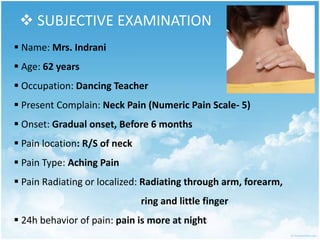
 Present Complain: Neck Pain (Numeric Pain Scale- 5)
 Onset: Gradual onset, Before 6 months
 Pain location: R/S of neck
 Pain Type: Aching Pain
 Pain Radiating or localized: Radiating through arm, forearm,
ring and little finger
 24h behavior of pain: pain is more at night
 Sensation: Parasthesia over medial forearm, No vertigo or tinnitis,
 Easing factors: lying position
 Aggravating factors: Neck Extension and lateral flexion to same side
of pain
 SIN factors: She can sustain positions, and pain reduced
immediately after aggravating movements
 Function: No pain in swallowing
Past medical history: No Diabetes, HTN, Cholesterol
Past surgical history: No
X - Ray – Intervertebral Disk space has reduced.
Osteophytes over C5, C7, T1 vertebral bodies
 OBJECTIVE EXAMINATION
 Observation
Anterior : Unequal shoulder level – R/S shoulder is elevated
Lateral : Cervical lordosis has reduced
Shoulders are slightly protracted
Head thrust slightly forward
Posterior : Scapulae are slightly abducted
 Palpation
 Tenderness over C6, C7, T1 spinous processes.
 Tenderness over C7-T1 and T1-T2 facet joints
Tenderness over R/S cervical paravertibral muscles.
 Jump sign is positive.
• Trigger points on upper trapuzius muscle.
 Test
 Cervical quadrant test (VBI Test) - Negative
 AROM - (Tape measurement) Normal
• Cervical flexion - 9cm 9cm
• Extension - 7cm (limited and painful) 9cm
• lateral flexion - R/S- 3cm (limited and painful) 5cm
L/S- 3cm (limited and painful) 5cm
• Rotation - R/S- 5cm (limited and painful) 9cm
L/S- 5cm (limited and painful) 9cm
• Checked Shoulder flexion. Extension, Abduction, Adduction, Medial
rotation and Lateral rotation (Normal)
• PROM is also limited because of pain
 O’Donoghue’s Maneuver
 Compression Test – Positive
• Radiating through R/S arm, forearm and ring and little finger
 Jackson Compression Test – Positive
• R/S - Radiating pain through arm, forearm and ring and little finger
• L/S - Negative
 Flexion Extension compression Test – Positive
• Flexion – No pain
• Extension – Radiating pain
 Adson’s test - Negative
• Lateral flexion, Extension and rotation caused radiating
pain (Muscle strength grading – Grade 4)
 Physiotherapy diagnosis
 Condition - Cervical spondilosis
• Radiating pain mainly C8,T1 area.
• Paresthesia over C8 area.
• Cervical extension, lateral flexion and
rotation are affected and limit the ROM
 Pain radiates because R/S nerve root compression because of
osteophytes and narrowing of intervertebral foramen.
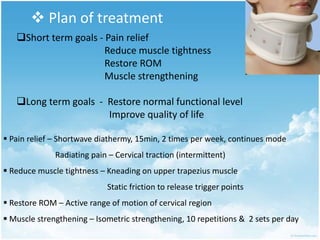
 Plan of treatment
Short term goals - Pain relief
Reduce muscle tightness
Restore ROM
Muscle strengthening
Long term goals - Restore normal functional level
Improve quality of life
 Pain relief – Shortwave diathermy, 15min, 2 times per week, continues mode
Radiating pain – Cervical traction (intermittent)
 Reduce muscle tightness – Kneading on upper trapezius muscle
Static friction to release trigger points
 Restore ROM – Active range of motion of cervical region
 Muscle strengthening – Isometric strengthening, 10 repetitions & 2 sets per day
 Justification of the plan of treatment
 Shortwave diathermy – To increase blood supply and remove
waste products
 Cervical traction – To widen the intervertebral foramina &
reduce pressure on nerve roots
 Kneading - To break the adhesion
 Static friction - To release trigger points
Active range of motion – To improve the range of limited
movements
Muscle strengthening – Increase strength of the muscle to
reduce load on cervical joints
 Outcome measurement of the
intervensions (Progression)
 Pain - Numeric Pain Scale - 4
ROM of cervical movements – Tape measurement (Measure the
improvement)
• Extension - 7.5cm
•Lateral Flexion L/S & R/S - 3.5 cm
• Rotation L/S & R/S - 5.5cm
Case presentation 221(2) sandamail

Case presentation 221(2) sandamail

  • 1.
    UCP/AL/11/221 E.K SANDAMALI Allied HealthSciences Unit Faculty of Medicine University of Colombo [Musculoskeletal Module]
  • 2.
     SUBJECTIVE EXAMINATION Name: Mrs. Indrani  Age: 62 years  Occupation: Dancing Teacher  Present Complain: Neck Pain (Numeric Pain Scale- 5)  Onset: Gradual onset, Before 6 months  Pain location: R/S of neck  Pain Type: Aching Pain  Pain Radiating or localized: Radiating through arm, forearm, ring and little finger  24h behavior of pain: pain is more at night
  • 3.
     Sensation: Parasthesiaover medial forearm, No vertigo or tinnitis,  Easing factors: lying position  Aggravating factors: Neck Extension and lateral flexion to same side of pain  SIN factors: She can sustain positions, and pain reduced immediately after aggravating movements  Function: No pain in swallowing Past medical history: No Diabetes, HTN, Cholesterol Past surgical history: No X - Ray – Intervertebral Disk space has reduced. Osteophytes over C5, C7, T1 vertebral bodies
  • 4.
     OBJECTIVE EXAMINATION Observation Anterior : Unequal shoulder level – R/S shoulder is elevated Lateral : Cervical lordosis has reduced Shoulders are slightly protracted Head thrust slightly forward Posterior : Scapulae are slightly abducted
  • 5.
     Palpation  Tendernessover C6, C7, T1 spinous processes.  Tenderness over C7-T1 and T1-T2 facet joints Tenderness over R/S cervical paravertibral muscles.  Jump sign is positive. • Trigger points on upper trapuzius muscle.
  • 6.
     Test  Cervicalquadrant test (VBI Test) - Negative  AROM - (Tape measurement) Normal • Cervical flexion - 9cm 9cm • Extension - 7cm (limited and painful) 9cm • lateral flexion - R/S- 3cm (limited and painful) 5cm L/S- 3cm (limited and painful) 5cm • Rotation - R/S- 5cm (limited and painful) 9cm L/S- 5cm (limited and painful) 9cm • Checked Shoulder flexion. Extension, Abduction, Adduction, Medial rotation and Lateral rotation (Normal) • PROM is also limited because of pain
  • 7.
     O’Donoghue’s Maneuver Compression Test – Positive • Radiating through R/S arm, forearm and ring and little finger  Jackson Compression Test – Positive • R/S - Radiating pain through arm, forearm and ring and little finger • L/S - Negative  Flexion Extension compression Test – Positive • Flexion – No pain • Extension – Radiating pain  Adson’s test - Negative • Lateral flexion, Extension and rotation caused radiating pain (Muscle strength grading – Grade 4)
  • 8.
     Physiotherapy diagnosis Condition - Cervical spondilosis • Radiating pain mainly C8,T1 area. • Paresthesia over C8 area. • Cervical extension, lateral flexion and rotation are affected and limit the ROM  Pain radiates because R/S nerve root compression because of osteophytes and narrowing of intervertebral foramen.
  • 9.
     Plan oftreatment Short term goals - Pain relief Reduce muscle tightness Restore ROM Muscle strengthening Long term goals - Restore normal functional level Improve quality of life  Pain relief – Shortwave diathermy, 15min, 2 times per week, continues mode Radiating pain – Cervical traction (intermittent)  Reduce muscle tightness – Kneading on upper trapezius muscle Static friction to release trigger points  Restore ROM – Active range of motion of cervical region  Muscle strengthening – Isometric strengthening, 10 repetitions & 2 sets per day
  • 10.
     Justification ofthe plan of treatment  Shortwave diathermy – To increase blood supply and remove waste products  Cervical traction – To widen the intervertebral foramina & reduce pressure on nerve roots  Kneading - To break the adhesion  Static friction - To release trigger points Active range of motion – To improve the range of limited movements Muscle strengthening – Increase strength of the muscle to reduce load on cervical joints
  • 11.
     Outcome measurementof the intervensions (Progression)  Pain - Numeric Pain Scale - 4 ROM of cervical movements – Tape measurement (Measure the improvement) • Extension - 7.5cm •Lateral Flexion L/S & R/S - 3.5 cm • Rotation L/S & R/S - 5.5cm