UCP/AL/11/190
H.A.A Nilakshi
• Subjective examination
• Name – Mr. Warnasuriya
• Age - 46 years
• Gender - male
• Occupation – school teacher
• Address - Gampaha
• Civil status – married
• Family - 2 children
• Present complain - pain in left upper arm and forearm
• Where is exact location of pain - deltoid muscle insertion area (more)
• Type of pain - dull ache pain
• Onset – gradual
• At what time pain is more – at night & cold weather
• Behaviour of pain - constant pain over few months & activities of
arm increase pain, can’t lie on affected arm side
• Measuring of pain using numerical pain scale - pt complained his
pain level number is 8
• Hx of present complains – 4 months ago fallen and knock his shoulder
on wall
• Past medical Hx - diabetics +
hypertension –
• Past surgical Hx –Nil
• X-ray - not taken
• Objective examination
• Observation
• anterior view - left shoulder elevated
• Lateral view - rounded shoulders
protruded chin
no colour changes in skin around left shoulder
• Left arm swing is less in walking
• Muscle wasting on deltoid area
• Palpation
temperature normal
muscle spasm in left side upper trapezius area
pain increase with palpation
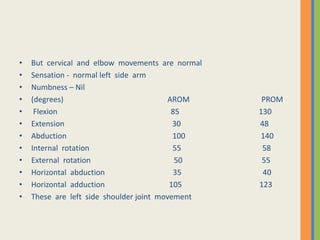
• All the movements are limited in left side shoulder compared
with right side
• But cervical and elbow movements are normal
• Sensation - normal left side arm
• Numbness – Nil
• (degrees) AROM PROM
• Flexion 85 130
• Extension 30 48
• Abduction 100 140
• Internal rotation 55 58
• External rotation 50 55
• Horizontal abduction 35 40
• Horizontal adduction 105 123
• These are left side shoulder joint movement
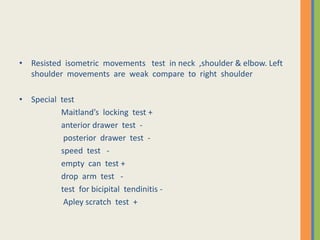
• Resisted isometric movements test in neck ,shoulder & elbow. Left
shoulder movements are weak compare to right shoulder
• Special test
Maitland’s locking test +
anterior drawer test -
posterior drawer test -
speed test -
empty can test +
drop arm test -
test for bicipital tendinitis -
Apley scratch test +
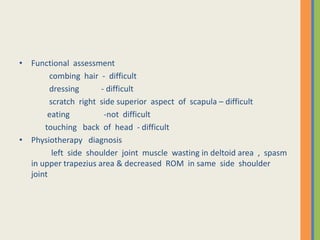
• Functional assessment
combing hair - difficult
dressing - difficult
scratch right side superior aspect of scapula – difficult
eating -not difficult
touching back of head - difficult
• Physiotherapy diagnosis
left side shoulder joint muscle wasting in deltoid area , spasm
in upper trapezius area & decreased ROM in same side shoulder
joint
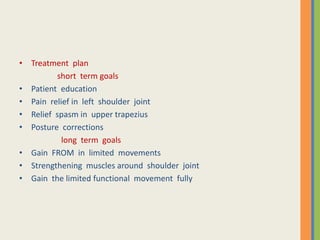
• Treatment plan
short term goals
• Patient education
• Pain relief in left shoulder joint
• Relief spasm in upper trapezius
• Posture corrections
long term goals
• Gain FROM in limited movements
• Strengthening muscles around shoulder joint
• Gain the limited functional movement fully
• Pain relief - apply short wave diathermy for shoulder joint
continuous mode 20 min 2 days per week
This gives deep heat & that increase blood circulation loosening the
adhesions remove the waste products from there. That help to relieve
pain. Hot water fermentation 15 min at home around shoulder 2
times per day.
• To reduce spasm - give deep transverse friction 10 min in spasm area
in upper trapezius 2 days per week. Spasm is tight area of muscle.
When it release feel relief of pain .
• To increase ROM - give accessory movement grade II , 60 oscillations 2
times per week (for AP,PA, Cephalo caudal , distraction)
• Ultrasound for supraspinatus tendon area to increase healing process &
relief pain.
• Relaxation - shoulder girdle retraction & depression with hold then
release should be practised regularly .
• Mobilization active exercises for shoulder area - every day 15
repetitions 2 times per day . Start from pendulum exercise &
progress according to improve the limited movements of the
shoulder. In pendulum exercise a weight in hand helps to apply
traction to humerus & increase momentum.
• Putting in suspension for flexion, extension ,abduction ,adduction
for left shoulder joint .This help to increase patient’s confidence &
re-educate glenohumeral rhythm)
• Wall climbing exercise useful to gaining elevation of shoulder girdle.
• Pulley exercises for ( flexion ,extension ,abduction ,adduction)
• Strengthening exercises for especially deltoid & other muscle
groups(serretus anterior,rhomboids ,trapezius) around shoulder joint
• Posture corrections -practise shoulder girdle & head retraction &
also depression of shoulder girdle
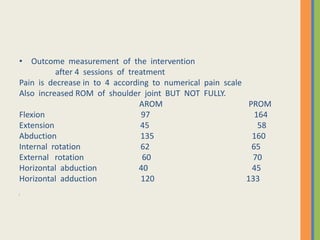
• Outcome measurement of the intervention
after 4 sessions of treatment
Pain is decrease in to 4 according to numerical pain scale
Also increased ROM of shoulder joint BUT NOT FULLY.
AROM PROM
Flexion 97 164
Extension 45 58
Abduction 135 160
Internal rotation 62 65
External rotation 60 70
Horizontal abduction 40 45
Horizontal adduction 120 133
i
190 ayodhya

190 ayodhya

  • 1.
  • 2.
    • Subjective examination •Name – Mr. Warnasuriya • Age - 46 years • Gender - male • Occupation – school teacher • Address - Gampaha • Civil status – married • Family - 2 children • Present complain - pain in left upper arm and forearm • Where is exact location of pain - deltoid muscle insertion area (more) • Type of pain - dull ache pain • Onset – gradual
  • 3.
    • At whattime pain is more – at night & cold weather • Behaviour of pain - constant pain over few months & activities of arm increase pain, can’t lie on affected arm side • Measuring of pain using numerical pain scale - pt complained his pain level number is 8 • Hx of present complains – 4 months ago fallen and knock his shoulder on wall • Past medical Hx - diabetics + hypertension – • Past surgical Hx –Nil • X-ray - not taken
  • 4.
    • Objective examination •Observation • anterior view - left shoulder elevated • Lateral view - rounded shoulders protruded chin no colour changes in skin around left shoulder • Left arm swing is less in walking • Muscle wasting on deltoid area • Palpation temperature normal muscle spasm in left side upper trapezius area pain increase with palpation • All the movements are limited in left side shoulder compared with right side
  • 5.
    • But cervicaland elbow movements are normal • Sensation - normal left side arm • Numbness – Nil • (degrees) AROM PROM • Flexion 85 130 • Extension 30 48 • Abduction 100 140 • Internal rotation 55 58 • External rotation 50 55 • Horizontal abduction 35 40 • Horizontal adduction 105 123 • These are left side shoulder joint movement
  • 6.
    • Resisted isometricmovements test in neck ,shoulder & elbow. Left shoulder movements are weak compare to right shoulder • Special test Maitland’s locking test + anterior drawer test - posterior drawer test - speed test - empty can test + drop arm test - test for bicipital tendinitis - Apley scratch test +
  • 7.
    • Functional assessment combinghair - difficult dressing - difficult scratch right side superior aspect of scapula – difficult eating -not difficult touching back of head - difficult • Physiotherapy diagnosis left side shoulder joint muscle wasting in deltoid area , spasm in upper trapezius area & decreased ROM in same side shoulder joint
  • 8.
    • Treatment plan shortterm goals • Patient education • Pain relief in left shoulder joint • Relief spasm in upper trapezius • Posture corrections long term goals • Gain FROM in limited movements • Strengthening muscles around shoulder joint • Gain the limited functional movement fully
  • 9.
    • Pain relief- apply short wave diathermy for shoulder joint continuous mode 20 min 2 days per week This gives deep heat & that increase blood circulation loosening the adhesions remove the waste products from there. That help to relieve pain. Hot water fermentation 15 min at home around shoulder 2 times per day. • To reduce spasm - give deep transverse friction 10 min in spasm area in upper trapezius 2 days per week. Spasm is tight area of muscle. When it release feel relief of pain . • To increase ROM - give accessory movement grade II , 60 oscillations 2 times per week (for AP,PA, Cephalo caudal , distraction) • Ultrasound for supraspinatus tendon area to increase healing process & relief pain. • Relaxation - shoulder girdle retraction & depression with hold then release should be practised regularly .
  • 10.
    • Mobilization activeexercises for shoulder area - every day 15 repetitions 2 times per day . Start from pendulum exercise & progress according to improve the limited movements of the shoulder. In pendulum exercise a weight in hand helps to apply traction to humerus & increase momentum. • Putting in suspension for flexion, extension ,abduction ,adduction for left shoulder joint .This help to increase patient’s confidence & re-educate glenohumeral rhythm) • Wall climbing exercise useful to gaining elevation of shoulder girdle. • Pulley exercises for ( flexion ,extension ,abduction ,adduction) • Strengthening exercises for especially deltoid & other muscle groups(serretus anterior,rhomboids ,trapezius) around shoulder joint • Posture corrections -practise shoulder girdle & head retraction & also depression of shoulder girdle
  • 11.
    • Outcome measurementof the intervention after 4 sessions of treatment Pain is decrease in to 4 according to numerical pain scale Also increased ROM of shoulder joint BUT NOT FULLY. AROM PROM Flexion 97 164 Extension 45 58 Abduction 135 160 Internal rotation 62 65 External rotation 60 70 Horizontal abduction 40 45 Horizontal adduction 120 133 i