Case Presentation.
Musculoskeletal Module.
UCP/AL/11/193
Perera W.V.A.I.
Allied Health Sciences Unit
Faculty of Medicine
University of Colombo
Subjective examination.
• Age:- 61 years
• Gender:- Male
• Occupation:- Electrician
• Family position:- Father of three children
• Present complain:- Can’t extend 4th and 5th fingers in right hand
• History of pc:- RTA, while travelling on the bike a three-wheeler has
come towards right side and stopped. Suddenly his R hand directly
blow on the side frame of the three-wheeler.
• Mechanism:- RTA, direct blow of R 4th & 5th digits, closed fracture in
the 5th proximal phalanx, open subluxation in the 4th PIP joint.
• History of surgery:- Surgical intervention in the 5th proximal inter
phalanx.
• Pain scale:- NPS; 3
• No tenderness, no numbness, no any other uncomfortable sensations.
• Past medical history:- HT+, DM+, Cho+, under medications for
above conditions as well as CHD.
Objective examination
• Observation.
 Deformity in 4th & 5th IP joints (Boutonnière, due to post traumatic
condition)
 Swelling around joints, and tendon sheath.
 Muscle wasting especially in thenar, hypothenar muscles, interossei
and extrinsic muscles.
 Skin condition (colour is much darker, temperature is normal)
• Palpation.
 Dorsal surface; Anatomic snuff box, carpal bones, metacarpal bones
& phalanges.
 Anterior surface; Pulses, tendons(L-M), palmar fascia and intrinsic
muscles, skin flexion creases, & arches, skin is more rough than the
surrounding skin.
 Stiffed and swollen around PIP joints in 4th and 5th digits.
Cntd,
• Examination.
 Active movements; Elbow, wrist, MCP, PIP and DIP joints in the R.
 Passive movements; Elbow, wrist, MCP, PIP and DIP joints in the R.
 Resisted isometric movements; Elbow, wrist, MCP, PIP and DIP
joints.
 Functional Assessment (Grip)
 Extrinsic and intrinsic hand muscle strength scales (MRC)
 Radiographic findings; Subluxation of the 4th PIP joint and simple
oblique fracture in the 5th proximal phalanx of the R side.
• Special tests.
 Ligamentous instability test for the fingers.
 Test for tight retinacular (Collateral) ligaments.
 Test for Extensor Hood Rupture.
 Phalen's (Wrist Flexion) Test.
Physiotherapy diagnosis.
• According to the examination,
 Active, passive, resisted isometric movements in elbow, wrist, MCP,
& IP (thumb & index finger) were almost normal.
 But, active, passive, resisted isometric movements were restricted in
MCP, PIP, & DIP joints of 3rd, 4th, & 5th digits.
 Power grip was less with compare to other types of grips, due to
affected ulnar portion.
 Making fist is normal, but expansion of it abnormal extension lags
in 4th, & 5th PIP joints.
 Extrinsic hand muscles is in grade 5, but intrinsic hand muscles is in
grade 4. (According to MRC scale). Atrophy of these muscles also
revealed that disuse of the right hand often.
Cntd,
• According to the special tests,
 Ligamentous instability test for the fingers was negative to all five
digits.
 Test for tight retinacular (Collateral) ligaments also negative to all
five digits.
 Test for extensor hood rupture was positive in 4th and 5th digits.
Which indicate that, Boutonniere Deformity has being occurred.
 Phalen's (Wrist Flexion) test was negative and there were no any
sings of carpal tunnel syndrome.
Physiotherapy diagnosis is impairments and functional limitations
may occur from the lack of motion and muscle contraction,
including:
Decreased ROM and decreased joint play with firm end- feel and
pain on overpressure. Tendon adhesions. This is a significant
complication if there was any inflammation in a tendon or its
sheath. Decreased muscle performance including muscle weak-
ness, weak grip strength, decreased flexibility, decreased muscle
endurance, and rupture in the extensor hood of 4th & 5th digits.
Treatment plan and justification
• Short term goals.
 Pain management-
o Gentle grade I or II distraction and oscillation techniques 10
minutes, twice a day, for 3-4 weeks, may inhibit pain and move
synovial fluid for nutrition in the involved joints.
o Applying Infrared therapy :20 minutes,3 times a week, for 3-4
weeks. Superficial heat ,causes vasodilation reducing muscle
ischaemia, this relieve muscle spasm, reducing pain(counter
irritation),prior to exercises.
o Applying an electric stimulation to the extrinsic hand muscles.
 Maintain Joint and Tendon Mobility and Muscle Integrity-
o Passive, assistive, or active ROM- It is important to move the joints
as tolerated because immobility of the hand quickly leads to muscle
imbalance and contracture formation.
Cntd,
• Tendon-gliding exercises- Have the patient perform full motion in
the uninvolved joints and as much motion as possible in the
involved joints to prevent adhesions between the long tendons or
between the tendons and their synovial sheaths.
• Increase Joint Play and Accessory Motions-
o Joint mobilization techniques- Apply grade III sustained or grade
IV oscillation techniques to stretch the capsules to all wrist, hand
and digits.
o Self-mobilization.
• Increasing the ROM in all joints of the R hand.
o Passive, assistive, or active ROM exercises.
• Resistance exercise for regain the muscle performance.
o Resistance exercises for all the elbow, wrist, hand and finger
movements.
All the above exercises are done twice a day(morning and evening),
10 repetitions for 2 weeks.
Cntd,
• Long term goals.
• Regain the neutral position to the 4th and 5th PIP joints.
(Neutralized the extension lag)-
o Static splinting to the 4th and 5th PIP joints. Wears a volar static
(resting splint), which holds the wrist in 15° of extension and the
fingers in full or almost full extension.
• Patient education.
o Educating the patient about all the exercises as well as the
importance of being an active participant of the exercise programme
for the rehabilitation.
Outcome measurements of the intervention.
Motion Session; 01 (°) Session; 02 (°)
Flexion 150 150
Extension 0 0
Pronation 80 80
Supination 90 90
 Elbow joint.
 Wrist joint.
Motion Session; 01 (°) Session; 02 (°)
Flexion 80 80
Extension 70 70
Ulnar deviation 30 30
Radial deviation 20 20
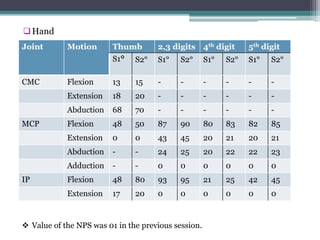
Hand
Joint Motion Thumb 2,3 digits 4th digit 5th digit
S1° S2° S1° S2° S1° S2° S1° S2°
CMC Flexion 13 15 - - - - - -
Extension 18 20 - - - - - -
Abduction 68 70 - - - - - -
MCP Flexion 48 50 87 90 80 83 82 85
Extension 0 0 43 45 20 21 20 21
Abduction - - 24 25 20 22 22 23
Adduction - - 0 0 0 0 0 0
IP Flexion 48 80 93 95 21 25 42 45
Extension 17 20 0 0 0 0 0 0
 Value of the NPS was 01 in the previous session.
Thank You

193 akila

  • 1.
    Case Presentation. Musculoskeletal Module. UCP/AL/11/193 PereraW.V.A.I. Allied Health Sciences Unit Faculty of Medicine University of Colombo
  • 2.
    Subjective examination. • Age:-61 years • Gender:- Male • Occupation:- Electrician • Family position:- Father of three children • Present complain:- Can’t extend 4th and 5th fingers in right hand • History of pc:- RTA, while travelling on the bike a three-wheeler has come towards right side and stopped. Suddenly his R hand directly blow on the side frame of the three-wheeler. • Mechanism:- RTA, direct blow of R 4th & 5th digits, closed fracture in the 5th proximal phalanx, open subluxation in the 4th PIP joint. • History of surgery:- Surgical intervention in the 5th proximal inter phalanx. • Pain scale:- NPS; 3 • No tenderness, no numbness, no any other uncomfortable sensations. • Past medical history:- HT+, DM+, Cho+, under medications for above conditions as well as CHD.
  • 3.
    Objective examination • Observation. Deformity in 4th & 5th IP joints (Boutonnière, due to post traumatic condition)  Swelling around joints, and tendon sheath.  Muscle wasting especially in thenar, hypothenar muscles, interossei and extrinsic muscles.  Skin condition (colour is much darker, temperature is normal) • Palpation.  Dorsal surface; Anatomic snuff box, carpal bones, metacarpal bones & phalanges.  Anterior surface; Pulses, tendons(L-M), palmar fascia and intrinsic muscles, skin flexion creases, & arches, skin is more rough than the surrounding skin.  Stiffed and swollen around PIP joints in 4th and 5th digits.
  • 4.
    Cntd, • Examination.  Activemovements; Elbow, wrist, MCP, PIP and DIP joints in the R.  Passive movements; Elbow, wrist, MCP, PIP and DIP joints in the R.  Resisted isometric movements; Elbow, wrist, MCP, PIP and DIP joints.  Functional Assessment (Grip)  Extrinsic and intrinsic hand muscle strength scales (MRC)  Radiographic findings; Subluxation of the 4th PIP joint and simple oblique fracture in the 5th proximal phalanx of the R side. • Special tests.  Ligamentous instability test for the fingers.  Test for tight retinacular (Collateral) ligaments.  Test for Extensor Hood Rupture.  Phalen's (Wrist Flexion) Test.
  • 5.
    Physiotherapy diagnosis. • Accordingto the examination,  Active, passive, resisted isometric movements in elbow, wrist, MCP, & IP (thumb & index finger) were almost normal.  But, active, passive, resisted isometric movements were restricted in MCP, PIP, & DIP joints of 3rd, 4th, & 5th digits.  Power grip was less with compare to other types of grips, due to affected ulnar portion.  Making fist is normal, but expansion of it abnormal extension lags in 4th, & 5th PIP joints.  Extrinsic hand muscles is in grade 5, but intrinsic hand muscles is in grade 4. (According to MRC scale). Atrophy of these muscles also revealed that disuse of the right hand often.
  • 6.
    Cntd, • According tothe special tests,  Ligamentous instability test for the fingers was negative to all five digits.  Test for tight retinacular (Collateral) ligaments also negative to all five digits.  Test for extensor hood rupture was positive in 4th and 5th digits. Which indicate that, Boutonniere Deformity has being occurred.  Phalen's (Wrist Flexion) test was negative and there were no any sings of carpal tunnel syndrome. Physiotherapy diagnosis is impairments and functional limitations may occur from the lack of motion and muscle contraction, including: Decreased ROM and decreased joint play with firm end- feel and pain on overpressure. Tendon adhesions. This is a significant complication if there was any inflammation in a tendon or its sheath. Decreased muscle performance including muscle weak- ness, weak grip strength, decreased flexibility, decreased muscle endurance, and rupture in the extensor hood of 4th & 5th digits.
  • 7.
    Treatment plan andjustification • Short term goals.  Pain management- o Gentle grade I or II distraction and oscillation techniques 10 minutes, twice a day, for 3-4 weeks, may inhibit pain and move synovial fluid for nutrition in the involved joints. o Applying Infrared therapy :20 minutes,3 times a week, for 3-4 weeks. Superficial heat ,causes vasodilation reducing muscle ischaemia, this relieve muscle spasm, reducing pain(counter irritation),prior to exercises. o Applying an electric stimulation to the extrinsic hand muscles.  Maintain Joint and Tendon Mobility and Muscle Integrity- o Passive, assistive, or active ROM- It is important to move the joints as tolerated because immobility of the hand quickly leads to muscle imbalance and contracture formation.
  • 8.
    Cntd, • Tendon-gliding exercises-Have the patient perform full motion in the uninvolved joints and as much motion as possible in the involved joints to prevent adhesions between the long tendons or between the tendons and their synovial sheaths. • Increase Joint Play and Accessory Motions- o Joint mobilization techniques- Apply grade III sustained or grade IV oscillation techniques to stretch the capsules to all wrist, hand and digits. o Self-mobilization. • Increasing the ROM in all joints of the R hand. o Passive, assistive, or active ROM exercises. • Resistance exercise for regain the muscle performance. o Resistance exercises for all the elbow, wrist, hand and finger movements. All the above exercises are done twice a day(morning and evening), 10 repetitions for 2 weeks.
  • 9.
    Cntd, • Long termgoals. • Regain the neutral position to the 4th and 5th PIP joints. (Neutralized the extension lag)- o Static splinting to the 4th and 5th PIP joints. Wears a volar static (resting splint), which holds the wrist in 15° of extension and the fingers in full or almost full extension. • Patient education. o Educating the patient about all the exercises as well as the importance of being an active participant of the exercise programme for the rehabilitation.
  • 10.
    Outcome measurements ofthe intervention. Motion Session; 01 (°) Session; 02 (°) Flexion 150 150 Extension 0 0 Pronation 80 80 Supination 90 90  Elbow joint.  Wrist joint. Motion Session; 01 (°) Session; 02 (°) Flexion 80 80 Extension 70 70 Ulnar deviation 30 30 Radial deviation 20 20
  • 11.
    Hand Joint Motion Thumb2,3 digits 4th digit 5th digit S1° S2° S1° S2° S1° S2° S1° S2° CMC Flexion 13 15 - - - - - - Extension 18 20 - - - - - - Abduction 68 70 - - - - - - MCP Flexion 48 50 87 90 80 83 82 85 Extension 0 0 43 45 20 21 20 21 Abduction - - 24 25 20 22 22 23 Adduction - - 0 0 0 0 0 0 IP Flexion 48 80 93 95 21 25 42 45 Extension 17 20 0 0 0 0 0 0  Value of the NPS was 01 in the previous session.
  • 12.