Case of Texas v. Johnson 
Michael Peto 
11/22/14 
Political Science
Case of Texas v. Johnson 
● Gregory Lee Johnson burned the American flag in front of 
the Dallas City Hall in 1984. 
● He was convicted in court, sentenced to prison for a year 
and was also fined $2000 for violating a Texas law that 
forbids desecrating respected objects. 
● He went to the Texas Court of Criminal Appeals; however, 
they could not charge him for his actions against the flag, 
because it would refuse the right for Freedom of speech 
mentioned in the First Amendment. 
● The state of Texas then asked the Supreme Court to hear 
Johnson's case, and in 1989 the decision was made to 
take his case.
Case of Texas v. Johnson 
● The justices on this case were Brennan, Marshall, Blackmun, 
Scalia, Kennedy, Rehnquist, White, Stevens, and O'Connor. 
● The question of this case was whether or not burning the flag 
was a form of speech that was protected under the First 
Amendment of the constitution. 
● Ms. Drew, who was representing for the state of Texas, is the 
one who presented Gregory Lee Johnson's case to Chief 
Justice William H. Rehnquist. 
● Ms. Drew stated that Johnson should be convicted of two 
offenses, preservation of the flag as a symbol of nationhood 
and national unity, and the preservation of the breach of peace.
Case of Texas v. Johnson 
● Ms. Drew and the state of Texas believed that by burning the 
flag, the act overpowered the First Amendment rights of 
anybody. 
● They also believed that overtime in desecrating the flag, it could 
possibly lose its symbolic effect. 
● On the other side, it was well pointed out that it has just the 
opposite effect. Although it is being desecrated, there is no 
reason why it should lose its symbolic effect on the country and 
its people. In fact, it could become more of a symbol for the 
country. 
● Both sides had very well rounded arguments, and Ms. Drew 
said that every individual has their own rights, but Texas just 
wanted to keep the physical integrity of the flag and for people 
to respect the flag.
Case of Texas v. Johnson 
● Mr. Kunstler, Johnson's lawyer, gave good points about if someone 
doesn't salute, it becomes disrespectful. However, they don't get fined 
and go to prison. 
● After an hour of intriguing arguments, the court judges come to a 
decision of believing the First Amendment protects Johnson for 
freedom of speech by burning the flag. 
● A 5 to 4 vote with Brennan, who wrote the majority vote, freed 
Johnson of all charges including the preservation of the breach of 
peace. 
● This case has rewritten the way Americans think about burning the 
flag, and has allowed us to respect it even more.
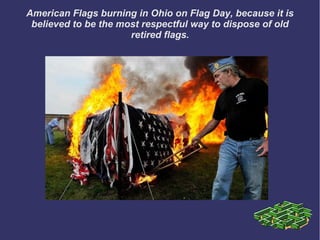
American Flags burning in Ohio on Flag Day, because it is 
believed to be the most respectful way to dispose of old 
retired flags.
American Flag burning on Memorial Day to honor veterans that risked 
their lives for this country.
http://www.oyez.org/cases/1980- 
1989/1988/1988_88_155#sort=seniority

Case of texas v. johnson

  • 1.
    Case of Texasv. Johnson Michael Peto 11/22/14 Political Science
  • 2.
    Case of Texasv. Johnson ● Gregory Lee Johnson burned the American flag in front of the Dallas City Hall in 1984. ● He was convicted in court, sentenced to prison for a year and was also fined $2000 for violating a Texas law that forbids desecrating respected objects. ● He went to the Texas Court of Criminal Appeals; however, they could not charge him for his actions against the flag, because it would refuse the right for Freedom of speech mentioned in the First Amendment. ● The state of Texas then asked the Supreme Court to hear Johnson's case, and in 1989 the decision was made to take his case.
  • 3.
    Case of Texasv. Johnson ● The justices on this case were Brennan, Marshall, Blackmun, Scalia, Kennedy, Rehnquist, White, Stevens, and O'Connor. ● The question of this case was whether or not burning the flag was a form of speech that was protected under the First Amendment of the constitution. ● Ms. Drew, who was representing for the state of Texas, is the one who presented Gregory Lee Johnson's case to Chief Justice William H. Rehnquist. ● Ms. Drew stated that Johnson should be convicted of two offenses, preservation of the flag as a symbol of nationhood and national unity, and the preservation of the breach of peace.
  • 4.
    Case of Texasv. Johnson ● Ms. Drew and the state of Texas believed that by burning the flag, the act overpowered the First Amendment rights of anybody. ● They also believed that overtime in desecrating the flag, it could possibly lose its symbolic effect. ● On the other side, it was well pointed out that it has just the opposite effect. Although it is being desecrated, there is no reason why it should lose its symbolic effect on the country and its people. In fact, it could become more of a symbol for the country. ● Both sides had very well rounded arguments, and Ms. Drew said that every individual has their own rights, but Texas just wanted to keep the physical integrity of the flag and for people to respect the flag.
  • 5.
    Case of Texasv. Johnson ● Mr. Kunstler, Johnson's lawyer, gave good points about if someone doesn't salute, it becomes disrespectful. However, they don't get fined and go to prison. ● After an hour of intriguing arguments, the court judges come to a decision of believing the First Amendment protects Johnson for freedom of speech by burning the flag. ● A 5 to 4 vote with Brennan, who wrote the majority vote, freed Johnson of all charges including the preservation of the breach of peace. ● This case has rewritten the way Americans think about burning the flag, and has allowed us to respect it even more.
  • 6.
    American Flags burningin Ohio on Flag Day, because it is believed to be the most respectful way to dispose of old retired flags.
  • 7.
    American Flag burningon Memorial Day to honor veterans that risked their lives for this country.
  • 8.