Miranda v. Arizona (1966) By Justin Schimek
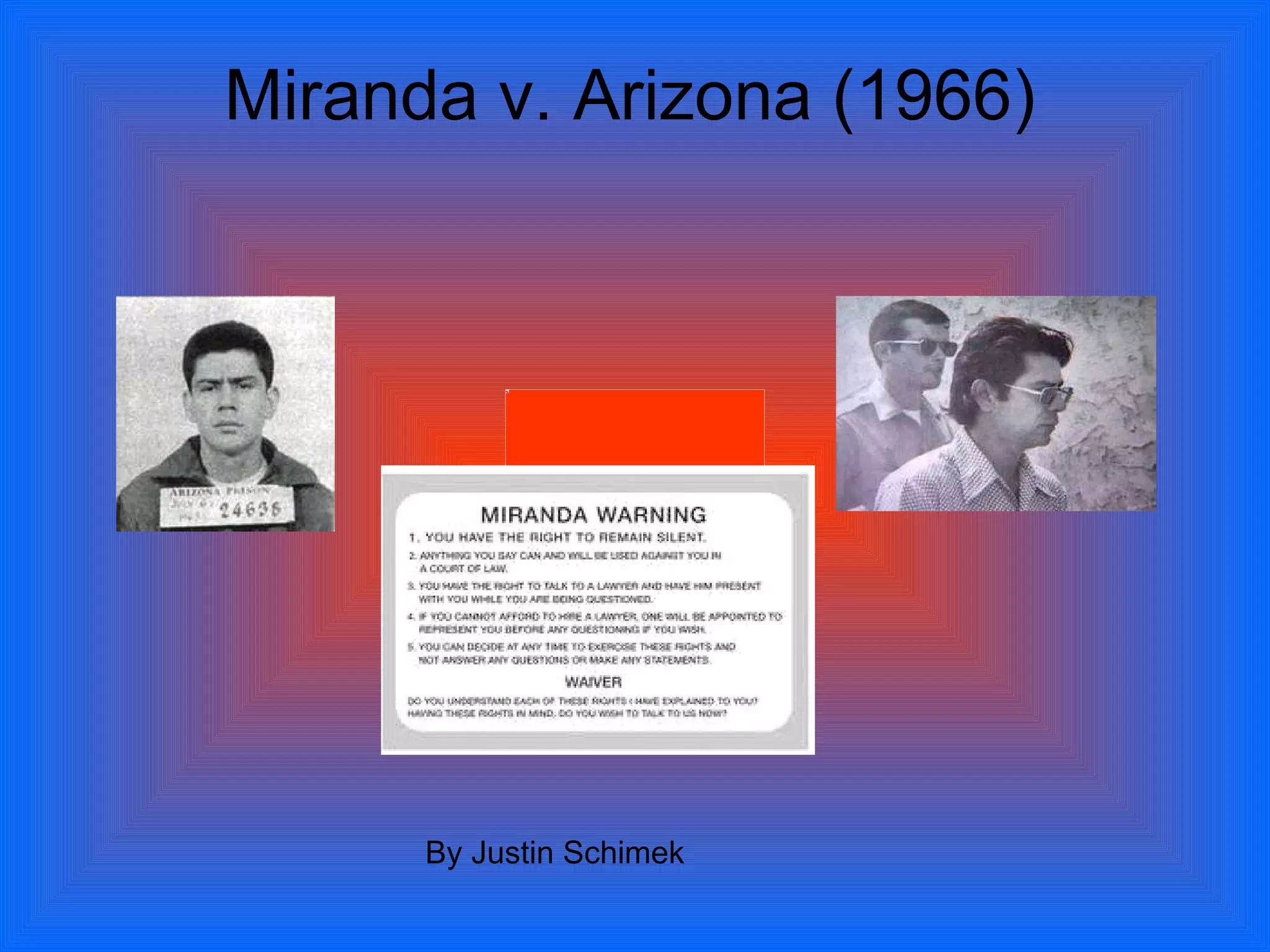
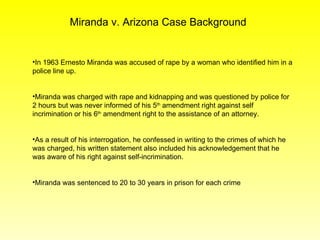
Miranda v. Arizona Case Background  In 1963 Ernesto Miranda was accused of rape by a woman who identified him in a police line up. Miranda was charged with rape and kidnapping and was questioned by police for 2 hours but was never informed of his 5 th  amendment right against self incrimination or his 6 th  amendment right to the assistance of an attorney. As a result of his interrogation, he confessed in writing to the crimes of which he was charged, his written statement also included his acknowledgement that he was aware of his right against self-incrimination.  Miranda was sentenced to 20 to 30 years in prison for each crime
Miranda, The Plaintive   His attorney argued that his confession should have been excluded from trial because he had not been informed of his rights, nor had an attorney been present during his interrogation.
Arizona, The Complainant   The police officers involved admitted that they had not given Miranda any explanation of his rights. They argued, however, that because Miranda had been convicted of a crime in the past, he must have been aware of his rights. The Arizona Supreme Court denied his appeal and upheld his conviction.
The Verdict  Miranda's defense attorney appealed to the Arizona Supreme Court. Eventually the case ended up at the supreme court where it was decided in favor of Miranda with a 5-4 vote.
Texas vs. Johnson (1989) Flag Burning, Freedom of Speech By: Vincent DiGiovanna
In 1984 Gregory Lee Johnson burned a flag in front of Dallas city hall as a protest against Reagan. Johnson was convicted under Texas State law for outlawing flag desecration and was sentenced one year in jail and a $2,000 fine. The Texas Court of Criminal Appeals reversed the conviction, and the case went to the Supreme Court. Summary
Arguments Plaintiff- Texas Texas believed that it was illegal for Johnson to burn the flag, because it was flag desecration under the state of Texas. Defendant- Gregory Lee Johnson According to Johnson it was protected under the first amendment that he could burn a flag because it was freedom of expression.
Majority vote was in favor of Johnson 5 to 4 ruling him not guilty They ruled that he was protected under the first right that he was allowed because of freedom of expression. This impacted the use of amendments because it allowed something that is frowned upon, but it is protected under the constitution. It is a landmark case because it set a precedent for what is freedom of expression and what is not. Decision

Miranda arizona

  • 1.
    Miranda v. Arizona(1966) By Justin Schimek
  • 2.
    Miranda v. ArizonaCase Background In 1963 Ernesto Miranda was accused of rape by a woman who identified him in a police line up. Miranda was charged with rape and kidnapping and was questioned by police for 2 hours but was never informed of his 5 th amendment right against self incrimination or his 6 th amendment right to the assistance of an attorney. As a result of his interrogation, he confessed in writing to the crimes of which he was charged, his written statement also included his acknowledgement that he was aware of his right against self-incrimination. Miranda was sentenced to 20 to 30 years in prison for each crime
  • 3.
    Miranda, The Plaintive His attorney argued that his confession should have been excluded from trial because he had not been informed of his rights, nor had an attorney been present during his interrogation.
  • 4.
    Arizona, The Complainant The police officers involved admitted that they had not given Miranda any explanation of his rights. They argued, however, that because Miranda had been convicted of a crime in the past, he must have been aware of his rights. The Arizona Supreme Court denied his appeal and upheld his conviction.
  • 5.
    The Verdict Miranda's defense attorney appealed to the Arizona Supreme Court. Eventually the case ended up at the supreme court where it was decided in favor of Miranda with a 5-4 vote.
  • 6.
    Texas vs. Johnson(1989) Flag Burning, Freedom of Speech By: Vincent DiGiovanna
  • 7.
    In 1984 GregoryLee Johnson burned a flag in front of Dallas city hall as a protest against Reagan. Johnson was convicted under Texas State law for outlawing flag desecration and was sentenced one year in jail and a $2,000 fine. The Texas Court of Criminal Appeals reversed the conviction, and the case went to the Supreme Court. Summary
  • 8.
    Arguments Plaintiff- TexasTexas believed that it was illegal for Johnson to burn the flag, because it was flag desecration under the state of Texas. Defendant- Gregory Lee Johnson According to Johnson it was protected under the first amendment that he could burn a flag because it was freedom of expression.
  • 9.
    Majority vote wasin favor of Johnson 5 to 4 ruling him not guilty They ruled that he was protected under the first right that he was allowed because of freedom of expression. This impacted the use of amendments because it allowed something that is frowned upon, but it is protected under the constitution. It is a landmark case because it set a precedent for what is freedom of expression and what is not. Decision