


CASE METHOD OF LEARNING
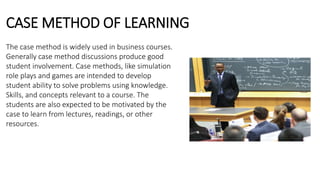
The case method is widely used in business courses.
Generally case method discussions produce good
student involvement. Case methods, like simulation
role plays and games are intended to develop
student ability to solve problems using knowledge.
Skills, and concepts relevant to a course. The
students are also expected to be motivated by the
case to learn from lectures, readings, or other
resources.
THE ROLE OF TEACHER IN THE CASE METHOD
The role of teachers in the case method is mainly to facilitate listening, discussion
challenging questioning encouraging problem solving and analysis and proposing
theoretical situations to test the rationality of generalizations.
THE ROLE OF STUDENTS IN THE CASE METHOD
The role of students in the case method is mainly to analyses the case, separating
relevant from irrelevant details, and arriving at practical conclusions.
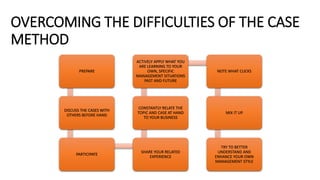
OVERCOMING THE DIFFICULTIES OF THE CASE
METHOD
PREPARE
DISCUSS THE CASES WITH
OTHERS BEFORE HAND
PARTICIPATE
SHARE YOUR RELATED
EXPERIENCE
CONSTANTLY RELATE THE
TOPIC AND CASE AT HAND
TO YOUR BUSINESS
ACTIVELY APPLY WHAT YOU
ARE LEARNING TO YOUR
OWN, SPECIFIC
MANAGEMENT SITUATIONS
PAST AND FUTURE
NOTE WHAT CLICKS
MIX IT UP
TRY TO BETTER
UNDERSTAND AND
ENHANCE YOUR OWN
MANAGEMENT STYLE
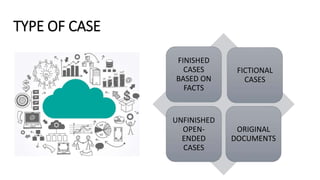
TYPE OF CASE
FINISHED
CASES
BASED ON
FACTS
FICTIONAL
CASES
UNFINISHED
OPEN-
ENDED
CASES
ORIGINAL
DOCUMENTS
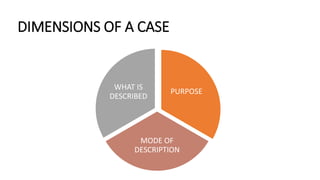
DIMENSIONS OF A CASE
PURPOSE
MODE OF
DESCRIPTION
WHAT IS
DESCRIBED
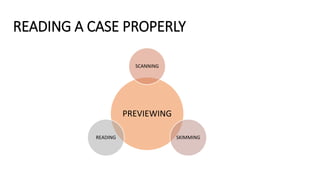
READING A CASE PROPERLY
PREVIEWING
SCANNING
SKIMMINGREADING
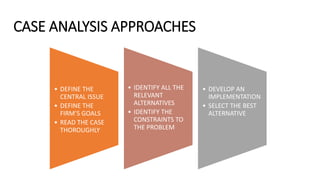
CASE ANALYSIS APPROACHES
• DEFINE THE
CENTRAL ISSUE
• DEFINE THE
FIRM’S GOALS
• READ THE CASE
THOROUGHLY
• IDENTIFY ALL THE
RELEVANT
ALTERNATIVES
• IDENTIFY THE
CONSTRAINTS TO
THE PROBLEM
• DEVELOP AN
IMPLEMENTATION
• SELECT THE BEST
ALTERNATIVE
ANALYSING THE CASE
FLEXIBLE
LIMITATIONS
CULMINATE IN
REFLECATION
COMPREHENSIVE
ADVANTAGES OF USING CASE STUDY METHOD
1.Allows the application of theoretical concepts to be
demonstrated.
2.Encourages the active learning.
3.Gives opportunities for the development of communication,
team work and problem solving.
4.Increases the students’ involvement and motivation to learn.
DO`S FOR CASE ANALYSIS
1. Go through the case twice, ones for a quick overview and once to gain full command of the facts, then take
care to explore the information in every one of the case exhibits.
2. Make a complete list of the problems and issues that the company`s management needs to address.
3. Be through in your analysis of the case situations.
4. Look for opportunities to apply the concepts and analytical tools in the text chapters – all of the cases in the
book have very definite ties to the material in one or more of the text chapters.
5. Do enough number crunching to discover the story told by the data presented in the case.
6. Support any and all oft-the-cliff opinions with well-reasoned arguments and numerical evidence.
7. Prioritize your recommendations and make sure they can be carried out in an acceptable time frame with the
available resources.
8. Support each recommendation with persuasive argument and reasons as to why it makes sense and should
result ¡n improved company performance.
9. Support each recommendation with persuasive argument and reasons as to why it makes sense and should
result ¡n improved company performance.
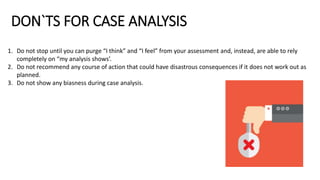
DON`TS FOR CASE ANALYSIS
1. Do not stop until you can purge “I think” and “I feel” from your assessment and, instead, are able to rely
completely on “my analysis shows’.
2. Do not recommend any course of action that could have disastrous consequences if it does not work out as
planned.
3. Do not show any biasness during case analysis.
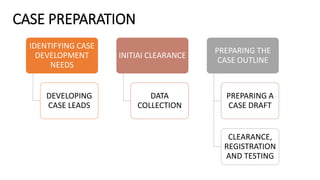
CASE PREPARATION
IDENTIFYING CASE
DEVELOPMENT
NEEDS
DEVELOPING
CASE LEADS
INITIAI CLEARANCE
DATA
COLLECTION
PREPARING THE
CASE OUTLINE
PREPARING A
CASE DRAFT
CLEARANCE,
REGISTRATION
AND TESTING

Case method of learning

  • 2.
    CASE METHOD OFLEARNING The case method is widely used in business courses. Generally case method discussions produce good student involvement. Case methods, like simulation role plays and games are intended to develop student ability to solve problems using knowledge. Skills, and concepts relevant to a course. The students are also expected to be motivated by the case to learn from lectures, readings, or other resources.
  • 3.
    THE ROLE OFTEACHER IN THE CASE METHOD The role of teachers in the case method is mainly to facilitate listening, discussion challenging questioning encouraging problem solving and analysis and proposing theoretical situations to test the rationality of generalizations.
  • 4.
    THE ROLE OFSTUDENTS IN THE CASE METHOD The role of students in the case method is mainly to analyses the case, separating relevant from irrelevant details, and arriving at practical conclusions.
  • 5.
    OVERCOMING THE DIFFICULTIESOF THE CASE METHOD PREPARE DISCUSS THE CASES WITH OTHERS BEFORE HAND PARTICIPATE SHARE YOUR RELATED EXPERIENCE CONSTANTLY RELATE THE TOPIC AND CASE AT HAND TO YOUR BUSINESS ACTIVELY APPLY WHAT YOU ARE LEARNING TO YOUR OWN, SPECIFIC MANAGEMENT SITUATIONS PAST AND FUTURE NOTE WHAT CLICKS MIX IT UP TRY TO BETTER UNDERSTAND AND ENHANCE YOUR OWN MANAGEMENT STYLE
  • 6.
    TYPE OF CASE FINISHED CASES BASEDON FACTS FICTIONAL CASES UNFINISHED OPEN- ENDED CASES ORIGINAL DOCUMENTS
  • 7.
    DIMENSIONS OF ACASE PURPOSE MODE OF DESCRIPTION WHAT IS DESCRIBED
  • 8.
    READING A CASEPROPERLY PREVIEWING SCANNING SKIMMINGREADING
  • 9.
    CASE ANALYSIS APPROACHES •DEFINE THE CENTRAL ISSUE • DEFINE THE FIRM’S GOALS • READ THE CASE THOROUGHLY • IDENTIFY ALL THE RELEVANT ALTERNATIVES • IDENTIFY THE CONSTRAINTS TO THE PROBLEM • DEVELOP AN IMPLEMENTATION • SELECT THE BEST ALTERNATIVE
  • 10.
  • 11.
    ADVANTAGES OF USINGCASE STUDY METHOD 1.Allows the application of theoretical concepts to be demonstrated. 2.Encourages the active learning. 3.Gives opportunities for the development of communication, team work and problem solving. 4.Increases the students’ involvement and motivation to learn.
  • 12.
    DO`S FOR CASEANALYSIS 1. Go through the case twice, ones for a quick overview and once to gain full command of the facts, then take care to explore the information in every one of the case exhibits. 2. Make a complete list of the problems and issues that the company`s management needs to address. 3. Be through in your analysis of the case situations. 4. Look for opportunities to apply the concepts and analytical tools in the text chapters – all of the cases in the book have very definite ties to the material in one or more of the text chapters. 5. Do enough number crunching to discover the story told by the data presented in the case. 6. Support any and all oft-the-cliff opinions with well-reasoned arguments and numerical evidence. 7. Prioritize your recommendations and make sure they can be carried out in an acceptable time frame with the available resources. 8. Support each recommendation with persuasive argument and reasons as to why it makes sense and should result ¡n improved company performance. 9. Support each recommendation with persuasive argument and reasons as to why it makes sense and should result ¡n improved company performance.
  • 13.
    DON`TS FOR CASEANALYSIS 1. Do not stop until you can purge “I think” and “I feel” from your assessment and, instead, are able to rely completely on “my analysis shows’. 2. Do not recommend any course of action that could have disastrous consequences if it does not work out as planned. 3. Do not show any biasness during case analysis.
  • 14.
    CASE PREPARATION IDENTIFYING CASE DEVELOPMENT NEEDS DEVELOPING CASELEADS INITIAI CLEARANCE DATA COLLECTION PREPARING THE CASE OUTLINE PREPARING A CASE DRAFT CLEARANCE, REGISTRATION AND TESTING