CASE ANALYSIS:
Aruna Ramchandra
Shanbaug v Union Of
India.
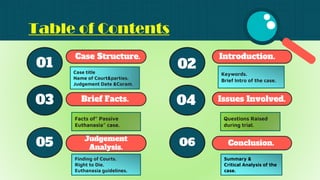
Table of Contents
Case Structure.
01 Case title
Name of Court&parties.
Judgement Date &Coram.
02
Introduction.
Keywords.
Brief Intro of the case.
03 Brief Facts.
Facts of” Passive
Euthanasia” case.
04 Issues Involved.
Questions Raised
during trial.
05 O6 Conclusion.
Judgement
Analysis.
Finding of Courts.
Right to Die.
Euthanasia guidelines.
Summary &
Critical Analysis of the
case.
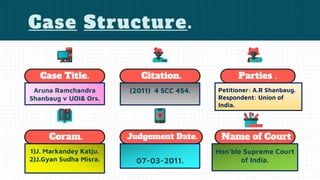
1)J. Markandey Katju.
2)J.Gyan Sudha Misra.
Case Structure.
Coram.
07-03-2011.
Judgement Date.
Hon’ble Supreme Court
of India.
Name of Court
Aruna Ramchandra
Shanbaug v UOI& Ors.
Case Title.
(2011) 4 SCC 454.
Citation.
Petitioner: A.R Shanbaug.
Respondent: Union of
India.
Parties .
Relevant Acts & Articles.
1)Mental Capacity Act, 2005.
2)Termination of Life on
Request & Assisted Suicide Act,
2002.
3)Burial & Cremation Act
Oregon Death with Dignity Act,
1997.
4)Transplantation of Human
Organs Act, 1994(sec.2&3(6)).
Relevant
Acts
Important
Articles
1)Gian Kaur v. State of Punjab
2)P. Rathinam v Union of India.
3)Dwarka Nath v ITO AIR,1966
4)Nancy B. v. Hotel Dieu de
Quebec (1992)
5)Maruti Sripati Dubal case
Etc, so,on.
Cases
Referred
Constitution of India - Article 12,
Constitution of India - Article 21,
Constitution of India - Article 32,
Constitution of India - Article 226,
Constitution of India - Article 226(1).
Introduction
The Constitution of India guarantees ‘Right to Life’ to
all its citizens. The ever-lasting debate on whether
‘Right to Die’ can also be read into this provision still
lingers in the air. The Hon’ble Supreme Court of India,
in this case, was approached under Article 32 of the
Indian Constitution to allow for the termination of the
life of Aruna Ramchandra Shanbaug, who was in a
permanent vegetative state.
Let us all see ,the say of the apex court , scope of life
under Article 21 & what was the guidelines for
euthanasia given in the given case.
KEYWORDS:-
Article 21, Scope of Life, Right to
Die, Brain Death, PVS, Euthanasia,
Withdrawal of life support
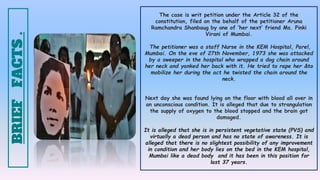
The case is writ petition under the Article 32 of the
constitution, filed on the behalf of the petitioner Aruna
Ramchandra Shanbaug by one of ‘her next’ friend Ms. Pinki
Virani of Mumbai.
The petitioner was a staff Nurse in the KEM Hospital, Parel,
Mumbai. On the eve of 27th November, 1973 she was attacked
by a sweeper in the hospital who wrapped a dog chain around
her neck and yanked her back with it. He tried to rape her &to
mobilize her during the act he twisted the chain around the
neck.
Next day she was found lying on the floor with blood all over in
an unconscious condition. It is alleged that due to strangulation
the supply of oxygen to the blood stopped and the brain got
damaged.
It is alleged that she is in persistent vegetative state (PVS) and
virtually a dead person and has no state of awareness. It is
alleged that there is no slightest possibility of any improvement
in condition and her body lies on the bed in the KEM hospital,
Mumbai like a dead body and it has been in this position for
last 37 years.
BRIEF
FACTS
.
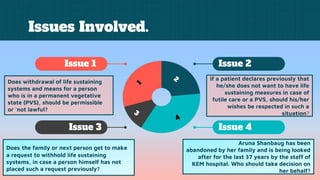
Issues Involved.
Does the family or next person get to make
a request to withhold life sustaining
systems, in case a person himself has not
placed such a request previously?
Issue 3
Does withdrawal of life sustaining
systems and means for a person
who is in a permanent vegetative
state (PVS), should be permissible
or ‘not lawful?
Issue 1
Aruna Shanbaug has been
abandoned by her family and is being looked
after for the last 37 years by the staff of
KEM hospital. Who should take decision on
her behalf?
Issue 4
If a patient declares previously that
he/she does not want to have life
sustaining measures in case of
futile care or a PVS, should his/her
wishes be respected in such a
situation?
Issue 2
JUDGEMENT HELD
The Hon’ble Division Bench of the Supreme Court of
India, comprising Justice Markandey Katju and Justice
Gyan Sudha Mishra, delivered this historic judgment on
March 7, 2011.
She could breathe without a support machine, had
feelings and produced necessary stimulus. Though she is
in a PVS, her condition was been stable. So, terminating
her life was unjustified.
The Court opined that based on the doctors’ report and
the definition of brain death under the Transplantation
of Human Organs Act, 1994, Aruna was not brain dead.
Further, the right to take decision on her behalf vested
with the management and staff of KEM Hospital and not
Pinki Virani.
The lifesaving technique was the mashed food, on which she
was surviving & removal of it in this case would have meant
not feeding her. The Indian law in no way advocates not
giving food to a person.
Removal of ventilators and discontinuation of food could not
be equated. Allowing of euthanasia to Aruna would mean
reversing the efforts taken by the nurses of KEM Hospital
over the years.
"Marte hain aarzoo mein marne ki, Maut
aati hai par nahin aati.”
—-- Mirza Ghalib
“Human rights rest on human dignity. The
dignity of a man is worth fighting for & worth
dying for.”
-- Robert Maynard.
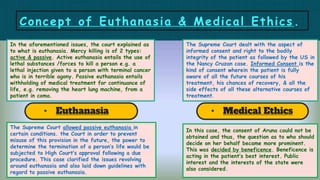
Concept of Euthanasia & Medical Ethics .
In this case, the consent of Aruna could not be
obtained and thus, the question as to who should
decide on her behalf became more prominent.
This was decided by beneficence. Beneficence is
acting in the patient’s best interest. Public
interest and the interests of the state were
also considered.
• Euthanasia • Medical Ethics
In the aforementioned issues, the court explained as
to what is euthanasia. Mercy killing is of 2 types:
active & passive. Active euthanasia entails the use of
lethal substances /forces to kill a person e.g. a
lethal injection given to a person with terminal cancer
who is in terrible agony. Passive euthanasia entails
withholding of medical treatment for continuance of
life, e.g. removing the heart lung machine, from a
patient in coma.
The Supreme Court dealt with the aspect of
informed consent and right to the bodily
integrity of the patient as followed by the US in
the Nancy Cruzan case. Informed Consent is the
kind of consent wherein the patient is fully
aware of all the future courses of his
treatment, his chances of recovery, & all the
side effects of all these alternative courses of
treatment.
The Supreme Court allowed passive euthanasia in
certain conditions. the Court in order to prevent
misuse of this provision in the future, the power to
determine the termination of a person’s life would be
subjected to High Court’s approval following a due
procedure. This case clarified the issues revolving
around euthanasia and also laid down guidelines with
regard to passive euthanasia.
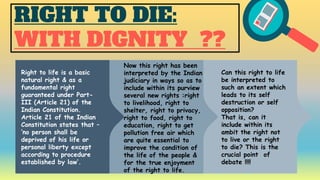
RIGHT TO DIE:
WITH DIGNITY ??
Right to life is a basic
natural right & as a
fundamental right
guaranteed under Part-
III (Article 21) of the
Indian Constitution.
Article 21 of the Indian
Constitution states that –
‘no person shall be
deprived of his life or
personal liberty except
according to procedure
established by law’.
Now this right has been
interpreted by the Indian
judiciary in ways so as to
include within its purview
several new rights :right
to livelihood, right to
shelter, right to privacy,
right to food, right to
education, right to get
pollution free air which
are quite essential to
improve the condition of
the life of the people &
for the true enjoyment
of the right to life.
Can this right to life
be interpreted to
such an extent which
leads to its self
destruction or self
opposition?
That is, can it
include within its
ambit the right not
to live or the right
to die? This is the
crucial point of
debate !!!!
Scope of new right :-
When Life
becomes far more
painful &
unbearable than
death, then it is
very normal for
him to desire
death. This
voluntary
embracing of
death is known as
euthanasia or
mercy killing.
Euthanasia is also
termed as
“DAYAMARAN”.
Cases in which
the scope of
right to die with
dignity evolved
were:
1)Maruti Sripati
Dubal case
2) P.Rathinam
v.UOI.
3) Gian Kaur v
State of Punjab.
4)Aruna
Shanbaug case.
5)Common Cause
v. UOI.
Causing
extinction of a
life unnaturally
by the action
of oneself is
morally bad +
legally
punishable.
Exceptions : In
certain
circumstances
death is allowed
when it is with
the full and
real consent of
the person who
is going to die.
Death can
be defined as
termination of
life.
It is categorized
Into 2 kinds:-
1) Natural
2)Unnatural
death.
It can be caused
by action as
well
as
the inaction of a
person.
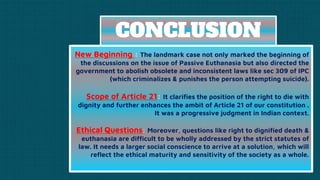
CONCLUSION
New Beginning : The landmark case not only marked the beginning of
the discussions on the issue of Passive Euthanasia but also directed the
government to abolish obsolete and inconsistent laws like sec 309 of IPC
(which criminalizes & punishes the person attempting suicide).
Scope of Article 21: It clarifies the position of the right to die with
dignity and further enhances the ambit of Article 21 of our constitution .
It was a progressive judgment in Indian context.
Ethical Questions: Moreover, questions like right to dignified death &
euthanasia are difficult to be wholly addressed by the strict statutes of
law. It needs a larger social conscience to arrive at a solution, which will
reflect the ethical maturity and sensitivity of the society as a whole.
CREDITS: This presentation template was created by Slidesgo,
including icons by Flaticon, infographics & images by Freepik
Thanks !!
THANK
YOU !! 

Case analysis.

  • 1.
  • 2.
    Table of Contents CaseStructure. 01 Case title Name of Court&parties. Judgement Date &Coram. 02 Introduction. Keywords. Brief Intro of the case. 03 Brief Facts. Facts of” Passive Euthanasia” case. 04 Issues Involved. Questions Raised during trial. 05 O6 Conclusion. Judgement Analysis. Finding of Courts. Right to Die. Euthanasia guidelines. Summary & Critical Analysis of the case.
  • 3.
    1)J. Markandey Katju. 2)J.GyanSudha Misra. Case Structure. Coram. 07-03-2011. Judgement Date. Hon’ble Supreme Court of India. Name of Court Aruna Ramchandra Shanbaug v UOI& Ors. Case Title. (2011) 4 SCC 454. Citation. Petitioner: A.R Shanbaug. Respondent: Union of India. Parties .
  • 4.
    Relevant Acts &Articles. 1)Mental Capacity Act, 2005. 2)Termination of Life on Request & Assisted Suicide Act, 2002. 3)Burial & Cremation Act Oregon Death with Dignity Act, 1997. 4)Transplantation of Human Organs Act, 1994(sec.2&3(6)). Relevant Acts Important Articles 1)Gian Kaur v. State of Punjab 2)P. Rathinam v Union of India. 3)Dwarka Nath v ITO AIR,1966 4)Nancy B. v. Hotel Dieu de Quebec (1992) 5)Maruti Sripati Dubal case Etc, so,on. Cases Referred Constitution of India - Article 12, Constitution of India - Article 21, Constitution of India - Article 32, Constitution of India - Article 226, Constitution of India - Article 226(1).
  • 5.
    Introduction The Constitution ofIndia guarantees ‘Right to Life’ to all its citizens. The ever-lasting debate on whether ‘Right to Die’ can also be read into this provision still lingers in the air. The Hon’ble Supreme Court of India, in this case, was approached under Article 32 of the Indian Constitution to allow for the termination of the life of Aruna Ramchandra Shanbaug, who was in a permanent vegetative state. Let us all see ,the say of the apex court , scope of life under Article 21 & what was the guidelines for euthanasia given in the given case. KEYWORDS:- Article 21, Scope of Life, Right to Die, Brain Death, PVS, Euthanasia, Withdrawal of life support
  • 6.
    The case iswrit petition under the Article 32 of the constitution, filed on the behalf of the petitioner Aruna Ramchandra Shanbaug by one of ‘her next’ friend Ms. Pinki Virani of Mumbai. The petitioner was a staff Nurse in the KEM Hospital, Parel, Mumbai. On the eve of 27th November, 1973 she was attacked by a sweeper in the hospital who wrapped a dog chain around her neck and yanked her back with it. He tried to rape her &to mobilize her during the act he twisted the chain around the neck. Next day she was found lying on the floor with blood all over in an unconscious condition. It is alleged that due to strangulation the supply of oxygen to the blood stopped and the brain got damaged. It is alleged that she is in persistent vegetative state (PVS) and virtually a dead person and has no state of awareness. It is alleged that there is no slightest possibility of any improvement in condition and her body lies on the bed in the KEM hospital, Mumbai like a dead body and it has been in this position for last 37 years. BRIEF FACTS .
  • 7.
    Issues Involved. Does thefamily or next person get to make a request to withhold life sustaining systems, in case a person himself has not placed such a request previously? Issue 3 Does withdrawal of life sustaining systems and means for a person who is in a permanent vegetative state (PVS), should be permissible or ‘not lawful? Issue 1 Aruna Shanbaug has been abandoned by her family and is being looked after for the last 37 years by the staff of KEM hospital. Who should take decision on her behalf? Issue 4 If a patient declares previously that he/she does not want to have life sustaining measures in case of futile care or a PVS, should his/her wishes be respected in such a situation? Issue 2
  • 8.
    JUDGEMENT HELD The Hon’bleDivision Bench of the Supreme Court of India, comprising Justice Markandey Katju and Justice Gyan Sudha Mishra, delivered this historic judgment on March 7, 2011. She could breathe without a support machine, had feelings and produced necessary stimulus. Though she is in a PVS, her condition was been stable. So, terminating her life was unjustified. The Court opined that based on the doctors’ report and the definition of brain death under the Transplantation of Human Organs Act, 1994, Aruna was not brain dead.
  • 9.
    Further, the rightto take decision on her behalf vested with the management and staff of KEM Hospital and not Pinki Virani. The lifesaving technique was the mashed food, on which she was surviving & removal of it in this case would have meant not feeding her. The Indian law in no way advocates not giving food to a person. Removal of ventilators and discontinuation of food could not be equated. Allowing of euthanasia to Aruna would mean reversing the efforts taken by the nurses of KEM Hospital over the years.
  • 10.
    "Marte hain aarzoomein marne ki, Maut aati hai par nahin aati.” —-- Mirza Ghalib “Human rights rest on human dignity. The dignity of a man is worth fighting for & worth dying for.” -- Robert Maynard.
  • 11.
    Concept of Euthanasia& Medical Ethics . In this case, the consent of Aruna could not be obtained and thus, the question as to who should decide on her behalf became more prominent. This was decided by beneficence. Beneficence is acting in the patient’s best interest. Public interest and the interests of the state were also considered. • Euthanasia • Medical Ethics In the aforementioned issues, the court explained as to what is euthanasia. Mercy killing is of 2 types: active & passive. Active euthanasia entails the use of lethal substances /forces to kill a person e.g. a lethal injection given to a person with terminal cancer who is in terrible agony. Passive euthanasia entails withholding of medical treatment for continuance of life, e.g. removing the heart lung machine, from a patient in coma. The Supreme Court dealt with the aspect of informed consent and right to the bodily integrity of the patient as followed by the US in the Nancy Cruzan case. Informed Consent is the kind of consent wherein the patient is fully aware of all the future courses of his treatment, his chances of recovery, & all the side effects of all these alternative courses of treatment. The Supreme Court allowed passive euthanasia in certain conditions. the Court in order to prevent misuse of this provision in the future, the power to determine the termination of a person’s life would be subjected to High Court’s approval following a due procedure. This case clarified the issues revolving around euthanasia and also laid down guidelines with regard to passive euthanasia.
  • 12.
    RIGHT TO DIE: WITHDIGNITY ?? Right to life is a basic natural right & as a fundamental right guaranteed under Part- III (Article 21) of the Indian Constitution. Article 21 of the Indian Constitution states that – ‘no person shall be deprived of his life or personal liberty except according to procedure established by law’. Now this right has been interpreted by the Indian judiciary in ways so as to include within its purview several new rights :right to livelihood, right to shelter, right to privacy, right to food, right to education, right to get pollution free air which are quite essential to improve the condition of the life of the people & for the true enjoyment of the right to life. Can this right to life be interpreted to such an extent which leads to its self destruction or self opposition? That is, can it include within its ambit the right not to live or the right to die? This is the crucial point of debate !!!!
  • 13.
    Scope of newright :- When Life becomes far more painful & unbearable than death, then it is very normal for him to desire death. This voluntary embracing of death is known as euthanasia or mercy killing. Euthanasia is also termed as “DAYAMARAN”. Cases in which the scope of right to die with dignity evolved were: 1)Maruti Sripati Dubal case 2) P.Rathinam v.UOI. 3) Gian Kaur v State of Punjab. 4)Aruna Shanbaug case. 5)Common Cause v. UOI. Causing extinction of a life unnaturally by the action of oneself is morally bad + legally punishable. Exceptions : In certain circumstances death is allowed when it is with the full and real consent of the person who is going to die. Death can be defined as termination of life. It is categorized Into 2 kinds:- 1) Natural 2)Unnatural death. It can be caused by action as well as the inaction of a person.
  • 14.
    CONCLUSION New Beginning :The landmark case not only marked the beginning of the discussions on the issue of Passive Euthanasia but also directed the government to abolish obsolete and inconsistent laws like sec 309 of IPC (which criminalizes & punishes the person attempting suicide). Scope of Article 21: It clarifies the position of the right to die with dignity and further enhances the ambit of Article 21 of our constitution . It was a progressive judgment in Indian context. Ethical Questions: Moreover, questions like right to dignified death & euthanasia are difficult to be wholly addressed by the strict statutes of law. It needs a larger social conscience to arrive at a solution, which will reflect the ethical maturity and sensitivity of the society as a whole.
  • 15.
    CREDITS: This presentationtemplate was created by Slidesgo, including icons by Flaticon, infographics & images by Freepik Thanks !! THANK YOU !! 