IT Security For
Librarians:
Outrunning The Bear
@ Your Library
Blake Carver – blake.carver@lyrasis.org
LYRASIS Systems Administrator
Attackers are economically rational – they
take scarce resources and apply them
efficiently to achieve a desired outcome. As
a defender, making the target less attractive
or too expensive for that economically
rational actor means they will go after
something else. “It’s like the old saying:
you don’t have to outrun the
bear. You just have to outrun
your friend.”
Brad Arkin, Adobe's chief security officer
Everything You Need To Know
Build a Defensible Library
Lock Everything Down
Assume your secrets are not safe
Threat Modeling
Training
From: Geraldo Spence <email@example.com>
To: <somone@example.com>
Subject: FW: Order Status #001204
Date: Tue, 22 Mar 2016 07:01:47 +0300
Dear someone,
We would like to thank you for your recent order.
Order Status updated on: 21/03/2016
Your Customer ID: 001204
Your Order ID: 4081F78D45-M-2016
Invoice Number: 5978299
Delivery Note:
We received your order and payment on 17/03/2016
Your order details are attached.
Best regards,
Geraldo Spence
Chief Executive Officer - Food Packaging Company
Libraries Live Below
The Security Poverty Line(Wendy Nather)
We simply can't afford to reach a great level of security
Few or no IT People
Few or no Security People
Hard to keep up with technology and security
Maintenance, planning, strategy are 2nd to OMG
Depend on consultants, vendors, family, patrons,
friends, volunteers, etc...
This leaves us in a bad place

Defaults

Old and outdated

Workarounds

Not much control

No time to focus

"We'll fix it later"
So what can we do?

Budget?

Buy things that are more secure.

Question our vendors and partners on
security.

Use our consortia
So what can we do?

Develop a good Threat Model

Set achievable security goals

Learning, Planning & Training

Develop IT- and security-focused
community groups for the exchange of
ideas, information and known security
threats. (Associations and Conferences)
Make Your Library Defensible
Able To Be Defended
• Defensible does not mean secure
• There are more things to defend than there
are resources to defend with
• Defensibility focuses on what, why, how,
when and from whom
Defensible Libraries
• A change in mindset
• Awareness of limitations & weaknesses
• Awareness of threats
• An admission of inconvenience
• A lot of hard, detailed and
underappreciated work.
So Let’s Think About…
• What do we have to secure?
• Who wants it?
• How could they acquire it?
• How could they benefit from its use?
–Can they sell it?
–Can they hold it hostage?
–Can they use & abuse it?
• How damaging would the loss of data be?
• How would this effect library operations?
• How secure do we really need to be?
But We’re Just A Library
IT Security For Libraries
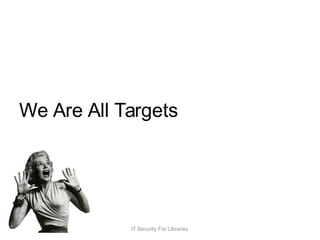
We Are All Targets
IT Security For Libraries
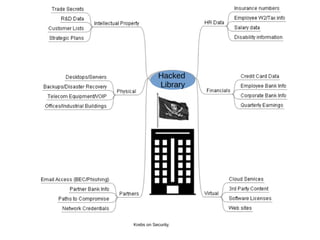
Why A Library?
Easy Access to PII
Organizational Rigidity
Limited Resources
Academic Mindset
Target Rich Environment
Krebs on Security.
Hacked
Library
Every access point to the
internet is potential breach.
83% targets of opportunity
92% of attacks were easy
85% were found by a 3rd party
IT Security For Libraries
Verizon Data Breach Investigations Report
84% were found by a 3rd
party
Bad guys were in for 175 days before
they were discovered.
Trustwave 2012 Global Security Report
IT Security For Libraries
It’s Easy Being Bad
IT Security For Libraries
The attacker only needs to
succeed once...
IT Security For Libraries
While we need to catch every
single thing...
IT Security For Libraries
Staying safe takes more than
just a firewall & AV/AM...
IT Security For Libraries
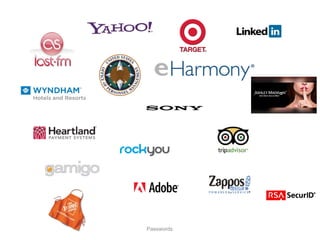
Passwords
Your security software /
hardware is a seat belt – not a
force field.
IT Security For Libraries
Complexity is the Enemy of
Security
• We have no shortage of access points
• We deal with any number of vendors
• Threats come from outside the libraries
• Threats come from inside the libraries
•Our libraries are full of people
IT Security For Libraries
“If It Ain’t Broke...”
• The vast majority of attacks…
–Won’t be targeted
–Will Be Easily Avoidable
–Will be invisible
Do something.... Do Anything!
IT Security For Libraries
Don't Make Things Easy
There are more things to
defend than there are
resources to defend with
Not every asset in your
organization is equally
valuable
An attacker will always pick
the weakest point of entry…
…but you can't know which
point that is
The Weakest Point In A Library?
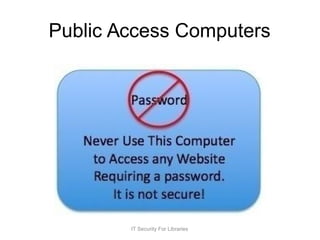
Public Access Computers
IT Security For Libraries
Public Access Computers
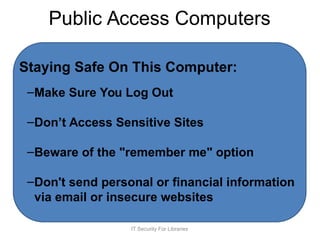
Staying Safe On This Computer:
–Make Sure You Log Out
–Don’t Access Sensitive Sites
–Beware of the "remember me" option
–Don't send personal or financial information
via email or insecure websites
IT Security For Libraries
Technical Countermeasures
Most exploits used “old”
issues that have been
patched
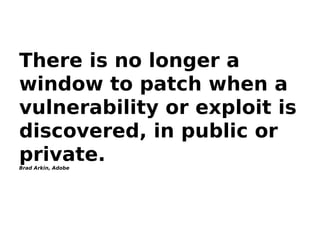
There is no longer a
window to patch when a
vulnerability or exploit is
discovered, in public or
private.Brad Arkin, Adobe
Locking Down Public Access
Computers
• Patching and Updating
–OS and *ALL* Applications
• Whitelisting
• Passwords
• SteadyState / DeepFreeze / SmartShield
• Don’t use Windows?
• Don’t use IE?
IT Security For Libraries
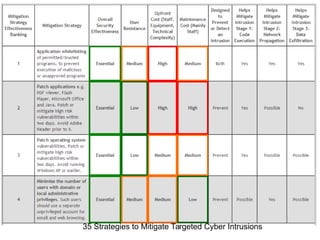
35 Strategies to Mitigate Targeted Cyber Intrusions
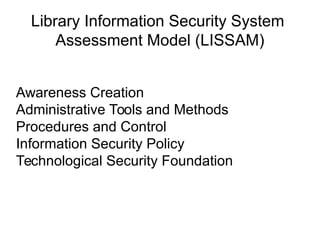
Library Information Security System
Assessment Model (LISSAM)
Awareness Creation
Administrative Tools and Methods
Procedures and Control
Information Security Policy
Technological Security Foundation
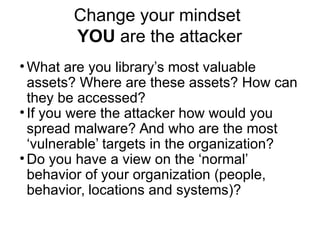
Change your mindset
YOU are the attacker
• What are you library’s most valuable
assets? Where are these assets? How can
they be accessed?
• If you were the attacker how would you
spread malware? And who are the most
‘vulnerable’ targets in the organization?
• Do you have a view on the ‘normal’
behavior of your organization (people,
behavior, locations and systems)?
Level the playing field…
Hack Your library!
Library Information Security System
Assessment Model (LISSAM)
Awareness Creation
Administrative Tools and Methods
Procedures and Control
Information Security Policy
Technological Security Foundation
Also...
• Check usernames/passwords for your library -
●
osint-opsec-tool
●
pastebin.com
• HTTPS
• Someone needs to stay current
• Is your domain name going to expire?
• 2FA
• Password Managers
IT Security For Libraries
- Training -
Non-technical Countermeasures
Train A Security Mindset
Quickly forgotten without practice and
reminders
Regular low level of training and awareness
Build Cybersecurity Champions
IT Security For Libraries
Training does not work
It's not worth it because someone will
still mess up
People already know what to do
This stuff us easy / obvious
Good security awareness
programs help all employees
know where to get help
Who they should call when there is trouble
Where they can look for guidance & policies
They should know that they will not be looked
down on for making a mistake
Someone’s job is to help them through
whatever difficulty they are having
We can't make everyone
an expert
We do NOT need to train the non-technical
employees about what the deep level geek
employees already know.
Building Good Habits
“Being secure” is something that is learned
over time and eventually becomes a habit.
Make the security mindset the default
Consistent reinforcement of the importance
of IT Security
Understanding awareness, training,
and development
What we want is policies that reinforce good
security principles that will foster over time a
new instinct in people, a new way of
looking at things, a new way of acting in
a more secure way.
This will require a huge amount of patience
and buy in from every at your library.
IT Security For Libraries
Carver, Blake Name
123456 ID Number
00123456 User ID
carver Password
05/01/2012 End Date
Training
• Phishing
• Social Engineering
• Privacy
• Passwords
• Email Attachments
• Virus Alerts
• How to practice safe social networking
• Keeping things updated
IT Security For Libraries
What we want is policies that reinforce good
security principles that will foster over time a
new instinct in people, a new way of
looking at things, a new way of acting in
a more secure way.
The goal is to make doing
things the right way become
the default in your library
Training…. Patrons?
• Your patrons don't care much for security
• Their habits are inviting malware
• Look for ways to make things safer in ways
that don't interfere with people's everyday
tasks as much as possible.
• Principle of Least Privilege
IT Security For Libraries
http://www.pewinternet.org/files/2015/09/2015-09-15_libraries_FINAL.pdf
Offer Training At Your Library
Library Security Mantra
• Security
• Privacy
• Confidentiality
• Integrity
• Availability
• Access
(based on Net Sec 101 Ayre and Lawthers 2001)
IT Security For Libraries
Preparation - Practical Resources
• SANS 20 Critical Security Controls
– sans.org
• Securing Library Technology: A How-To-Do-It Manual
– Earp & Wright
• Strategies to Mitigate Targeted Cyber Intrusions
– Australian Signals Directorate
• Library Information Security System Assessment Model
– (LISSAM)
– Malaysian Journal of Library & Information Science, Vol. 16, no. 2
 Virtual Privacy Lab from the San José Public Library
https://www.sjpl.org/privacy
 Library Freedom Project
https://libraryfreedomproject.org/
IT Security For Libraries
IT Security For
Librarians:
Outrunning The Bear
@ Your Library
Blake Carver – blake.carver@lyrasis.org
LYRASIS Systems Administrator

Carver IT Security for Librarians

  • 1.
    IT Security For Librarians: OutrunningThe Bear @ Your Library Blake Carver – blake.carver@lyrasis.org LYRASIS Systems Administrator
  • 2.
    Attackers are economicallyrational – they take scarce resources and apply them efficiently to achieve a desired outcome. As a defender, making the target less attractive or too expensive for that economically rational actor means they will go after something else. “It’s like the old saying: you don’t have to outrun the bear. You just have to outrun your friend.” Brad Arkin, Adobe's chief security officer
  • 3.
    Everything You NeedTo Know Build a Defensible Library Lock Everything Down Assume your secrets are not safe Threat Modeling Training
  • 4.
    From: Geraldo Spence<email@example.com> To: <somone@example.com> Subject: FW: Order Status #001204 Date: Tue, 22 Mar 2016 07:01:47 +0300 Dear someone, We would like to thank you for your recent order. Order Status updated on: 21/03/2016 Your Customer ID: 001204 Your Order ID: 4081F78D45-M-2016 Invoice Number: 5978299 Delivery Note: We received your order and payment on 17/03/2016 Your order details are attached. Best regards, Geraldo Spence Chief Executive Officer - Food Packaging Company
  • 6.
    Libraries Live Below TheSecurity Poverty Line(Wendy Nather) We simply can't afford to reach a great level of security Few or no IT People Few or no Security People Hard to keep up with technology and security Maintenance, planning, strategy are 2nd to OMG Depend on consultants, vendors, family, patrons, friends, volunteers, etc...
  • 7.
    This leaves usin a bad place  Defaults  Old and outdated  Workarounds  Not much control  No time to focus  "We'll fix it later"
  • 8.
    So what canwe do?  Budget?  Buy things that are more secure.  Question our vendors and partners on security.  Use our consortia
  • 9.
    So what canwe do?  Develop a good Threat Model  Set achievable security goals  Learning, Planning & Training  Develop IT- and security-focused community groups for the exchange of ideas, information and known security threats. (Associations and Conferences)
  • 10.
  • 11.
    Able To BeDefended • Defensible does not mean secure • There are more things to defend than there are resources to defend with • Defensibility focuses on what, why, how, when and from whom
  • 12.
    Defensible Libraries • Achange in mindset • Awareness of limitations & weaknesses • Awareness of threats • An admission of inconvenience • A lot of hard, detailed and underappreciated work.
  • 13.
    So Let’s ThinkAbout… • What do we have to secure? • Who wants it? • How could they acquire it? • How could they benefit from its use? –Can they sell it? –Can they hold it hostage? –Can they use & abuse it? • How damaging would the loss of data be? • How would this effect library operations? • How secure do we really need to be?
  • 14.
    But We’re JustA Library IT Security For Libraries
  • 15.
    We Are AllTargets IT Security For Libraries
  • 16.
    Why A Library? EasyAccess to PII Organizational Rigidity Limited Resources Academic Mindset Target Rich Environment
  • 17.
  • 18.
    Every access pointto the internet is potential breach.
  • 19.
    83% targets ofopportunity 92% of attacks were easy 85% were found by a 3rd party IT Security For Libraries Verizon Data Breach Investigations Report
  • 20.
    84% were foundby a 3rd party Bad guys were in for 175 days before they were discovered. Trustwave 2012 Global Security Report IT Security For Libraries
  • 21.
    It’s Easy BeingBad IT Security For Libraries
  • 22.
    The attacker onlyneeds to succeed once... IT Security For Libraries
  • 23.
    While we needto catch every single thing... IT Security For Libraries
  • 24.
    Staying safe takesmore than just a firewall & AV/AM... IT Security For Libraries
  • 25.
  • 26.
    Your security software/ hardware is a seat belt – not a force field. IT Security For Libraries
  • 27.
    Complexity is theEnemy of Security • We have no shortage of access points • We deal with any number of vendors • Threats come from outside the libraries • Threats come from inside the libraries •Our libraries are full of people IT Security For Libraries
  • 28.
    “If It Ain’tBroke...” • The vast majority of attacks… –Won’t be targeted –Will Be Easily Avoidable –Will be invisible Do something.... Do Anything! IT Security For Libraries
  • 29.
  • 30.
    There are morethings to defend than there are resources to defend with Not every asset in your organization is equally valuable
  • 31.
    An attacker willalways pick the weakest point of entry… …but you can't know which point that is
  • 32.
    The Weakest PointIn A Library?
  • 33.
    Public Access Computers ITSecurity For Libraries
  • 34.
    Public Access Computers StayingSafe On This Computer: –Make Sure You Log Out –Don’t Access Sensitive Sites –Beware of the "remember me" option –Don't send personal or financial information via email or insecure websites IT Security For Libraries
  • 35.
  • 36.
    Most exploits used“old” issues that have been patched
  • 37.
    There is nolonger a window to patch when a vulnerability or exploit is discovered, in public or private.Brad Arkin, Adobe
  • 38.
    Locking Down PublicAccess Computers • Patching and Updating –OS and *ALL* Applications • Whitelisting • Passwords • SteadyState / DeepFreeze / SmartShield • Don’t use Windows? • Don’t use IE? IT Security For Libraries
  • 39.
    35 Strategies toMitigate Targeted Cyber Intrusions
  • 40.
    Library Information SecuritySystem Assessment Model (LISSAM) Awareness Creation Administrative Tools and Methods Procedures and Control Information Security Policy Technological Security Foundation
  • 41.
    Change your mindset YOUare the attacker • What are you library’s most valuable assets? Where are these assets? How can they be accessed? • If you were the attacker how would you spread malware? And who are the most ‘vulnerable’ targets in the organization? • Do you have a view on the ‘normal’ behavior of your organization (people, behavior, locations and systems)?
  • 42.
    Level the playingfield… Hack Your library!
  • 45.
    Library Information SecuritySystem Assessment Model (LISSAM) Awareness Creation Administrative Tools and Methods Procedures and Control Information Security Policy Technological Security Foundation
  • 46.
    Also... • Check usernames/passwordsfor your library - ● osint-opsec-tool ● pastebin.com • HTTPS • Someone needs to stay current • Is your domain name going to expire? • 2FA • Password Managers IT Security For Libraries
  • 47.
    - Training - Non-technicalCountermeasures Train A Security Mindset Quickly forgotten without practice and reminders Regular low level of training and awareness Build Cybersecurity Champions IT Security For Libraries
  • 48.
    Training does notwork It's not worth it because someone will still mess up People already know what to do This stuff us easy / obvious
  • 49.
    Good security awareness programshelp all employees know where to get help Who they should call when there is trouble Where they can look for guidance & policies They should know that they will not be looked down on for making a mistake Someone’s job is to help them through whatever difficulty they are having
  • 50.
    We can't makeeveryone an expert We do NOT need to train the non-technical employees about what the deep level geek employees already know.
  • 51.
    Building Good Habits “Beingsecure” is something that is learned over time and eventually becomes a habit. Make the security mindset the default Consistent reinforcement of the importance of IT Security
  • 53.
    Understanding awareness, training, anddevelopment What we want is policies that reinforce good security principles that will foster over time a new instinct in people, a new way of looking at things, a new way of acting in a more secure way. This will require a huge amount of patience and buy in from every at your library.
  • 55.
    IT Security ForLibraries
  • 56.
    Carver, Blake Name 123456ID Number 00123456 User ID carver Password 05/01/2012 End Date
  • 57.
    Training • Phishing • SocialEngineering • Privacy • Passwords • Email Attachments • Virus Alerts • How to practice safe social networking • Keeping things updated IT Security For Libraries
  • 58.
    What we wantis policies that reinforce good security principles that will foster over time a new instinct in people, a new way of looking at things, a new way of acting in a more secure way.
  • 59.
    The goal isto make doing things the right way become the default in your library
  • 60.
    Training…. Patrons? • Yourpatrons don't care much for security • Their habits are inviting malware • Look for ways to make things safer in ways that don't interfere with people's everyday tasks as much as possible. • Principle of Least Privilege IT Security For Libraries
  • 61.
  • 62.
    Library Security Mantra •Security • Privacy • Confidentiality • Integrity • Availability • Access (based on Net Sec 101 Ayre and Lawthers 2001) IT Security For Libraries
  • 63.
    Preparation - PracticalResources • SANS 20 Critical Security Controls – sans.org • Securing Library Technology: A How-To-Do-It Manual – Earp & Wright • Strategies to Mitigate Targeted Cyber Intrusions – Australian Signals Directorate • Library Information Security System Assessment Model – (LISSAM) – Malaysian Journal of Library & Information Science, Vol. 16, no. 2  Virtual Privacy Lab from the San José Public Library https://www.sjpl.org/privacy  Library Freedom Project https://libraryfreedomproject.org/ IT Security For Libraries
  • 64.
    IT Security For Librarians: OutrunningThe Bear @ Your Library Blake Carver – blake.carver@lyrasis.org LYRASIS Systems Administrator