








Career Planning – Options for
Psychologists
Andy Kay
Tahira Majothi
Careers Consultants
www.careers.salford.ac.uk
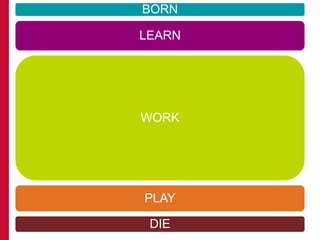
BORN
LEARN

WORK

PLAY

DIE

4
Aims and Objectives
• By the end of this workshop you will:
– Understand the value of your degree beyond the
subject knowledge you acquire
– Know the typical career paths followed by
psychology graduates
– Consider some career planning approaches and
apply them to your thinking about the future
– Know some credible sources of career information
that relate to your subject area
?
What is the value of your Degree?
It‟s all about employability
“A set of achievements – skills, understandings
and personal attributes – that makes
graduates more likely to gain employment and
be successful in their chosen occupations,
which benefits themselves, the workforce, the
community and the economy.”
Mantze Yorke, Higher Education Academy, 2003
But how do you choose a
career?
• If you don‟t know where you are going…how
do you know when you‟ve got there?
• If you don‟t know where you are going…you
might end up somewhere more interesting.
Career Theories
Matching
Development
Environment

Cognitive process
Some questions
• What approach feels right to you?
• Which theory corresponds to your view of
career?
• Can you plan a career?
• Did you plan to be where you are now?
– How did you approach this?
http://www.careerplayer.com/tips-and-advice/general-advice/start-your-career-hunt
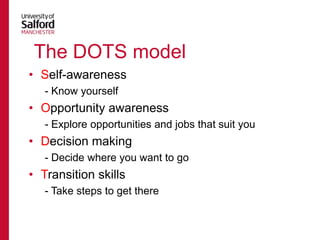
The DOTS model
• Self-awareness
- Know yourself

• Opportunity awareness
- Explore opportunities and jobs that suit you

• Decision making
- Decide where you want to go

• Transition skills
- Take steps to get there
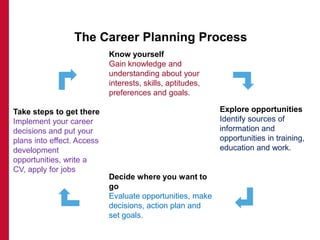
The Career Planning Process
Know yourself
Gain knowledge and
understanding about your
interests, skills, aptitudes,
preferences and goals.
Explore opportunities
Identify sources of
information and
opportunities in training,
education and work.

Take steps to get there
Implement your career
decisions and put your
plans into effect. Access
development
opportunities, write a
CV, apply for jobs
Decide where you want to
go
Evaluate opportunities, make
decisions, action plan and
set goals.
Planned Happenstance or the
“Chaos” approach
http://www.youtube.com/watch?v=7OqhUrXhaAM
What‟s the point?
• Evidence from research shows that self
awareness is at the heart of success in
graduate jobs
– Habits of self-awareness, reflection and pro-active
learning central to career development

(Strategis Research, 2004)

16
Career Planning – the
essentials
Focuses on some big things…
– Who you are and what makes you tick
– What you want & where you want to be
– Where you are now in relation to a goal
that you have defined
– What kind of life(style) you want
– How you can get there
17
Opportunity Awareness
• If you don‟t know what‟s „out there‟ how will
you know it‟s for you
• What do jobs really involve? Will I enjoy it?
• What are the entry requirements
• Do I need a postgraduate course?
• Who employs people doing this?
• Where are jobs advertised?
• How competitive is the job market?
Psychology Career options
What can help you decide?
• Getting some work experience in fields that
you feel might interest you
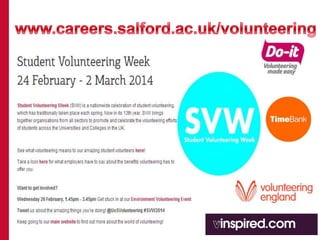
• Getting some experience through volunteering
• Understanding what you most enjoy or find
interesting about your course
• Researching career options and understanding
what jobs really involve
• Arranging informational interviews to find out
what it‟s like to do a job
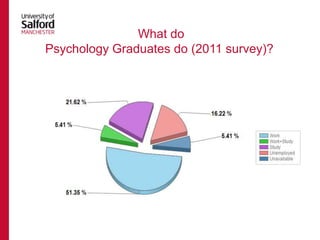
What do
Psychology Graduates do (2011 survey)?
Set up a Psychology
Student Society!

• Great way to connect with peers on the course
• Support provided by the Students‟ Union
• Funding may be available for activities, guest
speakers etc.
• Further develop key employability skills in
communication, teamwork, problemsolving, negotiation, budgeting, persuasion
and organisational.
http://www.salfordstudents.com/top-navigation/student-activities/start-a-group
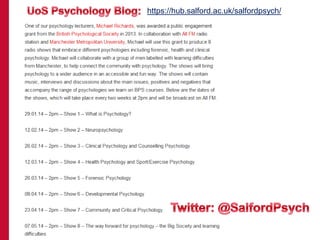
https://hub.salford.ac.uk/salfordpsych/
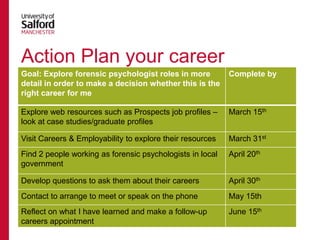
Action Plan your career
Goal: Explore forensic psychologist roles in more
detail in order to make a decision whether this is the
right career for me

Complete by

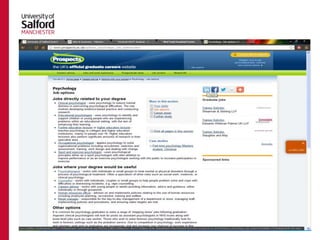
Explore web resources such as Prospects job profiles –
look at case studies/graduate profiles

March 15th

Visit Careers & Employability to explore their resources

March 31st

Find 2 people working as forensic psychologists in local
government

April 20th

Develop questions to ask them about their careers

April 30th

Contact to arrange to meet or speak on the phone

May 15th

Reflect on what I have learned and make a follow-up
careers appointment

June 15th
Careers and
Employability
• Based in Allerton Building &
University House
• Allerton Learning Space / Library
(10am – 4pm)

• futures@salford.ac.uk
• www.careers.salford.ac.uk
• SLC_CHSC@salford.ac.uk
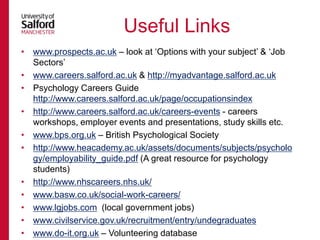
Useful Links
• www.prospects.ac.uk – look at „Options with your subject‟ & „Job
Sectors‟
• www.careers.salford.ac.uk & http://myadvantage.salford.ac.uk
• Psychology Careers Guide
http://www.careers.salford.ac.uk/page/occupationsindex
• http://www.careers.salford.ac.uk/careers-events - careers
workshops, employer events and presentations, study skills etc.
• www.bps.org.uk – British Psychological Society
• http://www.heacademy.ac.uk/assets/documents/subjects/psycholo
gy/employability_guide.pdf (A great resource for psychology
students)
• http://www.nhscareers.nhs.uk/
• www.basw.co.uk/social-work-careers/
• www.lgjobs.com (local government jobs)
• www.civilservice.gov.uk/recruitment/entry/undegraduates
• www.do-it.org.uk – Volunteering database

Career planning presentation for Undergraduate Psychology students

  • 1.
    Career Planning –Options for Psychologists Andy Kay Tahira Majothi Careers Consultants www.careers.salford.ac.uk
  • 4.
  • 5.
    Aims and Objectives •By the end of this workshop you will: – Understand the value of your degree beyond the subject knowledge you acquire – Know the typical career paths followed by psychology graduates – Consider some career planning approaches and apply them to your thinking about the future – Know some credible sources of career information that relate to your subject area
  • 6.
    ? What is thevalue of your Degree?
  • 7.
    It‟s all aboutemployability “A set of achievements – skills, understandings and personal attributes – that makes graduates more likely to gain employment and be successful in their chosen occupations, which benefits themselves, the workforce, the community and the economy.” Mantze Yorke, Higher Education Academy, 2003
  • 9.
    But how doyou choose a career? • If you don‟t know where you are going…how do you know when you‟ve got there? • If you don‟t know where you are going…you might end up somewhere more interesting.
  • 10.
  • 11.
    Some questions • Whatapproach feels right to you? • Which theory corresponds to your view of career? • Can you plan a career? • Did you plan to be where you are now? – How did you approach this?
  • 12.
  • 13.
    The DOTS model •Self-awareness - Know yourself • Opportunity awareness - Explore opportunities and jobs that suit you • Decision making - Decide where you want to go • Transition skills - Take steps to get there
  • 14.
    The Career PlanningProcess Know yourself Gain knowledge and understanding about your interests, skills, aptitudes, preferences and goals. Explore opportunities Identify sources of information and opportunities in training, education and work. Take steps to get there Implement your career decisions and put your plans into effect. Access development opportunities, write a CV, apply for jobs Decide where you want to go Evaluate opportunities, make decisions, action plan and set goals.
  • 15.
    Planned Happenstance orthe “Chaos” approach http://www.youtube.com/watch?v=7OqhUrXhaAM
  • 16.
    What‟s the point? •Evidence from research shows that self awareness is at the heart of success in graduate jobs – Habits of self-awareness, reflection and pro-active learning central to career development (Strategis Research, 2004) 16
  • 17.
    Career Planning –the essentials Focuses on some big things… – Who you are and what makes you tick – What you want & where you want to be – Where you are now in relation to a goal that you have defined – What kind of life(style) you want – How you can get there 17
  • 18.
    Opportunity Awareness • Ifyou don‟t know what‟s „out there‟ how will you know it‟s for you • What do jobs really involve? Will I enjoy it? • What are the entry requirements • Do I need a postgraduate course? • Who employs people doing this? • Where are jobs advertised? • How competitive is the job market?
  • 19.
  • 20.
    What can helpyou decide? • Getting some work experience in fields that you feel might interest you • Getting some experience through volunteering • Understanding what you most enjoy or find interesting about your course • Researching career options and understanding what jobs really involve • Arranging informational interviews to find out what it‟s like to do a job
  • 23.
  • 25.
    Set up aPsychology Student Society! • Great way to connect with peers on the course • Support provided by the Students‟ Union • Funding may be available for activities, guest speakers etc. • Further develop key employability skills in communication, teamwork, problemsolving, negotiation, budgeting, persuasion and organisational. http://www.salfordstudents.com/top-navigation/student-activities/start-a-group
  • 26.
  • 27.
    Action Plan yourcareer Goal: Explore forensic psychologist roles in more detail in order to make a decision whether this is the right career for me Complete by Explore web resources such as Prospects job profiles – look at case studies/graduate profiles March 15th Visit Careers & Employability to explore their resources March 31st Find 2 people working as forensic psychologists in local government April 20th Develop questions to ask them about their careers April 30th Contact to arrange to meet or speak on the phone May 15th Reflect on what I have learned and make a follow-up careers appointment June 15th
  • 28.
    Careers and Employability • Basedin Allerton Building & University House • Allerton Learning Space / Library (10am – 4pm) • futures@salford.ac.uk • www.careers.salford.ac.uk • SLC_CHSC@salford.ac.uk
  • 29.
    Useful Links • www.prospects.ac.uk– look at „Options with your subject‟ & „Job Sectors‟ • www.careers.salford.ac.uk & http://myadvantage.salford.ac.uk • Psychology Careers Guide http://www.careers.salford.ac.uk/page/occupationsindex • http://www.careers.salford.ac.uk/careers-events - careers workshops, employer events and presentations, study skills etc. • www.bps.org.uk – British Psychological Society • http://www.heacademy.ac.uk/assets/documents/subjects/psycholo gy/employability_guide.pdf (A great resource for psychology students) • http://www.nhscareers.nhs.uk/ • www.basw.co.uk/social-work-careers/ • www.lgjobs.com (local government jobs) • www.civilservice.gov.uk/recruitment/entry/undegraduates • www.do-it.org.uk – Volunteering database

Editor's Notes

  • #3 I have no ideas at all □I thought I knew what I wanted to do when I came to Uni, but I’ve completely changed my mind. □ I have a few vague ideas but my mate, family, friends, boy/girlfriend are trying to get me to go into a different direction. □  There’s too much information out there- I think I know what I want to do then I read something else that gives me fresh ideas □ I know what I want to do but don’t know how to get there □I want someone to tell me what to do □
  • #8 Content dates and is forgotten but competencies / skills / graduate attributes last
  • #11 Think about what has informed your study/career choices to date. Give them the AGCAS handout on these theories for them to discuss briefly in their groups to see which one reflects the way they are or if you prefer, suggest they take away the theories as a guidance sheet read in more detail and reflect back on.
  • #16 Planned – learning, work experience, networkingHappen – Responding to unexpected opportunitiesStance – An attitude of curious enquiry; keeping an open mind
  • #20 Move on to case studies.
  • #24 Sample size = 31 Destinations show a typical mix of destinations of students from a non-vocational course. A number of students are working in areas related to health and social care but there are a significant number of graduates who are in what would be termed ‘stop-gap’ jobs.