Carcinoma Cervix
DR.ANDREA
ANATOMY
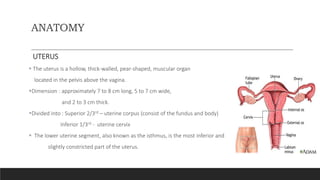
UTERUS
 The uterus is a hollow, thick-walled, pear-shaped, muscular organ
located in the pelvis above the vagina.
Dimension : approximately 7 to 8 cm long, 5 to 7 cm wide,
and 2 to 3 cm thick.
Divided into : Superior 2/3rd – uterine corpus (consist of the fundus and body)
Inferior 1/3rd - uterine cervix
 The lower uterine segment, also known as the isthmus, is the most inferior and
slightly constricted part of the uterus.
CERVIX
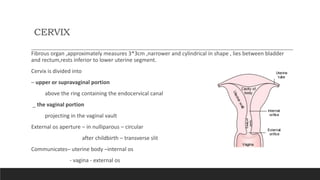
Fibrous organ ,approximately measures 3*3cm ,narrower and cylindrical in shape , lies between bladder
and rectum,rests inferior to lower uterine segment.
Cervix is divided into
– upper or supravaginal portion
above the ring containing the endocervical canal
_ the vaginal portion
projecting in the vaginal vault
External os aperture – in nulliparous – circular
after childbirth – transverse slit
Communicates– uterine body –internal os
- vagina - external os
NEUROVASCULAR SUPPLY
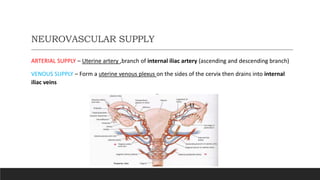
ARTERIAL SUPPLY – Uterine artery ,branch of internal iliac artery (ascending and descending branch)
VENOUS SUPPLY – Form a uterine venous plexus on the sides of the cervix then drains into internal
iliac veins
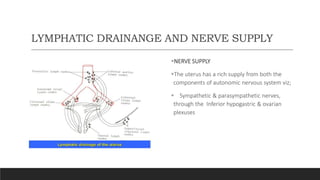
LYMPHATIC DRAINANGE AND NERVE SUPPLY
NERVE SUPPLY
The uterus has a rich supply from both the
components of autonomic nervous system viz;
 Sympathetic & parasympathetic nerves,
through the Inferior hypogastric & ovarian
plexuses
ETIOLOGY
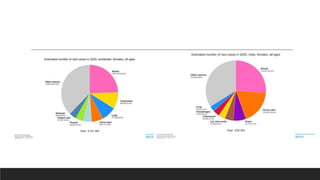
Worldwide, cervical cancer remains the most common gynecologic cancer and the fourth most
common malignancy in women.
Cervical cancer is more common in areas where women have less access to screening, including parts
of Asia, Africa, and Central and South America.
Estimates indicate that >90% of cervical cancers are related to the presence of human papillomavirus
(HPV) and are contracted via sexual intercourse.
A higher incidence of cervical cancer exists among women whose spouses are known or suspected to
have had higher exposure to HPV16 or whose partners have a history of penile carcinoma .
PATHOGENESIS
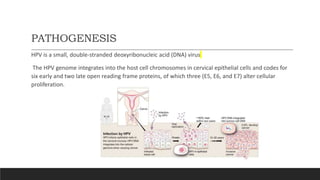
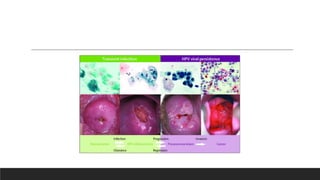
HPV is a small, double-stranded deoxyribonucleic acid (DNA) virus
The HPV genome integrates into the host cell chromosomes in cervical epithelial cells and codes for
six early and two late open reading frame proteins, of which three (E5, E6, and E7) alter cellular
proliferation.
RISK FACTOR
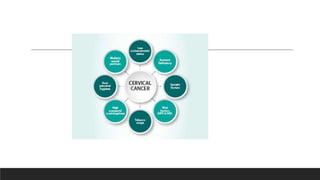
Cervical cancer may develop 10 to 20 years after initial exposure to HPV.
Social factors related to cervical cancer include those associated with HPV transmission
Such as early age of first intercourse
History of multiple sexual partners
 Male partner with a history of multiple sexual partners
 Large number of pregnancies .
History of sexually transmitted disease, including gonorrhea, chlamydia, herpes simplex virus II,
and/or HIV.
Chemical, hormonal, or other carcinogens may be implicated in cervical cancer.
Oral contraceptive use
Prenatal exposure to diethylstilbestrol (DES) is linked to the development of clear cell
adenocarcinoma, although the overall incidence is small .
Cigarette smoking may increase the risk of cervical cancer.
Family history
Poor socioeconomic status.
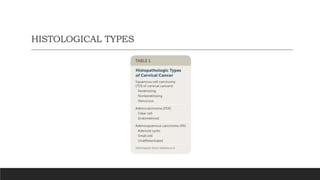
HISTOLOGICAL TYPES
SPREAD OF DISEASE
DIRECT-VAGINA AND PARA METRIUM
LYMPHATIC-ILIAC,OBTURATOR
HEMATOGENOUS-BONE,LUNG,LIVER,BRAIN
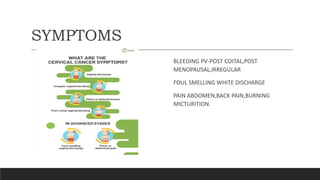
SYMPTOMS
BLEEDING PV-POST COITAL,POST
MENOPAUSAL,IRREGULAR
FOUL SMELLING WHITE DISCHARGE
PAIN ABDOMEN,BACK PAIN,BURNING
MICTURITION.
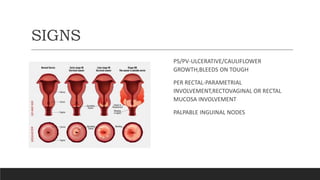
SIGNS
PS/PV-ULCERATIVE/CAULIFLOWER
GROWTH,BLEEDS ON TOUGH
PER RECTAL-PARAMETRIAL
INVOLVEMENT,RECTOVAGINAL OR RECTAL
MUCOSA INVOLVEMENT
PALPABLE INGUINAL NODES
INVESTIGATION
PAP SMEAR,BIOPSY
USG ABDOMEN PELVIS,
MRI PELVIS
CXR
PET CT
TREATMENT
SURGERY-HYSTRECTOMY +LN DISSECTION–FOR 1A
RADIOTHERAPY-2ND STAGE ONWARDS WITH CHEMO
CHEMOTHERAPY-IV B
RT
EBRT-COBALT/LINAC 50GY IN 25#-3D,IMRT.VMAT
BRACHY-VAGINAL/ICR/ISBT
CHEMO-CISPLATIN OR CARBOPLATIN
THANK YOU

Carcinoma Cervix-FOR MBBS/RT STUDENTS/RT TECHNOLOGISTS

  • 1.
  • 2.
    ANATOMY UTERUS  The uterusis a hollow, thick-walled, pear-shaped, muscular organ located in the pelvis above the vagina. Dimension : approximately 7 to 8 cm long, 5 to 7 cm wide, and 2 to 3 cm thick. Divided into : Superior 2/3rd – uterine corpus (consist of the fundus and body) Inferior 1/3rd - uterine cervix  The lower uterine segment, also known as the isthmus, is the most inferior and slightly constricted part of the uterus.
  • 3.
    CERVIX Fibrous organ ,approximatelymeasures 3*3cm ,narrower and cylindrical in shape , lies between bladder and rectum,rests inferior to lower uterine segment. Cervix is divided into – upper or supravaginal portion above the ring containing the endocervical canal _ the vaginal portion projecting in the vaginal vault External os aperture – in nulliparous – circular after childbirth – transverse slit Communicates– uterine body –internal os - vagina - external os
  • 4.
    NEUROVASCULAR SUPPLY ARTERIAL SUPPLY– Uterine artery ,branch of internal iliac artery (ascending and descending branch) VENOUS SUPPLY – Form a uterine venous plexus on the sides of the cervix then drains into internal iliac veins
  • 5.
    LYMPHATIC DRAINANGE ANDNERVE SUPPLY NERVE SUPPLY The uterus has a rich supply from both the components of autonomic nervous system viz;  Sympathetic & parasympathetic nerves, through the Inferior hypogastric & ovarian plexuses
  • 6.
    ETIOLOGY Worldwide, cervical cancerremains the most common gynecologic cancer and the fourth most common malignancy in women. Cervical cancer is more common in areas where women have less access to screening, including parts of Asia, Africa, and Central and South America. Estimates indicate that >90% of cervical cancers are related to the presence of human papillomavirus (HPV) and are contracted via sexual intercourse. A higher incidence of cervical cancer exists among women whose spouses are known or suspected to have had higher exposure to HPV16 or whose partners have a history of penile carcinoma .
  • 8.
    PATHOGENESIS HPV is asmall, double-stranded deoxyribonucleic acid (DNA) virus The HPV genome integrates into the host cell chromosomes in cervical epithelial cells and codes for six early and two late open reading frame proteins, of which three (E5, E6, and E7) alter cellular proliferation.
  • 10.
    RISK FACTOR Cervical cancermay develop 10 to 20 years after initial exposure to HPV. Social factors related to cervical cancer include those associated with HPV transmission Such as early age of first intercourse History of multiple sexual partners  Male partner with a history of multiple sexual partners  Large number of pregnancies . History of sexually transmitted disease, including gonorrhea, chlamydia, herpes simplex virus II, and/or HIV.
  • 11.
    Chemical, hormonal, orother carcinogens may be implicated in cervical cancer. Oral contraceptive use Prenatal exposure to diethylstilbestrol (DES) is linked to the development of clear cell adenocarcinoma, although the overall incidence is small . Cigarette smoking may increase the risk of cervical cancer. Family history Poor socioeconomic status.
  • 13.
  • 14.
    SPREAD OF DISEASE DIRECT-VAGINAAND PARA METRIUM LYMPHATIC-ILIAC,OBTURATOR HEMATOGENOUS-BONE,LUNG,LIVER,BRAIN
  • 15.
    SYMPTOMS BLEEDING PV-POST COITAL,POST MENOPAUSAL,IRREGULAR FOULSMELLING WHITE DISCHARGE PAIN ABDOMEN,BACK PAIN,BURNING MICTURITION.
  • 16.
    SIGNS PS/PV-ULCERATIVE/CAULIFLOWER GROWTH,BLEEDS ON TOUGH PERRECTAL-PARAMETRIAL INVOLVEMENT,RECTOVAGINAL OR RECTAL MUCOSA INVOLVEMENT PALPABLE INGUINAL NODES
  • 17.
    INVESTIGATION PAP SMEAR,BIOPSY USG ABDOMENPELVIS, MRI PELVIS CXR PET CT
  • 18.
    TREATMENT SURGERY-HYSTRECTOMY +LN DISSECTION–FOR1A RADIOTHERAPY-2ND STAGE ONWARDS WITH CHEMO CHEMOTHERAPY-IV B
  • 19.
    RT EBRT-COBALT/LINAC 50GY IN25#-3D,IMRT.VMAT BRACHY-VAGINAL/ICR/ISBT CHEMO-CISPLATIN OR CARBOPLATIN
  • 20.