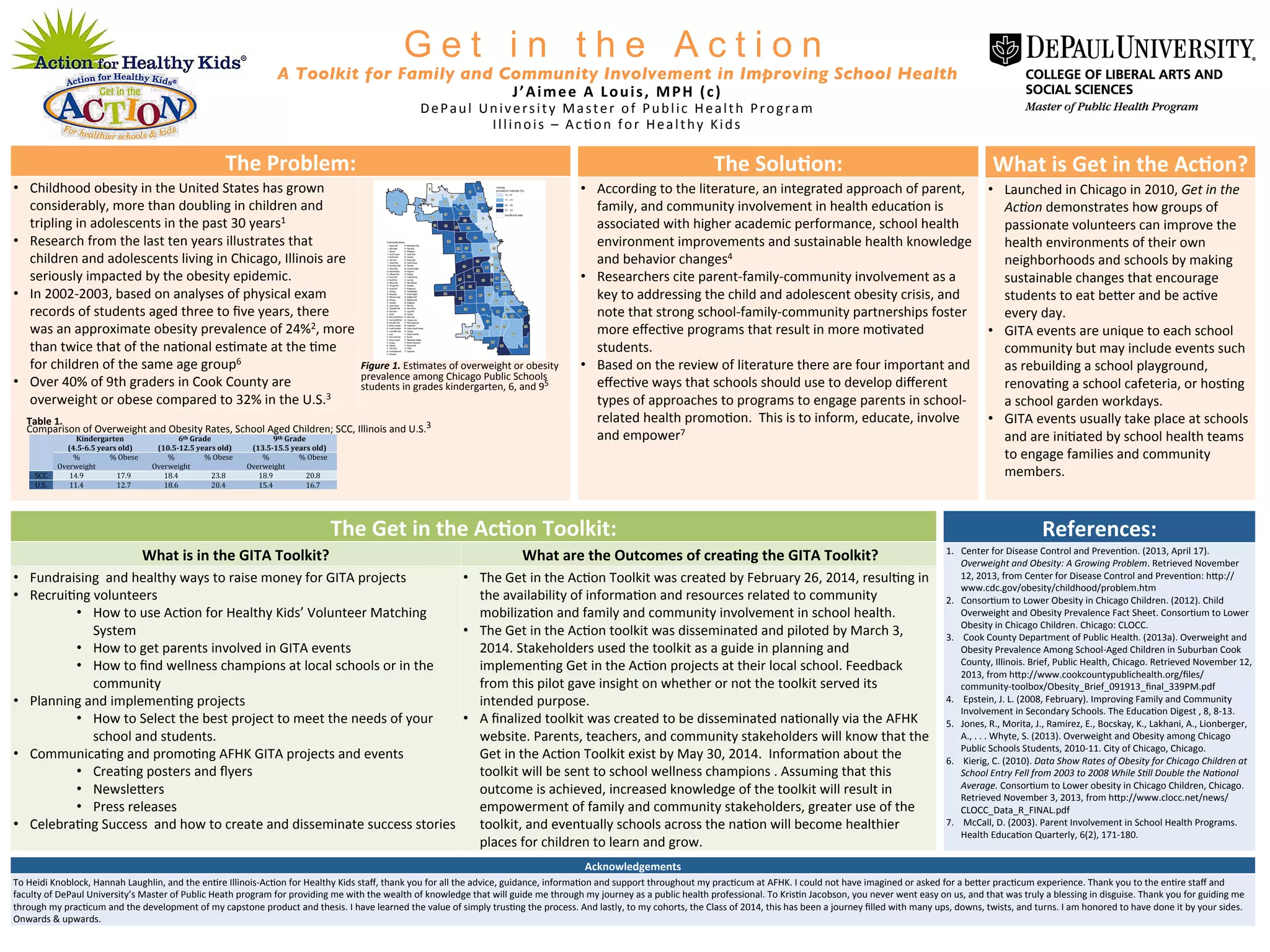
G e t i n t h e A c t i o n
A Toolkit for Family and Community Involvement in Improving School Health
J’Aimee	
  A	
  Louis,	
  MPH	
  (c)	
  
DePaul	
  University	
  Master	
  of	
  Public	
  Health	
  Program	
  
Illinois	
  –	
  Ac<on	
  for	
  Healthy	
  Kids	
  
The	
  Problem:	
  
•  Childhood	
  obesity	
  in	
  the	
  United	
  States	
  has	
  grown	
  
considerably,	
  more	
  than	
  doubling	
  in	
  children	
  and	
  
tripling	
  in	
  adolescents	
  in	
  the	
  past	
  30	
  years1	
  
•  Research	
  from	
  the	
  last	
  ten	
  years	
  illustrates	
  that	
  
children	
  and	
  adolescents	
  living	
  in	
  Chicago,	
  Illinois	
  are	
  
seriously	
  impacted	
  by	
  the	
  obesity	
  epidemic.	


•  In	
  2002-­‐2003,	
  based	
  on	
  analyses	
  of	
  physical	
  exam	
  
records	
  of	
  students	
  aged	
  three	
  to	
  five	
  years,	
  there	
  
was	
  an	
  approximate	
  obesity	
  prevalence	
  of	
  24%2,	
  more	
  
than	
  twice	
  that	
  of	
  the	
  na<onal	
  es<mate	
  at	
  the	
  <me	
  
for	
  children	
  of	
  the	
  same	
  age	
  group6	
  
•  Over	
  40%	
  of	
  9th	
  graders	
  in	
  Cook	
  County	
  are	
  
overweight	
  or	
  obese	
  compared	
  to	
  32%	
  in	
  the	
  U.S.3	


Figure	
  1.	
  Es<mates	
  of	
  overweight	
  or	
  obesity	
  
prevalence	
  among	
  Chicago	
  Public	
  Schools	
  
students	
  in	
  grades	
  kindergarten,	
  6,	
  and	
  95	


Table	
  1.	
  	
  
Comparison	
  of	
  Overweight	
  and	
  Obesity	
  Rates,	
  School	
  Aged	
  Children;	
  SCC,	
  Illinois	
  and	
  U.S.3	
  
The	
  Solu=on:	
  
•  According	
  to	
  the	
  literature,	
  an	
  integrated	
  approach	
  of	
  parent,	
  
family,	
  and	
  community	
  involvement	
  in	
  health	
  educa<on	
  is	
  
associated	
  with	
  higher	
  academic	
  performance,	
  school	
  health	
  
environment	
  improvements	
  and	
  sustainable	
  health	
  knowledge	
  
and	
  behavior	
  changes4	


•  Researchers	
  cite	
  parent-­‐family-­‐community	
  involvement	
  as	
  a	
  
key	
  to	
  addressing	
  the	
  child	
  and	
  adolescent	
  obesity	
  crisis,	
  and	
  
note	
  that	
  strong	
  school-­‐family-­‐community	
  partnerships	
  foster	
  
more	
  effec<ve	
  programs	
  that	
  result	
  in	
  more	
  mo<vated	
  
students.	
  
•  Based	
  on	
  the	
  review	
  of	
  literature	
  there	
  are	
  four	
  important	
  and	
  
effec<ve	
  ways	
  that	
  schools	
  should	
  use	
  to	
  develop	
  different	
  
types	
  of	
  approaches	
  to	
  programs	
  to	
  engage	
  parents	
  in	
  school-­‐
related	
  health	
  promo<on.	
  	
  This	
  is	
  to	
  inform,	
  educate,	
  involve	
  
and	
  empower7	
  
The	
  Get	
  in	
  the	
  Ac=on	
  Toolkit:	
  
What	
  is	
  in	
  the	
  GITA	
  Toolkit?	
   	
  What	
  are	
  the	
  Outcomes	
  of	
  crea=ng	
  the	
  GITA	
  Toolkit?	
  	
  
•  Fundraising	
  	
  and	
  healthy	
  ways	
  to	
  raise	
  money	
  for	
  GITA	
  projects	
  	
  
•  Recrui<ng	
  volunteers	
  	
  
•  How	
  to	
  use	
  Ac<on	
  for	
  Healthy	
  Kids’	
  Volunteer	
  Matching	
  
System	
  
•  How	
  to	
  get	
  parents	
  involved	
  in	
  GITA	
  events	
  
•  How	
  to	
  find	
  wellness	
  champions	
  at	
  local	
  schools	
  or	
  in	
  the	
  
community	
  	
  
•  Planning	
  and	
  implemen<ng	
  projects	
  	
  
•  How	
  to	
  Select	
  the	
  best	
  project	
  to	
  meet	
  the	
  needs	
  of	
  your	
  
school	
  and	
  students.	
  	
  
•  Communica<ng	
  and	
  promo<ng	
  AFHK	
  GITA	
  projects	
  and	
  events	
  
•  Crea<ng	
  posters	
  and	
  flyers	
  
•  Newsleaers	
  
•  Press	
  releases	
  	
  
•  Celebra<ng	
  Success	
  	
  and	
  how	
  to	
  create	
  and	
  disseminate	
  success	
  stories	
  
•  The	
  Get	
  in	
  the	
  Ac<on	
  Toolkit	
  was	
  created	
  by	
  February	
  26,	
  2014,	
  resul<ng	
  in	
  
the	
  availability	
  of	
  informa<on	
  and	
  resources	
  related	
  to	
  community	
  
mobiliza<on	
  and	
  family	
  and	
  community	
  involvement	
  in	
  school	
  health.	
  	
  
•  The	
  Get	
  in	
  the	
  Ac<on	
  toolkit	
  was	
  disseminated	
  and	
  piloted	
  by	
  March	
  3,	
  
2014.	
  Stakeholders	
  used	
  the	
  toolkit	
  as	
  a	
  guide	
  in	
  planning	
  and	
  
implemen<ng	
  Get	
  in	
  the	
  Ac<on	
  projects	
  at	
  their	
  local	
  school.	
  Feedback	
  
from	
  this	
  pilot	
  gave	
  insight	
  on	
  whether	
  or	
  not	
  the	
  toolkit	
  served	
  its	
  
intended	
  purpose.	
  
•  A	
  finalized	
  toolkit	
  was	
  created	
  to	
  be	
  disseminated	
  na<onally	
  via	
  the	
  AFHK	
  
website.	
  Parents,	
  teachers,	
  and	
  community	
  stakeholders	
  will	
  know	
  that	
  the	
  
Get	
  in	
  the	
  Ac<on	
  Toolkit	
  exist	
  by	
  May	
  30,	
  2014.	
  	
  Informa<on	
  about	
  the	
  
toolkit	
  will	
  be	
  sent	
  to	
  school	
  wellness	
  champions	
  .	
  Assuming	
  that	
  this	
  
outcome	
  is	
  achieved,	
  increased	
  knowledge	
  of	
  the	
  toolkit	
  will	
  result	
  in	
  
empowerment	
  of	
  family	
  and	
  community	
  stakeholders,	
  greater	
  use	
  of	
  the	
  
toolkit,	
  and	
  eventually	
  schools	
  across	
  the	
  na<on	
  will	
  become	
  healthier	
  
places	
  for	
  children	
  to	
  learn	
  and	
  grow.	
  
What	
  is	
  Get	
  in	
  the	
  Ac=on?	
  
•  Launched	
  in	
  Chicago	
  in	
  2010,	
  Get	
  in	
  the	
  
Ac*on	
  demonstrates	
  how	
  groups	
  of	
  
passionate	
  volunteers	
  can	
  improve	
  the	
  
health	
  environments	
  of	
  their	
  own	
  
neighborhoods	
  and	
  schools	
  by	
  making	
  
sustainable	
  changes	
  that	
  encourage	
  
students	
  to	
  eat	
  beaer	
  and	
  be	
  ac<ve	
  
every	
  day.	


•  GITA	
  events	
  are	
  unique	
  to	
  each	
  school	
  
community	
  but	
  may	
  include	
  events	
  such	
  
as	
  rebuilding	
  a	
  school	
  playground,	
  
renova<ng	
  a	
  school	
  cafeteria,	
  or	
  hos<ng	
  
a	
  school	
  garden	
  workdays.	
  	
  
•  GITA	
  events	
  usually	
  take	
  place	
  at	
  schools	
  
and	
  are	
  ini<ated	
  by	
  school	
  health	
  teams	
  
to	
  engage	
  families	
  and	
  community	
  
members.	
  
Table	
  1.	
  	
  
Overweight	
  and	
  Obesity	
  Rates,	
  School	
  Aged	
  Children;	
  Comparison	
  of	
  SCC,	
  Illinois	
  and	
  U.S.	
  
	
   Kindergarten	
  
(4.5-­‐6.5	
  years	
  old)	
  
6th	
  Grade	
  
(10.5-­‐12.5	
  years	
  old)	
  
9th	
  Grade	
  
(13.5-­‐15.5	
  years	
  old)	
  
%	
  
Overweight	
  
%	
  Obese	
   %	
  
Overweight	
  
%	
  Obese	
   %	
  
Overweight	
  
%	
  Obese	
  
SCC	
   14.9	
   17.9	
   18.4	
   23.8	
   18.9	
   20.8	
  
U.S.	
   11.4	
   12.7	
   18.6	
   20.4	
   15.4	
   16.7	
  
Note.	
  Adapted	
  from	
  “Overweight	
  and	
  Obesity	
  Prevalence	
  Among	
  School-­‐Aged	
  Children	
  in	
  Suburban	
  Cook	
  
County,	
  Illinois,”	
  by	
  Cook	
  County	
  Department	
  of	
  Public	
  Health,	
  2013a,	
  
http://www.cookcountypublichealth.org/files/community-­‐toolbox/Obesity_Brief_091913_final_339PM.pdf	


Acknowledgements	
  
To	
  Heidi	
  Knoblock,	
  Hannah	
  Laughlin,	
  and	
  the	
  en<re	
  Illinois-­‐Ac<on	
  for	
  Healthy	
  Kids	
  staff,	
  thank	
  you	
  for	
  all	
  the	
  advice,	
  guidance,	
  informa<on	
  and	
  support	
  throughout	
  my	
  prac<cum	
  at	
  AFHK.	
  I	
  could	
  not	
  have	
  imagined	
  or	
  asked	
  for	
  a	
  beaer	
  prac<cum	
  experience.	
  Thank	
  you	
  to	
  the	
  en<re	
  staff	
  and	
  
faculty	
  of	
  DePaul	
  University’s	
  Master	
  of	
  Public	
  Heath	
  program	
  for	
  providing	
  me	
  with	
  the	
  wealth	
  of	
  knowledge	
  that	
  will	
  guide	
  me	
  through	
  my	
  journey	
  as	
  a	
  public	
  health	
  professional.	
  To	
  Kris<n	
  Jacobson,	
  you	
  never	
  went	
  easy	
  on	
  us,	
  and	
  that	
  was	
  truly	
  a	
  blessing	
  in	
  disguise.	
  Thank	
  you	
  for	
  guiding	
  me	
  
through	
  my	
  prac<cum	
  and	
  the	
  development	
  of	
  my	
  capstone	
  product	
  and	
  thesis.	
  I	
  have	
  learned	
  the	
  value	
  of	
  simply	
  trus<ng	
  the	
  process.	
  And	
  lastly,	
  to	
  my	
  cohorts,	
  the	
  Class	
  of	
  2014,	
  this	
  has	
  been	
  a	
  journey	
  filled	
  with	
  many	
  ups,	
  downs,	
  twists,	
  and	
  turns.	
  I	
  am	
  honored	
  to	
  have	
  done	
  it	
  by	
  your	
  sides.	
  
Onwards	
  &	
  upwards.	


References:	
  
1.  Center	
  for	
  Disease	
  Control	
  and	
  Preven<on.	
  (2013,	
  April	
  17).	
  
Overweight	
  and	
  Obesity:	
  A	
  Growing	
  Problem.	
  Retrieved	
  November	
  
12,	
  2013,	
  from	
  Center	
  for	
  Disease	
  Control	
  and	
  Preven<on:	
  hap://
www.cdc.gov/obesity/childhood/problem.htm	
  
2.  Consor<um	
  to	
  Lower	
  Obesity	
  in	
  Chicago	
  Children.	
  (2012).	
  Child	
  
Overweight	
  and	
  Obesity	
  Prevalence	
  Fact	
  Sheet.	
  Consor<um	
  to	
  Lower	
  
Obesity	
  in	
  Chicago	
  Children.	
  Chicago:	
  CLOCC.	
  
3.  	
  Cook	
  County	
  Department	
  of	
  Public	
  Health.	
  (2013a).	
  Overweight	
  and	
  
Obesity	
  Prevalence	
  Among	
  School-­‐Aged	
  Children	
  in	
  Suburban	
  Cook	
  
County,	
  Illinois.	
  Brief,	
  Public	
  Health,	
  Chicago.	
  Retrieved	
  November	
  12,	
  
2013,	
  from	
  hap://www.cookcountypublichealth.org/files/
community-­‐toolbox/Obesity_Brief_091913_final_339PM.pdf	
  	
  
4.  	
  Epstein,	
  J.	
  L.	
  (2008,	
  February).	
  Improving	
  Family	
  and	
  Community	
  
Involvement	
  in	
  Secondary	
  Schools.	
  The	
  Educa<on	
  Digest	
  ,	
  8,	
  8-­‐13.	
  
5.  Jones,	
  R.,	
  Morita,	
  J.,	
  Ramirez,	
  E.,	
  Bocskay,	
  K.,	
  Lakhani,	
  A.,	
  Lionberger,	
  
A.,	
  .	
  .	
  .	
  Whyte,	
  S.	
  (2013).	
  Overweight	
  and	
  Obesity	
  among	
  Chicago	
  
Public	
  Schools	
  Students,	
  2010-­‐11.	
  City	
  of	
  Chicago,	
  Chicago.	
  
6.  	
  Kierig,	
  C.	
  (2010).	
  Data	
  Show	
  Rates	
  of	
  Obesity	
  for	
  Chicago	
  Children	
  at	
  
School	
  Entry	
  Fell	
  from	
  2003	
  to	
  2008	
  While	
  S*ll	
  Double	
  the	
  Na*onal	
  
Average.	
  Consor<um	
  to	
  Lower	
  obesity	
  in	
  Chicago	
  Children,	
  Chicago.	
  
Retrieved	
  November	
  3,	
  2013,	
  from	
  hap://www.clocc.net/news/
CLOCC_Data_R_FINAL.pdf	
  
7.  	
  McCall,	
  D.	
  (2003).	
  Parent	
  Involvement	
  in	
  School	
  Health	
  Programs.	
  
Health	
  Educa<on	
  Quarterly,	
  6(2),	
  171-­‐180.	
  

CAPSTONE POSTER

  • 1.
    G e ti n t h e A c t i o n A Toolkit for Family and Community Involvement in Improving School Health J’Aimee  A  Louis,  MPH  (c)   DePaul  University  Master  of  Public  Health  Program   Illinois  –  Ac<on  for  Healthy  Kids   The  Problem:   •  Childhood  obesity  in  the  United  States  has  grown   considerably,  more  than  doubling  in  children  and   tripling  in  adolescents  in  the  past  30  years1   •  Research  from  the  last  ten  years  illustrates  that   children  and  adolescents  living  in  Chicago,  Illinois  are   seriously  impacted  by  the  obesity  epidemic.       •  In  2002-­‐2003,  based  on  analyses  of  physical  exam   records  of  students  aged  three  to  five  years,  there   was  an  approximate  obesity  prevalence  of  24%2,  more   than  twice  that  of  the  na<onal  es<mate  at  the  <me   for  children  of  the  same  age  group6   •  Over  40%  of  9th  graders  in  Cook  County  are   overweight  or  obese  compared  to  32%  in  the  U.S.3                                   Figure  1.  Es<mates  of  overweight  or  obesity   prevalence  among  Chicago  Public  Schools   students  in  grades  kindergarten,  6,  and  95     Table  1.     Comparison  of  Overweight  and  Obesity  Rates,  School  Aged  Children;  SCC,  Illinois  and  U.S.3   The  Solu=on:   •  According  to  the  literature,  an  integrated  approach  of  parent,   family,  and  community  involvement  in  health  educa<on  is   associated  with  higher  academic  performance,  school  health   environment  improvements  and  sustainable  health  knowledge   and  behavior  changes4       •  Researchers  cite  parent-­‐family-­‐community  involvement  as  a   key  to  addressing  the  child  and  adolescent  obesity  crisis,  and   note  that  strong  school-­‐family-­‐community  partnerships  foster   more  effec<ve  programs  that  result  in  more  mo<vated   students.   •  Based  on  the  review  of  literature  there  are  four  important  and   effec<ve  ways  that  schools  should  use  to  develop  different   types  of  approaches  to  programs  to  engage  parents  in  school-­‐ related  health  promo<on.    This  is  to  inform,  educate,  involve   and  empower7   The  Get  in  the  Ac=on  Toolkit:   What  is  in  the  GITA  Toolkit?    What  are  the  Outcomes  of  crea=ng  the  GITA  Toolkit?     •  Fundraising    and  healthy  ways  to  raise  money  for  GITA  projects     •  Recrui<ng  volunteers     •  How  to  use  Ac<on  for  Healthy  Kids’  Volunteer  Matching   System   •  How  to  get  parents  involved  in  GITA  events   •  How  to  find  wellness  champions  at  local  schools  or  in  the   community     •  Planning  and  implemen<ng  projects     •  How  to  Select  the  best  project  to  meet  the  needs  of  your   school  and  students.     •  Communica<ng  and  promo<ng  AFHK  GITA  projects  and  events   •  Crea<ng  posters  and  flyers   •  Newsleaers   •  Press  releases     •  Celebra<ng  Success    and  how  to  create  and  disseminate  success  stories   •  The  Get  in  the  Ac<on  Toolkit  was  created  by  February  26,  2014,  resul<ng  in   the  availability  of  informa<on  and  resources  related  to  community   mobiliza<on  and  family  and  community  involvement  in  school  health.     •  The  Get  in  the  Ac<on  toolkit  was  disseminated  and  piloted  by  March  3,   2014.  Stakeholders  used  the  toolkit  as  a  guide  in  planning  and   implemen<ng  Get  in  the  Ac<on  projects  at  their  local  school.  Feedback   from  this  pilot  gave  insight  on  whether  or  not  the  toolkit  served  its   intended  purpose.   •  A  finalized  toolkit  was  created  to  be  disseminated  na<onally  via  the  AFHK   website.  Parents,  teachers,  and  community  stakeholders  will  know  that  the   Get  in  the  Ac<on  Toolkit  exist  by  May  30,  2014.    Informa<on  about  the   toolkit  will  be  sent  to  school  wellness  champions  .  Assuming  that  this   outcome  is  achieved,  increased  knowledge  of  the  toolkit  will  result  in   empowerment  of  family  and  community  stakeholders,  greater  use  of  the   toolkit,  and  eventually  schools  across  the  na<on  will  become  healthier   places  for  children  to  learn  and  grow.   What  is  Get  in  the  Ac=on?   •  Launched  in  Chicago  in  2010,  Get  in  the   Ac*on  demonstrates  how  groups  of   passionate  volunteers  can  improve  the   health  environments  of  their  own   neighborhoods  and  schools  by  making   sustainable  changes  that  encourage   students  to  eat  beaer  and  be  ac<ve   every  day.       •  GITA  events  are  unique  to  each  school   community  but  may  include  events  such   as  rebuilding  a  school  playground,   renova<ng  a  school  cafeteria,  or  hos<ng   a  school  garden  workdays.     •  GITA  events  usually  take  place  at  schools   and  are  ini<ated  by  school  health  teams   to  engage  families  and  community   members.   Table  1.     Overweight  and  Obesity  Rates,  School  Aged  Children;  Comparison  of  SCC,  Illinois  and  U.S.     Kindergarten   (4.5-­‐6.5  years  old)   6th  Grade   (10.5-­‐12.5  years  old)   9th  Grade   (13.5-­‐15.5  years  old)   %   Overweight   %  Obese   %   Overweight   %  Obese   %   Overweight   %  Obese   SCC   14.9   17.9   18.4   23.8   18.9   20.8   U.S.   11.4   12.7   18.6   20.4   15.4   16.7   Note.  Adapted  from  “Overweight  and  Obesity  Prevalence  Among  School-­‐Aged  Children  in  Suburban  Cook   County,  Illinois,”  by  Cook  County  Department  of  Public  Health,  2013a,   http://www.cookcountypublichealth.org/files/community-­‐toolbox/Obesity_Brief_091913_final_339PM.pdf     Acknowledgements   To  Heidi  Knoblock,  Hannah  Laughlin,  and  the  en<re  Illinois-­‐Ac<on  for  Healthy  Kids  staff,  thank  you  for  all  the  advice,  guidance,  informa<on  and  support  throughout  my  prac<cum  at  AFHK.  I  could  not  have  imagined  or  asked  for  a  beaer  prac<cum  experience.  Thank  you  to  the  en<re  staff  and   faculty  of  DePaul  University’s  Master  of  Public  Heath  program  for  providing  me  with  the  wealth  of  knowledge  that  will  guide  me  through  my  journey  as  a  public  health  professional.  To  Kris<n  Jacobson,  you  never  went  easy  on  us,  and  that  was  truly  a  blessing  in  disguise.  Thank  you  for  guiding  me   through  my  prac<cum  and  the  development  of  my  capstone  product  and  thesis.  I  have  learned  the  value  of  simply  trus<ng  the  process.  And  lastly,  to  my  cohorts,  the  Class  of  2014,  this  has  been  a  journey  filled  with  many  ups,  downs,  twists,  and  turns.  I  am  honored  to  have  done  it  by  your  sides.   Onwards  &  upwards.       References:   1.  Center  for  Disease  Control  and  Preven<on.  (2013,  April  17).   Overweight  and  Obesity:  A  Growing  Problem.  Retrieved  November   12,  2013,  from  Center  for  Disease  Control  and  Preven<on:  hap:// www.cdc.gov/obesity/childhood/problem.htm   2.  Consor<um  to  Lower  Obesity  in  Chicago  Children.  (2012).  Child   Overweight  and  Obesity  Prevalence  Fact  Sheet.  Consor<um  to  Lower   Obesity  in  Chicago  Children.  Chicago:  CLOCC.   3.   Cook  County  Department  of  Public  Health.  (2013a).  Overweight  and   Obesity  Prevalence  Among  School-­‐Aged  Children  in  Suburban  Cook   County,  Illinois.  Brief,  Public  Health,  Chicago.  Retrieved  November  12,   2013,  from  hap://www.cookcountypublichealth.org/files/ community-­‐toolbox/Obesity_Brief_091913_final_339PM.pdf     4.   Epstein,  J.  L.  (2008,  February).  Improving  Family  and  Community   Involvement  in  Secondary  Schools.  The  Educa<on  Digest  ,  8,  8-­‐13.   5.  Jones,  R.,  Morita,  J.,  Ramirez,  E.,  Bocskay,  K.,  Lakhani,  A.,  Lionberger,   A.,  .  .  .  Whyte,  S.  (2013).  Overweight  and  Obesity  among  Chicago   Public  Schools  Students,  2010-­‐11.  City  of  Chicago,  Chicago.   6.   Kierig,  C.  (2010).  Data  Show  Rates  of  Obesity  for  Chicago  Children  at   School  Entry  Fell  from  2003  to  2008  While  S*ll  Double  the  Na*onal   Average.  Consor<um  to  Lower  obesity  in  Chicago  Children,  Chicago.   Retrieved  November  3,  2013,  from  hap://www.clocc.net/news/ CLOCC_Data_R_FINAL.pdf   7.   McCall,  D.  (2003).  Parent  Involvement  in  School  Health  Programs.   Health  Educa<on  Quarterly,  6(2),  171-­‐180.