
TOPIC – MONEY AND CAPITAL
MARKET, CAPITAL MARKET :
MEANING, COMPONENTS AND
INSTRUMENTS
B Y – A D I T Y A M I S H R A , S A M A R T H B A J P A I A N D S A C H I N
P R A T A P S I N G H
I N T B B A - M B A , F I N A N C E
Financial Institutions and
Markets
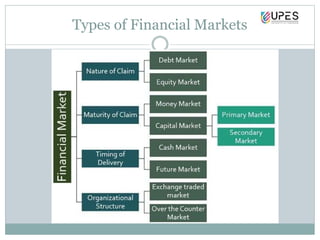
Types of Financial Markets
Money Market
 The Money Markets trade in products with highly liquid
short-term maturities (of less than one year) and are
characterized by a high degree of safety and a relatively
low return in interest.
 At the wholesale level, the money markets involve large-
volume trades between institutions and traders. At the
retail level, they include money market mutual funds
bought by individual investors and money market
accounts opened by bank customers.
 Individuals may also invest in the money markets by
buying short-term certificates of deposit
(CDs), municipal notes, or U.S. Treasury bills, among
other examples.
Capital Market
 Capital markets refer to the venues where funds are
exchanged between suppliers and those who seek capital
for their own use.
 Suppliers in capital markets are typically banks and
investors while those who seek capital are businesses,
governments, and individuals.
 Capital markets are used to sell different financial
instruments, including equities and debt securities.
 These markets are divided into two categories: primary
and secondary markets.
 The best-known capital markets include the stock market
and the bond markets.
Structure of Capital Markets
1) Primary Markets
When a company publicly sells new stocks or bonds for
the first time, such as in an IPO, it does so in the
primary capital market. This market is sometimes
called the new issues market. When investors purchase
securities on the primary capital market, the company
that offers the securities hires an underwriting firm to
review it and create a prospectus outlining the price
and other details of the securities to be issued.
Structure of Capital Markets
 The secondary market includes venues overseen by a
regulatory body like the SEBI where these previously issued
securities are traded between investors. Issuing companies do
not have a part in the secondary market. The National and
Bombay Stock Exchange are examples of secondary markets.
 The secondary market has two different categories:
The Auction and The Dealer Markets. The auction market is
home to the open outcry system where buyers and sellers
collect in one location and announce the prices at which they
are willing to buy and sell their securities. The NYSE is one
such example. In dealer markets, though, people trade
through electronic networks. Most small investors trade
through dealer markets.
Components of Capital Market
Equity Market
 Equity markets are meeting points for issuers and
buyers of stocks in a market economy.
 Equity markets are a method for companies to raise
capital and investors to own a piece of a company.
 Stocks can be issued in public markets or private
markets. Depending on the type of issue, the venue
for trading changes.
 Most equity markets are stock exchanges that can be
found around the world, such as the New York Stock
Exchange and the Tokyo Stock Exchange.
Components of Capital Market
Debt Market
 Investments in debt securities typically involve less
risk than equity investments and offer a lower
potential return on investment.
 Debt investments by nature fluctuate less in price
than stocks. Even if a company is liquidated,
bondholders are the first to be paid.
 Bonds are the most common form of debt
investment. These are issued by corporations or by
the government to raise capital for their operations
and generally carry a fixed interest rate.
Components of Capital Market
Derivatives Market
 Derivatives are financial contracts, set between two or
more parties, that derive their value from an underlying
asset, group of assets, or benchmark.
 A derivative can trade on an exchange or over-the-
counter.
 Prices for derivatives derive from fluctuations in the
underlying asset.
 Derivatives are usually leveraged instruments, which
increases their potential risks and rewards.
 Common derivatives include futures contracts, forwards,
options, and swaps.
Instruments of the Capital Market
Equities
Equities refer to the money invested in an organization by
purchasing shares in the stock market. -
 Equity Shares: Equity shares are part ownership where the
shareholders are fractional owners and initiate the maximum
entrepreneurial liability related to a trading concern. Equity
shareholders reserve the right to vote. However, holders of
this instrument rank bottom on the scale of preference in the
event of company liquidation because they are considered
owners of the enterprise.
 Preference Shares: Preference shares are issued by corporate
bodies, and on the scale of preference, the investors rank
second when the company goes under. These shares are often
treated as debt instruments as they do not confer voting rights
to the holders.
Instruments of the Capital Market
Debt Securities
Debt securities are financial assets entitling the owners to a stream of
interest payments. Borrowers must repay the principal borrowed and
are classified into bonds and debentures.
 Bonds: Bonds are fixed-income instruments primarily issued by the
state and center governments, municipalities, and organisations for
financing infrastructural development and other projects. It is
referred to as a loaning capital market instrument, and the bond
issuer is the borrower. Typically, bonds carry a fixed lock-in period,
and on the maturity date, bond issuers must repay the principal
amount to the bondholders.
 Debentures: Debentures are unsecured investment options and not
backed by any collateral. The lending is based on mutual trust.
Investors act as potential creditors of the issuing company or
institution.
Instruments of the Capital Market
Derivatives
Derivatives are capital market financial instruments. Their
values are determined by underlying assets like stocks,
currency, stock indexes and bonds. The most common types of
derivative instruments are:
 Forward: It is a contract between two parties in which the
exchange occurs at the end of the contract at a specific price.
 Future: It is a derivative transaction involving the exchange of
derivatives on a determined future date at a predetermined
price.
 Options: It is an agreement between two parties. Here, the
buyer has to right to buy or sell a specific number of
derivatives at an exact price for a particular period.
Instruments of the Capital Market
Exchange Traded Funds
 Exchange-traded funds are a pool of financial
resources from many investors. These are utilized to
purchase different capital market instruments like
debt securities (derivatives and bonds), shares, etc.
 Most ETFs are registered with the SEBI (Securities
and Exchange Board of India). Therefore, it is an
appealing option for investors with limited
knowledge of the stock market.
Thank you

Capital Market Assignment PPT 1.pptx

  • 1.
    TOPIC – MONEYAND CAPITAL MARKET, CAPITAL MARKET : MEANING, COMPONENTS AND INSTRUMENTS B Y – A D I T Y A M I S H R A , S A M A R T H B A J P A I A N D S A C H I N P R A T A P S I N G H I N T B B A - M B A , F I N A N C E Financial Institutions and Markets
  • 2.
  • 3.
    Money Market  TheMoney Markets trade in products with highly liquid short-term maturities (of less than one year) and are characterized by a high degree of safety and a relatively low return in interest.  At the wholesale level, the money markets involve large- volume trades between institutions and traders. At the retail level, they include money market mutual funds bought by individual investors and money market accounts opened by bank customers.  Individuals may also invest in the money markets by buying short-term certificates of deposit (CDs), municipal notes, or U.S. Treasury bills, among other examples.
  • 4.
    Capital Market  Capitalmarkets refer to the venues where funds are exchanged between suppliers and those who seek capital for their own use.  Suppliers in capital markets are typically banks and investors while those who seek capital are businesses, governments, and individuals.  Capital markets are used to sell different financial instruments, including equities and debt securities.  These markets are divided into two categories: primary and secondary markets.  The best-known capital markets include the stock market and the bond markets.
  • 5.
    Structure of CapitalMarkets 1) Primary Markets When a company publicly sells new stocks or bonds for the first time, such as in an IPO, it does so in the primary capital market. This market is sometimes called the new issues market. When investors purchase securities on the primary capital market, the company that offers the securities hires an underwriting firm to review it and create a prospectus outlining the price and other details of the securities to be issued.
  • 6.
    Structure of CapitalMarkets  The secondary market includes venues overseen by a regulatory body like the SEBI where these previously issued securities are traded between investors. Issuing companies do not have a part in the secondary market. The National and Bombay Stock Exchange are examples of secondary markets.  The secondary market has two different categories: The Auction and The Dealer Markets. The auction market is home to the open outcry system where buyers and sellers collect in one location and announce the prices at which they are willing to buy and sell their securities. The NYSE is one such example. In dealer markets, though, people trade through electronic networks. Most small investors trade through dealer markets.
  • 7.
    Components of CapitalMarket Equity Market  Equity markets are meeting points for issuers and buyers of stocks in a market economy.  Equity markets are a method for companies to raise capital and investors to own a piece of a company.  Stocks can be issued in public markets or private markets. Depending on the type of issue, the venue for trading changes.  Most equity markets are stock exchanges that can be found around the world, such as the New York Stock Exchange and the Tokyo Stock Exchange.
  • 8.
    Components of CapitalMarket Debt Market  Investments in debt securities typically involve less risk than equity investments and offer a lower potential return on investment.  Debt investments by nature fluctuate less in price than stocks. Even if a company is liquidated, bondholders are the first to be paid.  Bonds are the most common form of debt investment. These are issued by corporations or by the government to raise capital for their operations and generally carry a fixed interest rate.
  • 9.
    Components of CapitalMarket Derivatives Market  Derivatives are financial contracts, set between two or more parties, that derive their value from an underlying asset, group of assets, or benchmark.  A derivative can trade on an exchange or over-the- counter.  Prices for derivatives derive from fluctuations in the underlying asset.  Derivatives are usually leveraged instruments, which increases their potential risks and rewards.  Common derivatives include futures contracts, forwards, options, and swaps.
  • 10.
    Instruments of theCapital Market Equities Equities refer to the money invested in an organization by purchasing shares in the stock market. -  Equity Shares: Equity shares are part ownership where the shareholders are fractional owners and initiate the maximum entrepreneurial liability related to a trading concern. Equity shareholders reserve the right to vote. However, holders of this instrument rank bottom on the scale of preference in the event of company liquidation because they are considered owners of the enterprise.  Preference Shares: Preference shares are issued by corporate bodies, and on the scale of preference, the investors rank second when the company goes under. These shares are often treated as debt instruments as they do not confer voting rights to the holders.
  • 11.
    Instruments of theCapital Market Debt Securities Debt securities are financial assets entitling the owners to a stream of interest payments. Borrowers must repay the principal borrowed and are classified into bonds and debentures.  Bonds: Bonds are fixed-income instruments primarily issued by the state and center governments, municipalities, and organisations for financing infrastructural development and other projects. It is referred to as a loaning capital market instrument, and the bond issuer is the borrower. Typically, bonds carry a fixed lock-in period, and on the maturity date, bond issuers must repay the principal amount to the bondholders.  Debentures: Debentures are unsecured investment options and not backed by any collateral. The lending is based on mutual trust. Investors act as potential creditors of the issuing company or institution.
  • 12.
    Instruments of theCapital Market Derivatives Derivatives are capital market financial instruments. Their values are determined by underlying assets like stocks, currency, stock indexes and bonds. The most common types of derivative instruments are:  Forward: It is a contract between two parties in which the exchange occurs at the end of the contract at a specific price.  Future: It is a derivative transaction involving the exchange of derivatives on a determined future date at a predetermined price.  Options: It is an agreement between two parties. Here, the buyer has to right to buy or sell a specific number of derivatives at an exact price for a particular period.
  • 13.
    Instruments of theCapital Market Exchange Traded Funds  Exchange-traded funds are a pool of financial resources from many investors. These are utilized to purchase different capital market instruments like debt securities (derivatives and bonds), shares, etc.  Most ETFs are registered with the SEBI (Securities and Exchange Board of India). Therefore, it is an appealing option for investors with limited knowledge of the stock market.
  • 14.