Capability Document
Experiential Recursive Simulations
This presentation contains copyrighted content & proprietary information meant for the purpose of evaluation of the proposal and not to be circulated and shared with third parties
Holistic Approach
for Impact
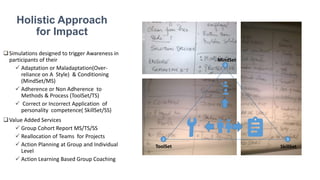
Simulations designed to trigger Awareness in
participants of their
 Adaptation or Maladaptation(Over-
reliance on A Style) & Conditioning
(MindSet/MS)
 Adherence or Non Adherence to
Methods & Process (ToolSet/TS)
 Correct or Incorrect Application of
personality competence( SkillSet/SS)
Value Added Services
 Group Cohort Report MS/TS/SS
 Reallocation of Teams for Projects
 Action Planning at Group and Individual
Level
 Action Learning Based Group Coaching
SkillSetToolSet
MindSet
1
2 3
2
Experiential Simulations
Designed for
 Decision Making
 Strategic Thinking
 Innovation
 Dominant Leadership Styles
 Goal Setting and Risk Taking
 Team Working
 Impact and Influence
 Customer Service
 Execution Excellence
 Diversity and Inclusion
 Communication
 Executive Confidence
 Sales Ability
Custom Level Based Simulations for
 Senior Leadership
 Middle Management
 Front Line
 Specialist Individual Contributor
Functions
Design and Duration
 Intra Group, Inter Group designs
 Functional and Cross Function
teams
 Duration from 3 hours to 8 hours
Designed as
 Stand alone Intervention
OR Combined with
 Psychometric Tools , Leader 360
Industries Delivered
 Media
 IT Product
 Healthcare
 Automotive
 IT Services
 Energy and Utilities
Roles Covered
 Country Leadership of CXOs
 Sales & Customer Service
 Production & Quality
 R&D
 Back Office & Shared Service Centres
 Support Functions
3
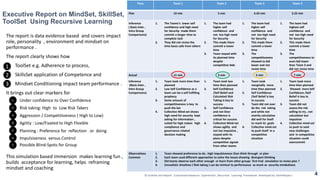
Executive Report on MindSet, SkillSet,
ToolSet Using Recursive Learning
Time Team 1 Team 2 Team 3 Team 4
Plan 10 min 5 min 4.43 min 3.25 min
Inference
( Basis Inter ,
Intra Group
Comparisons)
1. The Teams’s lower self
confidence and high need
for Security made them
commit a longer time to
complete task
2. They did not revise the
time basis calls from others
1. The team had
higher self
confidence and
not too high need
for Security
2. This made them
commit a lower
time
3. Team stayed with
its planned time
despite
competitive bids
1. The team had
higher self
confidence and
not too high need
for Security
2. This made them
commit a lower
time
3. The
competitiveness
showed to bid
lower and not
revise time
1. The team had
highest self
confidence and
not too high need
for Security
2. This made them
commit a lower
time
3. The
competitiveness to
even bid lower
than Team 3 and
did not revise time
Actual 11 min 3 min 5 min 7 min
Inference
(Basis Inter ,
Intra Group
Comparisons)
1. Team took more time than
planned
2. Low Self Confidence as a
team can be a self fulfilling
prophecy
3. Some amount of
competitiveness is key to
push the bar
4. Collective Mind-set shows
high need for security kept
asking for information ,
suited for high stakes high
compliance and
governance related
decision making
1. Team took less
time than planned
2. Self Confidence
/Self Belief and
Calculated Risk
Taking is key to
success
3. Self Confidence
and not Over
confidence is
critical for success
4. Collective Mind-set
shows agility and
not too impulsive ,
stayed with its
plans despite
competitive signals
from other teams
1. Team took
marginally more
time than planned
2. Self Confidence
/Self Belief is key
to success
3. Team did not over
do the risk taking
and while not
overtly calculative
did well for itself
to reach its goals
4. Collective mind-set
to push itself in a
competitive
situation
1. Team took more
time than planned
2. Showed more Self
Confidence /Self
Belief is key to
success
3. Team did not
assess the risk
willing to try , not
calculative but
impulsive
4. Collective mind-set
to push to seek
new challenges
and in competitive
situation could
overcommit
Observations
Common
1. Team showed preference to do , high impulsiveness than think through or plan
2. Each team used different approaches to solve the issues showing divergent thinking
3. Did teams observe each other enough or learn from other groups first trial simulation to revise plan ?
4. Unrealistic timelines ( Risk taking ) can be inimical to performance as much as security mindedness
The report is data evidence based and covers impact
role, personality , environment and mindset on
performance .
The report clearly shows how
1. ToolSet e.g. Adherence to process,
2. SkillsSet application of Competence and
3. Mindset Conditioning impact team performance .
It brings out clear markers for
This simulation based immersion makes learning fun ,
builds acceptance for learning, helps reframing
mindset and coaching
4© Content and Report Customised based on Experiential , Recursive Learning Framework developed by Karthikeyan J
1
2
3
1
2
3
4
5
6
7
Under confidence to Over Confidence
Impulsiveness versus Control
Planning : Preference for reflection or doing
Risk taking: High to Low Risk Takers
Possible Blind-Spots for Group
Agility : Low/Fixated to High Flexible
Aggression / Competitiveness ( High to Low)
J Karthikeyan
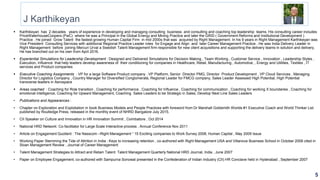
 Karthikeyan has 2 decades years of experience in developing and managing consulting business and consulting and coaching top leadership teams. His consulting career includes
PriceWaterhouseCoopers (PwC) where he was a Principal in the Global Energy and Mining Practice and later the GRID ( Government Reforms and Institutional Development )
Practice . He joined Grow Talent the fastest growing Human Capital Firm in mid 2000s that was acquired by Right Management. In his 9 years in Right Management Karthikeyan was
Vice President Consulting Services with additional Regional Practice Leader roles for Engage and Align and later Career Management Practice . He was India Delivery Leader in
Right Management before joining Mercuri Urval a Swedish Talent Management firm responsible for new client acquisitions and supporting the delivery teams in solution and delivery.
He has branched out on his own from April 2016.
 Experiential Simulations for Leadership Development : Designed and Delivered Simulations for Decision Making , Team Working , Customer Service , Innovation , Leadership Styles ,
Execution, Influence that help leaders develop awareness of their conditioning for companies in Healthcare, Retail, Manufacturing , Automotive, , Energy and Utilities, Textiles , IT
services and Product companies
 Executive Coaching Assignments : VP for a large Software Product company , VP Platform, Senior Director PMG, Director Product Development , VP Cloud Services , Managing
Director for Logistics Company , Country Manager for Diversified Conglomerate, Regional Leader for FMCG company, Sales Leader Assessed High Potential, High Potential
transverse leaders in Aerospace
 Areas coached : Coaching for Role transition , Coaching for performance , Coaching for Influence , Coaching for communication , Coaching for working X boundaries , Coaching for
emotional intelligence, Coaching for Upward Management, Coaching Sales Leaders to be Strategic in Sales, Develop Next Line Sales Leaders
• Publications and Appearances :
• Chapter on Exploration and Exploitation in book Business Models and People Practices with foreword from Dr Marshall Goldsmith Worlds #1 Executive Coach and World Thinker List
published by Routledge Press, released in the monthly event of NHRD Bangalore July 2015.
• CII Speaker on Culture and Innovation in HR Innovation Summit , Coimbatore , Oct 2014
• National HRD Network: Co-facilitator for Large Scale Interactive process , Annual Conference Nov 2011
• Article on Engagement Quotient : The Nasscom –Right Management “ 15 Exciting companies to Work Survey 2008, Human Capital , May 2009 Issue
• Working Paper Stemming the Tide of Attrition in India : Keys to increasing retention , co-authored with Right Management USA and Villanova Business School in October 2008 cited in
Sloan Management Review , Journal of Career Management
• Talent Management Strategies to Attract and Retain Talent: Talent Management Quarterly National HRD Journal, India , June 2007
• Paper on Employee Engagement, co-authored with Sampurna Sonowal presented in the Confederation of Indian Industry (CII) HR Conclave held in Hyderabad , September 2007
5
Contact
J Karthikeyan
+919972341009
karthikramant@gmail.com
https://in.linkedin.com/pub/karthikeyan-j/b/842/247

Capability Document Experiential Recursive Simulation

  • 1.
    Capability Document Experiential RecursiveSimulations This presentation contains copyrighted content & proprietary information meant for the purpose of evaluation of the proposal and not to be circulated and shared with third parties
  • 2.
    Holistic Approach for Impact Simulationsdesigned to trigger Awareness in participants of their  Adaptation or Maladaptation(Over- reliance on A Style) & Conditioning (MindSet/MS)  Adherence or Non Adherence to Methods & Process (ToolSet/TS)  Correct or Incorrect Application of personality competence( SkillSet/SS) Value Added Services  Group Cohort Report MS/TS/SS  Reallocation of Teams for Projects  Action Planning at Group and Individual Level  Action Learning Based Group Coaching SkillSetToolSet MindSet 1 2 3 2
  • 3.
    Experiential Simulations Designed for Decision Making  Strategic Thinking  Innovation  Dominant Leadership Styles  Goal Setting and Risk Taking  Team Working  Impact and Influence  Customer Service  Execution Excellence  Diversity and Inclusion  Communication  Executive Confidence  Sales Ability Custom Level Based Simulations for  Senior Leadership  Middle Management  Front Line  Specialist Individual Contributor Functions Design and Duration  Intra Group, Inter Group designs  Functional and Cross Function teams  Duration from 3 hours to 8 hours Designed as  Stand alone Intervention OR Combined with  Psychometric Tools , Leader 360 Industries Delivered  Media  IT Product  Healthcare  Automotive  IT Services  Energy and Utilities Roles Covered  Country Leadership of CXOs  Sales & Customer Service  Production & Quality  R&D  Back Office & Shared Service Centres  Support Functions 3
  • 4.
    Executive Report onMindSet, SkillSet, ToolSet Using Recursive Learning Time Team 1 Team 2 Team 3 Team 4 Plan 10 min 5 min 4.43 min 3.25 min Inference ( Basis Inter , Intra Group Comparisons) 1. The Teams’s lower self confidence and high need for Security made them commit a longer time to complete task 2. They did not revise the time basis calls from others 1. The team had higher self confidence and not too high need for Security 2. This made them commit a lower time 3. Team stayed with its planned time despite competitive bids 1. The team had higher self confidence and not too high need for Security 2. This made them commit a lower time 3. The competitiveness showed to bid lower and not revise time 1. The team had highest self confidence and not too high need for Security 2. This made them commit a lower time 3. The competitiveness to even bid lower than Team 3 and did not revise time Actual 11 min 3 min 5 min 7 min Inference (Basis Inter , Intra Group Comparisons) 1. Team took more time than planned 2. Low Self Confidence as a team can be a self fulfilling prophecy 3. Some amount of competitiveness is key to push the bar 4. Collective Mind-set shows high need for security kept asking for information , suited for high stakes high compliance and governance related decision making 1. Team took less time than planned 2. Self Confidence /Self Belief and Calculated Risk Taking is key to success 3. Self Confidence and not Over confidence is critical for success 4. Collective Mind-set shows agility and not too impulsive , stayed with its plans despite competitive signals from other teams 1. Team took marginally more time than planned 2. Self Confidence /Self Belief is key to success 3. Team did not over do the risk taking and while not overtly calculative did well for itself to reach its goals 4. Collective mind-set to push itself in a competitive situation 1. Team took more time than planned 2. Showed more Self Confidence /Self Belief is key to success 3. Team did not assess the risk willing to try , not calculative but impulsive 4. Collective mind-set to push to seek new challenges and in competitive situation could overcommit Observations Common 1. Team showed preference to do , high impulsiveness than think through or plan 2. Each team used different approaches to solve the issues showing divergent thinking 3. Did teams observe each other enough or learn from other groups first trial simulation to revise plan ? 4. Unrealistic timelines ( Risk taking ) can be inimical to performance as much as security mindedness The report is data evidence based and covers impact role, personality , environment and mindset on performance . The report clearly shows how 1. ToolSet e.g. Adherence to process, 2. SkillsSet application of Competence and 3. Mindset Conditioning impact team performance . It brings out clear markers for This simulation based immersion makes learning fun , builds acceptance for learning, helps reframing mindset and coaching 4© Content and Report Customised based on Experiential , Recursive Learning Framework developed by Karthikeyan J 1 2 3 1 2 3 4 5 6 7 Under confidence to Over Confidence Impulsiveness versus Control Planning : Preference for reflection or doing Risk taking: High to Low Risk Takers Possible Blind-Spots for Group Agility : Low/Fixated to High Flexible Aggression / Competitiveness ( High to Low)
  • 5.
    J Karthikeyan  Karthikeyanhas 2 decades years of experience in developing and managing consulting business and consulting and coaching top leadership teams. His consulting career includes PriceWaterhouseCoopers (PwC) where he was a Principal in the Global Energy and Mining Practice and later the GRID ( Government Reforms and Institutional Development ) Practice . He joined Grow Talent the fastest growing Human Capital Firm in mid 2000s that was acquired by Right Management. In his 9 years in Right Management Karthikeyan was Vice President Consulting Services with additional Regional Practice Leader roles for Engage and Align and later Career Management Practice . He was India Delivery Leader in Right Management before joining Mercuri Urval a Swedish Talent Management firm responsible for new client acquisitions and supporting the delivery teams in solution and delivery. He has branched out on his own from April 2016.  Experiential Simulations for Leadership Development : Designed and Delivered Simulations for Decision Making , Team Working , Customer Service , Innovation , Leadership Styles , Execution, Influence that help leaders develop awareness of their conditioning for companies in Healthcare, Retail, Manufacturing , Automotive, , Energy and Utilities, Textiles , IT services and Product companies  Executive Coaching Assignments : VP for a large Software Product company , VP Platform, Senior Director PMG, Director Product Development , VP Cloud Services , Managing Director for Logistics Company , Country Manager for Diversified Conglomerate, Regional Leader for FMCG company, Sales Leader Assessed High Potential, High Potential transverse leaders in Aerospace  Areas coached : Coaching for Role transition , Coaching for performance , Coaching for Influence , Coaching for communication , Coaching for working X boundaries , Coaching for emotional intelligence, Coaching for Upward Management, Coaching Sales Leaders to be Strategic in Sales, Develop Next Line Sales Leaders • Publications and Appearances : • Chapter on Exploration and Exploitation in book Business Models and People Practices with foreword from Dr Marshall Goldsmith Worlds #1 Executive Coach and World Thinker List published by Routledge Press, released in the monthly event of NHRD Bangalore July 2015. • CII Speaker on Culture and Innovation in HR Innovation Summit , Coimbatore , Oct 2014 • National HRD Network: Co-facilitator for Large Scale Interactive process , Annual Conference Nov 2011 • Article on Engagement Quotient : The Nasscom –Right Management “ 15 Exciting companies to Work Survey 2008, Human Capital , May 2009 Issue • Working Paper Stemming the Tide of Attrition in India : Keys to increasing retention , co-authored with Right Management USA and Villanova Business School in October 2008 cited in Sloan Management Review , Journal of Career Management • Talent Management Strategies to Attract and Retain Talent: Talent Management Quarterly National HRD Journal, India , June 2007 • Paper on Employee Engagement, co-authored with Sampurna Sonowal presented in the Confederation of Indian Industry (CII) HR Conclave held in Hyderabad , September 2007 5
  • 6.