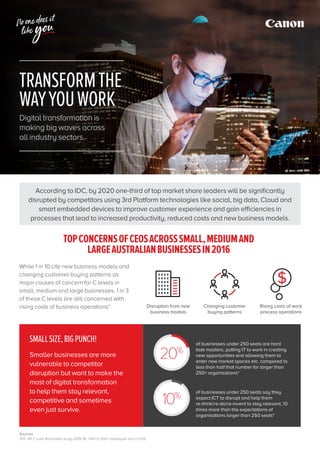
While 1 in 10 cite new business models and
changing customer buying patterns as
major causes of concern for C levels in
small, medium and large businesses, 1 in 3
of these C levels are still concerned with
rising costs of business operations*
of businesses under 250 seats are hard
task masters, putting IT to work in creating
new opportunities and allowing them to
enter new market spaces etc. compared to
less than half that number for larger than
250+ organisations*
of businesses under 250 seats say they
expect ICT to disrupt and help them
re-think/re-do/re-invent to stay relevant, 10
times more than the expectations of
organisations larger than 250 seats*
Smaller businesses are more
vulnerable to competitor
disruption but want to make the
most of digital transformation
to help them stay relevant,
competitive and sometimes
even just survive.
Disruption from new
business models
Changing customer
buying patterns
Rising costs of work
process operations
TOPCONCERNSOFCEOSACROSSSMALL,MEDIUMAND
LARGEAUSTRALIANBUSINESSESIN2016
SMALLSIZE,BIGPUNCH!
According to IDC, by 2020 one-third of top market share leaders will be significantly
disrupted by competitors using 3rd Platform technologies like social, big data, Cloud and
smart embedded devices to improve customer experience and gain efficiencies in
processes that lead to increased productivity, reduced costs and new business models.
TRANSFORMTHE
WAYYOUWORK
Digital transformation is
making big waves across
all industry sectors.
20%
10%
Sources
*IDC AP C suite Barometer study 2015-16, <100 to 500+ employee size n=320.
Sources
**IDC-Canon Transformation Study, March 2016, 100-999 employee size, n=170.
Call 1800 444 199 or visit www.canon.com.au/business
When we asked a diverse
range of businesses
where they were on their
digital transformation
journey what we found
was what they think is not
what they do.
The intent is there but
there are some inherent
things that businesses
need help with.
Increased productivity and cost savings are still the main focus of most
organisations. However, what is surprising is how important employee
engagement is in comparison to improved customer experience**
Digital transformation encourages businesses to shift their focus beyond short term
efficiency initiatives to longer term workflow and business model transformation strategies.
Canon provides solutions to help businesses of all sizes, and at any stage of the digital
transformation journey, to meet the challenges of their new and disruptive environment.
AREYOUATRUEDIGITAL
TRANSFORMER?
WHATISHOLDINGBACK
BUSINESSTRANSFORMATION?
WHATDOBUSINESSESWANTTOACHIEVEBYTRANSFORMINGTHEIRPROCESSES?
HOWEVER IN REALITY, THE SAME
SURVEY REVEALS THEIR
IMMATURITY IN TERMS OF THEIR
DOCUMENT PROCESS STATUS;
28%
of businesses still
worked with
completely paper
based processesof businesses said they
were highly dependent
on IT/had started or are
well into their digital
transformation journey.
82%
A RECENT CANON IDC
SURVEY SHOWED THAT:
57%
of the businesses
were working at
various stages of
paper and
14%
said they had completely
digitised workflows
58%
cited a lack of
internal capability
50%
said not a
priority right
now/lack of ROI
Almost
50%
Just under
cited employee
change
management
85% Improved decision making, speed
to market and reduced human error
78% Reduced cost
78% Improved employee engagement
and driving competitive advantage
55% Improved customer engagement

Canon Digital Transformation flyer

  • 1.
    While 1 in10 cite new business models and changing customer buying patterns as major causes of concern for C levels in small, medium and large businesses, 1 in 3 of these C levels are still concerned with rising costs of business operations* of businesses under 250 seats are hard task masters, putting IT to work in creating new opportunities and allowing them to enter new market spaces etc. compared to less than half that number for larger than 250+ organisations* of businesses under 250 seats say they expect ICT to disrupt and help them re-think/re-do/re-invent to stay relevant, 10 times more than the expectations of organisations larger than 250 seats* Smaller businesses are more vulnerable to competitor disruption but want to make the most of digital transformation to help them stay relevant, competitive and sometimes even just survive. Disruption from new business models Changing customer buying patterns Rising costs of work process operations TOPCONCERNSOFCEOSACROSSSMALL,MEDIUMAND LARGEAUSTRALIANBUSINESSESIN2016 SMALLSIZE,BIGPUNCH! According to IDC, by 2020 one-third of top market share leaders will be significantly disrupted by competitors using 3rd Platform technologies like social, big data, Cloud and smart embedded devices to improve customer experience and gain efficiencies in processes that lead to increased productivity, reduced costs and new business models. TRANSFORMTHE WAYYOUWORK Digital transformation is making big waves across all industry sectors. 20% 10% Sources *IDC AP C suite Barometer study 2015-16, <100 to 500+ employee size n=320.
  • 2.
    Sources **IDC-Canon Transformation Study,March 2016, 100-999 employee size, n=170. Call 1800 444 199 or visit www.canon.com.au/business When we asked a diverse range of businesses where they were on their digital transformation journey what we found was what they think is not what they do. The intent is there but there are some inherent things that businesses need help with. Increased productivity and cost savings are still the main focus of most organisations. However, what is surprising is how important employee engagement is in comparison to improved customer experience** Digital transformation encourages businesses to shift their focus beyond short term efficiency initiatives to longer term workflow and business model transformation strategies. Canon provides solutions to help businesses of all sizes, and at any stage of the digital transformation journey, to meet the challenges of their new and disruptive environment. AREYOUATRUEDIGITAL TRANSFORMER? WHATISHOLDINGBACK BUSINESSTRANSFORMATION? WHATDOBUSINESSESWANTTOACHIEVEBYTRANSFORMINGTHEIRPROCESSES? HOWEVER IN REALITY, THE SAME SURVEY REVEALS THEIR IMMATURITY IN TERMS OF THEIR DOCUMENT PROCESS STATUS; 28% of businesses still worked with completely paper based processesof businesses said they were highly dependent on IT/had started or are well into their digital transformation journey. 82% A RECENT CANON IDC SURVEY SHOWED THAT: 57% of the businesses were working at various stages of paper and 14% said they had completely digitised workflows 58% cited a lack of internal capability 50% said not a priority right now/lack of ROI Almost 50% Just under cited employee change management 85% Improved decision making, speed to market and reduced human error 78% Reduced cost 78% Improved employee engagement and driving competitive advantage 55% Improved customer engagement