Are most positive findings in 
psychology false or 
exaggerated? An activist's 
perspective 
Colloquium at ANU 
Research School of Psychology 
Sept 10, 2014 
James C. Coyne, Ph.D. 
University of Groningen University 
Medical Center Groningen (UMCG), 
Groningen, the Netherlands 
jcoynester@gmail.com
John Ioannidis documented many positive 
findings in the biomedical literature do not 
replicate and many apparent “discoveries” turn 
out to be exaggerated or simply false. 
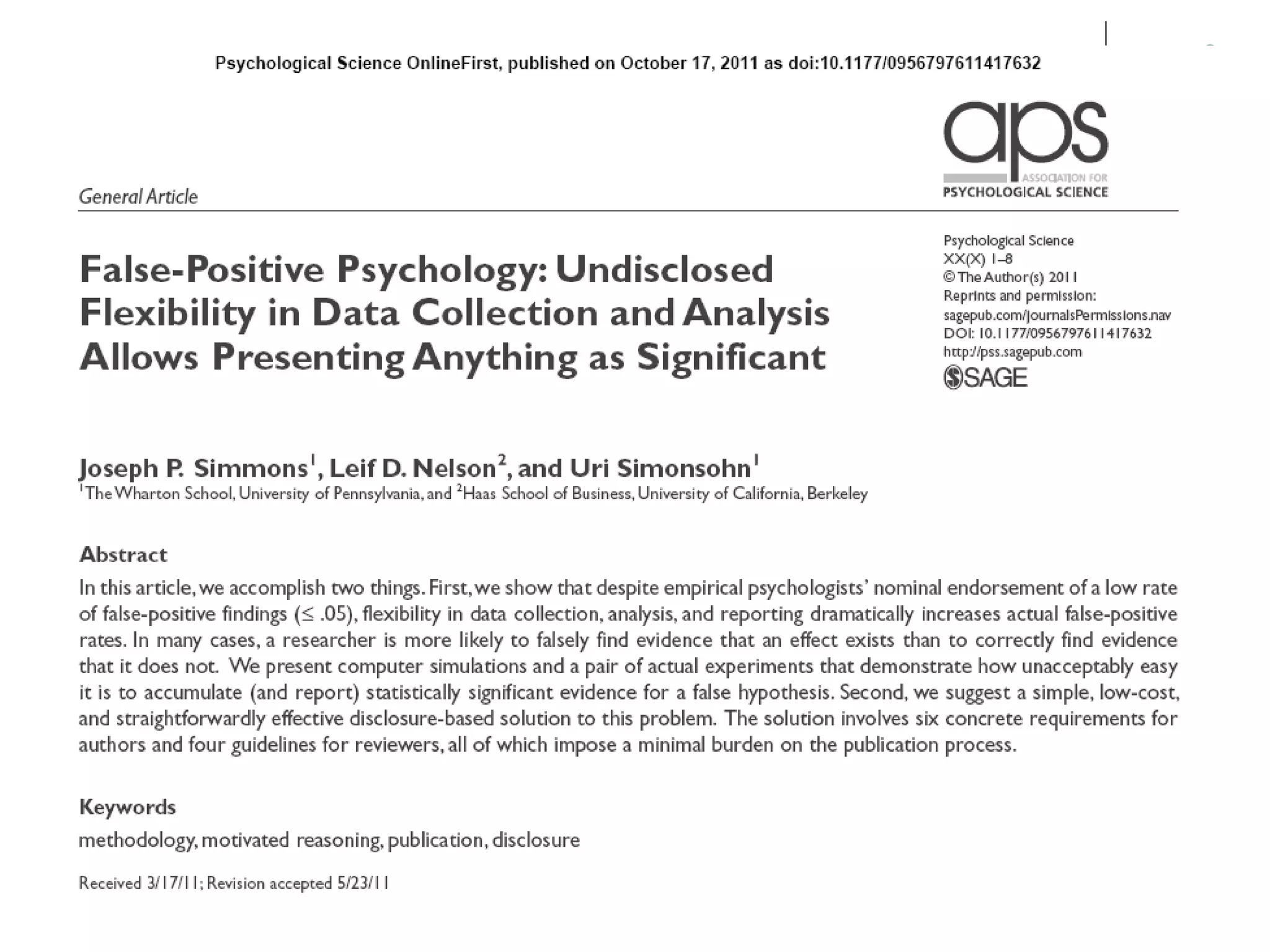
Many apparent discoveries are created by a 
combination of confirmatory bias, flexible rules 
of design, data analysis and reporting and 
significance chasing.
“It can be proven that most claimed 
research findings are false” 
Ioannidis, JPA. (2005). Why most published 
research findings are false. PLOS Medicine 2: 
696-701. 
Ioannidis, JPA. (2005). Contradicted and 
initially stronger effects in highly cited clinical 
research. JAMA 294: 218-228. 
Young, NS., Ioannidis, JPA. et al. (2008). Why 
Current Publication Practices May Distort 
Science. PLOS Medicine 5: 1418-1422.
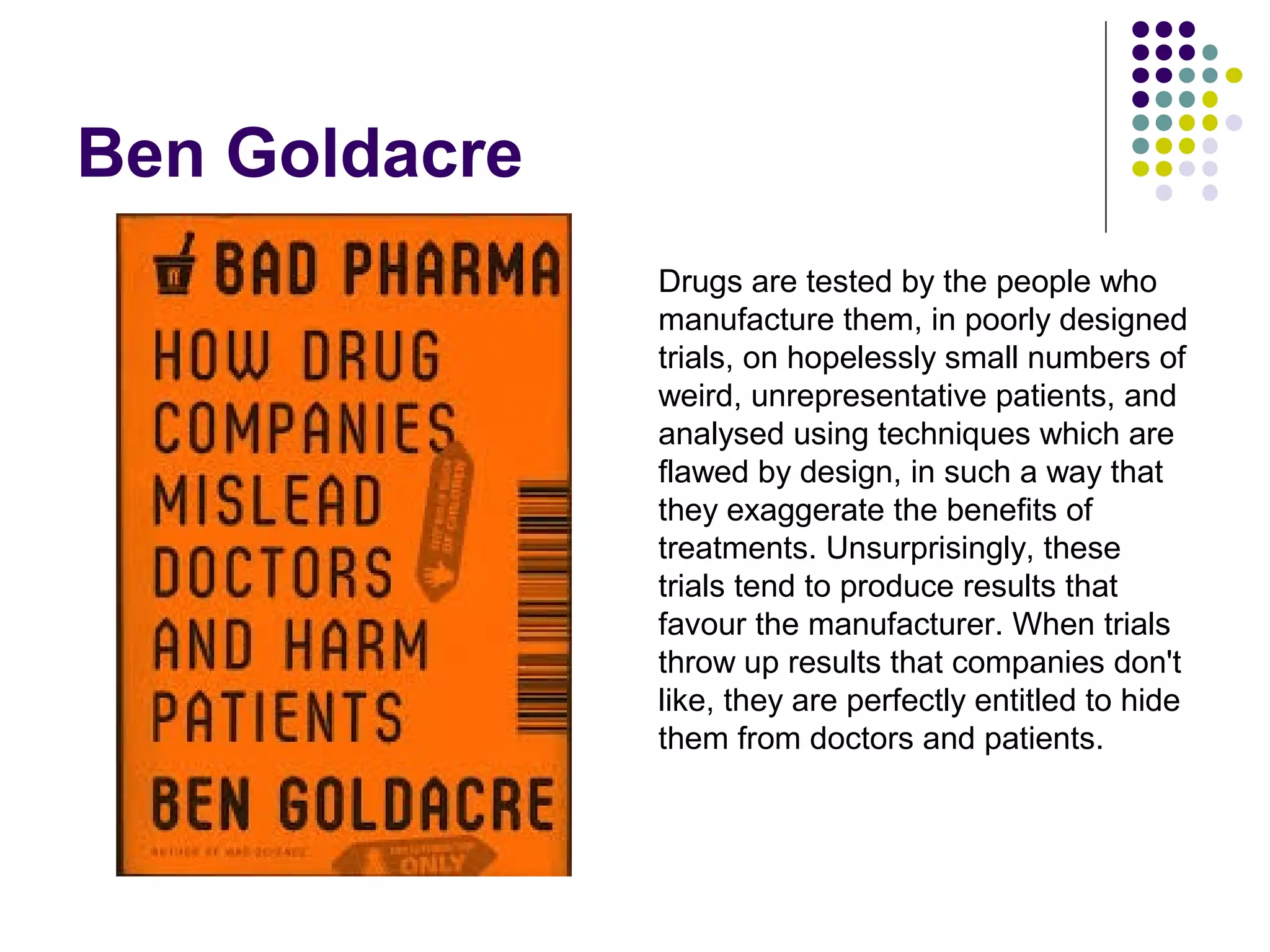
Ben Goldacre 
Drugs are tested by the people who 
manufacture them, in poorly designed 
trials, on hopelessly small numbers of 
weird, unrepresentative patients, and 
analysed using techniques which are 
flawed by design, in such a way that 
they exaggerate the benefits of 
treatments. Unsurprisingly, these 
trials tend to produce results that 
favour the manufacturer. When trials 
throw up results that companies don't 
like, they are perfectly entitled to hide 
them from doctors and patients.
Efforts at reform 
 Preregistration of clinical trials make it more 
difficult to hide negative trials or alter analytic 
plans after results are known. 
 Reporting standards ensure more transparent 
and detailed article so results can be 
independently validated. 
 Reporting standards and pre-registration of 
plans for meta-analyses and systematic reviews. 
 Making data available for independent 
reanalysis.
Our modest contribution to 
reform 
Roseman, M, Milette, K, Bero, LA, Coyne, JC, 
Lexchin, J., Turner, EH, & Thombs, BD. (2011). 
Reporting of conflicts of interest in meta-analyses 
of trials of pharmacological 
treatments. JAMA, 2011;305(10):1008-17. 
Roseman, M, Turner, EH, Lexchin, J., Coyne, 
JC, Bero, LA, & Thombs, BD. (2012). Reporting 
of conflicts of interest from drug trials in 
Cochrane reviews: cross sectional study. BMJ, 
2012; 345.
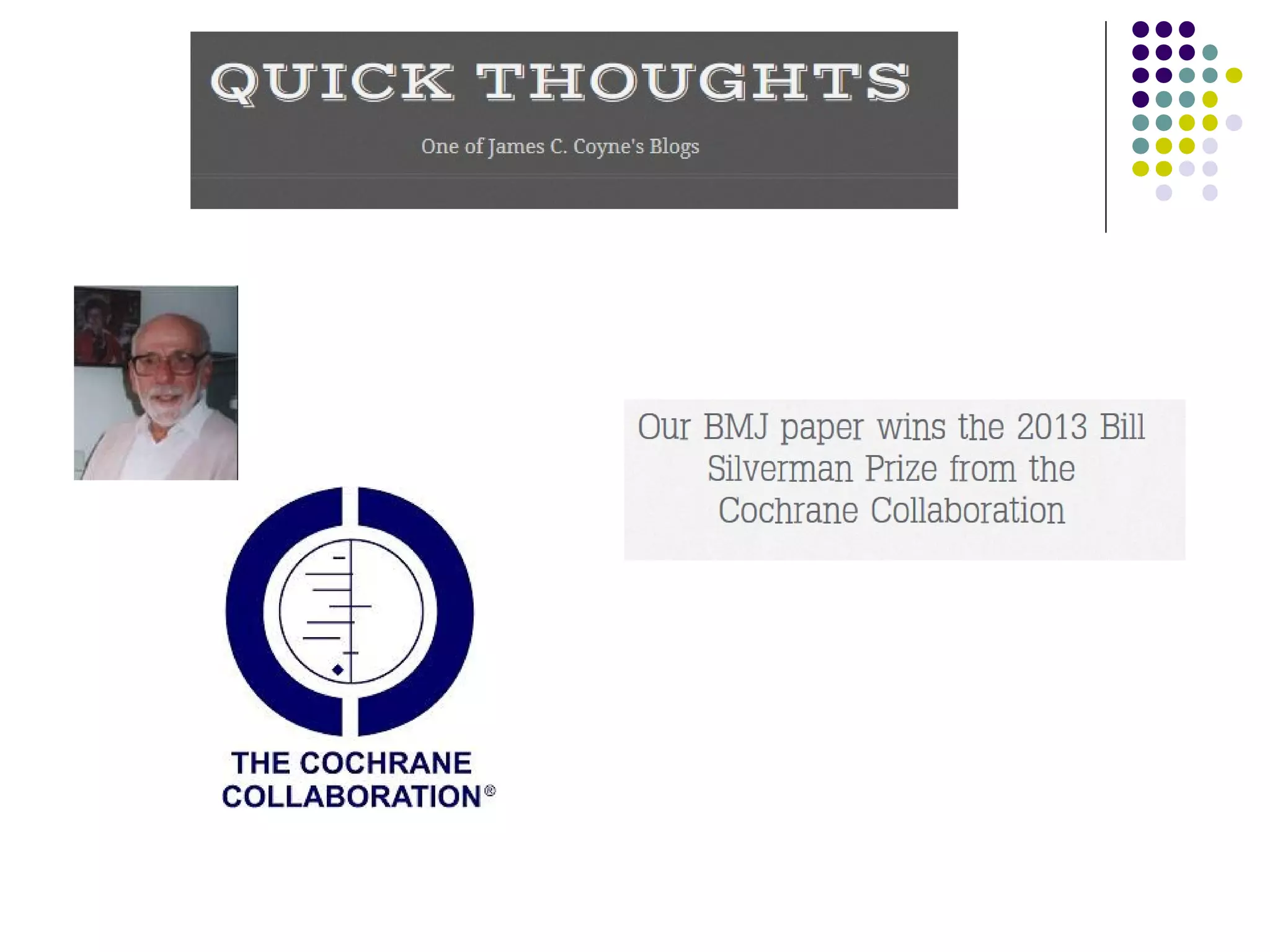
We documented with association of source of 
funding with claimed size of effects. 
We proposed considering conflict of interest as 
a moderator, source of heterogeneity, and 
another risk of bias in Cochrane risk of bias 
assessment. 
The Cochrane Collaboration agreed.
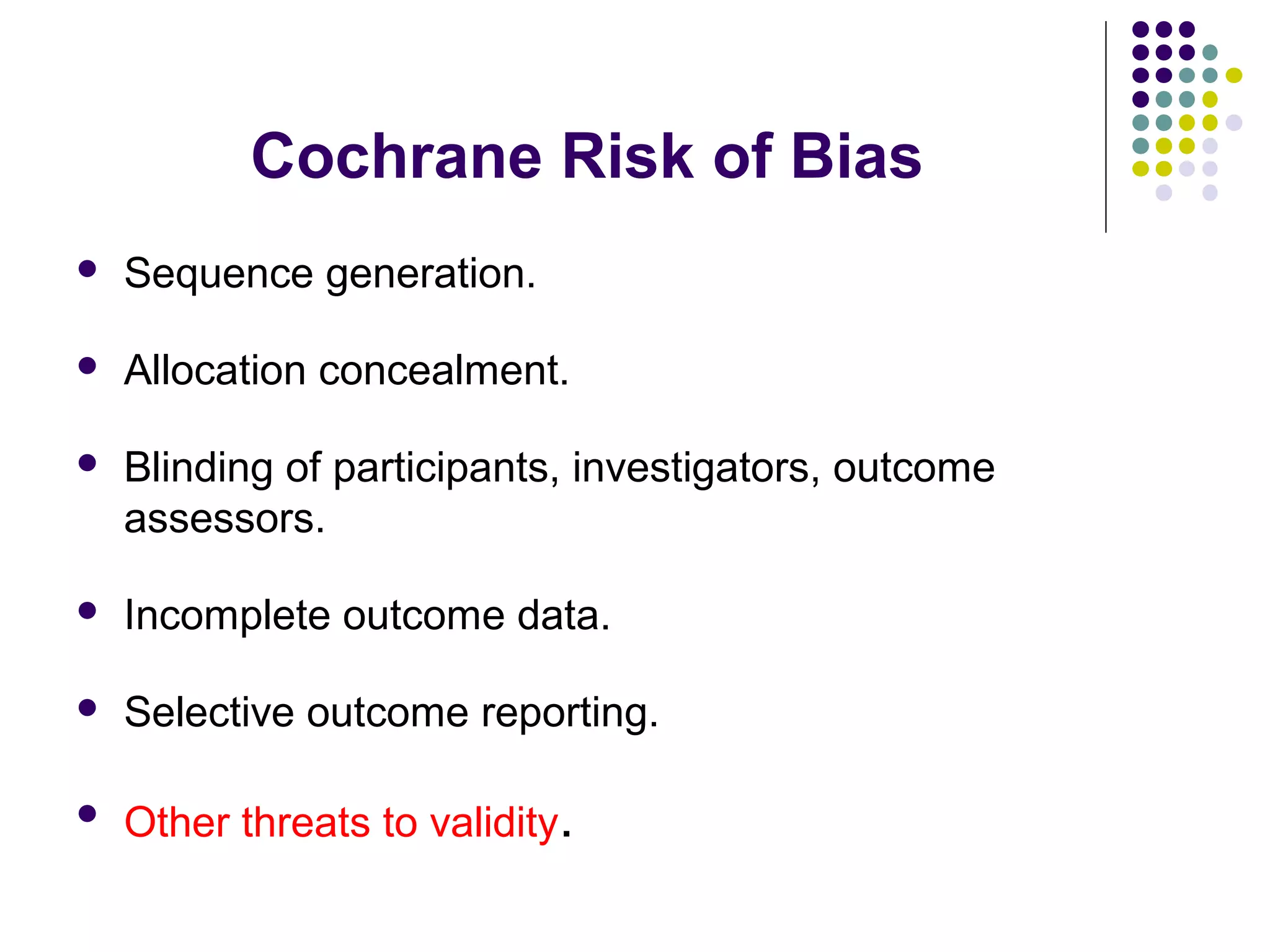
Cochrane Risk of Bias 
 Sequence generation. 
 Allocation concealment. 
 Blinding of participants, investigators, outcome 
assessors. 
 Incomplete outcome data. 
 Selective outcome reporting. 
 Other threats to validity.
Trickle down of reform 
 Changes forced upon Pharma slowly and 
inconsistently reach clinical psychology. 
 Larger data sets allow exploration of issues 
such as choice of control groups and 
investigator allegiance. 
 Behavioral Medicine adopts changes 
occurring in clinical psychology later and 
inconsistently.
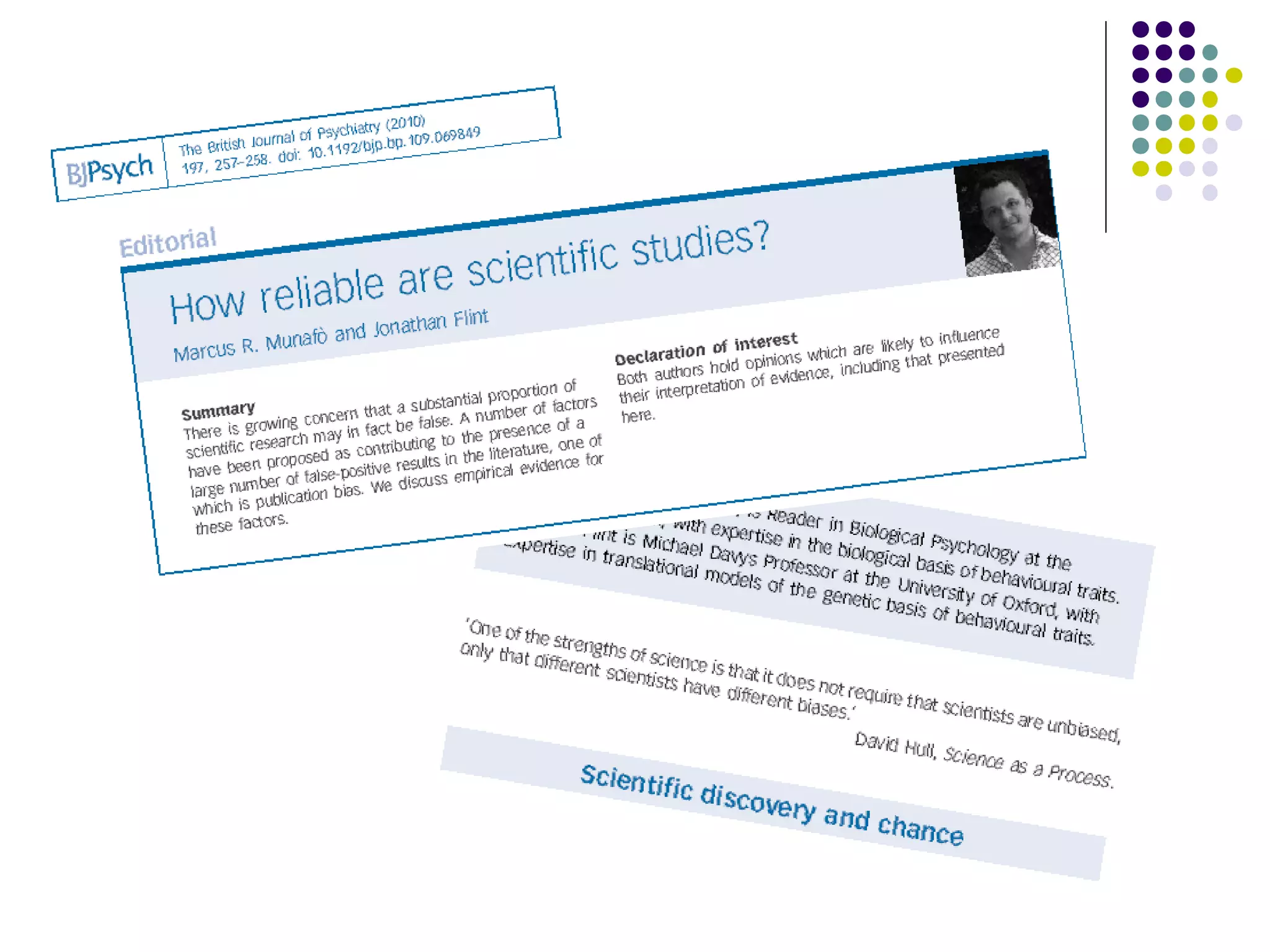
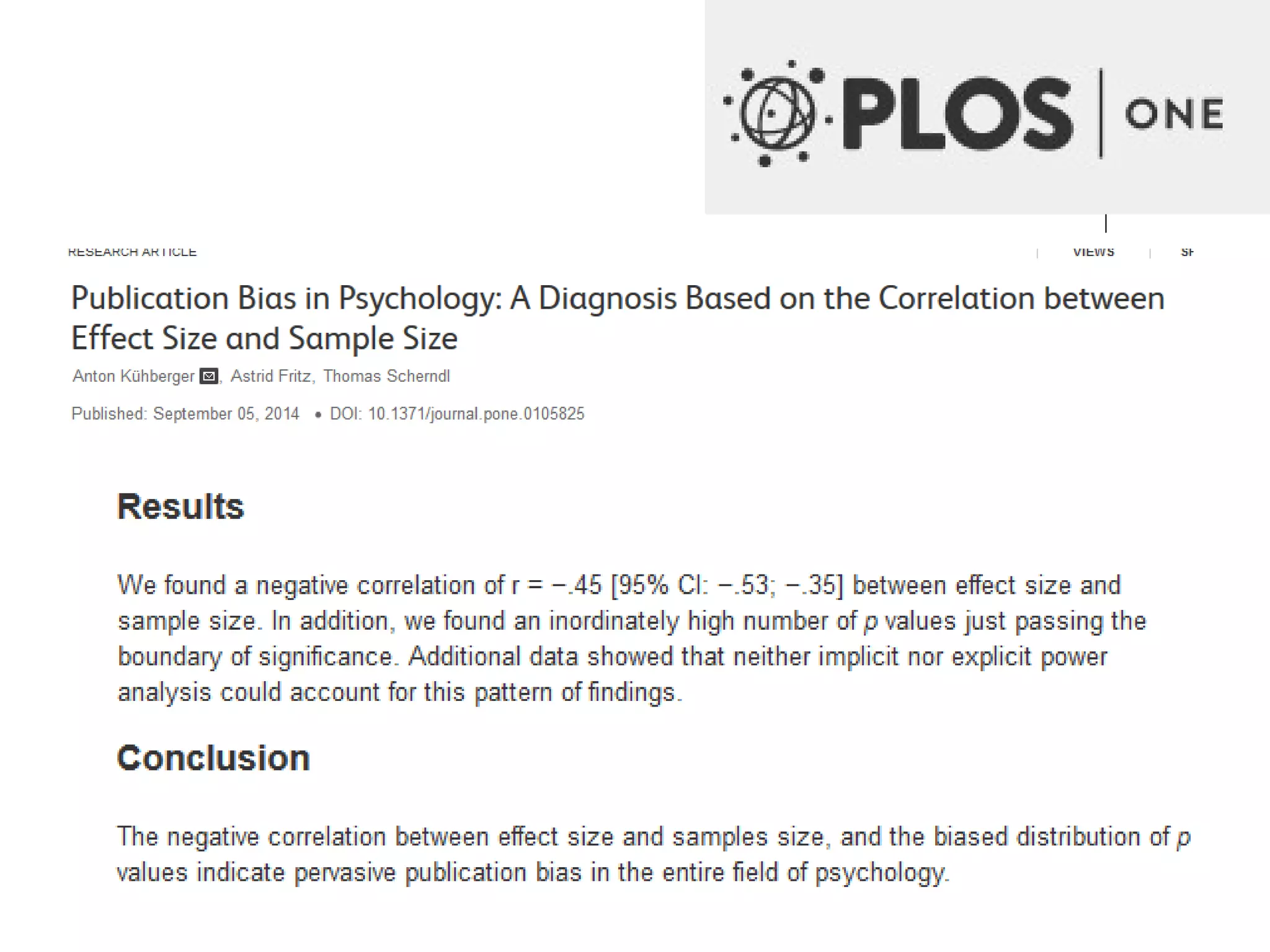
Psychology's crisis of credibility
Instances of outright fraud are unusual, 
but confirmatory bias is rampant and 
supported by diffuse institutional forces. 
On the other hand, when fraud is 
consistent with prevailing biases, it can 
be tough to root out.
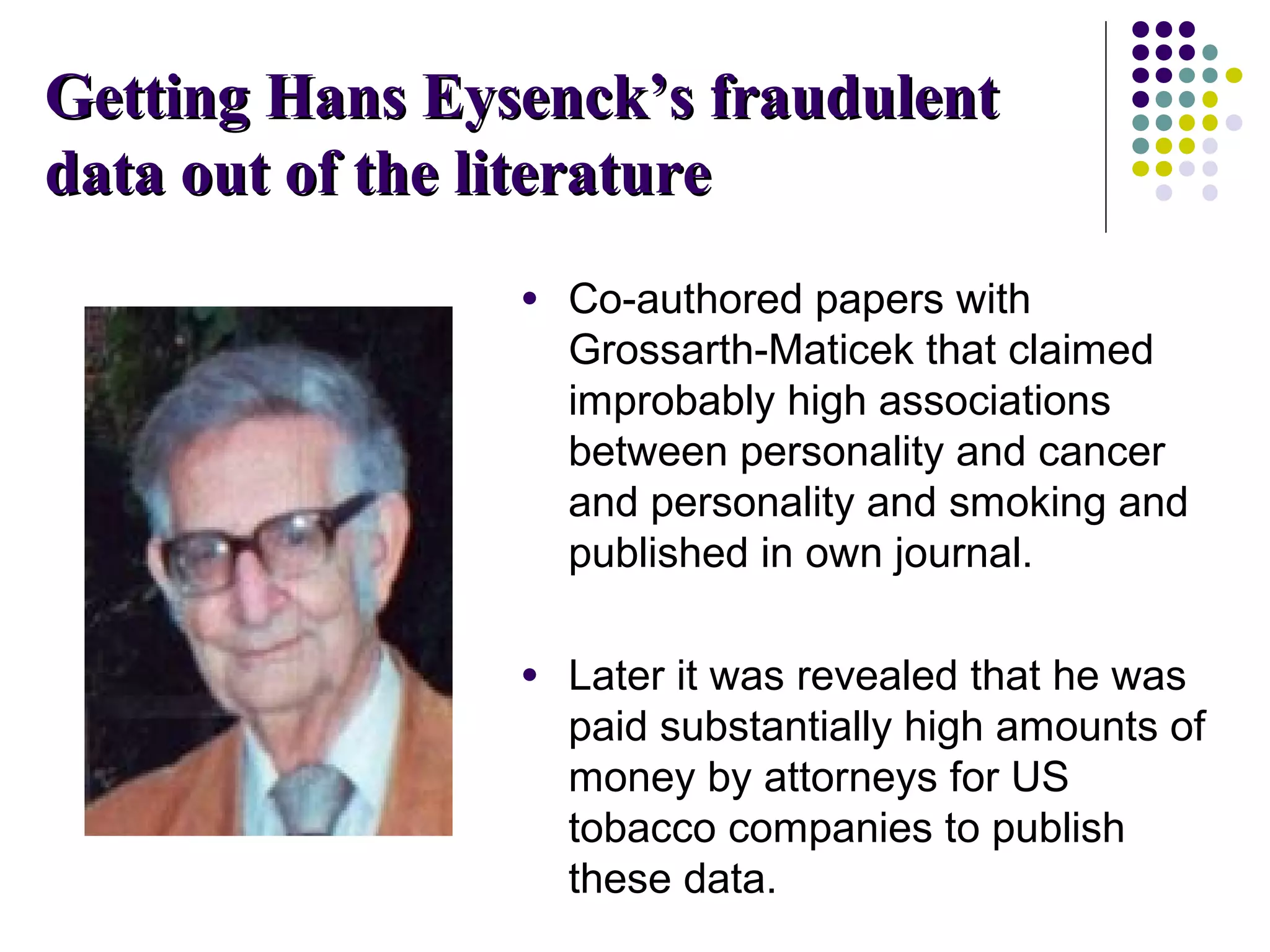
GGeettttiinngg HHaannss EEyysseenncckk’’ss ffrraauudduulleenntt 
ddaattaa oouutt ooff tthhee lliitteerraattuurree 
● Co-authored papers with 
Grossarth-Maticek that claimed 
improbably high associations 
between personality and cancer 
and personality and smoking and 
published in own journal. 
● Later it was revealed that he was 
paid substantially high amounts of 
money by attorneys for US 
tobacco companies to publish 
these data.
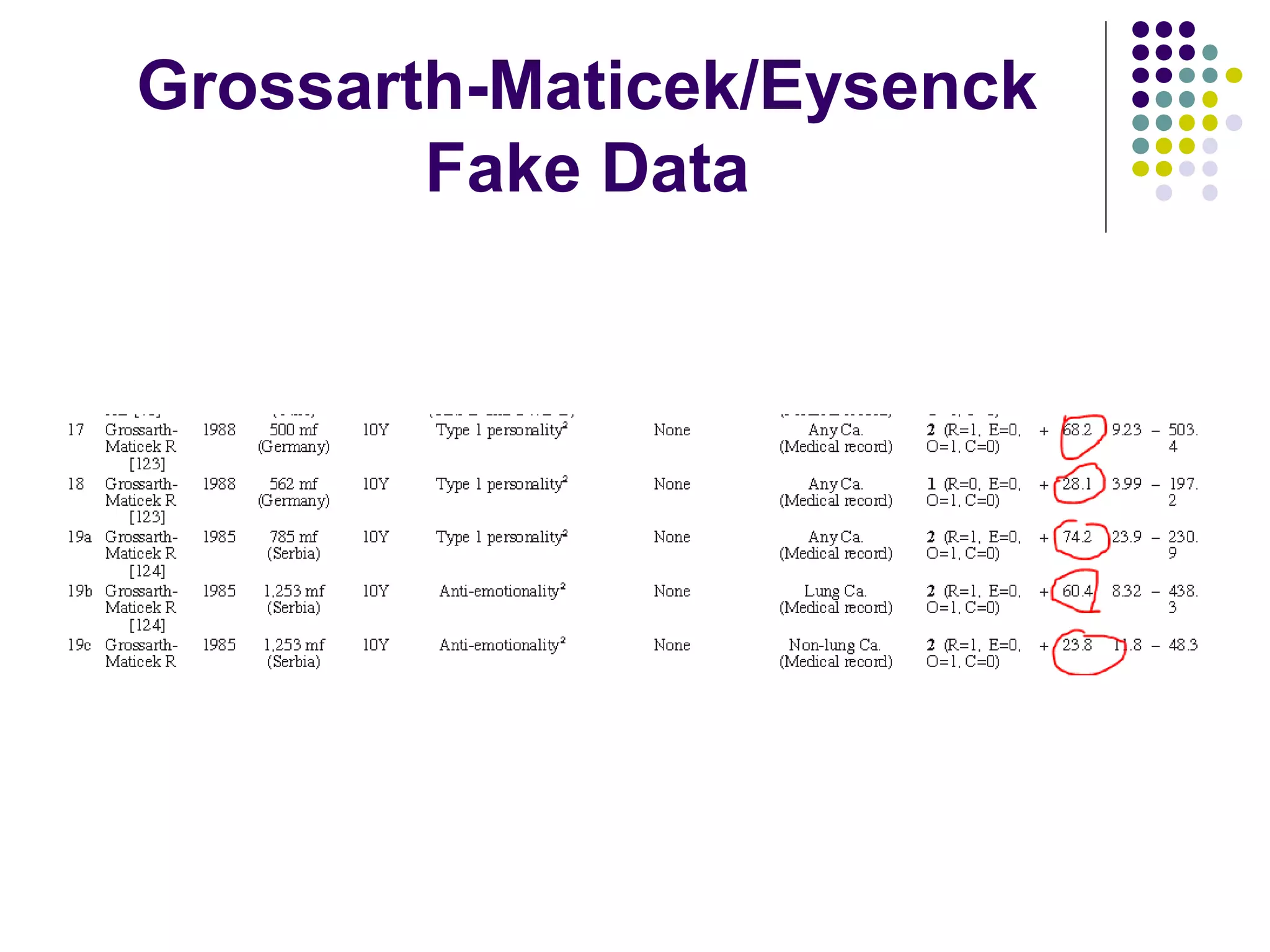
In a literature dominated by hazard ratios (HRs) 
clustered around 1.0, Eysenck/Grossarth- 
Maticek’s were extreme outliers, absurdly so. 
Their influence nonetheless lives on in inflated 
overall estimates of the effects of negative 
affect on cancer in tertiary sources that do not 
acknowledge their tainted origins.
Grossarth-Maticek/Eysenck 
Fake Data
Coyne JC, Ranchor AV, Palmer SC. Meta-analysis of 
stress-related factors in cancer. Nat Rev Clin Oncol. 
2010;7(5). 
Ranchor AV, Sanderman R, Coyne JC. Invited 
Commentary: Personality as a Causal Factor in Cancer Risk 
and Mortality-Time to Retire a Hypothesis? American 
Journal of Epidemiology. 2010;172(4):386-8. 
Coyne JC, Johansen C. Confirmatory bias and the 
persistent influence of discredited data in interpreting the 
stress-cancer link: Commentary on Michael et al. (2009). 
Health Psychol. 2011;30(3):374-5
Confirmatory bias entrenched, 
preached to be a virtue.
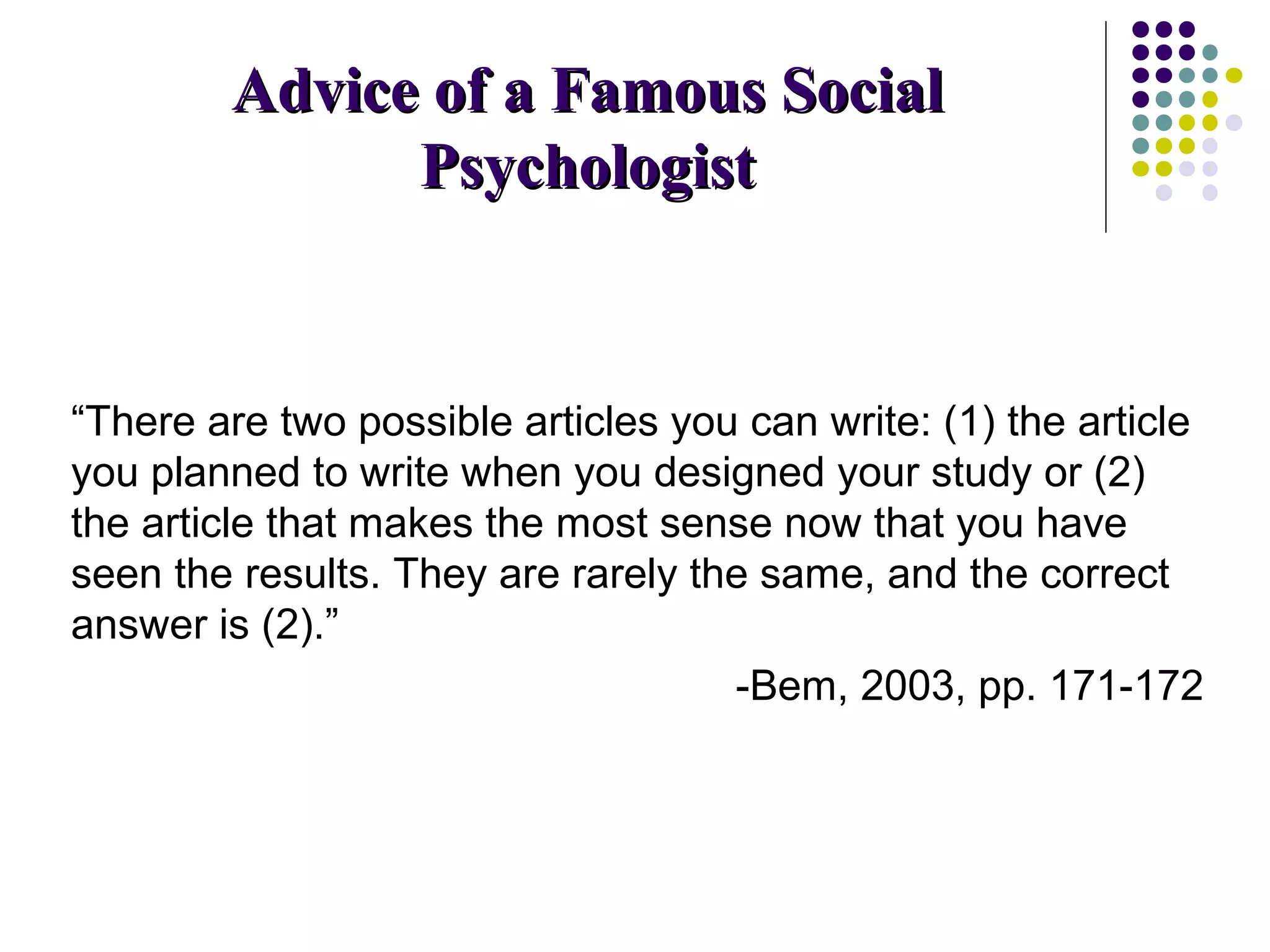
AAddvviiccee ooff aa FFaammoouuss SSoocciiaall 
PPssyycchhoollooggiisstt 
“There are two possible articles you can write: (1) the article 
you planned to write when you designed your study or (2) 
the article that makes the most sense now that you have 
seen the results. They are rarely the same, and the correct 
answer is (2).” 
-Bem, 2003, pp. 171-172
Breakthrough “discoveries” are created 
and perpetuated by a combination of 
confirmatory bias, flexible rules of 
design, data analysis and reporting and 
significance chasing.
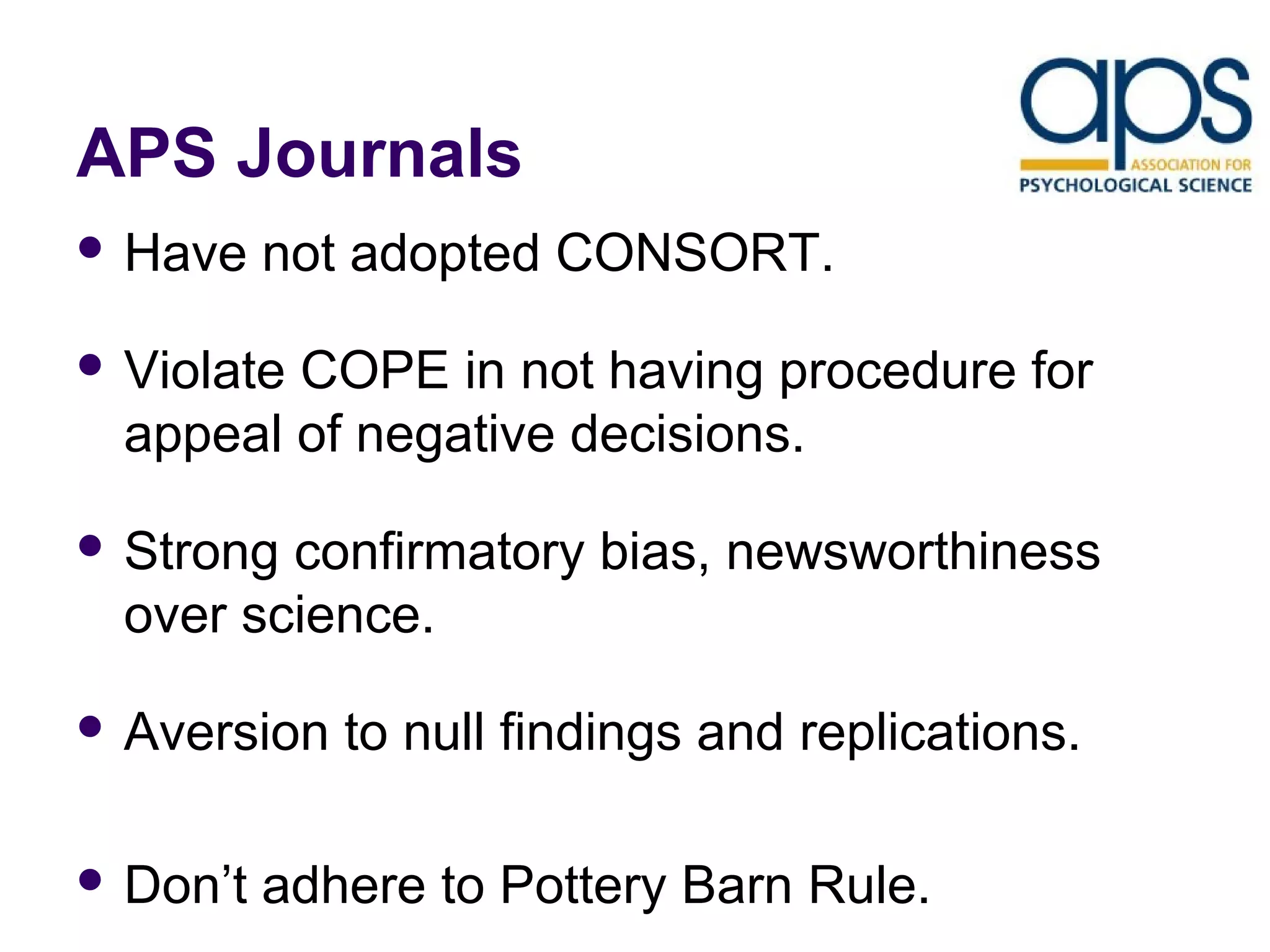
APS Journals 
 Have not adopted CONSORT. 
 Violate COPE in not having procedure for 
appeal of negative decisions. 
 Strong confirmatory bias, newsworthiness 
over science. 
 Aversion to null findings and replications. 
 Don’t adhere to Pottery Barn Rule.
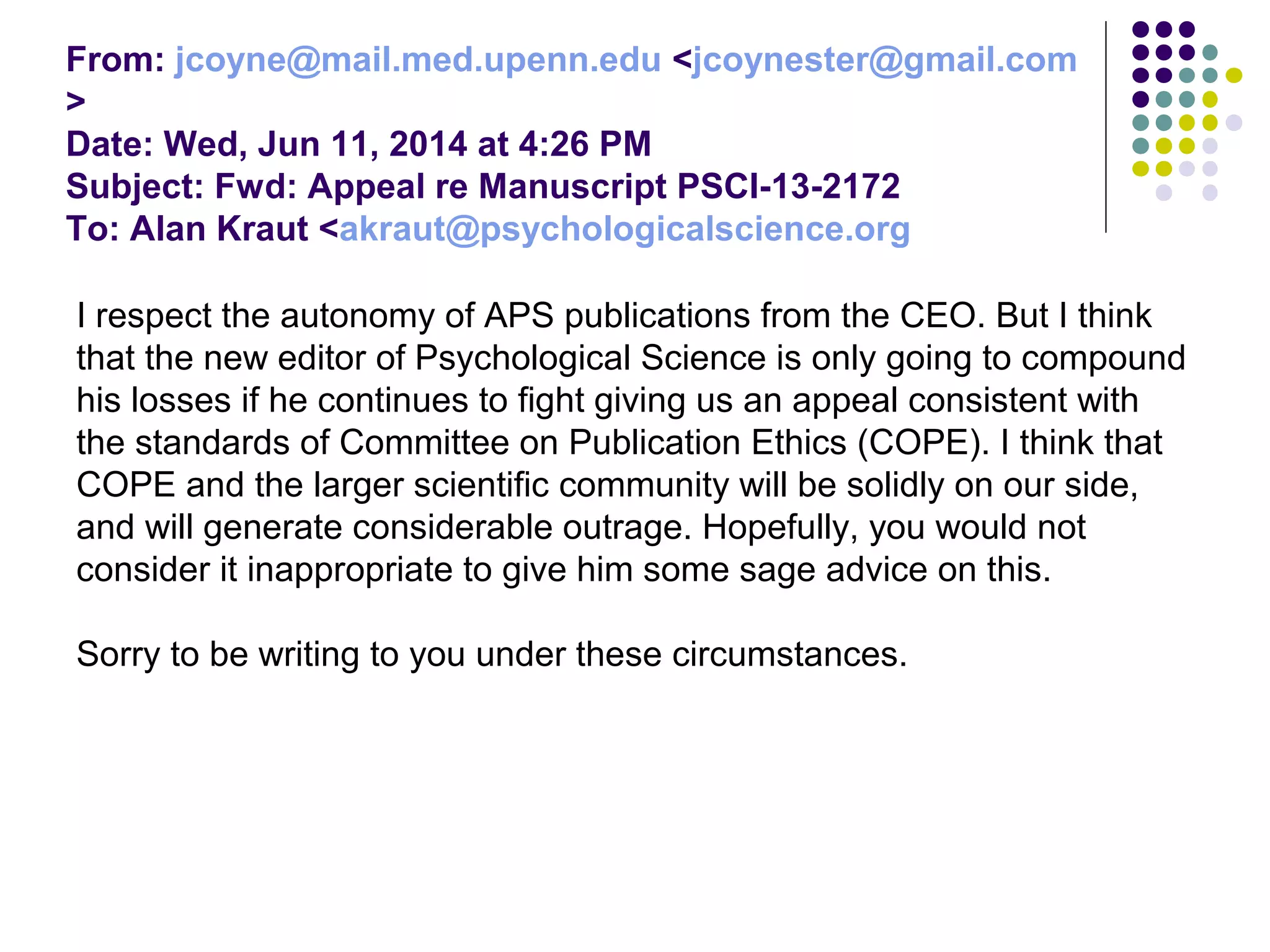
From: jcoyne@mail.med.upenn.edu <jcoynester@gmail.com 
> 
Date: Wed, Jun 11, 2014 at 4:26 PM 
Subject: Fwd: Appeal re Manuscript PSCI-13-2172 
To: Alan Kraut <akraut@psychologicalscience.org 
I respect the autonomy of APS publications from the CEO. But I think 
that the new editor of Psychological Science is only going to compound 
his losses if he continues to fight giving us an appeal consistent with 
the standards of Committee on Publication Ethics (COPE). I think that 
COPE and the larger scientific community will be solidly on our side, 
and will generate considerable outrage. Hopefully, you would not 
consider it inappropriate to give him some sage advice on this. 
Sorry to be writing to you under these circumstances.
Skepticism about the 
replication movement. 
May only serve to ghettoize null findings and 
failures to replicate. 
 Protect bias in prestigious journals toward 
false-positive findings and discrimination 
against attempted replication and now 
findings. 
 Sleeping with the enemy.
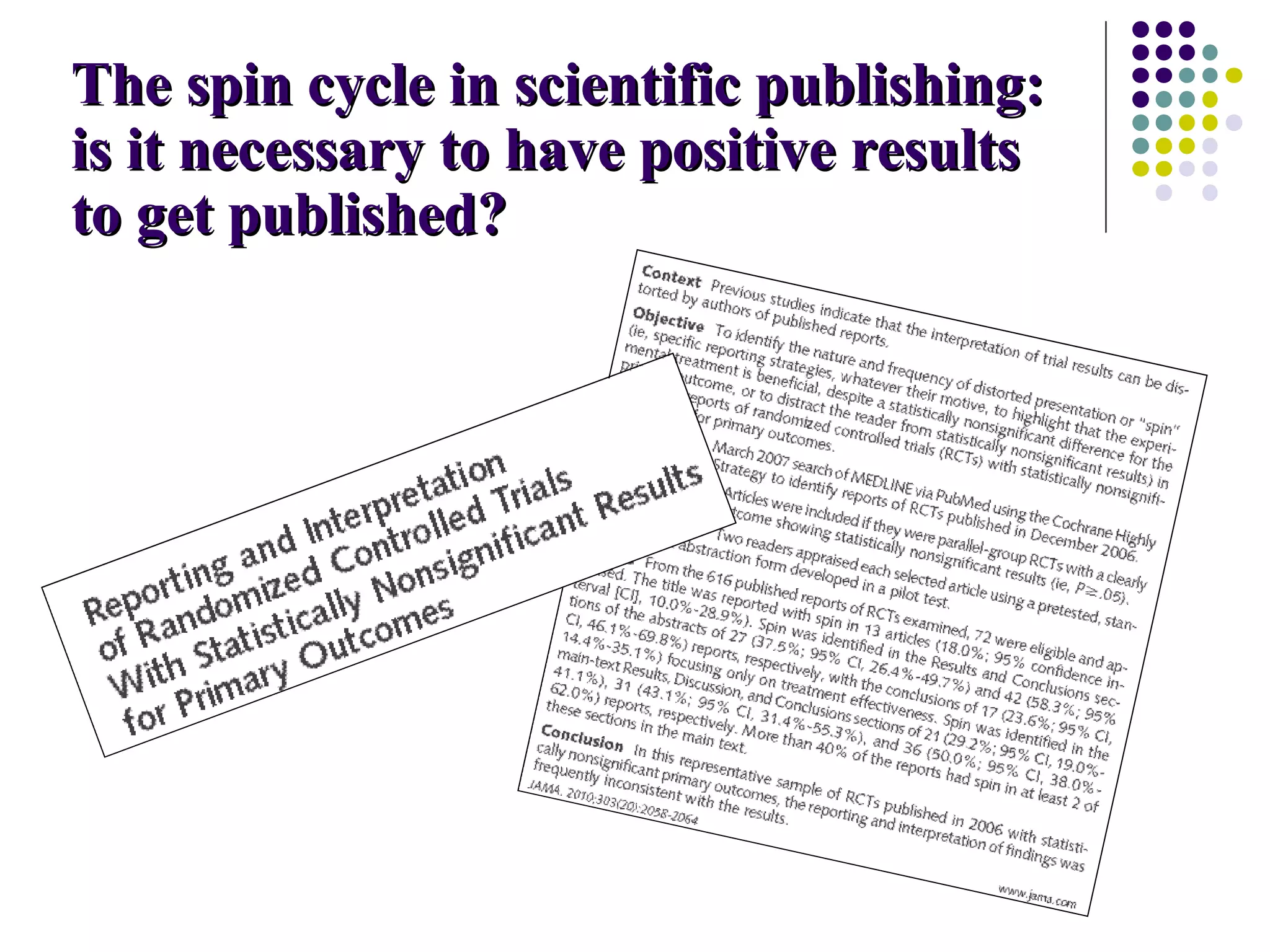
The spin ccyyccllee iinn sscciieennttiiffiicc ppuubblliisshhiinngg:: 
iiss iitt nneecceessssaarryy ttoo hhaavvee ppoossiittiivvee rreessuullttss 
ttoo ggeett ppuubblliisshheedd??
SSppiinn 
 “Spin”-- Distortion to impress readers that something is 
noteworthy. 
 Objective: To identify nature and frequency of spin in 62 
published reports of RCTs with statistically nonsignificant 
results. 
 Conclusion: Reporting and interpretation of findings 
frequently inconsistent with the results.
SSppiinn 
 Title was reported with spin in 13 articles (18.0%). 
 Spin was identified in the Results (37.5%) and Conclusions 
(58.3%) with conclusions of 17 (23.6%) focusing only on 
treatment effectiveness. 
 Spin was identified in the main-text Results (29.2%), 
Discussion (43.1%),, and Conclusions (50.0%). 
 More than 40% of reports had spin in at least 2 of these 
sections in the main text.
SSiiggnniiffiiccaannccee cchhaassiinngg bbiiaass 
The greatest threat [to the credibility of clinical research] 
may come from the poor relevance and scientific rationale 
and thus low pre-study odds of success of research efforts. 
Given that we currently have too many research findings, 
often with low credibility, replication and rigorous evaluation 
becomes as important or even more important than 
discovery. Credibility, replication, and translation are all 
desirable properties of research findings, but only modestly 
correlated.
“It is a common failing – and one I have myself suffered 
from – to fall in love with a hypothesis and to be unwilling to 
take no for an answer. A love affair with a pet hypothesis 
can waste years of precious time. There is very often no 
finally decisive yes, though quite often there can be a 
decisive no.” 
-P. B. Medawar
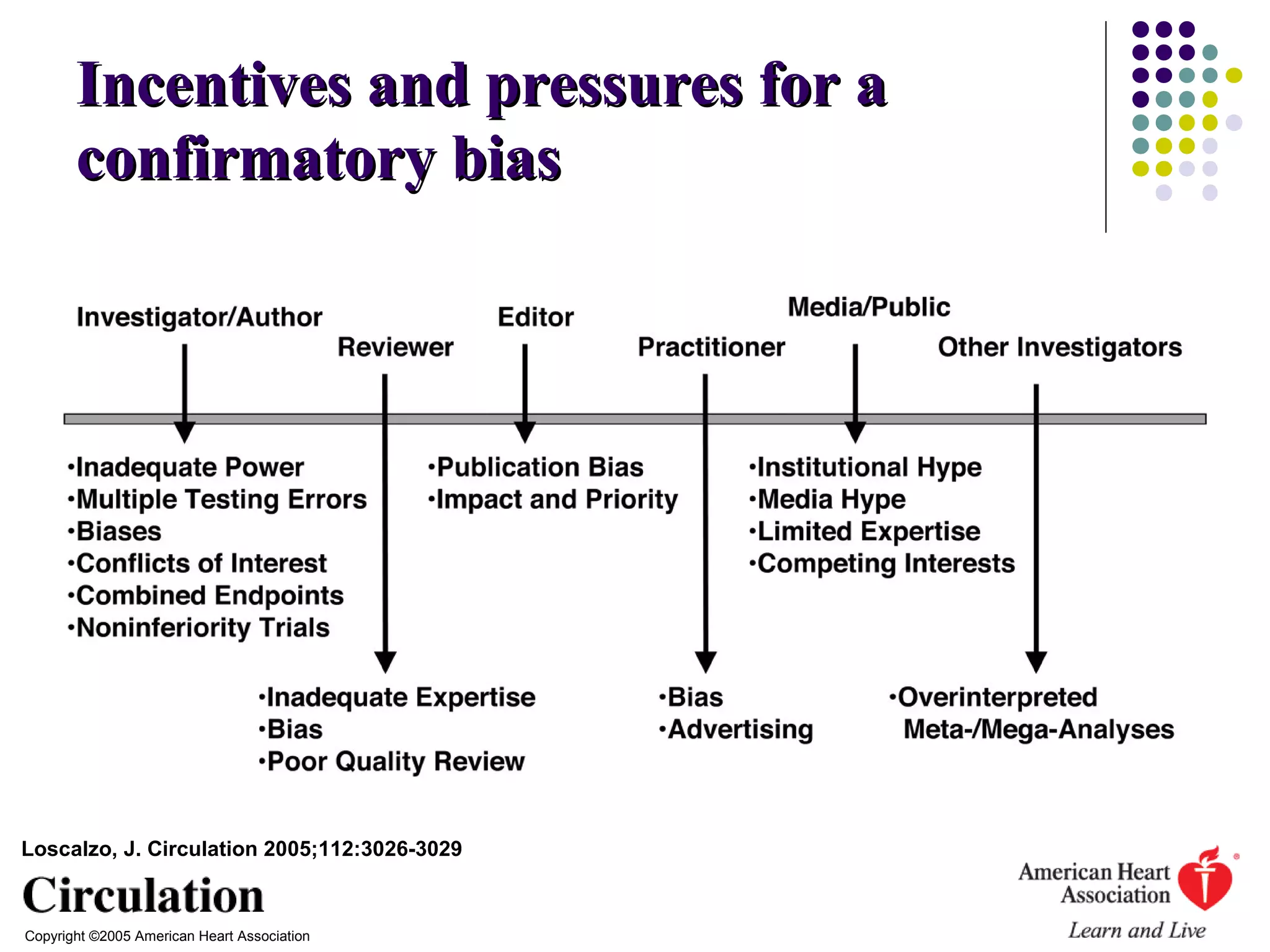
IInncceennttiivveess aanndd pprreessssuurreess ffoorr aa 
ccoonnffiirrmmaattoorryy bbiiaass 
Loscalzo, J. Circulation 2005;112:3026-3029 
Copyright ©2005 American Heart Association
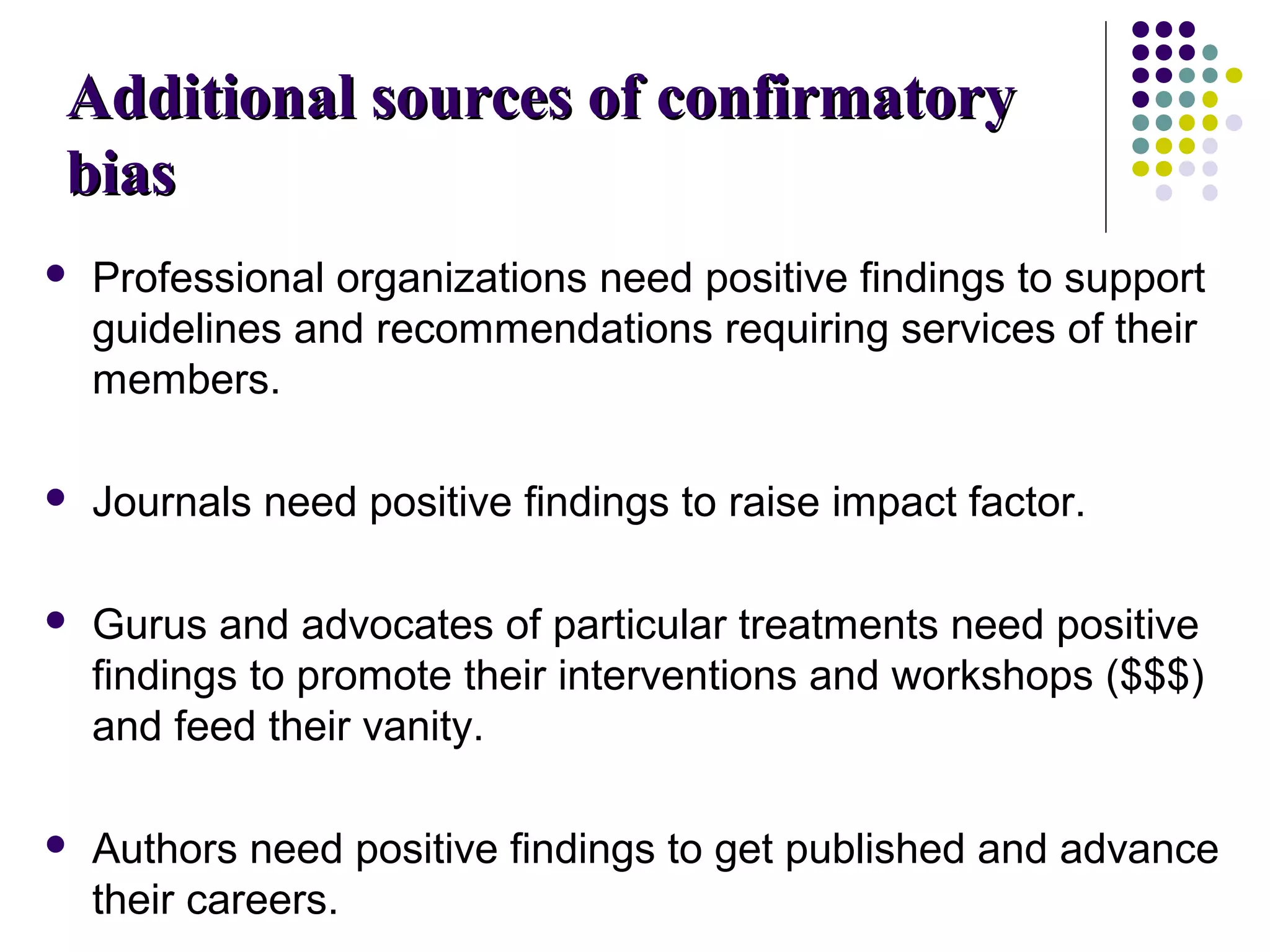
AAddddiittiioonnaall ssoouurrcceess ooff ccoonnffiirrmmaattoorryy 
bbiiaass 
 Professional organizations need positive findings to support 
guidelines and recommendations requiring services of their 
members. 
 Journals need positive findings to raise impact factor. 
 Gurus and advocates of particular treatments need positive 
findings to promote their interventions and workshops ($$$) 
and feed their vanity. 
 Authors need positive findings to get published and advance 
their careers.
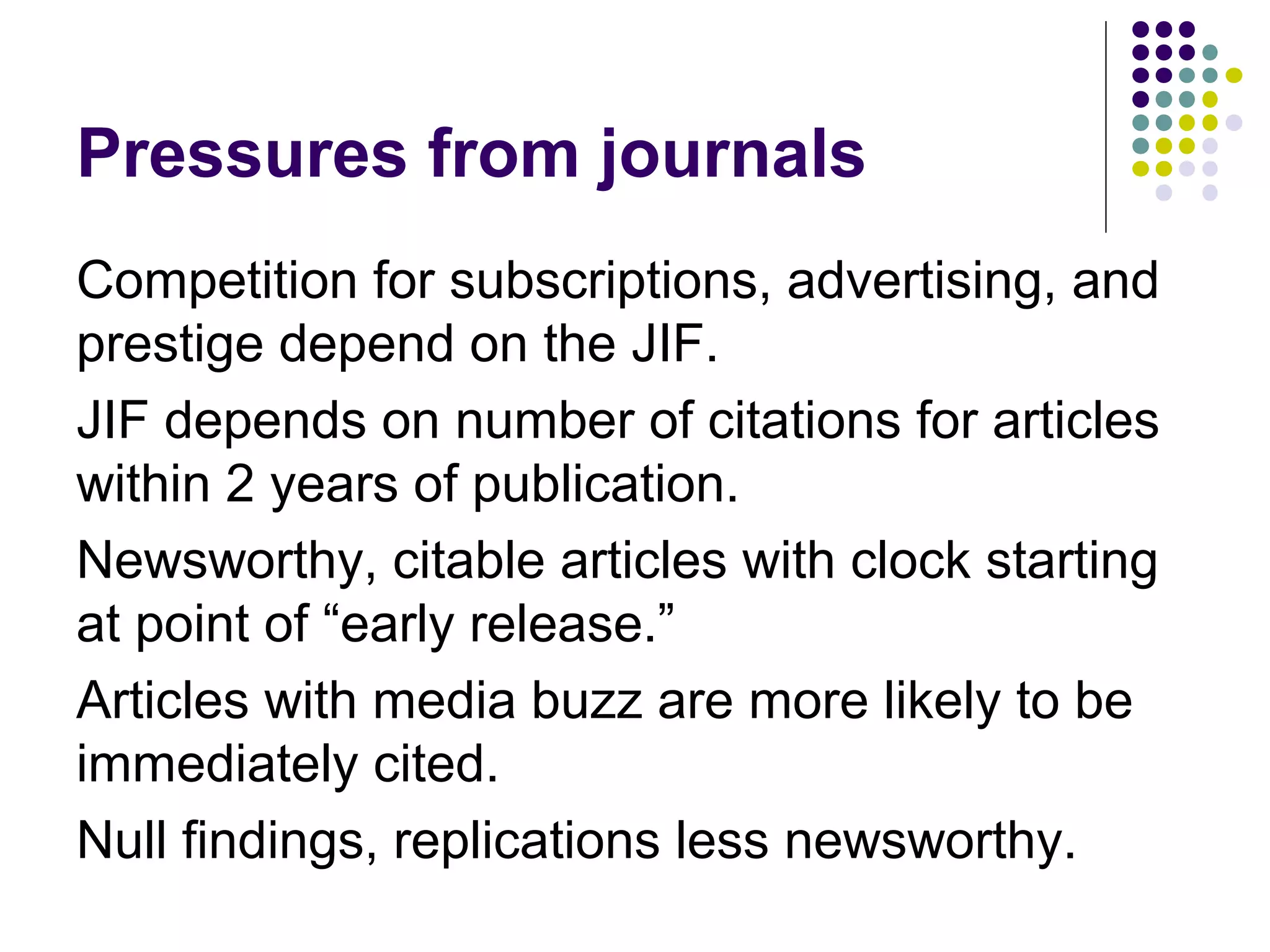
Pressures from journals 
Competition for subscriptions, advertising, and 
prestige depend on the JIF. 
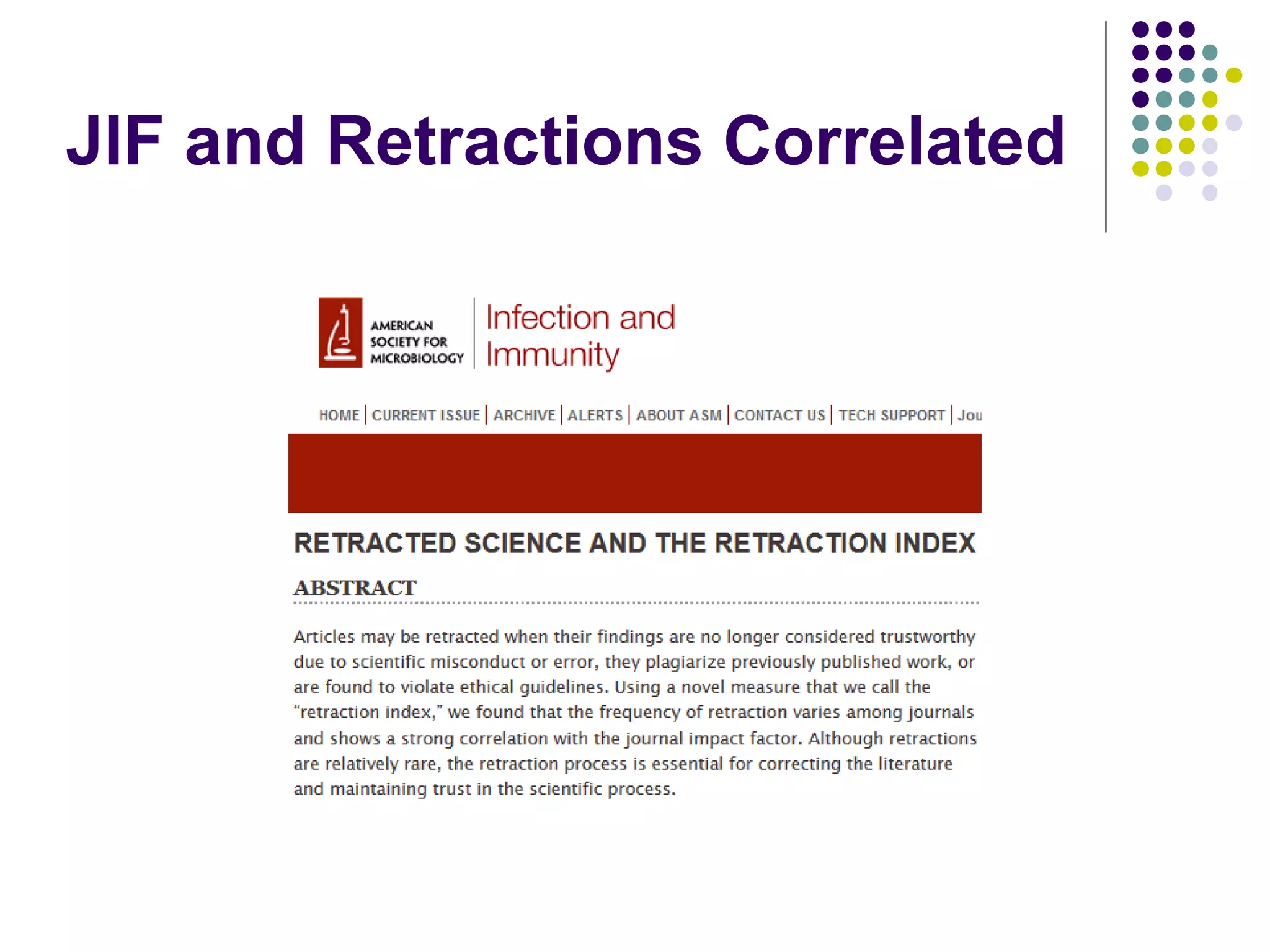
JIF depends on number of citations for articles 
within 2 years of publication. 
Newsworthy, citable articles with clock starting 
at point of “early release.” 
Articles with media buzz are more likely to be 
immediately cited. 
Null findings, replications less newsworthy.
JIF and Retractions Correlated
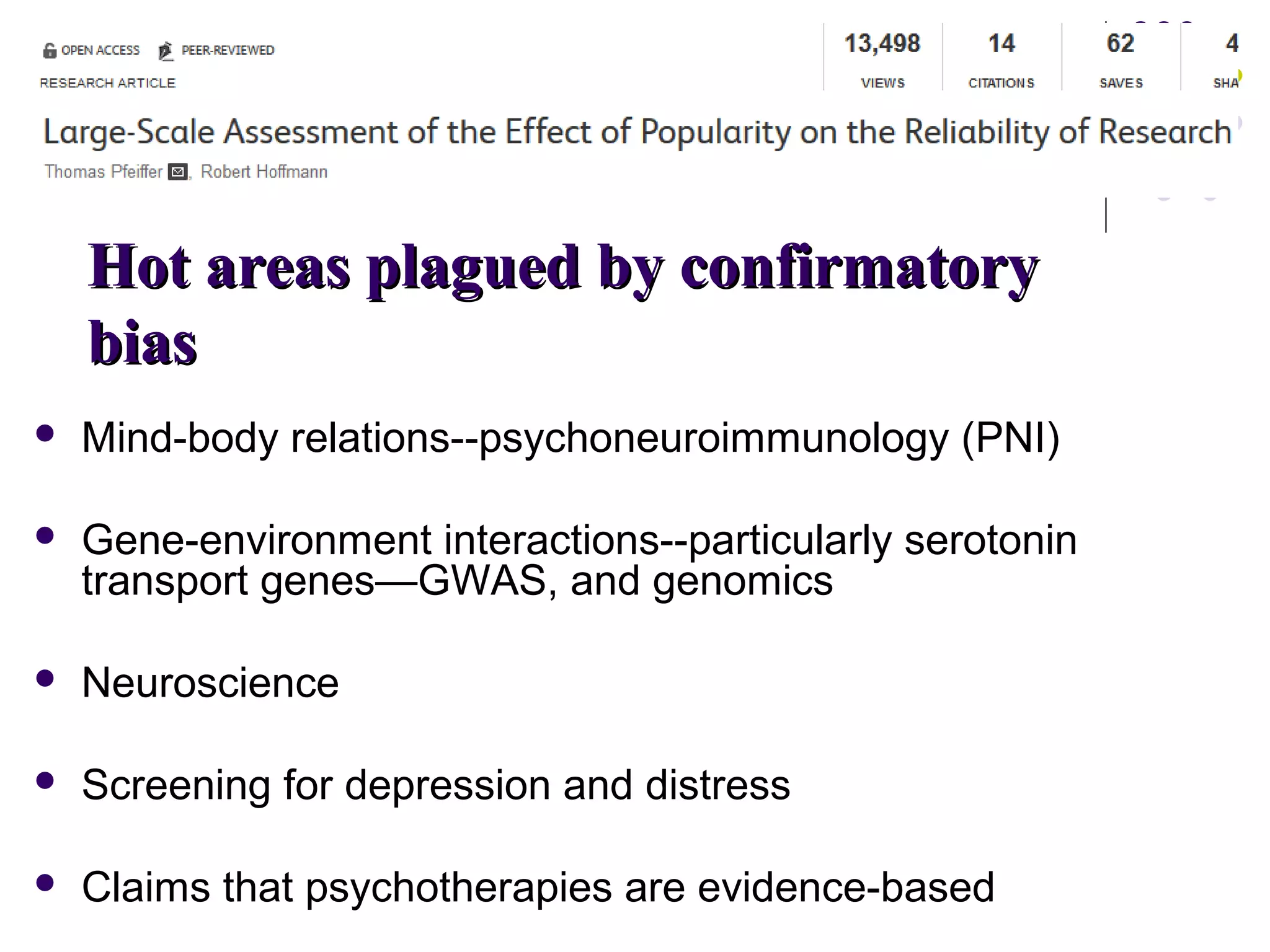
HHoott aarreeaass ppllaagguueedd bbyy ccoonnffiirrmmaattoorryy 
bbiiaass 
 Mind-body relations--psychoneuroimmunology (PNI) 
 Gene-environment interactions--particularly serotonin 
transport genes—GWAS, and genomics 
 Neuroscience 
 Screening for depression and distress 
 Claims that psychotherapies are evidence-based
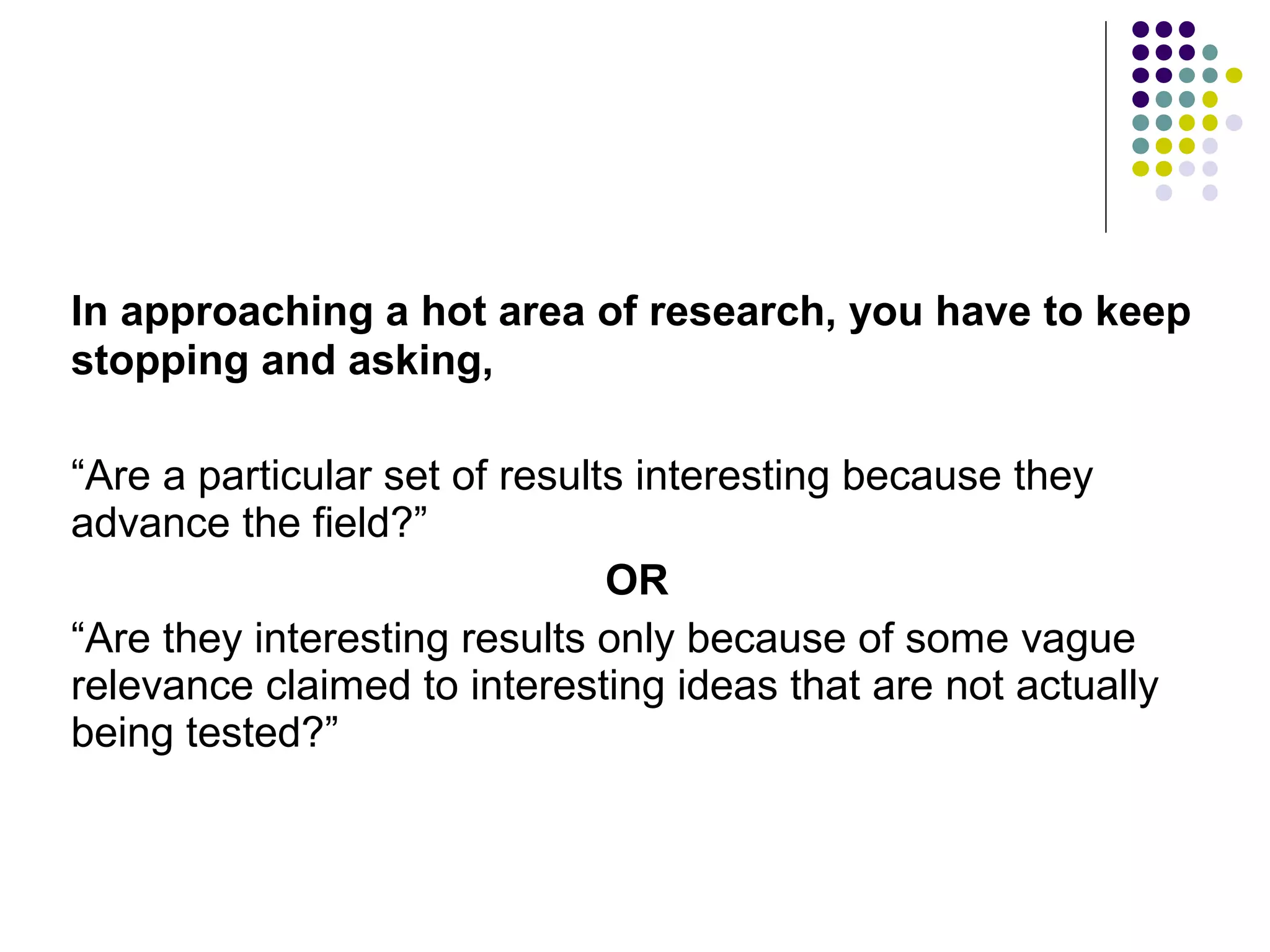
In approaching a hot area of research, you have to keep 
stopping and asking, 
“Are a particular set of results interesting because they 
advance the field?” 
OR 
“Are they interesting results only because of some vague 
relevance claimed to interesting ideas that are not actually 
being tested?”
Need for activism 
Cannot depend on journals to clean up editorial 
policies and review processes. 
Journals inadequately support reform or self-correct. 
Institutionalization of confirmatory bias and 
routine acceptance of bad science.
Promoting reforms 
 Strengthen post publication peer review. 
 Set standards for conducting and reporting 
clinical trials and meta analyses/systematic 
reviews 
 Greater transparency and sharing of data. 
 Preregistration of observational studies and 
hypotheses, as well as clinical trials. 
 Outing of conflicts of interest. 
 Use of social media to level the playing field.
Targeted takedowns of bad science 
highlight the problem and model 
solutions. 
 Social media campaigns: Critique by 
blogging, Twitter and Facebook. 
 Outing and confrontation with bad editorial 
practices. 
 Letters to the editor are ineffective, but 
PubMed Commons is promising. 
 Calls for retractions and erratum. 
.
Pet peeves 
Hype and hokum calculated to attract interest 
despite being premature or exaggerated. 
Ideas and practices which are potentially 
harmful to consumers. 
Undisclosed conflicts of interest, both 
financial and nonfinancial. 
Repeat offenders.
Pet peeves 
 Privileged access to supposedly peer-reviewed 
outlets. 
 Editors and reviewers' abuse of the review 
process to suppress alternative points of view 
and embarrassing data. 
 Gurus who undermine consumers' sense of 
self efficacy and increase their need for 
experts. 
 Gurus who sell products based on claims of 
being scientists.
““OOffffiicciiaall”” sscciieennccee 
Paradigms or ideas insulated from full critical scrutiny and 
standards of evidence by endorsement by funding 
agencies, professional organizations, and flagship 
journals.
Beware of Professional 
Organization Involvement as a Risk 
of Bias
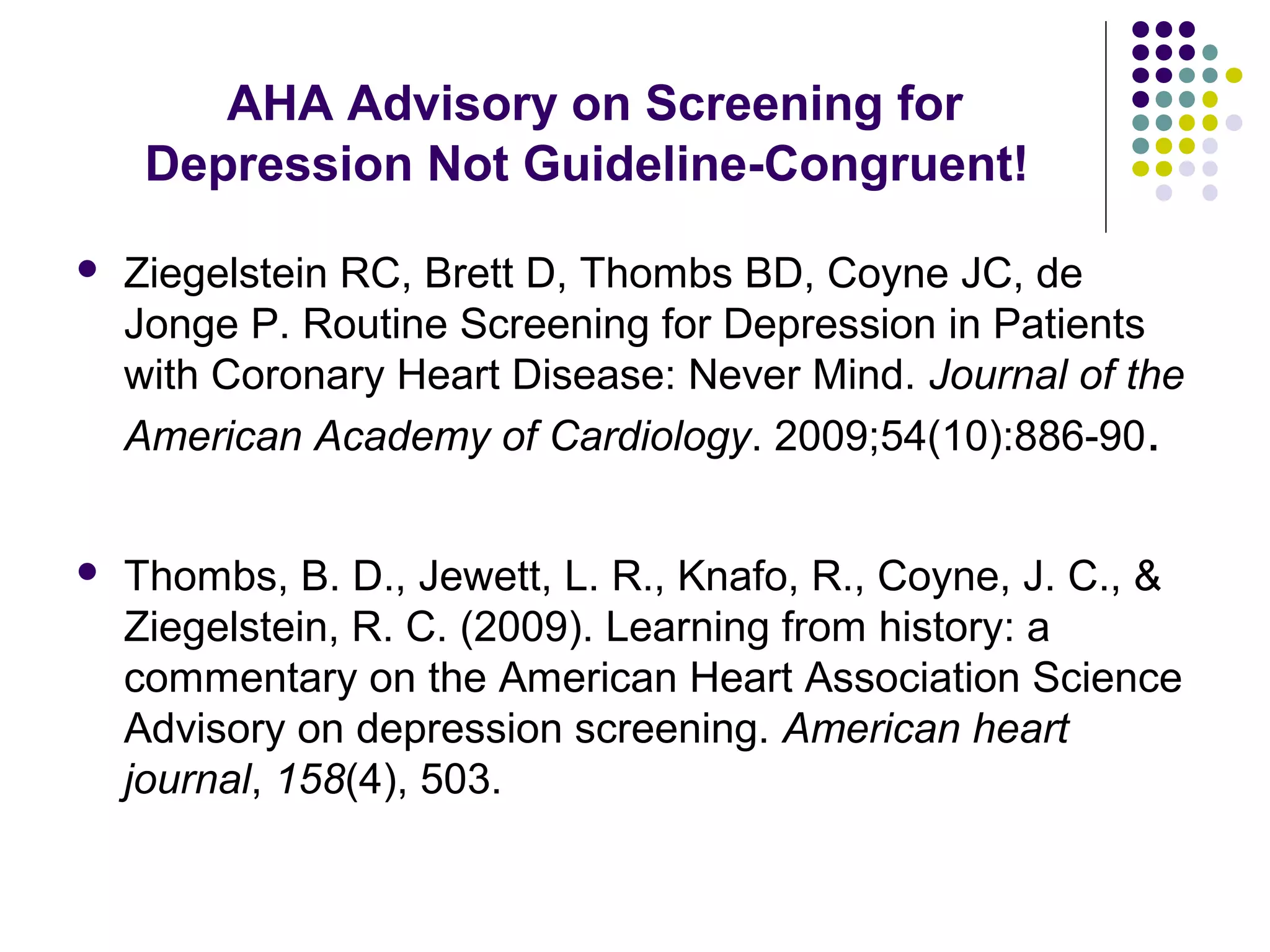
AHA Advisory on Screening for 
Depression Not Guideline-Congruent! 
 Ziegelstein RC, Brett D, Thombs BD, Coyne JC, de 
Jonge P. Routine Screening for Depression in Patients 
with Coronary Heart Disease: Never Mind. Journal of the 
American Academy of Cardiology. 2009;54(10):886-90. 
 Thombs, B. D., Jewett, L. R., Knafo, R., Coyne, J. C., & 
Ziegelstein, R. C. (2009). Learning from history: a 
commentary on the American Heart Association Science 
Advisory on depression screening. American heart 
journal, 158(4), 503.
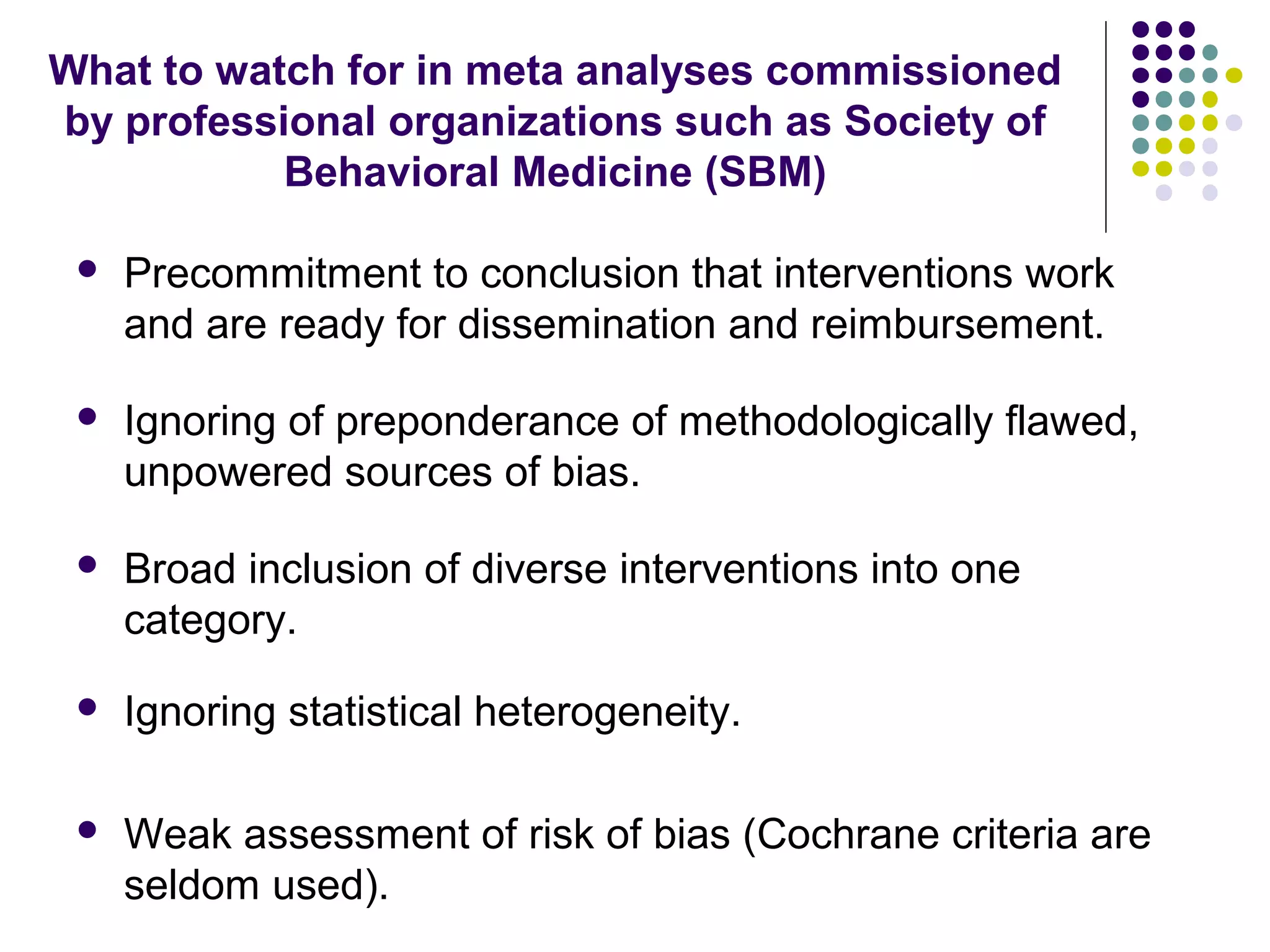
What to watch for in meta analyses commissioned 
by professional organizations such as Society of 
Behavioral Medicine (SBM) 
 Precommitment to conclusion that interventions work 
and are ready for dissemination and reimbursement. 
 Ignoring of preponderance of methodologically flawed, 
unpowered sources of bias. 
 Broad inclusion of diverse interventions into one 
category. 
 Ignoring statistical heterogeneity. 
 Weak assessment of risk of bias (Cochrane criteria are 
seldom used).
MMoosstt ppoossiittiivvee ffiinnddiinnggss aarree ffaallssee oorr 
eexxaaggggeerraatteedd:: TToooollss ffoorr rreeffoorrmm 
 A general heightened awareness of the problem and a 
healthy skepticism to what is published in peer-reviewed 
journals. 
 Reviews and editors educated about the problem and the 
need for enforcement of higher standards, conformity to 
established guidelines and transparency. 
 Readers/consumers armed with critical tools to evaluate 
for themselves claims of the literature. 
 Education of science journalists.
MMoosstt ppoossiittiivvee ffiinnddiinnggss aarree ffaallssee oorr 
eexxaaggggeerraatteedd:: TToooollss ffoorr rreeffoorrmm 
 Strengthened post-publication review. 
 Reduced resistance to publishing null findings and failure 
to replicate. 
 High-profile examples of particularly bad articles being 
retracted. 
 Open access journals, blogs, and Twitter.
Going after… 
Horrible meta-analyses written by 
American antiabortion activist, and 
accepted for publication by devout 
Catholic editor, Peter Tyrer.
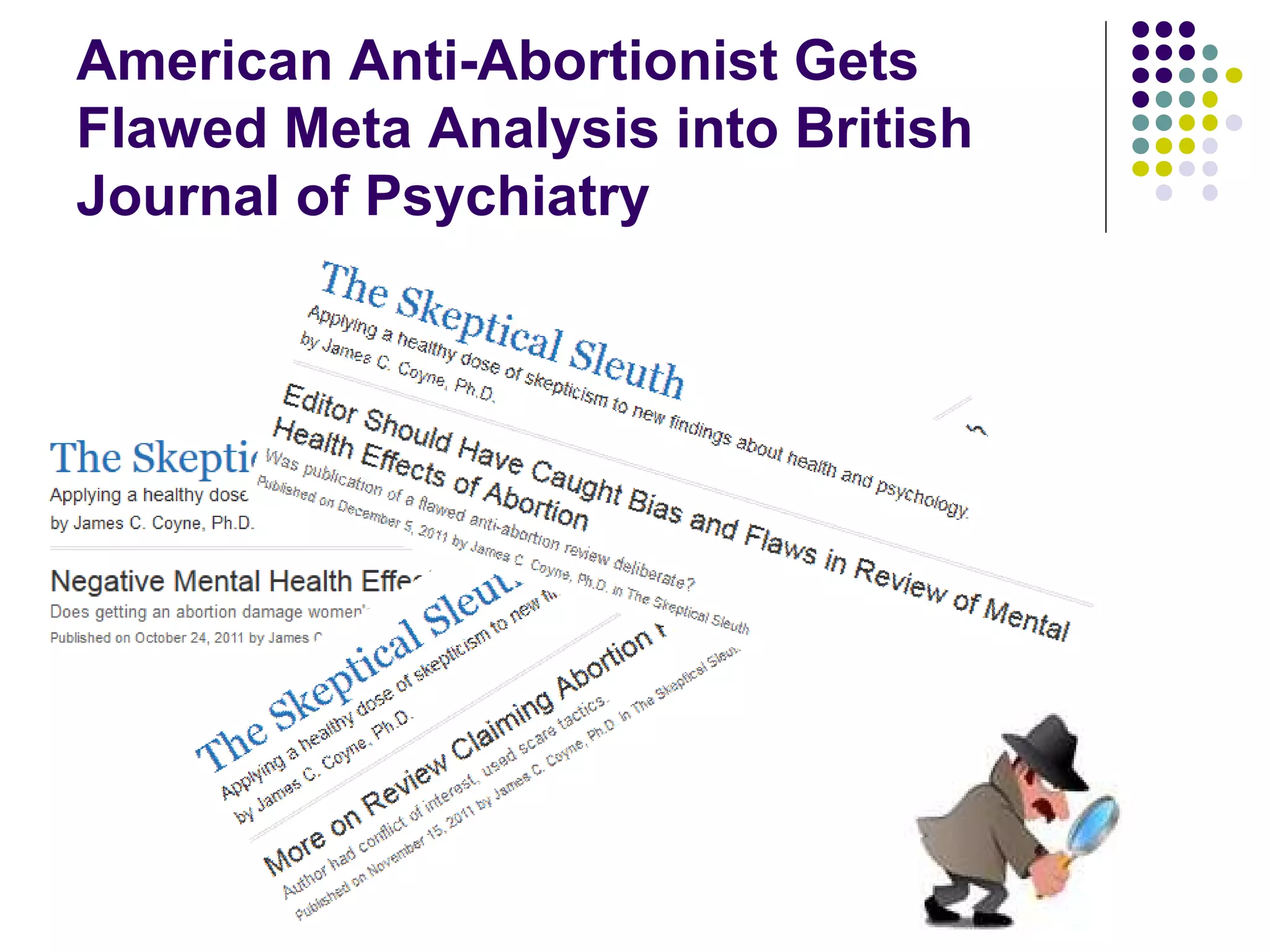
American Anti-Abortionist Gets 
Flawed Meta Analysis into British 
Journal of Psychiatry
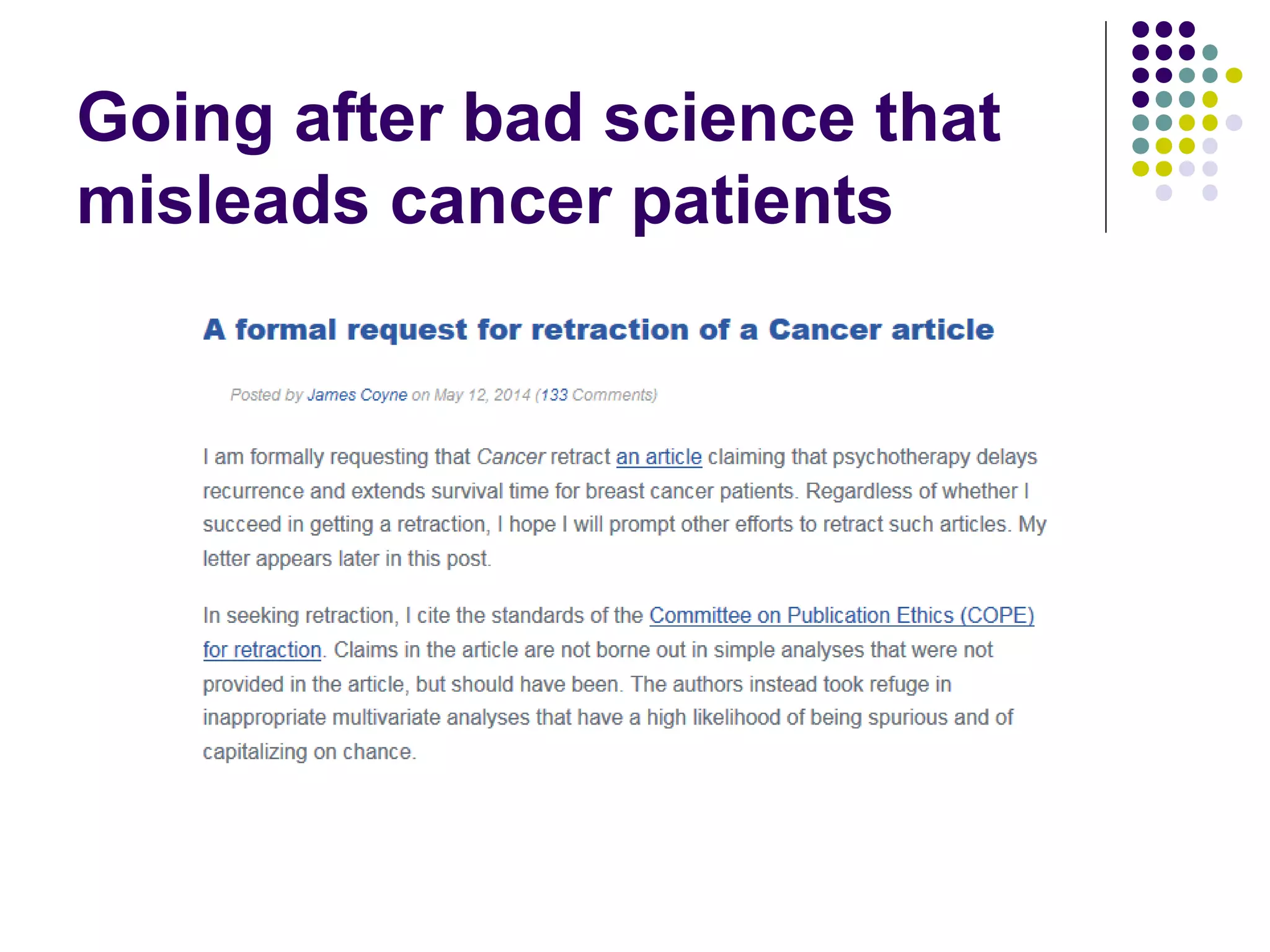
Going after bad science that 
misleads cancer patients
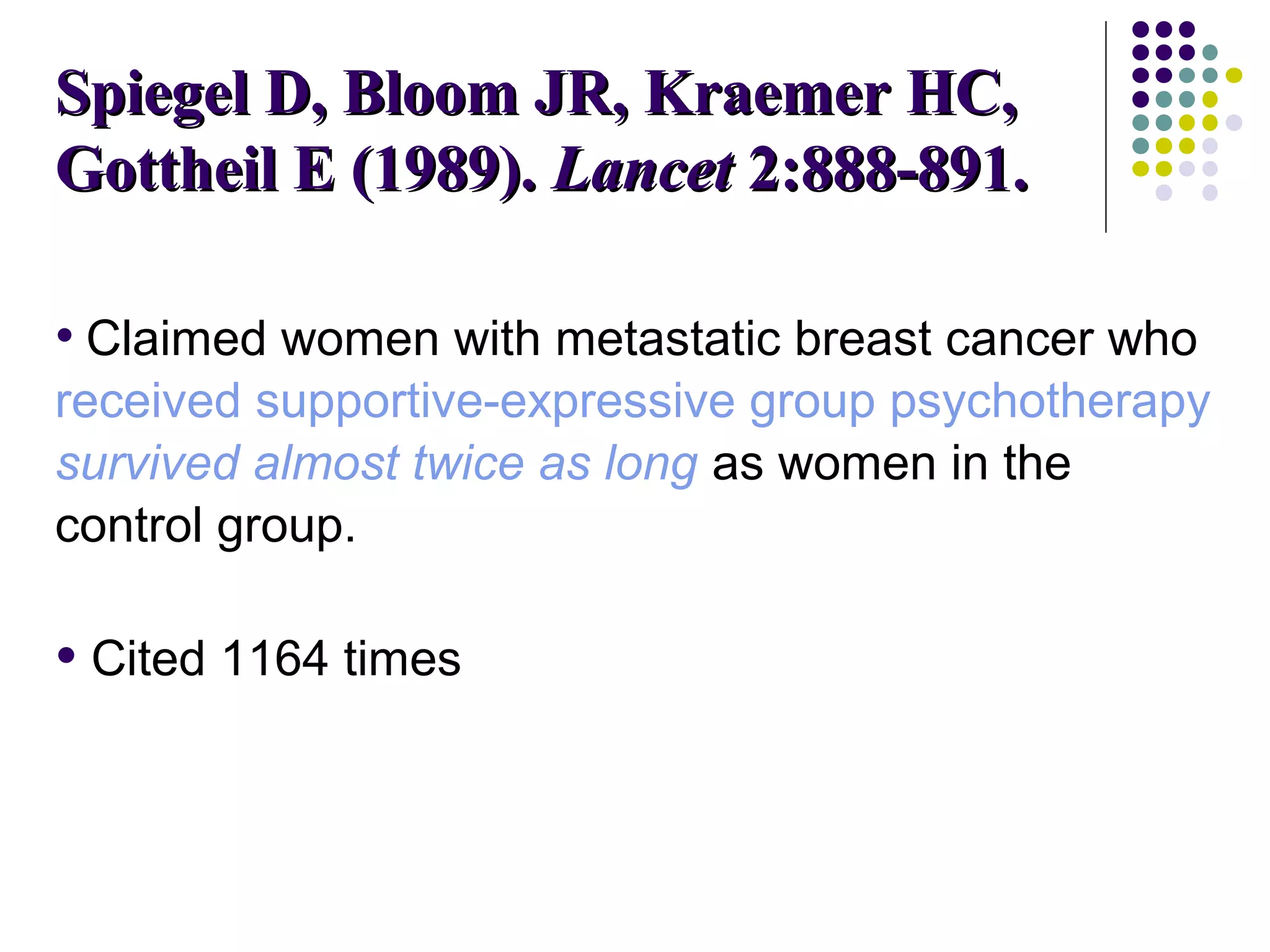
SSppiieeggeell DD,, BBlloooomm JJRR,, KKrraaeemmeerr HHCC,, 
GGootttthheeiill EE ((11998899).. LLaanncceett 22::888888--889911.. 
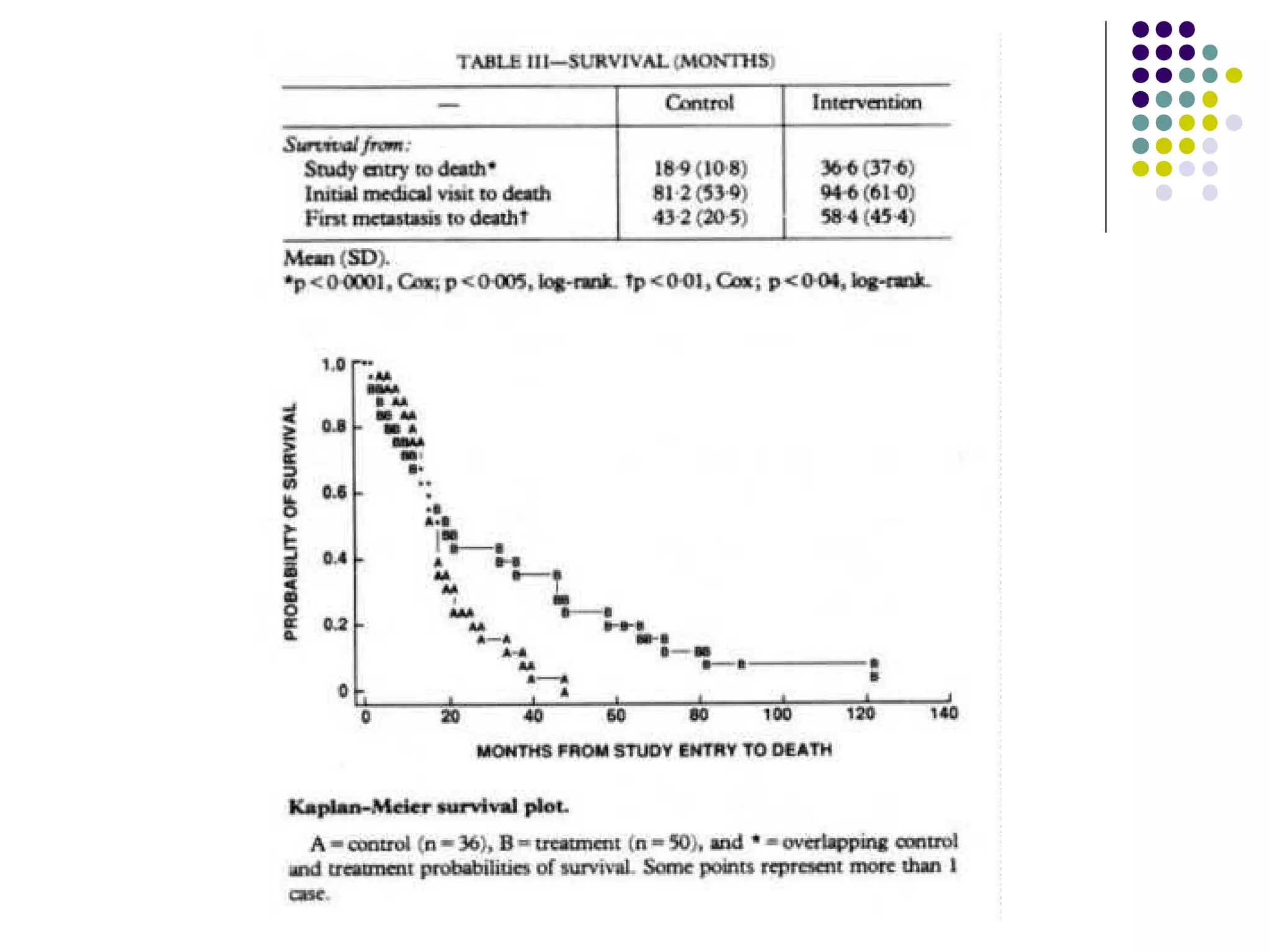
• Claimed women with metastatic breast cancer who 
received supportive-expressive group psychotherapy 
survived almost twice as long as women in the 
control group. 
• Cited 1164 times
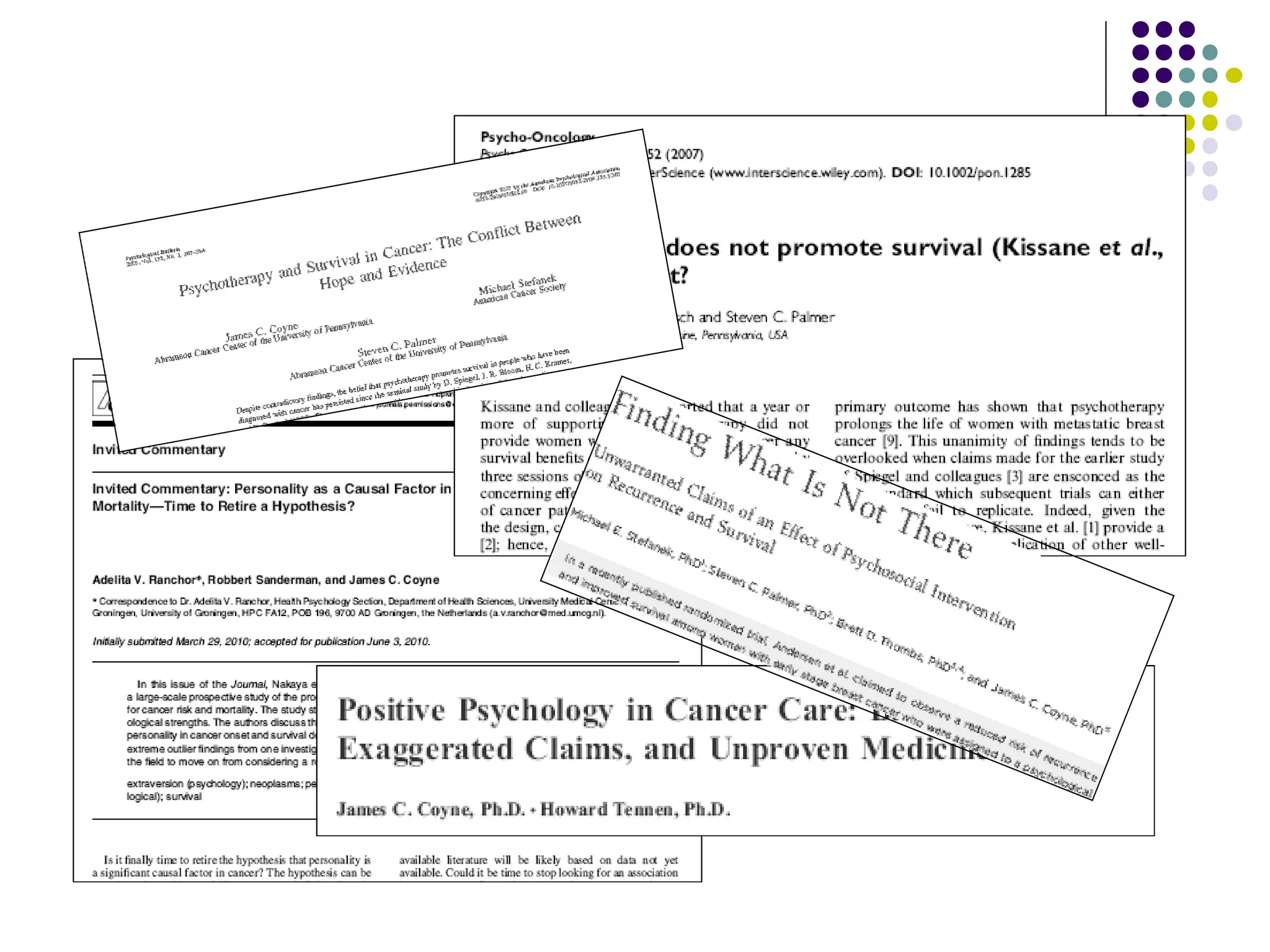
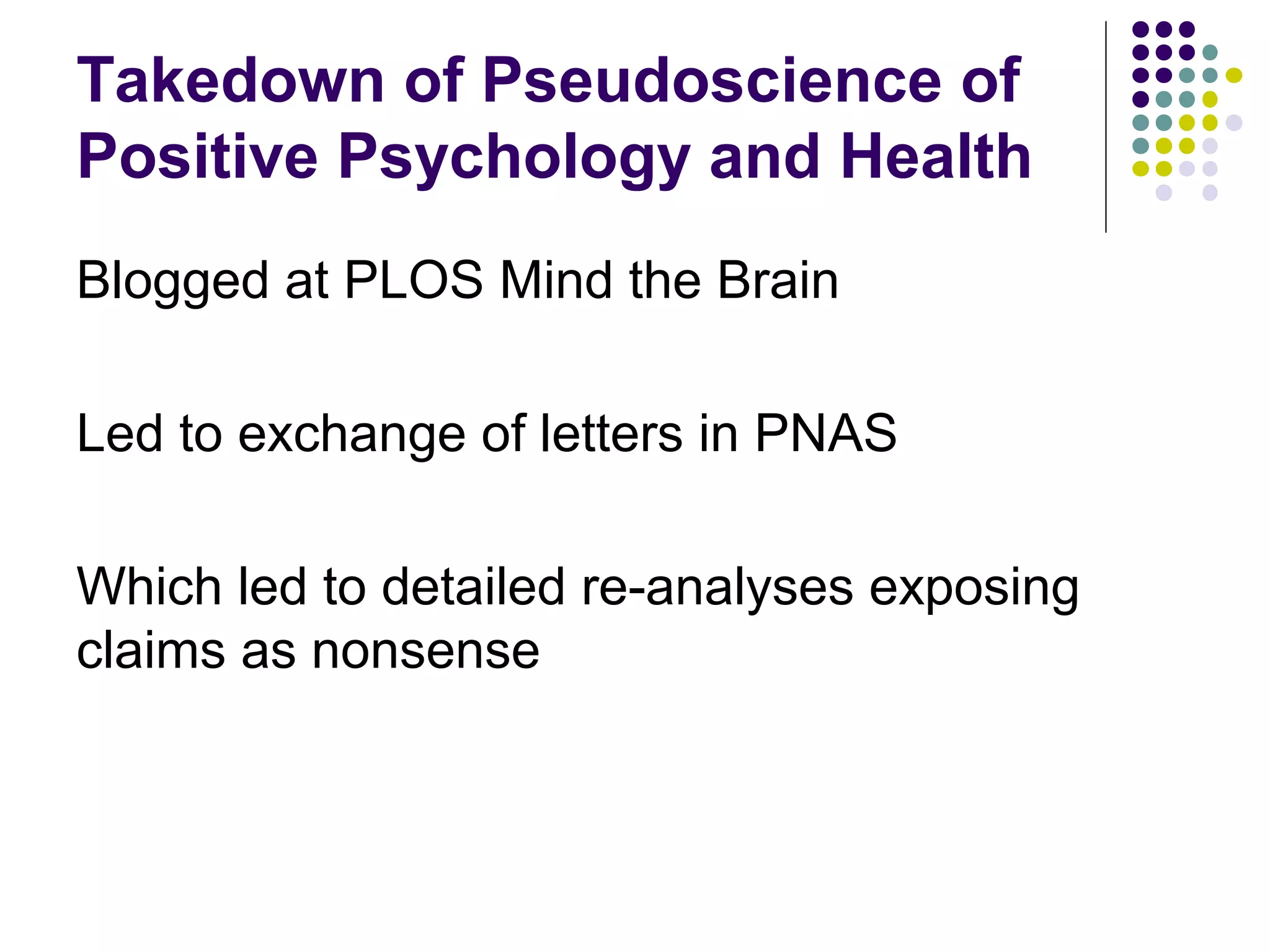
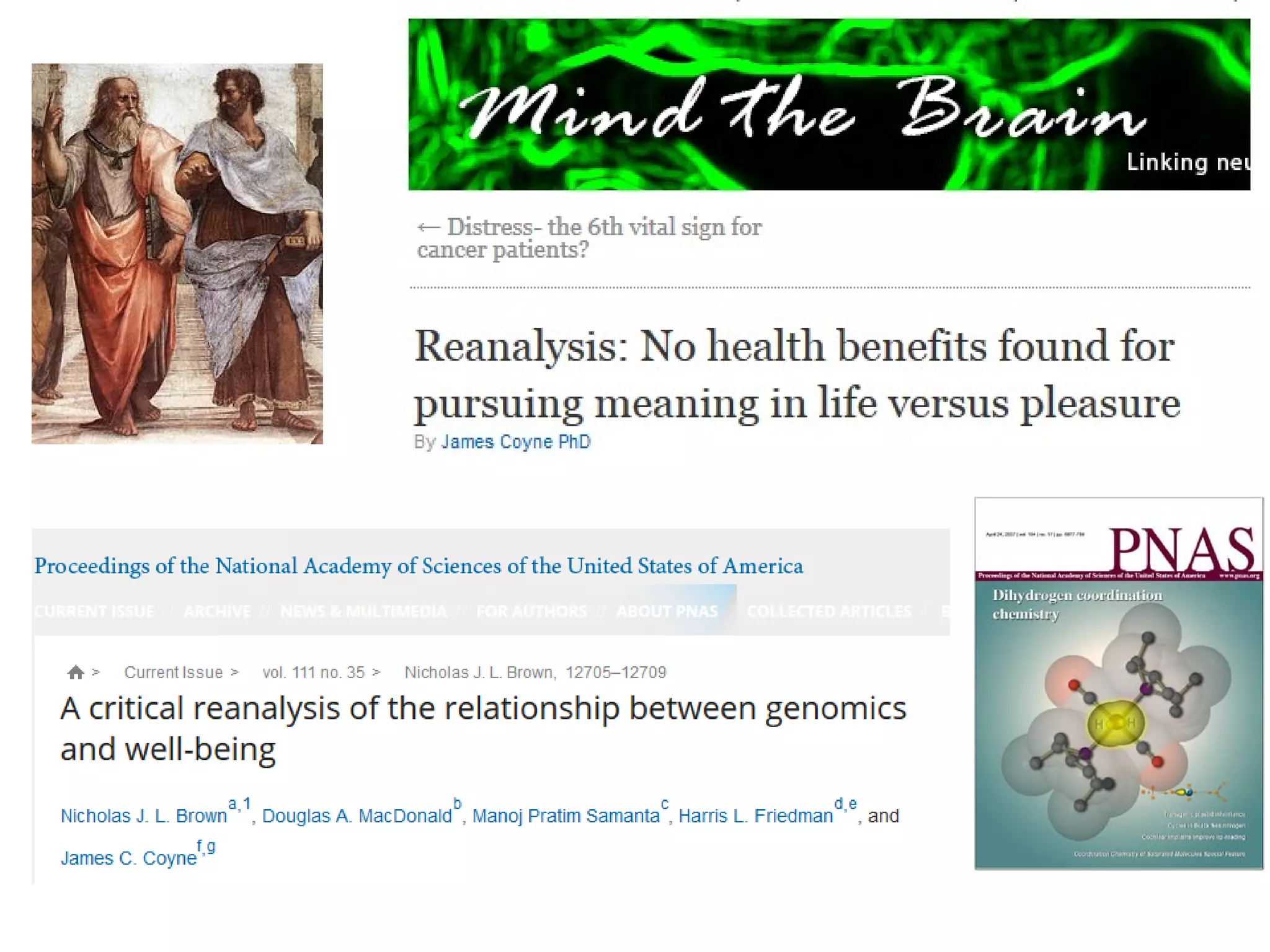
Takedown of Pseudoscience of 
Positive Psychology and Health 
Blogged at PLOS Mind the Brain 
Led to exchange of letters in PNAS 
Which led to detailed re-analyses exposing 
claims as nonsense
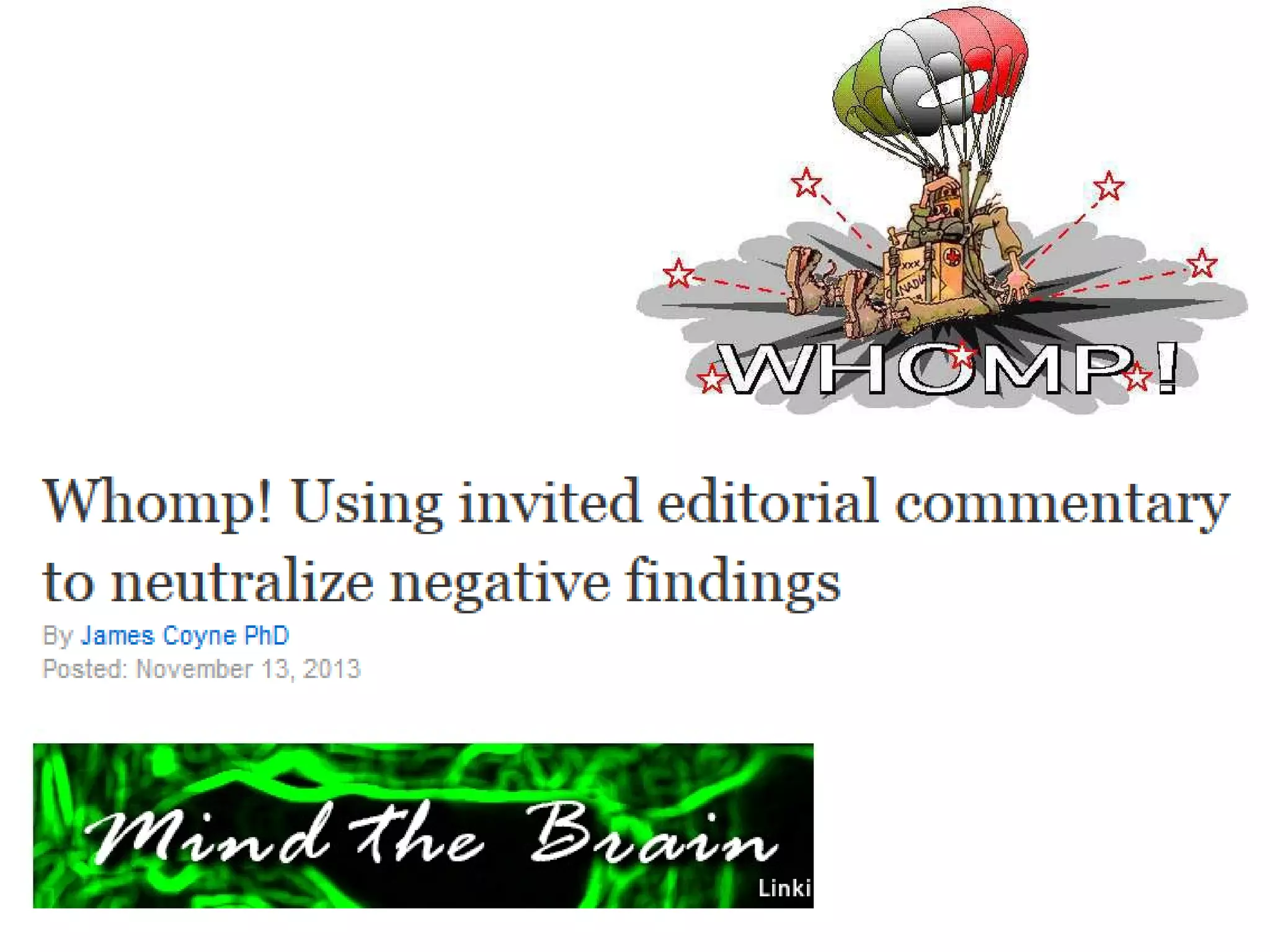
Unfair editorial practices 
 Articles published in peer-reviewed journals 
that are not peer-reviewed or only minimally. 
 Use of invited commentaries to selectively 
highlight or dampen evidence and arguments 
relevant to politicized topics. 
 Special issues with restricted calls for papers. 
 Authors’ control of whether critical letters to 
the editor of published. 
 Restrictions on letters to the editor,
Conflicts of interest 
 Psychology editors neither solicit nor 
routinely publish statements of conflict of 
interest. 
 Strong risk of bias associated with 
investigator allegiance, particularly when a 
particular treatment is being marketed. 
 Non-financial conflicts of interest are real and 
powerful, but not always easy to detect.
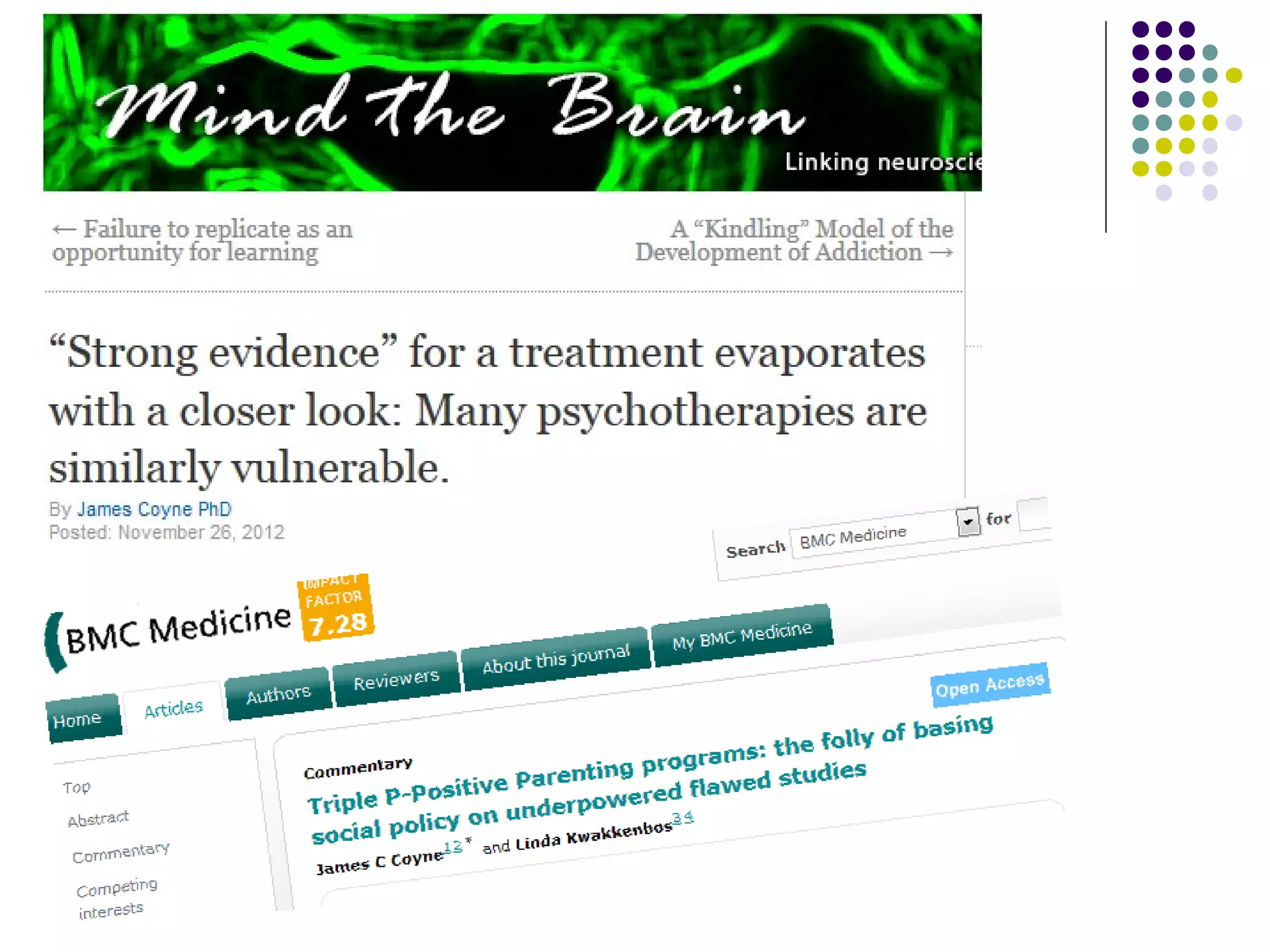
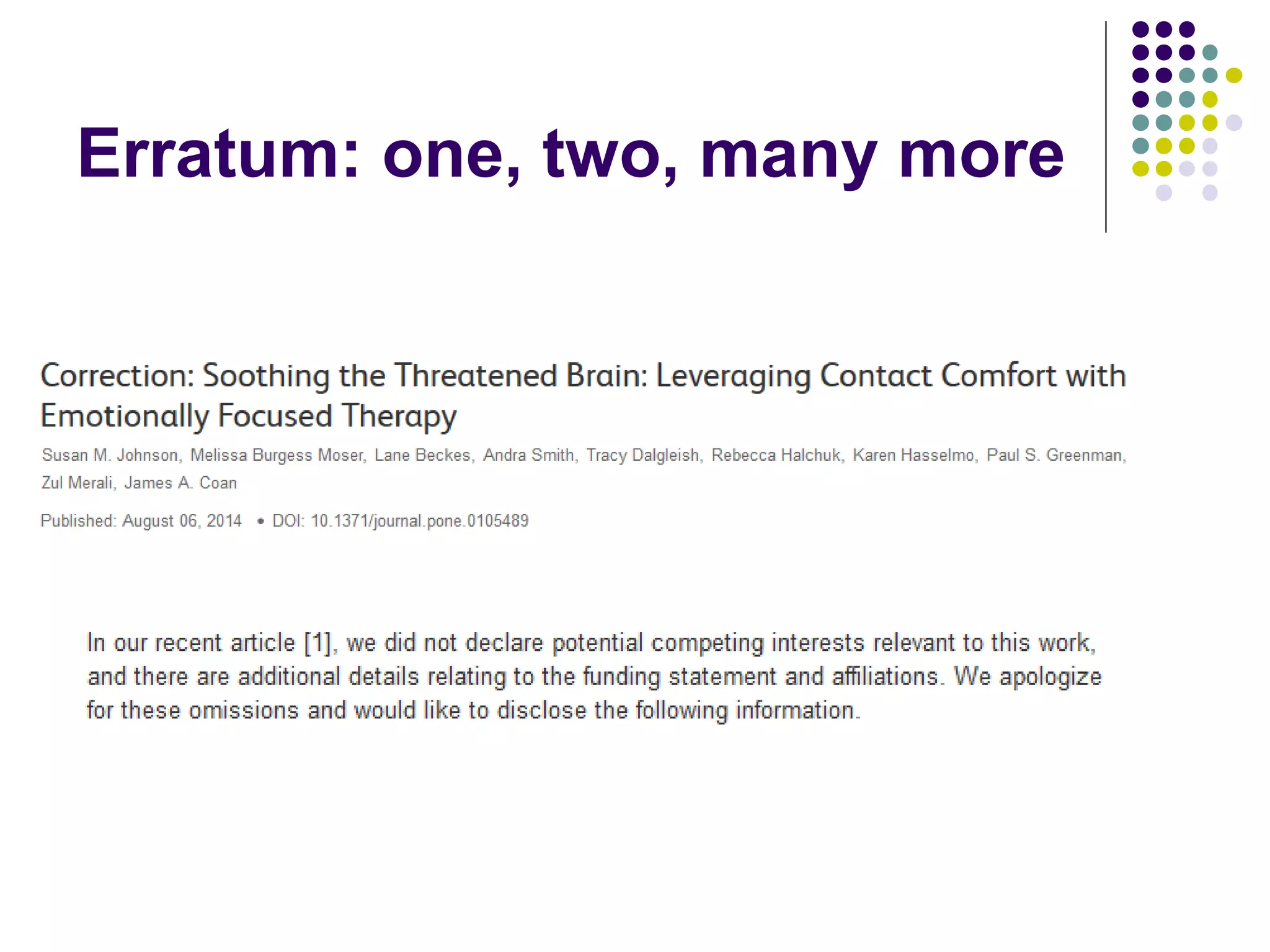
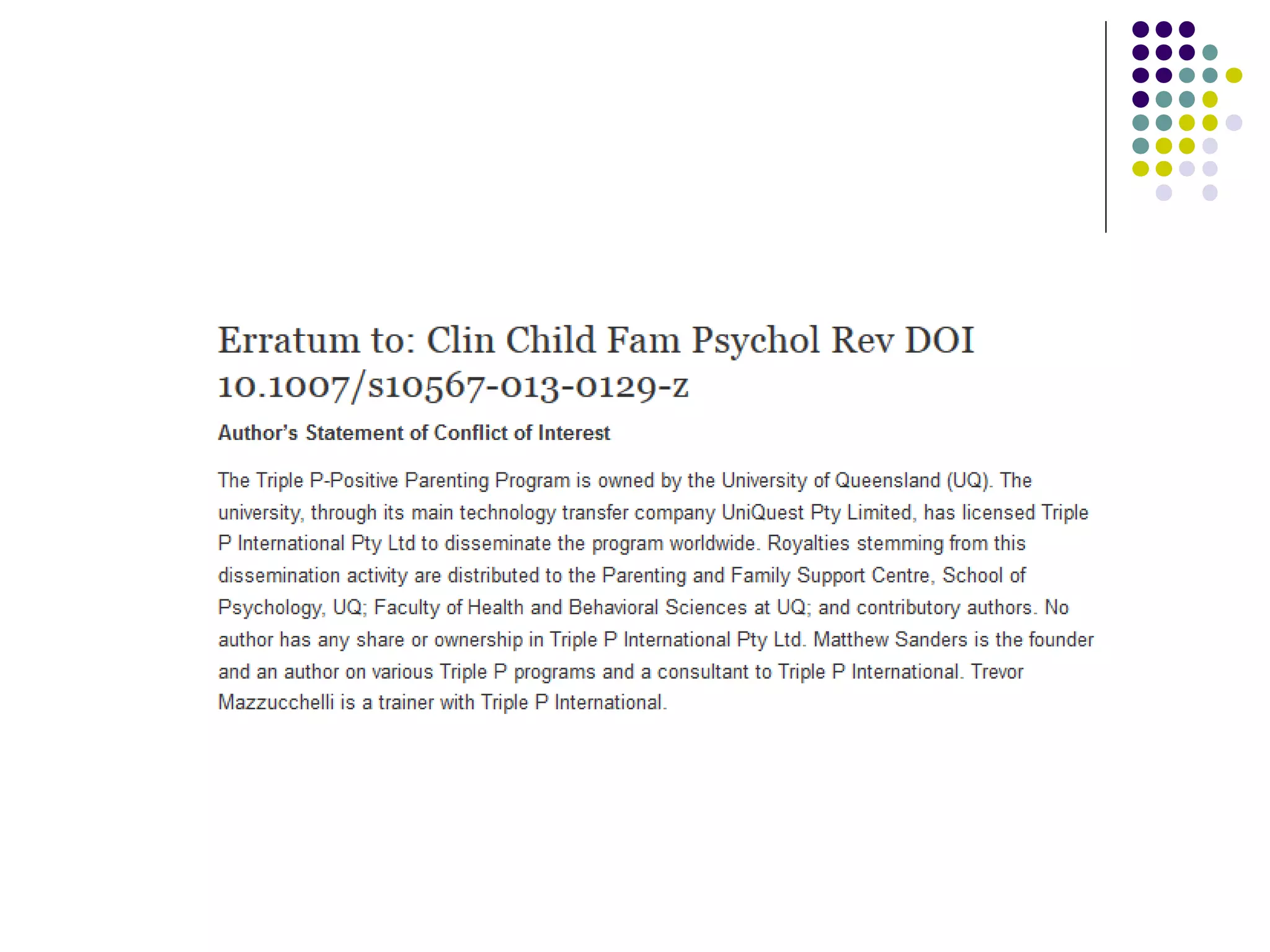
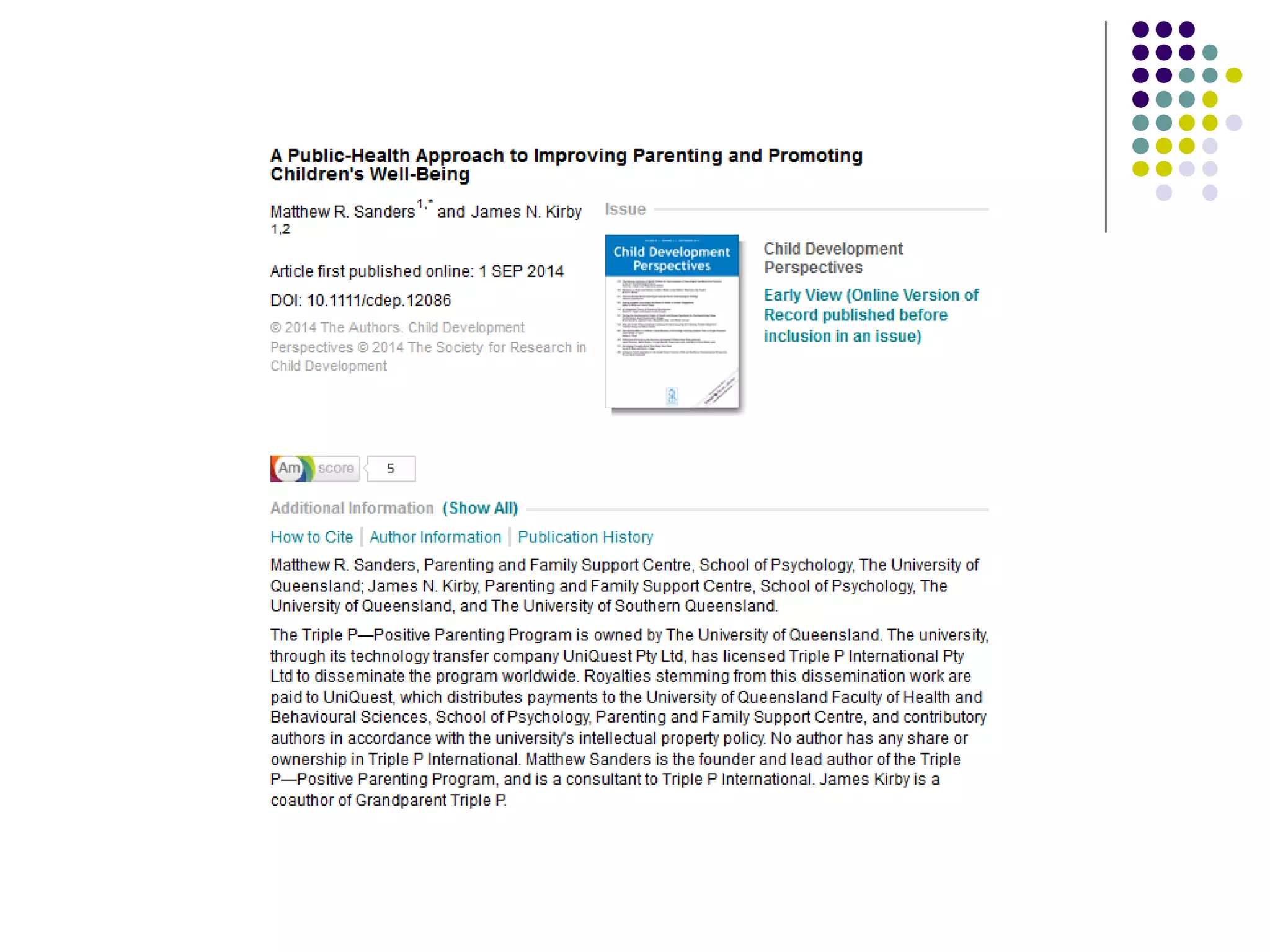
Exposures of conflicts of interests (COIs) 
associated with promoters of treatments 
conducting original studies and meta-analyses 
has led to numerous erratum rectifying 
nondisclosure and exposure of association of 
COI with confirmatory bias and bad science.
Erratum: one, two, many more
Moving From Criticism and Activism to 
Proposals for Constructive Change
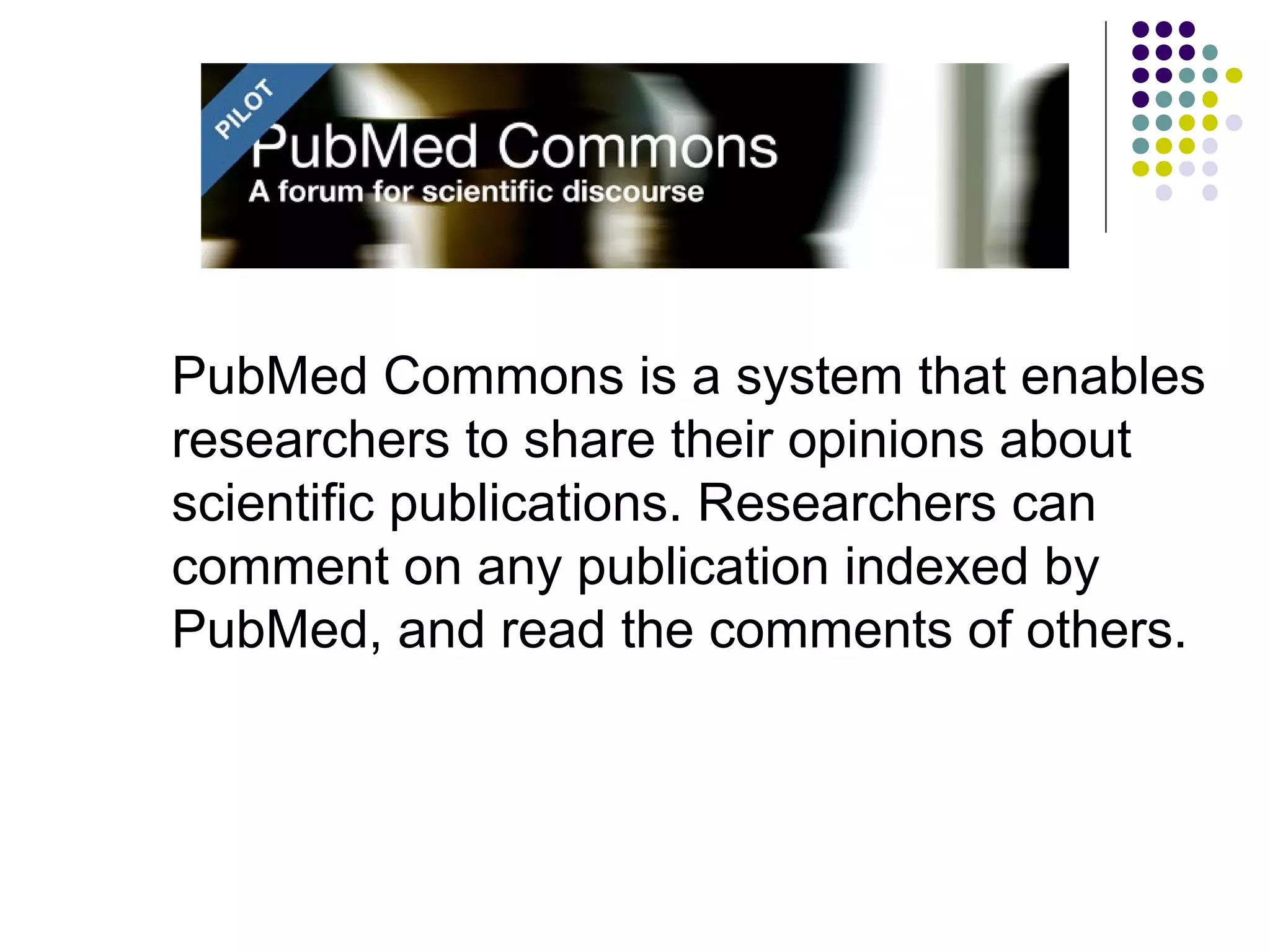
Democratizing Post-Publication Peer 
Review
PubMed Commons is a system that enables 
researchers to share their opinions about 
scientific publications. Researchers can 
comment on any publication indexed by 
PubMed, and read the comments of others.
 PubMed Commons is a forum for open 
and constructive criticism and discussion 
of scientific issues. 
 It will thrive with high quality interchange 
from the scientific community.
Join the Pubmed Commons 
Revolution 
No longer will a few people 
grant an irrevocable judgment 
of “must stand because it is 
peer reviewed.” 
You can take post publication 
peer review out of the hands 
of editors.
No criticism without offering 
solutions? 
It takes a lot of work to explicate bad science 
and the more general context that supports and 
rewards it. 
Critics should not be required to offer 
constructive solutions or positive steps, 
particularly when there is substantial opposition 
from the journals. 
But when a receptive audience has been 
created, identification of positive steps become 
more timely.
Thank you 
Follow me on Twitter 
@CoyneoftheRealm 
Blogging at Mind the Brain

Are most positive findings in psychology false or exaggerated? An activist's perspective

  • 1.
    Are most positivefindings in psychology false or exaggerated? An activist's perspective Colloquium at ANU Research School of Psychology Sept 10, 2014 James C. Coyne, Ph.D. University of Groningen University Medical Center Groningen (UMCG), Groningen, the Netherlands jcoynester@gmail.com
  • 2.
    John Ioannidis documentedmany positive findings in the biomedical literature do not replicate and many apparent “discoveries” turn out to be exaggerated or simply false. Many apparent discoveries are created by a combination of confirmatory bias, flexible rules of design, data analysis and reporting and significance chasing.
  • 3.
    “It can beproven that most claimed research findings are false” Ioannidis, JPA. (2005). Why most published research findings are false. PLOS Medicine 2: 696-701. Ioannidis, JPA. (2005). Contradicted and initially stronger effects in highly cited clinical research. JAMA 294: 218-228. Young, NS., Ioannidis, JPA. et al. (2008). Why Current Publication Practices May Distort Science. PLOS Medicine 5: 1418-1422.
  • 4.
    Ben Goldacre Drugsare tested by the people who manufacture them, in poorly designed trials, on hopelessly small numbers of weird, unrepresentative patients, and analysed using techniques which are flawed by design, in such a way that they exaggerate the benefits of treatments. Unsurprisingly, these trials tend to produce results that favour the manufacturer. When trials throw up results that companies don't like, they are perfectly entitled to hide them from doctors and patients.
  • 5.
    Efforts at reform  Preregistration of clinical trials make it more difficult to hide negative trials or alter analytic plans after results are known.  Reporting standards ensure more transparent and detailed article so results can be independently validated.  Reporting standards and pre-registration of plans for meta-analyses and systematic reviews.  Making data available for independent reanalysis.
  • 6.
    Our modest contributionto reform Roseman, M, Milette, K, Bero, LA, Coyne, JC, Lexchin, J., Turner, EH, & Thombs, BD. (2011). Reporting of conflicts of interest in meta-analyses of trials of pharmacological treatments. JAMA, 2011;305(10):1008-17. Roseman, M, Turner, EH, Lexchin, J., Coyne, JC, Bero, LA, & Thombs, BD. (2012). Reporting of conflicts of interest from drug trials in Cochrane reviews: cross sectional study. BMJ, 2012; 345.
  • 8.
    We documented withassociation of source of funding with claimed size of effects. We proposed considering conflict of interest as a moderator, source of heterogeneity, and another risk of bias in Cochrane risk of bias assessment. The Cochrane Collaboration agreed.
  • 9.
    Cochrane Risk ofBias  Sequence generation.  Allocation concealment.  Blinding of participants, investigators, outcome assessors.  Incomplete outcome data.  Selective outcome reporting.  Other threats to validity.
  • 10.
    Trickle down ofreform  Changes forced upon Pharma slowly and inconsistently reach clinical psychology.  Larger data sets allow exploration of issues such as choice of control groups and investigator allegiance.  Behavioral Medicine adopts changes occurring in clinical psychology later and inconsistently.
  • 11.
  • 14.
    Instances of outrightfraud are unusual, but confirmatory bias is rampant and supported by diffuse institutional forces. On the other hand, when fraud is consistent with prevailing biases, it can be tough to root out.
  • 15.
    GGeettttiinngg HHaannss EEyysseenncckk’’ssffrraauudduulleenntt ddaattaa oouutt ooff tthhee lliitteerraattuurree ● Co-authored papers with Grossarth-Maticek that claimed improbably high associations between personality and cancer and personality and smoking and published in own journal. ● Later it was revealed that he was paid substantially high amounts of money by attorneys for US tobacco companies to publish these data.
  • 16.
    In a literaturedominated by hazard ratios (HRs) clustered around 1.0, Eysenck/Grossarth- Maticek’s were extreme outliers, absurdly so. Their influence nonetheless lives on in inflated overall estimates of the effects of negative affect on cancer in tertiary sources that do not acknowledge their tainted origins.
  • 17.
  • 18.
    Coyne JC, RanchorAV, Palmer SC. Meta-analysis of stress-related factors in cancer. Nat Rev Clin Oncol. 2010;7(5). Ranchor AV, Sanderman R, Coyne JC. Invited Commentary: Personality as a Causal Factor in Cancer Risk and Mortality-Time to Retire a Hypothesis? American Journal of Epidemiology. 2010;172(4):386-8. Coyne JC, Johansen C. Confirmatory bias and the persistent influence of discredited data in interpreting the stress-cancer link: Commentary on Michael et al. (2009). Health Psychol. 2011;30(3):374-5
  • 19.
    Confirmatory bias entrenched, preached to be a virtue.
  • 20.
    AAddvviiccee ooff aaFFaammoouuss SSoocciiaall PPssyycchhoollooggiisstt “There are two possible articles you can write: (1) the article you planned to write when you designed your study or (2) the article that makes the most sense now that you have seen the results. They are rarely the same, and the correct answer is (2).” -Bem, 2003, pp. 171-172
  • 21.
    Breakthrough “discoveries” arecreated and perpetuated by a combination of confirmatory bias, flexible rules of design, data analysis and reporting and significance chasing.
  • 24.
    APS Journals Have not adopted CONSORT.  Violate COPE in not having procedure for appeal of negative decisions.  Strong confirmatory bias, newsworthiness over science.  Aversion to null findings and replications.  Don’t adhere to Pottery Barn Rule.
  • 25.
    From: jcoyne@mail.med.upenn.edu <jcoynester@gmail.com > Date: Wed, Jun 11, 2014 at 4:26 PM Subject: Fwd: Appeal re Manuscript PSCI-13-2172 To: Alan Kraut <akraut@psychologicalscience.org I respect the autonomy of APS publications from the CEO. But I think that the new editor of Psychological Science is only going to compound his losses if he continues to fight giving us an appeal consistent with the standards of Committee on Publication Ethics (COPE). I think that COPE and the larger scientific community will be solidly on our side, and will generate considerable outrage. Hopefully, you would not consider it inappropriate to give him some sage advice on this. Sorry to be writing to you under these circumstances.
  • 26.
    Skepticism about the replication movement. May only serve to ghettoize null findings and failures to replicate.  Protect bias in prestigious journals toward false-positive findings and discrimination against attempted replication and now findings.  Sleeping with the enemy.
  • 27.
    The spin ccyycclleeiinn sscciieennttiiffiicc ppuubblliisshhiinngg:: iiss iitt nneecceessssaarryy ttoo hhaavvee ppoossiittiivvee rreessuullttss ttoo ggeett ppuubblliisshheedd??
  • 28.
    SSppiinn  “Spin”--Distortion to impress readers that something is noteworthy.  Objective: To identify nature and frequency of spin in 62 published reports of RCTs with statistically nonsignificant results.  Conclusion: Reporting and interpretation of findings frequently inconsistent with the results.
  • 29.
    SSppiinn  Titlewas reported with spin in 13 articles (18.0%).  Spin was identified in the Results (37.5%) and Conclusions (58.3%) with conclusions of 17 (23.6%) focusing only on treatment effectiveness.  Spin was identified in the main-text Results (29.2%), Discussion (43.1%),, and Conclusions (50.0%).  More than 40% of reports had spin in at least 2 of these sections in the main text.
  • 30.
    SSiiggnniiffiiccaannccee cchhaassiinngg bbiiaass The greatest threat [to the credibility of clinical research] may come from the poor relevance and scientific rationale and thus low pre-study odds of success of research efforts. Given that we currently have too many research findings, often with low credibility, replication and rigorous evaluation becomes as important or even more important than discovery. Credibility, replication, and translation are all desirable properties of research findings, but only modestly correlated.
  • 31.
    “It is acommon failing – and one I have myself suffered from – to fall in love with a hypothesis and to be unwilling to take no for an answer. A love affair with a pet hypothesis can waste years of precious time. There is very often no finally decisive yes, though quite often there can be a decisive no.” -P. B. Medawar
  • 32.
    IInncceennttiivveess aanndd pprreessssuurreessffoorr aa ccoonnffiirrmmaattoorryy bbiiaass Loscalzo, J. Circulation 2005;112:3026-3029 Copyright ©2005 American Heart Association
  • 33.
    AAddddiittiioonnaall ssoouurrcceess ooffccoonnffiirrmmaattoorryy bbiiaass  Professional organizations need positive findings to support guidelines and recommendations requiring services of their members.  Journals need positive findings to raise impact factor.  Gurus and advocates of particular treatments need positive findings to promote their interventions and workshops ($$$) and feed their vanity.  Authors need positive findings to get published and advance their careers.
  • 34.
    Pressures from journals Competition for subscriptions, advertising, and prestige depend on the JIF. JIF depends on number of citations for articles within 2 years of publication. Newsworthy, citable articles with clock starting at point of “early release.” Articles with media buzz are more likely to be immediately cited. Null findings, replications less newsworthy.
  • 35.
  • 36.
    HHoott aarreeaass ppllaagguueeddbbyy ccoonnffiirrmmaattoorryy bbiiaass  Mind-body relations--psychoneuroimmunology (PNI)  Gene-environment interactions--particularly serotonin transport genes—GWAS, and genomics  Neuroscience  Screening for depression and distress  Claims that psychotherapies are evidence-based
  • 37.
    In approaching ahot area of research, you have to keep stopping and asking, “Are a particular set of results interesting because they advance the field?” OR “Are they interesting results only because of some vague relevance claimed to interesting ideas that are not actually being tested?”
  • 38.
    Need for activism Cannot depend on journals to clean up editorial policies and review processes. Journals inadequately support reform or self-correct. Institutionalization of confirmatory bias and routine acceptance of bad science.
  • 39.
    Promoting reforms Strengthen post publication peer review.  Set standards for conducting and reporting clinical trials and meta analyses/systematic reviews  Greater transparency and sharing of data.  Preregistration of observational studies and hypotheses, as well as clinical trials.  Outing of conflicts of interest.  Use of social media to level the playing field.
  • 40.
    Targeted takedowns ofbad science highlight the problem and model solutions.  Social media campaigns: Critique by blogging, Twitter and Facebook.  Outing and confrontation with bad editorial practices.  Letters to the editor are ineffective, but PubMed Commons is promising.  Calls for retractions and erratum. .
  • 41.
    Pet peeves Hypeand hokum calculated to attract interest despite being premature or exaggerated. Ideas and practices which are potentially harmful to consumers. Undisclosed conflicts of interest, both financial and nonfinancial. Repeat offenders.
  • 42.
    Pet peeves Privileged access to supposedly peer-reviewed outlets.  Editors and reviewers' abuse of the review process to suppress alternative points of view and embarrassing data.  Gurus who undermine consumers' sense of self efficacy and increase their need for experts.  Gurus who sell products based on claims of being scientists.
  • 43.
    ““OOffffiicciiaall”” sscciieennccee Paradigmsor ideas insulated from full critical scrutiny and standards of evidence by endorsement by funding agencies, professional organizations, and flagship journals.
  • 44.
    Beware of Professional Organization Involvement as a Risk of Bias
  • 45.
    AHA Advisory onScreening for Depression Not Guideline-Congruent!  Ziegelstein RC, Brett D, Thombs BD, Coyne JC, de Jonge P. Routine Screening for Depression in Patients with Coronary Heart Disease: Never Mind. Journal of the American Academy of Cardiology. 2009;54(10):886-90.  Thombs, B. D., Jewett, L. R., Knafo, R., Coyne, J. C., & Ziegelstein, R. C. (2009). Learning from history: a commentary on the American Heart Association Science Advisory on depression screening. American heart journal, 158(4), 503.
  • 46.
    What to watchfor in meta analyses commissioned by professional organizations such as Society of Behavioral Medicine (SBM)  Precommitment to conclusion that interventions work and are ready for dissemination and reimbursement.  Ignoring of preponderance of methodologically flawed, unpowered sources of bias.  Broad inclusion of diverse interventions into one category.  Ignoring statistical heterogeneity.  Weak assessment of risk of bias (Cochrane criteria are seldom used).
  • 47.
    MMoosstt ppoossiittiivvee ffiinnddiinnggssaarree ffaallssee oorr eexxaaggggeerraatteedd:: TToooollss ffoorr rreeffoorrmm  A general heightened awareness of the problem and a healthy skepticism to what is published in peer-reviewed journals.  Reviews and editors educated about the problem and the need for enforcement of higher standards, conformity to established guidelines and transparency.  Readers/consumers armed with critical tools to evaluate for themselves claims of the literature.  Education of science journalists.
  • 48.
    MMoosstt ppoossiittiivvee ffiinnddiinnggssaarree ffaallssee oorr eexxaaggggeerraatteedd:: TToooollss ffoorr rreeffoorrmm  Strengthened post-publication review.  Reduced resistance to publishing null findings and failure to replicate.  High-profile examples of particularly bad articles being retracted.  Open access journals, blogs, and Twitter.
  • 49.
    Going after… Horriblemeta-analyses written by American antiabortion activist, and accepted for publication by devout Catholic editor, Peter Tyrer.
  • 50.
    American Anti-Abortionist Gets Flawed Meta Analysis into British Journal of Psychiatry
  • 51.
    Going after badscience that misleads cancer patients
  • 52.
    SSppiieeggeell DD,, BBlloooommJJRR,, KKrraaeemmeerr HHCC,, GGootttthheeiill EE ((11998899).. LLaanncceett 22::888888--889911.. • Claimed women with metastatic breast cancer who received supportive-expressive group psychotherapy survived almost twice as long as women in the control group. • Cited 1164 times
  • 55.
    Takedown of Pseudoscienceof Positive Psychology and Health Blogged at PLOS Mind the Brain Led to exchange of letters in PNAS Which led to detailed re-analyses exposing claims as nonsense
  • 57.
    Unfair editorial practices  Articles published in peer-reviewed journals that are not peer-reviewed or only minimally.  Use of invited commentaries to selectively highlight or dampen evidence and arguments relevant to politicized topics.  Special issues with restricted calls for papers.  Authors’ control of whether critical letters to the editor of published.  Restrictions on letters to the editor,
  • 60.
    Conflicts of interest  Psychology editors neither solicit nor routinely publish statements of conflict of interest.  Strong risk of bias associated with investigator allegiance, particularly when a particular treatment is being marketed.  Non-financial conflicts of interest are real and powerful, but not always easy to detect.
  • 61.
    Exposures of conflictsof interests (COIs) associated with promoters of treatments conducting original studies and meta-analyses has led to numerous erratum rectifying nondisclosure and exposure of association of COI with confirmatory bias and bad science.
  • 63.
  • 66.
    Moving From Criticismand Activism to Proposals for Constructive Change
  • 67.
  • 68.
    PubMed Commons isa system that enables researchers to share their opinions about scientific publications. Researchers can comment on any publication indexed by PubMed, and read the comments of others.
  • 69.
     PubMed Commonsis a forum for open and constructive criticism and discussion of scientific issues.  It will thrive with high quality interchange from the scientific community.
  • 70.
    Join the PubmedCommons Revolution No longer will a few people grant an irrevocable judgment of “must stand because it is peer reviewed.” You can take post publication peer review out of the hands of editors.
  • 71.
    No criticism withoutoffering solutions? It takes a lot of work to explicate bad science and the more general context that supports and rewards it. Critics should not be required to offer constructive solutions or positive steps, particularly when there is substantial opposition from the journals. But when a receptive audience has been created, identification of positive steps become more timely.
  • 74.
    Thank you Followme on Twitter @CoyneoftheRealm Blogging at Mind the Brain